Relic point Vietnam
Việt Nam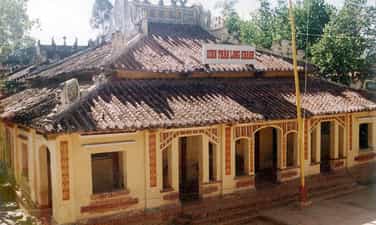
Long Khánh Temple
Long Khánh Temple (or Long Khánh Ancient Temple) is one of the oldest and most sacred temples in the delta region of Long Khánh A commune, Hồng Ngự district, Đồng Tháp province. Originally built in 1830 with simple bamboo and thatch, the temple is dedicated to the local tutelary deity and was honored with a royal decree from Emperor Tự Đức in 1852. After several relocations due to erosion caused by the Tiền River, the current temple was completely rebuilt and restored at the end of 2011 with a grand scale, featuring 114 sturdy wooden columns and a solid yin-yang tiled roof. Architecturally, Long Khánh Temple bears the strong imprint of Vietnamese-Chinese cultural exchange through its exquisite wood carvings. The temple is built in the traditional "double-tiered" style. Upon entering, visitors will be impressed by the system of large wooden columns, the gilded and lacquered horizontal plaques and couplets, and the intricately carved dragon and phoenix motifs on the side panels. More than just a place of spiritual worship, this communal house also carries significant historical weight. It was once a stopping point for the scholar Nguyen Sinh Sac to spread patriotic ideas, and it served as a military hospital treating Vietnamese soldiers during the 1978 Southwest border war. Every year, the Ky Yen festival at the communal house (held in the first lunar month) is the largest festival in the delta region, attracting thousands of locals and tourists who come to worship, pray for national peace and prosperity, and favorable weather. Source: Dong Thap Museum
Dong Thap
5 view
Rating : National Monument
Temple dedicated to General and Duke Tran Van Nang
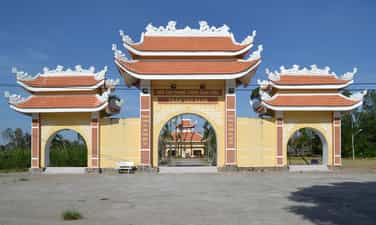
The temple dedicated to General Tran Van Nang, also known locally as Dinh Ong – Doc Vang, is located on the Tien River, at the mouth of the Doc Vang canal. This historical and cultural site is associated with the life and career of Tran Van Nang, a military general who made significant contributions to the defense and expansion of the southern region under the Nguyen dynasty. Tran Van Nang (1763–1835) held many important positions in the Nguyen army. In early 1835, after participating in a campaign in Phnom Penh, he fell seriously ill and handed over military command to Truong Minh Giang. On his way back to Vietnam, upon reaching Ben Sieu, now in Thanh Binh district, Dong Thap province, he passed away at the age of 72. His remains were brought to the mouth of the Doc Vang canal, where local officials, elders, and people erected a shrine to commemorate the meritorious general. For over a century, the temple has been preserved and beautified by generations of people, becoming a space for religious worship and commemoration of historical figures. The worship of Tran Van Nang reflects the tradition of "drinking water, remembering the source," remembering the contributions of those who helped protect the southwestern border region and the peace of the country. Every year, the commemoration ceremony is held over three days, the 14th, 15th, and 16th of the second lunar month, attracting a large number of local people and tourists from many places to offer incense and pay respects. Religious activities at the festival express wishes for national peace and prosperity, favorable weather, and a peaceful and prosperous life. The temple is situated amidst the characteristic riverine landscape of Dong Thap province, along with a system of gardens and riverside sandbanks, creating a destination that combines sightseeing, historical exploration, and cultural and religious activities. Source: Historical and Cultural Relics Information Page.
Dong Thap
6 view
Rating : National Monument

Phu Huu Temple
Phu Huu Temple is a national-level architectural and artistic relic, currently located in Phu Hoa hamlet, Phu Huu commune, Dong Thap province. The temple was built in the early 19th century, initiated by Mr. Thieu Quang Loc, who mobilized local people to build it to worship the tutelary deity. In 1852, during the reign of Emperor Tu Duc, the temple was granted the title "Tutelary Deity of the Locality". In 1903, due to erosion by swirling water, the temple was relocated and restored to its current location. Phu Huu Temple impresses with its airy space, surrounded by ancient trees, with the Sa Dec River in front and the Cai Tau Ha River to the side. The complex includes a screen wall, lotus platform, ceremonial gate, the Five Elements Shrine, the Tiger Shrine, the God of Agriculture Shrine, the Lady of the Land Shrine, and the temple dedicated to the tutelary deity. Every year, the temple holds three main ceremonies: the Lower Field Ceremony on the 17th of June, the Upper Field Ceremony on the 17th of September, and the Ancestral Temple Ceremony on the 17th of December (lunar calendar). This is not only a place of religious worship for the community but also preserves the distinctive cultural and architectural values of the Southern region of Vietnam. With its outstanding historical, cultural, and artistic values, on December 18, 2009, Phu Huu communal house was classified as a National Architectural and Artistic Monument by the Ministry of Culture, Sports and Tourism. Source: Wikipedia
Dong Thap
160 view
Rating : National Monument

Southern Vietnam Radio and Telecommunications Agency
The Southern Vietnam Radio and Telecommunications Agency – A Heroic Legacy in the Heart of Dong Thap. The Southern Vietnam Radio and Telecommunications Agency historical site is located at the Go Muoi Tai base in the Dong Thap Muoi region, now Phu Cuong commune, Tam Nong district, Dong Thap province. Established and operating secretly from 1945 to 1954, it was one of the first cradles of revolutionary communications in Southern Vietnam. Through the passage of time and the vicissitudes of history, it has been rebuilt and restored into a solemn historical site. The grounds are highlighted by the majestic Monument to the Southern Vietnam Radio and Telecommunications Agency, along with memorial structures commemorating the contributions of previous generations. This space not only preserves the memory of the rudimentary machinery repair workshop and the former telegraph operator training school, but also marks the glorious milestones during the nine years of service in the resistance war against the French, maintaining the uninterrupted flow of information between the Southern battlefield and the Central Government. Not only is it historically significant for the postal service, but the site is also a brilliant symbol of the patriotic spirit of the Southern region. Overcoming bombing raids and harsh conditions, it served as a safe transit point, ensuring the transportation of weapons, documents, and transporting tens of thousands of cadres to and from the battlefield. With its immense historical significance, the Southern Vietnam Radio and Telecommunications Post Office site today is not only a symbol of gratitude to our forefathers, but also a destination rich in cultural values, contributing to the education of revolutionary traditions for future generations. Source: Dong Thap Provincial Museum Information Portal
Dong Thap
101 view
Rating : National Monument

Giong Thi Dam - Go Quan Cung historical site
Giong Thi Dam - Go Quan Cung historical site, now in An Phuoc commune, Dong Thap province, is a place associated with an important victory in the revolutionary movement in the South. On September 26, 1959, Battalion 502 of Kien Phong province organized a battle at Giong Thi Dam, destroying and disintegrating a large part of the enemy force operating in the Dong Thap Muoi river area. Immediately afterwards, at Go Quan Cung, our troops continued to defeat the enemy forces that came to the rescue. With only 42 gunmen, Battalion 502 won against a force many times larger, capturing many weapons, vehicles and capturing prisoners. The Giong Thi Dam - Go Quan Cung victory has special significance, contributing to enhancing the prestige of the revolution, strengthening trust and encouraging the fighting spirit of the people of Kien Phong as well as the Mekong Delta provinces. This is considered one of the typical battles of the Dong Khoi movement in the South. To remember historical victories, relics were built and preserved at the place where the battle took place. On January 19, 2004, Giong Thi Dam - Go Quan Cung historical site was recognized as a national historical site. Source: Dong Thap Provincial Museum
Dong Thap
137 view
Rating : National monument
Trieu Am Pagoda (Thanh Dao)
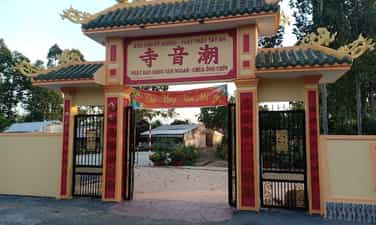
Trieu Am Tu (Ong Chin Pagoda) is located in Hoa Dan hamlet, Nhi My commune, Cao Lanh district, Dong Thap province. It is a pagoda following the Buu Son Ky Huong religion of Buddha Master Tay An - Doan Minh Huyen. The pagoda was first founded by Mr. Dang Van Ngoan (also known as Mr. Dao Ngoan) in the year Giap Dan (1854) during the 7th year of King Tu Duc's reign at Tra Bong canal, Nhi My village, Kien Phong district, Dinh province. Tuong (now Hoa Dan hamlet, Nhi My commune, Cao Lanh district, Dong Thap province). Mr. Dao Ngoan is a great disciple of the "twelve sages" of Buddha Master Tay An. He was born in the year of Canh Thin (the year of Minh Mang, 1820) in a virtuous family in Nhi My village, near Tra Bong canal. When he was over 20 years old, after diligently cultivating land to establish a field and garden so that his family could make a living, he asked his mother to let him leisurely find a quiet place to cultivate his mind and nurture his nature. With his mother's approval, he chose a plot of land in Ong Buong canal to build a thatched hermitage to meditate. Mr. Dao Ngoan studied Buddhism with Buddha and spread Buddha's Buu Son Ky Huong religion, guiding people to set up fields, reclaim land on the outskirts of Dong Thap Muoi and cure people's diseases. He directed his followers to recite Buddha's name and cultivate the Buddha's name, exploiting more than 500 square meters of land. Not long after that, the pagoda caught fire and burned down, followed by several Southern provinces being invaded by the French invaders. During the mutiny, Mr. Dao Ngoan and his followers had to leave the temple to seek refuge. In 1867, Mr. Ngoan returned to Tra Bong to gather followers to rebuild the old pagoda, continue to take medicine to treat people's illnesses and gathered a large number of followers to preach the teachings of the Four Graces, in which the grace of the country comes first. The country's situation is suffering from foreign invasion. Tra Bong Pagoda became a place where patriots gathered to discuss fighting the enemy. On the 19th day of the second lunar month, the year of the Tiger (1890), Mr. Dao Ngoan passed away at the age of 70. His mournful followers gathered together to bury him in accordance with Buddha's teachings. After Mr. Dao Ngoan passed away, the pagoda continued to be cared for by Nguyen Thi Hue (his third wife) and the pagoda. Mr. Dang Cong Hua (Chin Hua's son) was also taught the Dharma and healing methods by Mr. Ngoan and Mrs. Hue, so Tra Bong Pagoda still gathers a large number of followers. When Mr. Chin Hua replaced the abbot of the pagoda, he gave the pagoda a new name, Trieu Am Tu. In addition to the name Trieu Am pagoda that few people know, people still call this "Ong Chin Pagoda" because Mr. Chin's virtue and talent are no less than Mr. Dao Ngoan's. During the resistance war against America In 1965 - 1966, a secret cellar was built at the temple to house provincial and district officials. Every time there was an enemy raid, when they withdrew, the pagoda sounded three loud beeps to signal the cadres to take shelter in the cellar. This secret bunker was used very effectively until the day of liberation on April 30, 1975. From 1973 to April 30, 1975, Cao Lanh Town Party Committee returned to Tra Bong canal near the pagoda, the monks in The pagoda has just served as inter-commune liaison at Nhi My and protected commune officials. Trieu Am Tu (Ong Chin Pagoda) is a place to record traces of revolutionary events, a place to worship the title of Thanh Hoang Bon Canh and Dai Can of the Nam Hai Nation along with the 6-card box of Nhi My communal house which is descended from Mr. Chin's work preserves and maintains incense despite many historical events. The pagoda is also a place to educate patriotic traditions, virtues of compassion, preach and encourage people and believers to follow the teachings of "Four Graces". On December 23, 2019, the People's Committee of Dong Thap province ranked Trieu Am Tu is a Provincial-level historical and cultural relic. Source: Cao Lanh district website, Dong Thap province
Dong Thap
6962 view
Rating : Provincial level relics
Ap Bac Victory Relic Area
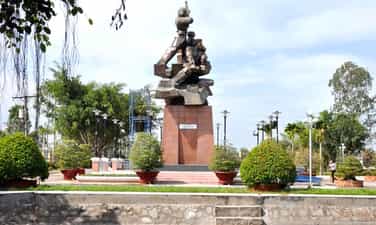
Ap Bac belongs to Tan Phu commune (Cai Lay town, Tien Giang) about 21km west of My Tho city center. It is a place known to the whole country and progressive people around the world. It is not a scenic spot, but the place where a resounding battle took place. The battle in which the US and puppet forces concentrated maximum force, using modern warfare equipment and innovative tactics, with American advisors and their henchmen determined to sabotage the revolution, in order to crush Ap Bac and destroy main force of the Southern revolution. On January 2, 1963, with 200 gunmen, the army and people of Ap Bac defeated more than 2,000 enemy troops with aircraft, tanks, warships supporting and American advisors commanding, breaking two new tactics. The period that the US applied in special warfare was "helicopter transport" and "armored transport" signaling the collapse of Ngo Dinh Diem's regime and the special war strategy of the US empire. Early in the morning of January 2, 1963, the enemy launched a sweep by the 7th Division Command and the Security Task Force in Dinh Tuong sub-region. The sweep took place within Tan Phu commune to encircle and destroy our local platoon that they discovered; Our forces only had company 1 of battalion 514 and company 1 of battalion 261. At 5:00 a.m. on January 2, 1963, the enemy divided into two wings to enter Ap Bac, but we blocked and attacked them, forcing them to call in reinforcements. institute. At the same time, our engineering field used mines to sink a ship at Kinh 3 and damaged two others. At 9:30 a.m., they landed a helicopter at Ap Bac; Under the command of company commander Bay Den, we broke up many enemy attacks supported by both helicopters and M113 vehicles. By evening, after many failed attacks, the enemy withdrew from the battlefield. As a result, they failed miserably, with: 450 dead and wounded, including 10 American advisors; 3 M 113 amphibious vehicles were destroyed; 8 helicopters were shot down; 1 ship sank and 2 other ships were damaged. Currently, the relic site is an architectural complex located on an area of nearly 3 hectares including: exhibition house, area recreating the activities of Ap Bac soldiers and people in battle, bronze statues of 3 iron and steel soldiers, area display of trophies after the battle: armored vehicles, helicopters, 105mm artillery; the grave site of 3 iron and steel soldiers: Nguyen Van Dung, Do Van Trach and Hung (don't know their last names); The manor house is interspersed with a flower garden that is always blooming and fragrant. Perhaps the most impressive on the campus is the bronze statue of three tall iron and steel soldiers, weighing 18 tons: one holding a gun, the other holding a gun standing proudly on an enemy tank, their majestic image as if carrying them away. We return to the scene of guns exploding and bombs rumbling more than 50 years ago. The Ap Bac victory is a brilliant milestone in the history of the struggle against foreign invaders of Tien Giang people and our nation. It spoke of the indomitable will of the Vietnamese people, the invincible strength of the people's war. On January 7, 1993, Ap Bac historical relic was ranked as a national relic by the Ministry of Culture and Information (now the Ministry of Culture, Sports and Tourism). Source: Department of Culture, Sports and Tourism of Tien Giang Province
Dong Thap
10248 view
Rating : National monument
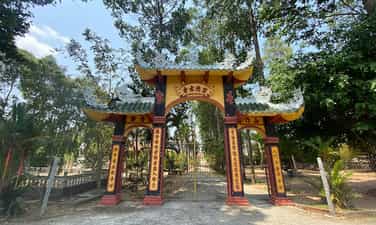
Buu Hung Pagoda
Buu Hung Pagoda is located in Long Thang commune, Lai Vung district, Dong Thap province. Buu Hung ancient pagoda was recognized as a national historical-cultural relic on August 3, 2007. Because the pagoda is located next to Ong Ca Cat canal, people have known this as Ca Cat pagoda for hundreds of years. According to historical records at the pagoda, Zen master Nguyen Dang from Hue capital built Buu Hung pagoda in the mid-18th century, around the years 1777 - 1780, with temporary materials of bamboo, mud walls, and roofing. water coconut leaves. In 1803, the pagoda was named Sac Tu Buu Huong Tu by King Gia Long. Legend has it that once, when the Tay Son army chased them away, Lord Nguyen Phuc Anh (later King Gia Long) had to run to the pagoda for shelter. Remembering his gratitude, after ascending the throne, Lord Nguyen bestowed the title of monk on the pagoda, and at the same time conferred the title of Venerable Tu Dung on monk Tien Thien Tu Lam. In the pagoda there is a sign that reads "Sac tu Buu Hung Tu Gia Long two years old". After that, the monk built the simple pagoda into a large, solid pagoda made of precious wood. In 1821, under the reign of King Minh Mang, Minh Tinh Buu Thanh and Minh Phuoc Tu Trung built a larger pagoda and the court offered a 1.8m high wooden Amitabha Buddha statue and other dharma objects for worship. In 1910, during the reign of Patriarch Nhu Ly, Thien Truong (1887 - 1969), the pagoda was majorly restored. During the years 1909 - 1911, the monk repaired the main hall, carved more altar panels, altar plates, horizontal panels, parallel sentences... At the same time, the monk also repaired the tomb tower and planted more ornamental trees. So the temple is even more beautiful and majestic. In September 1946, the pagoda was bombed by a plane and hit the ancestral house, killing the abbot Chanh Vien and four Buddhists. Responding to the resistance against the French, the pagoda donated a large donation to the revolution to manufacture weapons to fight the French. After that, Venerable Chon Hoa (1950 - 1966) became the abbot to rebuild the ancestral house as before, and the pagoda gradually flourished again as before. In 2002, the pagoda was renovated, the roof was covered with glass tiles, and the floor was tiled with ceramic tiles. The original bas-relief columns and four-quarter carvings are very unique and skillful. Regarding construction architecture, Buu Hung Pagoda is currently located on an area of about 4,000 square meters, designed in a triangle style with a width of 15 meters and a length of 50 meters including: Front hall, Main hall and Hau To house. The front hall and main hall are connected to each other. The main hall consists of three rooms and two large wings in the style of four pillars, with many lamellas, the Than Vong is very delicately carved with four sacred animals, and the Nguyen dynasty sent it as an offering in 1821. Behind the main hall of the pagoda is an open-air courtyard (provincial courtyard) shaped like a mouth, with corridors on both sides (East corridor, West corridor) connecting to the Hau To's house. In the bamboo garden next to the pagoda is an ancient tower. This is the resting place of the monks who have practiced at the temple. In addition to the ancient architecture, a special feature of Buu Hung Pagoda is that most of the Buddha statues in the pagoda are made of many types of precious wood that are hundreds of years old. Notably, the Amitabha Buddha statue made of wood sent by the Nguyen court as an offering in the 2nd year of Minh Mang (1821) is placed in the middle of the main hall. Currently, the pagoda still has more than 100 large and precious wooden pillars, three sets of large wooden doors (each door has 4 wings) with very artistic carvings of dragons and flowers. These three sets of doors were made in the early 20th century and were installed on the back wall of the Main Hall in the years 1909 - 1911. Source: Dong Thap Tourism
Dong Thap
7257 view
Rating : National monument
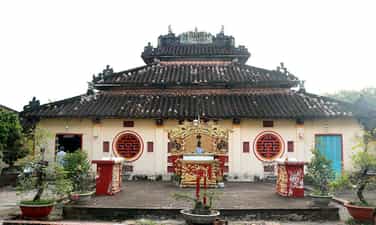
Dinh Yen Communal House
Dinh Yen communal house was built in the year of Canh Tuat 1909, located in An Loi A hamlet, Dinh Yen commune, Lap Vo district - Dong Thap. Local legend has it that: in the past, there was Mr. Pham Van An who was the first person to choose this place to reclaim land and establish a hamlet to settle down. To pay tribute to those who came before, the people here took his name and combined it with the word Dinh and named the village Dinh Yen (because they avoided calling the name An), hence the name Dinh Dinh Yen. The communal house is built in the style of domestic and foreign countries, with walls built with wooden columns, roofed with large tube tiles, flags, rafters and columns carved with clever and beautiful dragon head patterns. Parallel sentences and bamboo tureens are decorated with conch, carved with dragon-shaped fish, two dragons, painted with pearls, lotus, peonies... lacquered and gilded. The landscape paintings and frescoes have sharp lines, praising the country's people for literature, martial arts, wisdom, and virtue. In front of the communal house's spacious cement-floored yard with fragrant flower beds, rows of ancient poplar trees, oil trees, and tall stars swaying in the wind, evoking the scene of the old people still here somewhere. The inside and outside are skillfully arranged in harmony and balance, making the architectural work truly magnificent and splendid. At the communal house (main hall) on a high platform worship the god Thanh Hoang Bon Canh. Both sides of the ceiling are solemnly decorated with dragons, unicorns, tortoises, phoenixes, cranes, god thrones, incense burners, ashes, parasols... On both sides of the altar, the left and right sides are arranged to worship the ancestors of the communal house. . Every year on the 16th - 17th day of April and the 15th - 16th day of the 11th lunar month, the communal house worship ceremony takes place solemnly with full rituals such as: cavalry team, lion team, soldiers, students, drums, etc. gongs, ceremonial music... Coming to Dinh Yen communal house with reverence and remembering the merits of the ancients to their homeland, only then can we understand the word "God". That is the heroic spirit of the ancestors as if still mixed in the incense and smoke, always protecting many people and existing eternally in the hearts of the People. Source: Dong Thap Tourism
Dong Thap
7426 view
Rating : National monument
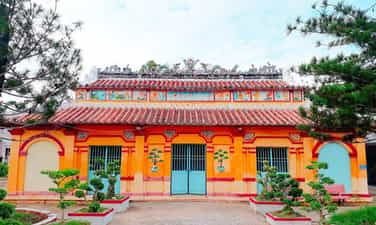
Tan Phu Trung communal house
Tan Phu Trung communal house is located on a large plot of land, in the middle of a rich countryside in Tan Phu Trung commune, Chau Thanh district, and is one of the ancient communal houses in Dong Thap that is worth a visit for tourists. Tan Phu Trung communal house worships the god Thanh Hoang Bon Canh, conferred by King Tu Duc in 1854. Tan Phu Trung village communal house was greatly restored in 1952, 1957... Up to now, Tan Phu Trung communal house is one of the communal houses with architectural ideas. The architecture is quite typical of Southern communal houses during the Nguyen Dynasty in the early 20th century. Looking at the gate, we can see the main buildings: communal house gate, communal house yard, main communal house and Huong Hoi house. The main gate is right in front of the main communal house, 3m wide, 3.5m high. The gate pillar is made of sturdy bricks, with a ceramic unicorn statue on top. Embossed horizontal bar of the communal house gate: Tan Phu Trung Communal House. The communal house's yard is large, tiled, and in the middle is an 8m high flagpole. At the foot of the flagpole is the Xa Tac altar. In front of the Xa Tac Dan is a Binh Phong, in front is a painting of a pair of dragons winding in the clouds, behind is a tiger descending the mountain (lower mountain forest). Balanced in the courtyard, on the right is the Son Than (Tiger God) Temple, symmetrically is the Ngu Hanh (Ngu Nuong) Temple. Just in the courtyard of the communal house, there are countless symbols of the spiritual, cultural life and thinking of agricultural residents The main communal house consists of three blocks of houses in an arranged arrangement, each house has four main columns, also four pillars, along which the trusses and rafters are pierced to four sides, called the four images, on each rafter there is also a rafter, on top That's a set of sesame rafters... creating a sturdy communal roof. The main communal house has three roofs, like an upper floor and a lower porch, with overlapping terraces. The communal house's roof is covered with yin and yang tiles, the top is elaborately decorated with two dragons painting pearls, fish turning into dragons, unicorns playing with mothers and children, eight fairies, phoenixes holding scrolls... In the communal house, there are many carvings of horizontal panels, bamboo panels, and couplets with popular themes such as: Dragon, Unicorn, Quy, Phung, spring - summer - autumn - winter, stylized flowers and leaves. In particular, the communal house has 3 statues of Saint - Emperor - Quan made of rare and precious agarwood that are still preserved. Tan Phu Trung Communal House is not only a long-standing architectural work of the local people but also a place to preserve typical community cultural and religious activities, contributing to preserving indigenous culture. On August 15, 2012, Dinh Tan Phu Trung received the Certificate of recognition as a national historical and cultural relic. Every year, Tan Phu Trung village communal house festival takes place on the 16th - 17th day of the fourth lunar month (even years) and the 12th - 13th day of the fifth lunar month (odd years) attracting tens of thousands of tourists to Dong Thap. Visit, worship, pray for peace in the country and people, a year of good rain and wind, lush crops, good business, prosperous and prosperous villages... Source: Dong Thap Tourism
Dong Thap
9107 view
Rating : National monument