Relic point Vietnam
Việt Nam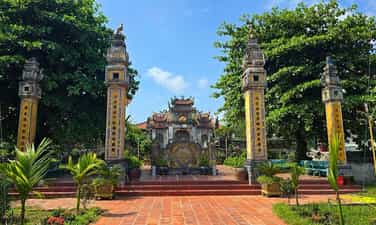
Ly Hoa communal house
Ly Hoa communal house is located in Hai Trach commune, Bo Trach district, Quang Binh province. The communal house is located on high land in the middle of the village, with a beautiful, airy terrain. About 1 km from National Highway 1A along the riverbank to the Northeast, the communal house faces South, in front is the gentle Ly River flowing down to the sea. Ly Hoa Communal House was built in 1737, by the villagers contributing their contributions. At first, there were 4 pillars made of ironwood. Every year, when people held ceremonies, they erected them and covered them with thatch. When the ceremonies finished, they took them down and folded them. The god worshiped in the village communal house "Cuong Khau Dai Vuong", a sea gate guardian god Cuong Gian is worshiped in the communal house of Cuong Gian village (Nghi Xuan - Nghe An) - The genealogies of the families in Ly Hoa all record the gods ancestors in Cuong Gian village - Nghe An. In 1804 - 1808, when the Ly Hometown Council was strong, people donated to build it, the communal house's roof was covered with scale tiles, the back part was only for worship. Then build a central communal house. In 1824, the outer part and two old rooms were built to worship the dead. According to the genealogy left behind, in the same "four pillars" there are 4 gods: Thien Yana, Hanh Tieu Nuong and two daughter princesses Thien Yana (people call them the four great gods). The middle communal house worships the tutelary god and worships the gods with temples in the village. The outermost part worships the twelve ancestors (ancestors of 12 families) with the king's diploma. Speaking of Ly Hoa village, no one does not know the Nguyen Duy family, a family that has succeeded for many generations to become highly respected mandarins. During the Nguyen Dynasty, from the 10th year of Minh Mang opening the first university until the last exam in 1919, the Nguyen Duy family in Ly Hoa village contributed 5 university professors (doctorates). That is a unique case in the history of Vietnam's feudal examinations. Ly Hoa Communal House, in addition to worshiping the ancestors who founded the village, opened up careers for their descendants, and worshiped the village's prestigious scholars, is also associated with typical historical events of the locality and the province in the past. During the pre-uprising period to seize power in the district capital, during the period of fighting against the French colonialists who invaded our country, especially during the fight against the destructive war of the American invaders. The first days were to prepare for mass mobilization, gathering forces in the Viet Minh front to join the local uprising to seize power. Ly Hoa Communal House is where revolutionary soldiers hid documents and traveled to make contact and meet to discuss major policies of their superiors. On August 23, 1945, the whole village gathered at the communal house and headed to the district road. Together with localities in the district, the August revolutionary uprising to seize power in the district capital was successful. During the war of sabotage by the American enemy. Ly Hoa communal house in particular and Ly Hoa village in general were one of the places of extremely brutal raids by the American invaders. The enemy attacked from the sky, from the sea, etc. Generations and classes of village youth gathered at the communal house before joining the army to be reminded to promote their ancestors' traditions and live worthy of their values. ancestors created spiritual culture, material culture and determination to protect the homeland. During the years of fierce war, Ly Hoa village was honored by comrades Vo Nguyen Giap and Dong Si. Nguyen, Le Quang Hoa... all entered the battlefield visit. Ly Hoa communal house as well as Ly Hoa village in general were attacked over and over again, the communal house was destroyed by American bombs, but the village is still a surviving communal house. The local people still persevere in holding on, not moving an inch, not leaving an inch, clinging to their villages and homeland. Maybe rowers and guns, responding to the slogan: "If the car hasn't passed the house yet, there's no regret, if the road hasn't been cleared, there's no regret for blood or bones." The pillars of communal houses collapsed and were broken, along with houses, people dismantled them to serve passing vehicles, ensuring traffic, ensuring blood vessels for the Southern region. Wounded soldiers and convalescent groups all stopped at the communal house to then go to the North and South. From the day peace was restored until now, the village communal house has become a meeting place, a place for cultural activities, and the political and social center of the village community, where generations of descendants learn more about the brilliant past of the village. ancestors, enhancing each person's pride and responsibility towards their homeland and neighbors. Ly Hoa Communal House has typical architectural and artistic historical value, and is a place to worship ancestors who have openly founded the village and the typical professions of the coastal village (the communal house's sacrifices are held in addition to the Spring and Autumn periods each year). There is a grand festival, village affairs, and Tet holidays. In addition, every 6 years there is a very solemn ceremony to worship the tutelary god. Ly Hoa Communal House is the embodiment of the cultural identity of Vietnamese villages along with many cultural values worth preserving. Furthermore, the communal house is also associated with typical historical events of the locality and province, especially from 1945 to present. The communal house is also a building with a historical and cultural symbol, a place for cultural activities of Ly Hoa coastal village. A place of education that promotes the tradition of studiousness and love of homeland for present and future generations. Source Electronic information portal of Bo Trach district, Quang Binh province
Quang Tri
6299 view
Rating : National monument.

Tuong Son communal house
Tuong Son Communal House is located right in the center of Quang Long commune, on a relatively high ground, in front of the Mai River (Kenh Kia River) flowing through, then leaning against the sand slope as if embracing Tuong Son village. The history of village communal house construction is associated with the history of construction and development along with the political and social changes that took place in the lands of Quang Long and Quang Trach (feudal time in Dai Dan commune, Thuan Bai district). The communal house was built in the year of Canh Ngo (1750), more than 250 years ago during the reign of King Canh Hung XI. Tuong Son Communal House was initially built to worship and recognize the ancestors who publicly founded Dai Dan village and those who were assigned by the king to "protect the nation and protect the people", later worshiping loyal and patriotic gods. Through the memories of many generations of villagers, Tuong Son communal house was one of the largest communal houses in Quang Binh at that time. The communal house was built and decorated quite elaborately. The communal house includes the courtyard, vestibule and back porch. The communal house yard and vestibule are places where festivals take place and where entertainment, meetings, ceremonies, meetings, and processions of the village take place. The rear communal house is a place to worship the Thanh Hoang and gods who have contributed to the homeland. Tuong Son communal house is a combination of government and theocracy. After the failed suppression of the Can Vuong movement in Quang Trach district (1888), the French colonialists frantically sought revenge. They took advantage of the enmity between pagans and incited Vietnamese traitors masquerading as religion to burn down the village communal house. Although at this time there are only vestiges of the communal house left, the image of the village communal house is still imprinted in the memories of every citizen. With that enthusiasm, in the spring of Nham Ty (1912), the village communal house was started to rebuild on the old communal house foundation according to the architecture of the Nguyen Dynasty. After a year of working together and contributing to the village community, in the spring of the year Quy Suu (1913), the village communal house was completed. In terms of structure, the second rebuilt communal house is basically the same but more massive and perfect. In particular, the exterior perspective decoration as well as the detailed lines and patterns, engraved images of battle elephants engraved on the screen all clearly demonstrate the martial spirit of Tuong Son land. As for the rear communal house, in addition to worshiping the village's Thanh Hoang, it also worships King Quang Trung and famous general Nguyen Dung in the main area, in accordance with the wishes of the people. In 1968, due to the nature of the increasingly fierce war of sabotage by the US imperialists, the communal house was again destroyed by a bomb. It was not until 1993 that the Party Committee and people of Quang Long restored the 3-room back communal house, built of stone, brick, cement, and tiled roof to its current state. However, that work only stopped at restoring the place of worship, not recreating the artistic architecture of the old communal house. Tuong Son Communal House is a historical-cultural work, a convergence of fine traditional cultural activities of the land of Quang Long and a place for transmitting cultural values between generations. The village customs and festivals taking place at the Communal House all focus on reflecting the concepts of worship and expressing the ideology of village farmers in honoring the gods. During the years of campaigning to establish local Party cells, Tuong Son Communal House was the place where communist soldiers traveled and held secret meetings to exchange and propagate the Party's policies and guidelines. During the period leading up to the August Revolution, the village communal house was also the place where rallies of the Viet Minh front took place calling on the masses to rise up to respond to the revolutionary cause of national liberation. On the night of August 19, 1945, at the village communal house, the Commune Uprising Campaign and Steering Committee was established. Here on August 23, 1945, the chief of staff handed over seals and books to the Viet Minh. Peace was restored (1954), Tuong Son Communal House was the administrative headquarters for a long time of the Quang Long Commune Committee. During the resistance war against America to save the country, to ensure the support of human and material resources for the southern front line. Tuong Son Communal House became a gathering place and stopping place for army units, a center for receiving goods and weapons. In addition, the communal house is also a place to store military equipment of company 365, artillery 37, and Quang Trach Hospital is also stationed here. When they discovered the hiding places, the US imperialists focused on fiercely raiding the land of Quang Long, at which time the communal house was destroyed. But with the spirit of all for the front line, all for victory, the Party Committee and people of Quang Long used the remaining wood to make air defense tunnels, ambulance tunnels and most of it was used to build Kenh Kia bridge for vehicles to pass through. . It can be said that during the years full of difficulties, hardships, and sacrifices against the destructive war of American imperialism, Tuong Son communal house contributed to accelerating the cause of national unification. With its historical values, in 2003, Tuong Son communal house was recognized by the Ministry of Culture, Sports and Tourism as a national historical relic. Source Quang Binh province electronic information portal.
Quang Tri
6039 view
Rating : National monument.
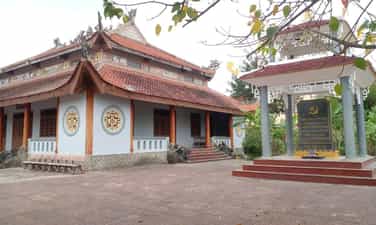
Lu Phong communal house
Quang Phong village communal house - formerly known as Lu Phong communal house, was built in 1542, to worship the five Tutelary saints who publicly restored and established the village through the ages. In 1962, the communal house was recognized as a national historical and cultural relic. During the years of resistance against the US, the communal house was the target of fierce attacks by the enemy. Up to now, the communal house has been renovated and gradually restored the good traditional historical values of the locality. Lu Phong village communal house is a place to commemorate the merits of the Village Thanh Hoang (the first mandarins and generals to colonize and live here), more specifically, the village communal house also marks the history of the first Party cell established in the District. Quang Trach and northern Quang Binh (October 1993). To commemorate the contributions of our grandfather and father and to pray for good business, good harvests, and a prosperous and peaceful life, people organize offerings every year. The preparations for the Lu Phong communal house festival are done very meticulously. On the afternoon of January 17, people of 10 residential groups of Quang Phong ward were busy, preparing feasts to worship for the next morning. The holiday offering tray is divided into two types: the first type of tray includes fruits, votive papers, incense, wine, etc.; the second type of tray includes meat and sticky rice. Lu Phong communal house festival is held from 9:00 a.m. on January 18 when the feasts of 10 residential groups in the ward are fully displayed at Lu Phong communal house. Worshiping rituals are performed by the elders in the ward. The process of formation and development of Lu Phong communal house, ancestral traditions will be recited during the ceremony, in order to educate future generations to remember their roots. At the same time, the Lu Phong festival also highlights the achievements that Quang Phong ward achieved in the previous year, praying for the new year to be favorable, good, peaceful, and that all people will have a better life. . Source Electronic information portal of Ba Don town, Quang Binh province.
Quang Tri
6345 view
Rating : National monument.

Phu Trich village communal house
Phu Trich village (Quang Loc, Ba Don town) is famous for its victory over Phu Trich - La Ha during the years of fierce resistance against the French. This land still retains many historical and cultural values that have endured over time. Phu Trich village communal house is a meeting place, cultural and artistic activities take place, preserves many good customs and practices and is also the embodiment of community solidarity. One of the values that creates lasting pride for the people of Quang Loc in general and Phu Trich village in particular is the ancient Phu Trich communal house roof, bearing the mark of time. Phu Trich Communal House was built in 1843, is an architectural work containing many historical and cultural values of the locality. What is precious is that inside Phu Trich communal house, 12 royal decrees from the Nguyen Dynasty from King Tu Duc to King Duy Tan are kept, which shows respect for the past, as well as the merits of the ancestors. The communal house's face faces the Gianh River, its back leans against the village, creating a solid stance in the open space. The communal house is designed in two parts: front communal house and rear communal house. The communal house was built quite large, with a beautiful and elaborate design. The pattern lines are carved elaborately and meticulously. On the east and west gables, there are two phoenix birds in flying positions, with delicate, sharp, flexible, harmonious, and beautiful curved lines, with the archetypal style. family. The back communal house has an architectural style and layout that bears similarities to other communal houses in localities in the Central region, from the details of the outside perspective patterns to the interior. The back communal house is built in a rectangular shape, the roof is covered with Hung Ky tiles. The queen's communal house is a place to worship the famous tutelary general Pham Ba Quy and other gods and generals with merit and virtue, and famous scholars with good reputations who support the people and help the country be admired by the people. About 20m away from the communal house on the left, the villagers also set up a separate, elaborately built mausoleum to worship Tutelary God Pham Ba Quy, who had great contributions in clearing the land to establish Phu Trich village, and was also a deity. talented general. Above the incense burner hang two Chinese characters "Hell Linh" given by the king, representing a solemn and respectful place to worship him. In 1817, he was awarded the title of "Tanh Hoang Than of the Land" by King Thanh Thai, then later awarded the title of "Supreme Venerable Than". Therefore, when building the temple, the villagers engraved two parallel sentences in Chinese characters: "Sir as General Binh Loi to save the country/Death to the god of the native land as tutelary god". Above the four roofs of the temple still retain the exquisite and original carvings of dragons and phoenixes, demonstrating the authority of a famous general. To the east, about 1,200m away from the communal house, local people also established a temple area called "Three Toa Four Temples", including 4 temples. Each temple is designed according to three similar architectural buildings, the contours, curves, and dots all follow a unified whole. Four temples are used to worship the following people: Nam Han Lang Lai, the Left Father of Zen Duke Nguyen Huu Hien, the fathers of the Left Fathers of the Duke of Zen, the four agricultural gods, those who had merit in suppressing the border and establishing the foundation. land, build and protect the homeland and were ordained by kings. The historical relic of Phu Trich communal house, in addition to worshiping the spirits of the founding fathers of the village, whose merits are respected by the people, is also associated with important historical events in the two resistance wars. war against France and America. Typically, the Phu Trich La Ha victory in the spring of February 1950 went down in the history of the locality and the nation as a brilliant milestone, the corpses and blood of the enemy stained the whole river red. During the resistance war against the US to save the country, Phu Trich was a key area; Phu Trich ferry wharf is an important traffic artery, a place to transport soldiers, young volunteers, people back and forth and transport goods to the battlefield. Phu Trich Communal House was a place to gather troops and hide important goods such as weapons, military supplies, rice and salt, and medicine. Phu Trich communal house and Phu Trich area became a hot spot where the enemy focused on raiding all night with thousands of different types of bombs and bullets to prevent and cut off road and waterway traffic. In 1967 and 1968, with the destructive war, the US imperialists bombed hospitals, schools, communal houses, pagodas, mausoleums, shrines... the front communal house was also destroyed from here. Through the two resistance wars against the French and the Americans, Phu Trich communal house in particular and Phu Trich village in general made significant contributions to the revolutionary cause of national liberation. It has been nearly two hundred years, but the carved patterns in the overall architecture of the communal house are still intact in a land with many military achievements, a place of worship, belief and spiritual cultural activities. of generations of Phu Trich villagers. Every New Year's Eve, especially on Lunar New Year's Eve, children and grandchildren in the village gather at the communal house to celebrate New Year's Eve together, offering incense and beating gongs and drums to usher in spring, on January 6 every year. Every year, all families gather at the village communal house to organize the village's first spring planting ceremony. This is an opportunity for clans and descendants from near and far to return to attend the ceremony and review the good traditional values of this land. And the village communal house will always be a proud place to return to for generations of people here. Source Electronic information portal of Quang Loc commune, Ba Don town, Quang Binh province.
Quang Tri
4633 view
Rating : National monument.
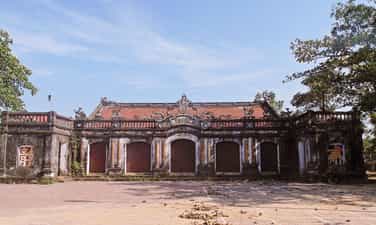
Hoa Ninh Communal House.
Hoa Ninh Communal House belongs to Hoa Ninh village, formerly Quang Hoa commune, Ba Don town, built in the 11th year of Bao Dai - 1936. During feudal times, the communal house was both a "communication station for army corps to serve administrative purposes." army", is also a place to worship heroes, those who openly reclaimed wasteland to establish villages... Along with cultural values, Hoa Ninh communal house during the two resistance wars against the French and the American invasion was also a place that marked many historical events. The communal house was a meeting place for the people, where rallies of the Viet Minh front took place calling for the masses to rise up to seize power in villages and district capitals (August 1945). During the years of resistance against America to save the country, this was also the place where our armed forces gathered and was a warehouse to hide weapons ready to fight back against enemy aircraft when they attacked the North. In 1965, American enemy bombs severely damaged Hoa Ninh communal house. But, with the determination of the people and the close guidance of the authorities at all levels, in 1976, the communal house was successfully renovated and became a "golden address" for the next generation to enhance their self-esteem. pride and responsibility for the glorious tradition of our ancestors. In 1993, the (former) Ministry of Culture and Information ranked Hoa Ninh Communal House as a national historical and cultural relic. Hoa Ninh Communal House was built with a massive and meticulous scale and architecture. The communal house is arranged with a system of surrounding walls, pillar gates, screens and a horizontal grand communal house. The sharpness and sophistication are shown right at the gate of the communal house, with the main gate built of bricks. The two pillars on both sides are designed extremely elaborately, the lines are in harmony with each motif and color. On the tops of the two pillars are images of two pigs delicately covered with green and light brown enamel, showing the strength of solidarity of the people. The communal house gate bears bold architectural and artistic features of Vietnamese villages. Hoa Ninh communal house in Quang Hoa commune consists of 5 rooms, 4 rooms, 1 main door and 4 side doors. In front of the main door of the communal house, there is an engraving of the word "Tho" embedded in the moon and three embossed Chinese characters: Phuc, Du, Dong. This is also the center for displaying decorative motifs such as: Dragon, Lion, Turtle, Phung, precious bowls, flowers... by the art of plastering and assembling pieces of porcelain and porcelain. In addition, this area also has 2 more couplets by bachelor Nguyen Tien Ich. Hoa Ninh communal house has a unique roof, built in a quadrilateral style, two upper roofs in the front and back, two lower roofs at the East and West ends. In the middle of the communal house's roof is the sacred image of two dragons flanking the moon. Every year, on every occasion of Tet, at Hoa Ninh communal house in Quang Binh, there is a Ky Phuc festival, this is a festival with the purpose of praying for blessings for the people, praying for peace in the country and people, good harvests, and smooth sailing. wind... In addition to the meaning of praying for good fortune, this is also an occasion for the people of Quang Hoa village, and more importantly, the people of Quang Binh, to remember their ancestors and preserve their national cultural identity. Source Electronic information portal of Quang Hoa commune, Ba Don town, Quang Binh province.
Quang Tri
4392 view
Rating : National monument.

Tan So Citadel Ruins
Tan So Thanh Base Relic is located in Mai Dan village, Cam Chinh commune, Cam Lo district. Tan So Citadel Base Relic was ranked National by the Ministry of Culture and Information on January 16, 1995. This is a relic of the last military citadel of the feudal dynasty of the Nguyen Dynasty marking historical events. Important history of the Can Vuong movement against the French in the early 20th century. Tan So is a land isolated from the plain and far away from the center of the provincial capitals. Surrounded on all four sides are mountain peaks and natural hills created like a closed citadel. The east side faces the Trieu - Hai plain, which is very convenient for communication with the lowlands. On the other sides, there are roads leading through Laos and to the North in case of retreat, so this place has been chosen by the feudal monarchy through the ages as a border guard post and mountain guard station. In 1883, it changed to Quang Tri Son Phong, also known as Tan So citadel. The resistance base in Tan So began construction in 1883 and was completed in 1885. Under the direction of mandarins: Nguyen Van Tuong, Ton That Le, Dang Duy Cat, thousands of soldiers and villagers worked diligently day and night. It was from the work of digging soil and planting bamboo to build the Tan So base that took a lot of effort, but our people did not think about their own benefits and had a song: "Eat home and carry bamboo and ivory for the mandarins." . Tan So citadel has a rectangular structure: length 548m, width 418m, total area is 22.9 hectares. The outer citadel has 4 gates: Front, Back, Left, Right covered with soil, outside there is a fence with sharp stakes and a surrounding moat system (2m deep, 10m wide), 4 sides of the wall are densely planted with ivory bamboo in four layers. Dozens of meters apart, between layers of bamboo is a wall made of soil. The 4 corners of the citadel have 4 wells 20m deep. Inside the outer citadel there are houses, barracks, warehouses, and training grounds for elephants and horses; At the gates and corners of the citadel, there are military posts and gun emplacements to guard and protect the inner citadel. The inner citadel was built of solid bricks, length is 165 m, width 100m, total area is 1.65 hectares. The inner city has 5 gates: Tien, Hau, Left, Right and Ngo Mon for the king and mandarins to enter and exit the palace. Inside the citadel, there are buildings where officials live and work. The French colonialists, after being attacked by the Nguyen Dynasty's imperial army, took brutal revenge. They caused a brutal massacre of the people of Hue capital, then immediately invaded Tan So, capturing King Ham Nghi and the leaders of the militant faction. In the end, the French captured Tan So, they burned it down and completely destroyed it. Tan So was engulfed in flames, signaling the end of a capital city - a nerve center leading the Can Vuong movement, recording an extremely heroic historical milestone against foreign invaders of our nation, becoming the place where witnessed and recorded the national spirit of a patriotic king - King Ham Nghi. After peace, Tan So was littered with piles of war scrap and filled with hundreds of bomb craters. The Tan So Citadel Base relic is in dire need of preservation and restoration. Source: Quang Tri Newspaper
Quang Tri
5386 view
Rating : National monument
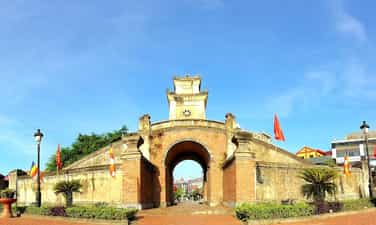
Quang Binh Quan
Quang Binh Quan (newly restored), right in the center of Dong Hai ward between four roads: the west is the road to Duc Ninh, the east is Me Suot road down to Nhat Le river wharf, the north is the road to Hanoi Noi, the south is the road to Hue. Quang Binh Quan also has many names. Some people say it is the entrance to Quang Binh palace, others say Binh Quan Gate. The book Dai Nam Nhat Thong Chi records: ''The mandarin gate is two truong 1 meter long, two truong 5 meters wide; The outer citadel protecting the mandarin gate is 14 meters long, 6 meters high, 3 meters high, built in the year of Minh Menh (1826) with brick and stone...'' Quang Binh Quan under the Nguyen Dynasty, covered with soil in 1631, is an ancient rampart system built to protect the Nguyen citadel. Quang Binh Quan is located in the Luy Thay system, including Luy Truong Duc, Luy Tran Ninh, Luy Nhat Le, Luy Truong Sa, stretching more than 30 km. The Luy Thay system was designed and directly directed by Lord Nguyen's military advisor Dao Duy Tu (1572-1634) and directly directed its construction from 1631-1634, to help Lord Nguyen in Dang Trong fight against attacks by Lord Trinh in Dang Ngoai during the Trinh - Nguyen period was divided. This place has a mountain-like terrain near a very solid ravine, separated from the North, extremely dangerous, like going into Thuc land. During the reign of Lord Nguyen, if people from Southern Bo Chinh or from the North had any business, if they wanted to go to Quang Binh palace, if they went by road, they had to first go to Quang Binh Quan to present their documents and then go back to the north and enter Nam Mon gate to leave. castle. Those traveling by water must stop by the boat at Nhat Le gate, present documents at Thu Ngu mandarin gate, then take the boat to the east gate to enter the citadel. Quang Binh Quan is located guarding the North-South vital road and waterway from Nhat Le seaport. Therefore, more than 7 times Lord Trinh's army crossed the Gianh River to the South and were stopped here. As painful evidence of a time of national conflict, Quang Binh Quan as well as the Luy Thay system have shown the high development of the architectural art of Vietnamese military fortifications. This place is the center of the Luy Thay rampart system, Quang Binh Quan was built according to a unique architectural model, harmoniously combining two elements, both a solid and solid defensive battle rampart, and a a unique architectural work of art. Quang Binh Quan is a reliable address for future architectural and military researchers. In 1825, King Minh Mang restored Quang Binh Quan and raised the watchtower with solid baked bricks. After inauguration, the king classified Quang Binh Quan as one of the special historical and cultural works. of the country, having the image of Quang Binh Quan embossed in Nghi Dinh placed in front of The Mieu Temple in the Forbidden City. Before the August Revolution of 1945, Quang Binh Quan (on Duc Ninh Street) also had a moat outside the citadel, a brick bridge around the moat and at the intersection between Duc Ninh and Cau Rao streets (in the past, during the Nguyen Lord's time, it was the There is also a ghost in a large cemetery. Quang Binh Quan was destroyed by the French army when they withdrew from Dong Hoi in 1954, then rebuilt almost identically. In 1965, the war broke out and was destroyed by American aircraft. Currently, Quang Binh Quan has been restored to its original appearance more than three centuries ago. Quang Binh Quan, an architectural relic with historical and artistic value, is a typical cultural symbol of the land of outstanding people. Source: QUANG BINH GENERAL MUSEUM
Quang Tri
4926 view
Rating : National monument

Cau Nhi communal house
Cau Nhi communal house relic belongs to Cau Nhi village, Hai Tan commune, Hai Lang district (now Hai Phong commune, Hai Lang district), a place associated with famous man Bui Duc Tai. The relic was ranked nationally by the Ministry of Culture and Information on March 13, 2001. Cau Nhi village in Hai Tan commune was formerly called Cau Lam - a village famous for literature. This land has produced many famous figures at one time, among them the famous Bui Duc Tai. Existing documents indicate that the village was founded in the early 15th century. Cau Nhi communal house was originally a large and beautiful communal house famous throughout the region. According to Thi Thien, the first communal house was built in the land that is now also called communal house in the early years of the early Le dynasty (1428 - 1433). During the Tay Son period, the communal house was moved to the beginning of the village, on the edge of the river confluence - at the current location. The Bui family genealogy shows that the communal house was built in 1879 and completed in 1882. This is the first time a large-scale communal house was built. The architecture of the communal house is a large house with 5 rooms and 2 wings. The wooden frame has a sturdy structure, the main columns are made of ironwood, the other columns are made of jackfruit wood. The roof is tiled. Surrounding the communal house is a brick wall covering three sides. In 1950, during the French invasion, the communal house was completely burned down. In 1955, the village organized a fundraising campaign to renovate, but due to lack of material resources, the area of the communal house had to be narrowed and the architectural appearance also changed. These are two horizontal rows of houses in the style of a second letter, made in the style of a 3-compartment, 2-wing house. In front is the front hall, behind is the main hall. During the war against America, Cau Nhi communal house, like many other communal houses in Quang Tri, could not avoid being destroyed by bombs and bullets. Cau Nhi Communal House was restored three times in 1967, 1985 and 1955. In 1991, the screen and front gate were rebuilt. The communal house currently only consists of a 3-room house, small in scale, spread horizontally, facing the O Lau river. The two gables are built with flat walls, the three sides are built with brick walls, the front is installed with a "upper but lower" door system. Structure of several stacks and roof columns. The roof is covered with hooked tiles. Although the dragon motifs on the roof are not monotonous, they are nothing special. The screen and city gate were rebuilt on a very large scale. In the communal house area, there is a notable architectural work, Van Thanh, located in the northwest corner, which villagers built to worship Confucius and those who passed the exam in order to hope that future descendants will follow the saint's lineage. In front of the communal house is a village market that opens every morning. It still exists today but is not very crowded. Behind the village communal house, across the road is Quan Kho pagoda. In the precincts of the pagoda, there was formerly a shrine worshiping Minister of Rites Bui Duc Tai (now only the foundation remains). Inside, the tutelary god and those who contributed to building the communal house are worshiped. The festival is held every year at Cau Nhi village communal house with the Cau An ceremony held on the first days of the year; On ceremonial occasions, villagers often organize village festivals with performances and fun games such as boat racing, fairs, swings, chess games... During its history, Cau Nhi communal house was the place where many events related to Cau Nhi village and Hai Lang land in Quang Tri took place. Under the Mac dynasty (1527 - 1592), the people of Cau Nhi, led by local general Hoang Boi, used the village communal house as a meeting place, practiced martial arts, and stored food. The Hoang Boi uprising left historical marks on the land on the banks of the O Lau River. During the resistance war against the French invasion, Cau Nhi communal house was the headquarters of the Hai Tan Commune Resistance Administrative Committee - where for the first time people on the banks of the O Lau River were able to hold ballots to elect the 1st National Assembly of Vietnam. Democratic Republic as the people's rule. This is also the place to organize meetings, practice self-defense, carry out movements to eliminate hunger, ignorance, golden week... Source: Historical and cultural relics and scenic spots in Quang Tri province
Quang Tri
8060 view
Rating : National monument

Memorial House of General Secretary Le Duan
General Secretary Le Duan's memorial area is located on the banks of Thach Han River, in Hau Kien village, Trieu Thanh commune, Trieu Phong district, Quang Tri province. The memorial relic area of General Secretary Le Duan was recognized as a national relic on October 29, 2010. Le Duan (1907 - 1986) was a son of Bich La Dong village, Trieu Dong commune, Trieu Phong district, Quang Tri province. Born and raised in a land with a rich patriotic tradition, Le Duan soon became enlightened about the revolution. In 1928, he joined the Vietnam Revolutionary Youth Association and became one of the first class members of the Communist Party of Vietnam. A life of vibrant revolutionary activities is closely linked to the history of revolutionary struggle as well as the cause of national liberation and building Socialism of the Party and country. During 26 years, as First Secretary and then General Secretary, no matter what the circumstances, comrade Le Duan always upheld the steadfast spirit of communists, especially those who contributed to it. Your great contribution to the revolutionary cause of national liberation, national reunification, and bringing the whole country forward to build socialism initiated and led by the Communist Party of Vietnam. Le Duan deserves to be an outstanding leader of the nation, a steadfast soldier of the international Communist and workers' movements and an outstanding son of his homeland Quang Tri. "Relics of General Secretary Le Duan's memorial area", is the common name for a complex of relics including: Comrade Le Duan's memorial house - the living place of comrade's family since moving from Bich La Dong to Hau Kien is now a place to worship two of his parents and comrades in his hometown, Hau Kien village; The memorial house is a place to hold ceremonies and visit visitors; The additional gallery is a place to display artifacts and photos related to comrade Le Duan's life and career. The memorial house of late General Secretary Le Duan is located on an area of 2,000 square meters. Formerly the house and garden of Le Hiep's father. The house is made of wood, quite spacious. Through two brutal wars, the house was burned many times, and after liberation, only the floor remained. In 1976, to show respect and gratitude for his great contributions to the Party and State, the Party Committee and people of Trieu Phong district joined hands to help rebuild his family's house on the ground. old. The house is structured in the form of an old bank, consisting of 3 rooms and 2 wings, with a back house (lower house) 4.5m wide, 9m long, thatched roof, bamboo walls, plastered with mud and wood. Inside the house, furniture such as beds, beds, tables, altar cabinets, etc. were restored. At the end of 1977, the thatched roof was damaged and the District People's Committee replaced it with moldy tiles. From 1978 - 1985, it continued to undergo many repairs and renovations, replacing bamboo walls with pressed wood. In 1995, the Quang Tri Provincial Museum restored the house based on the structure of the old house (four or two wings, with a back house) 10m wide, 12m long, each room 2.5m wide, each wing 1m wide. .5m with awning. In 2005, the planning, construction, restoration and embellishment of the memorial site of General Secretary Le Duan was completed, and a number of artifacts and documents previously displayed in the memorial house were transferred to display at the Exhibition House. additional. The memorial house is still used as a place to worship his parents and comrade Le Duan. The memorial relic area of General Secretary Le Duan is a historical relic commemorating typical famous people of Quang Tri province, linking the youth and years of revolutionary activities of the comrade in his hometown with the existence and developing the revolutionary struggle movement of the Party Committee and people of Quang Tri in the two resistance wars against French colonialism and American imperialism. Source: Quang Tri Provincial Museum and Monument Management Center
Quang Tri
8942 view
Rating : National monument

Vinh Moc Tunnels
Vinh Moc Tunnels and Vinh Linh Tunnel Village System are magnificent underground military structures, born during the resistance war against the US to save the country. With the slogan "militarize the entire population, fortification of the entire region" Vinh Linh's army and people have dug trenches, with many functions: headquarters, logistics warehouses, schools, hospitals, living areas. of each family..., arranged throughout the residential areas, along the roads, along the fields, and on the coast, connected by a network of trenches instead of roads on the ground. From the end of 1965 to 1968 (according to incomplete statistics), the entire Vinh Linh district had 114 tunnels with a total length of more than 40km, a trench system of more than 2,000km and hundreds of other tunnels, which became "tunnel village" - appeared for the first time in the history of the Vietnam War, expressing the will to "not move one inch, not leave one inch" to stay and fight to protect the homeland and keep blood vessels open to the front line. Vinh Moc Tunnels and Vinh Linh tunnel village system are distributed throughout 15 communes and towns of Vinh Linh district, Quang Tri province, including: 1. Vinh Moc Tunnel (Vinh Thach). Belongs to Vinh Moc village and Son Ha village, Vinh Thach commune. Includes 13 doors (6 doors open to the hill, 7 doors open to the sea). Along both sides of the tunnel, there are small niches enough for 2 to 4 people. In the basement there is also a hall (capacity of 50 to 60 people), a place for meetings, watching movies, performing arts... and a number of other works such as: bulletin board, maternity home, 3 water wells, toilet, surgery station, infirmary, cooking kitchen (Hoang Cam kitchen). In addition to the underground tunnel and tunnel system, Vinh Moc Tunnels also has above ground works such as trenches, artillery emplacements, breakwaters, exhibition houses... 2. Hien Dung tunnel system (Vinh Hoa). Located in Hien Dung village, Vinh Hoa commune, including 2 tunnels: The tunnel of the People's Armed Police Command in Vinh Linh area is about 1,540m long, including 18 up and down doors and 15 ventilation wells. The People's Armed Police Information Tunnel in Vinh Linh area has 8 up and down doors and 10 ventilation wells. 3. Huong Nam tunnel system, Troong Mon - Cua Hang, Rooc village and Hai Quan tunnels (Vinh Kim). Including Huong Nam Tunnel: belongs to Huong Nam village, Vinh Kim commune. Troong Mon tunnel system: located close to the coast of Vinh Kim commune. Cua Hang Tunnel: The tunnel axis runs East - West, with 2 doors. Rooc village tunnel: belongs to Rooc village Naval Tunnels: These tunnels are located close to each other within a radius of 50m including: Naval Tunnel 1, Naval Tunnel 2, Naval Tunnel 3, Naval Tunnel 4. 4. Mui Si tunnel system, tunnel 61 (Cua Tung town). Including Mui Si Tunnel: located on the coastal road from Cua Tung to Vinh Moc Tunnel, in Thach Ban neighborhood, Cua Tung town. Tunnel 61: located on the road leading to Ben village, An Hoa 2 neighborhood, Cua Tung town. 5. Naval Tunnels (Vinh Nam). Located on a hill in Nam Cuong village, Vinh Nam commune. Vinh Moc Tunnels and the Vinh Linh underground village system are historical evidence of strength, indomitable spirit, the unyielding will to hold on to the land to defend the village, the unique creativity of the people's war, and a shining symbol of revolutionary heroism, greatly contributing to the victory of the resistance war against America to save our nation. With particularly typical values, the historical relics of Vinh Moc Tunnels and Vinh Linh Tunnel Village System (Vinh Linh district, Quang Tri province) have been ranked as special national relics. Source: Department of Cultural Heritage
Quang Tri
10060 view
Rating : Special national monument