Relic point Vietnam
Việt Nam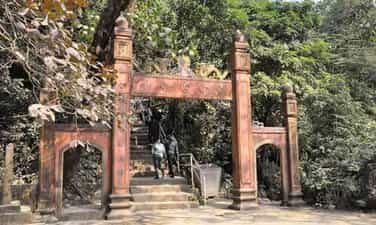
Hang Chua and Hang Pagoda
Hang Chua is also known as: Van Quang Dong, Hang Pagoda is the common name of the temple built in Van Quang cave, in the past the pagoda had the literal name: Thanh Lam Tu. It is called Pagoda Cave because of the 4 caves in this mountain, there are 2 caves with pagodas in them. Chua Hang Mountain is located in the middle of a field in Dong Mai village, Doc mountain and A Dong village, Yen Tri commune, Yen Thuy district, Hoa Binh province. Hang Pagoda - Hang Pagoda is a historical - cultural, architectural, artistic, religious and scenic site. Cave Pagoda 1: built with a rectangular (-) structure, 3m long; width 3.14m; 4.10m high, with main column structure, military column, front and rear table doors and wooden boards surrounding the pagoda. The pagoda was built a long time ago and was renovated during the Nguyen Dynasty. On the top of the pagoda, there is an inscription: "Khai Dinh Nham Tuat year of the royal dynasty" (Khai Dinh year of Nham Tuat 1892). Cave Pagoda 2: with a rectangular (-) shaped architecture, including four rows of 2.81m high columns; The military column is 2.38m high, the pagoda stands in front of the third cave entrance. Cave 2 pagoda also has a completely wooden architecture, including the roof. According to local people, Hang 2 Pagoda was built a long time ago and was restored during the Nguyen Dynasty. Currently, on Thuong Luong pagoda, there is an inscription of the year of restoration: "Twelve years of Dai Nam Bao Dai, ten years of Dinh Suu, ten two moons, twelve days of living, Thuong Luong is auspicious". That means the pagoda was renovated in the 12th year of Bao Dai, the 12th month, the 12th day of the year Dinh Suu (1937). Hang Pagoda was built in the second cave, with a completely wooden architecture. In the pagoda there is a system of Buddha statues carved in the 18th century. This is a unique heritage for Hoa Binh province relics, on the paintings. The pillars are elaborately carved patterns in the artistic style of the Nguyen Dynasty. Pagoda cave: The pagoda has 4 Chinese characters engraved on the cliff: "Lang Tieu Tieu Bich" means: Soaring blue mountain, covered with mist. According to archaeologists, Chua Cave is also the place where archaeological traces of the "Hoa Binh Culture" were discovered. In cave 2 and cave 3, people have found fossil deposits of food of ancient people such as snail shells, seashells, tool fragments... In the Middle Ages, cultural traces were also left here quite boldly: a bronze bell was cast in the 44th year of Canh Hung (1783). The ancients also left here 2 lines of inscriptions, 1 poem, 2 autographs, and a stone stele. These are very rare written texts in cave relics of Hoa Binh province today. Source: Hoa Binh Electronic Newspaper
Phu Tho
6688 view
Rating : National monument
Monument to hero Cu Chinh Lan
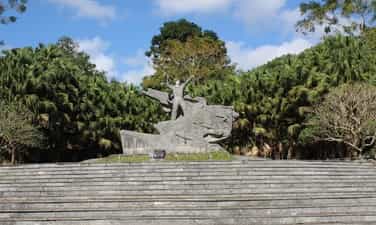
The relic marking Cu Chinh Lan's victory in destroying tanks is currently located on Giang Mo slope next to Road 6A (old) in Giang Mo hamlet, Binh Thanh commune, Cao Phong district, Hoa Binh province. Heroic martyr Cu Chinh Lan (real name Cu Van Mau), was born in 1930 in a poor farmer family in Quynh Doi village, Quynh Luu district, Nghe An province. In 1946, the French army returned to invade our country. Cu Chinh Lan, then only 16 years old, applied to join the National Guard and volunteered to go fight the enemy. In November 1951, the French colonialists expanded their attack into our free zone in Hoa Binh with a plot to reconnect the "East - West corridor" to cut off our communication between Viet Bac and Areas 3 and 4. to regain the initiative on the main battlefield. In Hoa Binh, they carried out a plot to establish an "autonomous Muong Land" to sabotage national unity. On November 24, 1951, the General Military Commission decided to open the Hoa Binh campaign. In the battle on December 13, 1951, when the French army entered the battlefield, the whole unit opened fire fiercely, destroying an enemy company. When preparing to withdraw, enemy tanks came to reinforce and fired fiercely at the team. our formation, blocking the escape route and causing many soldiers casualties. Mr. Cu Chinh Lan quickly jumped on the tank, placed the submachine gun into the gap in the turret and pulled the trigger, but unfortunately the submachine gun choked, the tank was still running and shooting. He shouted to his teammates to gather grenades for him, then continued to jump into the car, pull the lid and throw the grenade into the car. The enemy picked up the grenade and threw it back and drove the tank to change direction. The opportunity to destroy the enemy tank was right before his eyes, Mr. Cu Chinh Lan boldly opened the grenade latch, waited for the smoke to escape for a few seconds before throwing it into the cockpit. The grenade exploded, the enemy soldiers in the car died on top of each other. The tank branded "B2885498 USA", stopped on the spot, the battle ended successfully. The resounding victory at Giang Mo slope with the heroic spirit of Hero Cu Chinh Lan and the soldiers of Battalion 353, The 66th Regiment destroyed the tanks of the French invaders equipped by the US imperialists, starting the movement to defeat the enemy's modern battle tanks with conventional weapons. On December 29, 1951, when participating in a fierce battle on Route 6, Luong Son - Hoa Binh section. Even though he was seriously injured, Cu Chinh Lan still did not leave the battlefield, commanding the squad to continuously break open layers of barbed wire fences into the enemy bunker, clearing the way for his teammates to destroy the enemy. When the enemy's Co To post was completely destroyed by our troops, that was also the time he breathed his last. He died when he was just 21 years old. On May 19, 1952, at the first National Congress of Emulation Soldiers, martyr Cu Chinh Lan was one of the first 7 people nationwide to be posthumously awarded the title of Hero of the People's Armed Forces by the President. people . To remember the victory of Hero Cu Chinh Lan, in 1993, the Ministry of Culture and Information issued a decision to recognize the location marking Cu Chinh Lan's victory in destroying French tanks as a national revolutionary historical relic. . In 1994, construction began on the relic site, erecting the Tank Destroyer Hero Monument. Source: Hoa Binh Electronic Newspaper
Phu Tho
7716 view
Rating : National monument
Monument to Trieu Phuc Lich
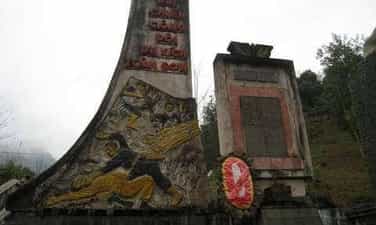
Trieu Phuc Lich monument at Tra slope, Toan Son commune, Da Bac district, Hoa Binh province. The monument was built in 1979, painted by artist Nang Mai. The monument is more than 3 meters high, located on the hillside to the right of the road to Da Bac town, and was recognized by the Ministry of Culture and Sports as a national historical relic in 1996. Perhaps the people of Toan Son commune do not know the captain Trieu Phuc Lich, who was always courageous and cunning in commanding the guerrilla team that fought to block many raids by the French invaders into his homeland. Especially the event of September 10, 1947 will forever be passed down to generations. That was when they received news that the French enemy at Che hamlet post (formerly Tu Ly commune) mobilized a platoon of over 20 legionnaires and soldiers to sweep the area of Toan Son commune. The commune's guerrilla team led by Trieu Phuc Lich, consisting of 30 people, quickly deployed an ambush plan to attack the enemy. The members' rudimentary weapons were crossbows, bows and arrows laced with poison, stone traps, bamboo poles, bamboo poles, rifles, and grenades stolen from the enemy. Near noon, the enemies arrived en masse. Waiting for them to fall into the ambush, Trieu Phuc Lich ordered an attack. The sound of gunshots, the sound of grenades exploding, a series of poisoned arrows flying at the enemy; Stone traps fell from halfway up the mountain onto the enemy's formation, causing them to panic and run away. In this battle, Toan Son commune's guerrilla team destroyed 14 enemies, captured 4 alive and captured 7 guns... History books write: Being attacked unexpectedly, advancing unsuccessfully, retreating was blocked, the enemy tried to flee along the trail through Sau stream to retreat to Tu Ly. Cleverly knowing the enemy's intentions, Trieu Phuc Lich sent guerrillas to pursue with the determination to completely destroy the enemy platoon. The captain himself chased after the enemy commander with his bare hands, then knocked the legionnaire down and quickly stole the submachine gun. Immediately after that, he discovered that the direction of the enemy's retreat was our base area. To ensure the secret of the base area and the safety of the guerrilla team's forces, Trieu Phuc Lich quickly distracted the enemy by running back to the rice fields. The enemy discovered him and immediately chased him and shot him, seriously injuring him. Even so, he still tried his best to pull out a dagger and stab the soldier standing nearby. Crazy about Trieu Phuc Lich's brave actions, the enemy soldiers discharged a magazine of bullets at him, the outstanding son of the Dao people of Toan Son commune heroically sacrificed his life. Trieu Phuc Lich's actions of robbing the enemy's guns with his bare hands, fighting tenaciously, and sacrificing heroically have ignited the patriotism and hatred of the enemy and encouraged the fighting spirit and victory over the French invaders of the Dao people in particular. and People of all ethnic groups in the province in general. Martyr Trieu Phuc Lich was posthumously awarded the first-class Resistance War Medal against the French. On June 11, 1999, Trieu Phuc Lich was posthumously awarded the title of Hero of the People's Armed Forces by the State. To commemorate the great contributions of him and the guerrilla team of Toan Son commune, and at the same time contribute to traditional education for future generations, the Provincial People's Committee directed the construction of the Victory Monument of Toan Son guerrilla team and it was inaugurated. September 2, 1991, on the 46th anniversary of National Day. The memorial was built on the exact spot where hero Trieu Phuc Lich fell in the past. His grave is located at the highest position on the Memorial grounds. Today, on holidays and New Year, officials, party members and people of Toan Son commune respectfully offer incense and flowers to commemorate the outstanding children and have more determination to join forces and unite to build a better homeland. renew. Source: Hoa Binh Electronic Newspaper
Phu Tho
7673 view
Rating : National monument
Historical relic of Hoa Binh Prison
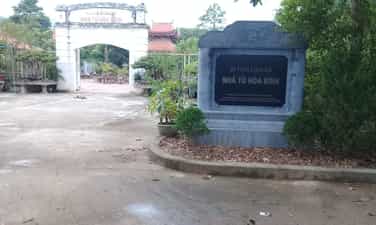
Hoa Binh Prison is located on the True stream, on the left bank of the Da River, in Tan Thinh ward (Hoa Binh city). The prison was built in 1896 to detain common criminals. In 1943, the French colonialists transferred a number of political prisoners from Son La Prison to detention here. Hoa Binh Prison relic has an area of 1,500 square meters, was restored by the province many years ago and was ranked as a national relic in 2000. There are almost no remaining traces of the prison except a round guard tower. made of concrete, built by French soldiers on the Da Giang dike slope that still exists. According to historical records, Hoa Binh prison was originally built on a rectangular area of land, surrounded on the outside by 4 3-meter high walls, with barbed wire on the walls, 4 wall corners were 4 guard towers. In March 1943, the French colonialists transferred a number of political prisoners from Son La prison to Hoa Binh prison to reduce the number, while waiting for favorable conditions to transfer and relocate a number of prisoners. Detained in Con Dao. In the years 1943 and 1945, the activity movement of the Hoa Binh prison cell, led by comrade Le Duc Tho as Secretary, flourished and had a profound influence on the revolutionary movement in Hoa Binh province. In 1943, the prison cell had a plan to recruit new party members. This was the first class of party members the cell developed in Hoa Binh prison. In March 1945, seizing the opportunity of Japan's coup against France, under the direction of the Party Central Committee and the Northern Region Party Committee, the prison cell successfully launched and organized the struggle demanding the release of political prisoners. Within a week, the majority of political prisoners at the prison were released, and were actively helped by cadres and revolutionary masses of Hoa Binh town. Party cell members have returned to contact the Party Central Committee and the Northern Region Party Committee. A number of comrades were added to the province's revolutionary force... In August 1945, joining the offensive spirit of the whole country, the Muong people simultaneously shook off the mud and stood up brightly. The communist soldiers in Hoa Binh prison that day were also important factors contributing to creating momentum for the day the revolution rose. Hoa Binh Prison is evidence of a tool of repression, representing the crimes of the French colonialists, and is the place where revolutionary soldiers were detained and tortured. At the same time, this place has fostered and trained resilient and indomitable communist soldiers, keeping the revolutionary spirit and fighting for the independence and freedom of the nation. Every year, many visiting groups inside and outside the province come to learn about revolutionary traditions at Hoa Binh prison. The rebuilt Hoa Binh Prison relic not only contributes to illuminating history, but also shows the deep gratitude of the Party Committee, army and people of the province to the previous generations of ancestors; contributing to educating revolutionary traditions, helping each person become more deeply aware of the nation's history, thereby appreciating, preserving and promoting the value of the nation's history in the new era. Source: Hoa Binh Electronic Newspaper
Phu Tho
7540 view
Rating : National monument
Thac Bo Temple
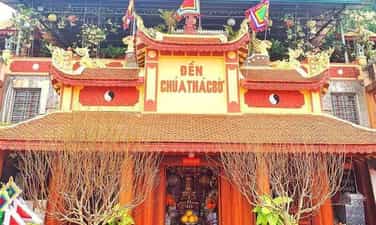
Bo Waterfall is the ancient name of the section of Da River when it flows through Bo market area, Hao Trang commune. Currently, it has been divided into two communes, Thung Nai Hoa Binh of Cao Phong district and Vay Nua commune of Da Bac district. Since ancient times, this has been a rich land where Muong people live. Legend has it that Lady Thac Bo Temple worships two female generals, Mrs. Dinh Thi Van, from the Muong ethnic group and a lady (name unknown) from the Dao ethnic group. During the reign of King Le Loi, the two women were instrumental in helping people and soldiers transport food and boats through Thac Bo to Muong Le (Son La) to quell the rebellion. After their death, the two women often had epiphanies to help people safely cross the famous dangerous and harsh waterfall when the Da River had not yet stopped its flow. The people were grateful so they built a temple to worship the two women to show their respect and hope that they would bless and protect them from danger when passing through the water. Built according to the view of the river, like a mountain with charming scenery, Thac Bo temple relic area is divided into 2 areas, Thac Bo Ba Chua temple on the left bank located on top of Hang Than hill, in Vay Nua commune and Thac Bo temple on the left bank. Bo Waterfall on the right bank is located at the foot of Bo Waterfall, right next to the Da River. After a number of restoration and rebuilding times, the temple still retains its unique and characteristic features. The temple on the left bank has a nail-shaped architectural plan, including a main worship house and a harem house. In front of the temple there are 5 doors covered with fish-scale tile roofs. The main door hangs a grand character written in Chinese characters. On the roof there is an embossed dragon face. The temple on the right bank consists of 3 main worship rooms and a harem, built on 2 floors leaning against the mountain. The first floor is a place to stay for pilgrims, and the second floor is a place to worship gods. In the temple, we not only worship Lady Thac Bo but also worship other deities such as the Great Council, the Five Venerable Men, Princess Son Trang, the Four Palaces of Thanh Co, the Four Palaces of Thanh Cau, the Great King Tran Quoc Tuan, Four Palaces of Chau Ba. The temple festival takes place from the 7th day of the first lunar month, lasting until the end of the third lunar month. Every year, Thac Bo Temple National Historical Site attracts tens of thousands of tourists to sightsee and celebrate. This place is not only a sacred religious address to pray for peace and luck, but is also chosen for a favorable start to the spring travel journey, exploring the impressive natural beauty of Hoa Binh Lake. Source: Vietnam National Tourism Administration
Phu Tho
7012 view
Rating : National monument
Hoa Duong Pagoda
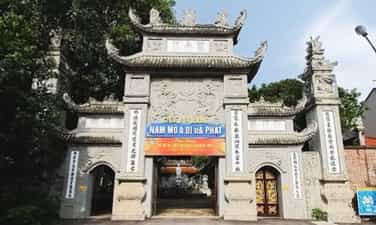
Hoa Duong Pagoda is in Tuan Lo commune, Tuan Lo district, Bach Hac district, Tam Doi district, Son Tay town. Now it is Thuong village, Tuan Chinh commune, Vinh Tuong district. The pagoda was built in the first year of Chinh Hoa (Canh Than 1680), during the reign of King Le Hy Tong Duy Hiep. Hoa Duong Pagoda was built in the Later Le Dynasty, in 1680. What remains today is a relic with quite massive and magnificent architecture, with a "cong" shaped floor plan consisting of 3 main buildings: Front Street (7 compartments). ), the upper palace (4 compartments) and the ancestral house (5 compartments), total area of 262m2 with 2 corridors including 20 compartments with an area of 196m2, in front of the yard is a hundred year old Bodhi tree and tree species: Dai, Ngau, Lan, and Crocodile create a solemn, somber atmosphere at the meditation door. Architecturally: The structure of the rafters is in the style of "stacking beams and gongs", the load-bearing column system is all made of large ironwood, the column circumference is 1.5m and is placed on square stone bases, each 75cm big to Anti-termite and anti-moisture. Regarding fine arts: The outstanding value of Hoa Duong Pagoda is the art of sculpture, expressed in the system of round statues and wooden sculptures (y subjects, shelf paintings, horizontal panels, parallel sentences). These are the basic classes of statues, generally representing the system of statues arranged in a Buddhist temple according to the Mahayana sect in Northern Vietnam, including the following classes: Set of statues of the Three Buddhas, Amitabha Buddha, Three Buddhas, Sakyamuni Buddha, Four Bodhisattvas, Four Heavenly Kings, Statues of Monsignors, Saints, Dharma Protectors and Patriarch Buddha statues. All Buddha statues are made from old, intact jackfruit wood, with elaborate, meticulous techniques, creative and skillful art, demonstrating high artistic aesthetic thinking ability and perfect harmony in perception. the absolute "emptiness" value of Buddha Dharma. The values of truth, goodness, and beauty of Buddhism originate from the simple truths of everyday life through thousands of years of cultivation, fostering, and transmission, and have become a fundamental part of the Vietnamese soul. The soul of the artist when giving life to statues made of wood, stone, or soil becomes shimmering, fanciful but very real for each person when entering the temple to worship Buddha. The wood sculptures include: 8 paintings of y mon (horizontal sea) all of the same size (3.0m long, 0.6m wide) embossed, lacquered and gilded with natural themes: flowers, leaves, clouds, Ancient trees, birds and animals are extremely close, natural and lively, in the middle are carved "great characters" with the meaning of praise and teaching, interwoven between Buddhism and Confucian philosophy. The 8 "Shelf paintings" engraved with verses in Chinese characters with content about natural landscapes and topics related to the propagation of Buddhism, are excellent poems embedded in talented sculptures, on The background of carving techniques, liberal decoration, harmonious layout, and beautiful painting is worthy of being a legacy for future generations to admire and reflect on. 8 sets of horizontal panels, parallel sentences lacquered with gold, precise and neat sentences, profound meaning, comprehensive semantics, sincere heart, true goodness. Along with ancient relics: bronze bells, incense sticks, stone stele, etc. are also ancient written documents on stone that will be preserved forever for future generations, tourists from all over, Buddhist monks and nuns to find opportunities to admire. worshiping in the quiet meditation scene hidden in the countryside. Hoa Duong Pagoda has a history of over 300 years old. The pagoda was ranked as a national historical relic on December 12, 1994. Source: Vinh Phuc electronic communication portal
Phu Tho
11016 view
Rating : National monument
Coi Pagoda
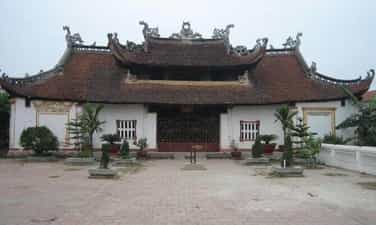
Coi Pagoda, formerly located in Coi village, Hop Thinh commune, Tam Duong district, now belongs to Hoi Hop ward, Vinh Yen city. Coi Pagoda relics are a complete complex of a Buddha hall including: Three gates, pagodas and towers. The three-entrance gate of Coi Pagoda has an architecture of 3 small, compact compartments, with the main load-bearing system being 10 meticulously carved monolithic blue stone columns, 0.25m in diameter, 2.0m high, with 3 rows of column bases, In which, the 2 columns of the middle compartment use ironwood columns extending beyond them to serve as common columns for the 2 roof rafters in a stacked-rail style architecture. Instead of the bottom row of rafters, there is a wooden trap head that comes out to support the roof ship. , the 4 corners of the roof are curved, graceful knife heads hidden in the canopy of green leaves, creating a charming scene. On the two stone pillars in the middle, which are beveled flat on one side, there are inscriptions on each side. Although they have faded over the years, if you look closely, you can still read "Canh Ty, strong spring, auspicious day". According to documents of the Vietnam Fine Arts Museum, the three-entrance gate of Coi Pagoda was built along with Coi Pagoda in the 13th century. The original Coi Pagoda no longer exists, now there are only 12 ancient statues kept at the temple that was rebuilt in the late 20th century, including: 3 Buddha statues, the Amitabha Tam Ton set (Amitabha, Quan). Amitabha Buddha and Mahasthamaprapta Bodhisattva), statues of Venerable Ananda and Shakyamuni Buddha preaching the Dharma, all made of wood, lacquered with gold, round sculpture style of the late 18th century. Tower: A type of Buddhist architecture, one of the characteristics of Buddhism, the tower can be a place to contain relics, paintings, statues or have symbolic meaning, for example: 4 steps up to the tower represent the concept The concept is loving kindness - compassion - joy - renunciation or the 10 levels are statues of the ten realms,... The tower floors represent the means of propagating Buddhism. If it is a tomb tower, the statue represents the grave of a monk or nun, and the 5-petal lotus symbolizes the "Five Buddhas". The Papyrus Tower has 7 floors, 7.70m high, gradually shrinking from the base to the top, each floor shrinks by 20cm on both square sides and height (1 square side of the base is 1.70m long) - the bricks used to build the tower are Bat Trang bricks. , square brick type, 3cm thick, the bricks at the 4 corners of the tower are all beveled up, giving the tower a gentle, elegant curved shape, the adhesive mortar is made from shell lime mixed with molasses - the tower body is plastered. covered with a protective layer of mortar. Legend. Coi Tower was built around the middle of the 18th century, related to the event of the uprising of the Heo District (Nguyen Danh Phuong, 1740 - 1751): In just one night, Nguyen Danh Phuong had his troops finish building the tower and The entire Tien restaurant, in order to gain prestige and win people's hearts against Le Trinh's court, over hundreds of years, an ancient moss color covers the entire tower, further increasing the desire to learn about a new species. Buddhist architecture in Vinh Phuc. Thus, Coi Pagoda was built in the 13th century, and in the 18th century after erecting two towers (now only one remains, due to war destruction) became an architectural whole with artistic value recognized by the Far East. Uncle Co was ranked as a valuable cultural heritage in Vietnam (in 1939). Located in a complex of relics: Dong Dao communal house, Quan Tien, Tien communal house, Ha pagoda, stone bridge... and in the center of Vinh Yen town, Coi tower pagoda will be a destination for sightseeing and research. A large number of tourists from near and far inside and outside the province. Source: Vinh Phuc Tourism Information and Promotion Center
Phu Tho
7534 view
Rating : Provincial level relics
Huong Canh communal house
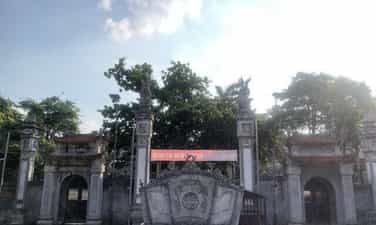
Huong Canh was originally the name of a commune of An Lang district, Son Tay town in the Later Le dynasty, then was taken as the general name of the Nguyen dynasty and the name of today's town - Huong Canh town (in Binh Xuyen district, Vinh Phuc province). According to folklore, Huong Canh is also called Tam Canh because this is the common name of three Canh villages including: Huong Canh, Ngoc Canh, Tien Canh. The place name Huong Canh also has the ancient name Ke Canh. This name comes from the local rice variety, which has two pointed rays on both sides of the grain. People call those two sharp rays WINGS and the grain of rice is called WINGS, taking the word WING as the name of the village. Initially, there was only one Huong Canh village here. Gradually, the population grew and the village was separated and named Ngoc Canh - a place with Gie Canh rice, rice grains as beautiful as pearls. Finally, when both villages Huong Canh (fragrant Canh rice) and Ngoc Canh (beautiful Canh rice) were densely populated, they expanded to the West and Northwest with another village and took the name Tien Canh, meaning "rice". Early wings”. Three communal houses in the three villages of Huong Canh, Ngoc Canh and Tien Canh are all ranked as national historical and cultural relics and are currently in the process of preparing documents to request special national ranking. The communal houses are located 50m to 100m apart, forming a monumental relic complex, adjacent to National Highway 2A, convenient for sightseeing, tourism and pilgrimage. Regarding the gods worshiped, according to local people's legend, after defeating the invading Southern Han army, Ngo Quyen became king and established the capital in Co Loa (now in Hanoi). The country was independent and at peace, but Ngo Quyen still did not forget to be vigilant and train soldiers and horses to prevent enemies. At that time, hunting was also a form of exercise, so once Ngo Quyen sent his two children, Ngo Xuong Ngap and Ngo Xuong Van, along with his close general Do Canh Thac, to bring troops to conduct an exercise in the form of hunting. They marched through Huong Canh, camped at a mound in the middle of the field, the people called Go Ngu. To record the sacred mark and pay tribute to the heroes of the Ngo Dynasty, the people of Huong Canh built a temple in Go Ngu to worship them, according to the concept of "life is a general, death is a god" (living is a good general - death is sacred). During the Later Le Dynasty, the people of the three villages of Huong Canh, Ngoc Canh and Tien Canh built a communal house in each village, took the sacred names to worship at the communal house and held festivals and offerings every year like today. 1. Huong Canh Communal House Formed the earliest, Huong Canh village built its communal house before the other two villages. Although not larger than Ngoc Canh communal house and Tien Canh communal house, Huong Canh communal house is crafted and shows more decoration and carving. The communal house is located in the south of Huong Canh town, the facade faces southwest, overlooking Diem Lang lake, the river arena and Cau Treo river. Through time and the ups and downs of history, for nearly 300 years Huong Canh communal house still stands there as if challenging the sun and rain, fighting with nature with its massive, graceful roof. The communal house's roof is covered with funny-nosed tiles, arranged in an orderly manner in the style of dragon-scale screws, very tight and beautifully flat. The roof of the communal house is built straight and the tips of the blades are curved. The entire roof of the communal house looks like a giant kite moving, about to fly into the air. 2. Ngoc Canh Communal House was built in the Later Le Dynasty and restored in the early Nguyen Dynasty. On the first sentence in Ngoc Canh communal house, there are two embossed words: "Twenty years in Gia Long, ten years in Quy Dau, ten moons, twenty-six days in old Thuong Luong, restoring earth and wood Giap Tuat years, five moons , the fifteenth day is completed, peace and prosperity are great." (Meaning: The 12th year of Gia Long is the year of the Rooster, on October 26, erect the roof tree as before. Repair the wood and door in the year of Giap Tuat. Complete on May 15, hoping for good harmony). According to the solar calendar, Quy Dau is in 1813 and Giap Tuat is in 1814, the restoration lasted 7 months. The second first sentence engraved is: "The year of Minh Menh, the year of Canh Thin, six moons, ten days, starting the golden cycle jewelry, ten months, ten days, completed great auspicious and prosperous" (Meaning: The first year of Minh Menh was the year of Canh Thin, construction started on June 11, painted golden, and completed on October 10, wishing good luck and prosperity. According to the solar calendar, Canh Thin is the year 1820, the first year of Minh Menh. The decoration lasted 4 months. 3. Tien Canh communal house was built last, but Tien Canh communal house is larger in scale than Ngoc Canh and Huong Canh communal houses. Regarding the construction date, when Thuong Luong's back house was dismantled for restoration, the engravings were still clearly clear: "Canh Hung thirty-seven years, five years Binh Than, twelve moons, twenty-two days, zodiac time, Receiving a high salary, great benefits and prosperity" (Meaning: Canh Hung year 37, year Binh Than, December, day 22, zodiac hour, building a roof tree is very auspicious, brings much prosperity). According to the solar calendar, the year Binh Than is 1776. So the communal house's back house was built 300 years ago (2022). The old first sentence of the great bow is engraved "Year of the Goat, ten months of At Hoi, twenty days of Dinh Mui, At Ty of the year, the great worship of Thu Thuong Luong" (Meaning: Year of the Goat, October of At Hoi, day 20 Dinh Mui, 10 a.m. At Ty, build a tree on the roof of the house to worship). Thus, the Tien Canh communal house was built in the 8th Canh Thinh era, Tay Son Nguyen Quang Toan dynasty - 1799, 223 years ago (2022), 23 years after the post house. These are three typical ancient communal houses of Northern communal house architectural art, built around the late 17th and early 18th centuries. The architectural and artistic relic of Huong Canh communal house cluster was recognized as a special national monument on December 29, 2022 by the Prime Minister. Source: Compiled by Vinh Phuc Newspaper
Phu Tho
9178 view
Rating : Special national monument

Bao An Pagoda
Bao An Pagoda, the full name in ancient documents is Bao An Thien Tu or Tu Gia Bao An, the popular name is Cam Pagoda, formerly belonging to Thap Mieu commune, Bach Tru canton, Yen Lang district, Phuc Yen province, Now belongs to Trung Nhi ward, Phuc Yen city, Vinh Phuc province. The pagoda was built in the 12th century during the reign of King Ly Cao Tong (1176-1210). This is one of the few pagodas dating back to the Ly Dynasty until today. The pagoda is built on a high hill, with luxuriant trees, windy on all four sides, beautiful scenery, quiet, full of solitude, a place of meditation. In the past, this area was called Tieu Dao Mountain, and is commonly called Cam Forest, perhaps that's why the pagoda is famous as Cam Pagoda. According to inscriptions and genealogies, the pagoda has existed for a long time. In the 12th century, the crown prince, son of King Ly Cao Tong, donated more than a hundred acres of fields, two thousand francs of money to repair the pagoda, and 700 francs of merit for a banquet. worship easily. Assign martial general Nguyen to directly direct and mobilize donations to repair the pagoda. As a result, the pagoda was restored with "seven newly built closely spaced rooms, columns painted with bright flowers, bright jade colors, a high and precious palace, bright sunlight and moonlight, a splendid Buddha statue, and a poised lotus throne." , the big bell towers over the phoenix, the noble king holds the dragon, the splendor and majesty are clear...". The military general of the Nguyen family also had the merit of a thousand francs to buy more than a hundred acres of fields to donate to the pagoda for farming. In the 14th century under the reign of King Tran Anh Tong, Bao An Pagoda was given a lot of money to repair and embellish by Princess Hung Nuong. To remember his merits, like many other pagodas in the area, people built a shrine to Princess Hung Nuong in the pagoda. Having gone through the ups and downs of thousands of years of history, Bao An Pagoda is still at the old campus but has had many changes. Ancient architectural buildings such as the front hall, incense burner, upper palace, ancestral house, Hung Nuong princess shrine and mother shrine were demolished due to deterioration. Currently, the pagoda has been renovated and rebuilt on a large scale, with reinforced concrete architecture and tiled roof. The pagoda also preserves valuable relics and antiques such as: Dharma statues, altars, bronze bells, and stone stele. Among them, the most typical is the stone stele "Bao An Zen Tu Bi Bi Ky" (inscription of Bao An Pagoda's stele). Up to now, according to review, survey and statistical data, this is the only Ly Dynasty stele remaining in the province. The stele was engraved in December of the year Tri Binh Long Ung (1209) and re-engraved later, probably at the end of the 18th century, placed at Bao An pagoda. The stele was mentioned and published by many researchers in Ly Tran Poetry (Social Sciences Publishing House, H.1977) and Ly Dynasty Epitaph (VNU Publishing House, H.2010). This is the oldest stele in Vinh Phuc and one of the 18 Ly Dynasty stelae remaining in our country today. The stele is 1.4m high, 0.85m wide, 0.14m thick, placed on the back of a smooth-shelled stone turtle, its head protruding, its four-clawed feet spread out in all four directions. The stele is engraved on both sides with 50 lines including 1498 Chinese - Nom characters, sharp handwriting in the style of Ly Dynasty script, very beautiful. The content of the memoir was composed by Wei Tu Hien in a parallel, parallel, and concise writing style. At the end of the memoir is an essay written in the style of Buddhist verse. The content of the stele describes the splendid and splendid scene of Bao An Pagoda in the 12th century, recording the merits of repairing the pagoda of Prince Sam, son of King Ly Cao Tong, military generals of the Nguyen family, along with Buddhists and people there. This. According to Nguyen Huu Mui (Research on Vinh Phuc Inscriptions, 2013), although the epitaph is still full of exaggeration, the image of a Ly Dynasty pagoda is clearly shown: the pagoda was restored by just one person. , the scale of the pagoda is large, inside the pagoda there are Buddha statues and lotus flowers, outside the pagoda there are bells and openings; The pagoda owns a lot of land and has a Thich Giao Zen Association (a type of Buddhist association, offering temple protection) to manage the meditation area. Based on this stele, it can be seen that the construction and restoration of pagodas took place on Vinh Phuc land since the Ly dynasty. The construction and restoration of pagodas was encouraged, not prohibited, by the royal court and assigned to the mandarins and aristocracy to preside and organize. The construction and restoration of pagodas is also considered an important event in the spiritual life of the people, attracting the whole region and even the whole country to join in the merit. This proves that during the peak development of Buddhism during the Ly Dynasty, Vinh Phuc area was also a popular center of this religion. The special thing is that among the nearly 1,500 words on the stele, there are mixed Nom words, these Nom words are used to write people's names and land names. It is said that this is one of the oldest evidences of Nom script found in Vietnam. Before this stele, traces of a few Nom characters were only found in two places: on the bell of Van Ban pagoda, Hai Phong (year 1076), and in an inscription at the pagoda of Huong Non commune, Tam Nong district, Phu Tho province. (year 1173). Bao An Pagoda was ranked as a provincial historical-cultural relic in 1995. In the period 2021 - 2025, Vinh Phuc province plans to build a scientific dossier to request recognition of the National Treasure for the pagoda steles. Bao An and upgrading the national monument ranking for Bao An Pagoda relics, these are activities to further strengthen the management, conservation and promotion of heritage values. Source: Bao An Pagoda Vinh Phuc
Phu Tho
11903 view
Rating : Provincial level relics
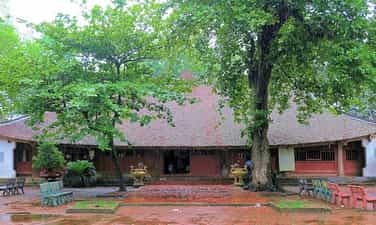
Dinh Tho Tang
Tho Tang communal house is located in Tho Tang town, Vinh Tuong district, Vinh Phuc province. The communal house was built in the 17th century, and over time, it still retains its architectural style of the Later Le period relatively intact. The communal house worships the famous general Lan Ho, who was credited with fighting the Mongol invaders in the 13th century. Legend has it that, according to King Tran's orders, Lan Ho led his army to the Gia Ninh region (now in Phu Tho province) to set up a defense line, arrange troops for battle, command soldiers to fight heroically, destroy many enemy forces, and protect the enemy. Protecting the capital Thang Long. Currently, along a strip from Duc My - Son Vi (Phu Tho) to Vinh Tuong - Yen Lac (Vinh Phuc), there is a system of relics worshiping Lan Ho. In Tho Tang commune, there is Truc Temple, Tho Tang communal house, Phuong Vien communal house, in which Tho Tang communal house is the center for organizing festivals with performances and rituals commemorating the talented general Lan Ho and the resistance war against the enemy. Foreign invaders protected our country during the Tran Dynasty. Tho Tang Communal House was built on a massive scale, consisting of two architectural buildings arranged in the shape of a "nail". The main pavilion has 5 rooms, 2 chairs, 6 rows of legs, and the harem has 2 rooms. The whole temple has 60 columns, made of high quality wood. The main column has a diameter of 0.80m, the child column has a diameter of 0.61m. The communal house's foundation is 25.80m long, 14.20m wide, surrounded by green stones. Four-pillar architectural structure, piled with gong-shaped beams, reinforced and durable. Tho Tang communal house still has 21 extremely delicate wood carvings, shown on the architectural components: body, trap, trunk, with rich content, overview of the cycle: labor - business. - enjoyment of agricultural residents, of our people during the reign of Le Trung Hung. The carvings here are arranged in order according to that cycle. Entering the communal house door, you will immediately see the first carving of "field festival" (farming ceremony) followed by paintings of "shooting wild animals" to protect crops and villages. Entertainment scenes include: "soccer", "playing chess", "drinking", "dancers". Family life scenes include: "boy and girl in love", "happy family". Criticizing bad habits including: "jealousy", "lazy husband and wife". Worship decorations include paintings: "nine dragons painting pearls", "eight immortals crossing the sea" and many other dragon and phoenix images. According to historians, Tho Tang is the only place in our country that worships the three words "Hoa Vi Quy". These three letters are still quite intact today. The letters are painted in gilded vermilion on a dark brown wooden background. On both sides of the diaphragm are two small lines of text recording the time of engraving. Because of such sacredness, since it was built until now, Tho Tang communal house has never been harmed by bad people. After 400 years, experiencing all the ups and downs, the communal house remains intact from the iron pillars to the mussel-scale tiles. Tho Tang communal house was ranked as a national monument in 1964. Tho Tang Communal House is one of the communal houses that reached the pinnacle of ancient folk wood carving art in the Later Le Dynasty, and is the earliest nationally ranked relic in Vinh Phuc. In recent decades, it has always attracted attention. research by the scientific community, concern for protection and restoration by the State at all levels, authorities and local people. Source: Vinh Phuc communication portal
Phu Tho
5855 view
Rating : Special national monument