Relic point Vietnam
Việt Nam
Bac Cung Temple
Bac Cung Temple (literally known as Thinh Temple) in Tam Hong commune, Yen Lac district is one of four large temples around the Ba Vi mountain region and the Red River Delta worshiping Saint Tan Vien. The temples: Tay Cung, Nam Cung, and Dong Cung are on the other side of the Red River in Son Tay territory. These are four temples that were built and preserved relatively carefully by the people. The temple is located in the middle of fertile fields on a 10,000 square meter plot of land next to winding canals, surrounded by rich and densely populated villages. On both sides, the left desert and the right desert stand majestically and silently, covering a large brick yard, looking up to a unique architectural work. Thinh Temple was built 20 centuries ago on the foundation of a small temple worshiping Saint Tan, where he had previously let his troops stay during a mission to help people clear land and manage water. The divine genealogy passes down that: Saint Tan (still called Son Tinh), whose name is Nguyen Tuan, was born on January 15, Dinh Hoi year in Lang Xuong cave, Trung Nghia commune, Thanh Thuy district, Phu Tho province. He lost his father at a young age and lived with his mother and two cousins, Nhuy Hien and Nguyen Sung. Every day, the three brothers crossed the Da River and went to the Ba Vi mountains to clear fields and farm, looking for a living. Here, Nguyen Tuan met Princess Thuong Ngan, was adopted by her, and gave her a walking stick and many magic spells to save humanity. After defeating Thuy Tinh and marrying Princess Ngoc Hoa, he refused the throne that King Hung wanted to give him, and with his two younger siblings traveled everywhere, helping people clear land and water, and was respected by people everywhere. When passing through the Tam Hong area, he let the troops rest and taught the people to grow rice and fish... After he left, the villagers came to the place where the Holy One rested and saw that there were still some packets of hearing left there, so after This temple is called Thinh temple. There is also a story that: when letting the army stay here, Saint Tan taught the people to butcher Thinh, so the people called the temple that name. From a small temple, during the reign of King Ly Than Tong (1072-1128), the temple was rebuilt into a large temple. This is where the king came to pray for longevity. During the reign of King Minh Mang (1820-1840), the temple was repaired many times. During the reign of King Thanh Thai, the Tri of Yen Lac district appointed monk Thanh At to restore the temple. The project lasted until the 6th reign of Khai Dinh (1900-1921). Through many ups and downs, the temple continues to be preserved and preserved by local people. On January 21, 1992, the temple was recognized by the Ministry of Culture and Information as a cultural and historical relic. Every year, the Thinh Temple festival is held from the 6th of the first lunar month to the 20th of the first lunar month. The festival includes sacrifices, palanquin processions from villages inside and outside the commune and many folk games will be held. Source: Vinh Phuc province electronic information portal
Phu Tho
12396 view
Rating : National monument

Ha Tien Pagoda
Ha Tien Pagoda is located on Ha hill - in Gia Vien village, Dinh Trung commune, Vinh Yen city, Vinh Phuc province. In the past, Dinh Trung commune belonged to Tam Duong district - During the Hung Vuong period, it belonged to Phong Chau, during the Tran dynasty, it belonged to Tam Bai route, during the Nguyen belongs to Vinh Tuong district, Son Tay province; In 1899, Vinh Yen province was established - now Gia Vien village, Dinh Trung commune, Vinh Yen city - Vinh Phuc province. Ha Tien Pagoda was built in the year of Quy Mui (1703), the 24th year of Chinh Hoa, during the reign of King Le Hy Tong Duy Hiep. From ancient times until now, tourists and Buddhists from near and far, when coming to Ha Tien Pagoda, not only burn incense and pray to Buddha but also sincerely worship before the Holy Mother to pray for peace in the country and people and a peaceful life. According to ancient books, the pagoda is located in the "mountain and water" position, on both sides there are large mounds of earth shaped like dragons and white tigers. When the country was invaded by foreign invaders, Mrs. Lang Thi Tieu, on her way to join forces with King Hung Vuong 7, saw a strange situation, so she stopped to recruit soldiers. Later, she was honored as National Mother Tay Thien. To commemorate her, people set up an altar tablet at the pagoda, called the Holy Great King. Ha Tien Pagoda is a place to worship the Three Jewels and also worship the National Mother. Ha Tien Pagoda also has another name: "Rain Praying Pagoda". In the past, the area often suffered from drought. People who rely on agriculture fall into hunger. The abbot of the pagoda at that time, Tinh Huan, built an altar to pray for rain. Furthermore, the monk vowed to self-immolate to pray for rain for the people on the 30th day of the 5th lunar month. After making a vow before the three jewels and heaven and earth, he sat in the lotus position and then immolated himself to worship the gods and pray for the people. On June 1, after a day of self-immolation, it rained heavily and lasted for 3 consecutive days. And since then, every year on the anniversary of the founder's death, it often rains. Deeply remembering the gratitude of the true monk, the people built a three-story stupa to store his ashes. Currently in the pagoda's tomb garden there are 8 towers. Most of the stupas are still intact with 3 main floors. The towers are about 3m high, have 4 sides, built of red bricks bonded with materials from tree resin combined with clay. Although all eight towers keep the treasured bodies of monks, Tinh Huan's tower is more special because it is covered by a birth tree. The perennial tree is still green and has many roots, covering nearly all three sides of the stupa. In the pagoda there is also an ancient well (Jade well) with cool water. In the past, during the drought season, all the other wells dried up, but the old well still had water, so people in the village had to go to the old well to draw water. The well of Ha Tien Pagoda is "clear and blue, with magical water veins", so the ancients still compared it: "No matter who is as ugly as a ghost/ Drinking the water of Ha Pagoda is as beautiful as a fairy". Every year, on major holidays, visitors from all over come to the temple to worship Buddha and ask for water from Ngoc well, bring it back to burn incense and drink gradually, especially in the early days of spring. People believe that having ancient well water to use during Tet will bring good luck. With the historical and cultural values outlined above, Ha Tien Pagoda was decided by the People's Committee of Vinh Phu province (now Vinh Phuc) to rank it as a provincial-level Historical and Cultural relic in 1995. Source: Vinh Yen City electronic information portal, Vinh Phuc province
Phu Tho
6184 view
Rating : Provincial level relics

Tran Nguyen Han Temple
Tran Nguyen Han Temple, also known as Ta Tuong Temple or Thuong Temple, is an artistic architectural work built in the Later Le Dynasty over 200 years ago. This relic is associated with the life and career of national hero Tran Nguyen Han. He was originally from the royal family of the Tran Dynasty and was a talented and virtuous general who made great contributions to helping Le Loi defeat the Ming invaders and win the Lam Son uprising. The temple is in Da Cai village, Son Dong commune, Lap Thach district. The temple worships General Tran Nguyen Han, who supported Le Loi in defeating the Ming invaders to liberate the country in the 15th century. The temple was built on a flat, wide and high ground, and is said to be the place where Tran Nguyen Han's old palace was located. The temple is structured in the style of the letter "Dinh", surrounded by walls forming a square "dien" campus. The construction works consist of 3 parts: Temple gate, pre-sacrificial house, and harem. Since its construction, the temple has been repaired and built many times, mainly during the Nguyen Dynasty. Architectural art in the style of the Nguyen Dynasty: Smooth, chiseled, simple decoration. Related to the relic, legend has it that there are two ancient objects: the Sword and the sword sharpening stone. The story goes that: During the period when the Ming invaders dominated our country, Tran Nguyen Han had just entered his youth. Because his parents went to reclaim land and set up camp at the top of Son Dong farm, Tran Nguyen Han still plowed and hoeed every day. While plowing in the Go Rach fields, Tran Nguyen Han plowed an iron bar as long as a sword. At night, he sharpened his sword on a large stone on the bank of Son pond, so that stone was called the sword sharpening stone. The stone had a dent that looked like a slash mark. Legend has it that it was the test cut of Tran's sword. Nguyen Han. The sword was carried by Tran Nguyen Han. By chance, Tran Nguyen Han was given a wooden stick shaped like a sword hilt from the riverbed by a raft owner at the mouth of the Phu Hau River. When the blade was inserted, it fit perfectly. That's the effect. That legendary sword was associated with the glorious victories of the first national founder of the Le Dynasty. Legend has it that Ton That Thuyet later borrowed that sword and took it to Can Vuong to fight against the French. As for the stone slab, after a long time being filled with silt from the Lo River, on January 12, 1998, people of Da Cai village found it at a depth of 2m leaning towards the lotus pond, about 2.49m long, about 1 meter wide. .6m, about 0.4m thick and weighs about 2 tons. This fairy stone was salvaged by the government and people of Son Dong commune and placed in the grounds of the Ta Tuong Quoc temple so that everyone can admire the remaining traces of the old hero. In 1984, the Ministry of Culture ranked the historical relic temple of Left General Tran Nguyen Han as a National Monument. Every year, on the anniversaries of his birth and death, especially at the beginning of Spring, people in the region and all over the country often come here to offer incense to commemorate the contributions of the National Hero. Source: Vinh Phuc Electronic Newspaper
Phu Tho
11357 view
Rating : National monument

Tay Thien scenic spot
Tay Thien - Tam Dao historical and scenic spot (Tay Thien Scenic Area) belongs to Dai Dinh commune, Tam Dao district, Vinh Phuc province. Tay Thien is located in the valley of the Tam Dao mountain system, with an altitude of 54m to 1,100m above sea level, a distribution range of about 11km2 with beautiful and majestic landscape. Tam Dao refers to 3 consecutive mountains (in a mountain range) that suddenly emerge, floating in the clouds, like 3 islands in a sea of clouds, according to ancient geology, Phu Nghi is 1,250m high; Thien Thi (Kim Thien) is 1,585m high; Thach Ban is 1,585m high. Tay Thien relics and scenic area is located on the slopes of Thach Ban mountain in Tam Dao range with a length of 11km and a width of 1km. It is a complex of historical - cultural relics and scenic spots, including a system of communal houses and pagodas with cultural and archaeological value such as Thuong temple, Thhong temple, Mau temple, Cau temple, Co temple... This place has a large concentration of old traces as well as cultural works and localities. only valuable for archaeological research hidden under old forests along Tay Thien stream... Thhong Temple: is the starting architecture for the entire Tay Thien relic system. The temple is located at the foot of the mountain, on a high and wide platform, built in a traditional style. The stone pedestal system runs along the front, with three ways up, separated by four large dragons. Next is the four-pillar ritual gate, newly rebuilt in the traditional style, with stone materials. Behind the ritual gate is the temple yard, very large and paved with stone. The main temple has a Dinh-shaped floor plan, including a front porch, with three compartments, two large wings, and the "malle", where the altar of the Holy Mother is located, has three vertical compartments. Cau temple - Co temple: pass Thhong temple on a bumpy stone road along the stream bank for more than 1km to Cau temple. There used to be a small temple there, but now it has been replaced by a seemingly simple house as a place of worship. In the center of the main hall, there are statues of three forest boys placed in the shrine. Cau Temple originated from Truong Sinh stream, which is said to be the place where "Cau" stayed to recruit and raise troops to follow the National Mother. The temple was renovated in 1993. Co Temple, about 2km from Cau Temple, near Silver waterfall, next to Giai Oan stream (upper part of Truong Sinh stream), so that sentient beings can shake off the dust of the world and gently move on to the holy land. Co Temple also has a long history and is currently worshiping Co Be, who is said to be a child of Heaven who together with the National Mother helped the people and the country. The scenery here is elegant, spacious and peaceful with rich vegetation and a fresh, cool climate all year round. Giai Oan stream and the ancient well near the foot of the temple add solitude and tranquility to the space here. If anyone takes water from there and offers it with offerings and then drinks, they will feel strangely relaxed, peaceful and calm. Thuong Temple area: Currently, this is a common spiritual area of both folk beliefs and religions, the center of which is the shrine of the National Mother Tay Thien. Thuong Temple: The alternating levels of the mountain circuit here have created the foundation of different shrines, in which, Thuong Temple is located in the center, with its back leaning against Thach Ban mountain, on both sides are two mountain arms running down, The front is spacious. Here, clouds play with the mountains, trees are lush, birds gather, streams ring happily, creating one of the Holy Lands of the Tam Dao mountain range. Thuong Temple faces West - South; The ritual gate is structured in a four-pillar style, with a wall connecting the large pillar and the side pillar, leaving only one door in the middle for pilgrims to enter and exit. On these walls are covered dragon fruit (green dragon), white tiger (white tiger) and plants symbolizing the four seasons. The stone-paved courtyard in the middle has a spiritual path, carved with three large letters Phuc, Loc, and Tho (connected vertically) leading to the steps leading up to the temple. This architecture has a Dinh-style base, three compartments, and two large wings. Looking at the front, the architecture is quite balanced with two "matching" floors and eight graceful curved roof corners. In the middle "match pile" hangs a large horizontal painting, titled "Temple of the National Mother Tay Thien" in the national language. On the main hall, there is only a statue of her sitting on the central pedestal, with a majestic and luxurious appearance, her legs hanging straight, her hands resting on the pillow, her right hand holding a folding fan. In addition, in this area there are also newly built works such as: Son Than Temple, Co Chin Temple, Dia Mau Temple, Tam Toa Thanh Mau Temple, Ta/Huu Vu. Tam Dao mountain god temple: Legend has it that the god had a blessing for the island bridge during the reign of Tran Nhan Tong (1279 - 1293), so he was awarded the title "Thanh Son Dai Vuong" by the king. During the early Le Dynasty, the reign of King Nhan Tong, the 8th Thai Hoa year (1450), the king sent his minister Le Khac Phuc to sacrifice, he left behind a ma chew stele (carved into the cliff) recording this event. (about 700m from the temple along the path). Stone stele: a valuable historical relic, is a stele written by ghosts in the area that locals call Stone Stele. This stele was previously known to many people but no one had published it because of the difficulties in traveling and coming into contact with the artifacts. Through actual survey, it is an epitaph carved directly into the middle of an ivory stone slab, about 5m long, about 3m high. The entire stone slab lies sideways on the bank of the stream, creating an arch shape, like a frog's jaw, preventing the letters of the stele engraved in the middle of the frog from being eroded by rain and sun. The stone stele has a total of 121 Chinese characters, inscribed in vertical rows, distributed on 11 lines, large lines have 16 characters, small lines have 3 characters. The text used is in the style of a book, with the characteristics of deeply engraved, easy-to-read letters. Only the three words Prajnaparamita (Prajna Stream) placed at the end of the stele are engraved large. With the above typical value, the historical relic and scenic spot Tay Thien - Tam Dao (Tam Dao district, Vinh Phuc province) was ranked by the Prime Minister as a special national monument on December 23, 2019. 2015. Source: Department of Cultural Heritage
Phu Tho
6151 view
Rating : Special national monument
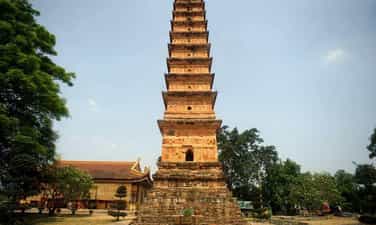
Binh Son Tower
Binh Son Tower (Then Tower, Then Pagoda Tower, Vinh Khanh Pagoda Tower) is located in Tam Son town, Song Lo district, Vinh Phuc province; is a Buddhist architecture bearing the mark of a rather long period (approximately from the 14th to 16th centuries). Binh Son Tower - Vinh Khanh Pagoda is located on a high and spacious mound, the area of the protected area is 17,200m2, including: Binh Son Tower, old Tam Bao building, new Tam Bao, ink well, house Guesthouse, lotus pond, gate, auxiliary works. 1. Binh Son Tower The tower is currently 16.5 meters high, (only 11 floors and 1 pedestal remain because the top of the tower was broken), and is constructed with a square plan that gradually gets smaller towards the top, with the side of the bottom floor being 4. 45 meters, the side of the 11th floor is 1.55 meters. The entire tower is built of unglazed fired bricks. From the base of the tower to the end of the 2nd floor, it is less than 6 meters high with the most complete pattern. On these two floors, there are carefully decorated motifs with rows of chrysanthemums, lotus petals, leaves, smooth-faced flowers, embossed dragons, and the "whispering lion" motif... From the third floor up, the decoration is still the same. However, the higher you go, the narrower the width of the tower's face is, and the decorations also gradually decrease. 2. The old Tam Bao Palace: was majorly restored in 1976, in the shape of the letter Dinh, with an area of 131.5 m2, including 5 rooms for the front hall and 3 rooms for the harem. In particular, the building has 2 bronze pillars in front, stretching out 6m, forming like the arms of a throne. The system of worship statues here is mainly made of painted soil, dating from the late 19th and early 20th centuries, with a few statues dating to the 20th century. 3. New Three Jewels: built in 2012, on the foundation of the old Three Jewels house, the architectural form is Zen monastery style. 4. Ink Well: Legend has it that this location was once the base of an ancient blue tower. When this ancient tower disappeared, it left behind a deep round well-shaped hole. 5. Guest house: newly built in 2012, area 283.5m2 with square floor plan, curved roof architecture, consistent with traditional ancient architecture. 6. Lotus pond: located in the garden in front of Binh Son tower, currently growing lotus 7. Gate to the relic site: consists of 4 brick pillars, attached with 2 iron gates in the middle, two side paths are temporarily fenced with trees and bamboo as protection gates. 8. Some decorations of Binh Son Tower Lion whinnying: One of the projects that has puzzled researchers is the "lion whinnying", because it is very different from the "jewel-catching crocodiles" wearing lotus crowns on Buddhist pedestals during the Ly Dynasty. Dragon: has horns, curls in a "nest", head turns to the center of the circle, body does not curl but forms a sinusoidal shape, so does not "tie the bag", legs kick out, or cross over the body to kick out, The spine has a "saw-tooth" shape, one front leg is raised to grasp the "hair"... Some of the details just mentioned are reminiscent of the dragons of the late Tran, but other details do not allow the dragon to be attributed to the Binh Tower. Paint in a certain pattern at all. What's more important is that Binh Son dragons often put their front legs up to grab their hair, in a funny, very mischievous pose, thus quite "folk": in this case, it has taken on the style of the dragon motif. stroking the beard in the post-Le period. The card: is a relatively popular type, with motifs that contain many meanings. Binh Son's "leaves" belong to many styles, but all styles are simple and not as elaborate as the "leaves" of the Ly Dynasty. String chrysanthemum: has been around since the Ly Dynasty in the form of a round frame, the inside of the frame neatly accommodates other decorative projects. The Tran Dynasty inherited that circular layout. Three-pronged (mountain) fighting: an interesting point is that this fighting has appeared since the Ly dynasty (Thap Chuong Son, Nam Dinh) and was even more popular under the Mac dynasty (Ty Dang Communal House, Ba Vi, Hanoi). ). Binh Son Tower has many unique features in terms of architecture, art, and construction techniques. Binh Son Tower not only has artistic architectural value, but also has high aesthetic value, called "The pearl of the national treasure", on the bricks there are many types of decorative patterns, places The shape is circular, some are circular, some are deep, some are shallow, some are dark... proving that the craftsman's hands are extremely skilled. Binh Son Tower is a work with unique architecture. According to the French, this is the most beautiful tower in Tonkin. Currently, the Festival at Binh Son Tower Relic - Vinh Khanh Pagoda is organized by the locality on January 15 every year, called "Pagoda Festival", including rituals: palanquin procession, prayer ceremony. for good weather and wind, a safe and peaceful country and cultural and artistic programs, sports, folk games (Chinese chess, human chess, cockfighting...) Binh Son Tower (Song Lo district, Vinh Phuc province) was ranked by the Prime Minister as a special national monument on December 23, 2015. Source: Department of Cultural Heritage
Phu Tho
11168 view
Rating : Special national monument
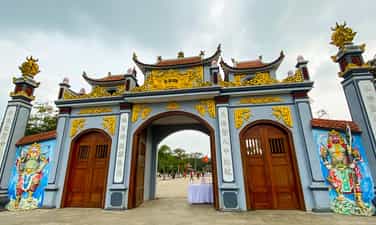
Lang Suong Temple
Lang Suong Temple is located in the system of relics worshiping Tan Vien Son Thanh along the Da River and the Northern Midlands Delta. The temple dates back to the reign of Thuc An Duong Vuong. During the Le dynasty, it was restored (981-1009), and under the Nguyen dynasty, in the 7th year of Thieu Tri (June 19, 1847), there was a major renovation. The temple is located in Trung Nghia commune, Thanh Thuy, Phu Tho. Tan Vien Son Thanh is known as the head deity of the "four immortals" of traditional Vietnamese beliefs. With respect and admiration, the people worshiped Tan Vien as the "Most Highly Spiritual" deity, "First blessed god" in Vietnamese traditional beliefs. Lang Suong Temple is proud to be the land where Saint Tan was born. This can be considered the land where the representative deity of Vietnamese folk beliefs is buried. Along with the belief in worshiping Saint Tan, Lang Suong Temple also worships Saint Mother - the person who is credited with giving birth to Saint Tan. The belief in Mother Goddess worship here has merged with the common belief in Mother Goddess worship of Vietnamese people such as Mother Au Co, Mother Earth, Mother Water... Lang Suong Temple has quite a large area and has architecture with many ancient and profound features. Experiencing rain, sun and fighting, the temple was much damaged. In 1991, the local government and people renovated Lang Suong Temple on a large area of land with an area of 3,000 square meters, including the following works: Temple gate, Hai Co temple, Thien Thanh well, stele house, hammock house, Left desert, right desert temple and Holy Mother's mausoleum. This is the only temple in Vietnam that worships the entire family of Saint Tan and is also the original place of worship in the system of relics worshiping Tan Vien Son in Vietnam. Truong Sa Beach - Trung Do where Lac Long Quan and Au Co met and became husband and wife - giving birth to Lac's children, Dragon's children - Origin of the Vietnamese people. With its profound historical and spiritual cultural values, Lang Suong Temple was recognized and ranked as a national historical relic by the Ministry of Culture and Information on July 12, 2005. Source: Phu Tho Tourism Promotion Information Center
Phu Tho
4766 view
Rating : National monument
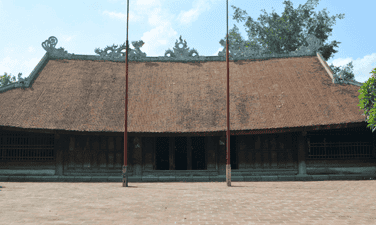
Lau Thuong communal house
Lau Thuong Communal House was built in the Dinh style, including a 5-compartment, 2-room worship hall and a 3-compartment harem, with a length of 28m and a width of 22m in the Southeast direction. The entire communal house has 60 large columns with a diameter of 0.75m linked with horizontal and vertical beams to form a frame with a sturdy structure in the shape of four boat valley pillars. The harem has a unique structure and is exquisitely carved. On the upper beam are two dragons flanking the moon with a tight layout, a harmonious combination of dragon-shaped lines and shapes intertwined with clouds, carved in the style of the Nguyen Dynasty. Below are two elaborately carved residual ends. The entire middle space of the harem is reserved for worship. The main structure of the altar is covered with four roof pillars, outside is a delicately carved door painted in red and gilded gold. Outside the forbidden door on the altar there is also a statue of Hai Ba Trung, carved in a sitting position. The communal house also retains a palanquin with bowls and bowls of tribute, painted and gilded with intricate carvings in the style of the post-Le period. Lau Thuong Communal House currently preserves a number of valuable artifacts such as 4 thrones and gilded tablets crafted during the Nguyen Dynasty, placed in the main altar. Besides, many classic stories such as: "Teaching Mister", "Double Phoenix Ham Thu", "Two Dragons Adoring the Moon", "Dragons Gathering", "Mother Dragon Trains Her Child"... are depicted in paintings. Elaborate carvings on architectural structures. Each carving is a unique work, vividly expressing the simple, liberal beauty, talent, ingenuity, creativity and aesthetics of our ancestors in the past. Lau Thuong village festival takes place on January 9 every year to perform worship rituals and participate in folk cultural and sports activities. Before the main festival, many sports and physical exchange activities between residential areas in the commune took place. On January 9, people organized a palanquin procession from the Ngoai Communal House to the Noi Communal House to celebrate, Then the procession took the palanquin to the front of Dinh Ngoai's temple and continued the ceremony. The annual festival of Lau Thuong village has great significance in connecting the community and educating the nation's patriotic traditions. With precious cultural and artistic values, Lau Thuong communal house was recognized and ranked as a national historical and cultural relic on February 21, 1975. Now when coming to Viet Tri city, tourists in addition to worshiping the Hung King temples on Nghia Linh mountain, visiting Hung Lo ancient communal house to listen to Xoan singing, sightseeing at Thien Co Temple... can also visit Lau Thuong communal house, Feel the ancient and quiet features of this precious architectural sculpture, calm your heart after a busy life to better understand and appreciate the cultural and historical values left by your ancestors. Source: Phu Tho Tourism Promotion Information Center
Phu Tho
4470 view
Rating : National monument
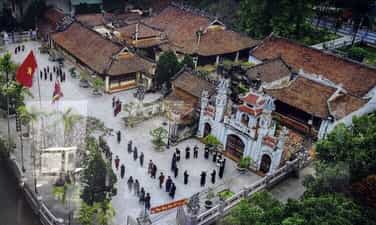
Hung Lo Communal House
Located in the ancient village of Hung Lo with a date of more than 300 years old, Hung Lo communal house has long entered the consciousness of Vietnamese people with customs and practices associated with the belief of worshiping Hung King. Hung Lo ancient village (Hung Lo commune, Phu Tho province) is located on the banks of the romantic Lo River, about 5km from the center of Viet Tri City. Hung Lo Communal House's historical and cultural relic complex was built on a land area of 5,000 square meters. Legend has it that in the reign of Le Hy Tong (1967), people here built a temple to worship the 18th Hung King, facing Nghia Linh mountain, where the Hung King's capital was located. Hung Lo Ancient Communal House is a complex of historical and cultural relics built on a large strip of land, including many construction items such as: Dai Dinh, Phuong Dinh, Bell Lau, Drum Lau, Sacrifice House... All are Built with rare types of wood such as nails, ironwood, bamboo, etc. The Great Court is structured according to the traditional architecture of three compartments, two wings; All three rooms have altars. The altar rooms are built according to the structure of five compartments and two wings. On both sides of the communal house are the Buddhist temple and the Shen Nong altar. The communal house's yard is spaciously decorated with rockery, sycamore trees, and shady banyan trees. This place also preserves a system of worship objects to serve the most complete worship rituals; In particular, the system of ancient couplets is very rich with 43 couplets praising the scenery of the homeland and the merits of King Hung. Most of the ancient worship objects are over 300 years old, typically 5 red-painted palanquins and gilded palanquins and festive symbols. Another notable feature, Hung Lo communal house is very famous for its tradition of the Hung Temple palanquin festival from ancient times to present. In the year of Mau Ngo (1918), Hung Lo communal house was awarded the "First Hung King Commemoration"; Currently, this reward sign is still solemnly kept in the communal house. On the occasion of the annual Hung Temple festival, coming to Hung Lo communal house, visitors will be immersed in a grand palanquin procession of over 200 men, wherever they go, it stirs up the whole region. The procession will go from the village communal house to Hung Temple; Returning from Hung Temple, the offerings at the village communal house were conducted, and finally the ceremony was held at Elder Yen's house. Source: Phu Tho Tourism Promotion Information Center
Phu Tho
4790 view
Rating : National monument
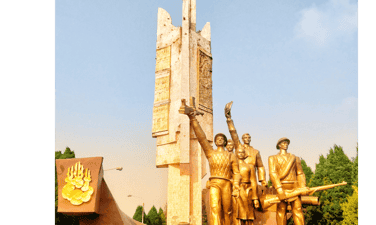
Song Lo victory monument
Song Lo Victory Monument is located on Don Mountain in Chi Dam commune, Doan Hung district. At the foot of the mountain, the Lo and Chay rivers merge here, creating a charming terrain and rich land. Standing in the monument area, looking far away, you will see the vast green river, close to the roofs and hamlets. Song Lo Victory Monument was built in 1987 with a total planning area of up to 2,537 m2; includes two parts: statue and monument. On both sides of the monument are two symbols of the ship's hull and soaring waves to represent the historical image: The victorious ship carrying the combined strength of the Vietnamese people is sailing out to sea following the flow of history. The 26m high pedestal next to the 7m high statue group is made of concrete and reinforced steel, painted in imitation bronze on the outside. The Victory Monument bears the image of a fire, symbolizing the strong vitality and everlasting existence of the Lo River victory; The body of the pedestal is designed with massive angles and is covered with stones that fit tightly together. On the four surrounding sides of the memorial, there are eight ceramic reliefs depicting the victory of Song Lo and summarizing some typical features in the life of the people of Doan Hung land. Each of the above reliefs is a delicate and elaborately sculpted work of art. The group of victory statues right at the foot of the monument, the statue's face facing the clear blue Lo River includes 5 characters representing the elements and forces he used to participate in the fight to win the Song Lo victory. Each statue is depicted standing and has a different charisma; There is a statue of a soldier in a proud posture holding a gun high, wearing a guard shirt, carrying a bag of rice on his back, and wearing rubber sandals; There is a statue of a soldier holding a rifle with both hands in a ready-to-fight position; The statue in the middle is the image of an ethnic female guerrilla, her head covered with a scarf, her hand holding a stick, her eyes looking into the distance, ready to fight; There is also a statue of a soldier standing next to a cannon, raising his hat and waving, his shirt fluttering in the wind, revealing a healthy, bare chest full of vitality... The above statues vividly portray the historical figures of the people who created the Song Lo victory, carrying the breath of years of heroic fighting to pass down to posterity in a complete and authentic way. . Many years have passed, generations of people born and raised, attached to this majestic land, all carry within them a great pride every time they mention the resounding victory of their ancestors. In their eyes, the Song Lo victory monument is not only a work honoring and praising the Song Lo victory but also a testament to the resilience of their ancestors who sacrificed themselves to protect the Fatherland. Song Lo Victory Monument was recognized as a national historical and cultural relic on September 27, 1997; Source: Phu Tho Tourism Promotion Information Center
Phu Tho
4831 view
Rating : National monument
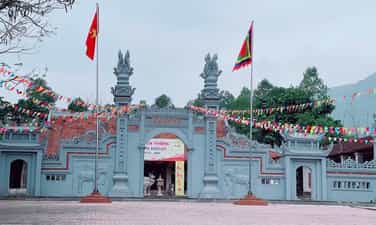
Dinh Thach Khoan
Thach Khoan Communal House was built a long time ago, at first it had small and simple architecture with main construction materials being wood, thatch, bamboo, and palm leaves. In 1905, the communal house was built a new one, and in 1914 the communal house was burned down. In 1925, the communal house was restored. In 1967, the communal house was renovated by the State and local people. After that restoration, the communal house exists to this day. Thach Khoan Communal House was built in the shape of the letter "Nhat" with 5 compartments in the southwest direction. The middle room looks directly towards Ba Vi mountain (Tan mountain), called the main palace, and has an altar to worship Tan Vien Son God. The left palace has tablets to worship Princess Mi Nuong, daughter of the 18th Hung King. The right palace has tablets to worship General Dinh Cong Moc and the Dinh family prisoners, who helped Le Loi fight against the Minh invaders. Thach Khoan village festival is held from January 23 to 25. The festival is organized into 2 parts including: the Ceremony part with activities of organizing palanquin processions, offerings, and offering incense according to traditional rituals. And the Festival part organizes cultural camps in residential areas, organizes cultural activities: Wrapping contest, cooking banh chung, pounding banh giay contest, gong performance, and dong duong contest; Mass entertainment festivals, folk games such as tea swing, tug of war, shuttlecock throwing... and mass sports activities. This is a typical traditional festival of the Muong ethnic people, a beauty in the way of educating the historical and cultural traditions of the homeland and the country, remembering the merits of the ancestors who opened the mountains and destroyed the mountains. The rocks that formed this land. Thereby contributing to preserving and promoting the cultural and spiritual values of ethnic communities, encouraging and encouraging people to return to their roots, promote local cultural traditions, and strengthen mass organizations. unite all people, honor traditional culture, raise awareness of responsibility in protecting, restoring and embellishing historical and cultural relics in the area. Source: Phu Tho Tourism Promotion Information Center
Phu Tho
3855 view
Rating : National monument