Relic point Vietnam
Việt Nam
Southern Regional Party Committee - Central Southern Department
In Ca Mau province, there are currently 29 points belonging to the Southern Party Committee - Central Southern Department (period from late 1949 to early 1955) that have been ranked as historical relics by the Ministry of Culture, Sports and Tourism. nation. These locations are located in 7 districts and Ca Mau city including: Thoi Binh district has 11 points including: Central Office of the Southern Department; Central Radio Station of the Southern Department; Central meeting room of the Southern Department; Southern Command; Cipher Station of the Southern Command; Tran Phu Printing House; Southern Administrative Resistance Committee, Southern Radio, Nguyen Van Nguyen School; Agencies and organizations under the Southern Party Committee - Central Southern Department; Tran Quoc Toan School; Comrade Le Duc Tho's workplace; Department of Transport and Communications - Radio - Southern Radio Station. Nam Can district has 1 point: Southern Special Printing Department. Cai Nuoc district 1 point: Southern Administrative Resistance Committee. Dam Doi District 6 points: Southern Party Committee - Central Southern Department; Hall of the Southern Administrative Resistance Committee; Southern Department of Treasury; The Southern Party Committee School is named Truong Chinh; Propaganda Department of the Southern Regional Party Committee; Code Division of the Southern Regional Party Committee. Phu Tan district 3 points: Central Party School of the Southern Department named Truong Chinh; The place where the late General Secretary Le Duan put pen to paper to draft the "Southern Revolutionary Path", the precursor to the Party's 15th Central Resolution; Southern Administrative Resistance Committee. U Minh district 2 points: Southern Department of Health; Location of the Southern Department of Education from 1948 to 1954. Tran Van Thoi District 4 points: The Central Organizing Committee of the Department merged with the Military Organizing Committee; Tran Phu Printing House; Where the late General Secretary Le Duan stayed during revolutionary activities in Ca Mau; Gathering location to the North in late 1954 and early 1955 at Song Doc, Ca Mau province. Ca Mau City 1 point: Gathering location to the North in 1954 in Ca Mau. The above locations were ranked as national historical relics by the Ministry of Culture, Sports and Tourism on November 10, 2010 (including 5 relics) and October 28, 2016 (4 additional relics) . Source: Ca Mau Province Electronic Information Portal
Ca Mau
5710 view
Rating : National monument

Hon Khoai Relics
Hon Khoai is the name of a cluster of islands located southeast of Ca Mau cape in Tan An commune, Ngoc Hien district, Ca Mau province. Hon Khoai is more than 6 nautical miles (14.6km) from the mainland and has an important position in national defense and security. This place is considered a forward station guarding the air, sea and land in the southwest of the country. Hon Khoai Island includes many small islands: Hon Khoai, Hon Tuong, Hon Sao, Hon Doi Moi, Hon Da Le. Hon Khoai is the largest island with an area of about 4km2 and is also the highest island above sea level at 318m. In the past, this place was also known by many different names such as: Giang Huong Island, Doc Lap Island or Poulop Island during the French period. However, because of its shape like a giant potato, local people still call it Hon Khoai to this day. Hon Khoai is an island of rocks, hills and primitive forests that are almost intact with many precious woods and rich flora and fauna, which has captivated many tourists. According to the latest research, the flora in Hon Khoai has more than 1,400 species including fruit trees, timber trees, medicinal trees... Animals are also quite rich with monkeys, wild chickens, pythons, monitor lizards, squirrels. white... and more than 20 species of rare birds. Hon Khoai is known as the pearl island of cape land, surrounding forests and mountains, gentle blue sea water and relics tinged with time. This place has become an attractive destination that tourists cannot miss when coming to Ca Mau province. In September 2013, the Hon Khoai island cluster was set the record for the island cluster closest to the equator. The history of Hon Khoai relic also tells about the 12.05m high lighthouse built by the French colonialists on the peak of the island. This lighthouse has a scanning capacity of 35km wide; is part of the Can Gio - Con Dao - Hon Khoai - Phu Quoc lighthouse system to help illuminate ships traveling in the East Sea. On December 13, 1940, this place marked an important historical event when Mr. Phan Ngoc Hien led the uprising at Hon Khoai against the French colonialists and won. This is also the day chosen as the Revolutionary Tradition Day of the Party Committee and people of Ca Mau to commemorate this important event. Hon Khoai has a long, sheltered coastline, an anchorage and storm shelter for fishermen and a breeding and sheltering place for many marine species. From tiny plankton species to aquatic species with high economic value such as: squid, lobster, mantis shrimp, grouper, cobia,... Hon Khoai beach has wide sandy beaches. When the tide is low and the sea is calm, visitors can walk on the sand to learn about marine life and breathe the fresh air of the forest and sea. On April 27, 1990, Hon Khoai Relic was recognized by the Ministry of Culture, Sports and Tourism as a national historical and cultural relic. Source: Ca Mau Province Electronic Information Portal
Ca Mau
6562 view
Rating : National monument

Cao Dan Pagoda historical site
Saraymel Chey Pagoda (Cao Dan Pagoda) is located in hamlet 7, Tan Loc commune, Thoi Binh district, Ca Mau province. Cao Dan Pagoda is located next to Highway 63 (in hamlet 7, Tan Loc commune, Thoi Binh district), about 16 km north of Ca Mau city center. Cao Dan Pagoda was built in 1922 on an area of 4 hectares, at the intersection of Duong Cay canal, donated by Mrs. Diep Thi Lai. At that time, people often called Chau Trang Pagoda (Bach Nguuu). After being burned by the enemy many times, in 1998, Cao Dan Pagoda was newly built. Inside the main hall of the pagoda there is a large altar, worshiping only Shakyamuni Buddha. Opposite the main hall is the Venerable Huu Nhem tower, built in 2003, 17m high, 12m² area. In 1954, the Geneva Accords were signed, we had to bring a group of core officers and children to the North, choosing Cao Dan Pagoda as the study center for the core officers and children. rolled in the province to send to the North. The remaining core cadres used their legal positions to the fullest extent; the cadres who had not yet been exposed were infiltrated into the enemy's ranks. The number of officials revealed to be roaming the operating area or withdrawing into secret. Revolutionary organizations were also reorganized and transformed to suit the situation at that time. On the other hand, Cao Dan Pagoda was directed by the Party to move next to bridge highway No. 6 (National Highway 63), to avoid enemy observation. At the same time, there are people's houses as security shields to make operations easier. During the two resistance wars against the French and the Americans, the Board of Directors and the monks and Buddhists of Cao Dan Pagoda were closely associated with the revolution. Cao Dan Pagoda is the secret base of the revolution. Among them, Venerable Huu Nhem, former abbot of the pagoda who passed away during the resistance war against the US, held the position of Vice Chairman of the National Front for the Liberation of the Southwest Region, actively campaigning for monks and the Management Board. ruled over pagodas and a large number of local Kinh - Hoa - Khmer ethnic people participated in the resistance war against the Americans to save the country. The enemy repeatedly bombed and destroyed the temple; Many monks and Buddhists heroically sacrificed their lives. Today, at Cao Dan Pagoda there are still many unfilled bomb craters, proving that the enemy's destruction cannot overshadow the rebellious and patriotic spirit of Buddhists and monks. During the process of formation and development, Cao Dan Pagoda has not only performed the task of maintaining religion, but also performed well the tasks of a patriotic citizen, always attached to the nation and the leadership of the Party and the strong revolution that has been created. The results are very appreciable. At the same time, we must not separate from the great national unity bloc to participate in the struggle against French and American invasion, contributing to completely liberating the South and reunifying the country. On December 29, 2017, Cao Dan Pagoda was decided to rank as a national monument by the Minister of Culture, Sports and Tourism. Source: Ca Mau Province Electronic Information Portal
Ca Mau
8430 view
Rating : National monument
Dam Doi - Cai Nuoc - Cha La historical relic area
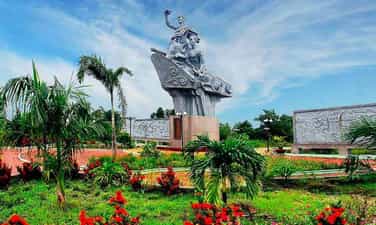
The victory site of Dam Doi - Cai Nuoc - Cha La, belongs to Cha La hamlet, Tran Phan commune, Dam Doi district, Ca Mau province. In September 1963, the Regional Party Committee, the Military Region Command (T3), the Provincial Party Committee and the Military Command of Ca Mau Province advocated opening a military attack campaign, aiming to destroy and destroy enemy forces and support the enemy. The masses rose up and expanded the liberated zone in South Ca Mau. Cai Nuoc and Dam Doi were two sub-districts (district capitals) in the south of Ca Mau, 20km apart, chosen as the main targets. The Military Region Command decided to destroy Dam Doi and Cai Nuoc Sub-Regions in one night, attack surrounding posts, and block enemy reinforcements. At the same time, step up attacks on enemy rear bases, airports, and command posts in Can Tho, Soc Trang and other provinces. Attack the enemy with 3 armored attacks, uproot fortresses, and destroy strategic hamlets. The time for shooting to destroy the two branches was uniformly determined on the night of September 9 and early morning of September 10, 1963. Dam Doi and Cai Nuoc Branch, built with a solid structure since 1955. This place became a place of strict defense of the enemy with a complex protection system; including steel barricades, minefields, and strategic watchtowers, etc. At Dam Doi Branch, U Minh Battalion 1 conducted a courageous and intelligent attack strategy. After two fierce hours, the army and people here destroyed the Dam Doi war zone, destroyed 110 enemies, captured 48 alive and seized many military weapons. The victory at Cai Nuoc was no less impressive. Battalion 306 attacked strongly on the night of September 10, 1963. As a result, 92 enemies were destroyed, 84 were captured and many important military weapons were captured. Cha La is also a location that suffered a comprehensive attack by our army. After more than 3 hours of fierce fighting, our army destroyed the Cha La base and completely defeated the enemy. The result was the capture of 30 enemies and the seizure of many types of weapons. These battles not only destroyed the enemy but also contributed to destroying the US military's "helicopter and parachute" strategy. Those victories not only expanded the liberated area; but also the clearest testament to the strength and fighting spirit of the Southern army and people in the war against America to save the country. The victory of Dam Doi - Cai Nuoc - Cha La was a great success of our army and people in implementing the "two legs, three prongs" approach (armed - political - political - military), promoting strength. The synthesis of the people's war, the victory of Dam Doi - Cai Nuoc - Cha La were two of the seven major victories of the Southern army in 1963. We destroyed many enemies, removed many posts and destroyed every hamlet. strategy, the liberated area was expanded, the Cha La battle not only eliminated the enemy from the battle but also contributed to defeating the US-puppet "helicopter and parachute" tactic. On August 18, 2016, the historical relic Dam Doi - Cai Nuoc - Cha La victory site was decided to rank as a national historical relic by the Ministry of Culture, Sports and Tourism. Source: Ca Mau Province Electronic Information Portal
Ca Mau
6603 view
Rating : National monument

Vo Doi Forest Village relic site
Location Vo Doi forest village, Vo Doi hamlet, Tran Hoi commune, Tran Van Thoi district, Ca Mau province. Currently, Vo Doi Forest Village Site has become U Minh Ha National Park and is located in the Ca Mau Cape World Biosphere Reserve. Vo Doi Forest Village was established in the late 50s of the 20th century. After the Geneva Agreements, the US imperialists increased the construction of their minion ruling apparatus to turn South Vietnam into their new-style colony. In Ca Mau, the Ngo Dinh Diem government also began sending troops to close garrisons everywhere in the province and set up a high-ranking apparatus from the province to the communes and hamlets that were previously liberated areas to carry out arrests. terrorize those participating in the resistance, restrain and oppress the people, and destroy the revolutionary forces. At the same time, America and Diem increased the concentration of people into "residence areas" and "dense areas", organizing population control in many very strict forms with the purpose of separating revolutionary cadres and "separate" people. fish out of water", causing the masses to distance themselves from the revolution, blocking supply sources and isolating and eliminating our cadres and soldiers. The "dense zones" and "residences" were set up by the enemy with hundreds of taboos and coercion to control people's lives, so when the Party's policies showed the way, the masses wholeheartedly supported them. , they left their old village and went into the forest to establish a new village to respond to the Party's call and stand up for revolution. Vo Doi forest village was formed with hundreds of stilt houses built of melaleuca wood concentrated in residential clusters on high mounds in the forest. From the market, if you want to get to the forest village, you have to go through many canals. Go to the edge of the forest to see the receiving station. From there, you have to walk through the forest for 7-8 km to reach the base. Houses in forest villages usually have an area of 20 - 25m2, with crowded houses the area is 40 - 50m2, built entirely of Melaleuca trees, Melaleuca planks, and roofs made of Melaleuca bark. To protect the base, people went to distant forests, selected large melaleuca trees and when peeling the bark, left a thin layer of bark close to the trunk so that the tree would not die. Cut cajuput bark about 0.6 - 0.8m long. When spread out, the width is about 0.4 - 0.5m, the roof can last for 2 - 3 years. There are some houses that use the leaves of the Mandarin tree (leaves that make hats) to form sheets for roofing and walls. The folding houses are covered with plastic roofs and covered with leaves, for short-term temporary residence. Houses that have the means to discharge Melaleuca boards, foam, etc. to line the floors. From one house to the other is bridged by cajuput trees. Next to each house, there is a drinking water well. This well does not have to be dug, but using a knife to cut off the surface layer of tree roots about 1m2, scrape off the leaves and compost it to get water. Further steam wells do the same but are larger and are used for bathing and washing. In the dry season, dig 0.4 - 0.5m deep to get water. Almost no house has water storage equipment such as jars, jars, containers... Regarding the organization of the forest village, in addition to the village elements, a management board with a commander, leadership organization, activities, protection, and strength building... such as party cells and branches are formed. Mass organizations, production groups, guard groups, construction site groups (weapon making), medical groups, education groups, arts groups... In the forest village, the military and people's love is a unified block, everyone People who only think about the common good, for the common good, put the interests of the revolution first. Forest Village existed until 1960, when the Dong Khoi movement was launched, our revolutionary forces in Forest Village combined with outside revolutionary forces to simultaneously attack the enemy, liberating many rural areas in the province. After Dong Khoi, the armed forces spread out and the people returned to their old hometowns to make a living, continuing to contribute to the revolution in human strength and wealth in the new period. On June 20, 2018, the Ministry of Culture, Sports and Tourism ranked Vo Doi Forest Village as a National Monument. Source: Ca Mau Province Electronic Information Portal
Ca Mau
6140 view
Rating : National monument
Vam Lung Pier No
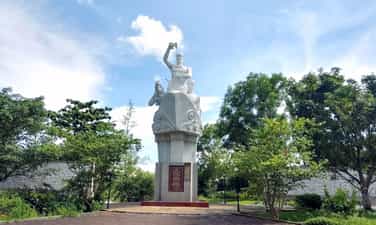
Ben Vam Lung Khom 8 historical site, Rach Goc town, Ngoc Hien district, Ca Mau province. This is the place to record the silent victories of the soldiers on the "Unnumbered Train" that crossed thousands of kilometers by sea, transporting weapons to support the Southern battlefield during the years of resistance against the US to save the country. created the miracle of the Ho Chi Minh Trail at sea. Due to pressing requirements for weapons and ammunition to be supplied to the Southern battlefield, the Politburo and the Central Military Commission instructed the Southern provinces to prepare yards and organize forces to receive weapons from the region. North for the South. Vam Lung Cua is the name of the local people, on the map it is written as Nang River, originating from the East Sea, outside the coast there is mud flats, on the right side is Xeo Lo canal. Vam Lung gate is over 100 m wide and has a water depth of 4-5 m, convenient for ships carrying over 30 tons to enter and exit easily. On October 11, 1962, the first train of the "unnumbered train", bearing the name "Phuong Dong 1", carried 30 tons of weapons from Do Son wharf, Hai Phong, opening the way to the South. On October 16, 1962, the ship Phuong Dong 1, commanded by captain Le Van Mot and political officer Bong Van Dia, crossed thousands of nautical miles under the surveillance and siege of enemy ships but still safely docked at Vam Lung. . This is the train of the "Train without number" opening the strategic transport route in the East Sea - the Ho Chi Minh sea route. After the successful return of the ship "Phuong Dong 1", the ships "Phuong Dong 2", "Phuong Dong 3", "Phuong Dong 4" continued to dock at Vam Lung Wharf to bring hundreds of tons of weapons from the region. The North moved in to support the Southern battlefield. By the end of 1970, Ben Vam Lung received over 70 ships with more than 4,400 tons of weapons and ammunition. Thanks to the rugged terrain, along with a network of canals and canals, above are covered with mangrove and fish sauce forests, creating ideal conditions for revolutionary soldiers to easily transport and hide weapons. Besides, the support and protection of the Rach Goc People are like "iron citadels and bronze citadels" to protect the revolution. Thanks to that, for more than 10 years of operation (1962-1972), our operating bases were safely protected, even though they were located not far from the enemy's military zone in Nam Can. Ben Vam Lung historical site is also associated with the birth of the military unit with the name "Group 962" (established on September 19, 1962) with the task of protecting the safety of trains. entering and exiting the yards, secretly receiving and hiding weapons and transporting weapons to liberation army units for combat purposes. Group 962, later Regiment 962, was twice awarded the title "Hero of the People's Armed Forces" by the State. Due to special requirements during the war period, it was necessary to maintain absolute secrecy and safety for activities of organizing the transportation of weapons, military equipment, and military supplies from the North to support the Southern battlefield, so the artifacts is not kept. However, there is still a damaged wreck of ship 69 of convoy 962, located at Xeo Gia peak about 8 km west of the wharf. To remember and honor the resounding and immortal victories of the Numberless Train, the Ho Chi Minh Trail Victory Monument at sea; A house displaying traditional documents and a number of related works were built at Ben Vam Lung. On October 23, Ben Vam Lung Historical Relic Area was recognized by the Ministry of Culture, Sports and Tourism as a national historical site. Source: Ca Mau Tourism
Ca Mau
6597 view
Rating : National monument

Tan Hung Communal House
Tan Hung Communal House was the first place to hang the flag of the Indochinese Communist Party in Ca Mau (in 1930) and was also the headquarters of the Tan Hung Front Command, the anti-French front in Ca Mau. Tan Hung communal house is located in Tan Hung hamlet, Ly Van Lam commune, Ca Mau city. Tan Hung Communal House is an ancient communal house worshiping the God Hoang Bon Canh, built by people in 1907. However, due to time and war, the communal house was completely destroyed. On the old ground, local people built another smaller communal house. In 2014, Tan Hung communal house relic was upgraded and restored including many items and works. The main communal house consists of one room and two wings, the roof is covered with yin and yang tiles, and on the roof are cast two flanking dragons. In front of the communal house is a tiger-shaped brick screen, on both sides there are two square brick pillars, the top of the pillars is covered with two stone lotus flowers. On both sides of the yard there are two small temples worshiping the God of Agriculture and the God of Earth. The main altar space of the communal house worshiping the God Hoang Bon Canh is majestically arranged with pedestals displaying swords, spears, drums, images of dragons and cranes. Tan Hung Communal House also has a space to worship Uncle Ho's image, placed in a solemn position. Tan Hung communal house was once awarded the title Bon Canh Thanh Hoang by King Tu Duc in the 5th year of Tu Duc (1852). Elders in the area said that on King Tu Duc's regalia were written the eight words "Righteousness - Huu gentleness - Don stop - Chi Than". The sacred spirit has now been lost due to the chaos of war. In the temple, there is still a sacred spirit container engraved with a winding dragon image. Every year, on the 10th and 11th days of the 5th lunar month, people in the region and tourists from everywhere come here to attend the Ky Yen ceremony at Tan Hung communal house. In addition to its spiritual meaning, paying respect to the gods and protecting tutelary gods, Ky Yen ceremony also aims to commemorate those who have contributed to the country and have fallen on this land. Tan Hung communal house has great cultural and historical value. At the same time, it is an image of preserving and promoting the cultural identity of Ca Mau province, the southernmost region of the country. For many generations, for local people, the communal house is the place where they entrust their dreams and aspirations for a peaceful, prosperous and happy life. Not only is it a place for cultural and religious activities of the people in the region, Tan Hung communal house is also a famous communal house in the history of struggle of the people of Ca Mau. Tan Hung Communal House is the first place in the province where the event of hanging the flag of the Indochina Communist Party (predecessor of the Communist Party of Vietnam) took place on the top of the poplar tree in front of the communal house. The red hammer and sickle flag has the words: "Eliminate the Dharma bandits". For the first time, the people of Ca Mau saw the Party flag publicly appear. And also here, on March 1, 1946, the Tan Hung Front was established. With the meaning of marking many historical revolutionary events, on August 4, 1992, Tan Hung communal house was ranked as a National Historical - Cultural Monument, becoming a "red address" for the young generation to learn about. , learning about historical values, culture, and traditions of fighting to protect the country that our ancestors left behind. Source: Ca Mau Tourism
Ca Mau
6564 view
Rating : National monument

Hon Da Bac relic site
Hon Da Bac is about 500 meters from the mainland, has an area of 6.34 hectares, located in the west of Ca Mau Peninsula, in Kinh Hon hamlet, Khanh Binh Tay commune, Tran Van Thoi district, Ca Mau province. Silver Rock includes Ong Ngo Rock, Silver Rock, and Odd Silver Rock. The highest peak of the island is about 50 meters above sea level. Although not a large island, Hon Da Bac is very convenient for all types of marine vehicles to anchor and avoid storms. Along with Hon Khoai, Hon Chuoi, Hon Da Bac is one of the island clusters with a strategic economic - defense - security position in the sea - Ca Mau island. Looking on the map, Hon Da Bac looks like a forward station guarding the air and sea southwest of Cape Ca Mau. Silver Rock - as its name suggests - around the island, on the water surface, and on the seabed, thousands of granite stones of all sizes lie on top of each other, forming many shapes as if arranged by humans. Walking on Hon Da Bac, visitors encounter Fairy hands, Fairy footprints, Fairy wells, and tiger feet. On the eastern peak of Hon Da Bac, there are large rocks and a fairly wide surface. Between the two pieces of rock there is a deep hole shaped like a foot. Legend has it that that footprint is the Fairy's foot, and this piece of rock is the Fairy's yard. On the island there are a few small temples such as Hang Pagoda and Tinh Do Pagoda. In particular, on the highest peak of Hon Da Bac is Ong Nam Hai temple - a place to worship the 13m long Ong fish skeleton. On May 20, 1995, Ong fish drifted into the Ong Doc river mouth area. About 3 days later, Ong Giat (died), Song Doc fishermen buried him and in 1996 brought the skeleton to Hon Da Bac to worship. Whenever fishermen in this area encounter big waves or strong winds when going to sea, they are saved by Ong fish. Therefore, the fishermen here silently thanked him and worshiped him as a god who saved humanity. Legend has it that Ong Nam Hai temple is very sacred. Today, not only fishermen in the area but also tourists from everywhere who hear his sacred voice come to pay their respects and pray for him to bless his family with peace, without encountering troubles or troubles. During the years of resistance against the US to save the country, the enemy chose Hon Da Bac as the place to station the 105 mm artillery platoon to control the Khanh Binh Tay revolutionary base area and the western coastal line of Ca Mau. This is also the location where the CM12 project took place, defeating the plot to import, sabotage, and overthrow the socialist regime in our country by the reactionary organization "Vietnam Restoration" led by Le Quoc Tuy and Mai Van Hanh. head. On June 22, 2009, the Ministry of Culture, Sports and Tourism recognized the relic: Hon Da Bac - CM12 Counterintelligence Plan Command Center (September 9, 1981 - September 9, 1984) as a Monument. national history and culture. The Ministry of Public Security and Ca Mau province built the CM12 Victory Monument, Traditional House, and Uncle Ho temple at this famous relic. Source: Ca Mau Province Electronic Information Portal
Ca Mau
8623 view
Rating : National monument

Cai Chanh Base Special National Monument
Cai Chanh Base (another name is Bac Lieu Provincial Party Committee Base Area), located in small Cai Chanh hamlet, Cay Cui hamlet, Ninh Thanh Loi commune, Hong Dan district, Bac Lieu province. Cai Chanh Base is the place of residence and operations of the Southern Regional Party Committee, the Central Committee of the Southern Department, and the Southern Administrative Resistance Committee: During the resistance war against the French colonialists, in the period from 1949 - 1954, the Base Cai Chanh base is the place of residence and revolutionary activities of the leaders of the Southern Party Committee, the Central Committee of the Southern Department, and the Southern Administrative Resistance Committee. The base is where many senior leaders of the Party and State operate. During the resistance war, at Dong Thap Muoi Base area as well as Cai Chanh, U Minh Bases and many other locations in the Southwest region, agencies and officers of the Southern Regional Party Committee and the Central Committee of the Southern Department , the Southern Administrative Resistance Committee is generally protected and safe, the people are truly the Party's "hundred hands and thousand eyes", firmly protecting the Party from victory to victory. Cai Chanh is where the Bac Lieu Provincial Party Committee Base was located during the resistance war against the US, period from 1973 - 1975: During the resistance war against the US to save the country, Cai Chanh area, Ninh Thanh commune once again became a revolutionary base. solid network. This was the base for revolutionary activities of the Bac Lieu Provincial Party Committee in the period 1973 - 1975. Also at this base, on January 13, 1975, the Provincial Party Committee met and approved the determination to liberate Bac Lieu province; At the same time, decided to move the Provincial Party Committee Base from Cai Chanh (Ninh Thanh Loi commune) to Lai Viet (Ninh Quoi commune), Hong Dan district to facilitate directing the attack point to liberate Bac Lieu town. By April 30, 1975, Bac Lieu province was liberated. Cai Chanh Base, from the time it was established by the Provincial Party Committee (November 1973) until the Provincial Party Committee moved it to Lai Viet (January 1975), has fulfilled its historical mission well, being a place to hide, shelter and protect. entirely for the Provincial Party Committee to lead the revolution to victory. Cai Chanh base is the place to recreate the revolutionary activities of leaders, agencies and people in both periods of resistance against the French and the Americans. During the resistance war against the French, Cai Chanh Base was the stationing and operating location of the Southern Regional Party Committee, Central Bureau of the South, Southern Administrative Resistance Committee, period 1949 - 1952. Here, the people sheltered, protected, and nurtured many high-ranking leaders of the Party and State. During the resistance war, at Dong Thap Muoi Base area as well as Cai Chanh, U Minh Bases and many other locations in the Southwest region, agencies and officers of the Southern Regional Party Committee and the Central Committee of the Southern Department , the Southern Administrative Resistance Committee are all protected and safe, the people are truly the Party's "hundred hands and thousand eyes", firmly protecting the Party from victory to victory. Cai Chanh base includes the main architectural items: Gate, exhibition house, stele house, comrade Le Duan's living and working house, conference hall, Provincial Party Committee Secretary's house, and the agency's kitchen. Provincial Party Committee, clerical and medical house, cipher house, radio house, defense platoon house, Provincial Party Committee Chief's office house, base construction committee house, waiting house, bunkers... With the above typical values, Cai Chanh Base was ranked by the Prime Minister as a special national historical site on December 31, 2020. Source: Department of Cultural Heritage
Ca Mau
6693 view
Rating : Special national monument

Phuoc Duc Ancient Temple
Phuoc Duc Ancient Temple, also known as Bang Pagoda, is located at 74 Dien Bien Phu Street, Ward 3, Bac Lieu City. This is the oldest temple of the Chinese people living in Bac Lieu. Phuoc Duc ancient temple was built by a group of Chinese people around 1810. Initially, the temple was built with simple leaves to worship gods according to Chinese folk beliefs such as: Bon Dau Cong (Ong Bon), Quan Di, Than Nong, Earth Duke, Mr. and Mrs. Cong Mau. Because Ong Bon is the main worshiper, it is called "Ong Bon temple"; Later, it was changed to "Phuoc Duc ancient temple", because the Chinese believe that Bon Dau Cong is also the main god Phuoc Duc - a god who is considered to be responsible for reclaiming land and supporting people to make a living and have a good career. peaceful life. In 1903, Chaozhou State was established, headquartered at Phuoc Duc ancient temple, in a large room next to Tay Lang, so it is also called Bang Pagoda. From a small temple with a modest area, after many restorations, the temple today has an area of 580 m2, following the Quoc-shaped architecture, a royal architecture style of the Ming Dynasty, China. The entire temple is a large-scale and flawless architectural work of art exuding majestic and ancient beauty. Columns, rafter ends, slanted ends, crowns, and altars made of stone and precious wood are all meticulously, elaborately, and exquisitely carved with gold-plated Chinese characters, following the style of the Book of Action and the Book of Revelation. All represent the following themes: Four sacred animals (dragon, unicorn, tortoise, phoenix), plants, flowers, dolls and magical beasts. In addition, there are decorated horizontal panels and couplets that are painted in vermilion and splendidly gilded. On the roof of the temple, there is a pair of dragons flanking the sun (two dragons in the sun), the most common image decorated on Chinese temples, symbolizing eternal happiness. The roof is covered with tube tiles, the roof border is made of green glazed ceramic, the end of the roof is decorated with a dragon-shaped pattern, on both sides are two small ceramic statues symbolizing yin and yang, the source of all harmony and discipline of all things. . Each part of the temple is considered an antique with high artistic value. With durable materials, Phuoc Duc ancient temple exists solidly to this day. These works of art have been harmoniously and closely linked together by artisans to form a unique architectural whole. Not only is it a place to worship the gods, Phuoc Duc ancient temple is also the base for revolutionary activities of Long Thanh village cell, Vinh Loi district, Bac Lieu province with comrade Nguyen Van Dang as secretary from 1930 to 1954. With With those values, the pagoda was recognized by the Ministry of Culture and Information as a national historical and cultural relic in 2000. Every year at Phuoc Duc ancient temple, major festivals are held such as: Via Ong Bon; Vu Lan Ceremony; Ky Yen Festival... The biggest is the Via Ong Bon festival held on the 29th day of the third lunar month; and Vu Lan festival is held on the full moon day of the 7th lunar month. Phuoc Duc ancient temple is not only a spiritual place for local people but also becomes a beauty of the cultural identity of the Chinese people in Bac Lieu. Source: Bac Lieu Tourism
Ca Mau
6207 view
Rating : National monument