Relic point Vietnam
Việt Nam
Duc Thang village communal house
According to history books, in 1692, Lord Nguyen named the newly discovered land in the southernmost Central region Thuan Phu; By 1697 (Dinh Suu), Phu Binh Thuan was formed with the boundary from the south of the Phan Rang river to the border of Bien Hoa today; In 1809, Binh Thuan palace was changed to Binh Thuan town including 2 districts: Ninh Thuan and Ham Thuan. Duc Thang was formerly a village in Tuy Dinh district, Ham Thuan district and a central village in Phan Thiet. Duc Thang village communal house was built in the late 18th century with mud walls and thatched roof to worship Thanh Hoang Bon Canh. In 1841, the people contributed to building a solid, sustainable building and by 1847 it was complete. On the roof of the Village Communal House, there is still an inscription in Chinese characters recording the construction date "Tan Suu Chi Dinh Mui", i.e. from 1841 - 1847. Compared to other communal houses in Binh Thuan, the main hall of Duc Thang communal house is the largest and most perfect folk art structure in both architecture and sculptural and visual arts, especially on the roof. roof and interior. Seen from the front, the main hall is built into 2 roof floors. The lower floor is low and wide, the upper floor is miniature and soaring, looking like a magnificent, ancient tower. The roof of the main hall is decorated with many images and motifs such as: two dragons, unicorns, bats, dragons, fish turning into dragons, animals, fairies, rivers and mountains, flowers... arranged harmoniously. and lively. The frame of the main hall where the God Emperor is worshiped has 36 round wooden columns arranged in 6 vertical rows, dividing the interior into 3 compartments and 2 wings. Duc Thang village communal house is a historical and cultural relic, typical and unique folk art architecture, showing the mark of ancient history and culture. The architectural structure is modeled after the folk architecture of the 17th and 19th centuries. Along with architectural values, Duc Thang Communal House also contains historical and cultural values through ancient Sino-Nom documents that fully reflect the early historical circumstances during the process of exploration and creation. establish villages. In addition, the village communal house also preserves many valuable ancient relics used in worship and offerings. Among them, there are 13 titles bestowed by the Nguyen Dynasty kings on Thanh Hoang Bon Canh as well as the Ancestors of the village. Next to Duc Thang village communal house, there is also Ba Duc Sanh Pagoda worshiping the Three Holy Mothers supporting the well-being of women, established under the reign of King Thieu Tri (1844) and restored in 1902 and 1911. A little further. Van Thuy Tu was built by Duc Thang residents in 1762 (Nham Ngo) to worship the Nam Hai God who supports the marine industry. All three relics together create a unique complex marking the ancestors of the land of Phan Thiet - Binh Thuan in the early days of establishing the hamlet, bringing traditional cultural values to cultivate people's love for the homeland and country. . Currently, Duc Thang Village Communal House as well as Ba Duc Sanh and Van Thuy Tu Pagodas are attractions in the City tour project to visit the tourist city of Phan Thiet. Domestic and foreign people and tourists who want to explore and learn about the unique features of Binh Thuan coastal culture should come to the relic of Duc Thang communal house, Trieu Quang Phuc street, Duc Thang ward, Phan Thiet city. , Binh Thuan Province. Source: Electronic information page of Binh Thuan Department of Culture, Sports and Tourism
Lam Dong
5657 view
Rating : National monument

Duc Nghia communal house
Duc Nghia communal house is an ancient communal house located in Duc Nghia ward, Phan Thiet city, Binh Thuan province. Duc Nghia communal house was built in the early decades of the 19th century, on a high sand cave, with a large lotus pond in front. The communal house has an area of more than three thousand square meters, facing the Ca Ty river (now in Duc Nghia ward, Phan Thiet city, Binh Thuan province). Duc Nghia village communal house has a nail-shaped (J-shaped) architectural form, the ancient floor is where the most unique artistic decorations in the entire village communal house are concentrated. Here, ancient artisans used the art of assembling pieces of porcelain and china to create the image of the "Four Spirits". The lower parts of the lower roof, the roof edges, and the ridges were also artistically decorated to make the communal house both ancient and modern. solemn. The Tien Hien and Hau Hien churches also have the same architectural style as the main communal house, but the length is somewhat longer. This is a characteristic of village communal house architecture in the second half of the 19th century in Binh Thuan.,. The interior of Duc Nghia communal house, especially the carved artistic decoration inside the main communal house with a system of wooden panels, like curtains down to the altars, is alive with vines, flowers, and birds. from the carvings of ancient craftsmen. The decorative art of Duc Nghia Communal House, both exterior and interior, coordinate with each other to create harmonious ancient architectural lines and reach the peak compared to some communal houses in this period. The worship content inside is like a treasure trove of hundreds of precious artifacts such as horizontal panels, diaphragms, and altar plates that have been elaborately carved and passed down through many generations to this day. The village's Tien Hien are worshiping at the Communal House, including Mr. Nguyen Van Bang, Tran Van Kim, Le Van Hanh, and Nguyen Van Thanh, who are representatives of the families who publicly founded the village and built the communal house, whose names have been recognized by the people. The village respectfully engraved it in the altar tablet at the communal house. Duc Nghia village communal house also has many horizontal paintings, couplets in Chinese characters, a number of official dispatches and papers reporting the military situation in Binh Thuan by a Chau mandarin during the Gia Long dynasty, which mentioned the the village's land, the literary history of the early 19th century, the origin of the village's population... the most important of which are the 13 royal decrees bestowed upon the village's Thanh Hoang and other deities by the Nguyen Dynasty kings. including the Goddess Yana Dien Ngoc Phi of the Cham people, and 3 mats, examples written from yellow tissue paper, dragon images hidden in clouds with the words "tho", pearls,... The main worshiping rituals at the village communal house are Spring offerings from the 14th to 16th of the first lunar month and Autumn offerings from the 14th to 16th of the August lunar month. Duc Nghia communal house was ranked by the State as a national historical and architectural and artistic relic in 1991, and is one of the ancient communal houses in the list of ancient communal houses in Vietnam. Source: Place name Binh Thuan
Lam Dong
5597 view
Rating : National monument

Van Thuy Tu Palace
Van Thuy Tu Palace is located on Ngu Ong Street, Duc Thang Ward, Phan Thiet City, Binh Thuan Province. This is an ancient artistic architectural work associated with the history and culture of seafaring, especially the custom of worshiping the god Nam Hai (fish - whale) of fishermen in Binh Thuan province in general and Phan Thiet. in particular. According to the beliefs of seafaring residents in the South Central region in particular and Vietnamese people in general, Ong fish is the water god who often appears to help them whenever they encounter storms or accidents at sea, so people People who go to the beach revere the Ong fish, considering it a guardian deity. Therefore, when encountering a dead Ong fish (customarily called Ong Giay fish), people often hold a burial ceremony and worship it very respectfully. Returning to the story of Van Thuy Tu palace, according to ancient documents, this palace was established in the year of Nham Ngo (1762) to worship the Ong fish. At first, the palace was just a wooden house with a thatched roof, then it was gradually renovated with brick walls and a yin-yang tiled roof with a total area of about more than 500 square meters. Even though it has been through more than 250 years of wind and frost, this architectural work is still quite intact. Because the design, decoration and worship of Van Thuy Tu palace are quite similar to communal houses, it can also be called a communal house. The main incense box in the middle of Van Thuy Tu palace worships the Nam Hai Cu Ngoc Lan Ton Than (ie Mr. Nam Hai), the left side worships Hy Hoang Thai named Tien Su Ton Than (the ancestor of agriculture and fishery), the right side worships Thuy Long Thanh Concubine Nuong Nuong Ton Than (water goddess). In short, worshiping characters related to the marine profession. In addition, Van Thuy Tu Palace also has many Sino-Nom cultural heritages related to maritime craft, shown in the worship content in altars, statues, horizontal panels, parallel sentences, and inscriptions of Dai Hong. general... This place is also one of the ancient relics with a large number of ordinations bestowed by the Nguyen Dynasty kings. Because according to old history, in the past, when fighting with the Tay Son Dynasty, the Nguyen Dynasty's generals were rescued many times by whales at sea. Currently in the palace there are 24 ordinations of kings: Thieu Tri, Tu Duc, Dong Khanh, Duy Tan, Khai Dinh. King Thieu Tri alone bestowed 10 divine colors, which is rare compared to other relics. In the grounds of Van Thuy Tu palace, there is a large area of land called Ngoc Lan Holy Land, used to bury the whale whenever he died and drifted in from the sea. According to custom, the fisherman who sees the "grandfather" first becomes his "eldest son", and this person is responsible for taking care of the funeral carefully, mourning after three years. This shows a strange custom of fishermen regarding Ong fish according to beliefs similar to relationships between people. In particular, in the Van Thuy Tu palace, a skeleton of the Ong whale, the longest and largest species of gray-backed whale in Vietnam and Southeast Asia, is currently being kept and worshiped, with the length and weight when he was alive. about 22m, 65 tons, preserved with almost no bones missing. The skeleton is more than 100 years old. Van Thuy Tu Palace is truly a sacred place, bringing many blessings to the people of Phan Thiet coastal area." Source: Binh Thuan Province Tourism Promotion Center
Lam Dong
5391 view
Rating : National monument
Duc Thanh School
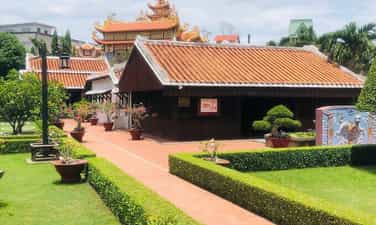
Duc Thanh School Where teacher Nguyen Tat Thanh (Uncle Ho's name at the age of 20) taught in 1910, before going abroad to Saigon to find a way to save the country. Duc Thanh School, formerly known as Duc Thanh Hoc Hieu, was established in 1907. Located in Thanh Duc village, 39 Trung Nhi Street, Duc Nghia Ward, Phan Thiet City, the school is near Ca Ty River. wonderful and peaceful. Duc Thanh Hoc Hieu was born thanks to the patriotism of scholars and Confucian scholars in Central Vietnam. Construction funding came from the generosity of Mr. Huynh Van Dau and Lien Thanh Thuong Quan. All students here study for free. This is a private school with progressive teaching content in Binh Thuan province at that time. Lien Thanh Thuong Quan (Lien Thanh company) was a patriotic organization in the early 20th century. Operating in the economic field. Duc Thanh Hoc opened a class to teach patriotic content according to progressive ideology for children of patriots and poor workers, in response to the Duy Tan movement initiated by Phan Chau Trinh, Tran Quy Cap and Huynh Thuc Khang in Vietnam. Mid-term. Lien Thanh Company operated effectively, secretly contributing part of its finances to Phan Boi Chau's Dong Du movement. Lien Thanh commune, led by Nguyen Hiet Chi, invited many speakers to give speeches, including Phan Chau Trinh, causing a lively buzz. In particular, Duc Thanh school has trained a class of young people to study according to the new books and spirit. In 1910, Nguyen Tat Thanh was introduced by his colleague Truong Gia Mo and came to Phan Thiet to teach at this school. At that time, the school had about 60 students and 7 teachers teaching subjects: Chinese literature, French literature, physical education... One of the school's students was Nguyen Kinh Chi, son of Nguyen Hiet Chi, later a doctor. , Deputy Minister of Health of the Democratic Republic of Vietnam, National Assembly delegate of the 1st - 4th term, is a direct student of teacher Nguyen Tat Thanh. Nguyen Tat Thanh teaches second grade, mainly teaching Vietnamese and Chinese characters. During this time, in addition to the content assigned to teach, Nguyen Tat Thanh also spread love for his homeland, country and ancestral race to students. During extracurricular classes or free time, Nguyen Tat Thanh also leads his students to visit beautiful scenery in Phan Thiet such as Thuong Chanh beach, Thieng village cave, Duc Nghia village communal house. In February 1911, Nguyen Tat Thanh left Duc Thanh and Phan Thiet schools to enter Saigon. A year later, there was no one left in charge and for many other objective reasons, the school closed in 1912. The architecture of Duc Thanh school bears bold Asian traditions. The school has three houses, including two large houses for classrooms and one upstairs house. In the classroom, there are wooden tables and chairs below, and above is a blackboard for teaching. The school campus is a lush green garden, neatly and carefully cared for. To the right of the main house, is the Ngu house used as a boarding house for students and teachers. Ngoa Du Sao is an area for receiving guests and discussing poetry, located right behind the classroom and the Ngu House. On the school campus there is a well for drinking water. Source: People's Committee of Binh Thuan province
Lam Dong
10378 view
Rating : National monument
Binh Thuan Provincial Party Committee Base Relic Area
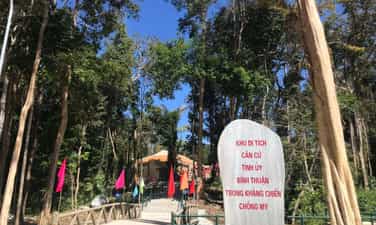
In Dong Giang's homeland, the heroic Ham Thuan Bac district has a revolutionary historical relic - the Sa Lon Provincial Party Committee Base Area. With an area of nearly 11 hectares, the Provincial Party Committee Base Relic Area in Sa Lon is both an educational address for patriotic traditions and national pride for the people and the young generation, as well as an attractive tourist destination. tourists inside and outside the province. Going back in history, after 1954, in the province, the enemy violently swept from urban to rural areas, many revolutionary bases were broken and loyal cadres were imprisoned. To ensure the safety of the Provincial Party Committee and continue to direct the resistance war, the issue of choosing a location to build the Provincial Party Committee Base was raised and was of vital nature. The Provincial Party Committee chose Sa Lon to build the base to ensure secrecy and safety. Sa Lon is a natural forest with a very important area, topography and strategic position, adjacent to the long coastal plain of Ham Thuan district. According to local Co Ho elders, Sa Lon means "Mother stream", the stream flows like a dragon. In the relic, there is a stream flowing through called Chin Khuc stream. During the resistance war against the US, the Binh Thuan Provincial Party Committee stood at more than 30 locations. At Sa Lon base alone, the Provincial Party Committee stood still 3 times over a period of more than 8 years (from December 1954 to June 1957, from mid-1961 to December 1964 and from September 1968 to August/ 1970) recorded many milestones and many important historical events such as: Conference to establish the Southern Vietnam Liberation Front in Binh Thuan province (October 1962); The First Congress of the Women's Union of Binh Thuan Province (1962) and the Second (1964); The First Congress of Emulation Soldiers of Binh Thuan Province (September 1964); Conference to establish the Provisional Revolutionary People's Committee of Binh Thuan province (June 1969), the 1st Binh Thuan Provincial Party Congress in the resistance war against the US (July 1970). In particular, on September 9, 1969, a memorial service for President Ho Chi Minh was held here with a portrait of him made of silk, wrapped in a frame, placed on the altar of a bamboo tree that is still preserved today. … With those special marks, the Provincial Party Committee Base Relic Area in Sa Lon was chosen by the Binh Thuan Provincial Party Committee as a place to restore, renovate, and embellish the original relics and build auxiliary items to preserve them. preserve and preserve the heroic and heroic revolutionary historical tradition of the Binh Thuan Provincial Party Committee in the resistance war against the US in particular, and of the Provincial Party Committee's History in general during the period 1954 - 1975. Can relic area The Provincial Party Committee headquarters in Sa Lon was ranked as a provincial relic by the Provincial People's Committee in October 2017. Construction on the relic site began on January 15, 2021, and was completed and put into use on February 2, 2023. The Provincial Party Committee base area includes the original relic area (civil items such as cellars, rest huts, hall, Hoang Cam kitchen, drainage ditch system...). The Sa Lon base relic site has 277 original artifacts, which are daily life items and combat equipment donated by veterans; Binh Thuan province also collected and found 219 original artifacts to display in the Memorial House. Since its construction, the historical revolutionary relic of the Sa Lon Provincial Party Committee base has had great significance in educating the young generation in patriotism and national pride. Source: Electronic Information Portal of Binh Thuan Province Party Committee
Lam Dong
5029 view
Rating : Provincial level relics

Chongshan Ancient Temple
Trung Son ancient pagoda is a monumental architectural complex created by monk Thich Buu Hien in 1973 at the historical site of Da Chong mountain (Phung Hoang mountain), in Ninh Hai district, Ninh Thuan province. Initially, the pagoda was just a simple Buddhist church on the mountain, a place where monk Buu Hien used every day as a place to practice, and also a place for relatives and Buddhists to visit, pray to Buddha, and pray for peace. Gradually, the small hut was expanded by the monk, adding additional items and miniatures to serve as a place to rest and enjoy the scenery for relatives and Buddhists from near and far when visiting the Buddha. Through the life of Venerable Thich Buu Hien, to the life of Venerable Thich Tam Tuong. The temple was built on an expanded area and grand scale, including many items such as the three-entrance gate, the main hall, the ancestral hall, etc. In 2012, due to budget constraints, the pagoda only completed the main item first. the temple, the ancestral temple, the courtyard, the three-entrance steps up and down... the three-entrance, miniature landscapes, the area for worshiping outdoor Buddha and Bodhisattva statues,... are still in the process of being completed. Due to the construction in mountainous terrain, it is difficult to distinguish between the front hall, the main hall, the main hall, the three-entrance gate or the ancestral church. That's why the overall pagoda project not only creates vividness with a unique architectural motif, but also creates complexity when identified. After more than 40 years of construction and completion. To this day, the pagoda has had three generations of abbots. These include: Venerable Thich Buu Hien (founder), Venerable Thich Tam Truong (second successor and also a disciple of Venerable Thich Minh Tam, senior brother Thich Buu Hien), Venerable Thich Nguyen Minh (current abbot, disciple of Venerable Thich Tam Truong). In general, the generations of abbots of Trung Son Pagoda all have the bond of "dharma sect". Trung Son Co Tu is more than 60m above sea level. The path leading to the pagoda is a steep, vertical three-step road with nearly 500 steps. Going to the end of the three-step road, the first scene that opens up is the three-entrance gate that is still being built in the pure Vietnamese ancient architectural style. Although not yet completed, when viewed as a whole, the Trung Son Co Tu three-entrance gate is a solid, durable and large project with materials made from concrete, reinforced steel and green stone. Passing the three gates, continuing up is the terrace below, with the highlight being many ornamental trees and a pair of majestic and powerful dragons of the Ly Tran Dynasty. From the terrace, going up the steps, is the architectural complex including the yard, main hall, ancestral church, guest house,... that three generations of abbots built. Ancient Trung Son Pagoda is also famous as a very sacred place as it is the home of two Zen pagodas Truc Lam Vien Ngo and the To communal house of Trung Khanh pagoda. This convergence represents a land of spiritual energy of heaven and earth. Source: Ninh Thuan Tourism
Khanh Hoa
10020 view
Rating : National monument

Thap Cham train depot relic
Thap Cham train depot is the infrastructure of the Railway Department established by the French, including: Station, maintenance and repair area for rolling stock, and civil servant housing area. Ninh Thuan people are familiar with the name Thap Cham train depot (in Do Vinh ward, Phan Rang - Thap Cham city today). Thap Cham train depot serves the transportation of passengers, goods, maintenance and repair techniques... It is known that the Trans-Vietnam railway has been operating smoothly since 1936. Before that, there were sections completed and in operation. For example, the Nha Trang-Thap Cham-Saigon railway has been in operation since 1903, and the railway from Thap Cham to Da Lat is 84 km long, including 16 km of cog railway, construction started from 1906 to 1996. 1933 started operations. With this characteristic, Thap Cham train depot was one of the best railway facilities in our country at that time such as Gia Lam (Hanoi), Ben Thuy (Vinh), Touran (Da Nang), Di An (Saigon). -Binh Duong)... According to historical data, with about 200 workers, Thap Cham Train Depot is a passenger station and a technical station that performs technical operations on locomotives, carriages and a number of other functions. Therefore, this is the place where many outstanding individuals from other provinces gather to work, from here they become the nucleus of propagating progressive political ideas. At the end of 1928, they established the Tan Viet Cell in Bao An village. In April 1929, the Tan Viet party changed into the Indochina Communist Federation, the Tan Viet party base in Ninh Thuan also changed its name and operated in a new direction. After February 3, 1930, the Communist Party of Vietnam was established. In April 1930, Tan Viet cells in Ninh Thuan transformed into Communist Party cells according to the general policy of the whole country, including the Decree Party Cell. - Thap Cham train station and Cau Bao Cell, Ca Na Salt Department Cell. From then on, the Party organization led the People's struggle, typically organizing protests on International Labor Day on May 1, 1930. Early in the morning of May 1, workers going to work saw the red hammer and sickle flag appearing on the top of the Thap Cham station water tower and on the ancient tamarind tree in Bao An village; Leaflets were scattered in many station areas and Bao An residential areas. At the same time, 120 Thap Cham Railway Depot workers held a rally to celebrate International Labor Day and asked employers to implement labor regulations. It can be said that, as soon as it was born, the Party cell at Thap Cham train depot organized a direct struggle with the French. With the above events and historical marks, Thap Cham Train Depot was recognized as a Provincial Revolutionary Historical Relic in 2003. Source: Ninh Thuan Newspaper
Khanh Hoa
10451 view
Rating : Provincial level relics

Nam Ba Temple
On February 28, 2023, Nam Ba Temple, Bao An ward, Phan Rang - Thap Cham city was ranked as a Provincial Historical Relic. Nam Ba Temple is a religious facility with important significance in the spiritual life of people in Bao An ward, Phan Rang - Thap Cham city. The temple not only has cultural historical value but is also associated with important revolutionary movements and resistance movements in Ninh Thuan province. During the August 1945 revolution, the Temple was a place for secret meetings of the Viet Minh government, a place for activities to hide revolutionary cadres, and a meeting place for local guerrilla militia. During the resistance war against the US (1954 - 1975), the Temple was the place to organize propaganda activities of the Party's revolutionary policies and guidelines, launch movements to participate in the resistance war to protect the Fatherland and many love activities. country, seeing off local children to join the army. When the country is at peace, the Temple is a place to organize community cultural and religious activities of local people. Today, every year at Nam Ba Temple, the Provincial Youth Union regularly organizes traditional activities and listens to veteran revolutionary comrades tell stories about the developments of the uprising to seize power in our province (August 21). /1945) for union members, young people, and students; Thereby, educating and fostering national pride, revolutionary ideals, and love for homeland and country in today's young generation. The ranking of Nam Ba Temple historical relics aims to establish the legal basis and improve the effectiveness of state management for preserving and promoting the values of historical - cultural and scenic relics above. provincial area; Protect the legitimate rights and interests of communities, organizations and individuals participating in cultural heritage practices at Nam Ba Temple. The Chairman of the Provincial People's Committee assigned the People's Committee of Phan Rang - Thap Cham city to directly manage, protect, repair, restore and promote the values of Nam Ba Temple according to regulations; At the same time, strictly prohibit all exploitation activities in the zoned relic area to provide inappropriate services; In special cases, using land at relics for other purposes must be permitted by the Chairman of the Provincial People's Committee. Source: Ninh Thuan Province Party Committee Electronic Information Portal
Khanh Hoa
7050 view
Rating : Provincial level relics

Hoa Lai Tower Relics
Hoa Lai Tower, an ancient tower is said to be one of the oldest Cham structures still in existence. Hoa Lai Tower is located right on National Highway 1A, in Ba Thap village, Bac Phong commune, Thuan Bac district, Ninh Thuan province. The tower was built around the 6th to 9th centuries, with unique artistic architecture of the ancient Champa kingdom of Panduranga region. Hoa Lai Tower was recognized by the Ministry of Culture and Information as a National Historical Monument in 1997. As of December 22, 2016, it was ranked as a special national monument. In the past, this place used to have three towers, so it was called Ba Thap, but due to the erosion of time and historical fluctuations, one tower collapsed. Indigenous people also call this tower Hoa Lai tower instead of the previous name Ba Thap. Different from the architecture of Po Klong Garai tower, the architectural style of Hoa Lai tower stands out with arched doors with many round noses, octagonal wall pillars with curved leaf-shaped decoration. Coming to Hoa Lai Tower, you will see with your own eyes the extremely delicate art of construction and sculpture of the Champa people. The tower is an architectural whole including the North tower, middle tower and South tower. Currently, only the central tower remains due to severe damage in the 9th century. This place is known as an ancient relic area with many auxiliary works surrounding the tower, but over time only a few remain. Traces remain such as city walls, brick kilns... The unique feature of the Hoa Lai tower cluster is the extremely sophisticated decorative style with patterned lines on the outside of the tower's face limited to the arches, pillars and roof frills. Each tower project has its own beauty but is built in extremely harmony with each other. The North Tower is built of bricks, with carved patterns on the walls of birds, animals, leaves, flowers... very impressive. In the East direction of the North Tower there is only one entrance, the remaining three directions are all fake doors. Inside the tower, there are triangular boxes to attach lights to when making offerings. The South Tower is the tallest, also built of bricks and carved with patterns on the walls but not yet completed. The entire tower body looks like a massive cube rising from a square base and supporting a system of smaller floors. After more than 1,000 years and many historical ups and downs, the beauty of Hoa Lai Tower still endures over the years and retains the unique artistic values in the architecture and sculpture of the ancient Cham people. Source: Ninh Thuan Tourism
Khanh Hoa
7512 view
Rating : Special national monument

Dac Nhon Communal House
Dac Nhon communal house is located in Dac Nhon village, Nhon Son commune, Ninh Son district, Ninh Thuan province. The communal house was built on a large, flat plot of land. In 1999, Dac Nhon Communal House was recognized by the Ministry of Culture, Sports and Tourism as a National Historical Site. According to the relics profile of the Ninh Thuan Provincial Museum, Dac Nhon communal house was built by a Chinese monk who came to Phan Rang in the 18th century named Venerable Lieu Minh - Duc Tang. When first built, Dac Nhon communal house was just a small temple named "Dak Nhon Tu Mieu". The mystery has existed for hundreds of years and no one can explain why the Dac Nhon communal house of the Vietnamese people worships King Po Klaong Garay of the Cham people? And the fact that King Po Klaong Garay of the Cham people became the royal god in the Vietnamese communal house is a very unique cultural exchange phenomenon. The people of Dac Nhon village still pass down the story that, in the past, the land they live in belonged to Champa. To show gratitude to the wise ancestors who cleared the wasteland and brought water to the fields, they worshiped him to pray for peace and prosperity, and in times of trouble, prayed for his blessing and protection. Through 6 generations of Nguyen Dynasty kings, Dac Nhon communal house was honored to be awarded 7 times from the reign of King Minh Mang (1840), to King Khai Dinh (1924). Among them, during the reign of King Thieu Tri, two awards were given. Thus, Dac Nhon communal house has a total of 8 ordinations. The content of the ordination papers said that the god emperor who was worshiped by the people at Dac Nhon communal house was named "Lac Phien Duong Than", also known to the people as King Lac. Architecturally, Dac Nhon communal house fully demonstrates the criteria of a traditional communal house. However, the architecture of Dac Nhon communal house has the appearance of a traditional Cham house consisting of 3 main rooms. In the main hall, there is a counter placed in the north-south direction, looking up at the ceiling is the ancient floor made of wooden planks woven together like the Lemlir curtain symbol symbolizing the sky in Cham culture or the Thang Sa symbol. Appears in the architecture of Po Klaong Garay temple tower, used to hang the Panil ceremony curtain when offering offerings in the temple tower. The traces and talented hands of the craftsman are still imprinted on the carvings and sculptures in the religious architectural work of Dac Nhon communal house, a living proof of Vietnamese - Cham cultural interference. The fact that a Cham king became a god emperor worshiped in a Vietnamese communal house is a strange and unique phenomenon that reflects the exchange and acculturation of Vietnamese - Cham culture. Vietnamese people worship King Po Klaong Garay with the name Lac Phien Duong god, who in folklore is called King Lac. At the same time, Vietnamese people also created more ideas about King Lac's origin from Cham people's fairy tales to suit Vietnamese concepts and thinking. When worshiping King Po Klaong Garay at the temple tower, Cham people offer goats and chickens. When adopting Cham culture, every year the offerings at Dac Nhon communal house always included a goat. Thus, the Vietnamese - Cham cultural borders in worshiping the gods and building houses further enrich the cultural value systems of the two nations. Source: Website of Cham Cultural Research Center
Khanh Hoa
6670 view
Rating : National monument