Tourist destination

Nam Rut Waterfall
Nam Rut Waterfall - a place likened to a sleeping princess in the forest, is one of the tourist destinations in Thai Nguyen that young people are "rushing" to explore this summer. The "attracting" point of the waterfall is the green, fresh natural space and the dreamy beauty of a natural waterfall in the legendary land of tea. Nam Rut waterfall is located in Than Sa commune, Vo Nhai district (Thai Nguyen), so if you choose this location to avoid the heat, the journey to explore here will not be too difficult. Tourists can travel by motorbike or car depending on their own needs and preferences to make the journey to explore and travel to Nam Rut in the direction of Highway 3 or along Highway 1 to move from Hanoi to Thai Nguyen. In addition, if starting from Hanoi and do not want to travel by other means, visitors can also choose the train - an interesting choice to explore the Hanoi - Thai Nguyen route. If you follow provincial road 242, visitors will see many natural scenery here. Typically, the quiet hills or the beautiful winding Rong/Nghinh Tuong river. The most prominent are the eye-catching tea hills, giving visitors the feeling of being lost in a cool green world that can only be found in the legendary land of Thai Nguyen. On the way to Nam Rut waterfall, visitors will see the Rong/ Nghinh Tuong river famous for its clear blue water. Along this river are images of small fishing boats diligently casting nets. All create a very attractive natural scenery that everyone who sees it will fall in love with. The emotion of looking at the landscape paintings here will make your soul more open, happy and loving life. After following this route, visitors will reach Nam Rut waterfall in Thai Nguyen - a place considered like a sleeping princess in the forest. Hidden deep in the cliffs, Nam Rut Thai Nguyen waterfall possesses a very special, pristine and attractive beauty. In the rainy season, in the middle of majestic mountains, on top of limestone mountains with many forest trees, streams of white water rush down the Nghinh Tuong river, creating a large waterfall. All around this waterfall are surrounded by forests and mountains, the sound of falling water is really pleasant. If you come here in the fall, you will see the image of water pouring from above, whitening the entire sky. All blend together to create an extremely interesting orchestral music of this Thai Nguyen mountainous region. “The image of white water flowing down makes us feel relaxed and carefree. This place not only brings feelings of peace and quiet but also gives me the feeling that there is only nature and people surrounding each other without any noise, hustle and bustle of everyday life. The dreamy beauty of Nam Rut will make me fascinated and just want to stay forever" - Ms. Tran Tuyet Nhung (Tran Nhan Tong, Hanoi) expressed. "Nam Rut will definitely be the ideal destination for a weekend getaway for those who love to travel" - shared Mr. Nguyen Thang, a tourist from Dong Da (Hanoi). At the same time, Mr. Thang said that for those who love to participate in excursions and explore the beauty of amazing nature, Nam Rut waterfall will be a great choice. We will discover many interesting things here, because this waterfall is very magical and has a unique shape, it is a mixture of many different waterfalls with water spraying down into blurry white foam. Virtually beautiful like a fairyland. All create small streams of water flowing down below that look even more attractive and interesting. Along the riverbank are large, undulating rocks so visitors can sit and fish and enjoy the scenery. Here you will see life absolutely separate from the outside world. Also according to Ms. Nhung, if in the dry season, in Nam Rut, the water is only enough to seep through the moss on the cliffs, falling into the green river, creating sparkles all over the river surface under the golden sunlight, making the scenery of Nam Rut memorable. So beautiful, strange and rare. If you explore Nam Rut waterfall in Thai Nguyen in the dry season, the water at the waterfall only has a single small stream. However, in this season, visitors can also participate in fishing experiences or sit on large rocks at Nam Rut Thai Nguyen waterfall to admire the scenery. Sitting and admiring the scenery and breathing the green air here also makes visitors feel more relaxed. In particular, the scenery here will bring a more comfortable and relaxing feeling. You will feel that coming here is the right decision for your vacation and that of your loved ones.
Thai Nguyen
6304 view


Museum of Cultures of Vietnam's Ethnic Groups
Thai Nguyen was considered the land of "the capital of thousands of winds" during the resistance period. Coming to this place, we have the opportunity to find the origin of humanity with the Nguom Than Sa Stone Roof, with the majestic wild Duom Mountain, immerse yourself in the romantic love story of Cong and Coc... And one of Addresses not to be missed are the Museum of Cultures of Vietnam's Ethnic Groups - a place that preserves the identity of the Vietnamese ethnic community. About 80km from Hanoi, the Museum of Vietnamese Ethnic Cultures is located at 1 Doi Can, Thai Nguyen city. The museum was established in 1960 with the original name Viet Bac Museum. In 1990, it changed its name to the Museum of Cultures of Vietnam's Ethnic Groups and became one of the 7 National Museums of Vietnam. Built on a 40,000m² campus next to the romantic Cau River, at the intersection of Doi Can, Hoang Van Thu, Bac Kan and August Revolution streets, the Museum of Culture of Vietnam's Ethnic Groups is A large-scale architectural work with many artistic features, it won the Ho Chi Minh Prize for architectural works in the first phase of 2006. After more than 50 years of establishment and development with hundreds of research and collections, the Vietnam Museum of Ethnic Cultures is managing nearly 30,000 valuable documents and artifacts, which are the basis for perfecting the system. Indoor and outdoor display systems, well serving the public's visiting needs. Entering the Museum grounds, we will stop at the Solemn Pavilion. This place introduces general features of Vietnamese culture. In the large lobby, we can see the portrait of President Ho Chi Minh, the beloved leader of the Vietnamese people. The person holds three babies, representing the three regions: North - Central - South. The statue represents Uncle Ho's boundless love for the children of the three regions, while also demonstrating the policy of unity, diversity and solidarity of the Vietnamese people. Behind the statue of Uncle Ho is a large relief carved in wood simulating typical traditional festivals of ethnic groups from North to South: Khen dancing in the highland market, lion dancing in the spring festival in the valley, festivals Ka Te of the Cham people, buffalo stabbing festival of the Central Highlands people and ngo boat racing festival of the Southern people. Next, visitors will take turns visiting a system of 5 galleries including: Displaying and introducing the culture of ethnic groups of the Vietnamese - Muong language group (Kinh, Muong, Tho, Chut). The people live mainly by growing rice and fishing. In spiritual life, there is the custom of worshiping ancestors and traditional crafts are developed at a high level; Display and introduce ethnic groups of the Tay - Thai language group (Tay, Thai, Nung, Giay, Lao, Lu, San Chay, Bo Y). The people live mainly in stilt houses, grow rice in valleys, along rivers and streams, with a water supply system of ditches, ditches, cans, cans, and water troughs. The crafts of blacksmithing and weaving are quite developed with beautiful and delicate products. In particular, they have a rich spiritual life with many unique xoe dances and then songs; Display and introduce the culture of ethnic groups belonging to three language groups: Hmong - Dao (Hmong, Dao, Pa Then), Ka Dai (La Chi, La Ha, Co Lao, Pu Peo) and Tibetan Burmese (Lo Lo, Phu La, Ha Nhi, La Hu, Cong, Si La). The people are good at farming on upland fields and terraced fields. The market is a place to clearly express the cultural identity of the highlands, culinary culture, clothing culture, embroidery art, flower printing, music performances, flute dancing... Display introduces the culture of 21 ethnic groups belonging to the Mon - Khmer language group (Ba Na, Brau, Bru - Van Kieu, Cho Ro, Co, Co Ho, Co Tu, Gie Trieng, H're, Khang, Khmer , Kho Mu, Mang, Xinh Mun, Mnong, O Du, Ma, Ro Mam, Ta Oi, Xo Dang, Xtieng). The people reside scatteredly in the Northwest, Central Highlands and Southern regions. The economic life is mainly slash-and-burn cultivation, which is at a relatively high altitude, and fields are cultivated using the method of poking holes and planting seeds. Architecture of communal houses in the Central Highlands and pagodas of the Khmer people; Wicker crafts and community cultural festivals are unique cultural features of Mon - Khmer residents; Display and introduce the culture of ethnic groups belonging to the Austronesian language group (Cham, Gia Rai, Ede, Raglai, Chu Ru) and Han language (Hoa, Ngai, San Diu). Ethnic groups belonging to the Austronesian language group reside concentrated on the red soil plateaus of the Central Highlands and the Central coastal strip; Austronesian culture is strongly matriarchal. Ethnic groups belonging to the Han language group reside in all three regions: North, Central, and South; Han culture is strongly patriarchal. Each gallery with a rich and diverse system of documents and artifacts realistically recreates the residential landscape and cultural life of 54 ethnic groups, from the northern tip of Ha Giang to the cape of Ca Mau. with familiar images such as: highland markets, wild elephant hunting scenes, images of hole-punching and seed removal of northern ethnic groups, gong festivals of the Ede and Ba Na people in the Central Highlands; rivers and waters of the Southern people; traditional crafts, forms of cultural activities in costumes, music, cuisine, festivals in labor production... A special highlight of the Museum is the outdoor display system with spaces of 6 cultural regions: Northern high mountains, Valley, Midland - Northern region, Central region - Coastal region, Truong Son - Central Highlands, and Dong Nai. Nam Bo will bring very interesting experiences to visitors. Each cultural region has a festival space, a landscape structure with regional characteristics and a specific, original house as a highlight to introduce Vietnamese cultural values to visitors. . Here, visitors can also easily see with their own eyes many very familiar tools of the nation from ancient times such as a rice mill woven from bamboo slats, a plow made of rudimentary trees, thatched roofs, mud walls... It can be said that the Museum of Vietnamese Ethnic Cultures in Thai Nguyen is like the "common roof" of the community of 54 ethnic groups on the S-shaped strip of land. Visitors will have the opportunity to admire a panoramic picture. , learn about the origins, traditions, and cultures of ethnic groups across the country. Along with the Nui Coc Lake Ecotourism Area, the ATK Safe Revolutionary Base, the Museum of Cultures of Vietnamese Ethnic Groups has been and will be an attractive destination for all domestic and foreign tourists.
Thai Nguyen
7013 view


ATK Resistance Safe Zone
Dinh Hoa (Thai Nguyen) - where 76 years ago (1947), President Ho Chi Minh and the leaders of the Party Central Committee and the Government chose to be the place to establish a safety zone (ATK), where important and landmark decisions of our Party were born during the August Revolution and the resistance war against the French colonialists. Journeying to historical places in the relic complex on historic autumn days, every Vietnamese person will feel the historical imprints and Uncle Ho's teachings still echoing somewhere. The first impression when arriving at ATK Dinh Hoa is a semi-mountainous land with mountainous terrain mixed with fields, streams, and villages of the Tay ethnic people. Cho Chu Valley is surrounded by rolling rocky mountains that look like sturdy, fortified trenches. Here, when stopping at dawn on May 20, 1947, Uncle Ho realized the advantages of the terrain to choose secret operating locations. Uncle Ho affirmed: "If there are good people and a good political base, there is a place where "advancing can attack, retreating can defend" (advancing can attack, retreating can hold). In particular, when choosing Tin Keo hill in Na Lom village, Phu Dinh commune (Dinh Hoa) as a place to set up a base, Uncle Ho affirmed: "Up above there are mountains, below there are rivers/There is land we can plant, there is a beach we can play on/Convenient way to the Ministry of General/Thuan The way to the Central Government/The house is airy, dry, with a closed roof/Near people, not near the road". Therefore, among the hundreds of relics in the ATK Dinh Hoa Special National Historical Relic Area, every location is associated with the image of Uncle Ho, comrades in the Party Central Committee and the Government and historical events during the arduous years of resistance. Historical places have left their mark in the ATK Dinh Hoa relic area such as: Chu Market, Hang Pagoda, Khau Ty hill, Khuon Tat waterfall, De pass, Hong mountain, Diem Mac, Dinh stream, Dinh Bien, Bao Bien, Pu Don hill, Tin Keo, the stilt houses where Uncle Ho lived and worked, AKT exhibition house... During the revolutionary activities at ATK Dinh Hoa, Uncle Ho along with the Party Central Committee and the Government outlined the strategic path for the nation's long-term resistance war. In particular, Uncle Ho drafted the "Modification of working style", chaired the Politburo meeting to approve the Winter - Spring campaign plan of 1953 - 1954, determined to destroy the Dien Bien Phu stronghold group, successfully ending the nation's long, arduous 9-year resistance war. During the arduous days of the resistance war, Uncle Ho's poem "Night Scene" was born in the mountains and forests of Dinh Hoa: "The sound of a stream is as clear as singing in the distance/The moon of ancient trees, the shadow of flower cages/The late night scene is like a painting, people have not slept yet/Not sleeping because of worries about the country." Today, at Hang Pagoda (Cho Chu Town), Uncle Ho's altar is placed in a solemn position with infinite respect. It was here that Uncle Ho lived in 1950 to direct the Winter - Spring war of 1953 - 1954.
Thai Nguyen
6277 view


Nui Coc Lake
Located in Thai Nguyen province, Nui Coc Lake tourist area is one of the most attractive destinations in the Northern region. This large eco-tourism area is about 16 kilometers from Thai Nguyen city center, and about 70 kilometers from Hanoi centers. Nui Coc Lake is an artificial lake, with an area of up to 25 hectares, with 89 large and small islands in the lake, creating a poetic natural landscape. Along with the touching love story of Nui Coc Lake between Coc and Cong, this place becomes more attractive than ever. Not only that, the tourist area also has many unique attractions for you to explore. Thai Nguyen is a northern province of Vietnam, so the weather here also changes according to the four seasons of the year. According to Klook's experience, traveling to Nui Coc Lake is most beautiful from March to September. During this time, the weather in Thai Nguyen is sunny, little rain, very suitable for participating in outdoor activities. Besides, this is also the time when Nui Coc Lake tourist area organizes many art and entertainment activities, creating a vibrant atmosphere for this place. The remaining months fall in winter, which is the cold season in Thai Nguyen, not suitable for outdoor entertainment and exploration activities. However, if you just want to find a resort with pure nature, Nui Coc Lake is still a suitable choice. Coming to Nui Coc Lake, you can participate in experiences such as: Playing at the Water Park, enjoying water music performances, visiting wildlife gardens, visiting caves,... and many other attractive experiences.
Thai Nguyen
6240 view


Mau Son
Coming to Mau Son, visitors can not only see the floating clouds wrapping around the mountains but also the golden terraced fields during harvest time. Mau Son is one of the few places in Vietnam where snow and ice appear in winter, creating extremely impressive multi-colored paintings. Mau Son is located in 3 communes: Cong Son, Mau Son, Cao Loc district and Mau Son, Loc Binh district, with a total area of 10,470 hectares. The highest area of the Mau Son mountain range is about 30 km east of Lang Son city center, less than 180 km from Hanoi capital, and close to the Vietnam-China border. This is the highest mountainous region of Lang Son province and in the Northeast region of our country, with an average altitude of 800 - 1,000m above sea level, including a complex of about 80 large and small mountains. The highest peaks are Phia Po (Father Mountain) at 1,541m high, Phia Me (Mother Mountain) at 1,520m high. Mau Son's climate is typical of the subtropical and temperate regions with an average annual temperature of 15.6 degrees Celsius with 2 distinct seasons. Summer is from April to October, the weather is cool, the average temperature is from 16 - 21 degrees Celsius. Winter is from November to March of the following year, with an average temperature from 7.2 - 13.2 degrees Celsius, the coldest year is -5 degrees Celsius, often covered with fog, with ice and snow on cold days. This is a famous tourist destination of Lang Son province, an ideal resort attracting hundreds of thousands of tourists each year. Many people think that traveling to Mau Son must be in the summer to be beautiful. In addition to bathing in waterfalls, they can camp in primeval forests with fresh, cool air. But after going a few times, visitors will realize that there are four seasons of beauty here. If spring is the season of festivals, the season of pear, plum, and peach blossoms blooming, then autumn is with golden waves of majestic terraced fields, pristine forests changing color, and winter is mountains and villages shy in the clouds. Visitors to Mau Son in April - May every year will see people working the land and cultivating rice on terraced fields interspersed with hillsides and among anise forests. Around June, Mau Son becomes an ideal tourist destination to avoid the heat. In the photo, there is a 3 km traffic jam on the opening day of the Mau Son Tourism Festival taking place in June 2019. In addition to bathing in the waterfall, camping in the forests to enjoy the fresh air, visitors can admire hydrangeas, a typical flower on Mau Son that blooms every summer. From July to August, the terraced fields are in harvest, creating an impressive picture of the golden season. The most beautiful cloud season in Mau Son is from December of the previous year to March of the following year. Because of this period, the temperature is extremely ideal for the accumulation of clouds. Viewed from above, Mau Son appears with rolling mountains and hills, interspersed with narrow valleys. With a mother mountain peak of 1,520 m high, in winter, Mau Son is always submerged in clouds. Clouds wrap around the mountains. Clouds swoop down into the primeval forest, crawling into the leaves. Clouds move with the wind. Not only that, the clouds this season are very quiet, you can admire a beautiful scene created by thousands of clouds. Mau Son is beautiful all year round, but spring can be said to make people ecstatic. At this time, the mountain takes on the shape of a beautiful princess changing into a colorful dress. The tender and passionate red peach blossoms are a bit passionate but even more seductive, making visitors who arrive in the spring surprised. Mau Son peach blossoms are single-petaled peach blossoms, more fragile and special than peach blossoms anywhere else. They have a strange vitality, clinging deep to cliffs and enduring the harshest climate, growing up drinking dew and wind, just waiting for spring to show off their sweet beauty in the middle of the wild.
Lang Son
6863 view


Nhi Thanh Cave
Nhi Thanh Cave is located on Nhi Thanh Street in Tam Thanh Ward, Lang Son City, part of the most famous relic complex in Lang including: Nhi Thanh Cave, Tam Thanh Cave, Mac Dynasty Citadel and To Thi Mountain. The cave is marked by majestic stalactites thousands of years old, and is also one of the spiritual destinations that attracts tourists in Lang Son city. Nhi Thanh Cave has a length of about 500 m, discovered by famous man Ngo Thi Si when he worked as a governor here. The cave is quite large, inside many different large and small passages, in the middle of the cave is Ngoc Tuyen stream flowing through. Nhi Thanh Cave relic area has two main parts: Tam Giao Pagoda and Nhi Thanh Cave. Tam Giao Pagoda worships 3 people: Shakyamuni Buddha, Confucius and Lao Tzu, located on the right, hidden in the rocks, at a higher position than the cave entrance. The altar to worship famous person Ngo Thi Si is located at the entrance to the cave. Above the wall is a carved picture of his leg in a sitting position leaning against the cliff. Nhi Thanh Cave still retains many stone inscriptions engraved on the cave walls, the content mainly praising the landscape, people, and the process of discovering and embellishing the cave by predecessors. Nhi Thanh Cave is very easy to explore. The paths inside are spacious and easy to walk. The deeper you go inside, the wider the road becomes. Stalactites of various shapes hang down from the ceiling and walls of the cave, making the cave look wild and mysterious. The "Stage" area is located in the middle, has a spacious flat floor, and above the ceiling there are "Heavenly" doors leading to the outside to welcome natural light. This is considered the most beautiful place of the cave. Stalactites appear everywhere, named after their shapes and inspired by old stories.
Lang Son
7071 view


Bac Le
Ancient Bac Le Temple was built in 1919, located on a high hill, about 10 km from Huu Lung town. Like any Mother Goddess Temple, Bac Le Temple worships the Council of the Four Palaces and worships the Spirits in the four regions of the universe, but here has a unique feature of paying special attention to the worship of gods associated with the locality such as Mother Goddess, little girl, little girl... gods who provide wealth in the mountains and forests, so Bac Le Temple is close to folk beliefs, friendly to indigenous people, the Temple has even become a community living place. Coming here, visitors will feel like they are bathing in the wild scenery of the mountainous region to feel more peaceful, like immersing themselves in nature to temporarily forget about daily worries. Mr. Nguyen Van Tuan, a tourist in Hanoi who has often gone to Bac Le Temple for many years, confided: "I am a person who, whenever I have the opportunity, always go to Bac Le Temple to worship... I honestly feel that this is The culture is very pure Vietnamese. If the agencies or temples manage in the right direction, it will be very good, avoiding superstition..." Coming to Bac Le, visitors can easily see that nature has cleverly gifted Bac Le with a charming space amidst the mountains and forests. People go to the ceremony not only to burn incense, offer prayers, pray for fortune, wealth, peace, success, and fame, but also to admire the scenery of the mountainous region. Although it has undergone 5 renovations and embellishments, the ancient architecture is still intact and bears the mark of folk sculpture. The solid wooden columns still retain their original features, adding to the warmth and sacredness of the Temple. As a spiritual tourist destination in Lang, many tourists from all over make pilgrimages to worship, but the current narrow space of the Temple no longer meets the needs of tourists, and the road to the Temple is narrow, causing obstructions. hinders the ability of tourists from all over to visit. The Relics Management Board is submitting an application to the Ministry of Culture, Sports and Tourism for a license to recognize Bac Le Temple as a national historical and cultural relic to be worthy of the spiritual place of Lang. According to people's beliefs, Bac Le is one of the country's two sacred Mother Goddess Temples, so many domestic and foreign tourists come to pray for good luck. The main festival of Bac Le Temple is held on the 20th day of the 9th lunar month, but with the uniqueness of the charming mountain and water landscape, Bac Le is always crowded with visitors from all over to visit and celebrate.
Lang Son
6365 view


Dong Kinh Market
Dong Kinh Market is a place for trading between small traders and large industrial and commercial enterprises between the two boundaries of Vietnam and China. The market is also the largest shopping and business center in Lang Son city. The market operates all day, always bustling and crowded, especially in Thap De and January, when festivals take place in Lang Son city and in the whole Lang Son province. The market is surrounded by 4 main roads: Phai Ve, Nguyen Tri Phuong, Ba Trieu and Nguyen Du so it is very convenient for transportation. The market has 3 floors with each floor selling different items: the 1st floor sells electronics, the 2nd floor sells groceries, and the 3rd floor sells fashion. It can be said that, with its location near the Vietnam - China border, Dong Kinh market has an extremely wide variety of products and designs. This place is known as "Shopping Paradise" for shopping fanatics. Customers do not need to worry about their wallets because Dong Kinh market sells goods at moderate prices, not expensive. Most of the sources here come from China and Vietnam. When it comes to cuisine in Lang Son, especially at Dong Kinh market, you definitely cannot miss the specialty dishes here: egg rolls, fried rice cakes, sour pho, dumplings, roasted pork, bamboo-tube rice,... These dishes are sold in the market or outside the market, so you can easily find and buy and taste the typical flavors of this Vietnamese-Chinese market. Because the market sells a variety of goods, be careful and delicate in bidding because there is no standard or fixed price. In particular, with Chinese products, you need to evaluate and review carefully before buying to avoid buying fake or poor quality products. In addition to items originating from China, Dong Kinh market also sells many items 100% originating from Vietnam such as brocade items handcrafted directly by the hands of ethnic minorities. Those are great gifts that you can buy as gifts for relatives and friends.
Lang Son
8193 view


Dong Dang Mother Temple
Dong Dang Mother Temple in Lang Son is a sacred temple, with great value in terms of religion, history and belief. Surely this will be a spiritual cultural tourism destination that you cannot miss when coming to Lang. Dong Dang Mother Temple worships Buddha and Saint Mother Lieu Hanh. This place is considered one of the most sacred temples worshiping Mother Goddesses of the Vietnamese people. Since ancient times, the temple was also known as "Dong Dang Linh Tu". According to historical records, Dong Nam Mau Temple was originally a pagoda located on a rock roof close to the foot of the mountain. Because it is famous as a sacred temple and is visited by people from all over the country for pilgrimage, the worship space is increasingly cramped. Since then, local people have moved the temple to its current location. People have passed down since ancient times that Lieu Hanh is the daughter of the Jade Emperor, whose name is Quynh Hoa. She had a deep bond with the world, so she often appeared to help her people. The court of the Later Le Dynasty ordained her as Princess Lieu Hanh, the Supreme God of Phuc. One day, she traveled and stopped at the land of Lang Son - a place with beautiful landscapes of mountains and water. The princess saw an abandoned temple in the dense forest, the Buddha statue had no incense smoke. Then the princess met Phung Khac Khoan and reminded Trang Bung to repair the temple. Afterwards, the pagoda was renovated and became a place to worship Buddha and the sacred Mother Goddess. Dong Dang Mother Temple owns a spacious campus, located close to the foot of the mountain. The Three Entrance Gate part was built with majestic ancient architecture, the door is built with a rolling arch, has a main door and 2 side doors. The gate is decorated with many unique motifs and patterns. The top of the three-entrance gate has a bronze bell and a bronze bell. Coming here, you will be able to admire the beauty of Dong Dang Mother Temple, leaving behind the noise and bustle of the city you live in. Return to Lang, visit the ancient and sacred temple, and enjoy moments of relaxation and comfort. It will definitely bring you interesting experiences and a happy and healthy spirit.
Lang Son
8410 view


Chi Lang Pass
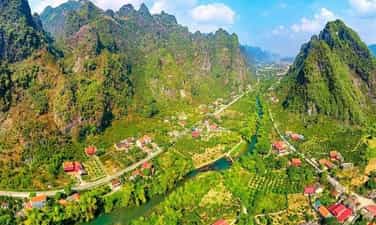
Chi Lang Pass is a famous tourist destination. If you come to Lang Son, you definitely cannot miss this place. This place is associated with the heroic historical marks of our nation in the fight against foreign invaders. At the same time, it also possesses majestic mountain beauty bestowed by nature. Chi Lang Pass is a historical relic deeply engraved in the subconscious of the Vietnamese people, it appears in poetry and is passed down from generation to generation. Located about 150km from Hanoi, the pass is large and massive, running nearly 20km long. It connects Chi Lang and Huu Lung districts of Lang Son province. Looking down from above, Chi Lang Pass appears with towering rocky mountains, typically the Kai Kinh rocky mountain range in the West and Bao Dai Mountain in the East. All create a solid framework to protect the safety of Vietnam's northern border, supporting the Vietnamese people in protecting their territorial sovereignty and fighting against foreign invaders from ancient times to the present. Chi Lang Pass and our army and people have gone through many ups and downs in history, blocking expeditions from the North. The gate is associated with military activities from the reigns of Ly Thuong Kiet, Tran Quoc Tuan... and is famous in history. In addition to historical relics, visiting Chi Lang Pass, you can also see with your own eyes a majestic natural picture, a bit poetic but also very close and dear. Especially the high mountains, rugged terrain with trapezoidal battlements that are "unique" in the world. Surely this will be a great tourist destination for activities to experience and explore Vietnamese history from time to time. And it's also an opportunity to relax in cool, fresh nature. Besides, you can also experience the wonderful dishes typical of Lang Son people such as roasted pig and roasted duck.
Lang Son
8780 view


