Relic point Vietnam
Việt Nam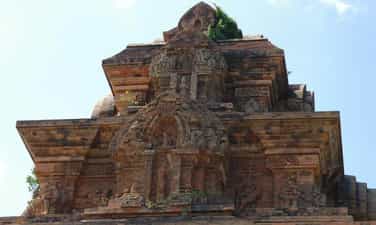
Binh Lam Tower
Binh Lam Tower is an ancient Champa tower in Binh Lam village, Phuoc Hoa commune, Tuy Phuoc district, 22km from Quy Nhon City. This is a relatively special tower in Binh Dinh, because unlike other towers located on the hill, the Binh Lam tower is located right in the plain and as immersed in nature and the surrounding residential area. The tower has a square jar, each side is about 10m, about 20m high is divided into 3 floors, delicate pattern decoration, architecture in harmony with the lines that are both stared and strong. The tower was ranked as an architectural monument in 1993. Source of electronic portal of Binh Dinh province.
Gia Lai
6243 view
Rating : National relics.
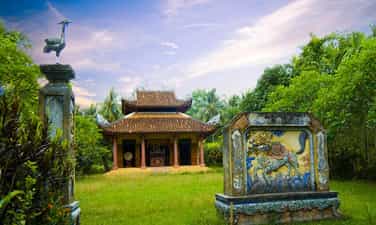
Dao Duy Tu Temple
Dao Duy Tu (1572-1634) is a historical figure of the 17th century, a person who proved excellent in many economic, political, military and cultural fields. Dao Duy Tu was born in 1572 in Tinh Gia government, Thanh Hoa (ie Tinh Gia district, Thanh Hoa today). As a master of history books, physics and tactics, but due to being restrained under the Le-Trinh dynasty, he did not allow him to enter the gate (a bachelor's degree) because he came from a dual family. species), so Mr. Uat Chi left in Dang Trong to start a career. It was in 1625, when Dao Duy Tu was 53 years old. When he first entered the South, due to many difficulties in his life, he had to hide himself at a buffalo for the rich family to wish Trinh Long in Bo De commune (now in Bong Son town, Hoai Nhon district in Binh Dinh province). Because of the talent of Dao Duy Tu, the examination of Tran Duc Hoa had married his daughter and advocated Dao Duy Tu for Lord Sai Nguyen Phuc Nguyen (Quan Ly Tran Duc Hoa (also known as Cong District Cong). And also brothers and sisters with Lord Nguyen Phuc Nguyen (also known as Thuy district). Lord Nguyen returned to the military, political, cultural organization and successfully confronted Trinh Lord in Dang Ngoai and was liked by Lord Sam as Ngoi Long Gia Cat (Khong Minh). Products, poetry and the ancestor of the art of drama, famous for the two songs, "Ngoi Long Cuong Van" and "Tu Dung Van". Co ", considered one of the two sets of military art books (the other work is" weak soldiers ") of Vietnamese people. He lost the year of Giap Tuat (1634), aged 62 years old. After dying, Lord Sinh was awarded "The Youth Union of Duc Cong Than, especially the Golden Golden Golden Loc Phu" for worship in Thai Mieu. Coming to the Minh Mang dynasty, Dao Duy Tu was ordained the title of "University of Sy - Master Hoang Quoc Cong" and set up a temple at his residence - now Ngoc Son village, Hoai Thanh Tay commune, Hoai Nhon district, province, province Pacify. The temple today retains its campus and is still worshiped and preserved by the local people and the local people. On October 15, 1994, Dao Duy Tu temple area was recognized as a national historical monument. Source of electronic portal of Hoai Nhon town, Binh Dinh province.
Gia Lai
6550 view
Rating : National relics.

Mo Dao Tan
Dao Tan (Dao Dang Tien, Dao Tien), self -ending, Mong Mai, Mai Tang, born in the year of the Snake (in 1845). Mr. hometown of Vinh Thanh village, Tuy Phuoc district, now belonging to Vinh Thanh village, Phuoc Loc commune, Tuy Phuoc district, Binh Dinh province. He passed a bachelor's degree in Dinh Mui (1867), 4 years later, King Tu Duc invited him to the Hue court signal, specializing in the plays under the king's order. In Giap Thin (1904), he retired after holding the position of the Ministry of Public Affairs. He was a famous patriot Thanh Liem, and a poet, editor and excellent drama director of Vietnam in the late nineteenth century and early twentieth century. With great contributions, Dao Tan was worshiped as the "post -ancestor" of Vietnamese classical art. Mo Dao Tan was started after he died in his hometown on July 15, 1907 (19th year of Thanh Thai) according to the national court ritual. His tomb is located on Huynh Mai Mountain (Hoang Mai) in Huynh Mai village, Phuoc Nghia commune, Tuy Phuoc district, 15 km from Quy Nhon city. Mo looked south, towards the village where he used to live. The tomb of Dao Tan is 3 meters long, 2 meters wide, in front of the tomb, there is a stele at the time of setting up a tomb and Binh Phong. Around the tomb is a rounded rectangular campus, before the gate, the back has a letter with a letter. Before and after the tomb, there were 4 lions standing adoration, the tail was raised upwards, and the face looked out in the main direction. This monument was ranked by the Ministry of Culture and Information on January 24, 1998. In 1994, the Department of Culture and Information of Binh Dinh coordinated with the People's Committee of Tuy Phuoc district and Phuoc Nghia commune to reinforce and relocate Dao Tan tomb based on the original. Today, the Mo Dao Tan relic is the sightseeing place for tourists from near and far to admire the artist who has dedicated to the art, where the incense offering the talented celebrity of the country by the Culture - Culture industry - News of the province and People's Committee of Tuy Phuoc district held on July 15 of the lunar calendar every year. Source of electronic portal of Binh Dinh province.
Gia Lai
5961 view
Rating : National relics.

Nhan Son Pagoda
Nhan Son Pagoda is called Ong Da Pagoda, located in Bac Nhan Thap village, Nhon Hau commune, An Nhon town, 23km northwest of Quy Nhon city. The temple is located under a shadow of a mango garden, leaning against Long Cot mountain, in front of a lotus lake with poetic scenery. Nhan Son Pagoda has a great value in history and art, which is the loser between the indigenous and Vietnamese culture, which is more especially the two giant sandstone statues worshiped inside the temple campus - A Cham sculpture. These are the two dvarapalla statues (subjects) with the meaning of the guardian of the Dharma, standing symmetrically 2.3m very vivid. The sculpture art has a typical style of Champa sculpture art in the 12th century, XIII. Two stone statues are painted black and red symbolizing Mr. Thien and Mr. Evil in the Vietnamese beliefs. In 2011, this temple was ranked by the Ministry of Culture, Sports and Tourism; The place of storing two statues of God - the work of Cham sculpture in the thirteenth century. Source of electronic portal of Binh Dinh province.
Gia Lai
6026 view
Rating : National relics.

The monument of the dock is not exposed
The ship is not arrived at Lo Dieu Ben, which is the first weapons shipping ship for Military Region 5 and is the only non -numerical train arriving at Binh Dinh beach. Hero of the people's armed forces, Lieutenant Colonel Ho Dac Thanh, former captain of the free ship, were participants in transporting 3 weapons to Phu Yen province in particular and 12 trips to the South in general. The weapons brought in by non-numerical ships have contributed to the victory of An Lao, Deo Nhan-Duong Lieu, contributing to changing the situation of the Southern battlefield to reach the reunification of the country. The non -Lo Dieu wharf relic is invested 15.8 billion dong, built on an area of 15,000m2. The highlight of the monument is a part of the ship made of stone, simulating the old ship in the past. This is the place to remember the merits of the "NO 401" soldiers and a revolutionary traditional educational place for people in Hoai Nhon district. Source of electronic portal of Binh Dinh province.
Gia Lai
5344 view
Rating : Provincial relics

Phu Loc Tower (Golden Tower)
Phu Loc Tower is also known as Thoc Loc tower, Phoc Loc tower, or a golden tower (Tour d'Or) as the French researchers have called, is an ancient Cham Pa tower in Nhon Thanh commune, An town Nhon 35km north of Quy Nhon city. This is a tower of Binh Dinh style, but at the same time, architectural style has partly influenced by the Khmer Angkor architecture. The tower is built on a hill top of 76m, so Phu Loc tower stands out in the middle of the plain of Binh Dinh province as a huge lighthouse. Like pacifying towers, tiles, especially the tiles in the corner, the vertical cells between the strong protruding columns and completely to smooth. The fake doors have three bodies and three floors like in the Tien and Thu Thien towers. The upper part of the fake doors is a long pointed arch that looks like a spear -shaped nose, both the remaining floors of the tower are repeating the style and layout of the body. Phu Loc Tower, built in the early 12th century, has a Binh Dinh style. This was a period of regular fighting between Cham Pa and Kingdom of Khmer, a study said that this tower was built during the Khmer army that was occupying the capital of Vijaya, Binh Dinh by the Cham king. Vidyanandana was built by the Khmer, so the architecture and art of Angkor greatly influenced this tower. The tower has a arrogant but sad beauty, standing from the foot of the tower, visitors can see all 4 directions of the surrounding scenery. The tower was ranked by the Ministry of Culture and Information of Architectural Architecture in 1995. Source of electronic portal of Binh Dinh province.
Gia Lai
6500 view
Rating : National relics.

Duong Long Tower (ivory Tower)
Long Duong Tower in Tay Binh commune, Tay Son district, about 50km from Quy Nhon city, was built in the late 12th century, this is the most brilliant development period of Champa culture. This tower cluster consists of three towers: the middle tower 42m high, the South tower is 36m high and the North tower is 34m high. The body of the towers made of bricks, the corners are paired with elaborate carved rocks. The size of Duong Long Tower is expressed not only in its height (the highest of the remaining Cham towers in Vietnam) but also in the unique architecture, especially the patterns and motifs engraved. Streamed on the massive rocks placed at the top of the tower with the skillful sculpture sculpture, the expressions are both monumental and splendid, delicate, soft, decorative animals and motifs. Both realistic, magical mysterious. Duong Long Tower is considered as one of the most beautiful Cham towers in Vietnam. Duong Long Tower was ranked by the Ministry of Culture and Information as an architectural monument in 1980 and ranked as a special national monument by the Prime Minister on December 23, 2015. Source of the portal port of Binh Dinh province
Gia Lai
6012 view
Rating : Special national monuments.

Thu Thien Tower
Thu Thien Tower is an ancient Cham Pa tower located on the south bank of Con River, located in Thu Thien village, Binh Nghi commune, Tay Son district, Binh Dinh province Up to now, the tower is still quite intact. Unlike some other Cham Pa tower clusters, Thu Thien tower is a monument with only one tower. Before 1985, on the top of Thu Thien tower was covered by a massive banyan tree on the top of the tower, in the 1980s, the entire Thu Thien tower was like turning into an ancient banyan tree, no one dared to cut this banyan tree because of the whole. The tower and trees both become sacred, the same thing is with other towers with trees growing on. However, the storm in 1985 landed in Binh Dinh province blowing a giant banyan tree from the top of the tower, but it was very strange that the banyan tree poured down without greatly damaging this ancient Cham tower. Like other traditional Cham towers, Thu Thien Tower is a square floor tower architecture including the body and three floors above simulating coal tower but smaller. On the outer walls of coal and the tower floors are adorned with small pyramids, heads and walls of the corner walls have protruding stone sculptures, but in Thu Thien tower, smooth, flat and flat columns Without decorative patterns, the umbrellas on the wall between the columns are not only carved with patterns but also turn into a loud base of strong protruding. The fake doors in the middle of the three sides of the West, the South, the North and the Eastern doors were all as large as the giant tip of the upper spear, the heads of the columns combined into a strong protruding roof, small towers in The corner of the roof floors is no longer a miniature tower but turns into a multi -layer pyramid. The tower dating back to the 11th century in the transition period between My Son A1 style and Binh Dinh style but bold style of Binh Dinh more. , mysterious. The tower was ranked by the Ministry of Culture and Information of Architectural Architecture in 1995. Source of electronic portal of Binh Dinh province.
Gia Lai
6321 view
Rating : National relics.

Little Cake Tower (Silver Tower)
Built in the late 11th century, the beginning of the 12th century in Phuoc Hiep commune, Tuy Phuoc, on the top of a hill between two branches of the Kon River, Tan An and Cau Ganh next to National Highway 1A, Quy Nhon City 20km. This is a population of 4 towers, standing from afar looks like a little cake, so people here call it little cake tower. The tower is also known as the silver tower because when studying this architectural complex, the French name the tower as the tour d’Argent (silver tower). Each tower here has separate architecture, different shades. In terms of art, in the entire Cham tower relic in Vietnam, the cake is less architectural complex with a diverse architectural appearance, beautiful decoration, with high artistic value. This tower cluster was ranked by the Ministry of Culture and Information Architectural Architecture in 1982. Source of electronic portal of Binh Dinh province.
Gia Lai
5802 view
Rating : National relics.

Cha citadel relics
In its golden age, the city was called Buddha Tathagata, the capital city of the capital Vijaya. This is one of the four ancient Champa citadels in Binh Dinh, once the economic and political center of this area from the 8th to the 15th century. Cha Citadel is located south of the Vijaya citadel, now in the territory of An Thanh village, Nhon Loc commune, An Nhon district - Binh Dinh. Located on a high strip of land on the south bank of the Kon River, Cha Citadel consists of two large and small citadels built close to each other (also known as the inner citadel and outer citadel), both with a rectangular plan. In the large citadel area, pairs of citadel walls face each other with negligible length differences. When building, the ancients relied on the direction of the Kon River, so the length of the northern wall was about 100m longer than the southern one. The east and west pair of walls are nearly 350m long, while the north and south pair of walls are nearly 950m long. Except for the north side of the citadel, which was mostly eroded due to its proximity to the Kon River, the remaining sides are relatively intact. In the northwest corner of the citadel area, there are also traces of a rectangular campus, surrounded by a brick mound in which a very large number of remaining bricks and tiles with thresholds and door pillars of different sizes are found. large, especially with many yin-yang bricks and roof tiles - decorative architectural materials only found in the old capital of Champa like Tra Kieu. In this area, people discovered a beautiful bust of the goddess Kabera Yakshini along with elaborate reliefs made of terracotta, proving the real existence of an architecture. urban. The small citadel is located back-to-back with the large citadel in the northwest direction, with a width of 134m and a length of 240m. An interesting thing here is that the creator of this ancient Buddhist citadel deliberately arranged two large and small citadels in a continuous pattern, shown in the fact that the eastern wall of the small citadel is also a part of the wall. To the west of the big citadel, another section is added. In this small citadel, no trace of the wall was found on the north side and it used the Kon River as a moat to create a shield to protect the citadel. This shows that the small citadel was arranged by ancient people as an outpost of the large citadel, a very important waterway transportation route. Citadel Cha is a citadel that also has many other names in folk culture such as Citadel Hoi, Citadel Ho Xu, Citadel Bac, Citadel Cu... but the most common name is Citadel Cha. The large citadel is located to the east. The north side of the wall runs west-east, 947m long, 3 to 5m wide, and currently about 1m high. In the middle of the citadel wall, there is an 8m high mound, gradually sloping towards the two sides of the citadel, called the Flag Pillar Mound. The southern wall has a similar length, but has been eroded, remaining only slightly above ground level. The most visible relics are the two eastern and western walls. The eastern wall runs north-south, is 345m long with an average height of 4m, and the wall is over 30m wide. The western wall has the same length and height, but the surface is narrower, about 7 to 10 meters. The northwest corner of the large citadel is surrounded by two sections of the citadel wall, one running from the Flagpole mound to the south with a length of 240m and a section perpendicular to it running to the west, connecting with the western wall of the large citadel to form a rectangular campus. In the middle of this campus there is a large mound of bricks, the remains of a collapsed structure. The smaller rectangular citadel is located adjacent to the northwest of the large citadel with a length of 440m and a width of 134m. Thanh Cha Relics was ranked a national historical and cultural relic by the Ministry of Culture, Information and Sports on November 27, 2003. Source: National Museum of History
Gia Lai
8054 view
Rating : National monument