Tourist destination
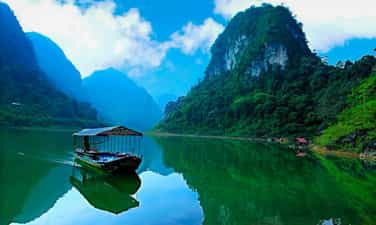
Ho Thang Hen
Thang Hen Lake, hidden behind the canopy of old forests and cat-eared cliffs, is a blue diamond-shaped lake with four seasons. The Tay people say it resembles the tail of a bee, so they call it Thang Hen ("bee tail" in the Tay language). Thang Hen is the largest freshwater lake among the 36 freshwater lakes in Tra Linh district. Although they are separated, they are connected by underground caves. The lake water is hazy jade green all year round, even during flood season - when other lakes in the same area are red with mud. The reason is because the lake's upstream is Thang Hen cave at high altitude. Water pouring out from the mouth of the cave provides a source of "clean water" for the lake. According to the legend of the Tay people, in the past, Cao Bang land had a handsome and intelligent man named Sung. After passing the exam, the king allowed him to return to honor his ancestors for seven days. Returning to his hometown, he married Miss Booc. He was so absorbed in his beautiful wife that he forgot to return to the capital. It wasn't until the night of Saturday that Mr. Sung suddenly remembered. He quickly said goodbye to his wife and ran back to the capital in the middle of the night. Mr. Sung ran 36 steps before falling, hitting his head on the mountain and dying. His 36 steps are 36 large and small lakes in the Thang Hen lake complex (now in Tra Linh district). As for the rock caves surrounding the lake, they were created by Mr. Sung's toes. Every year in September and October, Thang Hen Lake's water will be drained in just a few hours. Therefore, witnessing this strange phenomenon is extremely lucky. Even the indigenous people can only estimate the time and are not sure when the lake will dry up. When the water is barely scratched, people will race to the lake to catch fish, shrimp, and shrimp to eat. Big fish are the top "hunting" targets to grill for guests. Strangely, even though thousands of cubic meters of lake water dropped, the surrounding landscape remained unchanged. Therefore, many people compare Thang Hen Lake to a bag of water whose bottom has been punctured by someone. Local people spread word of mouth that the phenomenon of Thang Hen Lake drying up in just one night was a sea monster that had been imprisoned in the valley for many years. In the frenzy of being hunted, it used its claws to create underground caves vertically and horizontally. To enjoy the beautiful scenery of Thang Hen, you should not sleep late. When the sun just peeks behind the mountains is the best time to immerse yourself in the wonderland here. At this time, the lake surface is like a jade mirror covered with a white veil. Looming around are hidden mountains. The early morning scene here is strangely peaceful, completely separate from the hustle and bustle of the city outside. Thang Hen Lake area has steep rocky cliffs. On it, visitors can easily recognize wooden trees that are hundreds of years old and many varieties of wild orchids. This is the habitat of wild animals such as: golden monkeys, partridges, crows...
Cao Bang
9359 view


Pac Bo relic
The Pac Bo historical relic complex is located in Truong Ha commune, Ha Quang district, Cao Bang province. According to the Tay - Nung ethnic language, Pac Bo means "watershed". This is the place chosen by Uncle Ho as the revolutionary leadership base and is the place with an important mark in the nation's resistance war against the French and the Americans. Experiencing important milestones after all these years, this place still retains almost intact the evidence and imprints of the revolution and of President Ho. Pac Bo Cao Bang is covered with rugged mountains, beckoning waterfalls, and cool green bamboo groves throughout the sky. In addition to the beautiful scenery of the country, visitors can visit historical places such as Lenin stream, Karl Marx Mountain, President Ho Chi Minh memorial, Pac Po cave... Exploring the Pac Bo Cao Bang historical relic site, visitors will be immersed in the mysterious wild natural space and feel the historical and cultural values of this land. In the past, Lenin Stream was called Khuoi Giang stream by the villagers, which in the Tay language means heavenly stream, but in 1941, when Uncle Ho returned to the country and chose Pac Bo cave to live and work, he named this stream Lenin stream. Lenin Stream is located in the Pac Bo Cao Bang historical relic site, famous for its clear blue water that can be seen at the bottom like a mirror reflecting the great landscape of heaven and earth, creating a beautiful landscape. This destination is loved by many people because of its quiet space and poetic and lyrical scenery. There really is no beautiful word that can describe the beauty and purity of the Lenin stream. As history passes, this stream still retains its full beauty and increasingly attracts tourists because of the loving and graceful beauty of the water. Coming here, visitors will feel the place where Uncle Ho once lived, feel his warmth, and see the scenes that he was attached to during the resistance period. A destination not to be missed when coming to Pac Bo Cao Bang is Cac Mac Mountain. Along with the Lenin Stream, Karl Marx Mountain was also named by Uncle Ho. These are the names of the two thinkers who had the greatest influence on Uncle Ho's revolutionary career. Karl Marx Mountain has deep green forests with open terrain inside but is dangerous and secret outside. Perhaps because of such terrain, Uncle Ho chose it as a place for secret operations. Near the edge of Cac Mac mountain, along the Lenin stream, visitors will see the bamboo garden that Uncle Ho planted still exists. Everything seems to create a peaceful, poetic space for the place where Uncle Ho once stopped. "In the morning go to the stream, at night go to the cave" Uncle Ho's poem in the poem Pac Bo Scene describes Uncle Ho's daily life when he worked in Pac Bo Cao Bang. Pac Bo Cave, also known as Coc Po Cave, is only about 15 square meters wide. It is where he lived and worked when he first returned to the country. This is a place that contains many of his imprints. In the Cave, there is a wooden counter where Uncle Ho rested, a fire to warm himself, an unsteady stone table where people worked, or a stone made of Uncle Ho's size to sit fishing next to the Lenin stream, a bamboo garden next to the cave that Uncle Ho personally planted... all of it. are still there, and have become important historical markers of the Pac Bo historical site. Coming to the Pac Bo historical site, don't forget to visit Uncle Ho's temple located on Tieng Chit hill. The temple was built in May 2011 on the occasion of Uncle Ho's 121st birth anniversary. The temple was built in a stilt house style that is extremely close and familiar to the ethnic people here. This is not only a tourist destination for many domestic and foreign tourists, but also has historical and cultural value and shows respect and sacred affection for Uncle Ho - the man who devoted himself to the world. for the independence of the nation. Pac Bo Cao Bang is a charming place, every season has its own beauty. However, if you want to see the full beauty of this place, you should choose to come from October to May. At this time the weather is cool, not too cold nor too hot, and the weather is dry and convenient for traveling. Pac Bo's bumpy mountain roads. Especially, you can fully admire the poetic beauty of Lenin stream. Lenin Stream is famous for its beautiful turquoise water color, but during the year there will be about 2-3 months of rainy season (from July to September), the water flows so the water surface will not be clear, making it difficult to enjoy. enjoy the warm, poetic beauty of the place where Uncle Ho's footsteps were once imprinted.
Cao Bang
9695 view


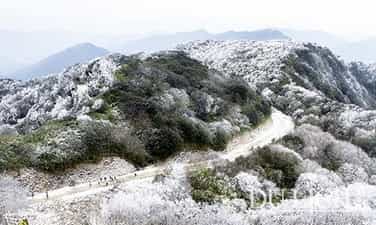
Phia Oac National Park - Phia Den
Phia Oac - Phia Den National Park is a special forest located in the Non Nuoc Cao Bang park system. This place is recognized by UNESCO as a Global Geopark because of its special geological system with high mountains, many rare minerals and a diverse ecosystem, with many rare flora and fauna species. The area of Phia Oac - Phia Den national park stretches across the area of 5 communes Thanh Cong, Hung Dao, Quang Thanh, Phan Thanh and Tinh Tuc in Nguyen Binh district, Cao Bang province and about 73km from Cao Bang city center. . This is a place with beautiful natural scenery, fresh air and especially snow and ice in the winter, so it is ideal for ecotourism development. Phia Oac - Phia Den is located in a global geopark area, so the terrain here is also very diverse and rich, from sunken valleys like deep basins, winding rivers creating a beautiful scenery. charming poetry to the towering mountain ranges creating a majestic and magnificent scene. Phia Oac - Phia Den are the names of two high peaks in the national park. Phia Den mountain peak is 1,391m high and Phia Oac mountain peak is 1,931m high, considered the western "roof" of Cao Bang province. In addition, within this national park there are also many other impressive high mountains such as Tam Loang peak 1,446m high, Niot Ti peak 1,574m high. In addition, Phia Oac - Phia Den National Park also has a diverse and special geological structure with a mixture of terrigenous rocks, limestone and granite creating many rare minerals such as silver, gold, tin, tungsten... This place is divided into 3 main areas: strict protection area, ecological restoration area and administrative service area, with diverse vegetation such as subtropical monsoon forests, closed evergreen humid tropical forests. tropical forest and a typical primary forest type of Northern Vietnam, which is dwarf forest, also known as moss forest. Within the Phia Oac - Phia Den National Park, there are up to 1,287 diverse plant species, including up to 90 rare and endangered plant species, which are recorded in the Vietnam Red Book as ironwood. rocky mountains, incense sticks, honeycombs, pa co pines, flower slices and gnats... Furthermore, on Phia Oac mountain there are many precious medicinal herbs of Vietnam such as Heptaphyllum flower, Cordyceps sinensis, mountain ginseng... Not only diverse in flora, Phia Oac - Phia Den also has a rich animal ecosystem with 496 different species of vertebrates and thousands of species of invertebrates and insects... In particular, there are up to 58 species in this ecological forest that belong to the group of rare animals, including 30 types of mammals listed in the Vietnam Red Book, 12 species of reptiles, of which 12 species are extremely rare and need to be protected. conserve. This is an extremely rare resource with high economic value and conservation value. Therefore, in addition to beautiful natural scenery, Phia Oac - Phia Den National Park is also a conservation area that Cao Bang province and the government pay attention to. It can be said that nature has been extremely kind when giving Phia Oac - Phia Den National Park a fresh and cool atmosphere throughout the four seasons. The blend of deep green vegetation with rolling mountains and lazily flying white clouds creates a poetic natural scene, as beautiful as a fairyland. On clear days, standing on the top of Phia Oac mountain, visitors can see the majestic mountain scenery. In particular, with its cool climate, low average temperature, and high humidity, Phia Oac - Phia Den National Park is like a paradise of flowers with brilliant colors, wild and enchanting beauty. or, praised by many tourists as the "sleeping fairy" of the Northeast mountains and forests. Scattered around Phia Oac - Phia Den National Park are villages, streams, hillsides, terraced fields grown by ethnic minorities, fields of corn, cassava, vast tea forests... create beautiful natural paintings full of vitality. Furthermore, Phia Oac - Phia Den National Park still has traces of ancient villas or European-style motels left by ancient French civil servants, so you can visit European architectural works. here too. In addition, visitors can visit other tourist destinations such as the Khay Phat fort relic, the beeswax printed brocade weaving village of the Dao Tien ethnic group, Tinh Tuc mine, Kolia tea hills, salmon farms, etc. .. Although each time this place has its own unique flavor with poetic and majestic scenery, the most attractive tourist attractions are still spring and winter. When spring comes, Phia Oac - Phia Den National Park seems to be transformed into a brilliant new outfit with countless wild flowers blooming. From the seductive red of azalea flowers to the fresh jade green of hydrangeas or the dreamy purple, white, and yellow of wild orchids. In particular, the cool climate and high humidity of this place seem to energize the flowers to bloom bigger, brighter, and the fragrance emitted is also passionate and ecstatic, making everyone forget the way home. . In the coming winter, when the temperature begins to drop, the Phia Oac - Phia Den mountains are immersed in a beautiful white color like the European sky. Frost covers the top of the mountain, white mist hovers around, making visitors feel like they are lost in a fairyland.
Cao Bang
9066 view


Ban Gioc Waterfall
Ban Gioc Waterfall is located about 90km from Cao Bang city and 400km from the center of Hanoi capital, in Dam Thuy commune, Trung Khanh district. Starting from Cao Bang city, you can go in the direction of Tra Linh - Tong Cot to reach Ban Gioc. For those who are passionate about backpacking, they can choose the route through Ma Phuc Pass because the mountain scenery along the way is very beautiful and attractive. The climate at Ban Gioc waterfall in Cao Bang is divided into two distinct seasons: rainy season and dry season. The rainy season starts from June to September. This is also the time when the waterfall pours water and white foam, very suitable for trips to Ban Gioc waterfall, especially in August - September. The waterfall in the dry season has a completely different nuance. At this time, Ban Gioc Cao Bang waterfall is quite peaceful, the golden rice fields at the foot of the waterfall create a romantic, but also very peaceful scene. When you come to Ban Gioc Waterfall, you can enjoy specialties such as: Da Hien vegetable, Bo Khai vegetable, Coong Phu cake, Trung Khanh chestnut, sour pho, bee pupa porridge, string sweet soup, bitter sweet soup, banh kha, Bao Lac plum, Dong Khe pear, Thang Hen lake fish, sour bamboo shoots, sausages, roasted duck, roasted pork...
Cao Bang
9989 view


Nguom Ngao Cave
Traveling to Cao Bang has never ceased to be interesting because this Northeast mountainous land contains countless interesting things that make visitors want to continue to explore and experience. Among them, it is impossible not to mention Nguom Ngao cave - one of the most beautiful caves in the country, a priceless gift given by the creator. Nguom Ngao Cave is located in Gun village, Dam Thuy commune, Trung Khanh district, Cao Bang province. The cave was discovered by a French explorer in 1921 (20th century). According to a survey by the British Royal Cave Association in 1995, this cave has a total length of 2,144m, with 3 main doors: Nguom Ngao, Nguom Lom and Ban Thuon. To reach Nguom Ngao cave, you need to cross 89km of mountain road, through Ma Phuc pass and Khau Lieu pass. Your trip to Cao Bang will be extremely flawed if you do not visit Ban Gioc Waterfall combined with a visit to the Cave, the distance of these two points is only about 3km. Nguom Ngao Cave is about 2,144m long but has only been exploited for nearly 980m. The inside of the cave is almost pristine with hundreds of unique and attractive shapes. According to research by scientists, Nguom Ngao is a limestone cave formed 300 million years ago. Over time, stalactites and stalagmites have created vivid and wonderful scenes that make people admire and wonder. According to legend, in the past, there were many fierce tigers living in the cave, so the Tay people named the cave Nguom Ngao with the meaning: Tiger Cave. However, there is a theory that the roaring sounds are made by the sound of water flowing from the stream inside the cave, which sounds like the roar of a Tiger, so the people named the cave Nguom Ngao. Nguom Ngao Cave, like many other caves, was formed by the long-term weathering of limestone mountains. Just taking the first steps into the cave, we will feel like we are lost in another world, completely separate from the outside world. It takes a long time for the unique shapes in the cave to be formed, including vertical stalactites, horizontal stalactites, stalactites with clear shapes, and there are stalactites that only those who like to imagine can see the shape. Exploring Nguom Ngao Cave, visitors can also discover countless special shapes inside the cave, images of terraced fields, fairy beds, miniature Ha Long Bay, statues of the three gentlemen Phuc - Loc - Tho, gold mountain, silver mountain... also created very specially. Nguom Ngao Cave is also associated with many stories and legends, including the story of an upside-down lotus flower. When entering Nguom Ngao cave, if you pay close attention, you will see that in the middle of the cave is an upside-down lotus-shaped stalactite. The story goes that, once upon a time, there was a monk who sat on a lotus stem and practiced endlessly without achieving righteous results. Because he was so bored and frustrated, he turned the lotus stem upside down, and he himself turned into a stone pillar standing next to the upside-down lotus stem. It's easy to understand why people say you will be overwhelmed from the first moment you step into the cave. The average temperature in the cave is about 15-20 degrees, so it always makes you feel cool and comfortable, much different from the outside temperature, especially when you travel to Nguom Ngao cave in the summer. Especially in Nguom Ngao cave, where there is a gap leading to the sky, at exactly 14:00 on April 22 every year, there will be 3 streams of light meeting, making a space inside the cave as bright as day for a few minutes. This is a beautiful natural phenomenon and many tourists have to admire the bright light in Nguom Ngao cave at this moment. Traveling to Cao Bang means experiencing the most natural things, scenes of breathtaking beauty. Surely the beauty of Nguom Ngao cave will make you miss it and not want to return.
Cao Bang
10103 view


