Relic point Vietnam
Việt Nam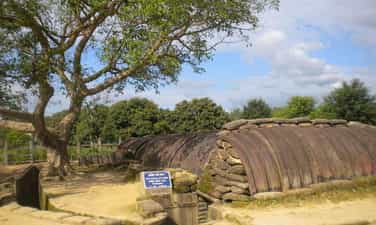
Command bunker of Dien Bien Phu stronghold group
Ham Do Castries (local people's name) full name is Dien Bien Phu stronghold group command post, also known as GoNo command post, located in Thanh Truong ward - Dien Bien Phu city - Dien Bien province. . During the Dien Bien Phu campaign, GoNo Command Post was located in the center of the stronghold group, 2m underground and in a lower position than the direction of our army's attack. This is the headquarters of a giant military group that France and the US are very proud to consider the strongest fortress ever in Indochina. GoNo command post is given priority to have solid and solid construction materials capable of resisting enemy firepower, in addition to being protected by all the most modern weapons and means of warfare at the time. then. The structure and arrangement of the basement are still kept intact with a length of 20m and a width of 8m divided into 4 compartments used for both work and accommodation. Surrounding the bunker is a barbed wire fence with alternating mines and 4 defensive tanks in 4 directions. In this basement, De Castries solemnly welcomed many high-ranking officials from England, France, America and dozens of writers and journalists from the Western journalism industry. It was also here that De Castries and his entire General Staff plotted to destroy our main army, but he also had to go crazy many times to deal with enemy attacks. Vietnam People's Army. At 3:00 p.m. on May 7, 1954, our campaign command ordered a general attack on the entire front to destroy the entire group of Dien Bien Phu strongholds. After destroying key strongholds around the central division, our troops crossed Muong Thanh bridge and headed straight to Gono Command. At 5:30 p.m., comrade Ta Quoc Luat, commander of company 360, regiment 209, regiment 312, and 2 assault soldiers captured General De Castries and the entire French command, holding the flag "Determined battle, Quyet". Victory" flew high above the tunnel roof in the middle of the historic summer afternoon of May, signaling the day of complete victory for our army and people. Today, the Ham Do Castries relic along with other relics in the Dien Bien Phu historical relic complex have been invested in by the Party and State to restore and renovate to serve domestic and foreign visitors. Part of promoting the value of the Dien Bien Phu historical victory relic site and also to propagate and educate the heroic Dien Bien Phu tradition. Source: Department of Culture, Sports and Tourism of Dien Bien province
Dien Bien
8524 view
Rating : Special national monument
Hill A1 National Martyrs Cemetery
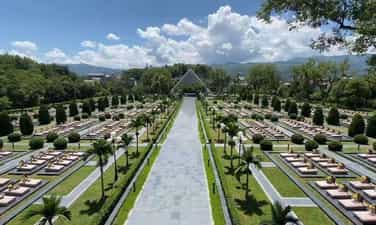
Hill A1 is located in Muong Thanh ward, Dien Bien Phu city, Dien Bien province, and is the most important base in the group of French colonial bases in Dien Bien Phu. Hill A1 is where the historic battle that lasted 39 days and nights between our troops and the enemy took place, contributing to the famous Dien Bien Phu victory in five continents, shaking the earth. A1 is the symbol that the Vietnamese army gave to the hill, while the French army called it Eliane 2. Due to its particularly important position, the French army built A1 to become the strongest resistance in Dien Bien Phu. With an extremely solid secret underground bunker system, strong firepower arrangements, machine gun nests, and battlements so that one defending soldier can fight off many attacking soldiers at the same time. At the same time, France continuously reinforced its strongest forces and provided maximum firepower support to protect this base to the end. Therefore, in the first attack, the 174th Regiment of the Vietnam People's Army launched four consecutive attacks but only captured half of the hill. It was not until dawn on May 7, 1954, thanks to a 1-ton explosive block secretly dug to destroy the underground tunnel system, that the Vietnam People's Army was able to complete the occupation of Hill A1. This was the most fierce battle in the entire Dien Bien Phu campaign, with the highest number of soldiers and casualties. Currently, on the Northwest peak of Hill A1, there is a monument commemorating the soldiers and martyrs who sacrificed their lives, built in the "Three Mountains" style, high in the middle, low on both sides and both shaped like a leader's roof. In front is an incense burner, in the middle is a stele, the National Flag insignia, a yellow star with a red circular background, surrounded by a wreath of flowers. Next to the monument is the body of one of two 18-ton tanks that Quan Ba Hecvuê brought from the center of Muong Thanh to counterattack the Vietnamese army. Another important relic is a funnel-shaped hole as big as a shallow "pavilion pond". That is a trace of our army's thousand-pound explosion, which our soldiers often call "digging a tunnel to conquer a tunnel", conquering both the enemy's bunkers and bunkers. Located not far south of the historical site Hill A1 is Hill A1 National Martyrs Cemetery built in 1958. This is the resting place of 644 military officers and soldiers who heroically sacrificed their lives to protect the country during the Dien Bien Phu campaign. In 1994, the cemetery was renovated, planned and built into a historical and cultural project, a park cemetery with many items. Inside the campus is the manor house designed in the style of a typical stilt house of the Thai Dien Bien people, the outside ceremony platform is designed in the Khue Van Cac style, on both sides are two types of ancient city walls with two moats in front. 6m wide, outside the city wall is a bas-relief depicting the heroic fight of our army and people and the nine years of long resistance to regain national independence. Source: Dien Bien province electronic information portal
Dien Bien
6608 view
Rating : National monument
D1 Hill and Dien Bien Phu Victory Monument
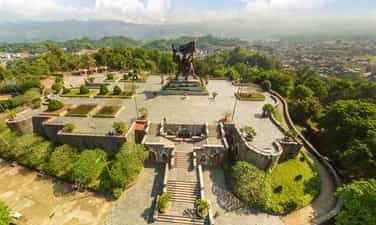
Hill D belongs to the Dominique cluster, the French colonialists built and turned this base into the frontline position of the eastern hills. Because the location of Hill D was to shield and protect the Dien Bien Phu Fortress Group Command Headquarters and Muong Thanh Airport, the French colonialists took advantage of the natural terrain to benefit them militarily to build the position. The defense position is extremely solid and powerful. Here, the French army arranged the very battle-hardened 3rd Battalion of the Algerian Regiment to occupy it. As for the Vietnam People's Army, capturing the Eastern peak range, including peak D1, is a very important task in the second attack of the Dien Bien Phu campaign. The unit responsible for destroying D1 base is Battalions 166 and 154 of Regiment 209, Group 312. At exactly 5:00 p.m. on March 30, 1954, artillery guns of the Vietnamese army simultaneously rained down on hill D1 and the eastern high points in the central area of Muong Thanh. Within 30 minutes, the 209th regiment captured D1 hill. The next morning, the French army counterattacked in conjunction with the air force to recapture the base. The battle took place fiercely after 2 days of complete control by the Vietnamese army. D1 hill base. After capturing hill cluster D, Vietnamese soldiers turned this place into a battlefield for the 209th Regiment's firepower, continuing to support other units to capture the remaining French bases. It can be said that the battle that took place on the eastern hills, including D1, was one of the important battles that contributed to the victory in the second attack of the Dien Bien Phu campaign. On the historic land of Dien Bien today, there are a number of monuments and bas-reliefs built to fully, realistically and vividly recreate the great battle of our army and people more than a few years ago. 6 decades, in which the Dien Bien Phu Victory Monument is the largest and only bronze monument in the project of works celebrating the 50th anniversary of the historic victory of Dien Bien Phu. Hill D1 relic was honored to be chosen as the location for the Dien Bien Phu Victory Monument, because the relic is located in the center of the city, has a beautiful terrain, from the relic you can observe the entire Dien Bien basin. Bien Phu. This was the tallest, largest and heaviest bronze statue cluster in Vietnam at that time. The statue was built with a height of 12.6m, mounted on a 3.6m high pedestal and cast with 217 tons of bronze. The Dien Bien Phu Victory Monument stands tall in the midst of historical Dien Bien and together with other relics such as: Hill A1, Muong Thanh bridge, Him Lam, Doc Lap, Ban Keo, Muong Phang.... has become The place is eternal with the country, a testament to the heroic history of the Vietnamese people in the thousands of years of struggle to build and defend the country; creating national identity, passing on heritage to future generations; Strengthen solidarity and attachment between generations of Vietnamese people and among ethnic groups in the area; It is one of the typical symbols for the desire for peace, friendliness, hospitality, always open to welcome friends and international tourists, and the spirit of cooperation and development towards the future. Source: Department of Culture, Sports and Tourism of Dien Bien province
Dien Bien
8440 view
Rating : National monument

Am Tien Cave
Am Tien pagoda and cave are located in the Ngu Phong Son mountain range, southeast of the Hoa Lu ancient capital relic site, in Truong Yen commune, Hoa Lu district, Ninh Binh province. This is a cluster of relics containing many values of unique architectural landscape, history, culture, and beliefs. In 1998, the relic was ranked by the Ministry of Culture and Information as a national historical and cultural relic. Am Tien pagoda and cave, in addition to worshiping Buddha, also worship Zen Master Nguyen Minh Khong, who was instrumental in repairing the cave and building the pagoda. Not only was he proficient in Dharma, he was also skilled in medicine. Because of his great merit in treating King Ly Than Tong, he was awarded the title of National Teacher - the top monk of Buddhism during the Ly dynasty. According to local legend and documents preserved at the site, in the 10th century, this cave was originally a stone prison, where King Dinh Tien Hoang kept tigers and leopards to punish those who committed serious crimes. Later, the cave was no longer used as a prison, but it is said that the evil souls of the dead still remain in the cave. Local people passing by here often hear the sounds of ghosts crying, tigers screaming, and leopards roaring. No one dares to come close to the cave. During the Ly Dynasty, National Master Nguyen Minh Khong came here and used the cave as a pagoda. He recited sutras and preached Dharma every day to stop the demons from howling and harming innocent people. According to the epitaph "Dai Chu Ma Son Ang Dai Quang Thanh lava tragedy". The 4th Chinh Long Bao Ung date (year 1166) engraved on the cave door wall says: This cave is called Dai Quang Thanh cave, located on the large mountain Chu Ma Son Ang. According to the epitaph "Tien Am Tu Bi Tien Am Thach Lo Chi". compiled by Phan Dinh Hoa's Tuan Phu in the 7th Bao Dai era (1932), currently kept at the relic, says: "Since Dai Quang Thanh took refuge in this cave, the cave was later used as a pagoda. Relying on the Buddha and Saints, the prison turned into a wonder park, and the cave turned into a pagoda from there. The 32nd reign of Tu Duc (1879) was recently revised. Association leaders around the area always pay attention to making the pagoda more beautiful and the Tap Phuc association named the pagoda Am Tien. Am Tien pagoda and cave are located halfway up the mountain, facing southwest, in front is a large meandering lake, surrounded by rolling limestone mountains. Epitaph "Tien Am Tu Biography". The 2nd Dong Khanh era (1887) said that when you want to enter the cave, you have to climb over a "mountain about 8.9 meters high... in the village there is a field estimated at more than 10 acres that can be planted with rice, and on both sides of the mountain there are beautiful scenery." wild, animals, birds and animals contrast, so it is called Co Am. The mountain forms a wall surrounding the hermitage, and there are caves in the rocky mountain. From below, follow the edge up to the cave." This epitaph also adds. "I don't know when the temple was built. In the 32nd year of King Tu Duc's reign (1879), the pagoda was desolate and gloomy, so the village agreed to repair it. The rotten things were carefully sealed, repainted the statue of Dai Quang Thanh, repainted the statue of national dharma Zen master Nguyen Minh Khong on the right side, and the Buddha statue could not be repainted. By the reign of King Ham Nghi, all the decorations were completed." Am Tien Pagoda and Cave still preserve valuable relics. On the cliff on the right side of the cave, there is a ghost stele "Dai Chu Ma Son Ang Dai Quang Thanh lava bi". (Meaning: stele engraved on the wall of Dai Quang Thanh cave on the large Chu Ma Son Ang mountain). The stele is dated Chinh Long Bao Ung's 4th year (1166). On the left side of the cave are three steles, including two stone steles of the Nguyen Dynasty dating from the 2nd Dong Khanh (1887), the 7th Bao Dai (1932) and one without words. The content of the two steles talks about the history of the pagoda's name and the process of repairing the pagoda. The cliff to the left of the cave entrance has a small bell hanging. In addition to the beauty of architectural landscape space, Am Tien pagoda and cave also preserve many valuable relics and antiques. This is a valuable historical source in learning and researching about the ancient capital of Hoa Lu, about the Dai Co Viet state, about historical events and characters. Source: Department of Culture and Sports of Ninh Binh province
Ninh Binh
5872 view
Rating : National monument
Tam Diep line
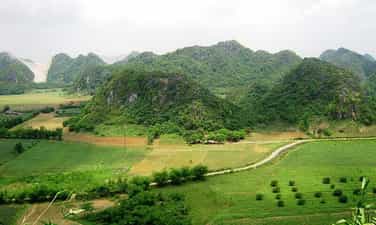
The Tam Diep defensive line relic area is called after the Tam Diep defensive line of the Tay Son insurgent army, built at the end of the Mau Than year (1788) to prepare forces for the speedy campaign, defeating 290,000 invaders. The Qing invaders and their gang sold the country to Le Chieu Thong in the early spring of Ky Dau (1789). At the end of the year Mau Than (1788), Le Chieu Thong's gang of traitors brought 290,000 Qing troops to invade our country. Faced with the initial strength of the enemy, Ngo Van So and Ngo Thi Nham and the Bac Ha generals retreated strategically to build the Tam Diep and Bien Son defense lines. The two water and land sides contacted each other to maintain the vulnerable position. . The Tam Diep Line is the final withdrawal limit of the Tay Son insurgent army, aiming to prevent and prevent enemy attacks, ensuring secrecy and safety for the rear in the South. When Quang Trung marched to the North, the Tam Diep line was the gathering place of the Tay Son insurgents (from December 20, Mau Than year, January 15, 1789 to December 30, Mau Than year, January 25, 1789). ). Temporary Line relic area, including 3 pass peaks of Tam Diep and a cluster of forts, Kem Do, Ong Ninh fort, Tam Diep fort, blocking Thien Ly road from the North to Thanh Hoa. Thien Ly road from North to South runs on 3 peaks of Tam Diep pass, the highest peak is about 110m. In the 16th century, taking advantage of the rugged terrain of the Tam Diep mountain range, the Le - Trinh feudal government built a number of ramparts on both North and South sides of Tam Diep pass and used Tam Diep as the boundary between the Southern and Southern dynasties. Northern Dynasty. At Kem That, on both sides of Thien Ly road, two ramparts were built connecting the cliffs to form a solid gate. About 400m north of Kem That is "Ong Ninh rampart", connecting two mountain ranges called Thanh mountain. In the middle of the rampart there is a path, on both sides there are stone embankments like "rampart gates". To the west of the rampart there is a moat about 8m wide, to prevent enemy attacks from coming in from Thien Ly road. About 100m away from this rampart is "Tam Diep post", about 1 acre in size, controlling the Thien Ly road north of the gate. When withdrawing from the strategy of building the Tam Diep defense line at the end of the year Mau Than (1789), the Tay Son insurgents used these strongholds, so there are many legends about Nguyen Hue and the Tay Son insurgents here. Local people believe that "Mr. Ninh's rampart" is the front door and "District Ke's rampart" is the back door of the Tay Son insurgents. The Tam Diep station in particular was used from the Le dynasty to the Tay Son dynasty and the Nguyen dynasty and belonged to the weakened Nguyen Quang Toan government, but was stationed in Tam Diep to fight against the Nguyen Anh government. When the Nguyen Dynasty was established, it also used Tam Diep post to control the Thien Ly road from North to South. At Kem That, two Thien Ly roads still have traces, two short ramparts connecting to the cliffs have been almost completely destroyed. Ong Ninh's rampart is still quite clear, 135m long, 15m wide, the main road, Tam Diep fort still have two faint traces on the eastern edge of the citadel. Currently, on the top of Tam Diep Pass, the highest pass (belonging to Thanh Hoa province), there is a stele with the poem "Qua Tam Diep Son" (through Tam Diep Mountain) carved in the 2nd year of Thieu Tri (1842), recording a poem written by Thieu Tri while on patrol here. On October 8, 1985, the Tam Diep defense line was recognized as a national historical relic Source: Department of Culture and Sports of Ninh Binh province
Ninh Binh
5719 view
Rating : National monument

Dinh Luoc
Dinh Luoc Communal House is located in Luoc village, Son Lai commune, Nho Quan district, in a cultural space with bold characteristics of the Northern countryside with a peaceful green scene of trees, ponds, and communal house yards. The communal house is a cultural activity point for the entire community of Luoc village. The name of the relic is named after the place of the village from ancient times. The communal house faces west and was built on high ground located at the western edge of the village. In front is the open space of Dau Hill, far away to the North is the gentle mountain range separating Gia Sinh and Truong Yen communes. Surrounding the communal house are ancient trees hundreds of years old with an ancient appearance, witnessing many ups and downs of the monument. In front of the communal house is a large lotus pond that serves as a hall, a place considered a gathering place for blessings and water in the village. The communal house was built according to Nhat architecture, consisting of 3 rooms, following the ancient style of gabled walls, four rows of pillars. The communal house's tiled roof, truss system, diaphragms, beams, and rafters are all made of quadrangular wood with moderate dimensions and are sturdy. The motifs and patterns in the communal house are typical of the Nguyen Dynasty style such as floral and geometric decorations. At the relic, the god Nam Quoc Do Dai Tran Bac Dai Vuong is worshiped, a figure of the Dinh Dynasty who contributed to supporting the country and its people. Dinh Luoc worships Princess Chan Vuong, formerly the daughter of a local tycoon, a beautiful woman with impeccable talent and virtue, selected by King Le Hien Tong to be a maid. She had great contributions to the people of Luoc village, together with her father, she used money to build communal houses and pagodas, invited teachers to teach literacy to children in the area, helping the whole countryside become prosperous. When she passed away, people respectfully worshiped her to commemorate her merits. The court bestowed the title of Trinh Uyen Huyen Chan Linh Lord on her. The relic still retains valuable documents and artifacts such as: copies of ordinations of the Nguyen kings, altar thrones, and incense bowls of historical and cultural value. During the resistance period, Dinh Luoc was the secret base of revolutionary cadres in Quynh Luu area, and a gathering point for local militia and guerrillas. During the peaceful period until now, the communal house has become a place for community activities and a spiritual cultural site for the people of Luoc village. Dinh Luoc Communal House has always been cared for, preserved, and renovated spaciously and majestically by the people and local authorities. Every year, at the monument, many unique cultural activities and rituals take place such as: New Year celebration (Lunar New Year), summer opening ceremony (January 7), Thuong Dien ceremony (June 24). ). This is an opportunity for people in the village and those far from home to meet and remember the contributions of their ancestors, those who built and preserved the village, and passed on the unique cultural features of the village. homeland for future generations to preserve and promote. Along with the heroic traditions of the revolutionary base land, Luoc Communal House relics have become the pride of the Luoc village community, a fulcrum for descendants far from home to return to their ancestral homeland. Source: Management Board of Trang An Scenic Landscape Complex
Ninh Binh
4897 view
Rating : Provincial level relics

Kha Luong Pagoda
Kha Luong Pagoda and Temple are in Kha Luong village, Ninh Thang commune, Hoa Lu district, Ninh Binh province. The pagoda also has the literal name Thang Lam Tu (Thang Lam Pagoda). Kha Luong Temple has a beautiful terrain located on a turtle-shaped piece of land, in front of the yard is the turtle's mouth, so the villagers do not level it, as a kind of "water tank" where water and blessings gather. Legend has it that the pagoda was built during the Ly Dynasty. During the Nguyen Dynasty, the villagers moved the temple from the site Ma La to the front of the pagoda, creating an architectural style of "Previous Gods, Later Buddhas". The temple has a Dinh harem type structure with a row of columns and a bed to form Tien Duong with three compartments. The harem has three rooms, four rows of ironwood pillars, tiled roofs, outer rafters, mesmerizing rafters, because in the style of gong stands, carved dragons, tigers, and four sacred animals: dragon, lyre, tortoise, phoenix, and lacquer. gorgeous gold plated. The temple is a place to worship the Great King of the Household, who had the merit of saving the villagers from great disaster, was appointed by the House as Great King of the House, and became the Thanh Hoang of Kha Luong village. Kha Luong Pagoda has an architecture in the style of Nhi (=) Tien Duong with five trusses like "upper bed, lower bed", three rows of pillars, hiding a row of columns in the middle, the front row of columns is made of green stone. The Harem or Upper Pagoda has three compartments, rafters like "upper bed, lower bed", three rows of pillars, front and back columns made of green stone, in front there are two stone dragons flanking each other (legend from the Ly dynasty). ). The pagoda worships Tam The, Amitabha Tam, the newborn Sakyamuni, the Holy Monk, and the white-bearded Tho Dia, a folk belief with the wish to bless and protect the people and their village. In addition, the pagoda also worships Han Lam, which is a place to worship ghosts, this is also an ancient worship of the good nature of the people. Every year, Kha Luong Pagoda and Temple take place many forms of cultural activities such as the festival commemorating King Tran Thai Tong, the day of forgiveness for the dead, the holy day of Shakyamuni Buddha, in addition to the days of Wednesday, Full Moon, and New Year. Every villager burns incense and worships. The relic through the ages is also the place where many local revolutionary events took place. During the resistance war against the French, the pagoda was a treatment facility for wounded soldiers, and the pagoda was also an evacuation site for Primary School, Ninh Thang commune. Many people have grown up in this school. Kha Luong Pagoda and Temple also preserve many precious artifacts such as: stone stele, bell, stone dragon, ordination, dragon throne, tablet... these are valuable artifacts that are carefully preserved by the people in the village. important to remember the merits of our predecessors. Kha Luong Temple and Pagoda in Ninh Thang Commune is an ancient temple and pagoda, with beautiful scenery, trees giving off cool green shade all year round, this is also an architecture of the Nguyen Dynasty with the traditional style of the nation. Based on the values of the relics, the People's Committee of Ninh Binh province ranked Kha Luong Temple and Pagoda relics as Provincial-level historical and cultural relics. Source: Management Board of Trang An Scenic Landscape Complex
Ninh Binh
5924 view
Rating : Provincial level relics

Dau Temple
Dau Temple is located in Nam Son ward, Tam Diep city, Ninh Binh province, the temple's literal name is Tang Da Linh Tu (meaning: Temple of Sacred Lady Dau) worshiping Princess Lieu Hanh - one of the four immortals of the Vietnamese pantheon. Nam transformed into a local girl who helped Tay Son people and soldiers grow mulberry trees and raise silkworms. Dau Temple is located on a beautiful feng shui position, the temple is located on a high land facing southeast, in front of the temple is Hong Ngoc mountain as a project, behind is Chong Den mountain as the occiput, on the left is Ngang mountain (Hoanh). Son) as Thanh Long, to the right of the temple there is Fat Mountain as White Tiger. The annual Dau Temple Festival opens on the 15th day of each month. Legend has it that it is the day of placing mulberry cuttings and also the day to celebrate King Quang Trung's triumphant victory, lasting until the 3rd day of the third lunar month (Mother's taboo day). Lieu), the local folk song still circulates: “No matter where anyone goes or where they go. The original festival of Dau Temple is back. No matter who is busy. When Nguyen Tieu celebrates the festival, he returns to Dau temple. In the past, the festival had the custom of processioning statues and drawing the words "Mother of the world", "Peace in the world" and "Ly Nhan is beautiful" but now the custom of processioning statues and drawing words has not been restored, only ceremonies and sacrifices remain. female officials still maintained. Like many other palaces and Mausoleums, this place has basic worship rituals such as: worshiping shadows, worshiping incense burners and presenting dong to pray for the Holy Mother and the gods' blessings, fortune, longevity and well-being. for hundreds of families. Dau temple relic is one of the relics closely related to Lieu Hanh temple such as Song temple, Pho Cat (Thanh Hoa), Phu Ngang hill, Quan Chao temple (Ninh Binh) related to the ancient Thien Ly road. north to south, associated with the space of Mau Lieu's influence from Phu Tay Ho (Hanoi) through Van Cat (Nam Dinh), through Tam Diep Pass (Ninh Binh - Thanh Hoa) to Ngang Pass (Ha Tinh - Quang Jar). The relic is located in the space of the Tam Diep - Bien Son defense line, associated with places such as Ong Ninh ramparts, Dong Quan valley, Tam Diep pass, Quen Tho ramparts, this is a defense line with important historical significance for the nation. in the victory of 200,000 Qing troops in 1789. Source: Ninh Binh Tourism Promotion Center
Ninh Binh
5095 view
Rating : National monument
Temple of Quy Minh Dai Vuong
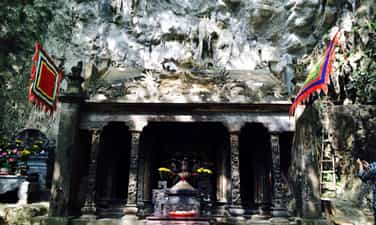
Quy Minh Dai Vuong Temple and Temple cave are located at the foot of Ham Rong mountain, northeast of Binh Khe village, Ninh Nhat commune, Ninh Binh city, Ninh Binh province. The temple is also known as Thanh Quy temple or Thuong temple. Temple Cave, also known as Nha Kho Cave, is right behind the temple. This is a relic that was ranked by the People's Committee of Ninh Binh province as a provincial-level historical and cultural relic in 2006. The temple is a place to worship Saint Quy Minh Dai Vuong, a general of the 18th Hung King. According to folk legend, he is one of three brothers - three generals who have been canonized as Saints (Saint Tan Vien, Saint Cao Son and Saint Quy Minh), who had the merit of defending the Son Nam pass, protecting the country during the reign of King Hung Due Vuong (ie the 18th Hung King). He is a "Superior God", ordained by kings through many dynasties, worshiped by people everywhere, and became the village tutelary god in many places. The temple was built in the Dinh-shaped architectural style, including the front hall and the back palace. The Tien Duong Court consists of 3 horizontal rooms used as a place of worship, newly restored in 2015. The Harem Court consists of 3 vertical rooms, still preserved almost intact, the outer truss is a maze style above the surface station. tiger suit, below there are 3 words "Cao Son Tu". The mesmerizing painting is on the left of the dragon station, the mesmerizing painting is on the right of the "Phuong Vu" station (phoenix dancing), the rafters inside are moi rafters. The temple resembles a sturdy, profound green stone cliff. Outside the temple, on the left, there is an altar to worship mandarins. In the temple, the altar of King Quy Minh is solemnly placed in the middle, on the right is the Observation altar, and on the left is the altar of Princess Sac Nga. In front of the temple gate is a semicircular lake, a place where water and blessings gather. Temple Cave is located right behind Thanh Quy Temple. To the left of the cave is a horse grave, with an altar. Legend has it that a precious war horse died here. Temple Cave is a large stone roof, the cave entrance is 10m wide and about 50m deep. The highest point is about 5m, in the middle of the cave there is a small well deep into the mountain body called the road to hell and a way to climb back up called the road to heaven. During the previous resistance war against the French and Americans, the temple was the headquarters of many agencies (the longest lasting of which was the Ninh Binh Printing Enterprise), where weapons, ammunition, and military provisions were stored. In addition, it is also a place to print documents, books and newspapers, and a place to evacuate people from surrounding areas... Currently, the temple still preserves many precious artifacts such as: 6 decrees of the Kings of the Nguyen Dynasty; Copper club; Phu Viet; Cleansing management; dragon throne; worship items… Every year, villagers hold sacrifices to the Saint at the relic on the 14th and 15th of the 10th lunar month. In addition, Mass is also offered on weekdays and full moon days of the year. Quy Minh Dai Vuong Temple and Temple cave are located in the Ham Rong mountain area, a beautiful and charming landscape, near the historic Hoa Lu Ancient Capital. In the future, this will be an attractive tourist destination on the outskirts of Hoa Lu Ancient Capital. Source: Management Board of Trang An Scenic Landscape Complex
Ninh Binh
5596 view
Rating : Provincial level relics

Temple of Princess Phat Kim
Princess Thuc Tiet Temple, also known as Ba Chua Palace, Phat Kim Princess Temple, is located in the Hoa Lu Ancient Capital historical and cultural relic site in Tam Ky village, Truong Yen commune, Hoa Lu district. The relic is located on a plot of land about 500 square meters, separated from the inter-village road by a wall decorated with the stylized word "Tho" in a pine style. Above are four Chinese characters "Cac Trung De Tu" (Place to worship the King's daughter). On both sides there are two cave pillars built into the wall. The relic has an octagonal Ngoc well with 8 sides, built adjacent to the surrounding wall. Princess Phat Kim is the third daughter of King Dinh Tien Hoang. For a great cause, Princess Phat Kim sacrificed her personal happiness and agreed to marry Ngo Nhat Khanh. Ngo Nhat Khanh proclaimed himself An Vuong, leader of the warlord in Duong Lam, one of the 12 warlords. As a son-in-law, Ngo Nhat Khanh still did not let go of his resentment and sought to seek help from Champa against the Dinh Dynasty. Faced with her husband's betrayal, in addition to the murder of her father King Dinh Tien Hoang and her brother Dinh Lien, Princess Phat Kim, out of pain and disappointment, threw herself into the well at Lau Vong Nguyet and committed suicide. According to local people, the current temple location is the foundation of Vong Nguyet Palace - the residence of Princess Phat Kim. Right after the princess committed suicide to preserve her virtue, the people built a temple to worship her. Through historical periods, the monument has been repaired many times, the most recent traces being in the Nguyen Dynasty. The temple's architecture is in the style of the Dinh script, including two buildings: the Tien Pagoda and the Hau Palace. The Tien Bai court is 8.2m long, 4.44m wide, consisting of 3 compartments and 2 compartments, male tiled roof, the front porch of Tien Bai court is made in the style of stacking matches, two floors. The roof of Tien Bai building in the middle is decorated with a moon shape, and the two ends of the roof are decorated with two dragon heads flanking it. The first row of columns consists of four simple wooden columns, the second row of columns consists of four rectangular stone columns, the third row of columns is adjacent to the Harem building, the two middle columns are circular, decorated with cloud dragons with lacquer. Gong-style truss architecture. The Tien Bai Court has incense altars to worship mandarins, and under the incense altar is a place to worship the god Bach Ho. All decorative motifs are sophisticated and imbued with the fine arts of the Nguyen Dynasty. The Harem court consists of 1 room and 2 rooms, running to the back are two rooms. The truss architecture is simple, with only one row of two wooden columns and the front is connected to the Tien Bai building. This is the main place of worship, the statue of Princess Phat Kim in the royal court, placed on the back of the banquet, is carved in a sitting position, the legs are five letters, the head is decorated with flowers, the eyes look straight, the beauty is kind and the face is pink. The back of the banh is decorated with patterns of leaves, phoenixes, twisted patterns, stylized flowers and leaves. The two arms of the back banh are almost similar to the arms of the throne, decorated in the shape of two dragons flanking the sides. On both sides of the statue are two maids carved in a standing position on a wooden pedestal. On both sides of the altar of the statue of Princess Phat Kim are many incense bowls worshiping the destiny of the people in the village according to ancient beliefs. Princess Phat Kim Temple is located in the historical and cultural relic site of Hoa Lu Ancient Capital, so forms of folk cultural activities and traditional festivals taking place at the relic are also part of the Festival's programs. Traditional Hoa Lu ancient capital (takes place from March 8 to March 10 of the lunar calendar every year, March 10 is also the taboo day of Princess Phat Kim, the main ceremony of the temple). During the festivals after the water procession ceremony, fire procession ceremony, code opening ceremony and incense offering ceremony at the two temples of King Dinh and King Le, delegates, worship groups and tourists from all over come to the secondary relics. others to offer incense and sacrifices. In addition, during the first and middle days of the lunar month, local people come to the temple to burn incense and offer offerings to pray for peace. Princess Thuc Tiet Temple or Phu Ba Chua, was built during the Dinh dynasty to worship Princess Phat Kim, honoring a woman with a loyal heart, pure virtue, and chastity. This is an ancient temple with many spiritual meanings and values of cultural roots that go along with the years. Source: Management Board of Trang An Scenic Landscape Complex
Ninh Binh
5111 view
Rating : National monument