Relic point Vietnam
Việt Nam
Hang Pagoda (Thai Nguyen City)
Hang Pagoda is located in the center of Chua Hang town, Dong Hy district, Thai Nguyen province, 3 km north of Thai Nguyen city, on the left of National Highway 1B, direction from Thai Nguyen to Lang Son. The pagoda has many characteristics of the mountainous region, so it was selected to be included in the collection of 100 typical Vietnamese pagodas published for the first time in 2011. According to legend, this is an ancient pagoda dating back to the 11th century and has been ranked Ranked as a national historical and cultural relic and scenic spot in 1999. Hang Pagoda, whose name is "Kim Son Tu", is also known as "Fairy Lu Buddha Cave". The Hang Pagoda scenic spot has three large, independent rocky mountains on flat land... The mountain in the middle is called "Huyen Vu", tall and sturdy, on both sides are two "Thanh Dragon - White Tiger" mountains rising. majestically high, three peaks connected by a saddle strip of about 1000m with an area of about 2.7 hectares at the foot of the mountain. Legend has it that "Hang Pagoda" dates back to the Ly Dynasty (11th century), considered a very prosperous period of Buddhism. The story is that: on a spring morning in the year of Nham Tuat, King Ly Thanh Tong woke up and told Nguyen Phi Y Lan about his dream last night, being led by Buddha to the spiritual land in Dong Hy, Thailand. Original. Ms. Nguyen Phi immediately went on a sightseeing tour, saw the charming scenery, majestic mountains, and large caves, so she took the cave and built a temple to worship Buddha. Perhaps "Kim Son Tu" was born from here, but people often call it Hang Pagoda because the pagoda is in a cave. Passing through the Three Gates, entering the pagoda, on the left and right sides there are two majestic statues of Dharma Protector Encouraging Goodness - Punishing Evil, riding an elephant and a tiger. The deeper you go, the wider the cave becomes, the stalactites on the cave dome seem like "old clouds mixed with strange rocks", many large stone pillars stand up against the cave dome like pillars against the sky. Around the cave walls, many stalactites protrude into altars and many strange and attractive shapes. The cave has many nooks and crannies, a path to heaven, a path to the underworld, and doors to the front and back, so the air in the pagoda is very fresh, cool in summer, warm in winter, incense smoke always shines, making the pagoda even more beautiful. becomes dark and mysterious. Hang Pagoda - Kim Son Pagoda with the legend "Cave of Tien Lu" is a water painting that has captivated the souls of many famous people and scholars of the "good people and guests" from the early Le dynasty to the Late Nguyen, still extant. Many poetic epitaphs in Chinese characters are engraved on the cave walls, praising the unparalleled natural beauty when visiting this place. According to the plan, Hang Pagoda will be built and restored divided into 5 areas, which is a conservation area including all caves and rocky mountains with a total area of 2.7 hectares; The spiritual main axis, including 8 works: Tam Bao main hall, ancestral church, Dharma preaching hall, stupa, bell tower, drum tower, three internal gates, three external gates; On the right side of the pagoda is the Zen monastery area; social charity center; grounds to serve the festival. Total investment cost is about 500 billion VND from socialized sources. With all the historical values inherent in this place and the wishes of the abbot and all the people, in the past 3 years, many Buddhist monks, nuns, units, and businesses have contributed their contributions and resources to build the temple. build a temple. The entire architectural complex of the pagoda is covered with water and paint. Behind the pagoda are mountains, in front of the pagoda is the winding Cau River surrounding it. The main works of the Three Jewels Palace, Three Entrance Gates, Bell Tower, and Drum Tower, which have been completed and are being completed, will soon become a place of worship, contributing to preserving a spiritual cultural heritage and enhancing the value of the relics. creating a beautiful landscape like a landscape painting, poetic in Penglai. With the great value of beautiful scenic relics from ancient times, after being restored and expanded, "Hang Pagoda - Kim Son Tu" will become a major Buddhist center of Thai Nguyen province and a tourist destination. Attractive spiritual calendar. Source: Thai Nguyen City Cultural and Media Center
Thai Nguyen
8142 view
Rating : National monument
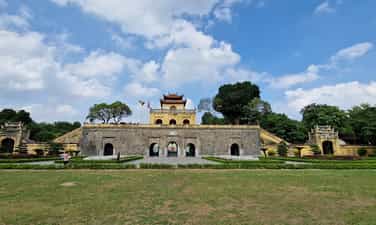
Imperial Citadel of Thang Long
Historical and archaeological relics of Thang Long Imperial Citadel Central Area - Hanoi with a core conservation planning area of 18,395 hectares (including Hanoi Ancient Citadel Relic Area and 18 Hoang Dieu Archaeological Relic Area) and a buffer zone area of 108 hectares. In 1009, Ly Cong Uan ascended the throne and established the Ly dynasty. In 1010, Ly Thai To moved the capital from Hoa Lu to Dai La citadel, renamed the new capital Thang Long and built it into the country's largest economic, political and cultural center. Through the Ly, Tran, Le So, Mac and Le Trung Hung dynasties, Thang Long citadel always held the position of "National Capital", the residence and working place of the King and Royal Family. This area is also where important ceremonies of the country are held. After the Nguyen Dynasty established the capital in Hue (1802), the capital role of Thang Long was dissolved... After 1954, the Thang Long citadel area became the headquarters of the Ministry of National Defense. It was in this area that many important decisions of the Party and State were made, contributing to great victories in the resistance war against the US to save the country, win national independence, and unify the country. Through time and historical events, Thang Long citadel has had many changes and deformations..., but up to now a number of historical and archaeological relics are still preserved, typically: Flagpole (Hanoi Flagpole): built in 1812, under the reign of King Gia Long, 33.4m high, including three floors: base, column body and lookout. Doan Mon: is the southern citadel gate, built in a rolling arch style. Doan Mon is arranged horizontally, including the middle door reserved for the king, on both sides there are 4 smaller doors, for mandarins and royal families. Kinh Thien Palace: located in the center of the imperial citadel (early Le Dynasty), built in 1428, right on the old foundation of Can Nguyen Palace under the Ly Dynasty (later renamed Thien An Palace). In 1886, this palace was destroyed by the French colonialists to build the French Army Artillery Command. Currently, only traces of the foundation of Kinh Thien Palace remain. In particular, this area still preserves two stone dragon steps, dating back to the 15th century. Hau Lau (Princess's Floor): built in 1821, used as a resting place for the maids in the convoy escorting the Nguyen Kings when traveling to the North. At the end of the 19th century, Hau Lau was seriously damaged, the French colonialists renovated and rebuilt it as it is today. Main Bac Mon (North Gate): is the northern city gate, built in 1805, consisting of two floors, eight roofs, with a curved blade head, in the traditional style. Surrounding walls and 8 palace gates of the Nguyen Dynasty: In 1805, the Nguyen Dynasty built a wall from Doan Mon gate around the inner palace, creating a palace for the king to work and rest every time the North patrolled. Currently, in the ancient citadel there are still 8 city gates along with a system of walls surrounding the palace made of bricks. Relics of house and bunker D67: built in 1967, in area A. This is where the Politburo, Central Military Party Committee, and General Command made many historical decisions, marking the milestones of the Vietnamese revolution: The 1968 Tet Offensive, the 1972 campaign, the 1975 General Offensive and the climax of the Ho Chi Minh Campaign... French architectural works: built from the late 19th century to the early 20th century in the Vauban style, including the French Army Artillery Command building; a 2-story building, built in 1897, now used as the headquarters of the Department of Operations; two one-story buildings, built in 1897. East of the Operations Department building is a guest house, built in 1930. Trees in the relic area: planted at high density and diverse in types, have contributed to creating a fresh environment and harmonious landscape for the relic area. Archaeological relics at 18 Hoang Dieu: located about 100m west of Kinh Thien Palace, with an area of 4,530 hectares, excavation began in December 2002, divided into 4 zones (A, B, C, D). While excavating here, archaeologists discovered traces of the foundations of ancient architectural works of Thang Long Imperial Citadel and many valuable artifacts, such as terracotta architectural decorative materials, wooden columns, ceramics of Vietnamese feudal dynasties and many foreign utensils and objects, such as porcelain of West Asia, China, Japan... Thang Long - Hanoi Ancient Citadel is a typical historical and archaeological relic, material evidence reflecting high technical level, containing historical, architectural and artistic values. At the same time, it reflects the cultural interference with countries in the region and around the world in a long historical process, shown through many historical artifacts, architectural works, and urban landscapes with thousands of years of history. With the special historical, cultural and scientific values of the monument, the Prime Minister decided to classify the Thang Long - Hanoi Imperial Citadel Central Area historical and archaeological site as a special national monument on August 12, 2009. Source: Department of Cultural Heritage
Hanoi
10720 view
Rating : Special national monument

Voi Phuc Temple, Hanoi
The temple was established during the reign of Ly Thai Tong (1028-1054) in the southwest corner of the old Thang Long citadel in the territory of Thu Le village, now Thu Le park. Worshiping Prince Linh Lang, son of King Ly Thai Tong, and his 9th concubine Duong Thi Quang, but it is said that he was originally the son of Long Quan, whose name was Hoang Chau, waterfall, who had meritorious service in the resistance war against Vietnam. Song Dynasty invaders. After his death, the people of Thu Le built a temple and was ordained by the king as Linh Lang Great Vuong, the supreme blessed god. The god has many times conspired to help the Tran dynasty in the war against the Yuan-Mongol invaders, and the Le dynasty in the revival. Because in front of the temple door there are two kneeling elephants, it is commonly called Voi Phuc Temple and because the temple is in the west of the capital, it is also called Tay Town or Doai Town (Doai, according to the Western eight trigrams). Voi Phuc Temple is currently located in Ngoc Khanh ward, Ba Dinh district, Hanoi. The temple is also called Phuc Thu Le Elephant Temple to distinguish it from Phuc Thuy Khue Elephant Temple at 251 Thuy Khue Street, Tay Ho District, Hanoi. Previously, the temple was located in the Tu Tran system, "keeping" the west of the capital. This place was originally a land full of lakes, ponds, and marshes, and was one of the Thirteen camps dating back to the Ly Dynasty. At that time, it belonged to the general cabinet, Quang Duc district, Phung Thien district. Legend has it that Voi Phuc Temple was built in the 7th year of Chuong Thanh Gia Khanh (1065) under King Ly Thanh Tong on a high mound in the land of Thu Le camp - one of 13 camp villages in the west of Thang Long capital. . The temple's opening is currently a four-pillar gate, like cosmic axes that bring vitality from the upper floors down to earth (this is a product of the 19th and 20th centuries). On both sides of the gate are steles of a horse and a pair of elephants. adoration ceremony (currently a new four-pillar ritual gate has been built, close to the main road). It is also because of this that the temple is named Voi Phuc. New
Hanoi
8633 view
Rating : National monument