Relic point Vietnam
Việt Nam
Relics of communal houses, temples, and Dao Xa pagoda.
Coming to Dao Xa village, Thang Loi commune, Thuong Tin district, visitors will admire the ancient and unique features of the cluster of communal house and pagoda relics with sophisticated and unique features in architecture, and be immersed in Green, clean, beautiful space of a peaceful village with talented, friendly, hospitable people... Thang Loi commune, Thuong Tin district, is famous for Dao Xa embroidery village with products of sophisticated artistic quality. This place is also a destination for many tourists from near and far because of a unique architectural complex including the East communal house, the Western communal house, and Dao Xa pagoda. All three of these relics were ranked national historical and cultural relics by the Ministry of Culture, Sports and Tourism in 2000. Dao Xa possesses a special feature that few other localities have: in one village there are two communal houses adjacent to each other. The two communal houses are distinguished by their rustic and rustic names: Eastern communal house and Western communal house. Tay Dao Xa Communal House was originally a temple to worship Chu Dong Tu (one of the Four Immortals of the Vietnamese people) and Princess Tien Dung. Legend has it that Chu Dong Tu and Tien Dung once passed by Dao Xa village and saw the charming scenery and stopped to rest. To commemorate the Saint and the Princess, people built a temple. The temple was built during the early Chinh Hoa period (1680-1705), the reign of King Le Hy Tong, and has architecture in the style of the word "two". Later, the temple became a village communal house. In front of the Western communal house, there is a pair of stone crocodiles - popular mascots of the Ly - Tran dynasties, still intact. The great pavilion has 5 steps, the roof is covered with fish-scale tiles, the top is embossed with the image of two dragons painting pearls, and there are roofs on both sides. The distance between the main altar and the upper hall is about 1m, on both sides the gate is decorated with an open holy mat. On both sides of the great altar wall are two sunken stone steles recording the restoration event of the communal house. The great altar has two great Chinese characters: "Nac Doc Chung Linh" and "Higher Class Spiritual Words" praising the merits of Saint Chu Dong Tu. The system of wooden pillars is placed on stone pedestals, the seven heads are carved with exquisite dragon shapes and the mascots are carved separately on the beam system. Dong Dao Xa Communal House was formerly Palm Leaf Temple, built in the early 20th century in a "tam"-shaped continuous architectural style. The three folds of the house gradually increase from the outside to the inside. The altar house has 4 rows of wooden pillars placed on stone pillars in a collared style. On the left is a stone dog lying with its head facing out. The temple worships the father of embroidery, Le Cong Hanh (1606-1661), originally from Quat Dong village (now Quat Dong commune, Thuong Tin district). Thanks to its great spiritual value, the temple was converted into a communal house and called the Eastern communal house to distinguish it from the Western communal house worshiping Chu Dong Tu - Tien Dung. The Eastern communal house is smaller in scale than the Western communal house. Dong Dao Xa communal house is where the death anniversary of embroidery master Le Cong Hanh is held on June 12 (lunar calendar) every year. Located between the two communal houses is Dao Xa pagoda (Van La pagoda), small in scale, with 36 statues arranged in layers from the altar to the upper palace. In front of the pagoda's yard, there is an incense tree carved with Chinese characters: "Vinh Khanh, the year of the year at At Dau, five moons, five moons and five moons" (built in 1729, during the reign of King Le Duy Phuong). Dao Xa is one of the few villages that still retains the spiritual architecture of the communal house - temple - pagoda and the system of courtyards, gates, ponds and ancient trees. The three gates are the common gate for the entire complex and are sculpted in detail. Over time, the three gates have acquired an ancient and majestic beauty. Each gate has 2 floors, a bell tower, and a reception floor. The main gate has 4 Chinese characters inscribed on it "Nhat edict, moonlight forest", facing southwest, 15m high, in front of it is a large yard creating a majestic and majestic look when viewed from afar. Dao Xa village festival is held on February 12 (lunar calendar). Every 5 years, there is a ceremony to bathe Thanh Chu Dong Tu and Princess Tien Dung with water taken from Da Trach lagoon (Hung Yen province). With great historical values, in 2000, the Eastern communal house, Western communal house and Dao Xa pagoda were ranked national historical and cultural relics by the Ministry of Culture, Sports and Tourism. In 2009, Dao Xa village was recognized by the Hanoi People's Committee as a Traditional Craft Village. Dao Xa is chosen by many tourists from near and far as a destination in their spiritual cultural tourism journey. Coming to Dao Xa, visitors will admire the ancient and unique features of the temple relic cluster with sophisticated and unique features in architecture, and be immersed in the green, clean and beautiful space of the village. still retains the characteristics of the Northern Delta countryside. Not only that, if you have time, visitors will have more wonderful experiences at Dao Xa embroidery village to understand more about this land and people. Source Hanoi Department of Culture and Sports.
Hanoi
6177 view
Rating : National monument

TO THE TEMPLE OF KINH DUONG VUONG
Every year, every Tet holiday and spring, thousands of "Lac descendants" from all over the region come to the temple relics and tombs of Kinh Duong Vuong, Lac Long Quan, Au Co, in A Lu village. , Dai Dong Thanh commune, Thuan Thanh district, to pay tribute and worship the ancestors of the nation who openly opened the country. A Lu is an ancient village located close to the southern bank of the Duong River. Legend has it that it is the convergence land of the "Four Spirits" with 99 ponds and 99 humps, considered as the Dragon, the Ly, the Quy, and the Phuong, the only place where Tombs and temples of Kinh Duong Vuong, Lac Long Quan, and Au Co are the ancestors who were instrumental in opening the country. Kinh Duong Vuong's tomb is located on a wide open alluvial ground close to the southern bank of the Duong River and is bustling with ancient forests surrounding it. In the past, two ancient temples in the west of A Lu village worshiped Kinh Duong Vuong, Lac Long Quan, Au Co (Upper Temple worshiped Kinh Duong Vuong, Ha Temple worshiped Lac Long Quan and Au Co), with large architectural scales. large, decorated with splendid "four sacred animals and four precious" decorations. To the east of Kinh Duong Vuong's tomb, there was also a pagoda with the literal name "Dong Linh Bat Nha Tu" worshiping the "Holy Mother Ancestors" namely Vu Tien, Than Long and Au Co. The ancestor Kinh Duong Vuong is also worshiped as the Thanh Hoang of A Lu village. The ancient communal house in the east of the village was built on a large scale, consisting of 2 buildings: the 7-compartment front hall and the 5-compartment main hall, with a splendid wooden frame carved with "four scriptures and four precious rooms". . The system of divine genealogy and ordaining of communal houses and temples clearly shows that the people worshiped are Kinh Duong Vuong, Lac Long Quan and Au Co, who are known for their achievements in mountain and water. In 1949-1952, the French invaders came to A Lu village, set up posts here, and destroyed all temples and pagodas. The villagers were able to save a number of precious ancient worship objects such as: thrones, palanquins, ordinations... of temple and communal house. In 1971, the people of A Lu village restored Kinh Duong Vuong Tomb. In 2000, a communal temple worshiping ancestors was restored in the traditional style. The extremely valuable thing about the relic complex is that it still preserves a treasure trove of tangible and intangible cultural heritage such as: divine genealogy, ordination, stone stele, horizontal panels, couplets, beliefs, and festivals: At Kinh Duong Vuong's tomb, a stone stele is still preserved clearly stating "Kinh Duong Vuong's tomb", dated "Minh Menh's second decade" (1840). At the temples of Kinh Duong Vuong, Lac Long Quan and Au Co, many precious antiques are still preserved such as: thrones, tablets, genealogies, ordinations, orations, diaphragms, and parallel sentences. The system of horizontal panels and parallel sentences reflects and praises the person being worshiped such as: "Nam Bang's ancestors" (Southern country's ancestors), "Nam To Mieu" (Southern country's ancestors' temple)... Especially the 15 ordinations of The kings named the worshipers Kinh Duong Vuong, Lac Long Quan and Au Co, with the following dates: 1 Gia Long 9 (1810), 1 Minh Menh 2 (1821), 2 Thieu Tri 2 (1842), 2 Thieu Tri 6 (1846), 2 Tu Duc 3 (1850), 1 Tu Duc 33 (1880), 2 Dong Khanh 2 (1887), 1 Duy Tan 3 (1909) and 2 Khai Dinh 9 (1924). The precious cultural heritage treasure of the relic complex is also expressed in traditional beliefs and festivals. Legend has it that every year on January 18, A Lu village temple and communal house held a festival. To take care of popular matters, right from within the five villages, tasks were assigned to officials and guards. Giap, who hosts the festival, receives public fields to raise pigs and make banh chung and banh day to sacrifice to the gods. At the festival, right from the 12th day, temples and communal houses are opened to pack worship items and fan flags. On the 16th, the village organizes a procession of water from the Duong River to the temple for offerings all year round. On the 17th, the village organizes a palanquin procession from the communal house to the Upper and Lower temples to request the procession of the nation's ancestors to the communal house for offerings and festivals. From the 18th to the 24th, each day is a week of worship. Offerings include whole pigs, banh chung, and banh day. On the 25th, offerings will be made at the Upper and Lower temples with fish salad. In addition to the festival on January 18, there are also special days for the Upper Temple and the Lower Temple. Legend has it that every August 15 (lunar calendar), villagers make 3 trays of black fillings and 3 trays of fish salad to worship the Kinh Duong Vuong ancestors. Lac Long Quan and Au Co at the Thuong and Ha temples. The offerings: "black filling" symbolizes the 50 children who followed their mother to the mountains and forests to make a living. The "fish salad" trays represent the 50 children who followed their father to the sea to open up the coastal region. During the festival days, thousands of "Lost Sons of Hong" from all over the country have been attracted to the mausoleum and temple relics, to pay tribute and worship to honor Kinh Duong Vuong, Lac Long Quan, Au Co are the ancestors who were instrumental in opening the country. With the great value and significance of the relics of the mausoleums and temples of Kinh Duong Vuong, Lac Long Quan, and Au Co, the People's Committee of Bac Ninh province recently announced a plan to preserve and promote the value of the relics. with a very large scale including many project items. The relic site has become a key cultural and spiritual tourism center of our country. Source: THUAN THANH CULTURAL HERITAGE
Bac Ninh
4044 view
Rating : Updating

BUT TAP Pagoda
But Thap Pagoda, the literal name is Ninh Phuc Tu - Known as one of the most beautiful ancient pagodas in the Northern Delta, still preserved relatively intact to this day, far from the capital Hanoi. About 30km from the inner city and 3km from Dau Pagoda. The pagoda is located next to the south bank of Duong River, in But Thap village, Dinh To commune, Thuan Thanh district, Bac Ninh province. The pagoda's ruins date back to the 13th century, and it was built during the reign of King Tran Thanh Tong. Monk Huyen Quang, after passing the exam and then resigning from mandarin, returned to practice here (Book of But Thap Pagoda - Bui Van Tien, also mentioned The abbot of the pagoda during the Tran Dynasty was Zen Master Huyen Quang, the third founder of Truc Lam). Over time, the pagoda has been restored and embellished many times. But the biggest restoration was at the beginning of the 17th century, during the Le - Trinh period. At that time, the abbot of the pagoda was monk Chuyet Chuyet (From 1633-1644), and his disciple, Zen master Minh Hanh (From 1633-1659), restored the entire pagoda on a large scale, with architectural style. "Domestic work, foreign work" and has great meritorious contributions in terms of money and fields from the Queen Mother - Dieu Vien, Trinh Thi Ngoc Truc (Daughter of Thanh King Trinh Trang) and Princess Le Thi Ngoc Duyen Dharma names Dieu Tue and Princess Trinh Thi Ngoc Co (These people were also later built temples, statues were carved and placed in shrines, and worshiped at But Thap Pagoda to this day). This restoration period lasted from 1644 to In 1647, the pagoda was completed and had the literal name "Ninh Phuc Zen Tu". In the early 18th century, But Thap Pagoda was repaired on a larger scale than before. The stele "Ninh Phuc Thien Tu Bi Ky" and "Khanh Luu Bi Ky" built in the year Vinh Thinh 10 (1714) write that "the pagoda was further repaired by officials, did not hesitate to buy thousands of gold to buy only good wood, and was popular with the people. The village contributed and invited workers to build and repair, with a magnificent temple, spacious pagodas, adorned with a world of glass. Compared to before, the pagoda has a separate row of houses behind the Buddha hall, the scale is much larger. In 1876, when King Tu Duc visited here, he saw a giant tower, so it was named But Thap Pagoda from then on. The architectural complex of But Thap Pagoda stands out among the vast rice fields. The pagoda faces south, which is the direction of wisdom and prajna in Buddhist philosophy. The outermost is the three-entrance gate, followed by the 2-storey and 8-roof bell tower. The central area includes 7 rows of houses, all horizontal, running parallel, arranged on a vertical axis - Shinto Street. Inside the inner temple, located between two corridors (each row consists of 26 rooms) are 7 buildings connected from the outside in, including: Tien Duong, Thieu Huong, Thuong Dien, connecting Thuong Dien and Tich Thien Am. The stone bridge spans the lotus pond (The bridge is 4m long and has 3 curved arches. The bridge surface is paved with green stone, on both sides of the bridge there are 12 elaborate and sophisticated stone reliefs of birds, flowers and leaves). Tich Thien Am Building, as the name suggests, means containing good things. In Tich Thien Am, there is a nine-level lotus tower - a wooden tower, 9 floors, 8 sides, 9 lotus petals symbolizing the 9 levels of Buddhist practice. Then comes the Trung house, the worship hall and finally the rear hall, with a total length of more than 100m. Behind the Hau Duong house is a row of stone towers, including the 5-storey, 11m high Ton Duc stone tower, which is where the relics of Zen Master Minh Hanh, the second patriarch of the pagoda, are placed. On the left side of the pagoda is the church of the first patriarch Chuyet Chuyet and the eight-sided Bao Nghiem stone tower, 5 floors 13m high, which is the burial place of Zen master Chuyet Chuyet. On both sides of the outer end, along the front hall, are two stele houses. Each architectural work of this temple is a skillful work of art with decorative motifs made of rich and diverse materials such as stone, wood, and brick. It represents a harmonious combination of architecture and natural environment. Overall, the pagoda is arranged symmetrically and tightly in the central area, but is very naturally open in the surrounding area, so But Thap Pagoda has its own and extremely unique features. In particular, in the system of ancient statues of But Thap Pagoda, there is an ancient treasure, considered unique in Vietnam. That is the Buddha statue "Thousands of hands, thousands of eyes - thousand eyes, thousand hands". The statue is 3.7m high, 2.1m wide, has 11 heads, 46 large arms and 954 small arms of different lengths, expanding and rising like a halo of light. This is considered a masterpiece of Buddha statues and contemporary statuary art. The statue is placed on a dragon lotus throne, with a relaxed, religious posture. The special and unique thing about the pagoda that cannot be found anywhere else in our country is the tall, majestic stone stupa, rising into the blue sky, called Bao Nghiem tower, which stands out in the middle of the area. vast plain. Bao Nghiem Tower is like a giant pen, reaching straight to the deserted sky. The tower is 13.05m high, 5 floors with a top part made of green stone, 5 corners of 5 floors have 5 small bells, around the tower are decorated with vivid and unique patterns. The inside of the tower has a circle with a diameter of 2.29m. The bottom floor of this tower has 13 stone carvings, mainly images of animals. The tower demonstrates the excellent stone grafting and sculpting skills of ancient Vietnamese craftsmen. Behind is the 11m high Ton Duc tower, where the relics of Zen Master Minh Hanh, the second patriarch of the pagoda, are located. The tower was built in the mid-17th century, all four sides of the tower are covered with stone. Recently, inside the tower, people have just found 2 ancient bronze books, written/engraved with Buddhist scriptures. Several centuries have passed, but what remains at But Thap Pagoda shows that this was one of the most influential Buddhist centers in the ancient Kinh Bac region, one of the few pagodas still kept quite intact. complete architectural blocks, altar objects, and ancient statues of our country. Through many historical ups and downs, But Thap Pagoda has always been protected, preserved and embellished more and more beautifully, becoming one of the famous spiritual tourist attractions in the Bac Ninh - Kinh Bac region. Every year, people in the area and tourists from near and far always remember and return to attend the pagoda festival, held on March 24 (Lunar Calendar). But Thap Pagoda Festival takes place amid the joy and reverence of visitors from all over every time they come to the pagoda. With typical values of history, culture and art of architecture and sculpture. But Thap Pagoda has been ranked and recognized by the Ministry of Culture and Information as a national cultural relic since April 28, 1962. By 2013, the Prime Minister granted a special national relic status and the Buddha Statue "Thousand Eyes - Thousand Eyes and Thousand Hands" was recognized as a national treasure./. Source: THUAN THANH CULTURAL HERITAGE
Bac Ninh
4180 view
Rating : Special National Monument
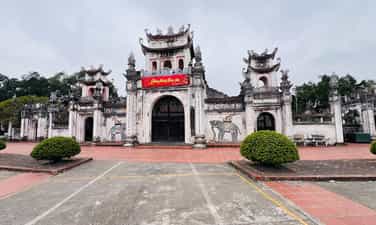
Ha Hoi Communal House
Ha Hoi is a commune in the northeast of Thuong Tin district. Before the August Revolution of 1945, Ha Hoi commune belonged to Ha Hoi district, Thuong Tin district, Ha Dong province. When talking about Ha Hoi commune, we must mention the ancient communal house located in the center of the commune - Ha Hoi communal house, which is one of 6 ancient communal houses in the Northern Delta that still exists today. The communal house was built more than 400 years ago during the Le Dynasty, 16th century. According to archaeologists, the communal house was built in 1578, during the reign of Mac Mau Hop, to worship Saint Cao Son, the village's tutelary god. Due to his many contributions to the people and the country, Mr. Cao Son Dai Vuong was conferred 24 titles by dynasties that are still kept today, the highest of which is Supreme Rank Most Holy Spirit. Through history, the communal house has gone through many dynasties, ups and downs of time and war, the communal house has been renovated many times, but still retains the quintessential artistic and architectural values of the artisans. old. Ha Hoi Communal House was built in a Tam-shaped layout, facing South and East, with a fairly large water pavilion in front. The great communal house consists of 3 large items, located parallel and adjacent, including: the Great Court, the Central Palace and the Harem. The communal house's roof is designed in the shape of a boat with tiled bows, the rafters are designed in a bed-stacking system, creating a solid appearance for the communal house. The floor is paved with monolithic stones, creating a cool space. The communal house still retains and preserves the architectural carvings and artistic sculptures, shown in the statues such as: Four sacred animals (Dragon, unicorn, tortoise, phoenix), mouse looking at the head of the lotus leaf, the remaining heads, The dragon-carved trap head is extremely soft and sophisticated. The Chinese-Vietnamese transliteration of the horizontal panel in the Central Palace is: "Protect the country for the people" (translation: Help the country, protect all people). Next to it are a couple of parallel sentences. Sino-Vietnamese transliteration is as follows: “Nai Van Nai Vu, the gods of the sea protect the people, The most outstanding and the most spiritual, the holy virtue always remains in the country." Translation: "As literature and martial arts, my merits are like underground lakes and oceans that help people stay peaceful, Outstanding and majestic, the saint's virtues are passed down to maintain the peaceful fortunes of the country." Outside the Dai Bai pavilion, there is a horizontal panel in the middle with four words inscribed on it: "Son anh ha tu" (Temporarily translated as: Mountains and rivers of heroic spirits). In addition, the communal house also preserves many parallel sentences, horizontal panels, hammock doors... and architectural items in the traditional Northern style, especially two Siamese stone Buddha statues right in front of the Harem gate. Outside the yard, in front of the grand altar, on both gables there are two stone dog statues, in the middle there are two stone pedestals carved with delicate and meticulous dragons made of Lam Son stone (Thanh Hoa). The two rows of houses on both sides (left desert - right desert) are slightly set back from the main palace. Looking from the outside at the gate of Ha Hoi communal house, there are up to 5 doors, also known as (five gates), different from other communal houses, the gate is designed in an arc shape, embracing the communal house, with three doors in the middle. It has the appearance of a three-door gate, the main door is up to 15m high, the lower floor is built into square blocks, the door is in the form of a dome, the roof is in the style of a stack of matches and covered with ri tiles. The two sides of the side door are built smaller, one-story style, connected to the wall running around the area leading to the Ta Mac - Huu Mac house. Past the Five Gates connecting to the narrow yard across the water pavilion is a brick bridge with 5 spans, the bridge wall is decorated with turquoise glazed tiles. It can be said that Ha Hoi Communal House is an architectural work of art, the entire space is a synthesis of knowledge, it carries the soul of national architecture, containing within itself a whole cultural and historical system. With its artistic and historical values, Ha Hoi Communal House is like a historical treasure that ancestors left behind for posterity. On December 23, 1985, Ha Hoi Communal House was recognized by the Ministry of Culture and Information as a National Historical and Cultural Relic. Source Electronic information portal of Thuong Tin district, Hanoi city.
Hanoi
6248 view
Rating : National monument
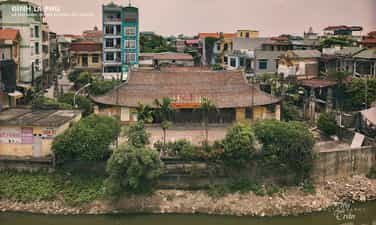
General La Phu Communal House
Tong La Phu communal house is the communal house of four people: La Uyen, Phuc Trai, Tho Ngai, Mai Hong (Tan Minh commune) and Mai Sao (Nguyen Trai commune), La Phu canton, Thuong Phuc district in the past (now belongs to Tan Minh commune, Thuong Tin district, Hanoi), built nearly five centuries ago. The communal house is still called by its general name, La Phu communal house. The communal house is located on a piece of land near La Uyen village, in front of the communal house is the Nhue Giang river, an important waterway of the country, connecting the capital Thang Long to the former Son Nam Thuong region. This is also one of the few oldest general communal houses not only in Hanoi, but in the entire Northern Delta region. According to the jade genealogy book and folk historical documents, the three deities in La communal house are the great king Minh Lang, the great king An Lang and the great king Xa Than. The three great kings are heroes who have contributed to the people and the country, and are honored by the people. The Great King Minh Lang is General Nguyen Phuc, a former god of the post-Le Dynasty. He was originally from Doan Tung commune, Truong Tan district of Dong (now Hai Duong), passed the Doctor of Hoang Giap faculty of Quy Dau, in the 11th year of Thai Hoa (1453) under the reign of Le Nhan Tong. During his life as a mandarin, he held the position of Academician, concurrently the position of Deputy Thai, and teacher of Le Thanh Tong when he was young. When King Le Thanh Tong went to fight the Champa invaders, he sent Nguyen Phuc to command the transportation of military provisions. During the sea transport, there was a storm and the military supplies arrived one day late, so they were punished by death according to military law. Because he had military provisions, the king defeated the Champa army. When he returned to discuss the reward, King Le Thanh Tong vindicated Nguyen Phuc and bestowed upon him the title Minh Lang Dai Vuong, protector of the country and people, protector of the country, and at the same time, decreed 72 places of worship. Originally, the temple had a Dai Bai house, an artistic architectural work built during the Mac Dynasty, with a rectangular floor plan of 24m30m long, 9m30 wide, 1m30 wide porch, four wide, low spreading communal roofs. The boats' four-sided roofs run in the shape of the boat's sides, intersecting to create curved corners that glide up into the sky. Wooden knife carved with flower petals. The edge of the roof, the edge of the communal house's roof are covered with nails. The roof leaves of the communal house are layered with funny-nosed tiles. During the Nguyen Dynasty, King Bao Dai 11 (1936) built a 3-room harem with a house in the back located parallel to the Dai Bai. In 1948, the French invaders burned down the harem, and when peace unified the country, the people contributed to rebuilding it. In particular, about the sculptural art of the Le - Mac dynasties on the architecture of two sets of nave, the back of which borders the harem, a set of pillars with an artistic sculpture cast engraved with a dragon creating an oval shape. The dragon is shaped like a saddle, with its head in the middle of its body, revealing bulging eyes, a round nose, a flared mouth, and bat ears. From the dragon's head, thin rays of spears emanate from both sides. This is a quite vivid piece of wood sculpture art of the Mac Dynasty. On the second porch, behind the harem, the Mac dynasty dragon is engraved on the dome, on the head of the rampart and on the porch. The dragon here has a saddle-shaped body with big ears, bulging eyes, and a quill tail. The dragon's face in the middle is placed on the back of the saddle, with a wide mouth, flat nose and raised forehead. What remains at La Phu communal house, although not much, has contributed to providing material for art research. During the Mac Dynasty, it was one of the five communal houses bearing the mark of the oldest communal house. Behind is the harem, a 3-compartment house located behind and running parallel to the Dai Bai, built with gabled walls, two flowing roofs, tiled roofs with nail-shaped roofs, rectangular pinnacles, wooden architecture. The rafters are made in the form of hitching a bridge truss and have a domed ceiling system of a crab roof. Currently, La communal house still preserves many rare artifacts such as genealogies, 38 ordinations, the earliest ordination of King Le Vinh Thinh (1705); a palanquin with a tribute bowl carved with a dragon's head, a pearl in its mouth, a big round nose, and a mane of netted hair flying back in the Le Dynasty's art style; 5 wooden boards carved with dragon and horse saddles of the Mac Dynasty; 2 sculptural stone turtles of the Le Dynasty; 3 sets of parallel sentences; 3 thrones carved with different dragon heads from the Nguyen Dynasty... Every year, La communal house opens two festivals, spring and autumn two times. The main festival is on the 12th day of the 8th lunar month. The annual festival still takes place normally, but the main festival is only held once every 2 years and on three days, the 11th, 12th, and 13th of the 8th lunar month. With historical, cultural, architectural and artistic values, La communal house was recognized by the Ministry of Culture, Sports and Tourism as a National Monument in 2003. Source Electronic information portal of Thuong Tin district, Hanoi city.
Hanoi
6018 view
Rating : National monument
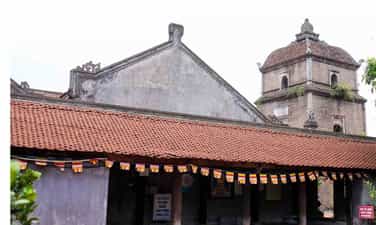
Dau Pagoda
Dau Pagoda is one of the oldest pagodas in Vietnam, where Buddhism originated. This is one of the typical spiritual tourist destinations of Bac Ninh province, attracting many domestic and foreign tourists to make pilgrimages and learn about historical values. Dau Pagoda is also known as Ca Pagoda, Co Chau Tu, Dien Ung Tu, Phap Van Tu. Dau Pagoda is located in Thanh Khuong commune, Thuan Thanh district, and was certified as a special National Monument in 2013. This is the oldest Buddhist center in Vietnam. The pagoda is also called by people with different names such as Ca Pagoda, Co Chau Tu, Dien Ung Tu, Thien Dinh Tu. This is the temple that is considered to have the earliest history in Vietnam, although the physical traces no longer exist, it has been rebuilt. The pagoda is one of the most famous landmarks of the Northern Kinh region in the past. This is also a special national monument of Vietnam ranked 4th. Dau Pagoda is considered the oldest pagoda in Vietnam. The pagoda is located in the Dau area, during the Han Dynasty, it was called Luy Lau. In the Dau area, there are five ancient pagodas: Dau pagoda worshiping Phap Van, Dau pagoda worshiping Phap Vu, Tuong pagoda worshiping Phap Loi, Dan pagoda worshiping Phap Dien and To pagoda worshiping Man Nuong, the mother of the Four Dharmas. These five pagodas, in addition to worshiping Buddha, also worship the Four Dharmas. Dau Pagoda in Dau area was destroyed during the war, so the statue of Ba Dau was worshiped in Dau pagoda. Among the Four Dharmas, Phap Van is at the top, Thach Quang Phat (the rock in the Dung tree) is always with Phap Van and Phap Van represents all Four Dharmas, every time the court invites the statue to the capital to pray for the island, they can process it in procession. all four statues or just Phap Van. It can be said that among the Four Dharmas, Phap Van and Phap Vu are worshiped most widely, but Phap Van is the focus, so Dau Pagoda has become the center of this belief in both the Dau region and the whole country. The front house consists of 7 rooms, 2 wings, inside there are a number of tables and chairs for guests to prepare their offerings before entering to worship Buddha. The most prominent of the pagoda's buildings is the Hoa Phong tower. According to ancient bibliographies, during the Tran Dynasty, Poinsettia Mac Dinh Chi restored Dau Pagoda and built a 9-storey tower. The architecture of the tower that still exists is from the Le Trung Hung period. The tower is built of old burnt bricks, with 3 floors, 15m high. Outside the tower there is a statue of a stone sheep 1.33 m long and 0.8 m high. In the tower there are 4 statues of Thien Vuong - 4 legendary gods who govern the 4 directions of heaven. In the tower, hang a bronze bell cast in 1793 and a gong cast in 1817. Tien Duong House consists of 7 rooms and 2 wings. In front of the house are three steps running through the 5 middle spaces. In the middle space, there are two dragon-carved stone steps, bearing the artistic style of the Tran Dynasty. At the front hall, there are altars to worship Ho Dharma, Monsignor, Duc Thanh Hien, and Bat Bo Vajra. The statue of Phap Van is worshiped in the Upper Palace. This is one of four statues in the Four Dharma statue system in Dau - Luy Lau region recognized as a National Treasure. The statue of Phap Van is majestic, quiet, bronze-colored, nearly 2 meters high. The statue has a beautiful face with a large mole in the middle of the forehead, reminiscent of Indian dancers and the homeland of Tay Truc. The area connecting the front room and back hall is the place to worship the Eighteen Arhats (18 enlightened disciples of Buddha who have cultivated to the Arhat realm). In addition, statues of Bodhisattva, Tam The, Monsignor, and Saint monk are placed in the back of the hall. Source 'Bac Ninh Province Electronic Information Portal'
Bac Ninh
3916 view
Rating : Special national monument
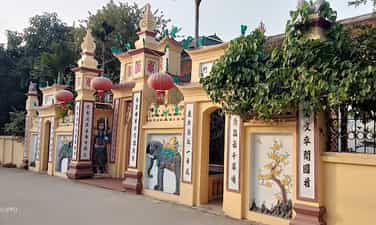
Nguyen Trai Temple.
Nguyen Trai Church is located in Nhi Khe commune, Thuong Tin district, Hanoi. Nguyen Trai (1380 - 1442), a national hero, outstanding cultural figure, and world cultural celebrity, was recognized by the United Nations Educational Scientific and Cultural Organization (UNESCO) in 1980. Nguyen Trai Church was built in Nhi Khe village, Nhi Khe commune, Thuong Tin district. In Con Son (Hai Duong) and other places there are also temples worshiping famous person - national hero Nguyen Trai. The gate of Nhi Khe village is embossed with four large Chinese characters: "Like seeing a great guest" (like seeing a big guest). That is the heart of the ancients who came to the village. This gate is also called "Quoc Gate" - according to legend, it is called so to commemorate the founder of the country Nguyen Trai. After passing the National Gate, a short distance leads to the Nguyen Trai church area with the Nguyen Trai monument, the church, the exhibition house "Nguyen Trai's life and career", and Nhi Khe library. Since then, the church has welcomed millions of visitors to admire and admire a work with good content, portraying Nguyen Trai - a talented man of literature and martial arts. Through the monument area you will reach the church. In front of the church there is a semicircular lake. The church has a system of pillars, walls, cannon gates... elaborately painted in the style of a village communal house. Through a small brick yard to reach Dai Bai, Nguyen Trai church was built of four-stone wood, gabled, and covered with ancient tiles. The church has the architectural appearance of the Nguyen Dynasty - the result of renovations in the 19th century. The art of architecture tends to be durable, smooth, and sharp. The highlight of the Dai Pagoda building is that the great paintings, horizontal panels and parallel sentences are all painted with gold or silver plated with gold to show respect and gratitude to the great mandarin and poet Nguyen Trai. Those are the royal concubines: Opening the country Nguyen Huan, Binh Ngo opening the country, Simple close to the people... On the altar of Nguyen Trai in the Hau Palace, there is a portrait of Nguyen Trai and the ordination box of the Le and Nguyen dynasties. In particular, there is a sign to honor the words of King Le Thanh Tong, in the 5th year of Quang Thuan (1464), "Uc Trai's heart is bright and beautiful" (Nguyen Trai's heart is as bright and beautiful as Khue star). That was the king's vindication of Nguyen Trai. Visiting Nguyen Trai church, guests will be introduced to "Guava Farm" and "Ao Hue" about Nguyen Trai's father, Nguyen Phi Khanh, who opened a teaching school. Nguyen Trai's great career is boldly imprinted on Nhi Khe land. Nguyen Trai Church has been renovated many times. On the occasion of the 1000th anniversary of Thang Long - Hanoi, Hanoi city and Thuong Tin district invested funds to restore and renovate the entire Nguyen Trai memorial area. Nguyen Trai Church was ranked as a historical relic by the Ministry of Culture and Information in 1964. Source Electronic information portal of Thuong Tin district, Hanoi city.
Hanoi
7352 view
Rating : National monument

Dau Pagoda
Dau Pagoda (Thuong Tin, Hanoi) was recognized with two national records: Being the place with the first fleshly statue in Vietnam and owning the oldest and most page bronze pagoda history book in Vietnam. Located on a high mound in the middle of the fields of Gia Phuc village (Nguyen Trai commune, Thuong Tin district, Hanoi), Dau Pagoda - the number one ancient pagoda - for more than 1,800 years has always been quiet under the shade of trees. Lush green, surrounded by lakes and the gentle Nhue River flowing behind. Dau Pagoda has the literal name Thanh Dao Tu or Phap Vu Tu, people often call it King Pagoda, Ba Pagoda, or Dau Pagoda, each name is associated with a legend. According to the ancient bronze book still kept at Dau Pagoda, the pagoda was started construction during the Sy Nhiep period in the 3rd century AD, at the same time as the legend of Man Nuong Buddha and the Buddhist worship system appeared. Four Dharmas (including Phap Van, Phap Vu, Phap Loi, Phap Dien). Initially, the pagoda was called Thanh Dao Tu. After the pagoda welcomed the Great Saint Bodhisattva Phap Vu (the goddess who governs the rain) to worship, it was called Phap Vu Tu. During feudal times, the pagoda was mainly for kings to worship Buddha, and people were only allowed to worship during festivals, so people called it King Pagoda. The pagoda worships Bodhisattva Phap Vu incarnated as a woman, so people also call it Ba pagoda. The temple is famous for its sacredness, the scholars who sought great careers here all passed the entrance exam and became famous; Farmers pray for a bountiful harvest, so people call it another name, Chua Dau. Under the reign of King Le Than Tong (17th century), the pagoda was degraded, then restored, making it more majestic and spacious. After that, the King ordained the pagoda as "The number one famous place in An Nam", meaning "Number one famous place in the South." Buddhists and people around the area consider it a Buddhist land because of the inspiration that the pagoda brings. Dau Pagoda not only has a beautiful location as if sitting on a blooming lotus flower, but is also a magnificent architectural complex with typical architectural art features of the Ly-Tran-Le-Nguyen dynasties. In particular, the pagoda is famous for the Bodhisattva bodies of two enlightened Zen masters Vu Khac Truong and Vu Khac Minh. These are two extremely rare cases in the Buddhist practice journey of Zen masters in the country and around the world. With a rich history, preserving many cultural, architectural, and artistic values, Dau Pagoda has been ranked a Class A historical and artistic relic by the State since 1964. Two statues of two Zen masters were recognized by the State as National Treasures in 2016; Dau Pagoda also set a record as the pagoda with the first corpse statue in Vietnam. Source Electronic information portal of Thuong Tin district, Hanoi city.
Hanoi
6499 view
Rating : National monument

Ba Kieu Temple
Ba Kieu Temple is located at 59 Dinh Tien Hoang, Ly Thai To Ward, Hoan Kiem, Hanoi. According to history books, Ba Kieu Temple's literal name is "Thien Tien Dien" or "Huyen Chan Tu", formerly located in Ta Vong village, Tho Xuong district, Hanoi province. In the mid-nineteenth century, the temple was located in Ha Thanh village, Dong Cac ward, Tho Xuong district. In the early twentieth century, the temple was on Bo Ho street (Rue du Lac), located in the south direction, opposite Ngoc Son temple. The temple worships three goddesses: Princess Lieu Hanh, Second Ngoc Nu and Third Ngoc Nu (Quynh Hoa and Que Hoa). According to Thang Long ancient archeology, the temple was built during the Le Dynasty, Vinh To Dynasty (1619-1628), and was expanded further during the Canh Hung Dynasty. During the Tay Son Dynasty, Canh Thinh Temple cast a large bell. During the reign of King Tu Duc, the temple was repaired again. Ba Kieu Temple was once quite spacious in a beautiful and spacious campus. In 1891, because the French colonialists built a road around Hoan Kiem Lake, the temple area was divided into two parts: The three-entrance gate located close to Hoan Kiem Lake includes three compartments built with bricks like "gable walls", tiled roofs and statues. The style of stacking beams supports the roof, the trunks of the beams are embossed with plant and rattan patterns; The main architecture includes the main hall, communal house and harem arranged in the shape of the word "cong". The main house consists of three compartments built with brick-style walls, tiled roofs, and small, wavy-like roofs. The roof is close to the architectural style of the ancient capital of Hue. The roof is shaped like a communal house, with a ceramic or green enamel image of a dragon-turned-fish looking at the sacred water vase in the middle. The frame is made quite solidly with 8 ironwood pillars, the main column's circumference is 115cm, the main column's circumference is 105cm. The smaller porch columns are made of white stone, rectangular in shape and each side is 25cm wide. The Tien Sacrifice House has 4 statues of carp turning into dragons placed on the beams and under the points of the two back and front roofs. The flat walls are expressed quite vividly, elaborately and bring significant efficiency to the incoming architecture. Immediately behind the altar is a small structure built on four large pillars in the style of a communal house, with two floors and four roofs. The four roofs are carved with popular traditional patterns following the architectural style of the Nguyen Dynasty. The harem is the place where the gods are worshiped with a row of horizontal houses built with bricks in the "gable wall" style. The goddesses are located in a large, elaborately carved altar. The upper layer includes three phos in the Holy Mother's palace. The lower layer has statues of Princess Lieu Hanh and two fairies Quynh Hoa and Que Hoa. In addition to the altar, there are also four small statues (two girl statues, two boy statues). On both sides there are two small altars, on the right is a statue of the temple guardian, on the left is Ba Chua Thuong Ngan. On both sides are places to worship popular gods in the Mother Goddess religion. Ba Kieu Temple still retains a collection of historical and cultural relics of many different types and materials spanning the three dynasties of Le, Tay Son, and Nguyen. Among them are four stone stele erected in Canh Thinh 8 (1800), Tu Duc 19 (1866) and a system of 27 religious sects from the Le, Tay Son to Nguyen dynasties deifying Lady Lieu and two fairies. Ba Kieu Temple Relics was ranked as a National Historical, Cultural, Architectural and Artistic Relic by the Ministry of Culture and Information (now the Ministry of Culture, Sports and Tourism) on May 2, 1994. Source Electronic information portal of Hoan Kiem district, Hanoi city.
Hanoi
6286 view
Rating : National monument

Dinh Vu Thach
Vu Thach temple and communal house is located at 13 Ba Trieu street, Trang Tien ward, Hoan Kiem district, Hanoi. Vu Thach Communal House, Temple and Pagoda were lucky to escape destruction in the late 19th and early 20th centuries when the colonialists demolished the old village to build many offices and Western streets. During the French colonial period, the relic complex was restored and repaired many times over the years: Tu Duc the 35th (1882), Thanh Thai the 3rd (1891) and Khai Dinh the 9th (1924). Vu Thach communal house is one of the places to worship Khoa Ba Son, the general of Hai Ba Trung. According to the remaining documents, he was ordered by Hai Ba to lead 500 troops to Hoa Dong hamlet (now in Cu Khoi commune, Gia Lam district, Hanoi) to set up a fake post to deceive the Han army, thereby defeating the governor. To Dinh. After ascending the throne, Hai Ba Trung sent Khoa Ba Son back to station at Hoa Dong hamlet, but he disappeared right in the middle of the party to reward the villagers. His main place of worship is currently in Xuan Do village, Cu Khoi commune. Here, there is a book called the Jade Pedigree that clearly records his origin and merits. The book records the date "the 6th month of Vinh Huu year" (i.e. 1740). To commemorate this deity, Vu Thach villagers open communal houses on February 10 and October 15 of the lunar calendar every year. During these days, there is always a delegation from Xuan Do village (Ha) who comes to participate. The festival has many traditional folk games such as ca tru singing, literature singing, and traditional martial arts performances. Vu Thach communal house used to be the place where the ballot box was placed to vote for the 1st National Assembly (January 6, 1946) and where the Hanoi Self-Defense Force was stationed during the 60-day resistance war in late 1946 and early 1947. In 1995, Trang Tien ward built a memorial stele for 77 heroic martyrs who are citizens of the ward. Over several hundred years, Vu Thach communal house has been restored many times. The courtyard in front of the great communal house was probably reduced in size when the French began to expand the streets. Part of the land behind and on both sides of the communal house was also encroached by people. The current appearance shows that the communal house has the architectural style of the Nguyen Dynasty. The communal house faces west, the three-entrance gate and long wall are built adjacent to the sidewalk of Ba Trieu street covered with green trees. The large worship house has 5 rooms, is structured with the upper hall in the shape of a mallet, and inside is decorated solemnly in the traditional style. In Vu Thach communal house, there is currently a statue of Saint Khoo Ba Son and 30 lacquered and gilded altar thrones, of which 5 large thrones are elaborately carved. The communal house also retains the palanquin and four pairs of white enamel vases painted with blue names bearing the Qing Dynasty era. The horoscope, couplets, hammock doors, and incense burners are all beautifully decorated, and the offerings show a very high level of craftsmanship. In particular, this place still preserves 5 royal decrees of the Nguyen kings with different era names scattered throughout the 19th century: Gia Long (1802), Tu Duc (1852 and 1879), Dong Khanh (1886), Thanh Thai (1889). These ordinations all show respect for the famous general Khoi Ba Son. Vu Thach Communal House and the adjacent Mau Temple along with Vu Thach Pagoda (in lane 13b Ba Trieu) were ranked by the Ministry of Culture and Information as a national architectural and artistic relic cluster in 1986. Electronic information portal of Hoan Kiem district, Hanoi city.
Hanoi
5806 view
Rating : National monument