Relic point Vietnam
Việt Nam
Ta Phu Temple
Ta Phu Temple is located in the center of Ky Lua market street, now in Hoang Van Thu ward, Lang Son city. Ta Phu Temple was built in the 4th year of Chinh Hoa (1683) to worship the mandarin of the Later Le Dynasty named Than Cong Tai, the Left Admiral of the Han Dynasty, who was instrumental in building and expanding Ky Lua market street. The main door of the temple faces west, located on high ground, creating a majestic and sacred look. The temple's architecture is in the Cong style, consisting of two buildings: the Dai Bai and the Hau Palace, connected together in a bamboo tube style. The column and truss structures are all made of wood, the walls are made of bricks, the roof is covered with yin and yang tiles, and are not decorated with elaborate patterns or motifs. The most valuable artifact in the temple is a stone stele erected in the year of the Pig, the 4th Chinh Hoa era (1683). The stele's title is: Respecting the Left Admiral Than Cong Tai as a teacher and father; On the side is written the words: Guests of the two countries. The content of the stele talks about the people of the two countries remembering the merits of Han Cong Than Cong Tai with Lang Son, with the merchants of Vietnam and China and the expansion of the trading market at Ky Lua market street. The stone stele is placed in the stele house inside the temple, the stele is crafted in a cubic shape, the stele body is square cylindrical, 2.1m high; The base of the stele has two floors, the upper layer is carved in the style of a collapsed mahogany leg supporting the stele's body, the lower layer is carved with lotus petals overlapping three layers running around. The top of the stele is gradually tapered upward, with a stylized two-petalled lotus flower hugging the top; Currently, only three sides of the stele can be read, one side is faded. It can be said that this is a well-balanced, artistically beautiful stone stele; There is historical value about the Han character Than Cong Tai worshiped at the temple and his merits. In 1993, Ta Phu Temple was ranked as a National Monument by the Ministry of Culture, Sports and Tourism. The temple festival is held from January 22 to 27 every year, attracting a large number of visitors and was recognized as a National Intangible Cultural Heritage in 2015. Source: Lang Son Provincial Museum Electronic News Page
Lang Son
6962 view
Rating : National monument
Tu Ly revolutionary base area, Hien Luong
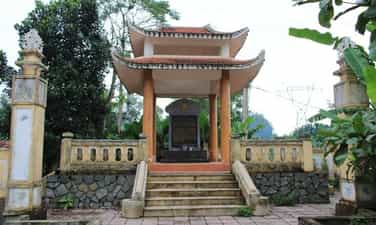
Here, during the pre-uprising period in August 1945, along with Hien Luong commune, Tu Ly and Hien Luong revolutionary base areas were formed, one of the province's four revolutionary base areas located in the Hoa and Hien war zone system. Ninh, Thanh (Quang Trung War Zone). At this base, the province's first military training class was held. From here, the revolutionary movement spread to surrounding areas. Going back in history, in February 1945, the Party Central Committee decided to establish the Hoa - Ninh - Thanh war zone. According to the Directive of the Party Central Committee, the establishment of base areas to quickly prepare for the uprising and welcome the Southern liberation army advancing through Hoa Binh by way of Phu Tho into the Tu Ly - Hien Luong area is one of the opportunities. Important conditions and conditions for the formation and development of the Hien Luong - Tu Ly revolutionary base area. Under the direct direction of the Northern Party Committee, the Provincial Party Committee decided to establish the Tu Ly - Hien Luong revolutionary base area. On February 10, 1945 (the 28th day of the Lunar New Year, Year of the Rooster), led by Mr. Dinh Cong Hau, comrade Vu Tho went to meet Mr. Dinh Cong Sac in Tinh Trang hamlet - Tu Ly commune to find connections to build a revolutionary base. . From here, Mr. Dinh Cong Sac's family became a place to contact, meet, discuss plans to build the Tu Ly - Hien Luong base area and open the first military training class for the province's armed forces. On the basis of the well-developed movement and having enough conditions to establish a base area, the Provincial Party Committee decided to open the first military training class at Mr. Xa Van Binh's house, Dong Lam village, Giang Seo village with 20 teams. National self-defense member of Hoa Binh town and Mai Da district. Under the protection and concealment of the people of Hien Luong - Tu Ly, the students who completed the course quickly returned to establish and develop self-defense teams to save the country, preparing for an uprising to seize power. The successful military class brought the prestige of the Viet Minh to a high level, spreading widely throughout all classes. The leaders were subdued, the people were excited and believed in the revolution. The revolutionary force in the base area grew stronger, making an important contribution to the victory of the uprising to seize power in August 1945 in the provincial capital, Cho Bo district, Suoi Rut, Vang street (Hoa Binh) and Moc Chau (Son La). In 1946, the forces of the Tu Ly - Hien Luong revolutionary base coordinated closely with other revolutionary forces of the province to completely destroy the Dai Viet Duy Dan Party that had come to occupy Muong Diem as its headquarters and plot to overthrow it. revolutionary government in Hoa Binh. To mark historical evidence, in Ma hamlet - Tu Ly commune and Rong hamlet - Hien Luong commune, memorial stele houses were built at the Tu Ly - Hien Luong revolutionary historical relic site. These are works of historical and cultural significance, a place to educate revolutionary traditions for generations of Tu Ly - Hien Luong regions to follow in their father's footsteps in protecting the achievements of the revolution, building, renovate the homeland. The relic site has been ranked as a national revolutionary historical relic. Source: Hoa Binh Electronic Newspaper
Phu Tho
5630 view
Rating : National monument

Phja Khao Temple
The Phja Khao temple project was built by local people on the top of Phja Khao mountain, Ban Thi commune, Cho Don district since 1933. This is a familiar place of spiritual cultural activities, long associated with daily life. of local people. Phja Khao Temple worships Saint Tran, who had the merit of defeating the Mongol invaders in the 13th century to maintain the peace of the country and people. Worshiping the mine workers who were killed by the French colonialists. In 2017, the temple was recognized as a provincial historical-cultural relic. Phja Khao peak has many lead and zinc mines, which are historical evidence of the exploitation of the French colonialists against Ban Thi mine workers, from 1909 - 1941. Here more than a hundred years ago, when the Indochina Mining and Metallurgical Company invested a lot of capital in the mine, especially building a cable car more than 3km long and a railway to transport ore. It is known that during its prosperity, the mine had up to 5,000 workers and 80 secretaries. By 1942, there were only 500 workers and 5 European managers. Within 27 years (1914 - 1941), France brought home over 350,000 tons of zinc ore. Phja Khao was a place that brought profit to the colonists, and was also a place where many complex elements gathered, where robberies and killings often occurred. On top of Phja Khao, about 15 meters from the relic site, is a deep abyss that, according to indigenous people, cannot be seen from the top of the abyss to the bottom because it is foggy all year round. That's where the French colonialists threw sick coolies (miners) or people who dared to protest down from the mountains. There are resorts of the French colonialists here, where mine management staff relax. The resort was built 100 years ago and is now just ruins, trees have grown over the walls, creating an ancient, mossy look. Peace returned here, there were no longer mines or resorts of the French colonialists. Phja Khao peak returns to the inherent peace and quiet of the mountains and forests. This place has become a biosphere reserve. The species reserve and habitat here are very diverse in flora and fauna. There are also langurs and cauldrons, species listed in the Red Book that especially need to be protected from extinction. Source: Bac Kan province electronic information portal
Thai Nguyen
6253 view
Rating : Provincial level relics
Hero Ly Tu Trong memorial area
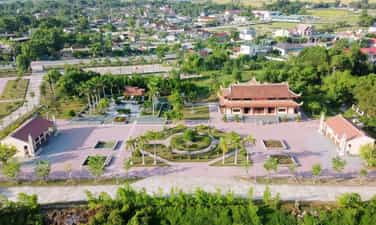
Heroic Martyr Ly Tu Trong Memorial Area is located in Tan Long village, Viet Xuyen commune, Thach Ha, Ha Tinh. This is a project of the youth of the country and the people of the province to pay tribute to the heroic sacrifice of heroic martyr Ly Tu Trong - the first member of the Communist Youth Union. Heroic martyr Ly Tu Trong's real name is Le Huu Trong, born in 1914 in Ban May, Nakhon Phanom province - Thailand, originally from Thach Ha district, Ha Tinh province. He was born into a family whose parents were both patriotic overseas Vietnamese. Born in a situation of "losing his country and home", his family had to travel to Thailand to live, always carrying in his heart the longing for his homeland, which was being invaded by enemies. Since he was young, Le Huu Trong was hardworking, eager to learn and soon became enlightened about the revolution. He was one of eight children selected by Ho Tung Mau to take him to Guangzhou - China to study and work in the association. patriotic youth, here Le Huu Trong was renamed Ly Tu Trong by comrade Nguyen Ai Quoc. After returning home, work. In 1931, during a rally commemorating the first anniversary of the Yen Bai uprising held in Saigon, Ly Tu Trong shot and killed secret agent Le Grand to protect speaker Phan Boi who was giving a speech at Lareni Square. He was later captured by the enemy and sentenced to death when he was only 17 years old. Although he fell at a very young age, hero Ly Tu Trong left behind generations of Vietnamese youth a valuable legacy, which is patriotism, courage and youthful enthusiasm. Ly Tu Trong went down in history with his famous statement before the enemy's court, "The path of youth is only the revolutionary path, there can be no other path", which has become a guideline and a model. A shining example for Vietnamese youth to study and follow. On April 30, 2011, 80 years after his death, Anh's remains were found and brought back to be buried in his hometown. According to the earnest wishes of officers, soldiers, people of Ha Tinh and youth union members nationwide, the Secretariat of the Central Committee of the Ho Chi Minh Communist Youth Union has approved the investment project to build a memorial area. Ly Tu Trong in Viet Xuyen commune, Thach Ha district, Ha Tinh province. This is a tribute to the young communist man; has historical, cultural and spiritual significance; Traditional education for children nationwide. On October 20, 2011, on the occasion of the 97th birth anniversary of hero Ly Tu Trong, the Standing Committee of Ha Tinh Provincial Youth Union held a groundbreaking ceremony to build the Memorial Area. On October 20, 2014, the project was completed on the occasion of the 100th anniversary of Britain's birth. Source: Ha Tinh Province Historical Archives Center
Ha Tinh
6358 view
Rating : National monument
Phai Khat Fort
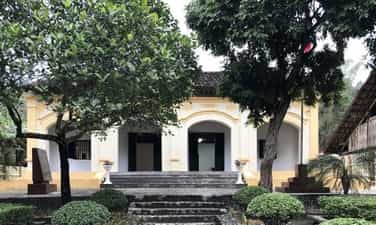
Phai Khat Fort is located in Tam Kim commune, Nguyen Binh district, 7km from Tran Hung Dao forest. Here, on December 22, 1944, the Vietnam Liberation Army Propaganda Team was established. President Ho Chi Minh instructed the Team to develop a plan to organize a battle to "encourage the revolutionary fighting spirit of an enslaved nation, seething with the will to rise up", at the same time " overcome the situation of lack of weapons and equipment". Under the command of comrade Vo Nguyen Giap, the Team discussed carefully to clarify the issue: "Where to attack and how to attack, so that with only a small force we can win a great political victory." political and military, while limiting the loss of our people and weapons. After discussing options, the Team Command decided "to raid the enemy's camp to capture ammunition", the goal. Targets are Phai Khat and Na Ngan stations. The garrison force consisted of two squads, under the direct command of comrade Van (Vo Nguyen Giap). In addition, there was also the participation of guerrillas and local Viet Minh officers on duty to guard the roads leading to the village. In order to break in smoothly, comrade Vo Nguyen Giap prepared a fake patrol permit with a red stamp to serve in the battle. On the afternoon of February 24, the forces participating in the battle disguised themselves as soldiers and marched to Phai Khat. After receiving news that Station Chief Simono was going to the capital of Nguyen Binh, at 5:00 p.m. on February 25, "Squad" Thu Son led his troops into the station easily. The team quickly divided into two prongs: Platoon 1 captured the gun storage area, Platoon 2 surrounded the station. While the enemy had not yet reacted, comrade Thu Son shouted: "Rat-sam-mang" (gather), 17 soldiers and the commander gathered in the middle of the yard. The enemy was surprised and could not react in time and quickly surrendered. The battle took place quickly, and Simono returning from Nguyen Binh was also destroyed. As a result, we destroyed 1 enemy and captured 17 enemies, capturing 17 guns, some ammunition and military equipment. After defeating Phai Khat post, on the night of December 25, the Team urgently marched to Cam Ly commune (15km from Phai Khat), where Na Ngan post was located. The team learned from experience and praised the comrades for completing the task well, and at the same time disseminated the attack plan the next day. Due to the dangerous terrain of Na Ngan station, the Team decided to disguise themselves as a group of soldiers and red loincloth soldiers to escort three Man Communists to hand over to the station. The force attacking Na Ngan garrison was all members who participated in attacking Phai Khat garrison. At around 7:00 a.m. on December 26, comrade Thu Son and the volunteer team led three tied communists into the station along with the tricolor flag (the team got it at Phai Khat station). The soldiers thought they were in a hurry to arrange 6 soldiers and the commander to line up to welcome them according to military protocol. After the whole team entered the station, according to the assigned plan, four soldiers approached the middle of the gun rack. Comrades Thu Son and Be Van Sat talked to Duong to create a distraction. Platoon 2 blocked the station gates, then divided into groups to capture prisoners. Platoon 3 fired into the air while calling for the enemy to surrender. At the end of the battle, we destroyed 5 people, captured 17 people, and collected 27 guns and many bullets. In this battle, comrade Nong Van Be was slightly injured. After taking down the station, the Team quickly collected guns, ammunition, documents and distributed leaflets and banners to the people. The group of prisoners of war was gathered in the middle of the yard. Two female comrades Cam and Thanh explained in Tay language to them to understand the Viet Minh's policy of fighting the French and Japanese to save the country, calling on them to turn their guns on France and Japan to win independence for the nation. After hearing the policies of the Viet Minh, some prisoners of war asked to join the revolution and most asked to return home. In the first two battles, the Team used the tactic of "attacking with a disguised raid (raid), which excellently opened the tactical history of the Vietnam People's Army". Training disguise is a way of fighting that uses few guns and bullets, has low casualties but is highly effective in combat. In the first two battles, in addition to destroying and capturing all enemy soldiers in the station, the Team also captured many weapons and military equipment. Most importantly, the team won in accordance with leader Ho Chi Minh's directive "The first match must be successful". Source: Cao Bang electronic information portal
Cao Bang
5864 view
Rating : National monument

Tan So Citadel Ruins
Tan So Thanh Base Relic is located in Mai Dan village, Cam Chinh commune, Cam Lo district. Tan So Citadel Base Relic was ranked National by the Ministry of Culture and Information on January 16, 1995. This is a relic of the last military citadel of the feudal dynasty of the Nguyen Dynasty marking historical events. Important history of the Can Vuong movement against the French in the early 20th century. Tan So is a land isolated from the plain and far away from the center of the provincial capitals. Surrounded on all four sides are mountain peaks and natural hills created like a closed citadel. The east side faces the Trieu - Hai plain, which is very convenient for communication with the lowlands. On the other sides, there are roads leading through Laos and to the North in case of retreat, so this place has been chosen by the feudal monarchy through the ages as a border guard post and mountain guard station. In 1883, it changed to Quang Tri Son Phong, also known as Tan So citadel. The resistance base in Tan So began construction in 1883 and was completed in 1885. Under the direction of mandarins: Nguyen Van Tuong, Ton That Le, Dang Duy Cat, thousands of soldiers and villagers worked diligently day and night. It was from the work of digging soil and planting bamboo to build the Tan So base that took a lot of effort, but our people did not think about their own benefits and had a song: "Eat home and carry bamboo and ivory for the mandarins." . Tan So citadel has a rectangular structure: length 548m, width 418m, total area is 22.9 hectares. The outer citadel has 4 gates: Front, Back, Left, Right covered with soil, outside there is a fence with sharp stakes and a surrounding moat system (2m deep, 10m wide), 4 sides of the wall are densely planted with ivory bamboo in four layers. Dozens of meters apart, between layers of bamboo is a wall made of soil. The 4 corners of the citadel have 4 wells 20m deep. Inside the outer citadel there are houses, barracks, warehouses, and training grounds for elephants and horses; At the gates and corners of the citadel, there are military posts and gun emplacements to guard and protect the inner citadel. The inner citadel was built of solid bricks, length is 165 m, width 100m, total area is 1.65 hectares. The inner city has 5 gates: Tien, Hau, Left, Right and Ngo Mon for the king and mandarins to enter and exit the palace. Inside the citadel, there are buildings where officials live and work. The French colonialists, after being attacked by the Nguyen Dynasty's imperial army, took brutal revenge. They caused a brutal massacre of the people of Hue capital, then immediately invaded Tan So, capturing King Ham Nghi and the leaders of the militant faction. In the end, the French captured Tan So, they burned it down and completely destroyed it. Tan So was engulfed in flames, signaling the end of a capital city - a nerve center leading the Can Vuong movement, recording an extremely heroic historical milestone against foreign invaders of our nation, becoming the place where witnessed and recorded the national spirit of a patriotic king - King Ham Nghi. After peace, Tan So was littered with piles of war scrap and filled with hundreds of bomb craters. The Tan So Citadel Base relic is in dire need of preservation and restoration. Source: Quang Tri Newspaper
Quang Tri
5118 view
Rating : National monument
Quang Binh Quan
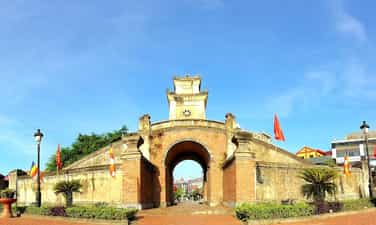
Quang Binh Quan (newly restored), right in the center of Dong Hai ward between four roads: the west is the road to Duc Ninh, the east is Me Suot road down to Nhat Le river wharf, the north is the road to Hanoi Noi, the south is the road to Hue. Quang Binh Quan also has many names. Some people say it is the entrance to Quang Binh palace, others say Binh Quan Gate. The book Dai Nam Nhat Thong Chi records: ''The mandarin gate is two truong 1 meter long, two truong 5 meters wide; The outer citadel protecting the mandarin gate is 14 meters long, 6 meters high, 3 meters high, built in the year of Minh Menh (1826) with brick and stone...'' Quang Binh Quan under the Nguyen Dynasty, covered with soil in 1631, is an ancient rampart system built to protect the Nguyen citadel. Quang Binh Quan is located in the Luy Thay system, including Luy Truong Duc, Luy Tran Ninh, Luy Nhat Le, Luy Truong Sa, stretching more than 30 km. The Luy Thay system was designed and directly directed by Lord Nguyen's military advisor Dao Duy Tu (1572-1634) and directly directed its construction from 1631-1634, to help Lord Nguyen in Dang Trong fight against attacks by Lord Trinh in Dang Ngoai during the Trinh - Nguyen period was divided. This place has a mountain-like terrain near a very solid ravine, separated from the North, extremely dangerous, like going into Thuc land. During the reign of Lord Nguyen, if people from Southern Bo Chinh or from the North had any business, if they wanted to go to Quang Binh palace, if they went by road, they had to first go to Quang Binh Quan to present their documents and then go back to the north and enter Nam Mon gate to leave. castle. Those traveling by water must stop by the boat at Nhat Le gate, present documents at Thu Ngu mandarin gate, then take the boat to the east gate to enter the citadel. Quang Binh Quan is located guarding the North-South vital road and waterway from Nhat Le seaport. Therefore, more than 7 times Lord Trinh's army crossed the Gianh River to the South and were stopped here. As painful evidence of a time of national conflict, Quang Binh Quan as well as the Luy Thay system have shown the high development of the architectural art of Vietnamese military fortifications. This place is the center of the Luy Thay rampart system, Quang Binh Quan was built according to a unique architectural model, harmoniously combining two elements, both a solid and solid defensive battle rampart, and a a unique architectural work of art. Quang Binh Quan is a reliable address for future architectural and military researchers. In 1825, King Minh Mang restored Quang Binh Quan and raised the watchtower with solid baked bricks. After inauguration, the king classified Quang Binh Quan as one of the special historical and cultural works. of the country, having the image of Quang Binh Quan embossed in Nghi Dinh placed in front of The Mieu Temple in the Forbidden City. Before the August Revolution of 1945, Quang Binh Quan (on Duc Ninh Street) also had a moat outside the citadel, a brick bridge around the moat and at the intersection between Duc Ninh and Cau Rao streets (in the past, during the Nguyen Lord's time, it was the There is also a ghost in a large cemetery. Quang Binh Quan was destroyed by the French army when they withdrew from Dong Hoi in 1954, then rebuilt almost identically. In 1965, the war broke out and was destroyed by American aircraft. Currently, Quang Binh Quan has been restored to its original appearance more than three centuries ago. Quang Binh Quan, an architectural relic with historical and artistic value, is a typical cultural symbol of the land of outstanding people. Source: QUANG BINH GENERAL MUSEUM
Quang Tri
4633 view
Rating : National monument
Memorial area for cultural celebrity Le Quy Don
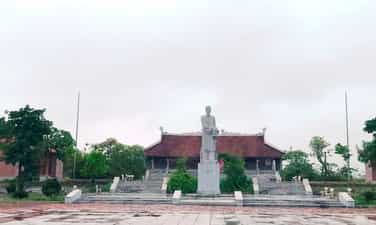
The memorial area of scientist Le Quy Don in Dong Phu village, Doc Lap commune, Hung Ha district is a place to store and preserve artifacts and traces that were closely associated with the scientist - an outstanding Vietnamese cultural celebrity. Male. Le Quy Don's real name is Le Danh Phuong, full name is Doan Hau, nickname is Que Duong, born on the 5th day of the 7th month, year of Binh Ngo, that is, June 2nd, 1726 in Dien Ha village, Son Nam Ha town, now is Dong Phu village, Doc Lap commune, Hung Ha district, Thai Binh province. His father, Le Trong Thu, passed his PhD as an official at the Ministry of Justice and Marquis. Her mother is Truong Thi Ich, daughter of Dr. Truong Minh Luong, who is a Hoang sect official. When he was young, Le Quy Don was famous as a child prodigy. In 1739, he followed his father to the capital to study with Dr. Le Huu Kieu. At the age of 18, Huong passed the exam and won the first prize, then stayed home to teach and write books. At the age of 27, he passed the Hoi exam and passed the Dinh exam. Le Quy Don successively worked at the Academy, the Toan Committee to study national history, went to Liem Phong to participate in military affairs, went to China as an ambassador, worked at Lord Trinh's palace... and was gradually promoted to the positions of Academy Officer and Private Career. Quoc Tu Giam, Litigation, National History General, Hiep Town... In 1784, he was promoted to Minister of Public Affairs, titled Nghia Phai Marquis. That same year, he fell ill and returned home to recuperate in his maternal hometown, Nguyen Xa village, Duy Tien district. (now in Ha Nam province) he died here on the 14th day of the 4th lunar month at the age of 58. His wife is Mrs. Le Thi Trang, daughter of school teacher Le Huu Kieu. He has four sons, Quy Kiet, Quy Ta, Quy Chau, Quy Nghi. Le Quy Don's creative career is very voluminous, he has written about 40 books of all kinds including most contemporary knowledge such as history, poetry, philosophy, classic commentaries, general categories... which is a treasure trove. precious treasure of the country's academic system. The memorial area for cultural celebrity Le Quy Don includes three works: From the street of cultural celebrity Le Quy Don, the mausoleum of Le Trong Thu (Le Quy Don's father), and Le Quy lake. 1. From the street of cultural celebrity Le Quy Don Tu Duong includes the five-room Bai Duong court, the Middle Palace and the Hau Palace, each with three compartments. Tu Duong's predecessor was the home of Le Quy Don. When his father passed away, Le Quy Don converted it into Tu Duong, until his lifetime. Le Quy Kiet also brought Le Quy Don's tablet back with his grandfather. Local people often call this place from Le Quy Don street. 2. Le Trong Thu Tomb. Le Trong Thu (1693 - 1783), was a mandarin during the Le Trung Hung period in Vietnamese history. He was the father of a great Vietnamese scientist during the feudal period, Le Quy Don. Le Trong Thu, Mr. Truc Am, studied very brightly as a child, was famous as a prodigy, and grew up studying with the Vu family's Tham Hoa in Ha Nam. At the age of 27, Le Trong passed Huong Tien, at the age of 31, he passed the 3rd rank of Doctorate. Origin, Giap Thin department, Bao Thai year 5 (1724), reign of King Le Du Tong and Lord Trinh Cuong, served as an honest mandarin Famous inside and out, at the age of 65, he retired to the position of Household Minister Huu Thi Lang. Not long after, he was invited to become a mandarin for the second time, promoted to the position of Minister of Justice, then retired at the age of 80. 3. Ho Le Quy. In the 26th year of Canh Hung (1765), he asked the court to return to his hometown to "close the door and write books". To relax and have conditions to read and write books, Le Quy Don dug a large lake. In the middle of the lake, build a small island, plant ornamental plants, and build a Thu Lan. During this time, he wrote many books "specially focusing on geography" such as: Geography of Essence, Compendium of Geography... Perhaps the chapter on images and products in the Van Dai language series was also prepared with documents from this period. The Memorial Area of cultural celebrity Le Quy Don was ranked a National Monument by the Ministry of Culture, Sports and Tourism on December 12, 1986. Source: Department of Culture, Sports and Tourism of Thai Binh province
Hung Yen
5302 view
Rating : National monument
Pho Minh Tower Pagoda
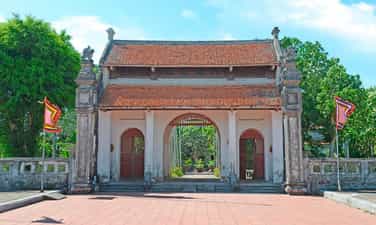
Pho Minh Pagoda, whose name is Pho Minh Tu, is a pagoda located in Tuc Mac village, Loc Vuong ward, Nam Dinh city. Based on the ordination stele as well as ancient bibliographies, the pagoda was built during the Ly dynasty, and in 1262 the Tran dynasty expanded to a more grand scale. In 2012, Pho Minh Pagoda was ranked by the Prime Minister as a special National Monument. Because in front of Pho Minh Pagoda there is a tower, the pagoda is also known as Chua Thap, the Tower is also known as Pho Minh Tower. Pho Minh Tower is a unique architectural work. This is the largest, oldest and most intact tower in Vietnam. The book Nam Dinh Province Geography by author Khieu Nang Tinh records about the pagoda as follows: "During the Tran Dynasty, King Nhan Tong restored his residence as a monk. When the king died, Anh Tong built a 14-storey tower, 53 meters high, with 10 meters on each side to house the relics. During the Tay Son period, the governor of this region broke the top of the bronze gourd tower. When we reached the 13th floor where the stone was, we saw an object shaped like a red ribbon flying into the sky, so we stopped destroying it..." In addition, among the people, there is also a saying of Buddha Emperor Tran Nhan Tong: “No matter who competes for the throne I would like to send back this handful of temple bones." Therefore, researchers believe that this is a tomb tower. Currently in the country there are only three towers built during the Tran Dynasty: Pho Minh tower (Nam Dinh), Hue Quang tower (Yen Tu, Quang Ninh) and Binh Son tower (Lap Thach, Vinh Phuc), but Pho Tower Minh is still the more majestic tower, with the most elaborate, artistic, and technical construction. The tower was built right in front of the worshiping house on the North - South axis. The tower has a total height of 19.51m including 1 palanquin and 13 floors. The tower is built on a small square yard, each side is 8.6m and located 0.45m lower than the ground. The palanquin is the base of the tower designed entirely of green stone, each side is 5.20m long. At the foot of the tower there is a lotus flower with large petals and small petals, gradually tilting towards the corner of the tower from the middle, symbolizing a lotus platform holding a palanquin. The lower part of the stone pedestal is shaped to curve up on both sides, making people mistakenly think it is due to the rock sinking, but in fact, the construction was intended to create momentum for the more than a dozen floors above to have the same curvature. Looking at the entire tower, people will think of a Lotus flower rising and blooming in the middle of a lake. From the palanquin and above, there are 13-storey towers built of red bricks with 4 gates: East, West, South, North. Previously, all the floors had exposed Dragon motifs and beautifully decorated flowers and leaves. The higher the tower floors went, the smaller the height and width of the tower's face became. At the top of the tower was a cube with the shape of an unbloomed lotus flower made of old terracotta. Unfortunately, in the early years of the twentieth century, when repairing the tower, people placed a coat of cement material on the outside of the tower, causing the patterns on the bricks to be lost. In 1987, because some of the upper tower floors were cracked by tree roots, the cultural sector repaired and restored them. During the renovation process, people discovered that on the 11th and 12th floors of the tower, there was a stone sarcophagus surrounding a bronze box, which according to people's legend, could be the box containing the relics of Buddha Emperor Tran Nhan Tong. . Pho Minh Tower has existed for 7 centuries. Despite experiencing many storms and natural disasters, the tower is still preserved almost intact, becoming a rare wonder that makes it unique not only for the city. Pho Minh Pagoda but also Nam Dinh province in general. Source: Management Board of Historical-Cultural Relics Tran Temple and Thap Pagoda
Ninh Binh
7313 view
Rating : Special national monument
Mac Dynasty Citadel Relics (Tuyen Quang Citadel)
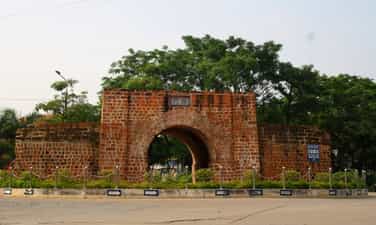
Tuyen Quang Citadel (also known as Mac Dynasty Citadel) is located between Xuan Hoa and Tam Co neighborhoods, in Tan Quang ward, Tuyen Quang city, built around 1533-1548. The citadel was built in a square shape, each side is 275m long, the wall is 3.5m high, and the thickness at the top of the citadel is 0.8m. In the middle of each side of the citadel there is a semicircular door opening to the four directions east, west, south, and north. A tower was built above the door and the roof was covered with scale tiles. Inside the citadel wall, there is a small path for refueling ammunition, first aid, and transporting wounded. Bricks are made of laterite containing iron ore, which is very hard. At the outer edge of the citadel is a layer of deep, flooded moats. At the beginning of the Nguyen Dynasty, the citadel was repaired, reinforced, and built with small bricks. In the citadel, slightly to the north, there is Tho Son mountain, nearly 50m high, steep, very convenient for observing and defending when surrounded. Located on the banks of the Lo River, located on a convenient transportation axis, the terrain and structure make the citadel an important military position. There were many historical events that took place in the Mac Dynasty citadel: In 1884, ethnic people led by Lanh Chan and Doc Thinh along with Luu Vinh Phuc's army besieged the French army in the citadel from August 1884 to April 1885, blocking supply ships and digging many tunnel, use explosives to destroy it. Out of a total of 600 enemies, 200 were killed and more than 300 were injured. At dawn on August 17, 1945, under the command of the Provincial Uprising Committee, the Liberation Army and local self-defense quickly captured the provincial governor's palace, security camp, post office, and treasury department, leaving only Tuyen Quang citadel was camped by Japanese troops. On August 20, the Liberation Army both blocked the Japanese army from Ha Giang and concentrated its forces to attack the citadel, organizing a mass march to show its might. On August 21, the Japanese army was forced to surrender. On March 20, 1961, at the stadium at the foot of Tho Son mountain, Tuyen Quang people held a meeting to welcome President Ho Chi Minh to visit and work. Tuyen Quang Citadel Relics was ranked as a National Relic on August 30, 1991. Source: Tuyen Quang Electronic Newspaper
Tuyen Quang
6396 view
Rating : National monument