Relic point Vietnam
Việt Nam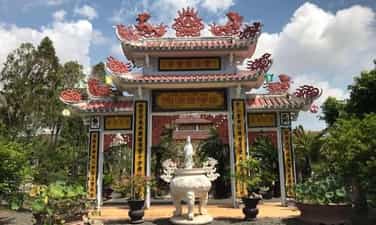
HISTORICAL RELIC OF LINH SON CO MIEU
Linh Son Ancient Temple is located at Thoi Hoa 1, Thoi Long Ward, O Mon District. This is not only the belief base of the Chinese people but also a solid Chinese foundation, contributing to protecting the revolution in the two resistance wars against foreign invaders. According to the elders, after a group of Chaozhou Chinese people came to Thoi Hung village (now Thoi Long ward) and saw the fertile land, they settled down to make a living here. In 1890, people decided to build the first temple made of leaves to worship Quan Thanh De, and at the same time create conditions for contact with Chinese groups far away from their homeland. In 1930, the temple was rebuilt firmly with wood and the roof was covered with yin and yang tiles. Later, it was renovated many times in 2002 and 2004, making the temple more and more spacious and carrying a certain aesthetic value. Linh Son Co Mieu is located on an area of 517.5 m2 and was built in the national-shaped architectural style, with rows of houses arranged perpendicular to each other including: front hall, natural yard, main hall, on the left of the temple is the state house. details, on the right is the gate to the Chinese cemetery, creating a space in the middle called Thien Tinh yard. The temple is surrounded by a fence with iron bars, the main side facing Bang Tang canal. On both sides of the door are a pair of tureens praising the saints worshiped at the Temple: “A thousand years of righteousness and bravery are unmatched. The eternal star is the number one person". The walls inside the Temple are decorated with paintings of Chinese classics, natural landscapes... creating a feeling of closeness and solemnity in the place of worship. The truss system is supported by 4 circular columns embossed in the shape of dragons called dragon pillars. Between the front hall and the quiet courtyard is a pair of "torches and cranes". Next is the Thien Tinh courtyard, the main hall decorated with blue "two dragons flanking the tai chi", below is a screen decorated with lions, mountain and river scenes, apricot, orchids, chrysanthemums, and bamboos symbolizing warm wishes. full, peaceful, happy. The main object of worship at Linh Son Co Mieu is Quan Thanh De Quan; In addition, Linh Son Co Mieu also worships the Earth God, the First Sage, the Later Sage... The worship statues at the Temple are carved in the style of round statues, very simple and rustic, expressing personality through each character's facial expressions, both close to mortals, while also carrying the majesty of the divine world. The architectural style and festivals at Linh Son Co Mieu have contributed to reflecting the typical folk culture of the Chinese people in Can Tho city. From 1950 - 1975, the main hall of Linh Son Co Mieu was also used as a meeting place for revolutionary cadres. Under the altar of the gods is a secret vault that can accommodate 4-5 people. The cellar door is right in the middle of the altar, previously disguised as the Earth God altar. Behind the wooden wall of the back office is also the exit to the cellar disguised by a hibiscus fence. Although many times suspicious enemies came to search everywhere in the Temple, thanks to skillful camouflage and the support of Chinese people, the revolutionary cadres were safely protected. Therefore, Linh Son Co Mieu is not only a religious base but also a historical relic recording the revolutionary struggle of the Chinese people in Can Tho. Linh Son Co Mieu was ranked as a historical relic by Can Tho City People's Committee on March 31, 2008. Source: Can Tho City People's Committee
Can Tho
6390 view
Rating : City-level relics

Am God
Am Chua is located on Dai An mountain, also known as Qua Son (Qua Lanh, Chua mountain, Cam mountain), the most common name Dai An in the past. Nui Chua is a mountain, 284 meters high. Am Chua is located halfway up the mountain, 80 meters above sea level, in Dai Dien Trung village, Dien Dien commune, Dien Khanh district, Khanh Hoa province. Up to now, there are no documents determining the specific time that Am Chua was built; But according to the story of local elders, Am Chua initially was a small hermitage located next to Dai An mountain pagoda on Hoa Son mountain and after many restorations, the hermitage became a place to worship Thien Y Thanh. The model is as spacious as today. Although the small pagoda named Dai An no longer exists, the blend of Mother Goddess worship and Buddhist rituals is still intact and is a typical cultural feature at Am Chua. The architectural system of worship at Am Chua has many similarities with the architecture of communal houses in Khanh Hoa. The worship structure has a coordination of worship and sacrifices that is similar to religious architectural works in the province and this is a religious feature of Khanh Hoa people. Architectural works at Am Chua include: Three gates, Mr. and Mrs. Tieu's tombs, inscriptions, Son Lam temple, Ngu Hanh temple, main hall. The main hall was restored for the third time in the year of the Dog (1958), the 4th time in the year of the Dragon (1988), and a major restoration in the year of the Ox (2009) with a three-room architectural form. The God Temple is decorated with altars, pairs of opposing tureens, and diaphragms carved delicately and sharply. The first altar is an incense altar worshiping the deity of Lady Tieu. The sacred altar of Thien Y Thanh Mau is splendidly decorated and is the most concentrated point of the worship structure in the Main Hall; On both sides are shrines worshiping the Six Immortals and the Twelve Immortals. On the left of the altar to worship the Holy Mother is the altar to worship the Four Crown Princes and the Twelve Executives, also known as the altar to Uncle (Prince Tri - son of the Holy Mother); On the right is the altar worshiping the Six Immortals and the Twelve Immortals, also known as the altar for the Lady (Princess Quy - daughter of Thanh Mau). All altars in the main hall are made of precious wood, carved with delicate and unique patterns and motifs. The entire main hall has a truss-style roof structure, rows of main columns and military columns made from highly valuable precious wood. Am Chua still retains two titles bestowed by the Nguyen Dynasty kings. According to folk beliefs, March is the month of Via Ba, "August is the anniversary of father's death, March is the anniversary of mother's death". Am Chua Festival is from the 1st to the 3rd day of the third lunar month every year and takes place according to a traditional process: Moc Duc (statue bathing) ceremony, Tam Hien Luong ceremony, main sacrificial ceremony, Van Mau singing, offering Female officials, Hau Thuong worshiping ceremony, incense offering ceremony and shadow dance. Through legends and folk tales, worship shows the continuity of culture and beliefs. Am Chua has brought within itself the values of the two cultures of Cham and Vietnam. Although there are different imprints, it must be affirmed that the image of Thien Y A Na is a Vietnamese creation, originating from the image of Po Nagar of the Cham people and originating from the image embodying the mother. creation of all species. With its tangible and intangible cultural values, in 1999 Am Chua was ranked by the State as a National Historical-Cultural Monument. Source: Ho Chi Minh Communist Youth Union, Khanh Hoa province
Khanh Hoa
5810 view
Rating : National monument
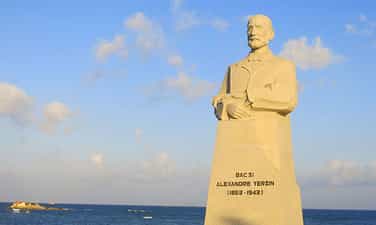
Memorial area of Dr. Alexandre Yersin
The memorial historical relic of scientist Alexan Dr Yersin was ranked as a National Monument by the Ministry of Culture, Information, Sports and Tourism on September 28, 1990. The relic is a complex of individual, typical, outstanding locations, directly linked to the life and career of scientist Alexan Dr Yersin, including 3 locations, which are the library at the Pasteur Institute of Nha Trang ( Tran Phu Street, Xuong Huan Ward, Nha Trang City), Linh Son Pagoda, Alexan Dr Yersin's grave (Suoi Cat Commune, Cam Lam District). Dr. Alexan Dr Yersin was born on September 22, 1863 in Switzerland. At the age of 20, he graduated from the University of Paris (France). In 1886, he worked at the Pasteur Institute in Paris and collaborated with Dr. Roux to find toxins. leukemic bacteria. In 1890, he was granted French citizenship. After he achieved certain successes in the medical field, Yersin suddenly left the field of microbiology - living a life of sailor and explorer - starting another life lasting 50 years. In 1891, he resigned from Messageries and went to Indochina to work as a physician for the Messageries shipping company to fulfill his dream of exploring new horizons. In July 1891, he came to Nha Trang for the first time. In 1895, Yersin founded the Nha Trang Pasteur Institute and prepared serum to cure the plague. A year later, the epidemic relapsed in China. Yersin went to China again and saved many people from the dangerous disease that killed 50 million people in ancient times. By the end of 1899, he returned to Nha Trang and established the Pasteur Institute. For nearly 50 years of living alone in Nha Trang, he devoted his entire life to his scientific career, successfully researching the production of medicine to cure the plague on June 20, 1894. Because he lived relatively simply and was close to the people of Con village, he was very loved by everyone. After that, he spent about two years (1902-1903) going to Hanoi to open the Indochina Medical College and become the first principal there. In 1924, he held the position of Inspector General of the Pasteur Institutes in Indochina. In 1933, he became honorary director of the Pasteur Institute in Paris. On June 28, 1935, Yersin High School was inaugurated in Da Lat, Yersin returned to Da Lat for the last time before his death. For the rest of his life, Yersin only lived and worked at the Pasteur Institute of Nha Trang. When he was old, he went to the top of the mountain above Suoi Dau to build a wooden house, grow medicinal plants, and research malaria medicine. Until his final days, he left a will with the wish to be buried in Suoi Dau. He would like to donate all of his assets to the Pasteur Institute of Nha Trang. On March 1, 1943, he died, the funeral was held very simply, many people came to see him off, following each other from Nha Trang to Suoi Dau. According to the will, when he was buried, people placed him on his stomach with his head facing the sea so that he would forever embrace his homeland. His tomb was built in a rectangular shape of cement, painted blue, with the words Alexan dr Yersin (1863. 1943) written on the surface. Source: Nha Trang tourism information portal
Khanh Hoa
6256 view
Rating : National monument
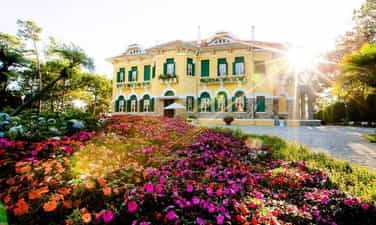
Bao Dai Palace 1
Da Lat is famous for 3 palaces during King Bao Dai's reign: Palace 1, Palace 2, Palace 3, associated with the ups and downs of our country's history. In 1940, a French millionaire named Robert Clément Bourgery built Palace 1. In 1949, King Bao Dai's father-in-law contributed money for the king to buy this mansion. King Bao Dai set up his General Headquarters here to work during his years as Head of State from 1949 to 1954. Besides Da Lat, King Bao Dai also owns another very famous mansion in Vung Tau, which is Bach Dinh. In 1956, Palace 1 was transferred to Ngo Dinh Diem for use. Many years later, this place became a resting place for heads of state until 1975. In 2014, the local government invested in restoring and repairing Palace 1, making this place available for sightseeing. vacation in Da Lat. Palace 1 of Da Lat (Bao Dai Palace) has undergone many renovations. The outside campus is spaciously designed and equipped with luxurious tables and chairs. Stepping through the gate into the campus, there are hundreds of blooming flowers, a giant flag garden, 7-color steps, hundreds of hanging lanterns... The fountain has a bold European feel as well. attracts many tourists. Stepping up to the first floor, in addition to the main lobby area, on both sides of the palace are 2 large living rooms, behind are 4 rooms of different sizes. In the past, these rooms were used as transition rooms, clerical rooms, kitchens and WCs. At the end of the first floor is a very majestic and magnificent photography room. Including a throne, a hammock painted in red and gold... When you step up to the 2nd floor of Bao Dai Palace 1, you will see 3 different bedrooms. The first room is the bedroom of King Bao Dai's mother (Mrs. Tu Cung). The second room is King Bao Dai's bedroom. Next is Queen Nam Phuong's bedroom, located opposite the palace hallway. It can be said that the second room is the most important in King Bao Dai's first palace. This is where important meetings took place during the reign of King Bao Dai from 1949 to 1954. This is also the place to discuss campaigns and wars from 1955 to 1963. During Ngo Dinh Diem's government, he renovated King Bao Dai's room and dug a secret tunnel here. The path down to the tunnel is disguised to look like a bookshelf to the right of the bed. This exit leads to the helipad behind the hill of palace 1. Especially in this mansion are military-style constructions, you will not help but be surprised and overwhelmed by its unique appearance. First is a large helicopter landing pad, gas depot, and emergency exit (tunnel). The tunnel door is equipped with metal weighing several hundred kilograms, artillery, bulletproof glass... Source: Da Lat tourism information portal
Lam Dong
7248 view
Rating : National monument

Relics of Resistance Base Area 6 Cat Tien
The historical relic site of resistance base in Cat Tien zone VI has a total area of nearly 50 hectares, located in village 5, Duc Pho commune, Cat Tien district, Lam Dong province. This is an ideal address to attract people and tourists who love nature, explore and learn about history and national revolutionary traditions. Area VI relic, Cat Tien is a work of important historical significance, recording the merits and achievements of generations of ancestors in the struggle against the American invaders, period 1963 - 1966. Mold The relic site of Area VI, Cat Tien is designed harmoniously, scientifically and beautifully, suitable for the landscape space, with a system of clean, beautiful concrete-paved internal roads winding around cool, green ponds and lakes; The majestic monument located on the top of the central hill has created a highlight that attracts the attention of people and tourists when visiting the relics of Area VI, Cat Tien. Not far from Monument Hill is a display house with 108 collected artifacts and a number of primitive weapons restored for display and explanation. Scattered on the green hillsides shaded by forest trees are buildings of camps and shelters recreating the working and living spaces of "Region and Military Region Party Committee agencies" with a total of 23 categories. categories, in which, the Regional Party Committee agency has 12 categories and the Military Region agency has 11 categories. According to historical documents, in the period from 1963 - 1966, Cat Tien Party Committee and Zone VI made important contributions marking the continuous growth of our country's revolutionary forces. In the beginning, Area VI was the place to focus on consolidating and preparing the necessary conditions to coordinate with the entire South to attack the enemy, destroy strategic hamlets, expand the controlled and liberated areas, and create position and force. for the Vietnamese revolutionary movement to win great victories. Especially in the Winter - Spring of 1964 - 1965, the revolutionary movement in Area VI had a leap forward in both width and depth; The army and people of Zone VI proactively coordinated with the entire South to attack the enemy in the Dong Xoai campaign in the summer of 1965, contributing to the bankruptcy of the US imperialism's "special war" strategy. In the dry season of 1965 - 1966, the army and people of Zone VI defeated the enemy's first counterattack in the Zone VI battlefield. From here, the army and people of Zone VI continuously failed the enemy's pacification and search-and-destroy plan in the second strategic dry season counterattack (1966 - 1967). By the dry season of 1967 - 1968, the army and people of the Zone VI stepped up its attacks and won great victories. From mid-1965 to the end of 1968, the Party Committee, army and people of Region VI coordinated with the entire region to defeat the "Local War" strategy of the US imperialists. The victories of the army and people of Zone VI - Cat Tien demonstrate the Party's ingenious and wise leadership. Among them, the ethnic community of Zone VI was united, heroic, and indomitable, achieving resounding victories, demonstrating the brilliance of revolutionary heroism, and with passionate patriotism helping the army. and the people of Area VI overcame countless difficulties and challenges, winning victory after victory in the resistance war against the US to save the country, contributing to completely liberating the South and reunifying the country. The construction and embellishment of the historical relics of the resistance base of Zone VI, Cat Tien has shown the spirit of drinking water, remembering the source, honoring and promoting the great historical values of the army and people of Zone VI, and the community. This is the place to educate, train and foster revolutionary traditions for future generations. Source: Cat Tien District Electronic Information Page
Lam Dong
10697 view
Rating : Special national monument
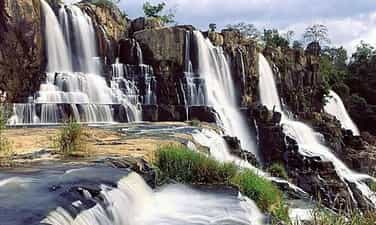
Datanla waterfall relic area
National historical and cultural relic tourist area Da tang la waterfall, also known as Da tan la, is a famous waterfall in Da Lat city, Lam Dong province, Vietnam. Located in the Da Tan La tourist area, the waterfall is 8 km from Prenn waterfall and about 10 km from Da Lat city center. Da Tang La Waterfall is considered one of the ideal destinations for tourists who want to visit and experience adventure. The name "Da tang la" or "Da tang la" is taken from the K'Ho language, made up of the word "Da-Tam-N'ha", meaning "there is water under the leaves". This name originates from the historical conflict between the Cham - Lach - Chil peoples in the 15th century. to the 17th century. Da Tang La Waterfall has abundant water thanks to a stable water source from upstream. Not as noisy as some other waterfalls, Da Tang La flows through many stone shelves and falls from rapids about 20m high. The lower part of the waterfall forms a very clear water area, called Suoi Tien, while the upper part has a deep pool called the Death Abyss. According to legend, because this abyss is located in the middle of a mountainous area, it was once a refuge for an army of the indigenous people during the war with the Cham people hundreds of years ago. There are many legends about the origin and meaning of Da Tang La waterfall. One of them tells about the meeting of the brave warrior K'Lang and the mountain girl Hobilang here. Some other legends about Da Tang La waterfall say that the waterfall is the place where fairies often bathe, or the story about the war between the Lat and Cham people, in which the waterfall played an important role in the fighting strategy of the people. Surname. With those cultural values, in 1998, Da Tang La Waterfall was recognized by our state as one of the famous landscapes and historical relics in Da Lat, ranked as a national monument. . Source: Da Lat tourism information portal
Lam Dong
5273 view
Rating : National monument
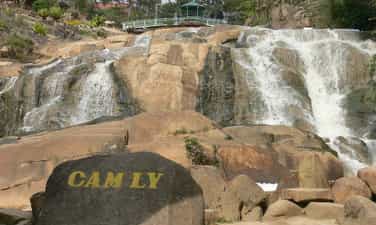
Historical relic of Cam Ly Waterfall in Dalat
Cam Ly Waterfall is located 2km west of Da Lat city. This is considered the waterfall located closest to the city center. Cam Ly waterfall is located next to Cam Le stream, the waterfall is formed from part of the water flowing in from Xuan Huong lake and another stream, Cam Ly stream, also flows here. Cam Ly Waterfall is one of the waterfalls that talks about the remembrance, gratitude, and respect of the people here for people with meritorious services during that period. Legend has it that Cam Ly waterfall originated from the K'Ho language. People in the Lach (Lat) tribe call Cam Ly waterfall Lieng To Sra - the boundary of Cam Le stream to Da Dong river. People in the new village took the name of the chief of the Lach (Lat) tribe at that time, K'Mly, to commemorate and show the villagers' gratitude to this chief. This chief took care of the meals and sleep of the entire tribe, lived in harmony with the people, and took care that the lives of the people in the village became prosperous, prosperous, and complete. So the name of this chief given to the waterfall was K'MLy, later pronounced Cam Ly. According to the Sino-Vietnamese origin, Cam Ly means stream with fresh water (Cam means sweet, Ly means permeable). Cam Ly Waterfall possesses poetic beauty, especially in the rainy season when the water flows rapidly, creating huge blocks of water pouring down violently. With a convenient location near the city center, Cam Ly waterfall attracts a large number of tourists every year. At the foot of Cam Ly waterfall is a small flower garden, contributing to creating a harmonious and beautiful landscape. In addition, in the waterfall area there is also Nguyen Huu Hao mausoleum, built with many unique architecture. In 1998, Cam Ly Waterfall was ranked by our state as a scenic spot and historical relic in Da Lat, recognized as a national monument. Source: Da Lat tourism information portal
Lam Dong
5266 view
Rating : National monument
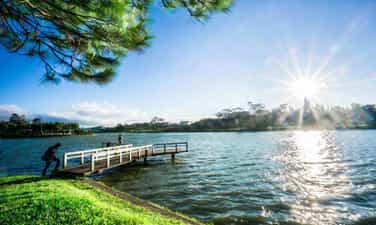
Xuan Huong Lake Relics
When mentioning Da Lat, no one knows about Xuan Huong Lake, a beautiful lake located right in the center of Da Lat city. Xuan Huong Lake is an artificial lake, with a circumference of about 5km and 25ha wide. The lake has the shape of a crescent moon, stretching more than 2 km and passing through many famous tourist attractions of Da Lat such as the City Flower Garden, Yersin Park, Cu Hill and Lam Vien Square. According to people here, the origin of the name Ho Xuan Huong comes from two different legends. The first legend says that every spring, there is a faint, fragrant scent around the lake, ecstatic. That's why people gave the lake the name Xuan Huong Lake. However, the second legend says that Ho Xuan Huong was named after a 19th century Vietnamese female poet named Ho Xuan Huong. Ho Xuan Huong is the author of a number of famous poems such as Floating Water Cake, Life as a Monk, Debt to Husband and Children,... Xuan Huong Lake was originally a large valley, and Cam Ly stream flowed through. In 1919, engineer Labbe blocked this stream so that water could accumulate and form a lake. Then, in 1923, French engineers built a dam at the bottom of the lake, but it broke after a storm in 1932. Engineer Tran Dang Khoa then rebuilt a new dam. made of stone. In 1989, Xuan Huong Lake was recognized by our state as one of the famous landscapes and historical relics in Da Lat, ranked as a national monument. Source: Da Lat tourism information portal
Lam Dong
6496 view
Rating : National monument

Tuyen Lam Lake Relic in Da Lat
Tuyen Lam Lake was formed in 1985 - 1986. At that time, the People's Committee of Lam Dong province and Duc Trong district deployed troops to build dams to retain water in the Suoi Tia area. Surrounding the Suoi Tia flow area are surrounding mountain ranges that form a basin. When the dam is built to retain the water, it forms Tuyen Lam Lake as it is today. Initially, the main purpose of Tuyen Lam Lake was to store water for main use for irrigation in agricultural production in the downstream area - Hiep An and Dinh An communes in Duc Trong district of Lam Dong province. By 1998, when Tuyen Lam Lake was recognized by the Ministry of Culture, Sports and Tourism as a national historical and scenic site on August 31, 1998, the Tuyen Lam Lake area received even more attention and attention. Not only does it serve irrigation purposes in agricultural production, but it is also used by agencies from central to local levels to guide tourism development planning. Tuyen Lam Lake has an area of 350 hectares; More than 6km south of Da Lat city center. Tuyen Lam Lake area has a fresh climate, quiet space, natural landscapes (forests, mountains, lakes, streams, waterfalls,...) that are diverse, attractive and have many attractive and promising humanistic elements. become a large-scale tourist area with many unique types of tourism such as: sightseeing, camping, relaxation, medical treatment, walking, climbing, fishing, festivals - beliefs, entertainment entertainment, sports,...especially eco-tourism. During the two resistance wars against the French and American invaders, with the location and topography of the Suoi Tia area (now Tuyen Lam Lake) and Elephant Mountain, it was the most important base of the revolutionary movement in Da Lat city and Da Lat city. Tuyen Duc province. This base area serves as a place to direct political and armed struggle movements of the army and people of Da Lat town and Tuyen Duc province, and a place to gather and train the armed forces. , the working teams of the Province and the military region, are the springboard for forces to attack Da Lat and maneuver to fight the enemy on fronts in Tuyen Duc province. During the resistance war against the Americans, in addition to the City Party Committee, there were also military units stationed such as the Financial Department, the clinic, the Women's Work Team, the Youth and Students, the Urban Work Team, and the City Special Forces 850 and 852. , 860... and leading agencies and front units of the province such as the Provincial Party Committee, Provincial Team, logistics, Corridor Station, Company 810 (later to become Battalion 810), Provincial Security Team and forces of the Region 6 as Battalions 186, 145, 200C. From 1982 to 1987, Lam Dong Irrigation Company, invested by the Ministry of Irrigation, built a 235m long dam across Tia stream to create Quang Trung lake, later renamed Tuyen Lam lake. By 2017, the Prime Minister recognized Tuyen Lam Lake National Tourist Area, Da Lat City, Lam Dong Province as a National Tourist Area. Tuyen Lam Lake National Tourist Area was honored by UNESCO as "Typical Asia-Pacific Tourist Area" in the Forum Program "Vietnam - India Cultural and Economic Exchange". Tuyen Lam Lake National Tourist Area has rich tourism resources including natural landscapes, forest resources, climate, cultural and architectural values; Invested and renovated infrastructure along with ongoing investment projects have been promoting value, contributing to affirming the position of Tuyen Lam Lake National Tourist Area on Vietnam's tourism map. South with diverse types of tourism. Source: Management Board of Tuyen Lam Lake National Tourist Area
Lam Dong
5550 view
Rating : National monument
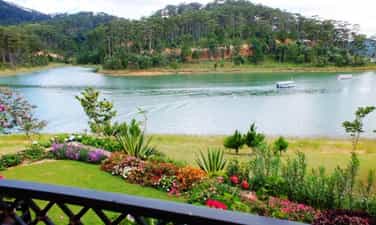
Historical site in Da Lat - Than Tho Lake
Than Tho Lake is located about 6 km east of Da Lat city center, near Da Lat National Martial Arts School (currently the Army Academy). The lake is located on a high hill in the middle of a pine forest, providing a peaceful and quiet space. On the north side of the lake there is a pair of pine trees that evoke the image of a couple, near the scenic Pine Hill Two Tombs with the legend of a broken love. Initially, the Than Tho lake area was just a small pond, and was called Tono Pang Dong. However, in 1917, the French built a lake here to provide daily water for Da Lat. The French named the lake Lac Des Soupirs (meaning "murmuring lake" in French). However, later, the lake was renamed Than Tho Lake by Mr. Nguyen Vy, Chairman of Da Lat Town Council, to express sympathy for the legend of the romantic love story between Hoang Tung and Mai relying on the year of the 18th century here. Than Tho Lake has experienced many ups and downs in history. From the reclamation of mountains and forests in the 1980s - 1990s, to the process of conservation and restoration at the end of 1990. In 1999, Than Tho Lake was recognized and ranked by our state as a scenic spot, national historical relics. Source: Da Lat tourism information portal
Lam Dong
5366 view
Rating : National monument