Relic point Vietnam
Việt Nam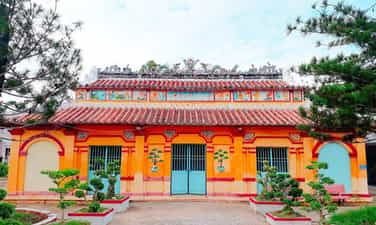
Tan Phu Trung communal house
Tan Phu Trung communal house is located on a large plot of land, in the middle of a rich countryside in Tan Phu Trung commune, Chau Thanh district, and is one of the ancient communal houses in Dong Thap that is worth a visit for tourists. Tan Phu Trung communal house worships the god Thanh Hoang Bon Canh, conferred by King Tu Duc in 1854. Tan Phu Trung village communal house was greatly restored in 1952, 1957... Up to now, Tan Phu Trung communal house is one of the communal houses with architectural ideas. The architecture is quite typical of Southern communal houses during the Nguyen Dynasty in the early 20th century. Looking at the gate, we can see the main buildings: communal house gate, communal house yard, main communal house and Huong Hoi house. The main gate is right in front of the main communal house, 3m wide, 3.5m high. The gate pillar is made of sturdy bricks, with a ceramic unicorn statue on top. Embossed horizontal bar of the communal house gate: Tan Phu Trung Communal House. The communal house's yard is large, tiled, and in the middle is an 8m high flagpole. At the foot of the flagpole is the Xa Tac altar. In front of the Xa Tac Dan is a Binh Phong, in front is a painting of a pair of dragons winding in the clouds, behind is a tiger descending the mountain (lower mountain forest). Balanced in the courtyard, on the right is the Son Than (Tiger God) Temple, symmetrically is the Ngu Hanh (Ngu Nuong) Temple. Just in the courtyard of the communal house, there are countless symbols of the spiritual, cultural life and thinking of agricultural residents The main communal house consists of three blocks of houses in an arranged arrangement, each house has four main columns, also four pillars, along which the trusses and rafters are pierced to four sides, called the four images, on each rafter there is also a rafter, on top That's a set of sesame rafters... creating a sturdy communal roof. The main communal house has three roofs, like an upper floor and a lower porch, with overlapping terraces. The communal house's roof is covered with yin and yang tiles, the top is elaborately decorated with two dragons painting pearls, fish turning into dragons, unicorns playing with mothers and children, eight fairies, phoenixes holding scrolls... In the communal house, there are many carvings of horizontal panels, bamboo panels, and couplets with popular themes such as: Dragon, Unicorn, Quy, Phung, spring - summer - autumn - winter, stylized flowers and leaves. In particular, the communal house has 3 statues of Saint - Emperor - Quan made of rare and precious agarwood that are still preserved. Tan Phu Trung Communal House is not only a long-standing architectural work of the local people but also a place to preserve typical community cultural and religious activities, contributing to preserving indigenous culture. On August 15, 2012, Dinh Tan Phu Trung received the Certificate of recognition as a national historical and cultural relic. Every year, Tan Phu Trung village communal house festival takes place on the 16th - 17th day of the fourth lunar month (even years) and the 12th - 13th day of the fifth lunar month (odd years) attracting tens of thousands of tourists to Dong Thap. Visit, worship, pray for peace in the country and people, a year of good rain and wind, lush crops, good business, prosperous and prosperous villages... Source: Dong Thap Tourism
Dong Thap
8497 view
Rating : National monument
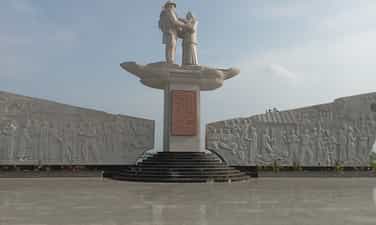
Monument to the 1954 Gathering event
On October 29, 1954, at Cao Lanh North Wharf, a special event took place - The send-off of tens of thousands of Southern officers, soldiers, and students gathering to the North. This is a military movement of great significance: bringing officers, soldiers, and students from the South to the North to work and study in order to train cadres for the Southern revolution and build a socialist North. to create a solid rear base to liberate the South and unify the country. 66 years have passed, but the event of gathering troops to move to the North in 1954 in Cao Lanh still retains its value, deepening the revolutionary tradition of the country's homeland. Cao Lanh North Wharf is the place to send off officers, soldiers, and students from provinces: My, Tan, Go, Long Chau Sa, Gia, Dinh, Ninh, Eastern Inter-Region and volunteers leaving their homeland to board training ships. connect to the North. The gathering to move troops to the North in Cao Lanh took place in 3 phases (August to October 1954) with a total of 13,508 people (of which Long Chau Sa province, now Dong Thap, was 2,655 people). During the gathering days in Cao Lanh, the image of Uncle Ho's soldiers was very dear and close. Demonstrates the bond between soldiers and people like fish and water. The compatriots welcomed soldiers and family members like family members, eating together, living together, working together. With the historical significance and stature of the event of moving troops to the North in 1954 still remaining valid, in order to educate revolutionary traditions, foster patriotism for cadres, party members and people, especially is the young generation; Dong Thap province received financial support from provinces and cities: Ho Chi Minh City, An Giang, Tien Giang, Long An, Binh Phuoc, Binh Duong, Dong Nai and Tay Ninh provinces organized the construction of the Monument. commemorate this historical event with an area of over 12,000 square meters, right at the location of the gathering event to move troops to the North in 1954 in Cao Lanh (Group 6, Ward 6, Cao Lanh city, Dong Thap province). The overall layout of the Monument campus looks like a blooming lotus next to the gentle, poetic Tien River. Located in the center are statues of two figures: the Southern Mother and the British soldier. The image of a mother sending her child off to the gathering - the mother puts a bandana on her beloved child's shoulder, a typical product of the Southern region, implying the sacred sentiments of the South to Uncle Ho and the North. relatives, and also implies that those who leave do not forget their roots so that one day they can return to reunite, Leaving to return. And they truly returned after "21 years of reconnection" when the country was completely unified by the victorious Ho Chi Minh campaign in the Spring of 1975. On both sides of the Monument are two relief panels shown on both the front and back sides. The overall relief has the image of an iron ship sending people off to gather, and is also an image of lotus leaves in a lotus pond - a characteristic of Dong Thap countryside. The relief panel on the right side of the Monument: Portrays activities filled with love for the army and people during the gathering days in Cao Lanh. The relief panel on the left side of the Monument: Depicts the scene of the farewell ceremony for the delegation of Southern officers, soldiers and students on the train to the North in 1954. The monument of the gathering event to move troops to the North in 1954 in Cao Lanh was ranked a National Monument by the Ministry of Culture, Sports and Tourism on October 29, 2019. Source: Dong Thap Department of Culture, Sports and Tourism
Dong Thap
6258 view
Rating : National monument
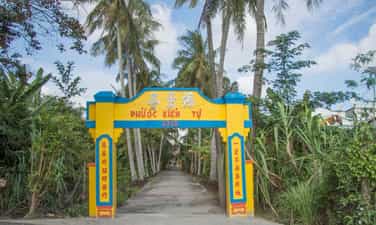
Phuoc Kien Tu (Lotus Leaf Pagoda)
Phuoc Kien Pagoda is located in Hoa Tan commune, Chau Thanh district, Dong Thap province, established before the reign of King Thieu Tri. The pagoda is ranked as a historical-cultural relic by the Ministry of Culture, Sports and Tourism. According to abbot Thich Hue Tu, in the past the pagoda was very large, majestic, and possessed a spacious, pure, and cool space. Phuoc Kien Tu Pagoda was also an operational base, raising the mark of revolutionary cadres. However, unfortunately in 1966, war bombs completely collapsed the temple. After 1975, the pagoda was rebuilt with a simple, uncomplicated architecture including: entrance gate, Guanyin worshiping tower and main hall. Bomb craters are used by monks in the temple as lotus ponds. In the lotus pond there is a strange and rare lotus species not only found in Vietnam but also in Southeast Asian countries. The lotus pond at Phuoc Kien Pagoda has a square shape symbolizing the earth, and the lotus leaf has a round shape symbolizing heaven. Huge lotus leaves, as big as stilts, with a curved rim nearly an inch wide, very beautiful. It is known that this lotus species appeared in the temple's pond in 1992 and has existed until now. No one knows their exact name, so people often call them by many different names. Some people call it the king's lotus, sometimes it is called the lotus king, other times it is called the lotus, etc. Because of the strange lotus species, people often call the pagoda by the popular name "Lotus King Pagoda" or "Lotus Leaf Pagoda"... King lotus leaves are special in that they can shrink with the seasons. In the dry season, the leaves are only about 1 meter long, but in the wet season, the leaves are large with a diameter of 3 to 4 meters. The edges of the leaves are about 3 to 5cm above the water surface, their shape resembles the strappy hats of Quan Ho village girls. During the flood season, large lotus leaves can easily hold a person weighing 70 - 80 pounds without only slightly shaking the water surface. In the dry season, lotus leaves are only about 1 - 1.5 meters long. The upper surface of the leaf is smooth and light green, while the lower surface is thorny and has many large veins, divided into squares that are light red when young and gradually darken as the leaf ages. Lotus flowers bloom for 3 days and bloom twice a day, changing color continuously. The flowers bloom for the first time around 6 pm, radiating a fragrant scent until 12 am the next morning, then begin to close. At about 3 o'clock the flowers bloom again, and at about 4 - 5 p.m. they close their petals. From the initial pink-white color, each time the flower blooms it will get a little darker until it fades to a dark purple color. Phuoc Kien Pagoda is also associated with the story of the magical turtle and magical crane. In 1948, someone brought a turtle to the temple. This turtle hangs around the monk all day long, eating only vegetarian food and listening to Buddha's chanting. In 1966, the devastating war left the pagoda devastated and the turtles were taken away, but then the turtle thief brought the turtles to the pagoda to confess his crime. In 1999, a crane appeared in the temple and it often perched on the turtle's back, but later, there was an idea to capture the crane and return it to the conservation area. From then on, people no longer saw the crane, the crane flew away, and the turtle also passed away. The abbot embalmed the turtle's body and wore a rosary around his neck, placing it in a glass cage in the temple. Source: Dong Thap Trade, Tourism and Investment Promotion Center
Dong Thap
6478 view
Rating : National monument
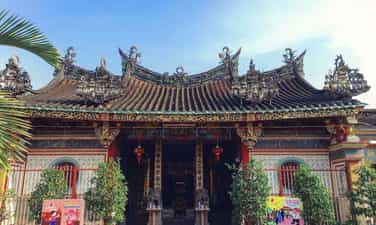
Kien An Cung (Ong Quach Pagoda)
Kien An Cung, commonly known as Mr. Quach Pagoda, is a temple located in the center of Sa Dec city (No. 39 Phan Boi Chau Street, Ward 1, Sa Dec city, Dong Thap province), facing the canal. Cai Son. The temple was built from 1924 to 1927 by Chinese people from Fujian. The pagoda has bold Chinese architecture, with an overall shape of the letter Cong consisting of three compartments: Dong corridor, Tay corridor and the main hall is larger. The tile roof consists of 3 layers, the top is tile, the middle is tile, and the bottom is tile. The tiles are roofed in dragon waves, covering the ground for the curved waves to rise high, creating a tile roof in the "five elements" style. Each end of the wave is a miniature palace, including 6 palaces. The entire pagoda There are no rafters, only wooden beams that bear the force on round wooden pillars. On the walls of the pagoda are images from Journey to the West, Romance of the Three Kingdoms,... At the entrance are two unicorns. made of very large green stone, above is a splendid lacquered and gilded diaphragm. In the middle of the main hall is the space to worship Quang Trach Ton Vuong. His statue is cast in red bronze with a kind face, holding a jade belt, next to two other gods. On his right side is the place to worship Patriarch Thanh Thuy, on the left is Bao Sanh the Great Emperor. The two outer rooms, Dong Lang and Tay Lang, are places to worship a number of other gods such as Quan Thanh De Quan... Above the altars there is a horizontal panel with four Chinese characters "Phu Bao An Dong". On both sides of the column are a pair of tureens: Dong village wishes the Holy Virtue to restore the Hao Trac Thanh palace Phu My thanked the gods and opened a magnificent temple Since its construction, the pagoda has been restored three times but is still located in the same location. Every year the pagoda has two major festivals on February 22 of the lunar calendar and August 22 of the lunar calendar, welcoming many visitors. With Chinese-style architecture and a unique traditional culture, Kien An Cung was recognized by the Ministry of Culture and Information as a national historical-cultural relic on April 27. 1990. Source: Dong Thap Tourism
Dong Thap
6547 view
Rating : National monument
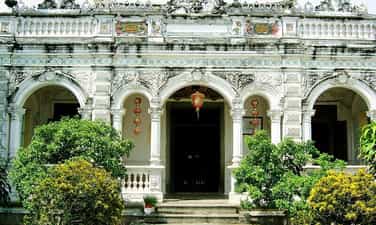
Huynh Thuy Le ancient house
Huynh Thuy Le ancient house is located at 255A, Nguyen Hue street, ward 2, Sa Dec city, Dong Thap province. The ancient house was built in 1895 by Mr. Huynh Cam Thuan, a famous and wealthy Chinese businessman (Fujian, China) in Sa Dec in 1895 in the bustling shopping area along the Sa Dec river. The house was built with a unique combination of East and West architectural styles, especially this ancient house is also famous for being related to a borderless love affair between a French female writer named Marguerite Duras and a young man. Chinese-Vietnamese named Huynh Thuy Le, son of Mr. Huynh Cam Thuan - the owner of the house. In 1929, Marguerite Duras and Young Master Huynh Thuy Le met and fell in love at first sight. However, after 18 months of love, because of Mr. Huynh Cam Thuan's vehement opposition, this relationship had to end and Marguerite Duras had to decide to give up and return to France. Later, Huynh Thuy Le had to obey the family to marry a girl of Chinese origin. This love affair later became a memoir for her to write the famous novel The Lover in 1984. This work was adapted into the film L'Amant in 1992 by French director Jean-Jaques Annaud. Huynh Thuy Le ancient house is a harmonious combination of Eastern and Western architecture. The entire house is built on an area of 258 square meters and is shaped in the style of a traditional Vietnamese house, with a yin-yang tiled roof and two curved boat-shaped gables in the style of a Northern pagoda to create a soft look. roof. However, the architecture inside the house is tall and airy, the walls are built of very thick solid bricks from 30-40cm covering the wooden frame structure, increasing the load-bearing capacity in accordance with traditional French architecture. The house has three rooms, decorated inside in Chinese style. The balconies and railings are painted with gold and carved very similar to Chinese pagodas. The middle balcony frame has a double Loan Phung carving representing "Loan Phung Hoa Minh Sac Cam Dao" which means eternal happiness. . The frames on both sides are carved with birds, flowers and leaves, representing the family's prosperity. In particular, in the middle of the main house there is a worship of Quan Cong, a traditional Chinese belief; At the same time, it also shows strength and prosperity in life. The wooden doors, cabinets, beds, and altars are all carved very elaborately and delicately. In 2008, Huynh Thuy Le Ancient House was recognized as a Provincial Historical Site and in 2009 it was recognized as a National Historical Site. Source: Dong Thap Tourism
Dong Thap
6611 view
Rating : National monument
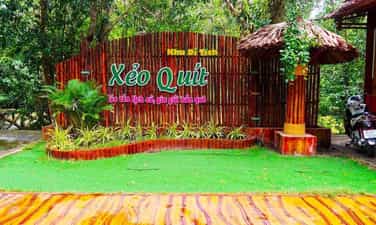
Xeo Quyt Relic Area
Xeo Quyt relic site is located on the territory of two communes My Long and My Hiep, Cao Lanh district, Dong Thap province, with a total area of 70 hectares. From 1960 to 1975, the Kien Phong Provincial Party Committee (now Dong Thap) chose this place as a base to lead the people of the province to join the whole country in successfully carrying out the resistance war against America to save the country. In the past, this place was a desolate, swampy land, full of weeds and alum-contaminated fresh water, full of mosquitoes and leeches. The accommodation and activities of the Provincial Party Committee mainly rely on the support and protection of the people around the area and must dig ditches to prevent enemy tanks, build fortifications and plant trees to create forests for shelter. and activity. Around this base, with a radius of 6 km, is an almost closed system of more than 10 enemy posts. Among them, there are two stations about 1 km from the base area. During the war, this place was a free range, free bombardment area, a "firing range" and a "helicopter training ground" for the enemy. Many times B52 aircraft, M113 amphibious vehicles, flying boats, artillery combined with enemy infantry continuously bombed, swept, and bombarded the base area, trying to destroy all life on this land. Therefore, Xeo Quyt became a very fierce war zone. There are times when the Provincial Party Committee has to face life and death narrowly. To operate and survive until the day of complete victory, on the one hand, the Provincial Party Committee has shown strategic intelligence, courageous perseverance, and endured hardships to cling to the land and people "not one inch, not one inch". to move", must have a suitable type of living to live and live well in the delta, delta, wet season (must travel and work on canoes)... On the other hand, the Provincial Party Committee's existence is due to a very good gesture. noble and beautiful: "Xeo Quyt lies right in the hearts of the people". This is a decisive factor for the survival and safety of the base. Therefore, today Xeo Quyt is called "THE BASE OF THE PEOPLE'S HEART". Xeo Quyt is divided into 2 areas: Area 1 is about 50 hectares, Area 2 is about 20 hectares. Area 1 is an area that preserves the historical and cultural values of the revolutionary base during the resistance war and the natural ecological diversity... Area 2 is the development area for business activities, tourism and picnic services such as: Restaurants, Conference Halls, outdoor food areas, recreational fishing, river experience games... Provincial Party Committee Hall - where many large conferences take place, proposing important policies and resolutions to lead the province's revolutionary movement; office of the clerical unit; combat fortifications, bomb shelters, secret bunkers, burial grounds, death grounds... Currently, Xeo Quyt has 170 species of plants (with 158 wild species) and 12 species of woody plants. Although not rare, they are adapted to flooded conditions. The fauna has 200 wild species including 7 species of frogs, 22 species of reptiles, 73 species of fish, 91 species of birds and 7 species of mammals. In particular, there are 13 rare animal species recorded in Vietnam's red book: pythons, cobras, box turtles, broad-billed citronella birds and common otters... Old cajuput carpets and populations of water hyacinths. These are two types that are now almost no longer found in other areas of Dong Thap Muoi. Many melaleuca trees with a lifespan of more than 30 years grow high, along with a system of vines clinging around, forming giant cone-shaped blocks. With those important historical marks, on April 9, 1992, Xeo Quyt was recognized as a national historical and cultural relic by the Ministry of Culture and Information. Source: Dong Thap Tourism
Dong Thap
6505 view
Rating : National monument
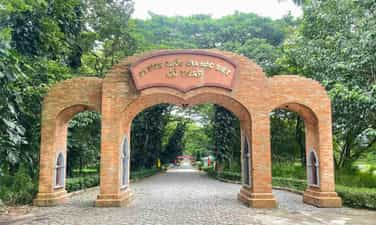
Go Thap relic site
Go Thap special national relic site is located in hamlet 1, Tan Kieu commune, Thap Muoi district, Dong Thap province. Go Thap is considered a convergence of special cultural, historical, archaeological and spiritual values associated with each different historical period. - Archaeological cultural value: The earliest records of archeology at Go Thap relic site were around 1881, by Captain Silvestre - a French inspector working here. Up to now, through research, survey, exploration and excavation, Go Thap relic site has been identified by archaeologists as a small kingdom of the Funan kingdom. This place preserves almost intact relics of Oc Eo culture and Funan kingdom, with more than 10 architectural relics of Hindu temples, magic ponds, magic wells, roads and many residential relics. , workshop,... and many unique collections of artifacts such as: Hindu god statues (including 2 Vishnu statues recognized as National Treasures), wooden Buddha statues and especially a collection of more 400 gold artifacts including gold leaves, gold earrings, gold rings, gold necklaces,... have been confirmed by the Vietnam Records Organization as "The largest collection of Oc Eo - Go Thap gold artifacts in Vietnam" . - Historical value: Go Thap relic site has a "golden history" in the fight to protect the country. This place was once the "Headquarters" of two national heroes, Thien Protector Vo Duy Duong and General Nguyen Tan Kieu in the struggle against the French colonialists in the years 1862 - 1866. After 1945, Go Thap was "red address" of the resistance war against the French. This place was chosen by the Party Committee and the Southern Administrative Resistance Committee as a resistance base in the period from 1946 to 1949. During the resistance war against the Americans to save the country, Go Thap was also the place that marked the glorious victory against the Americans. The collapse of the Ten-Story Tower (Observatory) of the Ngo Dinh Diem government on January 4, 1960 by the army and people of Kien Phong province. - Spiritual cultural value: Go Thap relic area also stands out through its spiritual values with religious and belief relics with relics such as: Ba Chua Xu Temple, Hoang Co Temple, Temple Heavenly Protector Vo Duy Duong, Doc Binh Nguyen Tan Kieu Temple and Thap Linh Pagoda. Every year there are two traditional festivals: Ba Chua Xu on the full moon day of the third lunar month and the death anniversary of two national heroes Thien Protector Vo Duy Duong and General Nguyen Tan Kieu on the full moon day of the 11th lunar month. Each festival in Go Thap attracts hundreds of thousands of tourists from all over. In early 2018, the Truc Lam Zen Sect Management Board held a groundbreaking stone-laying ceremony to build Truc Lam Thap Muoi Zen Monastery at Go Thap Relic Site with a scale of 10 hectares, with the highlight being the 99m high Dinh Quoc Stupa. When completed, Truc Lam Thap Muoi Zen Monastery combined with existing relics will create richness and diversity to attract tourists and promote the development of spiritual tourism at Go Thap Relics Area. - Ecological value: Go Thap relic area also has an ecological area of more than 160 hectares that was recognized by the Ministry of Natural Resources and Environment as a biodiversity conservation area in 2015. The ecological area in Go relic area The tower is a place that preserves many wild features of the Dong Thap Muoi ecosystem with many endemic species of flora and fauna, which is considered the kingdom of lotus. Go Thap lotus with its pure beauty has entered poetry, becoming a symbol of Dong Thap province, so that every time Dong Thap is mentioned, people immediately think of two verses by poet Bao Dinh Giang: " Thap Muoi is the most beautiful lotus, Vietnam is the most beautiful named Uncle Ho. With those special historical, cultural and scientific values, Go Thap Relics was recognized by the Ministry of Culture and Information as a National Monument in 1989 and in 2012 was ranked as a Monument by the Prime Minister. Special country. Source: Dong Thap Tourism
Dong Thap
6082 view
Rating : Special national monument
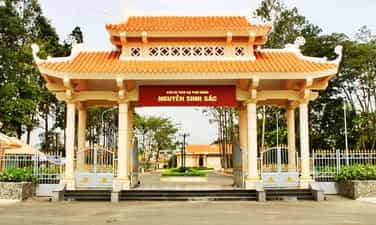
The relic site of Pho Bang Nguyen Sinh Sac
Nguyen Sinh Sac relic site is located at 137, Pham Huu Lau street, ward 4, Cao Lanh city, Dong Thap province. This is the resting place of Vice President Nguyen Sinh Sac, a patriotic Confucianist, and the father of President Ho Chi Minh. Nguyen Sinh Sac relic site was started construction on August 22, 1975 and inaugurated on February 13, 1977. On April 9, 1992, Nguyen Sinh Sac Relic Area was recognized by the Ministry of Culture and Information as a National Historical and Cultural Relic. Mr. Nguyen Sinh Sac was born and raised in Nam Dan, Nghe An province. In the year of Tan Suu (1901), he passed the Vice Ranking in 1906 and took the position of "Advocate of the Ministry of Rites" and then became Tri Phu in charge of Tri of Binh Khe district (Binh Dinh). During his time as a mandarin, he always stood on the side of the poor, punishing the evil tyrants and only served for a short time before being dismissed by the Nguyen Dynasty. After being dismissed, he went to the South and lived in Hoa An village in Dong Thap province to teach, dispense medicine to help the poor and live a pure life until his death. To commemorate his contributions, the government and people of Dong Thap built Nguyen Sinh Sac's mausoleum for people inside and outside the province to visit and burn incense to commemorate him. The relic area of Deputy Nguyen Sinh Sac is structured into 4 areas: the tomb area, temple and house displaying the career life of Deputy Nguyen Sinh Sac; Uncle Ho's stilt house area and fish pond garden; Cultural space of the ancient Hoa An village model and area for organizing folk games and entertainment festivals. The relic is not only built very meticulously but also carries a lot of profound meaning. The tomb facing the East is a stylized lotus petal shaped like a spread hand facing down, above are 9 innovative folk dragons, extending out into 9 gables, symbolizing the people of the plains. The Mekong River always protects and embraces the grave of a patriot. Mr. Pho Bang's tomb is covered with marble, the ash gray tomb rests on the irregular hexagonal white ground stone tomb, gradually expanding to the sides and front. On the grave there is an agarwood top made of Ngu Hanh Son stone, fragrant smoke day and night. The mausoleum grounds have many types of ornamental plants and rare fruits that people from all over the country bring home as souvenirs, especially the nearly 300-year-old star fruit tree located on the left side of the tomb and the more than 300-year-old sop tree located on the right side of the tomb. In front of the grave is a 5-pointed star-shaped lotus pond, in the middle of the pond is a stylized white lotus stand 6.5 meters high, symbolizing the pure life of Mr. Pho Bang. The memorial area displays many artifacts and documents related to his life and career, especially his time in Cao Lanh. This place authentically recreates each stage of Mr. Pho Bang's life from his hometown and family; years of hard work to become talented; place of mandarins - from mandarins to the South to operate; Mr. Nguyen Sinh Sac's feelings for the people of Hoa An and the feelings of the Hoa An people and the whole country for him... Every year, Dong Thap province organizes the death anniversary of Deputy Nguyen Sinh Sac on the 28th day of the 10th lunar month, with more than 100 thousand visitors. Tourists come from all provinces and cities, bringing products ranging from rustic to rare, offering their respects and offerings to the sacred ancestors, demonstrating the tradition of "Drinking water, remember the source", preserving national cultural identity. . Source: Dong Thap Tourism
Dong Thap
5826 view
Rating : National monument

Tan Hoa Communal House
Tan Hoa communal house is located in Vinh Binh district, Dinh Vien Phu, now located in Tan Hung hamlet, Tan Hoa commune, Vinh Long city. Tan Hoa Communal House is located on the banks of the Tien River, facing the Cai Doi canal, so locals call it Cai Doi Communal House. This is an architectural work that is both artistic and marks a time when Vietnamese immigrants came here to reclaim land and establish a hamlet. In 1998, Tan Hoa communal house was recognized as a national "historical-cultural" relic. Tan Hoa communal house was built around the mid-18th century. Today, there is no document proving the date of the first construction of the communal house, but today, Tan Hoa communal house still retains many artifacts such as the sacrificial poem to Thanh Hoang Dai. Vuong - a religious mark dating back to the 18th century... Most notably, the communal house also has an ancient signboard engraved with the three words Tan Hoa Dinh in the style of a seal made in the year Mau Ngo (1798), of great size, proving that at that time, The scale of Tan Hoa communal house is not small. Around the reign of Thieu Tri (1841 - 1847), the name of Tan Hoa village due to the same name as Queen Mother Ho Thi Hoa (wife of King Minh Mang, mother of King Thieu Tri) was changed to Tan Hoa. On November 29, the fifth year of Tu Duc (January 8, 1853), Tan Hoa village as well as many other villages in the region were simultaneously awarded the title of Thanh Hoang God. However, this precious document did not last long. In 1862, the French expeditionary force opened fire to annex the Southeast provinces and Vinh Long province, and the Tan Hoa deity was destroyed. Therefore, when implementing the 1862 Treaty, Vinh Long province was returned to the Hue court, the current government quickly reported and the Ministry of Rites quickly re-issued a copy of this imperial decree to Tan Hoa village. In the early stages of the French colonial period, Tan Hoa village merged with Tan Hoi and Tan Nhon villages, taking the new name Tan Hoa. Therefore, in the year of Canh Tuat (1910), Tan Hoa communal house was restored and named "Tan Hoa spiritual temple". Tan Hoa Communal House consists of six roofs made in a stacked style, giving the appearance of a Southern village communal house but also has its own unique features. The main hall is a four-pillar house, expanded to four sides by punching rafters and eight decisive rafters. Other houses such as martial arts, martial arts, rear hall... are all made in the style of three rooms and two wings. The communal house's foundation was built of split stone, but the later restoration built a surrounding brick wall and could not hide the artistic mark of that time, the French patterns on the top of the columns outside the front porch. The communal house's roof is covered with yin and yang tiles, connected by a gutter system. The ridges and roofs are built high and decorated with many ceramic decorations such as dragon tureens with pearl paintings, fish transforming into dragons, phoenix jaws, dragon rings, eight fairies, Mr. Sun and Mrs. Moon. In Tan Hoa communal house, there are still dozens of sets of blue envelopes, dozens of horizontal panels, couplets, many symbols such as burners, burners, tops, incense burners, altars... Every year, there are holidays at Tan Hoa communal house. : - Thuong Dien Festival is on the 11th and 12th day of the 9th lunar month. - In particular, Tan Hoa communal house still retains the tradition of Than Thanh Hoang, which means the Ky Yen (old) day when the communal house was first established, before being standardized by the Nguyen Dynasty. - But the biggest holiday of this communal house is Ha Dien - Ky Yen day, from 11 to 13 of the third lunar month every year. Tan Hoa Communal House is an artistic architectural work, testament to a rather long historical period. Through many ups and downs since our ancestors began to reclaim hamlets and establish villages, however, no matter the circumstances, our ancestors still tried to preserve cultural heritage. Therefore, Tan Hoa communal house was recognized by the Ministry of Culture and Information as a historical-cultural relic in 1998. Source: Book of historical and cultural relics of Vinh Long province
Vinh Long
6177 view
Rating : National monument
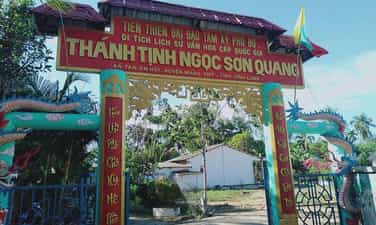
Holy purity Ngoc Son Quang
Ngoc Son Quang Holy Relic is located in Tan Thieng hamlet, Tan Long Hoi commune, Mang Thit district, Vinh Long province. Around the beginning of 1928, Mr. Truong Nhu Thi and Cao Dai dignitaries established the Kim Linh monastery. The religion here follows the Tien Thien sect. In 1936, Mr. Truong Hoang Ngu, a Cao Dai dignitary, donated 7 square meters of land to build a new place of worship. In 1936, Ngoc Son Quang Thanh Tinh was completed. Since 1931, besides practicing religion, dignitaries and followers of Ngoc Son Quang had revolutionary activities. In 1936, the French colonialists sealed the Ngoc Son Quang Holy Pure Land. After the Cochinchina uprising in 1940, many dignitaries and believers were arrested and exiled. Despite such difficulties, Ngoc Son Quang still turned towards the revolution. In 1943, the Party organization assigned comrade Tran Van Sen to break the seal on Ngoc Son Quang holy sanctuary and activities at Ngoc Son Quang holy sanctuary took place more and more vigorously, the organizations here operated under the leadership of Ngoc Son Quang holy sanctuary. Directly directed by the Party, in August 1945, unions in Ngoc Son Quang and the people rose up to take power back to the people. During the resistance war against the French, this place was a solid fulcrum of the revolution. Many army units and leading cadres of Vung Liem and Mang Thit stayed here to direct the local movement. In 1954, the Party cell of Thanh Tinh Ngoc Son Quang was born to direct the revolutionary activities of Thanh Tinh. During the period of fighting against the Americans to save the country, many revolutionary activities took place, sometimes silently and secretly, sometimes openly and directly with the enemy, winning great victories on many fronts. The highlight is the event of Saint Tinh Ngoc Son Quang building Nguong Thien monument - holding a Peace prayer ceremony, this event took place from November 12 to 16, 1970. The festival advocated a forum against American invasion. , affirming that Vietnam is determined to be peaceful and independent. This event resonated domestically and internationally. Many foreign news agencies came to Ngoc Son Quang to directly report news to the world. The enemy tried every way to destroy the ceremony and suppress religion. Nguong Thien Dai still stands firmly in the solidarity and protection of believers and people. This event made the enemy tremble in fear. In 2007, the State cooperated with followers of Cao Dai religions inside and outside the province to invest funds to restore the larger and more majestic structure to record the important historical event in 2007. world stature and also so that the People have a place to pray for peace. The second event that also created a big buzz took place in July 1973. Followers and dignitaries Ngoc Son Quang directly met with Minh Duc district chief, Vinh Long province chief, commander of the four tactical region, Ministry of Home Affairs, The Prime Minister's Office, the Supreme Court, and the puppet National Police Command fought fiercely against conscription. Faced with Ngoc Son Quang's strong struggle, the enemy had to give in and release 181 detained believers, pledging to end raids and searches for Thanh Tinh. Nowadays, on the 14th and 15th of the 11th lunar month every year, Ngoc Son Quang Holy Land celebrates a solemn and respectful Peace Prayer Ceremony. In addition, Ngoc Son Quang Holy Relic has main festivals: Ceremony for the Supreme Being (God) on the 9th of the first lunar month. Thuong Nguyen Festival is on the 15th day of the first lunar month. Feast of the Five Kings, worshiping Shen Nong on the 5th day of the 5th lunar month. Trung Nguyen Festival on the 15th day of the 7th lunar month. Ha Nguyen ceremony and initiation ceremony on the 15th day of the 10th lunar month. Ngoc Son Quang Holy Relic was recognized by the Ministry of Culture and Information as a national historical and cultural relic of the revolutionary historical type on August 31, 1998. Source: History of Mang Thit District Party Committee
Vinh Long
6374 view
Rating : National monument