Relic point Vietnam
Việt Nam
Phuoc Hau Pagoda
Phuoc Hau Pagoda is located in Dong Hau hamlet, Ngai Tu commune, Tam Binh district, Vinh Long province. This is an ancient Buddhist temple of the Lam Te sect, Chuc Thanh sect, and is also famous for its unique stone sutra garden, one of a kind in the West. Initially, Phuoc Hau Pagoda was just a thatched hut. In 1894, everyone in the village worked together to build a thatched hut into a pagoda with wooden ribs, yin-yang tile roof, plank walls, and brick floor. This pagoda is a type of village pagoda so it is named Dong Hau pagoda. In 1910, the name of Dong Hau pagoda was changed to Phuoc Hau, and more and more monks and nuns came to take refuge and receive precepts. During the period of national liberation struggle, Phuoc Hau Pagoda was also a place to house revolutionary cadres in the most difficult and dangerous times. Many monks studied at the pagoda, followed the teachings of the Venerable Monks, and listened to the call of the Fatherland, "taking off their robes and putting on their war robes". This is a relic of special importance to the history of Vietnamese Buddhism in the 20th century as well as the Revolutionary history of Vinh Long province and the Southwestern region during the war. After many times of restoration and new construction, Phuoc Hau Pagoda currently includes many works such as the main hall, middle hall, rear temple, sutra hall, stupa system... Except for the main hall, which was newly built in 1962 with materials. modern according to the architectural model combining East - West, other works are parts of the old temple, dating from 1894. The main hall of Phuoc Hau Pagoda is shaped like the word "painted", overlooking the river. The front of the pagoda is built in the style of an ancient building, with a model of a towering seven-storey tower in the middle. The inner hall is quite large, the middle altar holds a statue of Shakyamuni Buddha in meditating form along with a statue of newborn Prince Siddhartha and the Three Venerables (Avalokitesvara, Amitabha, and The Chi). On both left and right sides there are two altars. Here, there are a group of very precious statues from the ancient Dong Hau pagoda that are still kept, such as statues of Tieu Dien Dai, Ho Phap, Ksitigarbha, Chuan De and a set of Arhat statues all made of wood or Cay Mai ceramic. The pagoda has a very unique stone sutra garden, with elaborately carved sutras on stone. The Dhammapada Sutra Garden consists of 213 blue stone slabs measuring 0.4×0.6m, engraved with 423 sutras on both sides, in addition there is a poem about the general idea of the Dhammapada, 1 poem about the merits of the Dhammapada Sutra. the conduct of monks and Buddhists and a stone slab engraved with the image of Venerable Thich Minh Chau. The stone slabs are arranged to simulate Bodhi leaves spreading out in eight directions, symbolizing the Noble Eightfold Path. The center of the garden is a mountain with four Shakyamuni Buddha statues. There is also the Garden of Amitabha Sutra and the Garden of Bac Truyen Quoc Diem Sutra. Amitabha Sutra Garden has 31 stone slabs arranged in a row of small S-shaped lotus ponds, symbolizing Vietnam. Each North, Central, and South region has a stone slab placed in the middle of the lake inscribed with a symbolic pagoda, plus symbolic pseudo-mountains such as Yen Tu mountain, That Son... The sutras in this garden are translated in six-eight verse form. The pagoda also has a number of stone slabs engraved in English next to Vietnamese so that foreign tourists can understand when visiting and many stone slabs engraved with the words heart, patience, and Buddhist teachings are very unique... Phuoc Hau Pagoda was recognized by the Ministry of Culture and Information as a national revolutionary historical relic on January 25, 1994. Source: Vinh Long Tourism
Vinh Long
6656 view
Rating : National monument

Long Thanh Communal House
Long Thanh Vu Temple, also known as Long Thanh communal house, located on the banks of Long Ho River, is a typical ancient architectural work over a hundred years old in Vinh Long City and is ranked as a historical - cultural relic. national level on March 25, 1991. Long Thanh communal house was built around 1754, by people of the five families Mai, Ho, Mac, Vo, Doan and many other immigrants who came to Vinh Long to explore, build villages, establish hamlets and build communal houses to worship the village God. Initially, this communal house was temporarily built with leaves at Bung Binh village, then in 1844, Mr. Nguyen Van Khiem - a villager, realized that the communal house's location was not favorable, so he offered a piece of land about 2 hectares located next to it. banks of Long Ho river to move Long Thanh communal house here. Until the year Tu Duc 1852, Long Thanh communal house was ordained by the Nguyen court as the God of Bon Canh Thanh Hoang (meaning the title of Bon Canh Thanh Hoang as a God), currently this title is also worshiped at the queen's house. Descendants of the Ho family in Vinh Long. In 1913, Long Thanh communal house was restored, built with solid bricks and tiles and renamed Long Thanh Mieu Vu to this day. Overall, Long Thanh communal house was built according to the popular village communal house architecture in the South. Although not as massive as Northern communal houses, the process of forming Vinh Long communal houses is a true reflection of the cultural life and beliefs of the local community from the first time they came to this land. reclaim, open the realm. Long Thanh Communal House has typical Asian architecture with a communal roof consisting of five pyramid-shaped roofs, two Banh It roofs, fish-scale tile roofs and many adjacent annexes... this is a quite common communal house design in Vietnam. Southwestern region. Just like Cong Than Mieu Vinh Long, the layout inside Long Thanh communal house is divided into 4 main rooms, including martial arts, martial arts, main chamber, guest house in addition to the kitchen. In the middle of Long Thanh communal house's yard is a screen, then the martial arts and martial arts house - a place used to build adoration, opera and organize important holidays of the village. The main temple is located in the center of Long Thanh communal house, which is used to worship the village's Thanh Hoang. It has a four-pillar design with eight punching rafters and eight decisive rafters to ensure dryness in the rainy season and ventilation in the dry season. The part behind Long Thanh communal house is the guest house and kitchen located on the left side of the communal house. In addition to worshiping the Village's Tutelary God, in the main hall of Long Thanh Communal House, there is also a worship of the National Tablets of the Hung King, the Ta Huu Ban List, the Bach Ma Thai Giam God and is decorated with many red painted envelopes, horizontal panels, parallel sentences... gilded, delicately carved. The rear of Long Thanh royal court has a small but discreet space where ancestors and descendants are worshiped and sacred objects are kept. Besides, in front of Long Thanh communal house yard, there is also worship of Xa Tac altar (altar of Nong god), Ong Ho stele, Bach Ho temple, Ngu Hanh Nuong Nuong temple. Every year, at Long Thanh communal house, two major holidays usually take place: Ha Dien Festival on the full moon day of the third lunar month and Thuong Dien Festival on the full moon day of the 10th lunar month. In addition, Long Thanh communal house is also a place to preserve traditional rituals of the South such as Tuc Yet, Tien Hien, Hau Hien, Xay Chau, Dai Boi, Hoi Chau... Source: Vinh Long Tourism
Vinh Long
6274 view
Rating : National monument
Mausoleum of Ong Tien Quan, Marshal Dieu Bat
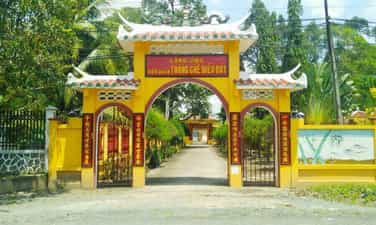
The relic site of Ong Tien Quan's Mausoleum of Marshal Dieu Bat, located in Giong Thanh Bach hamlet, Thien My commune, Tra On district, Vinh Long province. General Quan Tien, General of Dieu Van Ton, Nguyen Van Ton's real name is Thach Duong (1763 - 1820), a Khmer ethnic person, from Nguyet Lang village, Binh Phu commune, Cang Long (Tra Vinh). He followed Lord Nguyen and had great contributions in reclaiming the lands of Tra On and Cau Ke and creating solidarity between the Kinh, Chinese and Khmer ethnic groups, preventing the invasion of the Siamese army. He and his generals participated in supporting Thoai Ngoc Hau in dredging the Vinh Te canal, so Lord Nguyen was grateful and awarded him the title of Dieu Bat and was given the title Nguyen Van Ton. When he died, he was posthumously awarded the title of Field Marshal Dieu Bat. According to documents by researcher Truong Ngoc Tuong, Marshal Nguyen Van Ton was infected with the epidemic while participating in urging the Vinh Te Canal to be dug up. That year there was a major epidemic, killing thousands of peasants and spreading in many provinces of Cochinchina. Marshal Nguyen Van Ton and his wife died on the same day after Tet Canh Thin 1820. It is a coincidence that after the death of Marshal Dieu Bat and his wife, the epidemic suddenly ended. At that time, the people of the Tra On - Man Thit area thought that he had an epiphany to protect the villagers from the epidemic, so they flocked to the mausoleum to worship him, hoping to be protected, and the belief in worshiping Marshal Dieu Bat came from there. . Ong Tra On's mausoleum worships Field Marshal Nguyen Van Ton, has existed for 200 years and has been restored many times, and was recognized by the Ministry of Culture, Sports and Tourism as a national historical-cultural relic in 2019. 1996. Regarding architecture, the mausoleum has a main hall, a martial arts hall and a guest house, built in the style of a Southern communal house with wooden materials, tiled roofing, brick floors, and walls. Looking from the outside, the three-entrance gate and fence around Marshal Dieu Bat's mausoleum were built in 1963 and restored in 1994. On both sides of the gate are pairs of opposing tureens. After passing through this gate, you will see another gate. Behind this gate is a large, cemented yard with many trees and flowers surrounding the yard. Inside the campus there is a screen depicting a dragon and tiger. In front of the main hall is a martial arts hall and a 10m high flagpole hanging the Soai flag. Vo Ca was built in 1953 with heavy materials and has 4 round columns. The ends of the martial arts roof are decorated with porcelain coin shapes. The martial arts roof is covered with yin and yang tiles, and above it are statues of two dragons painting pearls and a pair of fish turning into dragons. On both sides of the martial arts door, there are statues of two majestic unicorns. The highlight is the gilded lacquered horizontal panel with the four great characters "Protect the country and protect the people". The main hall is about 200m2 wide, with four supporting pillars forming a banh it-shaped roof, across the bridge. The roof is covered with yin and yang tiles. The top of the roof has a crockery coin pattern. On the roof there are a pair of dragons flanking the sun and moon. There are three doors into the main hall. Above the main door is a sign engraved with the words "My Thanh Assembly Hall". On both sides of the door are pairs of tureens. Inside the middle altar, there is a portrait of Former Military Marshal Dieu Van Ton, on the right, there is a statue of Marshal Dieu Bat's wife. On the left, Binh Tay worships Deputy General Nguyen An. The graves of Field Marshal Dieu Bat and his wife are located behind the mausoleum in a double burial style built in 1820 with structures made of lime, honey, and sugar. His grave is higher than her grave. In front of the tomb there is a screen with two parallel sentences. Ong Tra On's Mausoleum Festival was included in the National Intangible Cultural Heritage List by the Minister of Culture, Sports and Tourism on January 22, 2020. Source: Vinh Long Tourism
Vinh Long
6355 view
Rating : National monument

Van Thanh Mieu Vinh Long
Van Thanh Mieu is located on Tran Phu Street, Ward 4, Vinh Long City, Vinh Long Province with an area of 10,322m2. Van Thanh Temple is a project that promotes Confucianism and is the official cultural institution of the feudal state. Compared to other Temples of Literature in the South, Vinh Long Temple of Literature was built the latest and is the only structure that still exists today. The three-entrance gate and two side gates are built in the ancient style, with 3 roof floors. On the top of the roof is decorated with two dragons flanking the sun made of blue ceramic, and the roof is covered with large and small tiles. On both sides of the column there are opposite tureens with Chinese characters embossed in cement with the meaning of promoting Confucius and Confucianism. From the gate, go straight to Dai Thanh Palace called Shinto. On both sides of the shrine are two rows of stars towering like two layers of soldiers. On the shrine there are 3 stone stele The first stele is engraved with the content written by Mr. Phan Thanh Gian before his death. The stele was established by Mr. Truong Ngoc Lang in 1872. The second stele was erected in 1917. The third stele was erected in 1931, recording the words of Mrs. Truong Thi Loan donating land and entrusting the worship of her biological father and father-in-law at Van Xuong Cac. In front of Van Xuong Cac there are two cannons. Cannons are two of the ancient guns placed along the banks of the Co Chien River to defend Vinh Long citadel. In 1937, these two guns were brought here. Van Xuong Cac is a unique cultural project built in the style of overlapping snails, creating the unique appearance of Van Thanh Mieu Vinh Long. Van Xuong Cac is also known as Tho Lau, Tan Dinh, Tuy Van Lau, and consists of two floors: the upper floor worships 3 Van Xuong De Quan (god in charge of literature) and is where books are kept; The lower floor was a place to rest when worshiping Confucius and was a place for literary commentary and martial arts discussion by mandarins at that time. In front is the altar to worship Gia Dinh executioner Sung Duc, Mr. Vo Truong Toan and Imperial Ambassador Phan Thanh Gian. The campus of Van Thanh Temple is very large and has many shady trees. There are two lakes that used to grow lotus trees, on the left is Nguyet Anh Lake, on the right is Nhat Tinh Lake. Located at the end of the "shrine" is the Temple of Literature, the main part is Dai Thanh Palace worshiping Confucius, in front are Ta Vu and Huu Vu worshiping Seventeen Sages. The interior of Dai Thanh Palace is decorated with worship spaces: the middle space is the altar of Confucius, the two sides are the altars of the twelve sages. In front is the altar of Teacher Chu Van An, on the left and right sides are the shrines worshiping the Twelve Sages, which are 12 of his excellent students. In the Temple of Literature, there are many horizontal panels and couplets donated by benefactors everywhere. On March 25, 1991, Van Thanh Temple was recognized by the Ministry of Culture, Information, Sports and Tourism (now the Ministry of Culture, Sports and Tourism) as a National Historical and Cultural Relic. . Every year, the Ceremony to Confucius and the Sages is held here on Dinh day in early February and Dinh day in late August. At Van Xuong Cac, there is the death anniversary of Phan Thanh Gian (the 4th and 5th of the 7th lunar month), the death anniversaries of high-ranking mandarins and soldiers (the 12th and 13th of the 10th lunar month). Source: Vinh Long Province Tourism Promotion Information Center
Vinh Long
6080 view
Rating : National monument
Memorial area for Professor and Academician Tran Dai Nghia
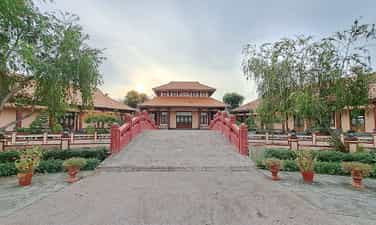
Comrade Tran Dai Nghia's memorial area in Phu My 1 hamlet, Tuong Loc commune, Tam Binh district (Vinh Long), the memorial area for Professor, Academician, Major General, Labor Hero Tran Dai Nghia is a cultural work. has a profound humanistic meaning, expressing gratitude for great contributions and helping generations better understand the background, life, spirit of overcoming difficulties, eagerness to study well, and creative work of a talented scientist. , a great intellectual who dedicated his life to serving the people and the country, an excellent student of President Ho Chi Minh. The memorial area for Professor, Academician, Major General, Labor Hero Tran Dai Nghia was started construction on November 24, 2013, inaugurated on May 18, 2015. The entire project has an area of about 16,000 square meters, designed in an open, airy, gentle, and intimate style, but still ensures dignity. The project includes main items such as: Memorial house, exhibition house, conference room, movie screening, traditional activities, square... The memorial area has nearly 1,000 documents and artifacts about the life of Professor, Academician, Major General, and Labor Hero Tran Dai Nghia. To contribute to increasing the meaning and value of the souvenir area, the General Department of Defense Industry, Ministry of National Defense recently handed over a military engineering workshop model and 132 defense and economic products for display. The highlight of the memorial area is the science and technology data integration center, a modern project invested in and built by the Ministry of Science and Technology. The Center is a place to store and promote scientific and technological information, serving the exploitation of agricultural production and new rural development in the Mekong Delta; Professor, Academician, Major General, Labor Hero Tran Dai Nghia's real name is Pham Quang Le, born on September 13, 1913 in a poor teacher family. With an intelligent and energetic personality, from a young age he was always determined to study, determined to rise and achieve excellent results at all levels of education and then went to France to study abroad. After 11 years working at gas power plants, aircraft manufacturers, weapons research institutes, and aeronautical engineering in France and Germany, in 1946, he volunteered to follow President Ho Chi Minh to serve the country. . With his knowledge, when he returned home, he was assigned the task of researching new weapons; Organizing the construction of hundreds of engineering factories across the country; carrying out a general movement of tens of thousands of tons of machinery, equipment, and materials to the Viet Bac war zone; Gradually improve organization, force, training, and team development; Successfully researched, manufactured and converted many types of weapons and equipment suitable for the Vietnamese battlefield. At many seminars about his career, many leaders of the Party, State, and scientists commented: He is an outstanding scientist, known as the father of industry. Vietnam's defense. At that time, his achievements in researching, manufacturing and improving many types of weapons contributed to reducing the gap in scientific level between us and the enemy, helping our troops gain the initiative on the battlefield, moving forward. won complete victory and unified the country in the spring of 1975. The memorial area of Professor, Academician, Major General, Labor Hero Tran Dai Nghia was recognized by the Mekong Delta Tourism Association as a typical tourist destination of the region in 2017 and re-recognized in 2022. Source: People's Army Newspaper
Vinh Long
6823 view
Rating : National monument

Memorial area of Chairman of the Council of Ministers Pham Hung
The memorial area for Chairman of the Council of Ministers Pham Hung is located in Long Thuan A hamlet, Long Phuoc commune, Long Ho district, Vinh Long province, with an area of 3.2 hectares. Comrade Pham Hung, born in 1912, died in 1988; Hometown: Long Ho commune, Chau Thanh district, Vinh Long province; He once held the following positions: Secretary of the Southern Party Committee (1946), and Deputy Director of the Southern Police Department (1947); Member of the Party Central Committee (1951); Deputy Secretary of the Central Committee of the Southern Department, Secretary of the Inter-Regional Party Committee and Chairman of the Inter-Regional Resistance Committee of the Southeast Region (1952); Minister of the Prime Minister's Office (1957); Deputy Prime Minister (1958); Secretary of the Central Committee of the Southern Department (1967); Deputy Prime Minister (1976); Vice Chairman of the Council of Ministers and Minister of the Interior (1980 - 1986); Chairman of the Council of Ministers (1987). Member of the Politburo term 2, 3, 4, 5, 6; Delegate to the 2nd, 3rd, 4th, 7th, 8th National Assembly. Chairman of the Council of Ministers Pham Hung belongs to the class of senior leaders with sharp vision and is a noble example of a true Communist soldier. Despite being in imperial prison, nine years of resistance against the French in the Southern battlefield, participating in building Socialism in the North, returning to the Central Committee of the Southern Department as Secretary and Political Commissar of the Campaign Command Ho Chi Minh, you have made important contributions to the cause of the struggle to liberate the South and unify the country. As Chairman of the Council of Ministers, he left a deep impression, creating an important premise in the cause of national innovation since the 4th Party Congress in 1986. Comrade Pham Hung's great contributions to the revolutionary cause have been awarded by the Party and State with the Gold Star Medal and many other noble orders and medals. Not only that, he also left many good impressions on peoples and friends around the world in building solidarity and friendship among countries. Comrade, the State of the Soviet Union awarded the Order of the October Revolution, the Medal for the cause of strengthening the combat alliance; The State of the Republic of Cuba awarded the Order of Che Gevara, first class; The Czechoslovak State awarded the First Class Fatherland Defense Medal and the Combat Brotherhood Medal; The Bulgarian State awarded the Medal. The memorial area for Chairman of the Council of Ministers Pham Hung was started construction on October 2, 2000, inaugurated on June 11, 2004. On June 6, 2012, the Ministry of Culture, Sports and Tourism recognized Comrade Pham Hung Memorial Area as a National Monument. Located in an overall cool landscape space with many trees, the Memorial Area includes two areas: the house from the street and the grave site of the Pham family's relatives; Construction works in the Memorial Area (reception house; memorial house; exhibition house; restoration of works: Wing 1, Phu Hai camp, Con Dao prison; Central military hut at the Department's Central Base the South, in Tay Ninh; House 72 Phan Dinh Phung, Hanoi). The memorial area of Chairman of the Council of Ministers Pham Hung is a memorial place for revolutionary celebrities. At the same time, it is a place of cultural activities that has profound traditional traditional propaganda and education for today and future generations. Source: Souvenir Area Management Board
Vinh Long
5745 view
Rating : National monument
Memorial area of late Prime Minister Vo Van Kiet
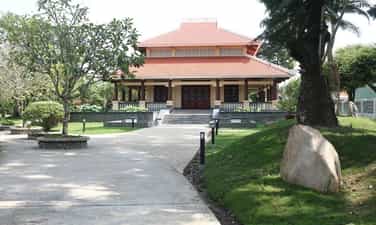
The memorial area of Prime Minister Vo Van Kiet is also known by the familiar name of "Mr. Sau Dan's Garden" by the people of Vinh Long. The memorial area is located in Phong Thoi hamlet, Vung Liem town, Vinh Long province. Total area of 1.7 hectares includes items: Exhibition house, office, worship area, garden. The highlight of the monument is the memorial house and the Prime Minister's working house during his lifetime. The exhibition house has many documents, artifacts, and images that vividly demonstrate the process of the Prime Minister's revolutionary activities. But the most impressive is the portrait of the late Prime Minister with a radiant smile hidden in the background of 15,000 photos about the Prime Minister's life and revolutionary career. Comrade Vo Van Kiet's real name is Phan Van Hoa, alias Sau Dan, born on November 23, 1922 in Trung Hiep commune, Vung Liem district, Vinh Long province, in a poor farmer family. Comrade Vo Van Kiet's life and career are closely linked to the heroic revolutionary struggle history of our Party and nation. When he was 16 years old, he became enlightened about the revolution, joined the anti-imperialist Youth movement and became a member of the Indochina Communist Party at the age of 17. When the Cochinchina Uprising broke out, at the age of 18, he was assigned to be Secretary of the Party Cell of Trung Hiep Commune, District Party Committee member of Vung Liem District, leading the People's Rebellion to seize power in the district capital of Vung Liem. Although the uprising failed, during the revolutionary activities, he began to reveal the qualities of a great talent. As a provisional Provincial Party Committee member of Rach Gia province, he built revolutionary bases, trained military forces, expanded and developed the U Minh base to become the headquarters of the resistance command of the provinces. Southwestern region. When the French colonialists recaptured the South, as Political Commissioner of the Western Interprovincial Revolutionary Militia, comrade Vo Van Kiet was assigned to directly lead the resistance war against the French colonialists in the provinces of Rach Gia, Bac Lieu. After the Geneva Accords, comrade Vo Van Kiet was assigned by the Party to secretly stay in the South, working alongside comrade Le Duan - Secretary of the Party Committee, continuing to direct the southern revolutionary movement. From late 1959 to early 1970, under the direction of the T4 Party Committee, headed by Secretary Vo Van Kiet, the soldiers and people of Saigon - Gia Dinh fought heroically and achieved many resounding victories to force the American Empire. must sign the Paris Agreement and withdraw troops from the South. After the Paris Agreement, in his position as Standing Member of the Central Committee of the Southern Department, Secretary of the Regional Party Committee and Political Commissar of Military Region 9, comrade Vo Van Kiet directed the Regional Party Committee and the Military Region Command to make decisions. historical determination, fight enemy encroachers, protect land and protect people; In the spring of 1975, during the campaign to liberate Saigon, as a member of the Special Party Committee of the Ho Chi Minh Campaign, he and the Campaign Command commanded five wings of troops to quickly enter the city. , coordinated with the People's uprising, forcing the Saigon government to surrender unconditionally, completing the cause of liberating the South and unifying the country. After the country's reunification, as Deputy Secretary of the City Party Committee, Chairman of the People's Committee of Ho Chi Minh City and then Secretary of the City Party Committee, you led the City to gradually stabilize. Later, in the positions of Chairman of the State Planning Committee, First Vice Chairman of the Council of Ministers, Chairman of the Council of Ministers, Prime Minister of the Socialist Republic of Vietnam, comrade always excellently complete the tasks assigned by the Party and People. Comrade Vo Van Kiet, 86 years old and 69 years old, has made great contributions to the glorious revolutionary cause of the Party and the nation. Comrade Vo Van Kiet's entire life of revolutionary activities was always devoted to the country, devoted to the people, lived simply and humbly, always putting the interests of the Party, the country, and the People first; is a typical and exemplary example of revolutionary ethics: diligence, frugality, integrity, integrity, public-mindedness, and impartiality; A true communist with a kind heart will forever be in the hearts of our people and international friends. Source: Vinh Long Electronic Newspaper
Vinh Long
6416 view
Rating : National monument

Tien Chau Pagoda
Tien Chau is one of the ancient pagodas in Vinh Long, with a history of about 250 years, located on a small island embraced by two branches of the majestic Mekong river, Tien River and Co Chien River, in the hamlet Binh Luong, An Binh commune, Long Ho district, Vinh Long province. Tien Chau Pagoda's official name is Di Da Tu or To Chau Pagoda. It is called Amitabha Temple because the pagoda worships Amitabha Buddha - the Patriarch of the Western Land of Ultimate Bliss. It is also called To Chau Pagoda because Binh Luong village (now Binh Luong hamlet, where the pagoda is located) in the past had willow trees casting shadows on the calm river, the scenery was beautiful and poetic, reminiscent of To Chau. - China. Tien Chau Pagoda was founded by Venerable Duc Hoi around the 19th century, with ancient architecture consisting of 4 roofs: front hall, main hall, middle hall and rear hall. The compartments are arranged in a four-pillar style, expanding both horizontally and vertically thanks to compacted and determined trusses. The truss set is made of precious wood, the roof is covered with yin and yang tiles. The pagoda's inner sanctum is beautifully arranged. In the middle of the four pillars is a large Amitabha Buddha statue. Behind the shrine of Amitabha Buddha is Maitreya Buddha, which is as large as the statue of Amitabha Buddha. On both sides of the Amitabha Buddha worship hall are places to worship Bodhisattva Tieu Dien Vuong, Avalokiteśvara Bodhisattva, Jade Emperor, Thap Dien Minh Vuong, Nam Cao Bac Dau, Quan Thanh De Quan, and Chuan De Vuong Bodhisattva. The middle hall is a place to worship the Patriarchs Bodhidharma, Shakyamuni Buddha, Tripitaka, Avalokiteśvara Bodhisattva, previous ancestors and good men and women who have passed away. This is also the place to receive guests, so there are many paintings promoting charity with parallel sentences full of profound meanings of the Buddha's realm. Over time, Tien Chau Pagoda has been degraded many times and has been restored and repaired many times. The Mau Than battle in 1968 caused considerable damage to Tien Chau pagoda. Artillery shells from Vinh Long town and warships left the pagoda with bullet holes, and the tiled roof collapsed in many places. After that, the Three Jewels Protection Committee in conjunction with the Vietnam Buddhist Association decided to restore the temple. Accordingly, the temple's facade is built of concrete and has 3 iron gates. In 1994, Tien Chau Pagoda was recognized by the Ministry of Culture and Information as a Historical - Cultural relic. Not only famous in Vinh Long, Tien Chau Pagoda is also famous throughout the Mekong Delta. Besides being famous for its monuments, landscapes, architecture... Tien Chau Co Tu is also known for the legend of Bai Tien. According to legend, in the past, Binh Luong village had charming scenery and favorable climate, so many people came here to participate in reclamation and establish hamlets. They are very honest, community life is very harmonious, so this place is called Binh Luong village. The people of Binh Luong village mainly make a living by fishing and catching fish and shrimp. On a bright moonlit night, young men in the village rowed boats to the river to catch fish. On the dunes, in a small tent under a cork tree, an old man lay awake. Cool and chilly winds gently blow, carrying the faint scent of flowers and leaves, blending with the melodious symphony of insects sobbing in the ground. He looked out at the white sand sparkling under the moonlight and suddenly saw the blurry white silhouettes of many girls gracefully flying and playing on the sand - Fairy descended to earth! The story was spread in the village, then spread far and wide across the world. From then on, the sandy beach on this river section was called Bai Tien. Source: Vinh Long Tourism
Vinh Long
6164 view
Rating : National monument

Ong Mat Pagoda
Ong Mat Pagoda is located in Ward 1, Tra Vinh city. The Sanskrit name of this temple is Bodhisàlaraja, Khmer people still call it Wat Kompong, which translates to Ben Temple. Ong Mat Pagoda is the provincial Khmer Buddhist center and was chosen to house the Mahanikay Khmer Buddhist Administration Office. In the early 20th century, when the Catholic Cathedral was invested in and built by the colonial government, the Khmer community also joined forces to build the solemn and majestic Ong Mat pagoda as a form of honoring cultural values. nationalization. The pagoda consists of many harmonious structures surrounding the main hall, in a campus of nearly 1.3 hectares, surrounded by a closed wall. The gate of Ong Mat pagoda is a beautiful architecture with 8 pillars supporting the gate roof and dividing the gate into a wide main walkway in the middle and two smaller walkways on both sides. At the top of each column is decorated with the two-faced Keyno Angel Bird, always smiling to welcome guests. On both sides of the gate are two walls that are both gradually lowering and expanding, decorated with a pair of seven-headed snakes in the style of traditional Khmer art. The main hall of Ong Mat Pagoda faces east and is built on a three-step foundation. The 1.35 m high blue stone foundation is surrounded by an iron fence nearly 2 m high and on each end of the fence post is a four-sided Bhrama image. On the altar inside the main hall is a majestic statue of Sakyamuni Buddha on a 4.4 m high lotus throne; 5 m long and 4.3 m wide. Around this large statue, there are many smaller Buddha statues made of many materials such as stone, cement, bronze, wood... with many different sizes and positions. Behind the main hall is the Library with the unique architecture of a traditional wooden stilt house of the ancient Southern Khmer people. All 24 column heads, central and longitudinal... are elaborately carved and painted with gilded vermilion. The library has three compartments, the middle compartment is where books are stored, including many ancient bibliographies; The two rooms on both sides are reading and studying places for monks and relatives in Phum Soc. In the campus of Ong Mat Pagoda, there are also a number of structures such as the monks' monastery, Mahanikay Buddhist Administration Office, lecture hall, Neakta worship sala, memorial tower... Originating from Ong Mat Pagoda, the movement demanding the teaching and learning of Sanskrit and Khmer scripts spread throughout the pagodas and villages in the province, against the "ignorant" policy of the French colonialists. After that, not only teaching and learning the Khmer language but also the national language was included in teaching, creating more favorable conditions for ethnic minority children to learn, and better realizing equal rights between ethnic groups. nation. Not only learning literacy and knowledge, generations of Khmer monks at Ong Mat Pagoda also focused on enhancing patriotism and the will to hate invaders. Therefore, this pagoda is the starting point of the political struggle movement of monks and Khmer people in the province and is a place that shelters many young people of all ethnic groups in the province from having to serve as soldiers for the enemy during the resistance. war against America. That's why, when the Spring Mau Than offensive was taking place, the enemy sent bombers to cause heavy damage. Ong Mat Pagoda was ranked a national historical and cultural relic by the Ministry of Culture, Sports and Tourism in 2009. Source: Tra Vinh Province Electronic Information Portal
Vinh Long
6377 view
Rating : National monument

HISTORICAL RELIC OF PHNO OM PUNG Pagoda (SIRIVANSARAMA)
Phno Om Pung Pagoda (Sirivansaràma), also known as Long Truong Pagoda, is located in Long Truong hamlet, Tan Hiep commune, Tra Cu district, Tra Vinh province. The pagoda was ranked as a provincial historical relic by the People's Committee of Tra Vinh province on March 15, 2016. In August 1945, the Youth Pioneer force, the people of Long Hiep commune and about 30 monks of Phno Om Pung pagoda, including the eldest monk, used rudimentary weapons such as sticks and bamboo sticks. Sharp, fake guns rose up to demonstrate loudly. Under strong pressure from the masses and the active and enthusiastic campaign of the monks, the Te commune handed over the government to the revolution. In September 1946, the first Long Hiep Commune Party Cell was established, Phno Om Pung Bo Pagoda was chosen as a base to house and protect revolutionary forces. During the period from 1946 to 1950, the 310th battalion of the 9th military region fought the Nomen battle, with the participation of local guerrillas, Buddhists and monks of Phno Om Pung pagoda. In this battle, our forces won. In April 1953, relying on spies to inform them, the enemy ambushed and captured comrade Thach Ngoc Bien, who was hiding in a closet at Phno Om Pung pagoda. At this time, they tortured the comrade in front of the temple yard until he fainted. Seeing this, the monk mobilized the monks in the temple to protest to put pressure on the enemies. Because we captured our revolutionary forces hiding right at the pagoda, the enemies saw the pagoda as a thorn in their side, and they always tried every way to search, arrest, and bombard the pagoda. Also this year, the pagoda was completely burned down, 5 Buddhists and 2 monks of the pagoda were injured. After the Geneva Accords were signed, the revolutionary forces encountered many difficulties, the enemy arrested and imprisoned many officials, and tried every way to isolate resistance families. However, many families were not afraid of hardships and hardships, accepting sacrifices to feed and protect revolutionary cadres, including the monks of Phno Om Pung pagoda. The temple built a secret cellar to house revolutionary cadres. In particular, the main hall is the most sacred place, but the monks did not hesitate to house cadres in the cellar under the Shakyamuni Buddha statue. In 1960, Phno Om Pung pagoda was chosen by the revolutionary forces as a place to print many types of leaflets, slogans and to house and protect revolutionary cadres stationed at the pagoda. From 1961 - 1968, the party cell campaigned to give food and clothes and distribute land to the people. Phno Om Pung Pagoda also actively contributed to providing food for the revolutionary forces. During this time, the temple opened a school to teach catechism, pali and general classes. Through these classes, monks and grassroots officials propagated the Party's policies, explained the enemy's sinister plots, and educated patriotism and revolutionary spirit. From these classes, many people later became revolutionary soldiers. During the period 1969 - 1971, Phno Om Pung continued to house and protect many officials of the commune, district and province. Through two resistance wars, monks and Buddhists, despite difficulties and dangers, were willing to sacrifice their lives to feed and protect revolutionary cadres and participate in the resistance. Phno Om Pung Pagoda contributed a part to the liberation of the country. Source: Tra Vinh Province Electronic Information Portal
Vinh Long
6038 view
Rating : Provincial level relics