Relic point Vietnam
Việt Nam
Bao Mon pagoda revolutionary historical relic
Bao Mon Pagoda, also known as Dom Bon Bak Pagoda, is located in Bao Mon hamlet, Don Chau commune, Tra Cu district, Tra Vinh province. Right from the early days when the Don Chau Commune Party Cell was established, the Party Cell went to Bao Mon Pagoda to build a legal base of operations, to serve as a place to house cadres, and at the same time mobilize monks to establish the Love Increase Committee. The province organized protests against conscription and demanded a reduction in taxes. In 1946 - 1950, through classes, the Party cell propagated the Party's policies, explained the evil plots of the enemy, and educated patriotism and revolutionary spirit for young people. From these classes, many people later became revolutionary officers and soldiers. In 1951, during the raid on Bao Mon hamlet and Mo Coi hamlet, Don Chau commune, the enemy shot dead a number of officials, the head monk of Bao Mon pagoda mobilized Buddhists to bring the cadres' bodies to the pagoda for burial. Later, during a raid by Commendo soldiers, the pagoda took some officials into the towers and the ceiling of the main hall to hide. Many revolutionary cadres in the resistance war against the French were sheltered, sheltered, and sheltered by the pagoda. During the resistance war against the US, Bao Mon Pagoda continued to be a solid base of the revolution. Many secret vaults were made in the temple grounds, under the Buddha altar, on the ceiling of the main hall and right in the eldest monk's room. At the end of 1968, the enemy discovered guerrilla forces stationed at the pagoda, they sent troops to surround it and called for surrender. Faced with that difficult situation, with his acumen, the chief sent the guerrilla squad down to spray water in front of the main hall. Then, with skillful and resolute words, the chief explained to the enemy that this was the place Practicing, as a Khmer, we must respect monks and temples. Faced with the monk's convincing arguments, the enemies could not find evidence and had to retreat in anger. During the Ho Chi Minh campaign to liberate Tra Vinh, monk Kim Toc Chon - Head of the Provincial Transport Committee assigned monk Lam Ruong Son (Bao Mon Pagoda) and monks Son Song, Thach Suong, and Son Sa Ra to the provincial palace. The chief persuaded Nguyen Van Son, governor of Vinh Binh province, to call on the puppet army and puppet government to surrender, contributing to the overall victory of the resistance war against the US. With the spirit of "All for the front line, all for the resistance", Buddhists and monks of Bao Mon pagoda contributed dozens of taels of gold, thousands of bushels of rice and many other items. There were 25 monks and Buddhists who heroically sacrificed their lives for the cause of national liberation. Particularly, the elder monk was awarded the Second Class Resistance Medal and Medal for National Development by the State. Bao Mon Pagoda was recognized by the People's Committee of Tra Vinh province as a provincial historical relic on June 10, 2005. Source: Tra Vinh Tourism Promotion Center
Vinh Long
5960 view
Rating : Provincial level relics
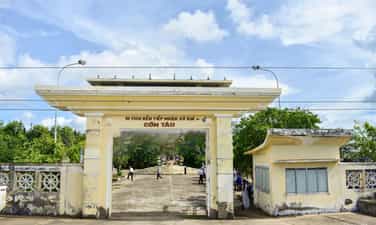
Historical relic of Con Tau weapons reception station
Con Tau weapons receiving port relic site is located in Con Egg hamlet, Truong Long Hoa commune, Duyen Hai district, Tra Vinh province. In July 1959, to provide resources for the Southern revolution in the war against America to save the country, the Politburo decided to establish a military transport unit at sea - Group 759 (later changed to Group 125). By early 1961, the Central Government issued instructions to provinces including Ba Ria, Ben Tre, Tra Vinh, and Ca Mau to prepare yards and organize ships to the North to explore routes to transport weapons to the South. In September 1962, comrade Pham Thai Buong, Member of the Party Central Committee, Member of the Central Committee of the Southern Department, decided to establish Group 962 to manage the weapons receiving ports in the provinces. Tra Vinh wharf is directly in charge of comrade Le Van Sen (Nam Sen) - Deputy Political Commissar of Group 162. At this time, the Tra Vinh Provincial Party Committee decided to choose two coastal communes, Truong Long Hoa and Long Vinh, in Duyen Hai district (now communes: Truong Long Hoa and Dan Thanh in Duyen Hai town; Dong Hai and Long Vinh communes). in Duyen Hai district) to open a weapons receiving station. Ben cluster 1 is in the area of Rach Co - La Ghi, wharf cluster 2 is in the area of Phuoc Thien, Ho Tau, Khau Lau, Lang Nuoc. These areas are revolutionary bases and are always the target of enemy attacks, so hiding and transporting weapons is extremely difficult. On March 17, 1963, Tra Vinh Wharf received the first train into Phuoc Thien Wharf. With a terrain of interlaced rivers and mangrove forests with many low trees, ships with large tonnage could be pressed into to camouflage, and the ship was safely hidden. Next was the second trip to Lang Nuoc airport carrying 70 tons of weapons. From 1963 to 1966, Tra Vinh Wharf welcomed 16 trips with 689 tons of cargo. Con Tau Port alone welcomed 10 flights, of which in 1963 welcomed 4 flights, in 1964 welcomed 6 flights. Although operating for only a short time, Tra Vinh Wharf is an important link of the Ho Chi Minh maritime route and Con Tau Wharf is the focus of that important link. In 2004, Con Tau Weapons Receiving Wharf was recognized as a national historical-cultural relic. By 2010, the Con Tau Weapons Receiving Wharf relic area was invested in construction and put into operation with an area of 1.2 hectares, including a memorial stele and a house displaying images and artifacts associated with the soldiers' victories. Tra Vinh's army and people towards the Ho Chi Minh Road at sea. Visiting the relic site, visitors can light incense sticks to commemorate the heroic martyrs who died while on duty on the Ho Chi Minh maritime route, visit the Exhibition House, and look at the Memorial Stele rising high in the sky. The new sunlight reminds us of the victories of the past and the resilient fighting tradition of our ancestors in the struggle for national liberation. Source: Tra Vinh Tourism Promotion Center
Vinh Long
6261 view
Rating : National monument

Phuoc My Tu relic
Phuoc My Pagoda relic is located in Ben Chua hamlet, Hiep My Tay commune, Cau Ngang district. Phuoc My Pagoda is also known as Cay Quan Pagoda or Ba So Pagoda. It is called Cay Quan Pagoda because in the past there was a large Curly tree on the river bank in front of the pagoda, so people took this feature to name the pagoda. It is called Ba So Pagoda because the pagoda was founded by Mrs. Pham Thi Do, also known as Ba So, a Go Cong immigrant who came here to settle down in 1886. The pagoda is located on a campus of more than 1 hectare, in front of the Thau Rau river. The river wharf during the resistance war was the Provincial Party Committee Base Area (Base Area Hamlet 5, My Long). About 500m south of the pagoda is the District Party Committee Base area (Ray Tieu Base Area). During the two resistance wars against the French and Americans, the pagoda was the base of the revolution, a stopping place for many units. The monks and Buddhists wholeheartedly supported, protected and contributed money to serve the resistance war. People always believe in the Party in the revolutionary cause, so this place is a support for the Cau Ngang District Party Committee to build a resistance base. As soon as the Hiep My Cell was born, the Cell chose the pagoda as one of the meeting and propaganda locations to launch fighting movements and received a strong response from the masses. After the Cochinchina uprising, the revolutionary movement subsided, Ba So Pagoda welcomed Comrade Tam Su, who was assigned to be the abbot of the pagoda to cover the enemy's eyes in rebuilding the base. Comrades were cared for and protected by Buddhists. During the "Long Resistance War" to control the revolutionary movement in the region, in June 1951 the French colonialists brought Leon Leroy from Ben Tre to use a ship along the Thau Rau River to station at Ba So Pagoda. But just one month later, with the support of Buddhists, our Company 380 attacked the station, causing heavy casualties. Entering the anti-American phase, Ba So pagoda continued to be the headquarters and stopping place for many agencies such as: District team, logistics, civil medicine, district construction site, Commune Party Committee, District Party Committee, Provincial Party Committee... Also at the pagoda, on December 5, 1974, comrade Nguyen Truong Tho, Deputy Secretary of the Provincial Party Committee, Provincial Political Commissar held a meeting with the Standing Committee of the District Party Committee, and the command committee of Battalions 501, 512, 509 deployed. rural liberation plan, liberating Cau Ngang. Because it was located in the base area and where our troops were stationed, during the resistance war, the pagoda was also the target of enemy raids and bombardments. Many times the pagoda was damaged by bombs and bullets, and there was a period when the enemy took over the pagoda as its headquarters. However, monks and Buddhists still believe in the Party, despite sacrificing their support and protection to protect the revolutionary base. It was here that many political struggle movements were initiated, the movement to besiege and evacuate garrisons, and the movement to destroy strategic hamlets. In addition, temples and Buddhists also contributed a lot of wealth to the revolution. With those achievements, on December 10, 2004, the People's Committee of Tra Vinh province recognized Phuoc My Pagoda (Ba So Pagoda) as a provincial historical relic. Source: Tra Vinh Province Electronic Information Portal
Vinh Long
5826 view
Rating : Provincial level relics
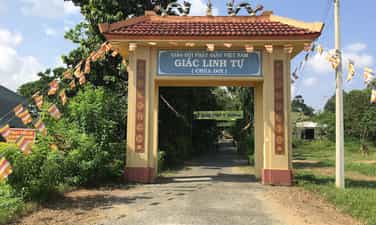
Giac Linh Pagoda (Bat Pagoda)
Giac Linh Pagoda is located on a high sand cave in Nhut A hamlet, My Long Bac commune, Cau Ngang district, Tra Vinh province. Giac Linh Pagoda is also called Bat Pagoda because in the past there were many birds living on ancient trees in the temple grounds, including crows and bats, so people took this feature to name the pagoda. Entering the temple gate, on the right is a large statue of Avalokiteśvara Bodhisattva, opening his heart of compassion to bring miracles to save sentient beings. Going a few dozen meters further, we will see the temple. The pagoda is built on a high plot of land, surrounded by many types of trees: horsetail, tamanu, bamboo, creating a quiet and sacred look. Entering the temple, we will notice the difference between Giac Linh Pagoda and other Buddhist temples. The Buddha altar does not arrange worship statues in the order: Three Buddhas, Amitabha, and Three Tons as in Mahayana Buddhist temples. The pagoda not only worships Buddha and those related to Buddhism: Bodhisattva, Arhat, but also Confucius, Lao Tzu, and integrates folk beliefs: Ba Chua Xu, Tao Quan, Uncle Tai, Uncle Precious. It is from the way of thinking of monks that Buddhists not only focus on religious matters but also on worldly matters. Compared to other pagodas in terms of construction scale, architectural value, and sculpture, Giac Linh Pagoda is modest. The only thing worth mentioning about the pagoda is the set of wooden panels painted in vermilion and gilded with the theme of the four sacred animals. However, the temple is rich in revolutionary achievements. Since the early years of the 20th century, Linh Son Dien has been a meeting and activity center for patriots fighting against the French in the Thien Dia Hoi organization. In 1922, the province's Red Youth organization was established here, including comrade Duong Quang Dong. Then one of the first three Communist Party Cells of Tra Vinh - My Long Party Cell also chose this location to meet regularly in the early years of its establishment. And in the protest of 300 farmers in 1931 demanding people's livelihood and democracy, banners and hammer and sickle flags flew on the temple fence. In 1934 - 1935, the pagoda was again chosen as the headquarters of the Vinh - Tra - Ben Joint Provincial Party Committee. In the period approaching the August 1945 Revolution, in order to seize the opportunity for the uprising to win, the pagoda witnessed a preparatory meeting to consolidate the Party Committee, convened by comrade Duong Quang Dong. During the resistance war against the French, nun Phung - a monk of the pagoda used the sound of gongs as a signal to summon or disperse revolutionary cadres when meeting or to hide during riots. During the period of resistance against the Americans to save the country, nun Phung became the abbot of the pagoda. Under her monk's robe, she blinded the enemies with pilgrimages to transport weapons to the revolutionary organization. In the years 1966 - 1967, the war was fierce, the southwest side of the temple grounds had a system of trenches over 300 meters long dug to resist enemy operations and raids. Also during this period, based on the quietness of the place of worship and the luxuriance of trees, dozens of secret tunnels were dug in the temple grounds for officials to hide. In particular, the temple also donated the large red bell to the construction site of making weapons to fight the enemy. In 1970, the enemy came and stationed a station next to the pagoda's fence, aiming to control the revolution in the My Long area and also to monitor the monks. Even so, nun Phung still single-mindedly stuck to the pagoda, so that a year later, when we attacked them, they had to abandon the post and flee. Giac Linh Pagoda was recognized by the Ministry of Culture and Information as a national historical and cultural relic on January 24, 1998. This place of Zen where no visitors are allowed is now always open to welcome us to reflect on religion and life. Source: Tra Vinh Tourism Promotion Center
Vinh Long
5523 view
Rating : National monument
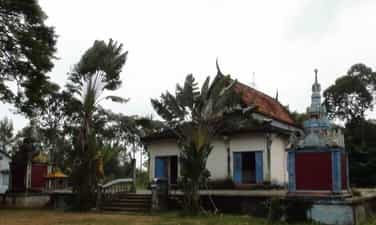
Relics of Teakhinasakor Ta Lon Pagoda
Teakhinasakor Ta Lon Pagoda (Cai Coi) is located in Cai Coi hamlet, Long Vinh commune, Duyen Hai district, Tra Vinh province. During the years of resistance, the pagoda was not only a secret base, a place to harbor and protect revolutionary cadres, but also a place where many political movements originated. Right from the time Long Vinh Commune Party Cell was established (September 4, 1933), the Party Cell discussed with senior monk Trieu Minh Ten to choose the pagoda as a legal base for the revolution, to organize shelter and protect cadres. and open classes for monks and children in the area. Through these classes, in addition to learning literacy and teachings, teachers also propagate the Party's policies and the enemy's sinister plots. Suspecting that Ta Lon Pagoda was a revolutionary base, in 1943, they searched the pagoda but found nothing. They were angry and burned down the main hall and a monk's monastery. The enemy's actions further increased the hatred among monks, Buddhists and the masses here. In 1948, the temple was once again ransacked by the enemy. Just like last time, no evidence was found that the leader of the temple, Prum Yen, ordered soldiers to burn down the main palace. During the anti-American period, under the leadership of Long Vinh Commune Cell, the revolutionary base of Ta Lon Pagoda continuously promoted the tradition of indomitable struggle. In early 1955, the enemy actively terrorized the masses and took revenge on the resistance fighters who caused us some damage. To cope with the situation, the monks of Ta Lon pagoda, despite difficulties, dangers and even their own lives, organized to house cadres right in their own rooms. In 1959, the enemy launched a terrorist operation, brutally bombarding, killing, looting and arresting people they suspected of being "undercover communists". During this campaign, they arrested the monk Son Hien and 4 monks and 3 Buddhists of Ta Lon pagoda. At the end of 1960, at the yard of Ta Lon pagoda, the National Liberation Front of Long Vinh commune was established and introduced before more than 500 public delegates. During the ceremony, there were more than 20 monks led by the second eldest monk Son Thuong. When they returned from secular life, they volunteered to participate in the resistance war for national liberation. In February 1962, unable to carry out their plan to gather people into a strategic hamlet, the enemy put poison into the fresh water source, killing 2 children and a monk at Ta Lon Pagoda. In May 1964, the enemy sent bombers and marines to park at Dinh An estuary and fired artillery shells at Ta Lon pagoda, killing dozens of houses. The pagoda owner, Mr. Son Ruong, died and eight Buddhists were injured. The temple burned down and the main hall partially collapsed. In the years 1965-1968, the enemy launched many sweeping operations and used planes to spray land clearing chemicals and spray Agent Orange. On February 22, 1966, 18 monks and more than 100 Buddhists of the pagoda went to Cai Doi densely packed area to fight with the enemy. The struggle of monks and Khmer compatriots in Long Vinh was supported by monks and Khmer compatriots throughout the province, so they won. With their achievements contributing to the cause of national liberation, the monks and Buddhists of Ta Lon Pagoda were awarded many certificates of merit, orders, and medals by the State. On April 18, 2013, the Ministry of Culture, Sports and Tourism recognized Ta Lon Pagoda as a national historical site. Source: Tra Vinh Province Electronic Information Portal
Vinh Long
5159 view
Rating : National monument

Tien Van Temple Relics
Tien Van Temple, also known as Tien Su Temple, is located on the campus of Le Van Tam Primary School in Group 1, Ward 1, Tra Vinh City. Back in history, when the French colonialists entered Indochina and then set foot on Tra Vinh, the problem was that they needed a number of people who knew French and Vietnamese to serve in the government apparatus. Initially, they recruited people who knew French and Vietnamese from Catholic churches, but the demand was increasing, so French-Vietnamese education was born in the late 19th century. The school for training In Tra Vinh is Ecole primaire Complementaire de Tra Vinh. Over time, the number of students increased, the school also expanded, many generations of teachers also passed away because of the bombs, bullets and smoke of war. In 1943, with respect for the teacher and the dedication of the teachers, including the great contributions of Master Pham Van Luoc, Master Vuong Hao Thuan and Master Vo Van Hoi, proposed and carried out the construction of the temple. serve teachers. In order to have funds to build the temple, Master Pham Van Luoc and Master Vuong Hao Thuan asked the provincial governor at that time to organize a "Fair Fair" on the school campus and asked to keep part of the funding. After a period of gathering, the two monks started construction of the temple according to the design of Master Vo Van Hoi. After nearly half a year of construction, by the end of 1943 the temple was completed. Located in the middle of the school yard is a small temple facing south. The structure of the temple is in the style of four pillars and wings, the load-bearing frame, and the doors and walls are all made of wood. The roof is covered with small yin and yang tiles, the top of the roof is a jade green glazed lotus-shaped tile. The temple floor is tiled. In particular, on both left and right sides of the temple there are two drums and gongs. On the left is the drum stand, on the right is the gong stand. The gong drum stand is designed in the style of two dragons and nine knives. The shrine's door hangs a sign of eternal memories written in Chinese characters. In the temple, right in the middle is the altar, behind is the stone stele. This stone stele previously had the names of 139 teachers attached, including French, Vietnamese, Chinese, and Khmer teachers who had contributed to the cause of education and passed away, but now bronze plaques are attached to it. The beer no longer exists, only a few names of teachers have been collected. Like many other projects, time accompanies damage. Since its construction, the temple has been restored and repaired three times but still retains its original appearance. Tien Vang Temple is a unique symbol in Tra Vinh - a symbol of respect for teachers, a place to recognize and honor generations of teachers who have contributed to the cause of education, and is recognized by the People's Committee of Tra Vinh province. Vinh recognized it as a cultural and historical relic on December 10, 2004. Source: Tra Vinh Province Electronic Information Portal
Vinh Long
5306 view
Rating : Provincial level relics

Ong Pagoda (Phuoc Minh Cung Pagoda)
Phuoc Minh Palace, also known as Quan Thanh De Pagoda or Ong Pagoda, is a typical religious facility of the Chinese community in Tra Vinh province. As the name of Quan Thanh De Pagoda suggests, the main deity worshiped at Phuoc Minh palace is Quan Cong, also known as Quan Vu or Quan Van Truong - a general of martial arts and martial arts, famous for his loyalty and filial piety in Chinese history during the Three Kingdoms period. . Also consorting with Quan Thanh De at Phuoc Minh Palace were the main god Phuoc Duc, the Lord of Birth and the two attendants of Quan Thanh De, Quan Binh and Chau Xuong. The main blessing and virtue in the concept of the Chinese people in Tra Vinh is the unity between the God of Earth, the God of Wealth and the God of Wealth. As for Mr. Bon, also known as Mr. Bon, he was an official named Trinh Tu Hoa - who was sent by the Ming emperor to negotiate with the courts of Southeast Asian countries to create conditions for overseas Chinese to do business and live. Phuoc Sinh Nuong Nuong, also known as Mother Thai Sinh, in Chinese beliefs, is the goddess in charge of giving birth and raising children. Phuoc Minh Palace is located at 44 Dien Bien Phu Street, Ward 3, Tra Vinh City. The pagoda's campus is more than 800 square meters wide. The pagoda has architecture in the style of foreign interior architecture (inside is the word Cong, the outside is the word Quoc). The overall plan includes three parallel buildings: front hall, central hall and main hall; Along both sides, there are two rows of houses, Ta Dien and Huu Dien, facing each other, forming the shape of the word Khau. Between the buildings there are quiet courtyards and corridors that communicate with each other. All buildings are designed in tiers and roofed with glass tiles. The gable facade is decorated with traditional Chinese designs such as two dragons and pearls, eight immortals, flowers, and animals. The front hall has 16 ironwood pillars painted in ocher, including 4 square pillars on round rocks and 12 round pillars on square rocks, symbolizing the harmony of yin and yang. The front hall is the place to worship the Jade Emperor in the middle with the combination of Tien Hien - Hau Hien on the left and right sides. The Central Palace is a small square building with four square columns on a round stone. This is where good men and women from all over gather to prepare offerings before entering the main hall. The main hall is a well-proportioned building with 16 round columns on a square stone. The main hall is divided into three compartments: – The central space places an altar to worship Quan Thanh De Quan under a large horizontal panel with the Chinese character Qiankun Chinh Qi. Three statues of Quan Van Truong in the middle with Quan Binh and Chau Xuong on both sides with Xich Tho horses made of rattan. - On the left side, there is an altar to worship the Lord of Birth and Refuge under the horizontal panel of "Loving Birth, Bringing Desire" in Chinese characters. – Gian must place the altar to worship the God of Phuc Duc under the horizontal panel of Uy Linh and Duc in Chinese characters. Phuoc Minh Palace is truly a Museum of traditional fine arts of the Chinese community in Tra Vinh as well as the entire South. With the cultural values of architecture, painting, sculpture, traditional music as well as the temple's role in the spiritual cultural life of the Chinese community, its role in strengthening the solidarity of Ethnic groups living together in the land of Tra Vinh and Phuoc Minh were ranked national historical and cultural relics by the Ministry of Culture, Sports and Tourism in 2005. Source: Tra Vinh Tourism
Vinh Long
5259 view
Rating : National monument
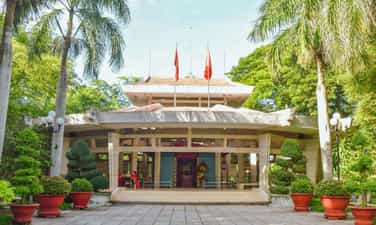
Uncle Ho Temple
The Temple of President Ho Chi Minh in Long Duc (Tra Vinh) is located in Vinh Hoi hamlet, Long Duc commune, Tra Vinh city, Tra Vinh province; about 5 km north of Tra Vinh city center. The Temple of President Ho Chi Minh in Tra Vinh province was ranked a national historical-cultural relic by the Ministry of Culture and Information, now the Ministry of Culture, Sports and Tourism, in 1989. Uncle Ho's temple relic area is 5.4 hectares wide with main items such as: Uncle Ho's temple, a house displaying the life and career of President Ho Chi Minh, green campus, fish pond, camping and entertainment area. and especially the model of Uncle Ho's Stilt House which was designed, printed and scientifically installed at a rate of 97 percent according to the original Uncle Ho's stilt house at the Presidential Palace in the capital Hanoi. The temple grounds are very large with rows of shady trees surrounding the rippling lake shore. The place is divided into many different areas, but the entire place reminds of the eternal gratitude of Uncle Ho - the beloved old father of the entire Vietnamese nation. The artifacts here are still as intact as the first day: the B52 plane that our army shot down, the tank of that war, the wooden-stilt house where Uncle Ho used to live. The Exhibition House was built according to traditional national architecture. In it, many artifacts, images, and documents help visitors gain a general understanding of Uncle Ho's life and activities; the tradition of resilient and indomitable struggle in the resistance war and the achievements in the renovation work of the Party Committee and people of Tra Vinh province; The process of building and fighting to protect the Temple. This place also displays black and white photos imbued with the love of soldiers and civilians, and the cruel war scenes that the people here experienced. The park with a large lotus pond in harmony with a system of green trees and ornamental flowers blooming all year round creates a diverse and attractive entertainment area. In particular, the canopy of ancient trees and surrounding bamboo ramparts along with the system of trenches and fortifications are witnesses of the process of building and fighting to protect the Temple, which has been seriously and thoughtfully restored and preserved. Uncle Ho's temple has become a pride and a symbol of the heart of Tra Vinh people towards President Ho Chi Minh. Source: Tra Vinh Tourism
Vinh Long
5403 view
Rating : National monument
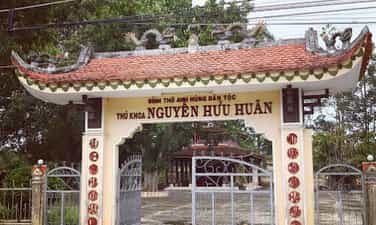
Thu Khoa Huan's tomb and temple
Thu Khoa Huan's real name is Nguyen Huu Huan. Born in 1830 in Tinh Ha village, Kien Hung district, Dinh Tuong province. Now it is My Tinh An commune, Cho Gao district, Tien Giang province. Son of Mr. Nguyen Huu Cam, a well-off farmer in the area. As a child, he was famous for being smart, assertive, very good at studying, and very diligent in his studies. In 1852 (during the reign of King Tu Duc), he took the exam in Gia Dinh and passed as valedictorian (top bachelor's degree). After that, he became a teacher or school director in Kien Hung district, Dinh Tuong province. When the French colonialists invaded our country (February 1859), he quit his teaching position, said goodbye to his family to join the resistance, linked up with patriotic scholars, recruited soldiers to stand up against the enemy, contrary to The Nguyen Dynasty's strategy of peace was essentially surrender. In April 1861, the French occupied My Tho. He and Thien Ho Duong launched an uprising, operating in Tan An and spreading to My Tho, greatly influencing the scholars of Cochinchina. At that time Thien Ho Duong was the Chief Administrator, he was the Deputy. At the end of 1861, seeing his influence, the French sent Ton Tho Tuong to persuade him to surrender but failed. In early 1862, he was ambushed, captured by the enemy and taken to Saigon. France assigned Mr. Do Huu Phuong (general governor of Phuong) to bribe the oligarch Viet Gian. He refused and cleverly sought to return to activities associated with Truong Dinh. In June 1863, the enemy discovered his base in Thuoc Nhieu (Cai Lay) so they surrounded and swept away. He and Thien Ho Duong escaped to An Giang to build Bay Nui base. Based on the Nham Tuat treaty, they sent an ultimatum forcing the An Giang province officials to hand over Thu Khoa Huan and Thien Ho Duong. Hearing the news, Thien Ho Duong escaped and then moved his base to Dong Thap Muoi while Thu Khoa Huan was captured and handed over to France. They accused him of opposing the state of Lang Sa (France) in opposing the treaty that the royal court had signed, sentenced him to 10 years of hard labor and was exiled to Réunion island. After 7 years in prison, they pardoned him and brought him under house arrest at Do Huu Phuong's house (Governor Phuong). At the same time, he was appointed as a teacher to teach students at Cho Lon in the hope of attracting him to their side. He took advantage of the teaching conditions to contact patriotic scholars and the Truong Phat Overseas Chinese Association to buy weapons. preparing for an uprising. While preparations for the uprising were in full swing, the French enemy, thanks to spies, captured the armed boat of Truong Phat's group. The uprising plan was broken because there were no weapons. Faced with that situation, he ordered the army to withdraw and return to My Tho to meet with Au Duong Lan to carry out the uprising. The operational area runs from Cai Lay to My Quy (Sa Dec). The center in Ben Tranh area has resonated throughout Cochinchina. To deal with the enemy, the governor and landowner Tran Ba Loc from Vinh Long to My Tho sent troops to suppress. In 1875, during a battle with an unfavorable enemy, he and his entourage, General Huong, sneaked back to Gao market with the intention of hitchhiking on a trading boat to Binh Thuan for help. But General Huong was bribed by Tran Ba Loc to lead troops to arrest Nguyen Huu Huan at Gao market on May 15, 1875, and take him into custody in My Tho. After 4 days of detention in My Tho, all his tactics to persuade him failed, and the French enemy sentenced him to death. On May 19, 1875, they sent a ship to transport him along the Bao Dinh river to his hometown of My Tinh An for execution (at 12 noon). He was 45 years old that year. On June 15, 1987, the Thu Khoa Huan Tomb relic was recognized by the Ministry of Culture and Information as a national historical relic. Source: Department of Culture, Sports and Tourism of Tien Giang Province
Dong Thap
9312 view
Rating : National monument
Tomb of Tu Kiet
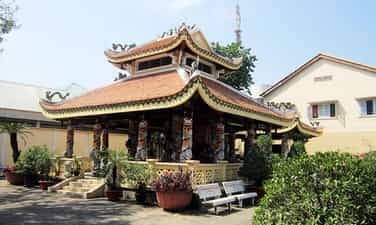
Tomb of Tu Kiet is the name of the tomb and temple of four heroes who fought against the French in the years 1868 - 1870, including: Nguyen Thanh Long (Nam Long); Tran Cong Than (self-styled Phuong); Truong Van Rong and Ngo Tan Duoc (Germany) led the people and insurgent army of Cai Lay - Cai Be to stand up against the French invasion in the last decades of the 19th century. The mausoleum is located on April 30 Street, Cai Lay Town, Cai Lay District, Tien Giang. After the Four Men sacrificed, people built a tomb and temple in Cai Lay Town and to show respect for the people called Tomb of Tu Kiet. According to folk tradition, the four men were all famous for their courage, strategy, and superior martial arts. Having a passionate patriotism, when the French invaded Dinh Tuong province (1861), the four men joined the insurgent force led by Thien Ho Duong. Along with other insurgents, the four of them participated in many fierce battles in the areas of Ba Giong, Cho Gao, My Tho... during the fighting, the four of them achieved many resounding victories. In 1868, when Thien Ho Duong's uprising failed, the four men returned to Cai Lay to gather soldiers, choosing the Cai Be - Cai Lay area as the area to continue fighting against the French. The most glorious victory of Tu Kiet's army was the attack on My Tho citadel and the destruction of Cai Lay garrison. After two years of operations causing a lot of damage to the enemy, Tu Kiet's uprising had to fail under the siege and total suppression of the French expeditionary force. The four men were arrested. They lured them with glory and wealth for many days but failed. On February 14, 1871 (December 25, Canh Ngo year), the enemy took the Four men to the execution ground to be beheaded. More brutally, they also beheaded the four men at Cai Lay market, in order to threaten the spirit of the people. Then punch it at the river wharf next to the market. Admired by the lives and heroic and indomitable fighting example of the four men, the people of Cai Lay built an earthen tomb, surrounded by a wooden fence and solemn incense smoke. In nearby My Trang village, Mr. Nhieu, a student of Dang Van Nguu, built a shrine in front of his house right in the area where the four men were beheaded. The temple was roofed with yin and yang tiles and to blind the colonial government, people called it Ong Pagoda (because in front there was an altar to Quan Cong symbolizing loyalty), and at the back was a tablet engraved with the four words Four Gods. The soul, painted with bright red and gold, worships the Four Noble Phantasms. The storm in the year of the Dragon (1904) caused the temple to collapse. Mr. Nhieu moved the temple to Thanh Son village (formerly in Thanh Hoa commune, now Cai Lay town). Currently, the temple is located in Quarter 1, Cai Lay town, more than a hundred meters from Tu Kiet's Tomb. In 1967, Cai Lay people restored the temple and the Four Ong's tomb on a larger scale, with a shrine inside and a guest house outside. In 1999, the mausoleum of the four men was restored on a large scale by Tien Giang province, looking very spacious and ancient as it is today. Every year on the 25th day of the twelfth lunar month, Cai Lay people gather here in large numbers to sweep the graves and hold a very solemn death anniversary, respectfully remembering the Four Men who sacrificed themselves for the country and killed the enemy, setting a shining example. for posterity. On September 13, 1999, the Tomb of Tu Kiet relic was recognized by the Ministry of Culture and Information as a national relic. Source: Department of Culture, Sports and Tourism of Tien Giang Province
Dong Thap
6704 view
Rating : National monument