Relic point Vietnam
Việt Nam
Historical relics of the Regional Party Committee and Southern Resistance Administrative Committee
The historical relic of the Regional Party Committee and the Southern Administrative and Resistance Committee is located in Nhon Hoa Lap commune, Tan Thanh district, Long An province - a national relic with many historical marks. The Regional Party Committee Base and the Southern Administrative and Resistance Committee are one of the three most important bases of the Southern revolution in the resistance war against the French. This place marks the revolutionary activities of the Party's leaders, famous politicians and military leaders in Vietnam's revolutionary history: Le Duan, Ton Duc Thang, Ung Van Khiem, Pham Hung, Pham Van Bach, Pham Ngoc Thuan, Nguyen Binh, Huynh Tan Phat, Tran Van Tra,... At the same time, it was the place where important historical events of the Southern revolution took place in the early years of the resistance war against colonialism. French people - a place marking the glorious victories of the Southern army and people. From the years 1946 - 1949, the Southern Party Committee, the Southern Administrative Resistance Committee, the Southern Command and affiliated agencies chose Nhon Hoa Lap commune, Tan Thanh district as the base for leadership. against French colonial re-invasion throughout the entire Southern region. This is the place that marks many important events of the nation, and is a place to commemorate the activities of senior Party leaders, political activists, and military leaders. The historical site of the Regional Party Committee and Administrative Committee of the Southern Resistance (1946-1949) in Nhon Hoa Lap commune, Tan Thanh district, Long An province has been recognized by the Ministry of Culture and Information, now the Ministry of Culture and Sports. and Tourism ranked national historical relics on August 3, 2007. Source: Tan Thanh District Party Committee Information Page
Tay Ninh
6557 view
Rating : National monument

Phuoc Lam Pagoda
Phuoc Lam Pagoda, also known as Ong Mieng Pagoda, is an ancient pagoda, located in Xom Chua hamlet, Tan Lan Commune, Can Duoc district, Long An province. Phuoc Lam Pagoda was ranked by the Ministry of Culture and Information as a national monument in 2002. According to the Book of National Monuments in Long An province published by the Department of Culture, Sports and Tourism in 2021, in 1880, a well-off man in Tan Lan village, Mr. Bui Van Minh, changed his family name, Taking his house, he built a pagoda called Phuoc Lam Tu, both worshiping Buddha and making sugar for the Bui family. Because he publicly established the village, after his death, Mr. Bui Van Minh was honored by the people as a descendant and brought into the Tan Lan communal house. The temple he founded, in addition to its Chinese name, Phuoc Lam Tu, is also called Mr. Mieng Pagoda (due to the custom of Mr. Minh's name). Overall, the pagoda consists of 3 parts: the main hall - the rear of the ancestors, the tomb tower and the tru house. The main hall is a large house built in the banh it style, with blue stone foundations, brick walls, and fish-scale tile roofing. All pagoda columns are made of circular cylindrical carpentry, placed on green stone canopies, linked together by a system of skewers, trusses, and roof ribs, creating a spacious and airy interior space. The interior of the main hall of Phuoc Lam Pagoda still retains its ancient features despite many restorations with more than 40 statues of Buddha, Bodhisattva, Jade Emperor, Attendant, Thap Dien Diem Vuong, Thien, Dharma Protector, Vajra... many The set of blue envelopes, diaphragms, and tureens are brightly painted and gilded. Most Buddha statues are made of wood and bronze and were crafted in the 19th century with an artistic style imbued with Southern Buddhist culture. There is a very special statue of a Bodhisattva wearing a robe, holding a dustpan, sitting on a wooden dragon horse. The sets of blue envelopes, diaphragms, and parallel tureens are all meticulously carved. The most special is the multi-layered scroll-shaped Dharma wheel with the theme of chrysanthemums. The word Tho is embossed in half at both ends of the scroll and the four letters dharma wheel are often painted red on a yellow background, contributing to increasing the sophistication and vividness of the horizontal scroll. This is one of the most beautiful horizontal paintings in Long An, proving the skillful artistic level of wood carving in Can Duoc, which flourished in the 19th and early 20th centuries. Like other village temples in the South, behind the main hall of Phuoc Lam Pagoda is the ancestral hall according to the formula of Early Buddha - Later Patriarch. The ancestral hall has altars and portraits of past abbots, relics and altars of Bui Cong - the founder of the pagoda, and altars of the Bui family. On the side of the main hall are 4 quite ancient tomb towers, including the bronze tower of founder Hong Hieu and the tomb of Mr. Bui Van Minh. Behind the pagoda is a large lotus pond full of flowers. Not only has artistic value, Phuoc Lam Pagoda also has historical significance as it once hid revolutionary soldiers during the years of resistance against the French and Americans. The blue roof in Xom Chua used to be a place where local leaders frequented revolutionary activities during the resistance war. The headquarters for the famous battle of Xom Chua in Tan Lan in 1962 was also located at Phuoc Lam pagoda. Because it was a revolutionary base, Phuoc Lam pagoda often became a target for enemy bombardment. On the main hall of the pagoda, there are still traces of war imprinted on wooden pillars. Phuoc Lam Pagoda is the ancestral temple of the Luc Hoa sect in Can Duoc. On full moon days, quite a large number of good men and women come to the pagoda to worship Buddha and pray as if to dispel the worries of everyday life and mingle with each other in the Buddha's immense love. Source: Propaganda Department of Long An Provincial Party Committee
Tay Ninh
7160 view
Rating : National monument

Revolutionary Historical Relic Area of Long An province
Long An province's revolutionary historical relic site (also known as Binh Thanh relic) is located in Binh Thanh commune, now belongs to Binh Hoa Hung commune, Duc Hue district, Long An province. The relic site was recognized as a national historical site in 1998. Along with the birth and development of anti-invasion movements, the Binh Thanh area base has become a historical place. Here, after the Cochinchina uprising, revolutionary soldiers built the first base in the South to continue fighting. During the resistance war against the French (1945-1954), this was the Dong Thanh military region. For a time, this was also the base of the Region 7 Command and the Cho Lon Provincial Party Committee. During 21 years of resistance against America, the Binh Thanh area with a rich tradition was chosen by the Long An Provincial Party Committee as the base to carry out the national liberation struggle until the day of complete victory. Binh Thanh revolutionary base in the resistance war against the US was large, mobile, and flexible because the war was very fierce, the enemy used every trick to destroy it, so the Long An Provincial Party Committee had to flexibly change locations and commit crimes. vi operated many times, but still remained at the base. Binh Thanh area relics is the center of the base, where the Provincial Party Committee and provincial departments have been headquartered the longest, and the remaining ruins are the clearest. In 1920, Cuu An district was renamed Thu Thua district, at this time the relic belonged to Binh Thanh commune, Cuu Cu Thuong district, Thu Thua district, Tan An province. After the South was completely liberated, Duc Hue and Duc Hoa districts were merged into the boundaries of Long An province. At that time, the relic belonged to Binh Thanh commune, Duc Hue district. Long An province's revolutionary historical relic site is a place that marks important historical events during the resistance war against the French colonialists and American imperialists. In particular, the relic is a place that deeply marks the birth and activities of the Provincial Party Committee and Long An Provincial Army during the 21-year resistance war against the US. Here, the Long An Provincial Party Committee stubbornly held on, in the face of all tricks aimed at destroying the enemy's base, to lead the struggle movement, making a decisive contribution to the noble achievement, Long An was loyal, courageous, and steadfast. strong. The relic is also a place to mark the presence and activities of the Southern Party Committee, high-ranking agencies of the Party Committee, Zone levels, many armed units of the Region, many Party and army leaders during the resistance war. fight against America to save the country; is concrete evidence of the arduous struggle and noble sacrifice from the beginning of the resistance against the French to the resistance against the US, to save the country of compatriots and soldiers not only in Long An but from all over the country. Source: Long An Provincial Party Committee Information Portal
Tay Ninh
7059 view
Rating : National monument

Hundred-pillar house
The hundred-pillar house, also known as Mr. Hoi Dong's house or Mr. Ca's house, is located on the left bank of the Vam Co Dong river, in Long Huu Dong commune, Can Duoc district, Long An province. This house was built by Mr. Tran Van Hoa, who was then Huong Su of Long Huu village, Loc Thanh Ha district, Cho Lon province. He worked in the French government's Cochinchina Colonial Council and was a prestigious person in society. Although it is called a hundred-column house, in reality, the house has up to 120 columns, of which 68 main columns and 52 small auxiliary square columns. The hundred-column house has the Chinese style, 3 compartments, 2 double wings with an area of 822m2 in a garden of 4,886m2. This house was started in 1901, completed in 1903, and in 1904, the decorative carvings were completed by a group of 15 workers from My Xuyen village - a famous carpentry village of Thua Thien - Hue using quality materials. The main materials are precious woods such as rosewood, ebony... the roof is covered with yin and yang tiles, the floor is made of 0.9m high boulders, and the floor is tiled with hexagonal Chinese tiles. The house consists of two parts: the first part is the internal and external part, the second part is the living and living part. The last rice granary was completely dismantled (1952), now only the foundation remains. The main side of the house faces Northwest, around the house there is a large yard used to dry rice and flour. The hallways, porches and floors are tiled with Chinese tiles, the spacious space faces a large garden so it is always cool. The main door and windows have slats and wooden panels. The main structure of the Hundred Pillar House is the Xuyen Dinh style (also known as the Dab Trinh house or the Ruong house), with an eight-pillar style frame, positioned in the West - East, Early - Later direction. Parts of the main structure such as trunh and truong are threaded and curved like a ruong house in the Central region. The junction between the crown and the truss to support the roof of the house is stylized in the shape of a mortar and pestle, symbolizing the harmony of yin and yang (so it is also called the pestle and mortar house style). This is a traditional house style that has many advantages because the frame is very sturdy. In particular, the architectural decoration at the Hundred Pillar House shows that the sculptural art of past artisans was at a high level through layout, theme expression as well as technical processing. The entire system of rafters and rafters is elaborately embossed and carved with the themes of clouds turning into dragons and four times, the wire and leaves turning into patterns typical of Hue, very sharp. The internal and external rooms are where the highest concentration of aesthetic value of the building is concentrated, to which the ancients engraved brocade on every touch. It is a diverse and rich collection of classical themes such as the four sacred spirits, the four times, and the eight results; Motifs representing Phuc - Loc - Tho alongside Western themes such as roses, squirrels - grapes, and Southern elements such as custard apple, bowl bowl, starfruit, mangosteen, have been expressed by artisans. Elaborate on the panels, box frames, partitions, wind-leaf walls, altars, chairs, round tables, long tables, using the techniques of parasol carving, embossment, canal carving, and embossed on parasol carving. , extremely skillful and ingenious. With that value, in 1997 the Hundred Pillar House was ranked by the Ministry of Culture and Information as a National Historical and Cultural Monument. Source: Long An Tourism
Tay Ninh
6913 view
Rating : National monument

Tomb and temple of Mr. Nguyen Huynh Duc
Nguyen Huynh Duc's tomb and temple relics are located in Khanh Hau ward, Tan An city, Long An province. The relic complex includes temples, mausoleums and document galleries with an area of about 1,300 m2. Nguyen Huynh Duc's real name is Huynh Tuong Duc, born in 1748 in Giong Cai En, Tuong Khanh village, Hung Thuong district, Kien Hung district, Dinh Tuong town, now Khanh Hau ward, Tan An city, Long An province. He was born into a family with a 3-generation martial arts tradition, so he had the personality of a general from a young age, and his health and charisma were also superior to others. In 1780, he followed Lord Nguyen Anh and accomplished many great achievements, so he was given the royal family name. When Nguyen Anh ascended the throne and took the title of King Gia Long, Nguyen Huynh Duc was granted the title of Duke and then Governor of the North. Six years later, he became Governor of Gia Dinh and governed the entire South. According to folk legend and historical records, he was a loyal person, righteous, and highly skilled in martial arts. Everyone called him "Tiger General". On the 9th day of the ninth month of the Year of the Cat (1819), he died and was buried in his hometown. The Tomb of Former Soldier Nguyen Huynh Duc was built in 1817 (before his death) and still exists almost intact to this day. With laterite and mortar materials, the monument is influenced by the architectural style and design of the Nguyen Dynasty but still has local identity and has become a typical example of the tomb architecture of the early mandarin class. 19th century. The mausoleum faces south, has a rectangular architectural plan, and is of the single burial type. The altar at the northern entrance to the tomb is a 3m high laterite screen, embossed with apricot and fortune patterns. The 17 m long Shinto path leads from the screen to the main part of the tomb. The architectural structure from outside to inside includes: mausoleum door, front screen, sacrifice yard, tombstone, tomb and back screen. Surrounded by a layer of city walls combined with pillars representing lotus buds. The tombstone is carved from Non Nuoc Ngu Hanh Son stone, embossed with exquisite patterns of the sun, flowers and leaves turning into dragons on both sides of the stele's forehead; The stelae border is decorated with embossed images of chrysanthemums and apricot flowers; The center of the tombstone is inscribed with the national name Viet Co, the tomb of Gia Dinh Envoy of the Governor General, General of Tien Quan, presented to the Trung Duc dynasty, the General of the Fatherland, Thuong Tru Quoc, Deputy Grand Duke Nguyen Huynh, Duke, The stele was established in November of the Year of the Cat (1819). Behind the stele is the burial place of Nguyen Huynh Duc's body with a long flat grave. Behind the tomb is a rear screen that closes the tomb's architecture. Notably, on the back screen there is an inscription that is said to have been approved by King Gia Long himself to remember the merits of a great mandarin who accompanied him in life and death, and was the one who preserved his life. for the king and the revival of the Nguyen Dynasty. 20m south of the grave is Nguyen Huynh Duc temple. From 1819 to 1959, the family worshiped him in the old house built by King Gia Long about 500m from the tomb. In 1959, to facilitate worship, the family built this new temple in the style of four pillars, two floors of roof, wooden doors facing the East. Right behind the main door of the temple, there is an incense burner carved with dragons, phoenixes, flowers and leaves painted in gold, above it is a painting of the predecessor Nguyen Huynh Duc painted in 1802. In the temple there are many very valuable antiques and documents. treat. Nguyen Huynh Duc's Tomb and Temple Relics were ranked as a national monument by the Ministry of Culture, Sports and Tourism on May 11, 1993. Source: Long An Tourism
Tay Ninh
9581 view
Rating : National monument
Vam Nhut Tao historical relic site
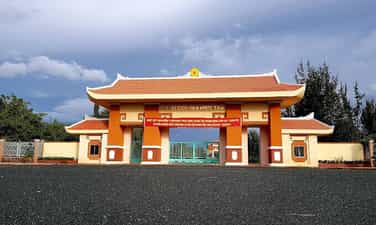
Vam Nhut Tao is the place marking the resounding victory of burning French ships by national hero Nguyen Trung Truc. Vam Nhut Tao was ranked as a national relic by the Ministry of Culture and Information in 1996. The entire relic is located in An Nhut Tan commune (now Tan Binh commune), Tan Tru district, Long An province. Nguyen Trung Truc's birth name is Nguyen Van Lich, also known as Chon, born in 1838 in Craft hamlet, Binh Nhut village, Cuu Ha district, Cuu An district, Tan An district (now Thanh Duc commune, Ben Luc district). , Long An province). Right when the French colonialists opened fire to attack Gia Dinh citadel, he joined the resistance army under the command of Truong Dinh and was sent to fight against the French in Tan An district. With the help of Nhut Tao village officials, he arranged a bold and intelligent plan to attack L' Espérance, a French small ship that was raging in the waters of Cuu An district. On the morning of December 10, 1861, after arranging an ambush on the shore and luring a part of the enemy to leave the ship, Nguyen Trung Truc and 59 insurgents boarded 5 boats pretending to be rice trading boats to approach the enemy ship. . While presenting his travel documents, he suddenly killed a French soldier and then joined the insurgents to attack French soldiers on the ship L' Espérance. Without time to react, all the enemies on the ship were destroyed (only 5 escaped). The insurgents used oil and inflammables to burn the ship L' Espérance. The rising fire slowly engulfed the ship to the deep river bottom. The news of Nhut Tao's victory excited the hearts of the people and soldiers throughout the country. The Hue court promoted Nguyen Trung Truc to the position of Quan Co, gave rewards to the insurgents, granted survivors, and provided financial support to Nhut Tao village (which was destroyed by the French army). The French colonialists were also extremely shocked because they could not imagine that the insurgents could cause them such great losses. "The Battle of Nhut Tao was the prelude to a general attack on almost all French posts... It was a tragic event that caused a deep emotion in the French and strangely stimulated the imagination of the Annamese people." - Excerpt from the work Abregede I'historie D'An Nam by Alfred Schreiner. Continuing that heroic spirit, immediately after the battle of Nhut Tao, the insurgents simultaneously rose up to attack the French fortress system in three eastern provinces, including the battle of Can Giuoc (December 16, 1861). history along with the immortal tribute to Can Giuoc martyr. Time passes quietly, Nhut Tao temple is still there as if it evokes nostalgia in the hearts of visitors. The ship L' Espérance, after nearly 120 years resting at the bottom of the deep river, has been excavated. The total number of artifacts recovered is 89, including 78 wooden artifacts, 8 iron artifacts, 2 bronze artifacts and 1 glass artifact. Through studying wooden artifacts, we also see all the parts to form the ship's frame such as beams, beams, keels, and masts. Although the L'Espérance ship had been chiseled to remove scrap, there were still some pieces of copper-covered wood that clearly showed burn marks. All of the above-mentioned artifacts have been preserved and displayed at Long An Museum to introduce domestic and foreign visitors to specific evidence of the heroic victory of fisherman hero Nguyen Trung Truc a long time ago. more than a century. In the future, a temple, a monument to fisherman hero Nguyen Trung Truc and other construction items will be built on the banks of Nhut Tao river, making this poetic river area not only of historical significance but also of historical significance. Also worth visiting for tourism. Source: Long An Tourism
Tay Ninh
9616 view
Rating : National monument

Ton Thanh Pagoda
Located next to Provincial Road 835 in My Loc commune, Can Giuoc district is a temple that has long been famous in history and literature: Ton Thanh Pagoda - a historical relic that has been ranked level by the Ministry of Culture and Information. National November 27, 1997. Ton Thanh Pagoda was originally called Lan Nha Pagoda and was founded by Zen Master Vien Ngo in 1808. The Zen master's real name is Nguyen Ngoc Dot, son of Mr. Nguyen Ngoc Binh and Mrs. Tra Thi Hue in Thanh Ba village, Phuoc Dien Trung district. Phuoc Loc district. Initially, the Zen master studied at Vinh Quang Pagoda, near Truong Binh market, and was given the Buddhist name Vien Ngo by his master. At that time, the road to Truong Binh market was densely covered with grass and trees, muddy and difficult to walk in. Tigers, leopards, and wild animals often came out to harm people. Seeing this, Zen Master Vien Ngo vowed to cut down trees alone and build a road from Truong Binh market to Tich Duc village and Hoa Thuan ward 250 meters long. In the 7th year of Gia Long's reign (1808), monk Vien Ngo came to Thanh Ba village (now in My Loc commune) to build Lan Nha pagoda - that is the current Ton Thanh pagoda. According to Dai Nam Nhat Thong Chi, this is a famous pagoda with "magnificent, golden pillars" in the ancient land of Gia Dinh. The Zen master also cast a bronze statue of Ksitigarbha Bodhisattva to worship in the temple. Legend has it that when the Bodhisattva statue was missing for the first time, Zen Master Vien Ngo cut off one of his fingers and put it in a pot of bronze water so that the statue could be perfect the next time it was cast. He is not only a filial son but also a person full of compassion and charity. When his father was sick, the Zen master swore in front of the Buddha platform that he would "sit" for 10 years to prolong his father's life. In the first year of Minh Mang (1820), in an area with a smallpox epidemic, monk Vien Ngo vowed to "recite sutras and recite Buddha's name and spend his life in isolation" to pray for the people to escape the disaster. In the 5th year of Thieu Tri (1845), he found that he had been a monk for 40 years but had not yet attained enlightenment, so he passed away for 49 days and then passed away. His Dharma body was buried by the monks in the stupa west of Ton Thanh pagoda. In memory of a Zen master who sacrificed his life to bring goodness to sentient beings, people called Ton Thanh Pagoda Tang Ngo Pagoda or Ong Ngo Pagoda. Sixteen years after Zen Master Vien Ngo passed away, Ton Thanh Pagoda entered the country's history with the tribute to the martyr Can Giuoc by blind poet Nguyen Dinh Chieu. During the three years 1859-1861, patriotic scholar Nguyen Dinh Chieu returned to Thanh Ba, using Ton Thanh pagoda as a place to teach, write poetry and make medicine. During the raid on Tay Duong post at Truong Binh market on the full moon night of the 11th month of Tan Du year, one of the three wings of the insurgent army set out from Ton Thanh pagoda, burned the teaching house, and beheaded the second mandarin of Phu Lang Sa. Touched by the altruistic hearts of the "hamlet villagers", poet Nguyen Dinh Chieu composed a famous tribute to the martyr Can Giuoc at Ton Thanh Pagoda. History has preserved the name of this pagoda of Long An through immortal sentences: ''Ton Thanh Pagoda freezes five years, the red heart leaves behind the full moonlight. Don Lang sa for a moment to pay back his anger and regret, his fate drifted with the flowing water''. Having gone through many ups and downs of history, Ton Thanh Pagoda today no longer has the same "magnificent, golden pillars" as before. Instead, it is an architectural complex including the front hall, main hall, lecture hall, east corridor, west corridor with tiled roofs and brick walls. However, Ton Thanh Pagoda still retains its ancient features through the system of four-shaped columns in the main hall, Buddha statues dating from the early 19th century, and gilded lacquered horizontal parallel sentences with Chinese characters. On the right side of Ton Thanh Pagoda, there are still two memorial stele built in 1973 and 1997 to preserve the vestiges of poet Nguyen Dinh Chieu. Source: Long An Province Electronic Information Portal
Tay Ninh
5406 view
Rating : National monument

Nguyen Thong memorial area
Nguyen Thong memorial area is located in Binh Tri 2 hamlet, Phu Ngai Tri commune, Chau Thanh district, Long An province. This is a place to commemorate the famous Nguyen Thong: a patriotic intellectual and great cultural activist of the Southern Luc Province in the second half of the 19th century. Nguyen Thong's real name is Nguyen Thoi Thong, full name is Hy Phan, nickname is Ky Xuyen, nickname Don Am, born in 1827 in a poor Confucian family in Binh Thanh village - Thanh Hoi Ha canton, Tan Thanh district, Phu Quoc. Tan An, Gia Dinh (now Phu Ngai Tri commune, Chau Thanh district, Long An province). As a child, Nguyen Thong was famous for his intelligence and studiousness. At the age of 18, his family sent him to Hue to have better study conditions. In 1849, he passed the Bachelor's degree in the Huong exam at Gia Dinh exam school, but when taking the Hoi exam, his card was stained with ink so he failed. Nguyen Thong began his official life in 1851 with the position of Instructor of Phu Phong district, An Giang province. In February 1859, when the French colonialists occupied Gia Dinh citadel, he joined the army to fight in the South and became a powerful assistant of the Governor of Military Affairs Ton That Hiep. After the fall of Ky Hoa post (February 1861), he returned to Tan An to fight against the French with local insurgent leaders. In 1862, Nguyen Thong was nominated by Kinh strategist Phan Thanh Gian to hold the position of Director of Vinh Long School and held this position from 1863 to July 1864. In 1865, three provinces in the western region of Cochinchina were invaded by the French. He and many Cochinchina intellectuals refused to cooperate with the enemy, so they were arrested and taken to Binh Thuan province. In 1867, Nguyen Thong was assigned to the Khanh Hoa murder case and then the Quang Ngai murder case. In 1870, he participated in judging the Perfume exam at Thua Thien school and then worked as Attorney General of the Ministry of Justice, Chief Justice of Quang Ngai. Here, Nguyen Thong actively implemented measures to eliminate corruption and oppression of the people by local tyrants. This action violated the rights of some high-ranking mandarins in the court, so not long after he was dismissed, imprisoned and executed. Only after asking the people to complain to the king, he was exonerated. In 1873, he asked to return home to recuperate in Binh Thuan. In 1874, the Court reinstated him and appointed him to work at the Ministry of Rites, but when he arrived in Hue, he fell ill and had to return home. In 1876, he was called back to the capital to hold the position of Quoc Tu Giam. In 1877, the court approved the plan to reclaim La Ngu and Ba Dau areas, so he was sent to work as a military envoy to Binh Thuan. In 1878, his old illness relapsed and he took a long-term leave. In 1880, Nguyen Thong was secretly assigned to work with local officials to handle the uprising of minorities and the case of immigrants from the South. Also this year, he established Dong Chau commune and built Ngoa Du Sao to have a place to write poetry and read books. In 1881, Nguyen Thong was appointed Deputy Minister of Agriculture and Education Director of Binh Thuan province. The following year he was promoted to Hong Lo Tu Khanh. On August 27, 1884, Nguyen Thong died at Ngoa Du Sao - Phan Thiet (Binh Thuan). Nguyen Thong Memorial Area was ranked a National Monument by the Ministry of Culture and Information on January 19, 2001. Source: Electronic information portal of Long An Provincial Party Committee
Tay Ninh
5246 view
Rating : National monument
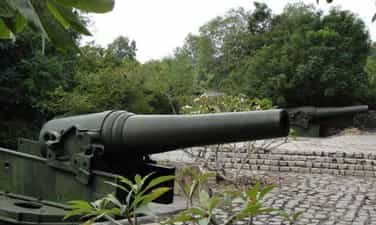
ARTILLERY BATTLE AND LARGE MOUNTAIN TOP TUNNEL
The mine bunker on Nui Lon (in Ward 5, Vung Tau City today) was built by the Japanese fascists in 1944. This was the place to store naval weapons of the Japanese army. However, with a courageous fighting spirit, our troops repeatedly broke into mine mines and took enemy weapons to make weapons to fight the enemy. In July 1941, Japan forced France to sign the "Commitment to the Common Defense of Indochina" treaty with Japan. With this treaty, Japan commanded France completely militarily. In October 1941, Japan landed in Vung Tau, quickly occupying an important position on Big Mountain, located at the Vung Tau - Can Gio seaport. From 1941-1945, the Japanese fascist army built many bunkers, underground bunkers, ammunition bunkers, and mines halfway up Big Mountain along the coast, now in Ward 5, Vung Tau City. Although the mine bunker is simply a warehouse used to store Japanese military weapons, it is no less elaborate in its construction. The mine bunker was built in 1944, and was completed after 4 months. The tunnel was built under a discreet mountain valley, built in an arch shape, inside the tunnel is a reinforced concrete wall 1m thick and 2.7m high. The front of the tunnel door is made of stone, 7m high and 20m long. The tunnels are arranged interconnected in a U-shape. The tunnel mainly stores mines and mines for coastal defense, creating an underwater battlefield blocking the Vung Tau-Can Gio estuary. At the end of World War II, Japan surrendered to the Allies, so they removed the mines from the sea, brought them up the mountain, put them in storage bunkers, and planted explosives outside. Japan's defeat on the battlefield created favorable conditions for the Vietnamese revolution to gradually win. During the long and arduous years of resistance against the Japanese and French, Vung Tau's army and people together with the army and people of Bien Hoa and Ba Ria not only defeated the enemy's long raids into war zone D and Sac forest but He also penetrated deep into the enemy's rear and won many glorious battles. During the war, the successful raids on the Nui Lon mine bunker were victories of Vung Tau's army and people. From the Ba Trao area (Nua mountain - Long Son island commune), our armed forces and security forces, relying on the people, have repeatedly broken into ammunition magazines and mine mines on Lon mountain, seizing military equipment and weapons. of the enemy to equip our troops. The mine-taking became a campaign involving hundreds of people, taking place at night and in great secrecy. Our forces are divided into groups: signaling, guarding, removing grenades, transporting mines, raising troops... According to the plan, when there was a signal of smoke and fire, the boats of our army and people in Ba Trao slowly arrived at Ben Da - Vung Tau port to receive and transport weapons taken from the enemy from the mine bunker. The guard group was divided into 2 groups to guard from the top of Ben Da slope and near the area where the Guanyin Buddha statue is now. The grenade removal team will join the special forces, guerrillas, and suicide soldiers of Thang Nhi into the mine bunker, one person will shine the light, the other person will remove the grenade, open the door, and when finished, put the grenade back as before. The group carrying the mines out worked together to climb up the mountainside in the dark night, carry the mines down the mountain, and transfer them straight to the boat and return to safety. The army support team consisted of women and sisters who transported food and lamp oil to everyone participating in the raids. At the end of June 1947, after the enemy army (the French army recaptured for the second time) withdrew from Ben Dinh post, our army and people's raids on mine bunkers became easier. Our forces transported an average of 2 mines out of the bunker at a time, each weighing more than 100kg. During the period from 1945 to 1954, our army secretly took about 60 mines to make bombs and mines as weapons to destroy the enemy. On August 4, 1992, Nui Lon mine bunker was ranked as a National Historical Monument. Source: Ba Ria - Vung Tau electronic newspaper.
Ho Chi Minh City
5579 view
Rating : National monument
Con Dao Prison Revolutionary Historical Relic Area
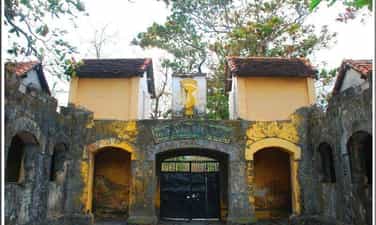
Con Dao historical relic site (Con Dao Prison) belongs to Con Dao district, Ba Ria - Vung Tau province, including the prison system in Con Dao and the cemeteries belonging to this prison system. Historically, the French colonial government and the US imperialists built 127 prison cells, 42 cells and 504 isolated cells - "tiger cages" in the Con Dao area. After the country was completely unified (1975), the function of the prison system in Con Dao was dissolved. In 1979, Con Dao Historical Relic Area was ranked a special national relic by the Ministry of Culture and Information (now the Ministry of Culture, Sports and Tourism), with 17 component relics. 1. Island Lord's House This area used to be the living and working place of 53 generations of Island Lords, during the time the prison system in Con Dao maintained operations. After liberation (1975) until now, the Dao Lord's house is used as a display place of the Con Dao Historical Relic Area. 2. Pier The bridge was built in 1873. This is also the place that witnessed the first extreme humiliation of those who were sent to prison on the island. The number 914 named for the bridge is also the number of prisoners who "fell" due to forced labor and accidents during hard labor to build the bridge. 3. Camp 1 Camp 1 is also known by other names, such as Banh 3, Lao 3, Camp Bac Ai, Camp Phu Tho. The camp was built in 1928, on a total area of about 12,700 square meters. In particular, the cell area is 1,200m2, including 3 prison examination blocks, medical house, kitchen and dining room, collective cell and isolated room, and mortgage (detention) block. 4. Camp 2 The camp also has other names, such as Banh 1, Lao 1, Camp Cong Hoa. By November 1974, this camp was called Phu Hai camp. Camp 2 was built in 1862 and permanently renovated in 1896, with an area of 12,040 square meters, including 2 prison rows, 20 cells, infirmary, chapel, lecture hall, stone crushing area, club. , the Supervisor's house..., is surrounded by four walls more than 4 meters high, surrounded by many guard posts. This is the largest and oldest prison in Con Dao. 5. Camp 3 The camp is also known by other names, such as Banh 2, Lao 2, Nhan Vi Camp, Camp 3, Phu Son Camp. The camp was built in 1916, located next to Block 1, with an area of 13,228 m2, including 13 large prisons, 14 cells, 1 barber room, shrine, medical room, kitchen, supervisor's room, club and Green campus, surrounded by a system of stone walls (4m high) and many guard posts. 6. Camp 4 Has a total area of 5804m2, including 8 cells, kitchen, warehouse, infirmary, surrounded by thick, high stone walls. 7. Camp 5 Has a total area of 3,594m2, with 12 collective cells, divided into 3 rows (each row of 4 rooms), a kitchen area, surrounded by thick stone walls, about 4m high. 8. Camp 6 Phu An Camp, with an area of 42,140 square meters, includes area A and area B. Each area has two rows, including 10 rooms, 4 cells, kitchen, infirmary, and warehouse. This camp is surrounded by two layers of fence, with an outer gate and an inner gate. 9. Camp 7 Also known as Camp Phu Binh, or American-style tiger cage. The camp has an area of 25,788m2, with 8 prison areas (A, B, C, D, E, F, G, H), each area has 48 tiger cages, warehouses, kitchens, supervisor's offices, and hospitals. amnesty. The camp is surrounded by barbed wire fences and concrete walls. 10. Camp 8 Also known as Phu Hung Camp, it includes 10 prisons, divided into 2 rows, along with auxiliary buildings, such as the warden's house and guard watch. Surrounding the camp is a barbed wire fence system. 11. Camp 9 While the US and Wei were pouring concrete for the foundation and casting columns to build the camp, the Paris Agreement was signed so this camp was abandoned. 12. Investigation room This is the workplace and storage of interrogation records. Every prisoner before being imprisoned is interrogated in this room. 13. Ma Thien Lanh Bridge From 1930 - 1945, the French colonialists opened a branch road to So Ong Cau to facilitate the control of escaped prisoners. The new bridge has 2 abutments, each about 8m high. The bridge was named after the prisoner named Ma Thien Lanh mountain in North Korea. 14. Cow Shed isolated area This area is where prisoners do hard labor and is also a prisoner's cemetery. The "skull field" here is the first cemetery in Con Dao Prison, followed by Hang Keo cemetery and Hang Duong cemetery. 15. Lime Kiln This is typical evidence of the brutal labor exploitation policy, along with the harsh and cruel prison regime, to extinguish the will of patriotic Vietnamese people imprisoned in Con Dao. 16. Cong Quan House Built in the late 19th century, with an area of 850 square meters, it was the resting place of French musician: Charles Camille Saint Saens - World cultural celebrity. Here he completed the last 3 chapters of the immortal musical Brunchida. 17. Hang Duong Cemetery Has an area of about 20 hectares. This is the resting place of tens of thousands of revolutionary soldiers and patriotic Vietnamese compatriots who sacrificed their lives under the yoke of imprisonment and brutal hard labor of colonialists and imperialists. In 1992, this monument was renovated and divided into 4 zones: - Area A: includes 688 graves (including 7 mass graves), with 86 named graves and 602 anonymous graves. - Area B: includes 695 graves (17 mass graves), with 275 named graves and 420 anonymous graves. - Area C: includes 372 graves (including 1 mass grave), with 329 named graves and 43 anonymous graves. - Area D: includes 148 graves, with 11 named graves and 137 anonymous graves. Con Dao Prison is a special relic (prison relic). This is the most concentrated place of the notorious prison system of France and America, typical of the regime of coercion, imprisonment, torture and massacre of revolutionary soldiers and prisoners working hard to the point of exhaustion; is a place where violent enemies tremble before the courage, revolutionary spirit and optimism of patriotic prisoners. With the special historical, cultural and scientific values of the monument, the Prime Minister decided to classify Con Dao Prison Historical Relic as a special national monument on May 10, 2012. Source: Department of Cultural Heritage
Ho Chi Minh City
5312 view
Rating : Special national monument