Relic point Vietnam
Việt Nam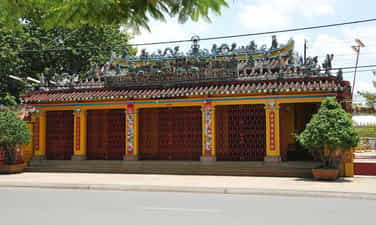
Tan Lan Communal House Historical Relic Area
Tan Lan Communal House is located on Nguyen Van Tri Street, Hoa Binh Ward, Bien Hoa City. Since its construction, the people took the name of the village, Tan Lan, to name the communal house. Through many ups and downs of history, the local name has changed many times, but the communal name still exists today. Legend has it that originally Tan Lan communal house was a small temple in Ken citadel, built by villagers during the reign of King Minh Mang to pay tribute to Tran Bien, admiral of general Tran Thuong Xuyen, who had great merit in exploring the land. belt and expand trade in Dong Nai - Gia Dinh region. After two moves (in 1861 and 1906), the communal house is in its current location. The front porch faces the windy Dong Nai river. The architecture of the communal house is in the style of a triangle consisting of three compartments: the vestibule, the main hall and the harem connected one after another. The main hall is decorated with altars, decorated with horizontal panels, parallel sentences, and wooden panels on large ironwood columns that are delicately carved and have artistic value. The vestibule roof is a unique work of art with ceramic paintings of hundreds of statues of people and objects representing vivid historical stories. The harem is divided into three compartments, the middle worships the Immortal Master, the two sides worship the Vietnamese Ancestors and the Chinese Immortals. The main object of worship in the communal house is the admiral and general Tran Thuong Xuyen. The main altar is solemn with a simple but majestic statue of a god on a lacquered and gilded throne. There are bronze sacred beasts standing around. In front of the god altar is a council table and two sets of bronze bowls. The two sides of the main hall are arranged with altars to worship the left and right banquets. Along the left and right walls, there are altars for eunuchs, queens, white horses and predecessors. Tran Thuong Xuyen was formerly the General of the three continents Cao - Loi - Liem under the Ming Dynasty (China). In 1679, the general guarding the water areas in Long Mon, Guangdong province (China) was Duong Ngan Dich and deputy general Hoang Tan; Together with the General Guard of the provinces Cao, Loi, Liem and Tran Thang Tai (ie Tran Thuong Xuyen) and deputy general Tran An Binh, they brought over 3,000 soldiers and family members, over 50 warships into the Tu Dung and Da estuaries. Nang asked the Nguyen lords for asylum in Vietnam. This was a group of Chinese people who were loyal to the Ming Dynasty and refused to submit to the Qing Dynasty, so they rebelled and waved the flag "anti-Manchu and submitted to the Ming Dynasty" but failed. Seeing that they were in a desperate situation, Lord Nguyen approved allowing them to immigrate... Lord Nguyen Phuc Tan "... then ordered a banquet to be held for them, comforting, praising, and providing medical care to the generals. They were given new mandarins and titles, and ordered to move into Dong Pho land to expand that land. They were guided by generals Van Trinh and Van Chieu, along with Duong Ngan Dich's Long Mon soldiers and soldiers, entering Loi Lap gate, following them. Dai and Tieu estuaries settled in My Tho. Soldiers and generals Cao, Loi and Liem of Tran Thuong Xuyen and Tran An Binh entered Can Gio estuary and then settled in Ban Lan, Dong Nai (Bien Hoa). Nowadays)". With a group of Vietnamese immigrants who arrived first, Tran Thuong Xuyen gathered Chinese merchants to build streets and create commercial establishments, making Nong Nai Dai Pho commercial port (Cu Lao Pho) once considered "the capital of Vietnam". "the most prosperous" association in the South at that time. Tran Thuong Xuyen is one of the people who made great contributions to the exploration and construction of the Dong Nai - Gia Dinh area. Regarding military activities, Tran Thuong Xuyen was a brave and strategic general who repeatedly commanded troops, kept the southern border safe, and expanded Vietnam's borders. Tran Thuong Xuyen died on the 23rd day of the 10th lunar month around 1720 (Canh Ty). Remembering the merits of Tran Thuong Xuyen, the Nguyen dynasty bestowed the noble title "Nguyen vi king, Tran vi general, great meritorious minister" (meaning: the Nguyen family is king, the Tran family is general, the success will never last. end), was ordained "Superior God" by King Minh Mang and Thieu Tri. In many places in the South, people have built temples to worship him, worshiping him as the country's deity. Source: Dong Nai Electronic Newspaper
Dong Nai
7644 view
Rating : National monument
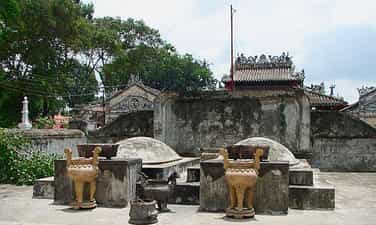
Trinh Hoai Duc Tomb Relics
Trinh Hoai Duc Tomb is located in Quarter 3, Trung Dung Ward, Bien Hoa City, Dong Nai Province. Ranked as a national historical relic by the Ministry of Culture, Information, Sports and Tourism on December 27, 1990. Under the Nguyen Dynasty, Trinh Hoai Duc's tomb was located in Binh Truc village, Tran Bien palace. During the French colonial period, it was changed to Binh Truoc, in Chau Thanh district, Bien Hoa province. In 1938, Trinh Hoai Duc's mausoleum was classified as a relic by the Far East School. Local people often call it "Mr. Mausoleum" and there are many ancient tombs built of compound laterite. Many people believe that this was previously the tomb of the Trinh Hoai Duc family. The tombs are all built in the shape of an elephant, with a rectangular block plan; The stone steles engraved with Chinese characters face southwest, the walls are covered with green moss. In the entire Trinh family tomb area, Trinh Hoai Duc's tomb stands out because of its architectural scale, perhaps this was the intention of the tomb builders in accordance with the ancient principles of family lineage. Before 1975, every year during the Qingming Festival, Trinh Hoai Duc's descendants from other localities came to pay their respects with solemn ceremonies. Later, there was a ceremony because some descendants of the Trinh family had grown old or wandered, so the visiting ceremonies were no longer maintained as before. In 1998, on the occasion of the 300th anniversary of the formation and development of Bien Hoa - Dong Nai, Trinh Hoai Duc's tomb was restored and embellished. The original tomb architecture was preserved, surrounded by a solid citadel. Behind the tomb is a raised wall, forming a wavy oval shape. On the wall is an inscription in Chinese characters that resembles a poem praising Trinh Hoai Duc's virtue, but it has faded over time and is no longer readable. Both sides are decorated with two insulated dragon heads. Currently, this wall is decorated with a hidden dragon pattern. In front of the tomb entrance is a large screen, engraved with Trinh Hoai Duc's biography and career. On the square pillars connecting the walls of the citadel in front of the tomb, Chinese couplets are carved, the content is mainly about history and Trinh Hoai Duc's erudition in research. Inside the citadel is the main element of architecture, consisting of two parts: Graves: one of Trinh Hoai Duc and one of the main wife, surnamed Le. The structure of the tomb is the same, shaped like an elephant, surrounded by a horseshoe-shaped edge, in front of each grave is a stone stele, engraved with Chinese characters; The surrounding area is decorated with lines of text, yin and yang symbols, and the bottom is embossed in the form of a kneeling leg. The contents of the steles at Trinh Hoai Duc's two graves briefly state the titles, positions, ranks, and titles that Trinh Hoai Duc was bestowed with, along with his wife; Stele: also clearly states the time is November of the year At Dau, children Trinh Thien Le Nhien, Trinh Thien Nhien Bao, and Trinh Thien Bao jointly established the stele. Trinh Hoai Duc, a great talent, a great personality, has contributed to laying the foundation for a circle of pride in Dong Nai - Dong Nai Culture, which is the pride of Dong Nai people. Source: Dong Nai province electronic information portal
Dong Nai
10415 view
Rating : National monument
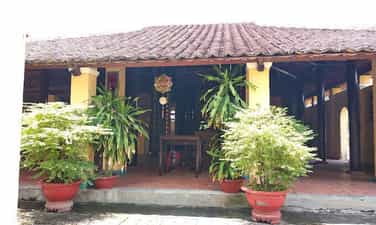
An Hoa communal house relic, Dong Nai
An Hoa communal house relic is a communal house with a long history when it was built in the late 18th century, located in An Hoa commune, Long Thanh district, on the banks of Dong Nai river. An Hoa Communal House was built by the people of the village in 1792. It was originally a small temple located on the left bank of the Dong Nai River, worshiping the Thanh Hoang. Over time, An Hoa communal house has shown signs of deterioration and was restored and renovated many times in 1944, 1953, 1994 and 2009. Currently, the communal house is located on a campus of nearly 3,000 square meters. In addition to intangible values and wood carving art, the communal house also has typical value in terms of architectural and artistic scale typical of Southern village communal houses in the 18th century in Dong Nai. The communal house preserves the characteristics of national architecture quite intact, not influenced by Chinese architecture like some other communal houses in the area. Accordingly, the vestibule overlooks the Dong Nai river to welcome fresh breezes. The communal house's architectural layout is arranged in the shape of the letter Cong, including the main hall, the Senior House and the Guest House. In addition, the communal house also has a martial arts house built separately in front facing the main hall. This is also the place where artistic performances and lion - lion - dragon dances take place during communal ceremonies. The communal house's architectural items include four-pillar houses (square houses) and slanted houses using traditional tenon joining techniques to create a solid, highly resistant frame. The communal house's roof is covered with yin-yang and fish-scale tiles, and the floor is tiled with Chinese tiles. The edge of the roof is decorated with motifs of dragons flanking the sun and carp turning into dragons made of green glazed ceramics, symbols of clouds, rain, thunder and lightning, expressing the wish for good weather, a good harvest, and everything going smoothly... An Hoa Communal House is a rare communal house that retains its architectural features and sophisticated wood carving art with motifs and themes such as: dragon hidden in the clouds, fish crossing the dragon gate, chrysanthemums, apricot trees, bats holding fruit, water waves... on system of rafter ends, cross beams, hammock doors and worship sites. This also symbolizes the wish for good weather, a peaceful nation, and a peaceful life for the agricultural and fishing residents of Ben Go village. Before 1945, communal houses were the administrative headquarters of communes and villages, where community activities were organized. After the liberation of the South, the communal house became a meeting place and organized community cultural activities managed by the An Hoa Commune's Welfare Committee. According to the House's Noble Committee, through the ups and downs of times and life's fluctuations, the communal house's artifacts are basically still preserved and protected, but some antiques are also lost. Every year, on the full moon day of the 8th lunar month, a ceremony to worship the God of the Gods takes place, with the wishes of a peaceful country and people, good weather, prosperous business, and a prosperous and happy life. On January 21, 1989, An Hoa communal house relic was recognized by our state as a national historical and cultural relic. Source: Dong Nai Electronic Newspaper
Dong Nai
6243 view
Rating : National monument
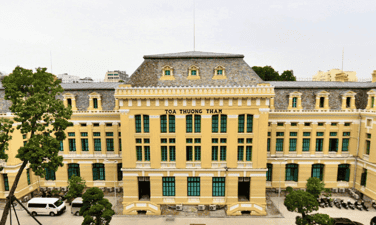
Long Khanh Dong Nai Administrative Court
The Long Khanh Provincial Administrative Building relic located on Cach Mang Thang Tam street, Xuan An ward, Long Khanh town, was ranked a national historical relic by the Ministry of Culture on November 16, 1988. Long Khanh Administration Building has a total area of 9,000 square meters, built in 1965 in French-style architecture, including a ground floor and an upper floor. This was the highest working headquarters of the American puppet in Long Khanh province at that time. In March 1975, the US - puppet government built the strategic defense line of Phan Rang - Xuan Loc - Tay Ninh to prevent the advance of our troops along the North-East gateway to Saigon. Long Khanh Administrative Building was chosen as the control center for all military activities of this defense line. Thoroughly grasping the ideology of the Party Central Politburo, the Regional Command decided to launch the Xuan Loc campaign to liberate Long Khanh town, destroy the enemy's strategic defense line, and advance to liberate Saigon. On April 9, 1975, 5 hours after the campaign started, a major battle took place at the Long Khanh Administrative Building. Comrades Pham Le Canh, Nguyen Van Trong, battalion 5; Nguyen Thanh Son, Nguyen Minh Duc, the 7th battalion of Regiment 266 of the 341st Division's assault spearhead led by comrade Tran Van Tran, attacking from the north of the town, planted the flag "Determined to win, determined to win" on the top of the flagpole. on the 1st floor of the Administration Building. This is a historic turning point victory for the Vietnamese revolution and the pride of the people of Long Khanh in the resistance war against America to save the country. After the liberation of the South on April 30, 1975, Long Khanh province was reorganized into Xuan Loc district. The Administration Building was repaired and became the headquarters of the People's Committee of Xuan Loc district. In 1991, Long Khanh district was separated from Xuan Loc district, the Administrative Building became the headquarters of the People's Committee of Long Khanh district. In 2004, the Administration Building was assigned to the Department of Culture, Sports and Information of Long Khanh town to manage and use: The ground floor is a library to store documents to serve readers, the upper floor is a traditional gallery with 176 documents and artifacts. Every year it attracts about 500 visitors, researchers and students. Source: Dong Nai Electronic Newspaper
Dong Nai
10237 view
Rating : National monument

Dong Nai Memorial Monument
The memorial - also known as the Soldier's Monument is located in the center of major roads in the inner city of Trung Dung ward, Bien Hoa city. This work was built by the French colonial government in 1923 with the name "Vietnamese Memorial Monument". This is an architectural work modeled after the Hue Ngo Mon style during the Nguyen Dynasty, constructed by Professor Robert Balick and his wife and a team of teachers and students of Bien Hoa Arts School. Under the skillful hands and aesthetic minds of artisans, the Soldiers' Monument was a unique work of that time and completely national in color. The stone pillars are carved with delicate lines, the ceramic patterns are elaborately done with harmonious colors. The stone stele engraved with Chinese characters records the names of people in Bien Hoa who died for France - they were colonial people who were conscripted and fought on fronts far from home that the French colonialists masterminded. In his work "The verdict of the French colonial regime", Nguyen Ai Quoc mentioned this relic when the French colonial government held its inauguration on January 21, 1923. This is a demagoguery of the colonial government. With a simple but extremely eloquent pen, Nguyen Ai Quoc dedicated his passionate words to stand on the side of the suffering people, condemning the brutal colonial regime that trampled on a nation, crushing every person of the land. slave country, sent a message, an indictment to oppressed countries, peoples and destinies that had only one way left: to rise up and liberate themselves. The appearance of the Soldiers' Monument relic was repaired and embellished with a spacious and beautiful campus, becoming a cultural park beautifying Bien Hoa City. Although more than three-quarters of a century has passed since its construction until now, time has faded and damaged many times, the Soldiers' Monument remains forever an irrefutable proof of the crimes of the real people. French people, reminding the people of Bien Hoa of a painful history under foreign domination so that they can rise up and build a prosperous and happy life. The Memorial Monument (Soldiers' Monument) was ranked a national historical relic by the Ministry of Culture and Information on November 16, 1988. Source: Dong Nai Electronic Newspaper
Dong Nai
6935 view
Rating : National monument

Dong Nai Green House historical site
The Blue House relic is located on the campus of Dong Nai Technical Workers School, Thong Nhat ward, Bien Hoa city, Dong Nai province. The relic was ranked as a national historical relic by the Ministry of Culture and Sports on December 12, 1986. The Green House was built in 1912 according to French architecture with modern materials, including a ground floor and a first floor. When first built, the Green House was used as the Office of Bien Hoa Industry and Forestry Company, abbreviated as B - I - F, "Bien Hoa Industrelle et Forestiere". In 1958, the Saigon government took this villa as a residence for the US Military Advisory Mission in Bien Hoa. This place is considered a safe and ideal location, surrounded by many posts and protected by security units. After Law 10 - 59 of the Republic of Vietnam regime, the war between us and the enemy became more and more difficult and fierce. The US increased its deep intervention in the South to plot to quickly destroy the revolutionary forces. Faced with that situation, the Eastern Provincial Party Committee decided to organize a raid on the American advisory delegation in Bien Hoa at the Blue House. On July 7, 1959, a special forces squad consisting of 6 comrades, Hue, Phu, Be, Sac, and Hung, led by comrade Nguyen Van Hoa, suddenly attacked the Blue House. In less than 15 minutes, our troops destroyed two American advisors Bui-s and Ovmand. This was a daring opening battle that shook the US - Diem government. The Blue House raid demonstrated the determination of the army and people of Bien Hoa to fight the US as a signal to encourage the revolutionary movement in Bien Hoa and the whole South, which was burning with enthusiasm. With the great historical significance of the first American battle at Bien Hoa. The Blue House exists as a historical witness affirming the determination of our army and people to fight and win against America. From 1986 until now, the Blue House has become a familiar address for people of all walks of life, pupils and students in Dong Nai and the whole country. Many international delegations have visited and expressed their admiration for the spirit. The bravery and daring intelligence of the revolutionary soldiers created a resounding battle, a pre-emptive battle that humiliated the will of the American army. The Blue House relic has been repaired many times in 1991, 1993, 1999. To meet the increasing sightseeing and learning needs of people and tourists, with the approval of the Department of Culture and Sports, In early December 2006, the Management Board of Monuments and Landscapes coordinated with the Dong Nai Technical Workers School to repair and upgrade the monument and is expected to complete it and serve visitors during the Lunar New Year. Dan. Source: Dong Nai Electronic Newspaper
Dong Nai
7255 view
Rating : National monument

La Nga victory relic
La Nga Victory Relic (at km 104-112 on Highway 20 to Da Lat, in Phu Ngoc commune, Dinh Quan district) was ranked a national historical relic by the Ministry of Culture on December 12, 1986. To cheer for the Viet Bac victory in the fall-winter of 1947 and also to deal a fatal blow to the enemy, the command board of squad 10 decided to organize a big battle, to show the enemy that the Vietnamese people were , Vietnamese people do not easily submit to any enemy; With a spirit of courage and ingenuity after nearly half a year of preparation, studying the terrain, and choosing a location: at 15:12 on March 1, 1948, the La Nga ambush battle began and ended at 15:12 on March 1, 1948. 15:57 on the same day, in just 45 minutes. The victory of La Nga delighted the people of Dinh Quan in particular and the people of Dong Nai in general. This is a victory that demonstrates the cunning and courage of our army and people, causing the enemy to be stunned and defeated. From this victory, our force grew stronger and stronger, contributing to defeating the enemy's plan to attack quickly and win quickly, forcing them into a passive position. The scenic complex of Chong Rock, Mai Waterfall, La Nga River and La Nga Victory Monument is an interesting tourist complex of Dinh Quan. The amazing beauty of Hon Ba Chong, Da Voi Mountain, Hon Dia, along with the natural pagoda at the foot of the rocky mountain are typical clusters that create a harmonious beauty for the Da Chong scenic area. Dinh Quan Da Chong Complex is also a place that retains traces of prehistoric life. Here, under the stone roofs, along the streams and on the slopes along the valley, many production and daily life tools of the ancients made of stone, bronze and terracotta were discovered. During the 30-year resistance war. Dinh Quan is an important part of War Zone D. Da Chong witnessed the formation, development, stationing, and combat deployment of revolutionary forces. Today, a part of the land of Da Chong Dinh Quan scenic area has been used and built into the Dinh Quan District Cultural and Sports Center. In the near future, Da Chong Dinh Quan scenic area will be invested in and renovated, contributing to making the natural landscape more beautiful and becoming an attractive eco-tourism destination. Source: Dinh Quan District People's Committee
Dong Nai
13930 view
Rating : National monument

Hang Gon Dong Nai Megalithic Tomb Relic.
Hang Gon Megalithic Tomb (also known as Hang Gon 7 Site, Indochina Tomb, Ong Da Tomb), located in Hang Gon commune, Long Khanh town, Dong Nai province, includes: Tomb area (discovered in 1927) and crafted (discovered in 1995). In 2011, the monument was renovated and embellished with a total area of 37,120 square meters, with the following items: Tomb area, processing area, Ong Da temple, Tho Than temple, auxiliary works (gates, fences). , internal road yard, duty - ticket sales house, shelter house, reception - display house, administration house). 1. Catacombs: The current Hang Gon Megalithic tomb relic, compared to its discovery in 1927, still retains the structure and current state of the tomb. However, the tomb-like relic is buried deep underground, about 3 meters above the current ground level. 2. Processing area: The manufacturing area is located southwest of the main gate and southeast of the Catacombs. Excavation in 1996 revealed a number of marble panels and two sandstone pillars with diagonal ends, along with many marble and pebble scraps. 3. Ong Da Temple: Dinh-shaped floor plan, including Main Hall and Kitchen. The main hall, with an area of 51.84m2, is built in a four-pillar style (square house, 4 columns), facing east. The column system is made of reinforced concrete and painted with imitation wood. The three walls are built tightly, the facade is open with a layout of three doors made of red oak wood, the lower part is plain, the upper part is carved with apricot flowers. 4. Earth God Temple: located about 3m northwest of Ong Da Temple, area 4m2, built of bricks, painted yellow, red tiled roof, inside there is an Earth God altar. 5. Other auxiliary works: Main gate: Side gate. Fence system. House on Duty - Selling tickets. Covered house. The catacomb wall system includes: Exhibition House and Operating House. Hang Gon Megalithic Tomb Monument is an ancient stone architecture with a unique scale, size, construction material and style in Vietnam. Hang Gon Megalithic Tomb has contributed to diversifying types of dolmen (large stone tombs) worldwide. During excavations at the relic, scientists have obtained many valuable artifacts of diverse types. Hang Gon Megalithic Tomb Monument is an architectural work related to the beliefs of ancient Dong Nai residents, complementing the awareness of worldview and human life in the process of struggle, survival and creation. culture of humanity. Religious activities at the Hang Gon Megalithic tomb relic are the custom of worshiping "Mr. Stone", with the hope that "Mr. Stone" helps people live in a peaceful, "prosperous" and "peaceful country and people" environment. .. Every year, on the 13th day of the 9th lunar month, the "Mr. Stone" worship ceremony is held, including the main rituals: procession of Mr. Stone from the crypt to Ong Stone temple, holding worship ceremony at the temple and worshiping Mr. Stone about the Catacombs and many cultural activities such as: Five-fruit tray contest, lion dance performance, dragon dance... With typical value, the historical and archaeological relic of Hang Gon Megalithic Tomb was ranked by the Prime Minister as a special national monument on December 23, 2015. Source: Department of Cultural Heritage
Dong Nai
8451 view
Rating : Special national monument

Victory location: O Ship Blockade
Tau O is the name that comes from Tau O stream flowing across Highway 13 in Hamlet 4, Tan Khai commune. During the Nguyen Hue Campaign, the Tau O blocking point was located about 400m north of the Tau O culvert (the section of the Tau O stream flowing through Highway 13). This is an important key point in the blocking system of Division 7. The victory of the Tau O Blockade contributed to the overall achievements of the Nguyen Hue Campaign in the 1972 Strategic Offensive, contributing to bringing our nation's resistance to the stage of complete victory both militarily and in parliament. situation, forcing the US to sit at the peace negotiation table, sign the Paris Agreement, ending the war in Vietnam. To commemorate the officers and soldiers of Division 7, soldiers and local people in the 1972 Nguyen Hue Campaign who sacrificed for national independence, in 2009, received material attention from the Provincial Party Committee and Provincial People's Committee. Binh Phuoc, Binh Duong province, Dong Nai province, City. Ho Chi Minh City, the Veterans Liaison Committee of Division 7, Division 7 organized the construction of the Tau O Victory Monument on an area of 11,451.7m2. The project includes 2 main items: Memorial stele house and the Victory Monument of the O-Train checkpoint. The relic has become a red address for trips back to the origin, sightseeing, and studying of people inside and outside the province. The Tau O Block Victory Site Relic is a typical relic with great historical significance and value. On March 29, 2012, the Ve O Passage Victory Site relic was decided by the Minister of Culture, Sports and Tourism to be classified as a national historical relic. Source: Binh Phuoc Province Electronic Information Portal
Dong Nai
5084 view
Rating : National monument
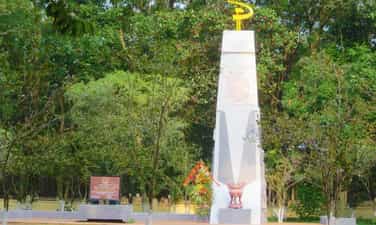
Location of establishment of Indochina Communist Party Cell in Phu Rieng
The site of the establishment of the Indochina Communist Party cell in Phu Rieng is located in Thuan Phu commune, Dong Phu district, Binh Phuoc province. Here, on October 28, 1929, the Indochina Communist Party Cell was established as the foundation for the later revolutionary movement of rubber workers in the Southeast region. Phu Rieng rubber plantation belonging to Michelin Company was established in Phu Rieng village, Ba Ra district, Bien Hoa province (now belongs to Dong Phu Rubber Joint Stock Company). When investing in exploiting and developing rubber here, French capitalists recruited hundreds of thousands of people from the Northern and Central provinces to the South to work as laborers. With the support of the colonial government apparatus, French capitalists severely and cruelly exploited the labor of the laborers such as: beatings, salary cuts, torture, harsh working regimes, homeless, hungry, lacking clothes, living in "hell on earth", causing "For every rubber tree that grows, a worker falls". The workers only knew how to react in spontaneous ways such as cutting down rubber trees, protesting, fleeing... but all were severely suppressed. Faced with that situation, in 1928, comrade Nguyen Xuan Cu was sent by the Revolutionary Youth Committee of the Northern Association to "proletarianize" the Phu Rieng rubber plantation. To lead the workers' struggle movements, in April 1928, the Revolutionary Youth Comrades' Association was established with comrade Nguyen Xuan Cu as Secretary along with comrade Tran Tu Binh and comrade Pham Thu. Hong, comrade Ta, comrade Hoa, comrade Doanh and comrade Song. This is the headquarters leading the fighting activities of Phu Rieng rubber workers. From this grassroots organization, implementing the policy of developing the Party organization, on October 28, 1929, on the banks of the Village 3 stream, the Indochina Communist Party Party Cell, also known as the Phu Rieng Party Cell, was established, led by Comrade Nguyen Xuan Cu as Secretary. This is the first Communist Party cell of Binh Phuoc province and also the first cell of the Vietnamese rubber industry. The birth of the Indochina Communist Party Cell - Phu Rieng Party Cell promptly responded to the requirements of revolutionary struggle, quickly leading rubber workers to demand their rights through different, organized forms of struggle. organizations and plans in many forms. Among them, a typical strike of 5,000 rubber workers in 1930 created the heroic "Phu Rieng Do", destroying "Hell on Earth". After 8 days (from January 30, 1930 to February 6, 1930), the struggle won a great victory, with far-reaching influence, contributing to promoting the struggle movement of the Vietnamese working class. a victorious step and a historical milestone in the country's revolutionary struggle. The site of the establishment of the Indochina Communist Party cell in Phu Rieng is a place that marks the value and importance of the correct policy and the strong development process of the Party organization. Today, the old "Phu Rieng Do" has become a vast land of rubber, contributing "white gold" to building and creating an increasingly rich and beautiful hometown of Binh Phuoc. In 1985, Dong Phu Rubber Joint Stock Company built a memorial. In 2019, Vietnam Rubber Industry Group invested in embellishing the monument. The location of the establishment of the Indochina Communist Party Cell in Phu Rieng more spacious. Today, the relic of the founding site of the Indochina Communist Party cell in Phu Rieng is a place to review the tradition of revolutionary struggle, affirming and enhancing pride in the contributions of rubber workers in particular. in particular, the working class, the army and people of Binh Phuoc in general for the cause of national independence. With those typical historical values, on February 12, 1999, the site of the establishment of the Indochina Communist Party Cell in Phu Rieng was decided by the Minister of Culture and Information to be classified as a historical relic. nation. Source: Binh Phuoc Provincial Museum Electronic Information Page
Dong Nai
6080 view
Rating : National monument