Tourist destination
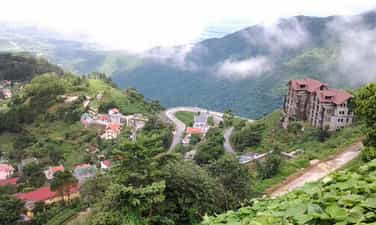
Tam Dao Mountain
As a medium mountain range located in three provinces of Vinh Phuc, Thai Nguyen and Tuyen Quang, the name Tam Dao mountain originates from the three highest peaks of Rung Rinh, Thach Ban and Thien Thi. The closed terrain along with the typical forest system evokes to travelers a mysterious mountainous area that needs to be explored. Most climbing trips start from Tam Dao National Park and go deep inside with many different routes such as Thai Nguyen Pass route, Thach Ban peak route or route to the southern peak.... The route is still very popular. Climbers' best choice is the route that passes through three peaks in order: Thien Thi, Thach Ban and Rung Rinh. Before starting the challenge, you must notify the ranger station at the foot of the mountain to receive a climbing permit. If this is your first time challenging yourself with mountain terrain in Tam Dao, you should hire a guide in Tam Dao town center to prevent getting lost and deal with bad situations. The Tam Dao mountain climbing route will include many types of sloping, slippery terrain, mysterious green bamboo forests but no less interesting and dramatic. The peaks of Thach Ban and Thien Thi, although the path is not too dangerous and dark, requires you to have endurance and judgment to be able to conquer the cliffs distributed along the climbing path. Standing from the first and second peaks, you will bring yourself surreal experiences when immersing yourself in nature, watching the mist and clouds drifting below. An overwhelming scene that perhaps one has to come here to easily feel. Conquering Rung Rinh peak (also known as Phu Nghia) is probably the real challenge for young people who decide to travel to Tam Dao. After getting tired of the obstacles at the previous two peaks, Rung Rinh peak requires you to have patience and determination to conquer as a climber. Normally such a climb takes about 4 to 6 hours. You should pay attention to the time and decide wisely if you do not want to stay in the forest. Safety is always a top priority for every trip, especially experiential journeys like climbing Tam Dao mountain. Clean water, snacks like chocolate, snacks, and instant noodles are the fastest, most compact, and lightest foods you should prepare, in case you have to stay in the forest at night. At night, the temperature at the mountain tops will drop. You should bring warm clothes or rent tents and thick sleeping bags to avoid heat stroke. In addition, a flashlight is a mandatory item if you need to move at night. Don't forget to bring nasal sprays, pain relievers, daggers and plastic bags to cover electronic items, in case of unexpected rain, insect bites or unnecessary accidents.
Phu Tho
6247 view


Ham Long Church
Ham Long Church is one of the largest churches in Hanoi, located at 21 Ham Long Street, Hoan Kiem District, whose patron is Saint Anthony of Pavoda. This architectural building was designed by architect Doctor Than, who studied abroad in France before returning to Vietnam. The church was completed in December 1934, is 17m high and has extremely unique architecture. The most special feature of Ham Long church lies in the choice of materials. Thanks to the use of folk materials such as cork, paper combined with lime straw and a few other special materials to create dome details without the help of equipment. Modern sounds, the sounds of ceremonies are still echoed very loudly. Not only that, the uniqueness of Ham Long church also comes from the motifs, the most famous of which is the rope motif, like the straps of the Franciscan order, carved on the church pillars as well as the on altar pedestals. The land of Hanoi has many architectural works with high historical value, but Ham Long church is always an attractive destination not only for parishioners but also for those who love to learn about public culture. teacher. Known as one of the most beautiful churches in Hanoi, don't miss the opportunity to visit Ham Long church if you have the opportunity.
Hanoi
6274 view


Me Linh Flower Village
In Hanoi, perhaps everyone is too familiar with names like Nhat Tan flower village, Ngoc Ha flower village or Nghi Tam, Quang Ba. These are not only flower villages with famous beautiful scenery over time, but also carry deep historical and cultural meanings, contributing to the poetic and famous beauty of this ancient land. Not as old as Nhat Tan flower village, Me Linh flower village is known to many people because it is the main flower supplier for Hanoi and some northern provinces on holidays. Flower growing has been established on this land for more than 20 years. The soil here is most suitable for growing roses. On frosty nights, Me Linh flower garden is beautiful under the light of hundreds of lights running across the field, creating a special scene. With fresh, vibrant scenery and fresh, natural atmosphere, Me Linh flower village is becoming one of the interesting tourist destinations in Hanoi. Not only is it popular with young people, it has become the number one choice for many families' weekend picnics. The flower village is located 30 km from the city center, near Noi Bai airport. Visitors can ride a motorbike or take bus number 7. From the center of the capital, tourists follow Thang Long bridge to the overpass into Thang Long industrial park, turn onto the road to the industrial park but do not go inside. If you continue about 5km, you will reach Me Linh flower village. Visitors will also immediately see vast flower fields on both sides of the road. People in Me Linh grow many types of flowers such as roses, chrysanthemums, peonies... But the most popular are still roses including velvet roses and red roses. The flowers here have bright, diverse and eye-catching colors. Just standing from afar can feel the smell of flowers blowing in the wind, giving visitors a very enjoyable feeling. Visitors will be even more interested in the rustic, rustic simplicity of the scenery here. Fresh air and a feeling of relaxation are also factors that make visitors reluctant to leave. That is the advantage that makes Me Linh flower village a priority choice when compared to other flower villages such as Nhat Tan or Quang Ba. Because while other flower villages, because they emphasize commercialism too much, have replaced the natural beauty of the landscape with the gaudy, gaudy appearance of artificial decorations, the naturalness and rusticity of flower villages Me Linh has become an impressive attraction for tourists. If in 1995, Me Linh commune (Me Linh district) only had 2 hectares of flower growing, then now the whole commune has 236 hectares. In Me Linh, most households grow and trade flowers. Flowers in the fields and gardens are all covered, making the village here always colorful and bringing a prosperous life to the people. Of the 236 hectares planted with flowers, roses and chrysanthemums play the leading role. In addition, Me Linh farmers also grow a number of other flowers such as lilies, calla lilies, peonies, gladiolus...
Hanoi
7014 view


Quan Thanh Temple
Quan Thanh Temple is located at the intersection of Thanh Nien Street and Quan Thanh Street, opposite West Lake, which is always cool all year round. Built in the Ly Dynasty, Quan Thanh Temple is also called Tran Vu Quan because it is a place to worship Huyen Thien Tran Vu - a deity guarding the north of the ancient capital Thang Long. Right from the entrance gate, you will be impressed by four pillars decorated with back-to-back phoenix images and flanked by ancient screens. Around the pillars are a pair of striking red parallel sentences. Stepping inside, you will be amazed by the ancient space of the three-entrance gate, the courtyard, and the three layers of the front house - the middle house - the harem in Chinese architectural style. With extremely unique wood carvings in a harmonious space, the temple's architecture has extremely high artistic and aesthetic value. The most prominent highlight in Quan Thanh Temple is the statue of Huyen Thien Tran Vu cast in black bronze with a height of nearly 4 meters and weighing about 4 tons on a marble block more than 1 meter high. In ancient legends, Huyen Thien Tran Vu is the god who fought off many foreign invaders, helped the people of Thang Long exorcise evil spirits and monsters, and govern the North. The statue has a square face that is majestic but gentle and calm with straight looking eyes. This is a unique work of art and partly affirms the ingenuity and talent in sculpting and bronze casting techniques of Vietnamese artisans three centuries ago. The statue is placed in the Harem area. Every month or Tet holiday, people flock to Quan Thanh Temple to pray for health, peace and fortune. Legend has it that if you use your right hand to rub the left leg of Huyen Thien Tran Vu statue, the person rubbing will receive good luck and prosperity. In addition, the Quan Thanh Temple festival also takes place every year on the 3rd day of the third lunar month, attracting a large number of people to offer incense, sacrifice and pray for peace.
Hanoi
6695 view


Long Bien Bridge
Long Bien Bridge connects Long Bien, Hoan Kiem and Ba Dinh districts. The bridge is the symbol of Hanoi. This is the first steel bridge across the Red River. The bridge was once in the top 2 longest bridges in the world, just behind the Brooklyn Bridge across the East-River of the US. After many years of formation and development, Long Bien Bridge in Hanoi has accompanied our people through two resistance wars against the French and American colonialists. The bridge has witnessed many heroic and memorable historical events and milestones. Long Bien Bridge has become a beautiful and meaningful symbol of Hanoi Capital. The bridge is always imprinted in memories and has become a source of national pride. Long Bien Bridge has an extremely unique architecture with a length of 2,290m across the river, 896m of bridge with 19 steel beam spans and 20 sturdy high pillars. When inaugurated, the bridge was compared to the "horizontal Eiffel Tower" with its harmonious and meticulous design. The bridge is 4.75m wide with 3 lanes. The two lanes on both sides for cars, motorbikes, and bicycles are 2.6m wide, the outermost lane for pedestrians is 0.4m wide. The middle lane is the railway lane, for trains, 1.75m wide. The bridge was built according to famous French architecture, designed and constructed by Daydé & Pillé company (Paris, France). Modern bridge construction techniques ensure safety and high aesthetics. The entire bridge is made from high quality steel, stacked tightly together to create a harmonious and impressive whole. From afar, the bridge looks like a giant, soft, winding dragon, lying across the fast-flowing river. Time passed, the devastation left behind by the war was extremely heavy, but the bridge was still there, still standing tall. Long Bien Bridge is a historical witness of the Vietnamese people, with the nation experiencing many important historical events and milestones. The bridge marked each step forward in the two resistance wars against the French colonialists and the American imperialists. The bridge has always accompanied our people during the arduous and difficult days of fighting against invasion. And until witnessing the moments of joy and excitement when the South was liberated and the country was unified. Let's look back at the historical events of Long Bien Bridge: September 2, 1945: At historic Ba Dinh Square, President Ho Chi Minh read the Declaration of Independence, the bridge became a bridge leading thousands of suburban people to Uncle Ho in joy and jubilation. October 1954: On the day of liberation of the Capital, the bridge still stood tall, witnessing the joy and pride of the nation. 1965-1968: During the Rolling Thunder campaign, the bridge was bombed 10 times by American aircraft, losing 7 spans and 4 pillars. September 10, 1972: During Operation LineBacker II, the bridge was bombed 4 times, damaging 1500m of the bridge and 2 large pillars were cut off, causing heavy damage. December 30, 1972: When the US was forced to stop bombing Hanoi, workers repaired the railway on the bridge. 1975: On the day of liberation of the South and unification of the country, Long Bien Bridge once again witnessed this joy and pride with our people. Long Bien Bridge has witnessed and accompanied the Vietnamese people for a long time. Having gone through many ups and downs and events, now the bridge is not only a historical witness but also an extremely close companion to every Vietnamese person.
Hanoi
6257 view


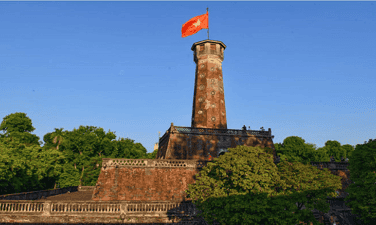
Hanoi flagpole
The Hanoi flagpole is also known as the Hanoi Flag Tower, built in the early 19th century and now located on the campus of the Vietnam Military History Museum. After many years, this work is still intact and the most valuable in the Thang Long Imperial Citadel complex after the French and American resistance wars. Built from 1805 to 1812 under King Gia Long of the Nguyen Dynasty as an observatory. Hanoi flagpole is a place visited by many people of the capital as well as international tourists when traveling to Hanoi and taking souvenir photos. The first interesting thing that makes most tourists visiting Hanoi want to set foot here is the unique and ancient architecture. Visitors to Hanoi do not have to go too far, the flagpole is located right in the center of Hanoi capital. To get here, just ask for directions to Cua Nam and Uncle Ho's Mausoleum and you will find it. From the shore of Hoan Kiem Lake to the Flagpole is only less than 1km. Visitors can take a taxi or bus or rent a bicycle and stroll to admire the streets. The entire Hanoi flagpole is over 33m high, including the flagpole, it is 44m. Here you can visit both outdoor and indoor areas. Inside is very spacious and airy, displaying guns and statues of heroes. The base floors of the flagpole are square, gradually getting smaller, overlapping each other, and surrounded by tiles. That balanced layout has created straight, steady lines for the Hanoi Flagpole. What's special is that on Hanoi's hottest days, the inside temperature of the Flagpole is always cool. On the top of the Flagpole is the national flag, an important symbol of national unity, and is replaced every 2 to 3 weeks. Following the steps leading to the top of the flagpole, visitors can see the tanks and helicopters of the Lenin Park and Military Museum. Designed with a stone spiral staircase inside the flagpole, visitors can stop and look out at the hia-shaped windows dotted along the curved walls. There are 3 separate observation floors and a column. If you want to see the scenery, it is best to go to the top observation deck. From the top of the monument, one can observe a large area inside and outside the ancient citadel. Except for the North door, the remaining three doors of the Flag Tower are all engraved with their own names. The door facing East is "Nganh Huc" (receiving the morning sunlight), the door facing West is "Hoang Khuc" (reflecting light), and the door facing South is "Huong Minh" (facing the light).
Hanoi
5627 view


Imperial Citadel of Thang Long
Thang Long Imperial Citadel is a complex of relics associated with the history of Thang Long - Dong Kinh capital city and Hanoi province. This archaeological site is a living testament to the Red River Delta civilization throughout 13 centuries: starting from the pre-Thang Long period around the 7th century, going through the Dinh and pre-Le dynasties, developing strongly under the Ly, Tran, post-Le dynasties, until the Nguyen dynasty and persisting until today. The highlight of Thang Long Imperial Citadel was formed in 1010, when King Ly Thai To issued a decree to move the capital from Hoa Lu to Dai La and built the Imperial Citadel as well as a series of palaces and palaces, including the Thang Long Imperial Citadel. According to history books and archaeological documents, Thang Long Citadel was built according to the model of three overlapping citadels, including: the outermost circle is La Thanh or Imperial Citadel - where the residents live, the middle circle is the Imperial Citadel - the main court area, the residence and working place of court officials, and the innermost circle is the Forbidden Citadel or Long Phuong Citadel - a place for the king, queen, and other royal family members. What we still see today in the capital Hanoi is the Thang Long Imperial Citadel Central Relic Area with an area of about 20 hectares (out of the total area of 140 hectares of the Imperial Citadel), including two areas: 18 Hoang Dieu Archaeological Area and Hanoi Ancient Citadel Relic Area. Except for Bac Mon and Ky Dai, the remaining buildings are only reconstructions and archaeological relics found over the years. The central relic site of Thang Long Imperial Citadel is located at 19C Hoang Dieu, Dien Bien ward, Ba Dinh district, Hanoi city. In fact, the entire relic cluster is surrounded by four roads: the North is Phan Dinh Phung Street, the South is Dien Bien Phu Street, the East is Nguyen Tri Phuong Street and the West is Hoang Dieu Street, located in Dien Bien and Quan Thanh wards, Ba Dinh district, Hanoi city. The first stop in the Imperial Citadel relic complex is Ky Dai, commonly known as the Hanoi Flagpole. This is a monument with a tower-like structure, built under the Nguyen Dynasty from 1805 to 1812, at the same time as Thang Long Imperial Citadel. The flagpole architecture includes three levels of base, body, and watchtower, with a total height of about 33.4m. Inside the building, there is a spiral staircase design leading to the top - where you can enjoy a panoramic view of Thang Long Imperial Citadel. The Hanoi Flagpole project still stands firmly and solidly today, and has become one of the symbols of the capital Hanoi. Leaving Hanoi Flagpole, you go a little further and you will reach Doan Mon, the main gate leading to the Imperial Citadel. Doan Mon has appeared since the Ly dynasty, but the architecture we see today was built by the Le dynasty in the 15th century and renovated by the Nguyen dynasty in the 19th century. Doan Mon is the southern city wall, built in an arched architectural style that is almost perfectly symmetrical through the "spiritual axis", with 5 city gates: the largest middle gate is for the king, the remaining 4 gates are for mandarins, princes, and nationals. This is the most checked-in location because of the grandeur and majesty of the building. Starting from Doan Mon, you cross a large courtyard called Long Tri, then reach Kinh Thien Palace - the main nucleus in the overall Imperial Citadel relics. Kinh Thien Palace was built in 1428, where King Le Thai To was crowned, and later became the place to celebrate solemn royal ceremonies, hold court meetings and welcome foreign envoys. Currently, this project only retains the foundation and two stone dragon steps. However, the vestiges found here and the pair of flanking dragons partly recall the magnificence and splendor of Kinh Thien Palace in the past. Hau Lau, also known as Tinh Bac Lau, is a building built behind Kinh Thien Palace, in the past it was a harem - a living place for queens, princesses, concubines, and beautiful women. Hau Lau appeared after the late Le dynasty, built in a box-shaped architecture with three floors, combining traditional Vietnamese and French architecture. The most characteristic feature of Hau Lau is the thickness of the walls, making the rooms always cool in the summer and warm in the winter. At the end of the 19th century, Hau Lau was seriously damaged, and was renovated and rebuilt by the French as it is today. Bac Mon, or Cua Bac, is one of the five gates of the ancient citadel of Hanoi under the Nguyen Dynasty, and is also the only remaining gate. North Gate was completed in 1805, following the gazebo style: above is the floor, below is the citadel. Upstairs is currently the place to worship two Governors Nguyen Tri Phuong and Hoang Dieu - who together with the people of Hanoi fought to protect the citadel to the death. The palace gate is a guard place for soldiers, to keep the king and royal family safe. Each palace gate is a structure with sophisticated and sturdy design, enhancing the magnificence of the palace. In the Hanoi Ancient Citadel Relic Area, eight such palace gates still exist. Thanks to these palace gates, the work of determining the coordinates of the palaces and walls is more accurate. In addition to archaeological works, in the Hanoi Citadel Relics Area, there is also a system of French architectural works built in the late 19th and early 20th centuries, now requisitioned as headquarters and agencies of the Vietnamese State.
Hanoi
6594 view


Hoa Lo Prison
Hoa Lo Prison is located at 1 Hoa Lo Street, Hoan Kiem, Hanoi. The relic still stands the test of time until today, a clear testament to a period of hardship and hardship, symbolizing the indomitable and resilient spirit of patriotic Vietnamese people. Hoa Lo Prison, also known as Hoa Lo Prison, formerly known in French as Maison Centrale, meaning central prison, and in Vietnamese as Hanoi Prison, is an old prison located on Hoa Lo Street, Hoan Kiem District, Hanoi. This prison was built by the French in 1896 in an area that was still on the outskirts of the city at that time, with the purpose of serving as a central prison for both Central and Northern regions, detaining mainly political prisoners and patriots who opposed the colonial government. During the French colonial period, Hoa Lo prison was designed and built with a structure consisting of 4m high, 0.5m thick stone walls reinforced with electric steel wires. The entire prison area is divided into 4 zones: A, B, C, D, of which: Areas A and B: for prisoners under investigation, unimportant prisoners or prisoners who violate prison discipline. Area C: for French or foreign prisoners. Area D: for prisoners awaiting death penalty. The total area of the entire former prison area was more than 12,000 square meters. However, today only 2,434 square meters are retained and preserved to become a relic site, serving the purpose of sightseeing and tourism for those who want to come and see with their own eyes what the colonial prison scene looked like. Dubbed the "hell on earth" and the scariest prison in Southeast Asia, during its time of operation, Hoa Lo prison has become a detention place for many generations of Vietnamese revolutionary soldiers and activists with a prison architecture designed with extremely barbaric and cruel forms of torture and forced confessions, most notably the guillotine machine, which has put the prison in the top 10 most notorious prisons in the world. After liberating the capital in 1954, Hoa Lo prison was used to detain American pilot prisoners of war until 1973. With its historical role, Hoa Lo prison has now become an interesting tourist destination in Hanoi, attracting many domestic and foreign tourists. This place is open to everyone who needs and wishes to visit with an extremely affordable ticket price of 30,000 VND/person, with a 50% discount for pupils, students, people with disabilities, the elderly or those who are subject to social policies. In addition, subjects such as children under 15 years old, people with severe disabilities or people with meritorious services to the Revolution will be completely exempted from ticket prices.
Hanoi
6333 view


Hanoi Opera House
Located at the center of No. 1 Trang Tien Street, Hoan Kiem District, Hanoi Opera House is a place that many tourists love to visit every time they have the opportunity to come to the capital. This is an architectural work built by the French in the years 1901 - 1911 (during the period of Vietnamese domination), at that time the theater was a place specializing in performing luxurious classical art performances such as Opera, chamber music, drama... for the mandarin class, the French elite and some Vietnamese bourgeoisie. Inspired by famous European architectural works such as the Paris Opera House, Tuylory Castle... so the "soul" of Europe permeates this place. A century has passed with many ups and downs, the Hanoi Opera House has deteriorated a lot and has recently been renovated, giving it a new look and vitality. Saying goodbye to the original pale yellow color, the theater now wears a coat of dark yellow mixed with white to create a majestic and beautiful look. Right from outside the theater, we can feel the "breath" of Europe with delicate lines and classic carved patterns. Entering the main lobby, visitors cannot help but feel overwhelmed by the splendor of this place. The entire room is paved with white stone imported from Italy and red carpet in the middle aisle, creating a luxurious and noble feeling like the British royal palace. The ceiling and surrounding walls are decorated with a system of small copper or gold-plated chandeliers in a vintage style that looks very noble. Next is the audience room where artistic performance activities take place for audiences today. The space here is delicately designed with a stage in the middle and the stands are designed in an arc inspired by the Roman arena, embracing the stage, helping to keep the audience's view unobstructed. the best possible sound quality. With 598 seats reasonably distributed across 3 floors, creating the most comfortable enjoyment space. Finally, there is the mirror room, where important ceremonies are held or high-ranking figures are welcomed... The space here is filled with classic looks from the design that combines many large windows combined with Mozaic technology, to the Hanging lamps and chandeliers are plated with gold or copper... all exude luxury and splendor. In addition, inside the Hanoi Opera House, there are also a few other auxiliary works such as: administration room, 18 makeup rooms, 2 vocal rehearsal rooms, library and meeting room. When coming to the theater, visitors can stop by and buy some small souvenirs at the showroom and souvenir sale room. Recently, Hanoi Opera House officially announced its opening for tourists with a fee of 400,000 VND/person, with students receiving a half discount. In addition, you can buy show tickets at the theater with prices ranging from 300,000 VND - 1,000,00 VND/person and take the opportunity to visit some beautiful architectural works here.
Hanoi
6235 view


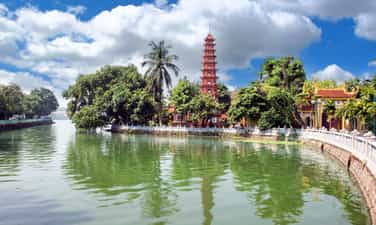
Tran Quoc Pagoda
Tran Quoc Pagoda was originally called Khai Quoc Pagoda, built in 541 during the Early Ly Dynasty. At that time, the pagoda was located near the banks of the Red River, so when the dyke collapsed in 1615 (during the reign of King Le Trung Hung), the pagoda was moved inside the Yen Phu dyke to the Kim Nguu mound area. Then, around the 17th century, Lord Trinh built Co Ngu dike (now Thanh Nien road) to connect with Kim Nguu island. The pagoda changed its name to Tran Quoc Pagoda during the reign of King Le Hy Tong (1681 - 1705) with the hope that this would be a place to help people ward off natural disasters and bring a peaceful life to all people. And that name is used to this day. In the past, Tran Quoc Pagoda was the Buddhist center of Thang Long capital. Kings Ly and Tran often visited sights and worshiped on holidays and Tet at the pagoda, so many palaces were built to serve the king's rest: Thuy Hoa palace, Ham Nguyen palace. The pagoda is located on an island east of West Lake, nestled quietly on busy Thanh Nien street. As an ancient pagoda built a long time ago, Tran Quoc Pagoda has undergone many restorations, its appearance has changed somewhat, the current scale and architecture of the pagoda is the result of a major restoration in 1815. The total area of the pagoda is about more than 3000m2, including the tower garden, ancestral house and upper palace. The pagoda belongs to the Northern sect with structure and architecture according to strict principles of Buddhism including 3 main temples: Front hall, incense burning house and Upper hall connected together to form the letter Cong (工). The Tien Duong house is facing west, behind is the Tam Bao house. Two corridors are located on both sides of the incense burning house and the Upper Palace. Behind the Upper Palace is the bell tower located on the main hall axis with a three-compartment architecture with a match roof. The ancestral house is located on the left of the Upper Palace and on the left is the stele house which still preserves 14 steles with many historical and cultural values. In 1998, the six-level lotus stupa was built, and in 2003, it was completed to form the pagoda's tower garden. The Stupa is 15m high and has 11 floors. On each floor of the tower, there is a white gemstone statue of Amitabha Buddha in each arched doorway. In particular, at the top there is a 9-storey lotus tower (Nine Lotus Flower) carved from precious stones, creating a majestic, sacred yet very soft beauty. The Stupa was built symmetrically with the Bodhi tree given by the President of India in 1959 during his visit to the capital Hanoi. This Bodhi tree is extracted from the Maha Bodhi tree in Dao Trang - where Buddha Shakyamuni sat and practiced more than 25 centuries ago. Currently, the pagoda still preserves many valuable Buddha and Bodhisattva statues located mainly in the Upper Palace. The most prominent among them is the statue of Shakyamuni Buddha entering Nirvana made from wood, lacquered with gold, and is a beautiful Nirvana statue in Vietnam. Through many ups and downs of time, Tran Quoc Pagoda still stands there majestically, bringing a peaceful yet ancient look in the heart of bustling Hanoi. Every year, the pagoda attracts many Buddhists from all over, domestic and foreign tourists to offer incense, worship Buddha as well as visit the pagoda.
Hanoi
6305 view


