Relic point Vietnam
Việt Nam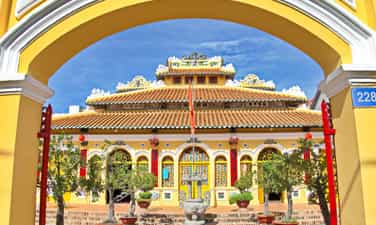
Chau Phu Temple
Chau Phu Temple – A historical landmark along the Hau River. Located in Chau Doc ward, An Giang province, on the Hau River, Chau Phu Temple is one of the typical religious structures of the Chau Doc region. Its predecessor was the Le Cong Ancestral Temple, built around the beginning of the 19th century to worship Le Thanh Hau Nguyen Huu Canh, a figure who made significant contributions to the development and expansion of the Southern region of Vietnam. Later, the structure was relocated and rebuilt; the current temple was completed in 1926. The temple is grand in scale, reflecting the distinctive architectural style of Southern Vietnamese village temples. The structure is arranged in a three-part layout, with large wooden columns, tiled roofs, and many exquisite carvings. The roof and architectural elements prominently feature traditional themes such as two dragons fighting over a pearl, two dragons worshipping the moon, fish transforming into dragons, phoenixes, and lions. Inside, many valuable horizontal plaques, couplets, religious artifacts, and other relics are preserved. Besides Nguyen Huu Canh, the temple also worships Thoai Ngoc Hau Nguyen Van Thoai and several other figures who contributed to the Chau Doc region. Every year, the temple holds the Ky Yen festival on the 10th and 11th of May in the lunar calendar, attracting a large number of people to offer incense and pay respects. With its unique historical, cultural, and architectural values, Chau Phu Temple is a destination that contributes to the distinctive spiritual and cultural landscape of Chau Doc and the Southwestern region of Vietnam. Source: Tuoi Tre Newspaper
An Giang
64 view
Rating : National Monument
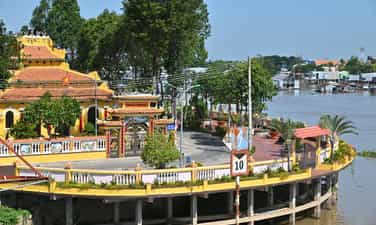
Vinh Nguon Temple
Vinh Nguon Temple is located at the head of the Vinh Te Canal, where it intersects with the Hau River, in Chau Doc ward, An Giang province. The temple was formed during the process of settlement and village development in the Chau Doc area. It is a place of worship for the tutelary deity and other deities, including Nguyen Huu Le, and also serves as a religious space for the local community. In 2011, the temple was recognized as a national-level architectural and artistic heritage site. Architecturally, the temple features the characteristics of Southern Vietnamese village temples with its tiled roofs, decorative dragon and phoenix motifs, and wooden columns carved with images of dragons, unicorns, turtles, and phoenixes. The temple's space harmoniously combines traditional architectural values with the characteristic riverine landscape of the Chau Doc region. Every year, the temple holds traditional ceremonies, including the worship of the tutelary deity Nguyen Huu Le on the 16th day of the 4th lunar month, praying for national peace and prosperity, favorable weather, and a peaceful and prosperous life. These rituals contribute to maintaining the religious life and traditional customs of the local community, and help showcase the unique cultural features of the people in the southwestern Mekong Delta region. Source: An Giang Newspaper
An Giang
134 view
Rating : National Monument

Nguyen Trung Truc Shrine
The Nguyen Trung Truc Temple, located at 8 Nguyen Cong Tru Street, Rach Gia Ward, An Giang Province, is one of the earliest and largest temples dedicated to Nguyen Trung Truc in Southern Vietnam. After his death in 1868, local people secretly established a shrine to commemorate the hero who led the resistance against French colonialism. The temple currently has a three-part structure, consisting of the main hall, the East wing, and the West wing. The triple-arched gate, the roof, the horizontal plaques, the couplets, and the dragon and floral motifs are elaborately decorated. Inside the main hall, the central altar is dedicated to Nguyen Trung Truc, flanked by altars for the resistance fighters, the ancestors, and the Great General of the South Sea. Within the grounds are Nguyen Trung Truc's tomb and a display room showcasing artifacts related to the uprising. Every year, from the 26th to the 28th of August in the lunar calendar, a solemn festival commemorating Nguyen Trung Truc's sacrifice is held, attracting a large number of locals and tourists. The festival combines traditional rituals with various cultural, artistic, and folk game activities, expressing reverence for the national hero. In 1988, the temple and tomb of Nguyen Trung Truc were recognized as a national historical and cultural relic, becoming a typical spiritual and cultural site of Rach Gia and Southern Vietnam. Source: Wikipedia
An Giang
316 view
Rating : National Monument
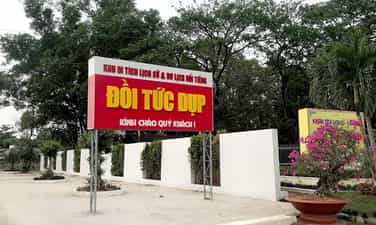
Tuc Dup historical relic site
Tuc Dup historical relic site in Tri Ton district, An Giang province, is an important base of An Giang's army and people during the resistance war against the US. Tuc Dup in Khmer means "night water", located at an altitude of about 300m, with a system of caves and rocky crevices like a giant "honeycomb". Since the 1940s, Tuc Dup has been a shelter for revolutionary soldiers. By 1960, this place became the base of the Tri Ton District Party Committee and An Giang Provincial Party Committee. Relying on the rugged terrain and the continuous cave system, our army and people stubbornly held on, fought and resisted many fierce raids and bombs by the enemy. Therefore, Tuc Dup is also known as "steel hill". Today, the caves that used to be the working places of the Military Command, Propaganda Department, Women's Union, Civil Medicine and hall C6 are still preserved. Visitors can explore the unique cave system, learn stories about the lives and battles of our people and soldiers during the war, and admire the wild beauty of That Son mountains and forests. Tuc Dup today is not only an attractive tourist destination but also a traditional "red address" for education, reminding of a period of resilient fighting and the great sacrifices of An Giang's army and people. Source: Vietnam National Tourism Administration
An Giang
732 view
Rating : National monument
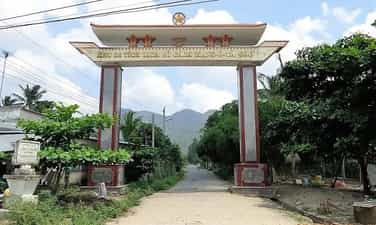
O Ta Soc Base
O Ta Soc base, Luong Phi commune, Tri Ton district, An Giang province, is a national revolutionary historical relic. O Ta Soc, in Khmer language means "Ong Soc Stream", located on Dai Mountain, outstanding with rugged rocky terrain, many caves, rock formations and year-round flowing streams. Since the end of 1962, O Ta Soc became an important base of the An Giang Provincial Party Committee and revolutionary agencies. Based on the rugged mountainous terrain, our army and people built defense systems, arranged anti-mines, shelters and organized many battles, resiliently resisting enemy raids. From here, the An Giang Provincial Party Committee directed the revolutionary movement, fought to destroy strategic hamlets, protected the people and organized fighting forces throughout the province. During the years 1965–1967, the enemy repeatedly launched large-scale operations to attack the base, but they all encountered fierce resistance from revolutionary forces. The soldiers took advantage of every rock hole, slope and dangerous terrain to fight the enemy and protect the safety of the Provincial Party Committee. By the end of 1967, the Provincial Party Committee moved its base to To - Tuc Dup mountain, but O Ta Soc continued to be the place of operation and combat coordination of revolutionary forces. Today, O Ta Soc base not only has the wild beauty of the mountains and forests but is also a red address for educating revolutionary traditions, helping today's generation better understand the resilient spirit, cunning and sacrifice of An Giang's soldiers and people in the resistance war against the US. Source: Management Board of Monuments and Attractions of An Giang province
An Giang
780 view
Rating : National monument
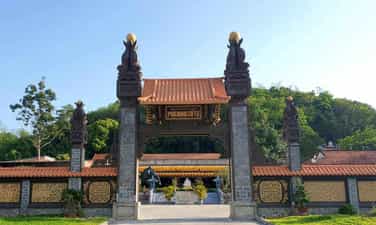
Phu Dung ancient word
Phu Dung Pagoda also has another name, Phu Cu Pagoda, located at the foot of Binh San Mountain, Binh San Ward, Ha Tien City, Kien Giang. As one of the ancient landscapes of the peaceful and poetic land of Ha Tien, Phu Dung Pagoda not only adorns the borderland with the quiet majesty of a temple but also captivates visitors by its discovery. tells the beautiful love story of the Governor and "Miss Ai in the upside-down pot". Phu Dung Pagoda is associated with the story of the person lying in the ancient tomb, Ms. Phu Dung, who later people also gave another name, Ms. Di Tu, the first nun to live at the pagoda. Actually, the above anecdote is told by folk based on the historical novel Ai Co in an upside-down pot by Mrs. Mong Tuyet. The story is summarized as follows: Cong Mac Linh, General of the Army, Grand Admiral Mac Thien Tich, has a second wife named Aunt Tu, who is "beautiful and fragrant and has good writing". Mac Linh Cong, because of his love for beauty and poetic talent, turned from favor to natural love. As a result, Mrs. Nguyen became jealous and plotted to harm the second wife. One day, while Cong Mac Linh was busy reviewing troops, at home, Lady Nguyen locked her concubine in a pot and covered it until she suffocated and died. Suddenly, it started to rain heavily and Cong Mac Linh just arrived. Seeing that it was raining but the big pot was not tilted up to catch the water, he ordered the pot to be opened and discovered that Aunt Tu was barely alive, but luckily she was still able to save her. Although she escaped death, Aunt Tu became bored with the situation and asked Duke Mac Linh for permission to become a monk. Faced with that unruly situation, the General had no other choice but to comply and build a temple for his "Ai Co" to practice. Next to the temple, he dug a pond and planted white lotus flowers to commemorate his old love. When she passed away, Cong Mac Linh built a solid tomb, structured in the shape of a pot, to pay tribute to the beautiful woman who had to endure injustice and hardship because of him... That tomb later became Phu Dung Tu. Although there are different opinions, there is even an opinion that the love story of Mac Doge and Ai Co Phu Cu is just a fiction of writers, but most Ha Tien people know it by heart and believe that it is a beautiful, true love story, associated with the work of opening up Ha Tien land. The historical love story soaked in literature and tears between Governor Mac and Ai Co Phu Cu has since then been the inspiration for many works of stories, operas and poems. In 1959, Kien Giang writer and poet Ha Huy Ha wrote the opera "Wedding dress in front of the temple gate" based on the work "Miss Ai Co in an upside-down pot" by female artist Mong Tuyet. The opera attracted countless hearts of audiences at that time. In front of the pagoda yard is a high platform with a statue of Avalokiteshvara about 4 meters high made of cement and painted white. Next is the solemnly decorated main hall: in the middle is the statue of Sakyamuni, on both sides are the two great disciples Anan and Ca Lett. There are also 4 large reliefs (each 1.3 m high, 2.3 m wide) illustrating 4 scenes of Buddha's birth, renunciation, sermon and nirvana. Behind the main hall, through a small yard, visitors will see a two-story high attic called "Ngoc Hoang Buu Dien", which worships the Jade Emperor and the two kings Nam Tao and Bac Dau. To the left of Phu Dung Pagoda, there is a small path along the mountainside. Walk about 20 meters and you will see an ancient tomb leaning against a cliff in the middle of a forest of towering, cool, secluded trees. On the tombstone there are many lines of Chinese characters. Next to the grave, there is a stone stele engraved with Vietnamese writing: Mausoleum of Mrs. Phu Dung - Tu Thanh Thuc Nhon - Nguyen Thi Xuan (1720-1761) - passed away on the full moon day of the second lunar month - Phu Cu brand. Source: Kien Giang Tourism
An Giang
7765 view
Rating : Provincial level relics

Go Thap An Loi
The national archaeological relic of An Loi tower mound (Chau Lang commune, Tri Ton district, An Giang province) is a religious and religious architectural work of the post-Oc Eo culture period, dating from the 8th - 9th centuries. on a large scale and still quite intact. The relic contributes to revealing many scientific data about the origin, content, and nature of Oc Eo ancient culture. Oc Eo culture is one of three ancient cultures in Vietnam, including: Dong Son, Sa Huynh and Oc Eo. According to experts, the relics, ruins and values of Oc Eo culture belong to the ancient Funan Kingdom. Typically, there is the architectural relic of An Loi tower mound (the relic is located on a high mound foundation, so people here often call it "tower mound"). In 1999, the An Loi tower mound relic was discovered by the Provincial Museum during a survey in the mountains in Tri Ton district. In 2002, the Provincial Museum coordinated with the Center for Archaeological Research under the Institute of Social Sciences of the Southern Region to re-survey the archaeological site of An Loi tower mound. The An Loi tower mound archaeological site has a rectangular shape and an area of over 300 square meters. The top of the mound is flat, 2.5m high above the surrounding surface. The surface of the mound reveals many bricks, many brick seams running in a straight line in an east-west direction along with a few stone blocks and architectural stone slabs lying exposed in the middle of the mound or next to tree stumps. There is a circular "stone table" placed on top of whole and broken bricks in the middle of the mound. The slopes of the mound on the south and north sides are brick walls that are still vertical. On the east and west sides, due to being dug up to get bricks, bricks and jagged rocks were left on the slopes of the mound... That is a sign that this architecture was built with mixed bricks and stones in the traditional style of ancient Oc Eo - Phu Nam culture residents. The results show that, despite being excavated, the architectural foundation is still quite intact with the height of the tower walls ranging from 1.5 - 2.5m. Excavation results show that the An Loi tower mound relic has a rectangular architectural plan built of quite large bricks and stones, angled many times with a length of 19.2m in the east-west direction, a width of 11.6m in the east-west direction. north-south, 2.5m high from the base of the false column edge or 3.6m from the base of the last brick foundation - close to the foundation stone layer up to the top. The architectural layout consists of 2 parts: The lobby in the east is connected to the up and down steps, and the back lobby is in the west. Inside the architecture of the back hall, there is a square well-shaped worship pit, the sides are 1.2m wide in the east-west direction and 1.1m in the north-south direction. The hole was dug quite deep, containing many raw bricks, rocks and gray sand. In addition, in the pit, a large ceramic jar was discovered broken into many pieces. The jar had a not high mouth, a wide bulging body, a flat bottom, and a very shiny dark brown enamel layer on the outside. The relics collected are mainly stone objects of various types, such as: Stone Linga fragments, Somasutra sacred water troughs, stone tables; Stone slabs of many shapes, such as: Semi-circular stones, fan-shaped stones, rectangular stones and a few pieces of ancient pottery and vase spouts in insignificant quantities. Through research, the An Loi tower mound belongs to the heavy architectural type built of mixed brick and stone of the post-Oc Eo period. The discovery of many Linga and Somasutra suggests that the An Loi tower mound architecture is a temple belonging to the Siva belief where blessing rituals of ancient communities in the post-Oc Eo period were performed. The estimated date of the architecture is around the 8th - 9th centuries AD. An Loi Tower Mound has high value in terms of scientific research, the historical origin of the land and national culture is more than 1,000 years old. With important historical and cultural significance and high scientific value, An Loi tower mound was ranked a national historical, cultural and archaeological relic by the Ministry of Culture, Sports and Tourism on February 26, 2019. 2008. Source: An Giang Online Newspaper
An Giang
7587 view
Rating : National monument
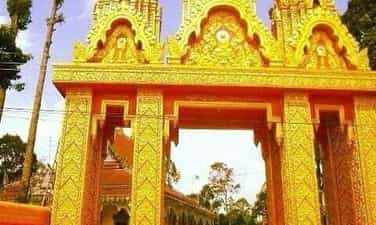
Cu La Pagoda
Cu La Moi Pagoda located in Minh Lac neighborhood, Minh Luong town, Chau Thanh district, Kien Giang province is a Khmer Theravada Buddhist temple. Cu La Pagoda was recognized as a national historical and cultural relic on September 28, 1990. After the 1968 Tet Offensive and uprising in the summer of 1972, the people and soldiers of the South rebelled everywhere. Meanwhile, the Saigon puppet army continuously failed. Since then, the Saigon government has continuously launched many sieges on Khmer pagodas, blocking roads, searching, and arresting monks and children of ethnic minorities to become soldiers. Faced with the above situation, under the direction of the Provincial Party Committee and the Khmer Transport Committee, at 5:30 a.m. on June 10, 1974, monks and ethnic Khmer, Kinh, and Hoa people flocked to Highway 12 (now the National Highway). Highway 61) to protest demanding the release of monks forced into military service. At the same time, the protest group also raised slogans such as: "Stop bombarding temples, killing monks and innocent people"; “Respect freedom of belief”; “Reestablish peace, fight unjust war”… The four monks sacrificed their lives. After shooting the monks to death, they transported the bodies to the provincial hospital, stripped the monks of their robes, put on black robes, and placed a gun on each monk's body. A-K guns, then slandered them as Viet Cong. Faced with the strong struggle of the monks and compatriots, they were forced to send people down to apologize to the monks and compatriots, return the bodies of the four monks who had died, and at the same time take the injured monks and compatriots for treatment. . At 4:30 p.m., June 10, 1974, the enemy government sent a vehicle to transport the bodies of four monks to Cu La pagoda for burial. After the complete liberation of the South, in order to recognize and commemorate the heroic sacrifice of the four monks and their compatriots, the State recognized and granted the Fatherland Certificate to honor the four monks: On the 20th September 1990, the tower of 4 martyrs was recognized as a national cultural and historical relic. Cu La Pagoda was chosen to be built on a large area of land, surrounded by rows of olive trees, palm trees, and lush melaleuca forests. The entire pagoda includes: pagoda gate, fence, main hall, ossuary tower, monks' hall, assembly house, amnesty, etc. Among them, the most prominent and important is the main hall built in the center of the pagoda. pagoda. Outside the main hall, there are auxiliary works, embossed decorations, showing the images of beautiful fairies, the god Krud bird supporting the temple roof, the fierce Yeak, the four-faced god Bayon's head, etc. . Taken from Khmer folk culture and beliefs, there are also corridors that create a cool space, decorated with images of evil forces that were conquered by Buddha. The space in the main hall is decorated with many delicate motifs with an altar in the shape of a lotus flower divided into many levels and elaborately and carefully decorated to worship the Buddha above. The Shakyamuni Buddha statue is carved in harmony with the main hall space and can be posed in many standing, lying, and sitting positions, demonstrating the diversity and richness of the Buddha's moral meaning and beauty. Source: Electronic information page of Department of Home Affairs of Kien Giang province
An Giang
8203 view
Rating : National monument
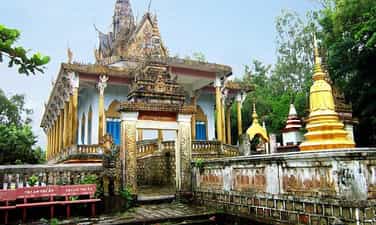
Soc Xoai Pagoda
Located in Son Tien Quarter, Soc Son town, Hon Dat district, Soc Xoai Pagoda is a pagoda with typical architecture of Khmer Theravada Buddhism in Kien Giang province. The pagoda was recognized as a National Historical and Cultural Monument in 1989. It was founded in the late 18th century by Venerable Danh Phiech. Over 19 generations of abbots, Soc America saved the country. Besides, Soc Xoai Pagoda is both a school teaching writing and an education center for local Khmer people. According to Venerable Danh Huu Giang, Deputy Abbot of Soc Xoai Pagoda, Soc Xoai Pagoda is considered a place to protect and gather local Khmer people, a cultural connection point and national solidarity. , is a factor that beautifies the national and religious traditions of the people of Hon Dat in particular and Kien Giang province in general. According to Venerable Danh Huu Giang, Deputy Abbot of Soc practice according to Buddhist teachings, practice culture according to national traditions. In addition, the Soc dandruff, harrowing... ancient Khmer people. According to the development of society, production labor tools as well as items serving daily life of the ancient Khmer people are no longer suitable with the times. These items, over time, will gradually become forgotten and damaged if not preserved and maintained. Therefore, these items are recreated with the purpose of letting future descendants know about the production activities and cultural beauty of their ancestors from ancient times. Regarding school, at Soc Among them, there is the Khmer language and the Buddha's precepts. Besides, we also coordinate to open intermediate Law classes. This class is for monks and Buddhists to understand the core policies and legal guidelines of our state, especially religious laws. When we understand clearly, we will easily be able to operate in the law. If you want to build something in your community and in your temple, it is not against the law. In addition to teaching literacy and training cultural and legal knowledge for monks and Buddhists, Soc Xoai Pagoda also preserves and preserves national cultural identity through organizing art programs and competitions. fashion show. Through festivals organized in accordance with cultural traditions, it helps local Khmer youth understand and respect traditional cultural values, thereby correctly understanding the meaning of festivals and preserving cultural values. nation, enhancing the role of Khmer people in community building, construction and defense of the country. Source: Electronic information portal of Kien Giang Department of Culture and Sports
An Giang
11517 view
Rating : National monument

MoSo Historic Sites and Attractions
Mo So historical relic and landscape is located in Ba Nui hamlet, Binh An commune, Kien Luong district (Kien Giang). Mo So in Khmer means limestone mountain, or white rock. This mountain has an area of 23.5 hectares. Mo So was ranked a national historical relic and landscape by the Ministry of Culture, Sports and Tourism on February 13, 1995. During the war against the French, Mo So was the station of Military Region 9's Engineering Workshop and 18th Engineering Workshop to manufacture and repair weapons and supply our troops in the Southwest battlefield. In the 1950s, the enemy launched many raids into the rear of the liberated area, including Mo So, to cut off logistics sources and weaken the offensive power of our army and people. On the morning of March 4, 1951, the enemy attacked Mo So. Cannons were fired from the sea, weapons were rained down from planes. Mo So roared in the rain of bullets, the space was covered in a gloomy color. Our force only has 60 comrades, fighting heroically. At noon on the same day, his comrades bowed and said goodbye to Mr. Thach Xiem, a Khmer who heroically sacrificed his life to protect his comrades and Engineer Workshop 18. During the resistance war against the US, Mo So continued to be a solid base of the Ha Tien District Party Committee. This is also an important key point on route 1C to supply weapons from north to south, through Kampot province (Kingdom of Cambodia) to U Minh Thuong region. In mid-July 1969, Ha Tien's agencies moved to Mo So. In July 1970, the enemy surrounded Mo So mountain mouth. They sprayed chemicals, Mo So from the green color of the mountains and forests remained only stone. Many soldiers who sacrificed their lives had to be brought to the foot of Mo So mountain to bury them. Not backing down before the enemy, the will of our forces at that time was like Mo So mountain, towering and proud. From July 1969 to April 1970, at the Mo So battlefield, our troops destroyed more than 4,000 enemies, destroyed 80 tanks, and shot down 10 aircraft. The Mo So victory contributed to the victory of our army and people in the resistance war against the US and to save the country. According to Vietnamese archaeologists, Mo So Mountain has more than 20 large and small caves, some very large caves containing thousands of people. According to Vietnamese archaeological data, Mo So and many other limestone mountains in Kien Luong district were formed about 240 million years ago. The foot of the mountain also left traces of seawater indented deep into the cliff, a mark dating back to about 4,000 to 5,000 BC. Mo So is beautiful and poetic. Protecting, embellishing and developing tourism at Mo So historical relics and landscapes is not only protecting the natural scenery and sustainable development of a limestone mountain and cave ecosystem, but also preserving Defend your father's achievements. This place once surrounded and protected heroic children who contributed to making history. Source: Kien Giang Tourism
An Giang
8252 view
Rating : National monument