Relic point Vietnam
Việt Nam
Dien Bien Phu Victory Monument
Dien Bien Phu Victory Monument, located on D1 hill, Dien Bien Phu city, is the largest bronze monument in Vietnam, symbolizing the famous victory in 1954. The Dien Bien Phu Victory Monument is 16.6m high, including 3 soldiers holding a Thai baby and a flag of victory, demonstrating the spirit of solidarity and resilient will of the nation. The path up to the monument consists of 320 steps, divided into 3 landings corresponding to 3 attacks, on both sides are 56 blue stone milestones symbolizing 56 days and nights of fighting. The Dien Bien Phu Victory Monument was inaugurated in 2004 (commemorating the 50th anniversary of the victory), this is an important historical attraction, marking the "illustrious victory of five continents, shaking the earth"
Dien Bien
2417 view
Rating : National monument

Dien Bien Phu Historical Victory Museum
Dien Bien Phu Historical Victory Museum is located at Highway 279, Street 3, Muong Thanh Ward, Dien Bien Phu City, Dien Bien Province. Construction began in October 2012 on an area of 22,000 square meters and officially opened to welcome visitors on May 5, 2014 after 19 months of construction, Dien Bien Phu Historical Victory Museum is the largest, most majestic and modern project in Dien Bien province today. The museum is designed in the shape of a truncated cone, the surrounding decoration is shaped like a diamond, symbolizing the camouflage net of a soldier's hat, including 1 basement and 1 aboveground floor. In particular, the basement is a place to welcome visitors, a space for learning, interaction and entertainment services. The upper floor is a fixed exhibition space dedicated to the historical victory of Dien Bien Phu, a panorama space and a working department. With an area of 1,250m², the museum displays nearly 1,000 artifacts, documents, images, maps, combined with fake landscape models and modern lighting to recreate the "pan of fire" of Dien Bien in the past. Dien Bien Phu Historical Victory Museum is not only a place to visit and learn about history, but also the pride of the people of the country about a glorious period "illustrious in five continents, shaking the earth".
Dien Bien
1974 view
Rating : National monument

General De Castries' command bunker
General De Castries' command bunker is a special historical relic located in the center of Dien Bien Phu stronghold group, City. Dien Bien Phu. This was the workplace of General Christian De Castries in 1954, solidly built with a structure 20m long, 8m wide, a symbol of France's defeat. This place is famous for the event of the flag "Determining War - Deciding to Win" flying on May 7, 1954. At 5:30 p.m. on May 7, 1954, company commander Ta Quoc Luat (Division 312) captured General De Castries alive at his desk in this basement, marking the complete victory of the Dien Bien Phu Campaign. Currently, the tunnel is still preserved intact and is one of 23 special national monuments, attracting a large number of tourists to visit and learn about history. De Castries Tunnel is not only a military relic but also a living witness to the heroic fighting will of the Vietnamese people.
Dien Bien
2202 view
Rating : National monument

Ban Keo Hill
Ban Keo hill is located in the northwest of the stronghold group. The French colonialists gave Keo village a new name as the Anno Mari resistance center. This base is located next to Keo village - a village of Thai ethnic people, so it is called Keo hill. In Thai, Keo means a small "Thung" at the foot of the mountain. Here there is a large beach near the foot of the mountain (currently soldiers often use it as a training ground). Ban Keo hill is not very high but quite long, shaped like a crescent moon, concave and facing the northern mountains. Along with Doc Lap Hill, Keo village is responsible for protecting Muong Thanh airport, preventing attacks by our troops from the direction of Lai Chau to Dien Bien Phu. Here, the French army arranged a quite solid defensive fortification system. In addition to the fortified battlefield, they also use barbed wire fences surrounding the base. Opening the first attack, on March 13, 1954, we destroyed the Him Lam base. On March 15, 1954, we destroyed Independence base. At this time, Ban Keo base had become isolated, under strong threat from our troops, those reluctant puppet soldiers were in a very tense mood and during the 2 days of the battle, the Thai soldiers witnessed The rapid collapse of the two strongest resistance centers, protected by French European and African units considered to be fierce, saw with their own eyes how soldiers, even when going to the rescue, were beaten to pieces in their vehicles. Bloodied monks from Doc Lap fled to Muong Thanh, and now they had to consider a way out, they saw the strength of the Viet Minh. The Viet Minh had big artillery and a mighty army. The Viet Minh had artillery trucks. Just appearing on the field was a strange event never seen before in the war at Dien Bien Phu. The 36th Regiment of the 308th Infantry was assigned to destroy Keo village. The 36th Regiment realized that it had the ability to solve this stronghold without a battle, so it used a single-army order to call on the Thai soldiers to surrender. On March 16, 1954, at the foot of Ban Keo hill, a large picture-like scene appeared of a group of Thai soldiers leaving their positions with the words: "Return to the Fatherland, with your compatriots, you will received a kind welcome." Although the French commander tried to control him, the Thai soldiers took advantage of the time the French commander went underground to hide, brought out their weapons, and pulled out the line. The French sent tanks to chase the Thai Wei army and artillery. of the Viet Minh fired to cover the above-mentioned soldiers running to safe shelter positions in the forest. Without firing a shot, the 36th Regiment captured Keo village, ending the first attack, opening the northern door to the center of the Dien Bien Phu stronghold. Source: General electronic information portal of the Department of Culture, Sports and Tourism of Dien Bien province
Dien Bien
7053 view
Rating : National monument

Independence Hill
Independence Hill is a component relic of the Dien Bien Phu Battlefield Special National Monument. Doc Lap Hill has another name: Pu Vang (Victory Hill). Located right at the foot of Pu Vang is Tong Khao field, a sunken field. In the past, the Phe invaders captured all the children in the area and killed them. Children who are still infants are put in a mortar and pounded. Children who are toddlers or older are thrown into this low field and then drained to die. When the field dried up, children's bones were white all over the field, from then on this field was called Tong Khao (local language meaning field of white bones). At Tong Khao field, according to local people, there are also traces of the victory of the insurgent leader Hoang Cong Chat who came from the lowlands to wave the insurrection flag. The leader was assisted by the Thai ethnic people, typically General Ngai and General Khanh, in the fight against Phe enemy general Pha Chau Tin Toong in Tam Van citadel. The insurgents chased the Phe invaders up to the foot of the hill and destroyed all the enemy troops, beheading the enemy general in 1754. During the 1954 Dien Bien Phu campaign, the French Army named this base Gabrielle. Doc Lap is the name given to this base by the People's Army of Vietnam because the hill stands separately in the middle of a flat area in the north of Muong Thanh field. On November 20, 1953, French troops parachuted to occupy Dien Bien Phu and then built Dien Bien Phu into an unprecedented stronghold in Indochina. Gabrielle base, located on Muong Thanh hill, 500m long, 200m wide, is one of the most fortified resistance centers of the Dien Bien Phu base group, in the North division, about 4km from Muong Thanh center. . Doc Lap resistance center, along with two resistance centers Him Lam and Ban Keo, form a powerful outer defense area to the North and Northeast of the stronghold Group Center. As for the Vietnamese Army, during the Dien Bien Phu Campaign, the task of attacking Doc Lap Hill was assigned to the 88th Regiment, 308th Infantry commanded by Regimental Commander Bui Nam Ha and the 165th Regiment, 312th Infantry led by Lieutenant General Bui Nam Ha. Group leader Le Thuy commanded. The two units were reinforced with 4 105mm guns, 4 120mm mortars, 4 75mm mountain guns and were under the command of 308th Company Commander Vuong Thua Vu. Regiment 165 took on the main offensive, breaking through from the East-South direction, attacking along the length of the base. Regiment 88 took charge of the secondary attack to break through from the East-North direction, and at the same time organized a return mission in the West and arranged forces to block reinforcements from Muong Thanh. The victory on Doc Lap base was the second biggest victory after the Him Lam victory, creating a very good spirit for the soldiers of the Vietnamese Army to fight and win in the next battles. The victory at Doc Lap base opened the way to the central Muong Thanh subdivision, the Vietnamese Army destroyed and wiped out the elite Le Duong units of the French army. Currently, Doc Lap Hill Relic is one of 45 component relic sites belonging to the Special National Historical Site of Dien Bien Phu Battlefield. Restoration and renovation work is expected to be carried out in the near future to meet the sightseeing, learning and research needs of domestic and international tourists, becoming an official tourist destination on their travel itinerary. calendar, learn about the history of tourists when coming to Dien Bien province. Source: General Electronic Information Portal Department of Culture, Sports and Tourism of Dien Bien Province
Dien Bien
7148 view
Rating : National monument

Cannon road
The artillery track relic is located in Na Nhan commune, Dien Bien district, Dien Bien province, located along Highway 279 on the right bank of Nam Rom river in the direction from Tuan Giao to Dien Bien. This place marked the change in the combat motto of the Front Command from "fight quickly, win quickly" to the motto "fight firmly and advance firmly". And this is also a historical place imprinted with sacrifices, difficulties and hardships as well as solidarity and synergy during the preparation of the campaign, the spirit of determination to overcome all challenges and hardships to win. On January 14, 1954, at the Campaign Command Headquarters in Tham Pua Cave, Km 15, Tuan Giao - Dien Bien Street, the Party Committee and the Campaign Command met to discuss a plan to destroy the Dien Bien Phu stronghold group. The Politburo's strategic determination at the meeting was to concentrate forces to destroy all enemy troops in Dien Bien Phu according to the principle of "sure victory". The artillery towing command was established with comrade Le Trong Tan as commander and let each type of gun be tested to learn from experience and decided to use a truck to tow the artillery at kilometer 9 near Na Nhan village and stop cutting. The artillery got out of the vehicle and used human power to pull dozens of 3-ton artillery pieces into battlefields over a distance of 15km. The artillery road is 3m wide, running from the mouth of Na Nhan forest through the 1150m high Pu Pha Song peak, equivalent to a 40 - 60 degree slope down to Ban Tau, Dien Bien Phu - Lai Chau road to Nghiu village. To ensure secrecy, the artillery path must be completely camouflaged to prevent detection by reconnaissance aircraft. The estimated road construction time was one day and one night. The soldiers of the 308th Army, a company of mountain artillery, and an engineering battalion of more than 5,000 people successfully completed the road to pull the artillery in 20 hours. The next thing is to put howitzers and anti-aircraft guns into the battlefield position to fire. The mission was given to Group 351 and Group 312, expected to be completed in 3 nights. But after 7 arduous days and nights, our artillery still did not reach all the battlefields compared to the original plan, so the planned shooting time of January 20, 1954 had to be postponed for 5 days, i.e. January 25, 1954. At this time, our Command Post moved from Tham Pua cave to Huoi He cave, Na Tau village. Here, after considering the many changes in the enemy's situation, in order to ensure "a sure victory", General Vo Nguyen Giap quickly changed the battle plan from "quick attack, quick victory" to "sure victory, sure advance." ”, ordered the artillery to be pulled out of the battlefield, retreated to the gathering place, and re-prepared. Pulling artillery into the battlefield is difficult and difficult, pulling artillery out is even more difficult. Our artillery path has now been exposed, the road is slippery, enemy planes are searching day and night to bomb. On open roads, artillery transfer must be carried out at night. At night, on the roads pulling artillery, the soldiers' backs were drenched in sweat, their eyes were dark from lack of sleep, their hands were tightly clinging to the winch rope, their feet were as if they were stuck to the ground, gritting their teeth to hold the artillery. Also in this situation, the song "Ho pulled up artillery" by musician Hoang Van was born. The song immediately became widely popular among front office units, taking to the streets to sing artillery to serve the soldiers. . Up to now, the comedy song "Ho pulling the firecrackers" has become an immortal epic about one of the heroic historical periods of our nation. After 11 arduous days and nights, all of our artillery was gathered to a safe area. In 2004, on the occasion of the 50th anniversary of the historic victory of Dien Bien Phu, our Party and State provided funding to build, restore and embellish the road to pull artillery by hand. Source: Dien Bien Phu Historical Victory Museum
Dien Bien
7854 view
Rating : National monument
Him Lam Resistance Center
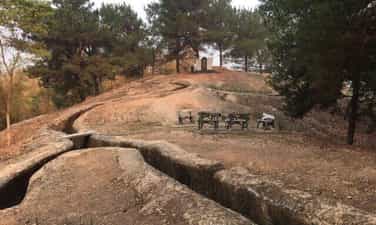
Him Lam is one of the outer locations of the Dien Bien Phu stronghold group, located on Road 41 (now Road 279) next to a small village, the gateway to the Northeast, blocking the road from Tuan Giao to Dien Bien. , one of the strongest resistance centers of the Dien Bien Phu stronghold group. The French colonialists chose to build a defense system here located on 3 hills at a height of nearly 500m with 3 bases in the form of a tripod, supporting each other, with a solid defensive position and lots of powerful firepower. There is also a system of secondary fortifications made of dense barbed wire fences, in addition to being equipped with guns with infrared rays to detect targets at night, tanks, artillery, and air force. Him Lam was identified by our Front Command as the opening battle. To ensure the principle of "the first battle must be won", our troops arranged strong forces, including backup plans; plans for artillery defense, air defense, prevent enemy counterattacks, anticipate basic situations and how to handle them during the course of combat. The task of destroying the Him Lam Resistance Center was assigned to the 312th Battalion. Before we opened fire, all doubts about the defensive capabilities of the Dien Bien Phu stronghold group were extinguished. The French colonialists completely knew in advance the time and plan to attack the Him Lam resistance center of the Vietnam People's Army and had the most optimal preparations. French artillery was also ready and waiting for the opportunity to extinguish any movements that could cause aggression against the base group. But the element of surprise is something they cannot predict. The presence of our heavy artillery on the hillsides surrounding the basin and the construction of perfect camouflaged battlefields brought an unbelievable surprise to the French, for which they had to pay the price with a near collapse. almost completely of the Him Lam stronghold cluster right in the first hours of the campaign. Also in this battle, we witnessed the heroic sacrifice of Mr. Phan Dinh Giot, who used his body to cover the enemy's fire points, creating an opportunity for his comrades to advance and occupy the remaining positions. Along with Be Van Dan, To Vinh Dien and Tran Can, these four heroes stand out for the spirit of "Determining to die for the country and deciding to live" and become examples and immortal names in history books, associated with the war. later won Dien Bien Phu. The rapid fall of the Him Lam Resistance Center caused deep mental panic to not only the soldiers but also high-ranking figures of the Dien Bien Phu stronghold group. Immediately after Him Lam, Doc Lap and Ban Keo were also quickly destroyed and forced to surrender; We have opened the northern and northeastern gates of the Dien Bien Phu stronghold group, continuing to take the next steps towards another important goal, the center of Muong Thanh, gradually destroying the extremely strong stronghold group. This strong. Him Lam resistance center is a component relic of the ancient Dien Bien Phu battlefield relic site. Source: Department of Culture, Sports and Tourism of Dien Bien province
Dien Bien
7769 view
Rating : National monument

Tham Pua Cave
Tham Pua Cave is located at the foot of Pu Hong Cay limestone mountain in Ban Po area, Chieng Sinh commune, Tuan Giao district, Dien Bien province. Dien Bien Museum in conjunction with the Department of Culture, Information and Sports of Tuan Giao district inspected and surveyed Tham Pua cave and collected more than 100 relics including pebble work tools; rough almond-shaped chopping tool with rough chisel on one end; Labor tools made of stream snail shells and traces of charcoal and ash. The archaeological relics discovered in Tham Pua cave have many points very similar to the relics unearthed in Tham Khuong cave and the rocky mountains with Tham Pua cave. All of these artifacts have great historical significance, proving that this is the place of residence of ancient Vietnamese people since ancient times and this land is always associated with the history of existence and development as well as the history of Vietnam. The history of the struggle to build and defend the country of the Vietnamese people. That's why Tham Pua cave is truly a historical and cultural relic of immense value in Dien Bien. During the resistance war against the French colonialists, Tham Pua cave was chosen as the location for the first Command Post of the Tran Dinh Campaign (alias of the Dien Bien Phu Campaign) led by General Vo Nguyen Giap as Commander-in-Chief. (from December 17, 1953 to January 17, 1954). Here, from the early days of January 1954, combat orders were disseminated on a large sand table. The location of Tham Pua cave was chosen as the Command Post with a safe terrain. Next to the cave is a flat land, more than 10 hectares wide, convenient for directing campaigns in mountainous areas. Near the day of opening fire to attack the Dien Bien Phu stronghold group, the command post from Tham Pua cave was moved to Huoi He cave at km 62 near Na Tau village. Tham Pua Cave, the location of the first Command Post in Chieng Sinh, Tuan Giao and Huoi He Cave in Na Tau, Dien Bien District, where an important moment was witnessed in the decision to change the motto "fight quickly". "Quick victory" became the motto "Strong fight, steady advance" of the Dien Bien Phu Campaign Command, headed by General Commander Vo Nguyen Giap, which has become one of the prominent relics of the battlefield relics cluster. Dien Bien Phu. Source: Dien Bien Phu Historical Victory Museum
Dien Bien
8805 view
Rating : National monument

Muong Thanh Bridge
Muong Thanh Bridge, also known as "Prenley" bridge by the French military, is a bridge across the Nam Rom River, built by the French. The bridge is a military project located in the central subdivision of the Dien Bien Phu base group. On November 20, 1953, the French Colonialists chose Dien Bien Phu to build the strongest stronghold group in Indochina at that time with 49 strongholds divided into 3 subdivisions: Northern Division, Southern Division, also known as is the Hong Cum subdivision and the Central subdivision is the most important subdivision. Because the terrain of Dien Bien Phu is a wide basin, surrounded by high mountains, in the central battlefield there is the Nam Rom river flowing through dividing the central area into left and right banks, so the Communication from the central command post with the base groups on the eastern and northeastern hills encountered many difficulties. To solve those difficulties, the French army built Muong Thanh bridge across Nam Rom river. Muong Thanh iron bridge is a pre-made bridge that was shipped from France and assembled in Dien Bien. The entire bridge is 40 m long and 5 m wide. On both sides of the bridge are simple supporting iron bars, without a middle shaft. The bridge floor is paved with wood, and underneath are iron beams that are very firmly linked together to ensure a load of 8-15 tons. To protect this vital bridge, the French arranged bases 509, 508 and 507 on the eastern bridgehead, while on the western bridgehead they arranged a 4-barrel machine gun nest to prevent the enemy from attacking beyond. Cross the bridge to attack the central command post. With such a force arrangement, General De Cat hoped to maintain the bridge and maintain the gateway for reinforcements to the eastern and northeastern peak clusters of the Dien Bien Phu stronghold group. When war has not yet occurred, Muong Thanh bridge is a transport route for raw materials, ammunition, and barbed wire to serve the construction of defensive bases in the East and the Northern subdivision. During the general attack to destroy all the eastern heights at 4:00 a.m. on May 7, 1954, our troops destroyed the entire A1 base. At 2:00 p.m., Regiment 209, Division 312 launched an attack. Base 597 at the beginning of Muong Thanh bridge. The enemy at base 507 raised the white flag to surrender, took advantage of the victory, and rushed forward. Group 312 attacked and destroyed two bases 508 and 509 on the left bank of the Nam Rom river. At these two bases, the enemy resisted weakly and was quickly defeated. extermination. From the east, Regiment 209 advanced straight into the central area of Muong Thanh with Regiment 98 and Regiment 174 close to the central area. In the west, the 36th Regiment entered the last strongholds covering the enemy's headquarters. The 88th Regiment opened the way through the airport and straight into Gono's last lair. Wherever our troops fought, the enemy's white flag appeared, many enemy groups from bases and trenches flocked out to surrender their weapons. At exactly 5:30 p.m. on May 7, 1954, our army's Decisive War - Determined Victory flag fluttered on the roof of General De Cat's bunker, successfully ending the historic Dien Bien Phu campaign. This was the biggest victory in the long resistance war against the French colonialists and American interventionists, and also the most famous victory in the history of the Vietnamese people against foreign invaders. Initially, Muong Thanh bridge was built by the French after parachuting to occupy Dien Bien Phu. In the end, the bridge became a means of guiding the way for our soldiers to attack, planting the Decisive Victory flag on the roof of the bunker of defeated General De Cat. Source: Compiled by Department of Culture, Sports and Tourism of Dien Bien province
Dien Bien
10271 view
Rating : National monument
Pha Din Pass
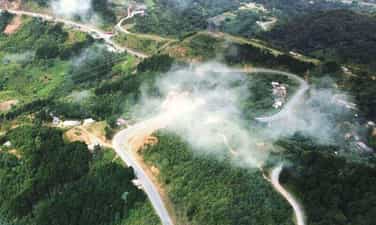
Nearly 100 km from Dien Bien Phu city, Dien Bien province, Pha Din Pass is the boundary between Son La and Dien Bien provinces. The name Pha Din Pass comes from the Thai word "Pha Din" in which "Pha" means "Heaven", "Din" means "Earth", meaning this is the junction between heaven and earth. The pass is 32km long and is located on Highway 6, part of it in Phong Lai commune, Thuan Chau district, Son La province and part of it in Toa Tinh commune, Tuan Giao district, Dien Bien province. The starting point of the pass is 66km west of Son La town, while the end point of the pass is about 84km from Dien Bien city. At Pha Din slope, she carried the burden. Lung Lo Pass, brother and sister sing. Even though bombs and bullets shatter bones and flesh. Don't get discouraged, don't regret your youth. The optimistic poem sketches the spirit of a fiery time 65 years ago. Pha Din Pass has an altitude of over 1,000m above sea level, the terrain is very dangerous with one side being a steep cliff, the other side being a deep abyss "a thousand meters up, a thousand meters down". During the Dien Bien Phu campaign in 1954, Pha Din Pass was one of the important arterial routes transporting weapons, ammunition and food to the front and it became a symbol of bravery for more than 8,000 young people volunteered to "Determine to die for the country." In order to block the Viet Minh's reinforcement line into Dien Bien Phu, for 48 days and nights, General De Castries sent planes to hijack Route 6, in which Pha Din Pass was one of the points that suffered the most bombs and bullets. At the top of the pass there is still a stele recording this historical mark. On the stele, it is written: "This is the place that suffered the most from air bombardments by the French colonialists to block our supply of weapons, ammunition, food, and food to serve the Dien Bien Phu campaign." ". By 2005, the government decided to invest in upgrading National Highway 6 to the Northwest. The new Pha Din Pass was built along the mountainside on the left side of old Highway 6, 26km long. The new pass route has been put into use to help vehicles circulate more safely. The old pass route is now for indigenous people or adventurous tourists to conquer and explore. Source: Dien Bien Province Monuments Management Board
Dien Bien
10717 view
Rating : National monument