Relic point Vietnam
Việt Nam
Nam Tun archaeological site
Nam Tun archaeological site was excavated in Nam Tun cave, Phieng Danh village, Muong So commune, Phong Tho district, now Phong Tho town, Lai Chau province. Before 1945, Nam Tun cave was called Tham Ho Khoai - meaning Buffalo Cave. Nam Tun archaeological relic excavated in 1973, the cultural layer is 1.8 m thick with two layers. The upper layer has ground stone axes, pottery and 3 graves (still retaining remains) typical of the late Neolithic period. The lower class found nearly 200 large, rough-hewn pebble tools, over 700 scrap pieces and 2 graves typical of the late Paleolithic period, representing the oldest cave archaeological relics in the Northwest. belongs to the Son Vi culture. Nam Tun cave site is the residence, burial and tool making of two classes of people, with two cultural layers, the pre-Neolithic period and the post-Neolithic period. In Nam Tun cave, there are 5 ancient tombs and many ancient relics, especially bone awls, found for the first time in Vietnam. Nam Tun Cave is in a quite favorable location. The cave entrance looks west. In front of the cave is a large stream, today people here often call it Nam Phe village (Nam Phe is not more than 100 m from the cave entrance). During the flood season, the stream rises and floods the valley surrounding the cave. The valley is clearer today, and from there, villages of Chinese and Thai people living side by side have sprung up. Nam Tun Cave has a very complex structure. There are places where stalactites are thickly covered. There are places where the stalactites are only coated in a thin layer. This layer is about 0.15m to 0.20m thick. Here you can find cultural relics of many different eras. Full-body grinded axes, ceramic pieces that, although rough, were made on a turntable, decorated with engraved patterns, rope patterns..., a double-edged stone mold, a green bead made of jade - All of them, if the earliest, belong to the late Neolithic period. Through the layer of large pebbles, there is a layer of dark brown soil mixed with many gravels. Here, many crudely hewn pebble tools were found, with different weights and sizes, without a stable shape. Many large scrap pieces were found, products of the tool making process by the hewn method. direct. Nam Tun cave archaeological relic was ranked as a National Archaeological Historical Monument on February 7, 2013. Source: Lai Chau province electronic information portal
Lai Chau
9917 view
Rating : National monument
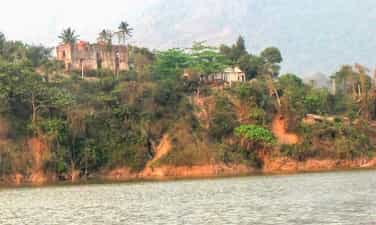
Deo Van Long mansion
Deo Van Long mansion is located in Le Loi commune, Sin Ho district, Lai Chau province. According to the 1983 survey results of the Department of Culture and Information of Lai Chau province, this project began construction in 1916. The documents left behind about the mansion and the Deo family are still very primitive, but They all believe that all the work of choosing the direction, choosing the location for the main gate, the shrine, and the Dam house (ancestral church) were carefully considered by the Deo family, who hired a geographer. Two architects, one French and one Chinese, were invited to design and supervise, and materials were brought from the lowland provinces. Therefore, the architecture of the mansion has Western features blending Eastern looks, and is also a characteristic of Thai construction art and feng shui. The mansion has an area of about more than 1 hectare. Due to the need for defense, welcoming Indochina Government officials and to satisfy their luxurious lifestyle, the Deo family gathered people, soldiers, and workers for the job. Build a villa complex, located in a critical location, at the junction where the Da River, Nam Na River and Nam Lay Stream meet. Behind the mansion is a high mountain, in front is a confluence of rivers (Da River, Nam Na River and Nam Lay Stream) that can control the road to Phong Tho, Muong Te and down to Hoa Binh, Son La, as well as For example, through Dien Bien to Laos, the terrain is suitable for defending and fighting against the enemy. If they fail, they can retreat safely. In 1918, the mansion was completed with 8 main units: Main gate, Dam house, dining room, swing house, water tower, prisoner cellar, forest ghost shrine and another house with L-shaped face ( unknown purpose). In addition, there are a number of other supporting works such as surrounding walls, side gates, driveways leading to the main gate, long and narrow steps leading down to prisoners' cellars, granaries, boat docks, and cemeteries. The main house is built with two floors of red bricks, wooden floors, and a tiled roof separated from stone slabs, often called black stone (when first separated, the soft stone can be cut with a knife, but when exposed to sunlight, the stone will hard as porcelain). Surrounding the castle is a wall over 3m high, built of 40 to 50cm thick slate, very sturdy, with many battlements on the wall to observe the outside. In front of the main house, there is a large yard for dancing when Deo Van Long holds parties and receives guests. It can be said that the palace complex is an "impregnable fortress" of the Thai king. Speaking of Deo Van Long, he is the second son of Deo Van Tri and a lord of the Thai Autonomous Region in the Indochina Federation. The Deo family comes from an aristocratic lineage in Yunnan (China). They are not reactionaries but have lived together in harmony on the land of Lai Chau for a long time. In the late 19th century, responding to the Can Vuong movement, the Deo family stood side by side with the Black Flag insurgents to defend Son Tay and achieved many victories. However, after huge losses in the decisive battle along with suspicion and lack of internal unity, Deo Van Tri signed a permanent ceasefire treaty with the French army. Protected by the French Government, supported with money and weapons, France restored Deo Van Tri to govern the land of Sipsong Chuthai (12 Thai lands). In 1908, Deo Van Tri died, handing over military power to his son Deo Van Khang. After Khang died, Deo Van Long replaced his brother to take power. From here, with his brutal nature, Deo Van Long spread terror to the people in the area. In addition to sending soldiers to plunder and loot the wealth of the people in the area, the Thai king also built large boats, using the Da River as the main transportation axis to transport forestry and land products that he had robbed from the local people. They went to the lowlands to sell opium, tiger skins, leopard skins, bear bile, etc. then brought the goods up to sell to local people. After the liberation of Lai Chau town (1952), Deo Van Long fled to France in exile, and the mansion was destroyed by the people. Up to now, the entire mansion has become ruins, many buildings have been completely lost and the original architectural shape cannot be determined. In 1980, the Deo Van Long mansion was decided by the People's Committee of Lai Chau province to be classified as a provincial relic and included in the restoration plan. However, since 2010, the Son La hydroelectric project has accumulated water, part of Deo Van Long's mansion has been permanently sunk into the river bed, leaving only a few ruins. Source: Lai Chau Newspaper
Lai Chau
8779 view
Rating : Provincial level relics