Relic point Vietnam
Việt Nam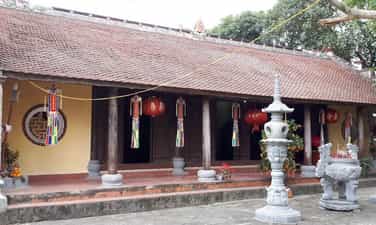
Lang Dau Communal House
Dau village is also called My Doi village, located in An My commune, Binh Luc district, Ha Nam province. Located in an area with a rich history. Here, three sisters A Dao, Nguyen Phuong, and Nguyen Que are worshiped, who commanded the insurgents to fight the Ming invaders in the early 15th century. According to Ngoc Dinh Dau family tree and local legend, the father of the A Dao sisters came from Tien Lu area, Hung Yen, to Bo Xa Binh Luc commune, married a concubine, Thi Huong, and gave birth to A Dao, Nguyen Phuong, and Nguyen Que. At that time, the Ming invaders invaded our country, killed lives, looted property, and caused many tragedies in Trang Co Tho (now An My commune). Faced with the tyrannical actions of the Ming enemy, A Dao discussed with the two children and the villagers to find a way to fight the enemy and eliminate harm to the people. The insurgents of Bo Xa and Co Tho villages decided to attack the Minh enemy base. At midnight on February 14, A Dao divided his army into three groups, coordinating with the villagers of Co Tho to attack and destroy the enemy post. Before departure, the insurgents used banh day as food, used sugarcane as water and absolutely did not use fire. The raid successfully destroyed the enemy post. The people of ancient Tho were liberated and regained peace in their villages. To remember the gratitude to the heroes who saved the people and the country, local people set up temples on the marching routes. Therefore, Dau village has three small temples on three sides, each temple worships a general such as Princess A Dao, King Nguyen Phuong, King Nguyen Que. The people of Dau village also built a large communal house with a curved roof, with elaborate sculptural work, to serve as a place for the community to worship the deities who, over the ages, were all ordained with good words. The special thing is that the village takes February 15 to perform, "Destroying the Minh Binh post, revealing the legend" (opening the demonstration of the legend of attacking the Ming enemy's post). In addition to the above legend, Dau village communal house also worships two Doctors, Bui Cong Bang and Bui Cong Minh. The two doctors of the Le Dynasty made a name for themselves and were symbols of the studiousness of the people of Dau village. During the Ho Chi Minh era, Dau village was also a "red address", where heroic pages of history of the Party Committee and people of Binh Luc district were written. In 1930, the Party cell of My Tho commune was officially established at the temple area in the relic complex of Dau village; started the stubborn struggle movement against French colonial domination. Dau village communal house and elite party members of the homeland protected and protected many senior revolutionary soldiers such as comrade Hoang Quoc Viet (Northern Party Committee), comrades Tran Tu Binh, Pham Mong Sach, and Ca. All... when these comrades returned to lead the revolutionary movement in Ha Nam. In the years 1950-1954, many times Dau village guerrillas surrounded and attacked enemy positions on Route 21, as well as surrounding posts. In March 1954, Company 37 of Ha Nam province and Company 60 of Binh Luc district raided the 9th French battalion, causing them many losses. With the historical and cultural values of Dau communal house and its spread to the heroic revolutionary struggle tradition of the local people, the State has decided to recognize Dau communal house as a historical relic. national level culture; Source: Electronic Information Portal of Binh Luc District, Ha Nam Province
Ninh Binh
7706 view
Rating : National monument

The temple worships National Cong Tran Nhu Lan
From Luong street (church) of Cong Tran Nhu Lan in Thuong Lang village, Ngoc Lu commune, Binh Luc, Ha Nam. This church was built by the family's children, grandchildren, and great-grandchildren in the 2nd year of Chinh Hoa (1681) 46 years after Cong Tran Nhu Lan passed away. The 5-compartment house is made entirely of ironwood, each truss has 4 columns, the main column has a diameter of over 30cm, all column bodies are placed on green stone bases, 3 sides of the church are built with brick walls, in front is a system of ironwood doors running through 5 compartments that can be easily assembled and disassembled. The outer surface of the two upper gables is covered with tiger balm, in front, close to the gable ends, are two copper pillars, making the house more spacious and grand. . All are roofed with male tiles. The roof edge on both gables is covered with 2 needles. These symbols easily show people that the characters worshiped here are more martial than civil. At the Church of the Duke, there are also many diverse worship objects including many types of materials such as wood, precious metals, ceramics, stone, fabric... All wooden altar objects are painted with gilded vermilion, brilliant color. In particular, 15 ordinations from the Later Le Dynasty are still preserved here. The earliest religious record was on December 5, 1769 (the 5th year of Vinh To). Appointed the Duke of Left Admiral Tieu Bao, the most outstanding minister of the country, Tran Nhu Lan. The last ordination was given to Tran Nhu Tiep (7th generation of the Tran Nhu Lan family on July 19, 1769) in the 30th year of Canh Hung). At the church, there are also epitaphs and genealogies from more than 300 years ago, which help a lot in researching the past history of our homeland. Through preserved documents and legends in the area, it is recounted: Tran Nhu Lan was born in 1563 in Kim Lu village (now Ngoc Lu commune, Binh Luc district) into a poor farmer family. His biological father died early and living in a widowed and orphaned situation, he soon had a sense of autonomy to shoulder all the family chores left by his father. From herding buffaloes to collecting firewood to work for hire, he did not hesitate. He was also passionate about practicing martial arts and learning, which helped him have great intelligence and extraordinary health. At this time, the country's situation was chaotic, divided, people were divided, and the people were miserable because of the constant civil war. Tran Nhu Lan, who had a strong and heroic personality, wholeheartedly supported the king and helped the country and its people. Whatever is assigned is completed. For his homeland, Tran Nhu Lan and his descendants always wished for their homeland to change for the better. He and everyone helped repair village communal houses and Buddhist pagodas, renovate and expand Kim Lu market (Chu Chu market). He also built roads, built bridges and culverts, set up ferry wharves for people to travel easily, and encouraged people to declare. destroy waste land to improve lives, buy more land for villagers to cultivate to take care of common matters. Name some hamlets and fields of the village. Organize some annual village activities. From his practical contributions to his homeland, he was respected and worshiped by local people as a village god while he was still alive. After his death, every year in spring and autumn, when the village held festivals, he also enjoyed offerings at the village communal house. Currently, Ngoc Lu pagoda also has many statues of queens who are the wives of the Tran Nhu family. Due to many contributions of money and land during the temple's renovation, they were carved to worship (There are 6 statues). female). From Luong Street, Tran Nhu Lan District was ranked as a national historical relic on January 16, 1995. Source: History of Tran Nhu Family
Ninh Binh
7503 view
Rating : National monument

Co Vien Communal House and Pagoda
Co Vien communal house and pagoda are located in Hung Cong commune, Binh Luc district, Ha Nam province. Co Vien Communal House is a large-scale architectural work consisting of 4 buildings made in both domestic and foreign styles. Although it has been repaired and embellished many times, the monument still retains the artistic lines of the 17th and 18th centuries. In addition to creating solid durability, the architectural structures on the building are also carved. Many vivid themes bearing the sculptural style of the Later Le period such as flanking dragons, dancing phoenixes, leaves turning into dragons, dark clouds, and fire leaves. Along with the beauty of Co Vien communal house's architecture, a number of worship objects with artistic value are also preserved. It is a fairly large desk placed in the middle of the front hall with a unique appearance, reasonable pattern layout, decorated with many folk themes with coherent carved and embossed lines. At the main communal house, there is an altar that is a work of art from the Later Le period. In addition to being decorated with many themes and motifs with elaborate carving techniques, the altar is also covered with a splendid layer of gold, contributing to the solemn atmosphere of the place of worship. Co Vien Pagoda is located adjacent to Co Vien communal house, the literal name is "Linh Quang Tu" (Linh Quang Pagoda). The project consists of 2 main buildings, 8 rooms designed in a nail style, with a flat roof covered with male tiles. In addition, behind there is a 5-compartment ancestral house, in the west is a 5-compartment worship hall with the architecture of the front and back. According to local legend, the pagoda was built during the Ly Dynasty. However, due to time and the influence of natural conditions and war, Co Vien Pagoda has been repaired many times, and now the architecture of the building is completely in the artistic style of the Nguyen Dynasty. Based on the book, Geography of Binh Luc district, Co Vien communal house is the place to worship Nguyen Hoang, general of the Hung Due Vuong period. Nguyen Hoang was proficient in literature and martial arts from a young age, so when he reached adulthood, Nguyen Hoang was recommended to the court by Tan Vien Son saint. Appointed as General Dung, he often escorted the king as he traveled everywhere. Once he visited Co Vien site and saw that the people here were kind and generous, so he immediately built a palace as a place to travel and rest. When the Thuc invaders brought troops to attack, Nguyen Hoang mobilized 28 Co Vien people to follow him to fight the enemy. After successfully resisting the war, he was awarded the title "Hung Suc Cao Huan Hong Liet Dai Vuong" by the royal court, given him a hamlet in Thien Truong district and exemption for the villagers of Co Vien. After Nguyen Hoang passed away, to remember his merits, the people of Co Vien site set up a communal house to worship him as a tutelary god with incense and smoke to worship him forever. Also according to the jade genealogy currently kept at the relic, in addition to worshiping Buddha according to the Mahayana sect, Co Vien Pagoda also worships Princess Pham, the child of King Ly Thanh Tong and his wife Y Lan. Princess Pham was a talented and beautiful person, but when she reached full moon age, she did not think about marriage and only asked her father to set up her own palace in Gia Quat village to advise people to cultivate and do business and help the poor and hungry. , diseases. In addition to worshiping Co Vien pagoda, he also contributed many contributions to the revolution and resistance war to liberate his homeland. The relic site is a reliable base to nurture and protect officers of the Provincial Party Committee, Inter-Provincial Party Committee C, and Ha Nam Provincial Party Committee during the resistance war against the French. Co Vien pagoda is also a place to hide documents and a place to gather forces of local militia and guerrillas to fight back against enemy raids into villages. Source: Electronic Information Portal of Binh Luc District, Ha Nam Province
Ninh Binh
7022 view
Rating : National monument
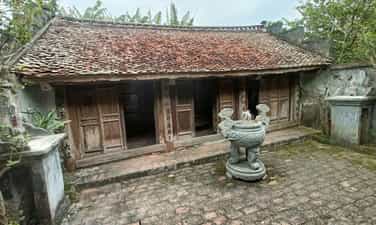
From the street of poet Nguyen Khuyen
From Nguyen Khuyen street is located in Vi Ha village, Trung Luong commune (formerly Yen Do commune), Binh Luc district, Ha Nam province. Nguyen Khuyen Street Tu Area was recognized by the Ministry of Culture, Sports and Tourism as a National Historical Site in 1991. Poet Nguyen Khuyen (1835 - 1909), real name Nguyen Thang, nickname Que Son, pseudonym Mieu Chi, was born on February 15, 1835, in his maternal hometown, Van Khe village, Hoang Xa commune, Y Yen district, Nam province. Dinh. His paternal hometown was in Vi Ha village (customarily called Va village), Yen Do commune, now Trung Luong commune, Binh Luc district. In 1864, Nguyen Khuyen passed first in the Huong exam, and in 1871 he consecutively passed first in the Hoi and Dinh exams. Because he passed first in all three exams, he was called "Tam Nguyen Yen Do" at that time. In 1873, he was appointed Superintendent of Thanh Hoa and then promoted to Thanh Hoa Provincial Police Department. In 1883, he was appointed deputy envoy to the Qing dynasty. Working as an official from 1871 to 1884, he retired to his hometown at the age of 50. With more than 800 works written in Nom and Chinese in many genres such as: Poetry, prose, couplets... Especially the series of 3 poems: Thu Dieu, Thu Am, Thu Vinh, imbued with Vietnamese soul, bringing him up. top position "Vietnamese Village Scene Poet". This is an old house - where the poet lived during his examination period and in his old age after retiring from office. Not only is it a place of worship, the temple also preserves many memorabilia closely associated with the poet's life: 2 book boxes, 2 shins, 2 "Grace of honor" signs that the king gave to Mr. Nguyen Khuyen, a plaque. Photos he took during his lifetime, couplets of Governor Ninh - Thai Bui Uoc celebrating in the fall of 1872; poem given by Dr. Duong Khue in 1871, engraved on the letter... The entrance gate to Tu Duong is built of small bricks (repainted) with three large words "Mon Tu Mon" (students' entrance) above. On both sides of the gate are a pair of embossed parallel sentences, with Chinese characters pressed into the stucco. The steps are built in three levels with a height of 0.40m. The almshouse area has 7 rooms. There are seven compartments in this house, three in the middle to receive guests, two compartments at each gable end are divided by wood to make rooms. These houses are made in the style of gong trusses, columns with a diameter of 0.35m, and simple Nguyen Dynasty-style sculptures. Through a 0.35m wide brick yard with brick walls on both gables, you will reach the second house. In the yard, towards the wall, there are a number of tubs built to grow flowers and ornamental plants. The second house is currently Tu Nguyen Khuyen Street. The house consists of three compartments, four rows of columns, the diameter of the columns is 0.25m, and is styled as a row of gongs stacked on top of beams. The two gables and the back wall are built with brick walls, while the front is a row of wooden doors, each with four doors. This door can be completely removed when there is work to do, making the house airy, bright, and the space expanded. The engraving in the house is not elaborate. In addition to a few leaf shapes and a few simple seal letters, the technique here is mainly diaphragm, horizontal and vertical, and closely structured together. The photo of Nguyen Khuyen wearing a turban and wearing an ao dai, holding a bowl of jackfruit seeds, taken during his lifetime, is solemnly placed in Tu Duong. Source: Ha Nam Electronic Newspaper
Ninh Binh
8028 view
Rating : National monument
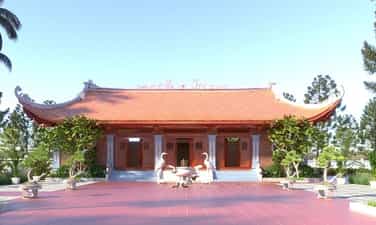
STRIKE OF AN THAI COMMUNITY
Cong Dong communal house in An Thai village, Binh My town, Binh Luc district, Ha Nam province. According to historical records, An Thai village has 3 ancient communal houses worshiping 3 brothers Hoang Cong, Huy Cong and Do Cong. During their lifetime, the three brothers were on their way to fight Ngo Hoang's enemy. When passing through An Thai, they saw that the land had a dangerous terrain and the people were kind, so they ordered troops to station and build trenches and ramparts. Not only did they defeat Ngo Hoang's enemy, but the three of them also achieved many famous victories, chasing away An enemy. Together with Thanh Giong, they escaped the world and flew to the sky on clouds. To commemorate the merits of the Saints, people worshiped and established a village tutelary god, worshiping with incense and smoke all year round. Every year, a festival is held to honor the merits of the saints, reminding children and grandchildren in the village to preserve patriotic traditions, fight against foreign invaders, unite and share together to build a sustainable society. The festival officially takes place from the 10th day of the 2nd lunar month, ending on the 12th day of the 2nd month with traditional sacrificial rituals and holy procession from Cong Dong communal house to Thanh Ca communal house. One of the important rituals and imbued with cultural identity at the Cong Dong communal house festival of An Thai village is the holy palanquin procession. The dragon dancing and lion dancing troupes, the ritual teams, the palanquin carrying force, and the pagoda are all in neat costumes according to regulations to process the palanquin from the Cong Dong communal house to the Third communal house, to the Thanh Ca communal house for the announcement ceremony. . In the procession, the palanquin support force is the force that absolutely obeys the village's regulations. Although anyone can be a palanquin bearer, even those living far away from home, they must meet the following standards: Men from 20 to 50 years old, women from 18 to 25 years old, healthy, clean, and free of trouble. All must fast for 10 days before the festival. Costumes are affordable and people buy them themselves, but they must be of the right style. Men wear white pants, colored shirts, red belts, shoes, and a turban. Women have neat hair, colored ao dai, white pants, pink belt, and shoes. Even men and women holding eight symbols, swordsmen, and palanquin bearers all dress as above. For each palanquin, the person holding the flag is wearing sacrificial clothes. Everyone participating in the procession both incarnates and reincarnates, praying for good weather, good crops, prosperity, and good fortune. On March 2, 1990, Dong Cong communal house in An Thai village, Binh Luc district, Ha Nam province was ranked as a national historical relic. Source: Ha Nam Electronic Newspaper
Ninh Binh
7023 view
Rating : National monument
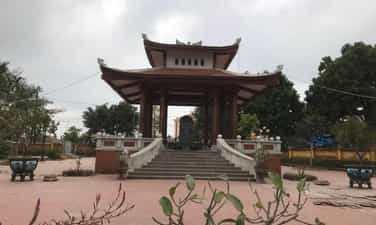
Dinh Trieu Hoi
Trieu Hoi communal house in Bo De commune, Binh Luc district, Ha Nam province is a place to worship two village tutelary gods. One was Cao Mang, a talented general of the Tran Dynasty, and the other was Tran Xuan Vinh, who passed the second doctoral degree and became a mandarin under the reign of King Le Thanh Tong, in the reign of Hong Duc. The genealogies of the two gods are now lost, but the villagers still tell the strange story about the doctor of Le Dynasty Tran Xuan Vinh. Legend has it that, after passing his doctorate, on the way back to visit his hometown by Chau River, his and his parents' boats capsized, the whole family drowned, and his body floated to Bai Nhot. People built a small temple to worship him. The temple is very sacred, so the villagers asked for incense sticks to build a temple to worship him as the tutelary god. Thus, according to legend and logical reasoning, the god Cao Mang of the Tran dynasty must have been worshiped before, and after having a temple to worship the doctor of the Le dynasty, a communal house was established to concubine these two gods. Trieu Hoi Communal House is built in a three-compartment style: the front hall has five rooms, the second palace has five rooms, and the main palace has three rooms. The communal house has been renovated many times and on the upper salary, there is a record of one renovation in the sixth Thieu Tri era. The front hall has five compartments, roofed with male tiles, and the roof is covered with two dragons flanking the moon. The communal house's door frame is made of ironwood. The floor is paved with silk thread tiles, true to the ancient style of Vietnamese communal houses. The door set is made in the style of a table, with sliding bars on top and bottom. The second palace was repaired many times, the carvings remaining only on the first verses, 4-line armpit beams with simple stylized motifs. The three main rooms are designed with ironwood like the front hall, although the carvings here are not as elaborate. Trieu Hoi Communal House is classified as a historical relic because it was here that a demonstration march to demonstrate the prestige of farmers in the area took place on October 20, 1930. This march aimed to mobilize the masses to fight for the abolition of the Cai Luong council, for a reduction in tax collection, to support the Nghe Tinh Soviet and the struggle of farmers in Tien Hai and Thai Binh. Bo De commune was chosen as the location of that protest because the Ha Nam Provincial Party Committee determined that not only was the movement stable, but it was also adjacent to three districts of Binh Luc, Ly Nhan, and My Loc, so it could focus on promoting prestige. The time of the protest was set for October 20 because that was the main session of 3 markets: Bo De, Thanh Thi and An Ninh. At exactly 7 a.m., the drums at the Trieu Hoi communal house rang out, the red hammer and sickle flag flew, and protesters posing as market goers began to stand in line. Under the direction of the Ha Nam Provincial Party Committee and Binh Luc District Party Committee, the protest group went to designated locations such as Diem Tong, Don market (An Ninh), Ba Hang (Thanh Thi), speaking and broadcasting while walking. A petition calling on people to rise up and fight against feudalism, against terrorist attacks, and to support the Nghe Tinh Soviet Union. The protest group is increasingly crowded, starting from Bo De market with 300 people and reaching Vac market (An Ninh) to thousands of people. Faced with the overwhelming revolutionary spirit of the protest, the landowners, tycoons, and lackeys of the French colonialists were very frightened. At 12 noon, the leaders decided to hold a rally at Voc market and then disperse. The demonstration was a complete victory. The victory of the protest is an important political victory, having a great influence on the political struggle movement in the province and the whole country. This event was taken by leader Nguyen Ai Quoc as a proof of the spirit and revolutionary ability of Vietnamese farmers in his report to the International Farmers on November 5, 1931. Source: Ha Nam Province Electronic Information Portal
Ninh Binh
7235 view
Rating : National monument
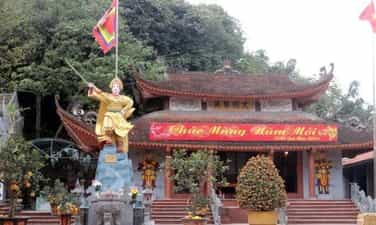
Temple to worship female general Le Chan
According to historical records, Female General Le Chan was born on February 8, 20 early AD. She was born in the coastal region of Quang Ninh; established a hamlet and trained soldiers in the coastal city of Hai Phong, but committed suicide in the mountainous region of Lat Son (now Hong Son village, Kim Bang, Ha Nam). Bearing a grudge against the family, owing money to the country, and listening to Queen Trung's message to save the country, Le Chan brought insurgent troops to follow Hai Ba Trung and set up an uprising flag to expel the Han invaders. Giat Dau Mountain is the highest mountain in the Lat Son region, where on July 13, 43, when unable to defeat the Han enemy, the female general committed suicide and threw herself from the top of the mountain into the valley. People in the area commemorated her by setting up an altar at the foot of the mountain and building a pagoda and temple to worship her. This place still has traces in the Lat Son forest. Le Chan Temple is currently located on Le Chan Street, Hong Son village, the main hall faces south. In front of the temple gate in the past was the Ngan River - a tributary of the Day River, behind the temple was Ong Tuong Hill. The overall architecture of the temple area includes: Main temple, shadow, Son Trang cave, guest house and auxiliary works forming a closed complex with an area of over 4,000m2. On the yard, in front of the temple door, the statue of a female general stands majestically, drawing her sword and facing the old base. The statue was built before the temple was rebuilt (in 2006) and was modeled after the statue of a female general in Thuy An temple (Quang Ninh), her birthplace. The biggest festival taking place at the temple is on the 13th day of the 7th lunar month every year (the day of female transformation). People will organize a festival to commemorate the merits of the female general, and at the same time pray for people to go to the forest and farm smoothly... From July 11, the villagers began preparing to hold the announcement ceremony at the temple, asking for permission to open the festival. During festivals, the temple welcomes many groups of visitors from inside and outside the province to the temple to worship. The main festival day is July 13. Early in the morning, villagers and tourists gathered at the temple to carry out the palanquin procession into the village communal house. Source: Ha Nam Electronic Newspaper
Ninh Binh
7162 view
Rating : National monument
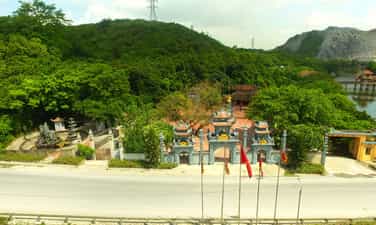
Historical Relic of Lat Son Base
Lat Son base - where Female General Le Chan established a base and died during the uprising of Hai Ba Trung in the Spring of Canh Ty in the year 40 (AD). This was the first uprising of the Au Lac people against the Northern Eastern Han feudal force. The uprising won, Trung Trac proclaimed himself king, named Le Chan "Princess Thanh Chan" and assigned the task: "In charge of internal military authority" stationed at the center of Giao Chi to guard the East Sea. North of our country). Some time later, the Eastern Han Dynasty sent Ma Vien to return with troops to invade us. The Hai Ba Trung uprising failed. Le Chan secretly sent his army to operate in the Hai Phong area (Kien An). ) - Hai Duong - Thai Binh - Ha Nam today. When the war against the Eastern Han invaders fell into a dangerous situation, Female General Le Chan continued to sail with her navy to the south of the Red River Delta and chose the rugged mountainous area of La Son (Kim Bang, Ha Nam) as a base. Keep defending to block the Eastern Han army. The reason Le Chan chose Lat Son as his base is because this place has a dangerous location, its back leans against the bow-shaped mountain range in the West running from North to South; In front, to the East are the Day River and the Ngan River like two moats. The terrain of the base can be attacked when advancing, retreating can be held, and the ends can respond to each other. The defensive battle was built in the valleys in front of the mountain, in caves and rocky hills stretching about 7 km from North to South. The head of the base is in the North, placing an outpost in Moc Bai valley, where the vanguard army is arranged to block the first attack of the enemy... behind Moc Bai is Doc Voi Truot hill where the soldiers are arranged. . Next to the South, Hoc Bac valley has food warehouses and logistics; Be valley (also known as Mo valley), Dau valley where the army is stationed. Diem Cave on the southern slopes of Be Valley is where the headquarters is located. To the west of Dau Valley is Thuoi Mountain (about 225m high), where the watchtower is located, observing the entire base. Near Thuoi Mountain, there is Troop Point Hill, probably a gathering place to count the number of soldiers. Behind Thung Dau are two valleys, Doi Nhat and Doi Nhi, where the two armies are stationed, and Dong Loan valley near Giat Dau, where the fiercest battle took place between the insurgents and the invaders. Ong Tuong Hill, the starting point of the base, is not far from the Ngan River to the west. Some places in the base area such as Don hill, Non Tien, Thung Cha valley, especially Egg Lake, which is several dozen acres wide. When Ma Vien sent troops to besiege and launch many attacks. Female general Le Chan organized resistance both in the valleys and on the Ngan River. Fierce battles took place, our troops fought tenaciously. The enemy quickly destroyed the Moc Bai outpost, poured into Hien valley and Be valley, and drove the insurgents to Dong Go. The final fierce battle took place in Dong Loan valley. Due to not having enough force to defeat the enemy, female general Le Chan and her confidant retreated to Giat Dau mountain. From the top of a high mountain, on a steep slope, Female General Le Chan committed suicide to avoid falling into the hands of the enemy. The confidant General buried Female General Le Chan in a cave in the Lat Son base. Later, to engrave and commemorate the great contributions of Female General Le Chan, Thanh Son people respectfully honored her with the noble title: "Holy Mother", and also sculpted a statue and built a temple in forest gate, on Ong Tuong hill. Nearly 2,000 years have passed, but the land names, mountain names, river names, relics, and relics that exist here are still there, reminding today's generations of historical places associated with the tradition of building the country and protect the country of the nation. With the historical and cultural values mentioned above, the Lat Son base area (with 3 typical locations: Le Chan Temple, Thanh Chan Cave, Giat Dau Mountain) - is both a place that marks historical events. , both a place of worship and honoring the contributions of Female General Le Chan to this land, has been ranked a national monument in 2023 by the Ministry of Culture, Sports and Tourism. Source: Ha Nam Electronic Newspaper
Ninh Binh
7302 view
Rating : National monument
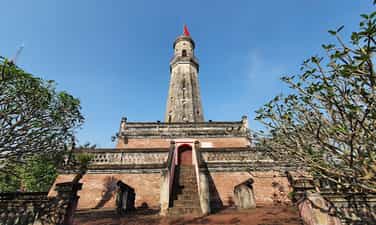
Nam Dinh flagpole
Nam Dinh flagpole is located on To Hieu street, Ngo Quyen ward - Nam Dinh city. In ancient times, Nam Dinh flagpole was also called flagpole. This is one of four flagpoles built in the early Nguyen Dynasty. Nam Dinh flagpole was ranked as a national historical relic on April 28, 1962. The Nam Dinh flagpole today consists of three main parts: the base (pedestal), the body (long body) and the lookout (gazebo). Nam Dinh flagpole is 23.84m high; Located south of the Citadel, about 100m from Vong Cung communal house (now Vong Cung pagoda). The old flagpole yard was built into a ceremony yard, square in shape, with railings on four sides. To the south are placed two cannons. In the east, there is an incense burner commemorating the martyrs who sacrificed their lives in two resistance wars against the French to protect the Flagpole - the Citadel in 1873 and 1883. The base of the flagpole consists of two square bases. The upper platform is smaller than the lower platform. Around the outside of both sides of the pedestal, railings are built. From the lower platform to the upper platform, there are steps up and down. The four sides of the pedestal have railings and four doors. On the second pedestal, there is a door leading into the body of the flagpole (stand body). On the east door are the two words Nghenh Huc (welcoming the morning light); The southern door has two words: Huong Quang (directing according to the virtue of light). Below the pedestal is the Temple of the Flagpole Princess - Princess Nguyen Thi Trinh - the first martyr, who died in the battle of the French invaders to capture Nam Dinh citadel on December 11, 1873 (archaeological discovery in 2002). – Vietnam Institute of Archeology – Le Ba Ngoc). The flagpole's body is 12.65m high and gradually shrinks towards the top with two parts: The lower part is built in an octagonal cylinder, the upper part is built in a circle with a base diameter of 3.25m. In the flagpole's body, there is a spiral staircase, including 54 steps going up to the lookout, illuminated by 32 rosette-shaped windows on the eight sides of the flagpole's body. The lookout part is built in a cylindrical shape with a railing, 4 arched doors and 8 small windows. From the lookout side, there is a small iron ladder to the top of the flagpole. The flagpole is built of old burnt bricks, dark red in color. The square corners of the two pedestal floors are built of a type of brick that specializes in a 450 beveled end, while the 1200 corners of the octagonal pillar body are a separate type of brick. Thanh Nam flagpole is associated with many important historical markers. On March 27, 1883, French warships from the Dao River bombarded the Citadel. At the flagpole, at a height of 11m, to the south, there is a bullet hole 4cm deep and 6cm in diameter. During the period of secret activities, many officials and Party members still used the Flagpole as a place of communication and activities to discuss plans to direct the movement. In 1967, Nam Dinh was fiercely attacked by American aircraft. The top of the flagpole is where the aircraft observation team led by comrade La Vinh Hao - self-defense of the Textile factory is on remote mission. On June 11, 1972, American planes rushed to attack the city of Textile. At 10:10 a.m., they fired rockets and bombs, hitting the Flagpole area, causing the entire ancient structure to collapse. In 1997, commemorating the 43rd anniversary of the liberation of Nam Dinh city, the flagpole was restored to its original form. For nearly two centuries, Thanh Nam flagpole has witnessed many historical events and changes in the country and homeland. This is an ancient architectural work with historical and cultural value and is also a symbol that arouses love for one's homeland, a sense of pride, and an iron determination to protect sovereignty, independence, and freedom. due to the Vietnamese Fatherland. Every year, this place welcomes hundreds of domestic and international delegations to visit and burn incense to commemorate the Flagpole Queen. In 1962, Nam Dinh Flagpole was recognized by the Ministry of Culture and Information as a national historical-cultural relic. Source: Cultural and historical relics
Ninh Binh
8009 view
Rating : National monument
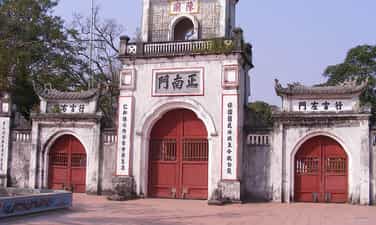
Tran Nam Dinh Temple
Nam Dinh Tran Temple relic area is a temple worshiping 14 Tran Dynasty kings, their families and mandarins with meritorious service. This place is also famous for the incense offering ceremony to open the Tran Temple seal in early spring and the Tran Temple Festival in the eighth lunar month every year. The Tran Temple - Nam Dinh relic area includes 3 main architectural works: Thien Truong Temple, Co Trach Temple and Trung Hoa Temple, with a common design and equal scale. In front there is a five-door gate. Through the gate is a rectangular lake. In the middle behind the lake is Thien Truong Temple. Thien Truong Temple, often called Thuong Temple, is located in the center of the Tran Nam Dinh Temple relic area. The temple was built on the foundation of Thai Mieu and Trung Quang Palace of the Tran Dynasty, which was formerly the family temple of the Tran family. Trung Quang Palace is where the Tran Dynasty emperors lived and worked. The current architecture of Thien Truong Temple includes the front hall, middle hall, main altar, incense burner, 2 rows on the left and right, 2 rows on the left and right of the morning glory tube, 2 rows on the left and right of the bamboo tube, 2 rows of the East and West. There are a total of 9 buildings and 31 rooms. The temple frame is built of ironwood, the roof is tiled, and the floor is tiled. The front hall is the place for worshiping and altars of mandarins who had great meritorious service in the Tran Dynasty. In the middle of the hall are the tablets of the 14 Tran Dynasty emperors. The main temple worships the four ancestors of the Tran family, and their wives and royal concubines. The incense burning court (sutra altar) houses the altar and tablets of the Tran Dynasty's officials. Co Trach Temple, often called Ha Temple, is located on the east side of the Tran Nam Dinh Temple relic site. In the front of the hall are tablets of three trusted generals of Tran Hung Dao, Pham Ngo, Pham Ngu Lao and Nguyen Che Nghia. The middle hall worships tablets and statues of Tran Hung Dao, his four sons, Pham Ngu Lao and other generals. The main altar placed the tablets of his parents, Tran Hung Dao and his wife (Princess Thien Thanh), 4 sons and 4 daughters-in-law, daughter and son-in-law. Burn incense (sutras) and place the dragon's temple, inside there is a statue of Tran Hung Dao and 9 Buddha statues. The space left the tablets of Truong Han Sieu, Pham Thien Nhan and Tran Dynasty officials. Thieves placed the tablets of the Tran dynasty's martial gods, Tran Cong and relatives of the Tran family. Trung Hoa Temple is located on the west side of the Tran Temple relic area. The temple was newly built in 2000, on the foundation of the ancient Trung Hoa Palace - where the Tran Dynasty emperors came to consult with the emperors. In Trung Hoa Temple, there are 14 bronze statues of 14 Tran Dynasty emperors placed in the middle hall and main palace. The incense burning court places thrones and tablets to worship the council of mandarins. Fraudulently worshiping civil servants. Fraudsters worship military mandarins. Every year, at the Tran Temple relic site in Nam Dinh, two major festivals will take place, which are the Tran Temple Opening Ceremony in early spring and the Tran Temple Festival in August, attracting a large number of local people and tourists from all over to attend. , grateful for the merits of the 14 Tran kings and praying for good things. Tran Temple is a special and important historical and cultural relic site of Nam Dinh province, ranked by the state as a national historical relic in 2012. Source: Nam Dinh City Electronic Information Portal
Ninh Binh
10575 view
Rating : National monument