Relic point Vietnam
Việt Nam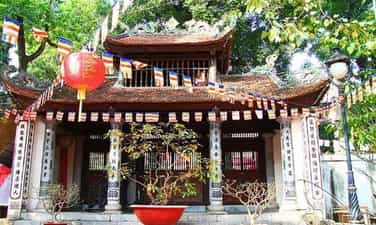
Chan Tien Pagoda
Chan Tien Pagoda (Chan Tien Tu) is located on the top of Tien An mountain, one of the 99 mountains of the Hong Linh range, revered as "Tien An's first scenic spot". The pagoda is located in Thinh Loc commune, Loc Ha district, Ha Tinh province. The pagoda was recognized as a national historical-cultural relic in 1992. Chan Tien Pagoda was built during the Tran Dynasty (13th century). The pagoda has been restored and embellished 3 times, the most recent time being in 2005. Currently, the pagoda has 2 temples to worship the Buddha and the Holy Mother. The Buddhist temple has an area of 50.2 m2, four-pillar style architecture including 3 rooms with yin and yang tiles, 4 masonry columns, and walls on 3 sides. The pagoda worshiping Thanh Mau, also known as "Holy Mau Palace", includes the Upper Palace, the Middle Palace (Dragon Pavilion) and the Bai Duong with a total area of 56m2. In front of the front door of the Upper Palace, there are four Chinese characters inscribed: "Thien Ha Mau Nghi" (The gentle mother in the world) and a picture of a phoenix spreading its wings and flying. In the middle of the top of the roof is a moon shape. The four corners of the roof have dragon shapes and flowers around them. In the palace on the back roof there are 3 Chinese characters: "Thuong Thanh palace" (palace of the Holy Thuong). The central hall is where offerings are placed and where guests burn incense. The four sword heads on the temple roof have 8 dragon images. In the temple, there are 8 cranes. On both sides of the corridor worshiping the Holy Mother's subordinates, there are 2 tiger talismans. The front of the Bai Duong house has three Chinese characters "Ta Phuc Duong" (house of blessings), and the four pillars of the house have parallel sentences hanging praising the merits of the Holy Mother. In Chan Tien Pagoda, there are currently 14 Buddha statues made of jackfruit wood, an altar, an incense burner, an incense burner, drums, drums... Legend has it that when King An Duong Vuong opened the country, he visited this place. Not only is it the place where "Fairies descend to earth", but around this mountain there are also many thrilling and mysterious ancient stories passed down in folklore. Surrounding the pagoda is a natural pine forest that is lush and green in all seasons. Tien An Mountain also has many beautiful caves, such as: Truc Cave, Mai Cave, Thach That Cave, Nguoi Cave... and many ancient stone caves such as: Ban Co Cave, Gia Gao Stone, Coi Xay Stone, and Muoi Twelve Stone. The gate... especially has the tall Wife and Husband stones, towering side by side for thousands of years at the foot of the mountain, facing the East Sea. At the foot of the mountain in front of the pagoda there are Bau Tien and Ban Co Tien along with vestiges such as: Mr. Banh To's footprints, Fairy's footprints, Horse hooves, Ngoc stream, Fairy well, Kim Quy stone (turtle stone)... The historical and cultural relic of Chan Tien Pagoda is also the red address of the revolutionary movement and the contact place of Party organizations during the period 1930 - 1931. At this location, on April 25, 1930, the Party Cell Yen Diem, the predecessor of today's Thinh Loc Commune Party Committee, was established. Chan Tien Pagoda Festival is held every year on the 3rd day of the 3rd lunar month. The festival takes place for 2 days, after the offering of incense, there is a festival with cultural exchange activities, boat racing on Bau Tien, traditional wrestling, beach volleyball, tug of war, playing card games, and playing chess. kites, camping... Source: Ha Tinh Province Tourism Electronic Information Portal
Ha Tinh
6849 view
Rating : National monument
Nguyen Loi Tomb and Temple Relics
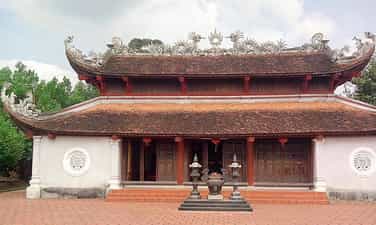
Nguyen Loi Temple is hidden at the foot of Bach Ma Mountain in Bao Thinh village, Duong Trai commune, Huong Son district, now Son Binh commune, Ha Tinh province. Nguyen Loi, a general who participated in many major battles in Do Gia - Huong Son district, established a base to fight the Ming invaders in Nghe Tinh region, was one of 18 comrades-in-arms of Le Loi present at the Lung Nhai oath ceremony. Nguyen Loi is the first son of General Nguyen Nhu Lam, a fourth-generation descendant named Le Loi, now the head of the lineage in Tho Xuan Thanh Hoa. During the reign of King Thieu Binh Phong: scholar and scholar, middle-ranking scholar and public servant, special golden prince, honorary physician, lawyer of the country's military, entered the country from the concubine, captain of the district's capital city. , Nguyen Tuong Cong, Four Thuy Simplified Stars; Died on February 25. Nguyen Loi's wife was the first child of King Le Thai Tong, her name was Yen Quoc, the head of state was a princess, her first name was Minh Tu, she died on January 6. After the victory over the invading Ming army, on March 5, 1428, Le Loi bestowed merit badges on 93 people. Nguyen Loi was ranked 17th among the 93 founders of the Le dynasty, and was given the national name Le. On November 7, 1434, the Marquis of the Royal Palace, Senior General Nguyen Loi, passed away while he was holding the position of Western Path Controller - Left Radiation. Considering his contributions to the cause of helping people save the country, King Le Thanh Tong posthumously awarded him to the ranks of righteous heroes. Nguyen Loi Temple is structured in Nhi style, including 2 main parts: lower palace and upper palace. The lower palace has the most typical horizontal architectural structure, consisting of 3 compartments and 2 gables built with closed walls. The roof is covered with yin and yang tiles, and on the top of the roof there is a decoration of two dragons flanking the moon. The house's interior structure is designed in a four-pillar style "inner is a bridge, outer is a roof" which is very popular in Nghe Tinh villages. The structure of the upper palace consists of 3 compartments and 2 gables, surrounded by walls built with bricks, the roof is covered with yin and yang tiles, on the top of the roof in the middle is embossed with the image of a tiger holding the sun, the 2 ends are the image of a dragon's head embossed with mortar and pieces of porcelain trying to piece together. The interior has altars to Nguyen Loi and his descendants, complete with traditional worship objects. This is a famous historical relic, dating back to the 15th Century, and was ranked as a national historical relic on December 28, 2001. Source: Son Binh Commune Electronic Information Page
Ha Tinh
8538 view
Rating : National monument
Relics of Do Dai Bui Cam Ho Temple
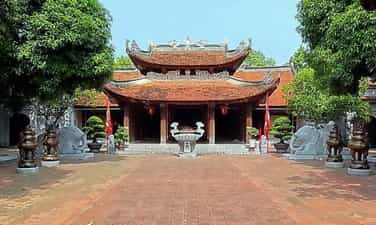
Do Dai Temple, also known as Bui Ngu Su Temple, belongs to Dau Lieu commune, ancient Can Loc district, now Dau Lieu ward, Hong Linh town, Ha Tinh. The relic is located at the foot of Bach Ty Son mountain, one of the 99 mountains of the Hong Linh range. Do Dai Temple relic is associated with a loyal historical figure Bui Cam Ho. He was born in 1380. He had many contributions to the country during the early period of the Later Le Dynasty. He is an honest, straightforward and fair-minded person. When he retired, he still sought happiness for the people with a Thanh Khe irrigation project, turning the poor Ke Treo and Kiet Thach lands into the richest place in the region. Evaluating Bui Cam Ho's merits, feudal dynasties have conferred many titles on him as "Superior God". To remember Bui Cam Ho's merits, after his death (1483), people built an altar and honored him as a Saint. When he passed away, Dau Lieu people built a temple and held a gratitude ceremony. Every year on January 12 is a gratitude day and a traditional spring festival. Do Dai Temple is also a place containing many events of the Soviet Nghe Tinh period. On the old ground, bomb craters have not been leveled yet. The temple had to be built in another place, next to the foot of the nearby mountain, but on higher ground. The old temple was originally quite massive, with an upper, middle and lower palace facing southeast. In front of the temple is a road through the fields, along the road is the top of Khe Vet, the temple area is covered by a dense forest. In the temple there are all kinds of offerings and ritual objects. In front of the door, two men were almost as big as adults, their hair was braided in two swirls, they clasped their hands and knelt respectfully and solemnly. During the war, both the forest and the temple were destroyed by bombs and bullets. Peace was restored, local people voluntarily contributed to rebuilding the new temple. The new temple has a smaller scale with an altar and an altar reused from the old temple, which still has some traces of ancient carvings. Some sacrificial items such as robes, crowns, belts, vestments, and ordinations are kept almost intact. Do Dai Temple is a historical site associated with famous man Bui Cam Ho. In addition, Do Dai Temple also has high artistic architecture. With its historical and architectural artistic significance, in 1992 Do Dai Temple was ranked by the Ministry of Culture as a national historical and cultural relic. Source: Ha Tinh Tourism
Ha Tinh
6656 view
Rating : National monument