Relic point Vietnam
Việt Nam
Ta Con Airport
Ta Con airport relic area is located in Hoa Thanh village, Tan Hop commune, Huong Hoa district, Quang Tri province. With a terrain like a valley surrounded by hills and mountains, Ta Con airport was one of the strategic military bases of the US army in the years 1966 - 1968 at the Khe Sanh battlefield. Near the border, located on National Highway 9 connecting Dong Ha (Vietnam with Southern Laos), this place has an important military strategic position not only on the Quang Tri battlefield but also in the Indochina region. That's why Khe Sanh was used by the US military as a springboard for ground operations. Ta Con Airport was built with the purpose of allowing reconnaissance aircraft to check and point out many raiding, blocking and cutting off Ho Chi Minh routes. In particular, located in the Namara electronic fence system stretching from Cua Tung beach to the border area, Khe Sanh base is determined to be the center. Therefore, the US military built the most solid defense group in the US in the southern region of Vietnam, including bases: Lang Vay, Huong Hoa Military Branch - a cluster of defensive bases at Ta Con airport. . And the Ta Con stronghold cluster - Ta Con airport, is considered a construction center with a scale of 2km long, 1km wide, including many sub-bases with dense fortifications and a large airport. The airport has an area of about 10,000 square meters located in the middle of the base with a runway paved with thousands of tons of aluminum and iron rims. This place became the take-off and landing place for armed helicopters, combat jets and even heavy military transport aircraft such as C130 and C123. In the airport area, there is a base command headquarters, an airport command post, a communication station... and a dense system of defensive fortifications. Outside is a loose wire fence and large minefields. Along with modern military equipment and an important location, Ta Con airport and adjacent high points formed a continuous, mobile defense position, considered by the US and puppet troops at that time to be the most important. the most "hard" position in the entire Khe Sanh base group system. And Ta Con airport is considered by the US military as an invincible fortress Here, faced with the power of the Vietnam People's Army's attacks to liberate Khe Sanh from February to July 1968, the US military had no choice but to launch a tactical withdrawal by air force to saved thousands of American soldiers. Exactly 55 years ago, on July 9, 1968, our army's victory flag flew over Ta Con airport base. The Route 9-Khe Sanh campaign ended with a resounding victory. Khe Sanh - Huong Hoa was the first district of Quang Tri and the South to be completely liberated and created firm confidence for our army and people to advance to complete victory, liberate the South, and unify the country. At the current Ta Con airport relic site, the Museum of Street 9 - Khe Sanh is a place to display hundreds of valuable historical and scientific artifacts. Along with that, the tunnel system, air traffic observation tower... were restored within the airport campus. In 1986, Ta Con airport relics were ranked as national relics. This place also displays outdoor artifacts such as airplanes, tanks, artillery and dozens of bomb and bullet casings. These are the weapons and means of war that the US military used to fight at the Khe Sanh - Ta Con battlefield 55 years ago. Source: Ministry of Culture, Sports and Tourism
Quang Tri
6405 view
Rating : National monument

Lao Bao Prison
Lao Bao Prison Relics, also known as Lao Bao Exile House, is located southwest of Road 9, next to the Se Pon River, in Duy Tan village, Lao Bao town; The monument was ranked National on January 25, 1991. During the feudal period, Lao Bao was a border post of the Nguyen Dynasty, used to guard a part of the western border of the country, and also used as a place to exile criminals with heavy sentences. Since the French colonialists placed protectorate over Vietnam and officially opened Route 9 (in 1904), after 4 years, the colonial government began upgrading Bao Tran Lao during the Nguyen Dynasty into a Lao prison. Bao (1908). When first established, Lao Bao prison had only two rows of wooden cells, tiled roofs, and plastered walls, called Lao A and Lao B; Each row of buildings is 15m long, 5m wide, 2m high and can hold 60 prisoners. Since the birth of the Communist Party of Vietnam, many revolutionary movements broke out throughout the Central region, and the French colonialists increased their hunting, arrests, and suppression of the revolution. To serve the detention of prisoners who are members of the Communist Party. At the end of 1934, they built an additional system of solid prisons made of concrete and reinforced steel, prisons C, D, cellar E; Each prison is 30m long and 6m wide. Detain about 180 prisoners. And the solitary confinement area has 13 rooms, each room is 1m wide, 2.14m high. All buildings are surrounded by a 3.5m high solid wall system and many protective bunkers at the corners and walls. important position. In addition, there are a number of other service works such as: the Commander's House, torture and interrogation house, barracks, warehouse, carpentry workshop, blacksmith workshop... These works are located on an area of more than 10 hectares. Lao Bao Prison is one of the five largest prisons in Indochina, imprisoning patriots and communist soldiers of the Central region. With the harsh climate, wild mosquitoes, flash floods, and harsh prison regimes such as brutal torture and heavy forced labor; Bad food, illness and no medicine have tortured people's bodies to death... Lao Bao prison has become a living hell for prisoners. For nearly 40 years of existence, Lao Bao prison has imprisoned thousands of Communist soldiers and patriots. Through two wars, especially during the war against the US, Lao Bao Prison was almost completely destroyed, many buildings only had part of their architecture remaining such as: Lao C, D, E, Question House. palace, solitary confinement area, some bunkers... but most have been deformed and become abandoned. Today, in addition to the evidence of the crimes committed by the enemy against our nation, there are also a number of new constructions built here to serve the work of preserving and promoting the value of relics such as: Additional displays, Monument cluster, Stele house, Reception house... Lao Bao Prison is living evidence of the crimes of the French colonialists against our people in the first decades of the 20th century. Source: Quang Tri Newspaper
Quang Tri
5170 view
Rating : National monument

The banks of Hien Luong - Ben Hai
The Hien Luong - Ben Hai Banks Relic is located in Vinh Linh district (Vinh Thanh, Vinh Giang, Vinh Son communes, Cua Tung town) and Gio Linh district (Trung Hai commune), Quang Tri province. Hien Luong - Ben Hai is a place that witnessed the pain of division between the two regions and historical events associated with the process of fighting for national liberation and unification of our army and people during the anti-American period - Wei. After the Geneva Accords were signed (July 20, 1954), our country was temporarily divided into two regions, North and South, taking the 17th parallel (Ben Hai River) as the boundary, waiting until October. In July 1956, general elections were held to unify the country. But with the events caused by the sabotage of hostile forces, it took us 21 years (1975), with the blood of soldiers and compatriots, to gain independence and unity. country. The main axis of this monument lies in the North - South direction, with the center being the historic Hien Luong Bridge - the span connecting the Northern Flagpole and the "Aspiration for Unification" monument cluster on the Southern bank. The main components of the monument include: 1. Area on both banks of Hien Luong bridge: Including the following relics: Hien Luong Bridge, Union House, Hien Luong flagpole, North bank loudspeaker system, Hien Luong Police Station, "Latitude" exhibition house 17 and the desire for unity", South Coast Police Station, Monument Cluster "The Desire for Unity". 2. Cua Tung Police Station. Currently, the Cua Tung Police Station location belongs to Border Guard Station 204 barracks. In addition to the function of working and staying, the project also serves national security purposes. The lower floor of the two-story building is partly reserved for the Station's Traditional House, displaying 92 documentary photos and 60 artifacts directly related to the history of the revolutionary struggle of officers and soldiers of Cua Police Station. Tung, posts and stations along the North bank of Ben Hai River and Border Guard Station 204 since 1954. 3. Ferry wharves on Hien Luong River - Ben Hai: Including the following relics: Cua Tung wharf (Ferry A), Tung Luat wharf (Ferry B), Luy wharf (Ferry C), Wharf Thuong Dong and Duc Duc boats. 4. The monument includes: a pedestal and a symbolic artistic complex, with the image of boats rushing forward, despite all dangers and enemy bombs, bringing goods and equipment at night. team entered the battlefield to fight the Americans. In addition to preserving and embellishing relics, the Unification Festival is periodically held at the relic on April 30 every year (normal years are organized by the locality, even years are organized by the Ministry of Culture and Sports). and Tourism and the People's Committee of Quang Tri province co-organised). This is a unique revolutionary festival, unique to the Hien Luong - Ben Hai banks relic site, Quang Tri. With the special values of the relic, on December 9, 2013, the Prime Minister ranked the Hien Luong - Ben Hai banks historical relic (Vinh Linh district and Gio Linh district, Quang Tri province) as a relic. special national monument. Source: Department of Cultural Heritage
Quang Tri
5080 view
Rating : Special national monument
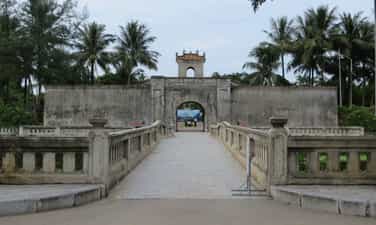
Quang Tri ancient citadel
Quang Tri Ancient Citadel relic is located in the heart of Quang Tri town; nearly 1km northeast of National Highway 1A, about 14km southeast of Dong Ha city - the capital of Quang Tri province today. Quang Tri Ancient Citadel was built during the reign of King Gia Long and was completed during the reign of King Minh Mang, lasting nearly 28 years (1809-1837). The citadel was initially covered with soil, and in 1837, King Minh Mang rebuilt it. with bricks. The citadel's campus has a square shape with a wall circumference of 2160m long, the citadel is 3m high, 13.5m thick at the base, and 0.72m thick at the top. Outside the citadel, there is a wide moat system surrounding it. The four corners of the citadel are four high fortresses jutting out. The citadel has 4 gates: Front, Back, Left, Right. Built with a rolling arch, 3.4m wide, above is a gazebo, curved roof, tiled, all 4 gates are located in the middle of the 4 sides of the Citadel. During the period of French colonial domination, Quang Tri Citadel served as the nerve center of the local and provincial governance apparatus. Quang Tri Ancient Citadel was chosen by the French army as one of the important bases of the military station system. France built an additional prison system, expanded and solidified the prison to serve as a place to detain patriots and revolutionary soldiers in the province and region. Quang Tri Prison at one time became the center of leadership of the revolutionary movement because this was the place where the core core of youth, the first communist soldiers of Quang Tri and many leaders of the Communist Party of Vietnam were detained. The Provincial Party Committee and the Regional Party Committee belonged to the pre-uprising period. Coming to the American - puppet period. After the Geneva Agreement was signed on July 20, 1954, according to the agreement, the 17th parallel was used as the temporary dividing line. A part of Quang Tri from Ben Hai River outward was liberated, the districts from Gio Linh back to Hai Lang became a new type of colony of the American empire. Quang Tri Town, including Quang Tri Ancient Citadel, became the political, military, economic and social center. The US - puppet transformed the Citadel into a military zone, used it as a military warehouse and command center for the entire province, and opened more prisons to suppress the revolutionary movement. The 1972 strategic offensive across the South began. On April 28, we captured Dong Ha and approached Quang Tri town. On May 2, Quang Tri Town was liberated. The victory of the Quang Tri campaign in 1972 fundamentally changed the battlefield situation, pushing the US strategy of "Vietnamization of the war" to the brink of bankruptcy, creating momentum and room for the complete liberation of the South. . Having lost Quang Tri, the US-puppet crazily launched a counterattack to recapture Quang Tri with the code name "Lam Son 72". The number 1 goal is to capture Quang Tri Ancient Citadel. Quang Tri town during the 81 days and nights from June 28 to September 16 was likened to a bag of bombs. On average, every day the enemy mobilized jet planes 150-170 times and B52s 70-90 times to bomb and destroy the town and Quang Tri Ancient Citadel. With an area of less than 3 kilometers, in 81 days and nights, the town and Quang Tri Ancient Citadel had to bear 328,000 tons of bombs and bullets, on average each of our soldiers had to bear 100 tons of bombs and 200 artillery shells. We were determined to keep the city, while the enemy tried to capture the city at all costs. Thousands of soldiers sacrificed their lives here, but their remains have not yet been retrieved because there was too much smoke, fire, and bombs. Their blood and bones have mixed into the rubble and rubble. That's why today at the center of the monument, people built a memorial to form a common grave for thousands of soldiers who fell during these fierce days and nights. This mass grave was designed according to the concept of yin and yang philosophy, which has a profound meaning to escape the souls of the deceased. There are 81 stairs going up, symbolizing 81 days and nights of fighting in Quang Tri ancient citadel. Source: Quang Tri Provincial Museum and Monument Management Center
Quang Tri
6591 view
Rating : Special national monument
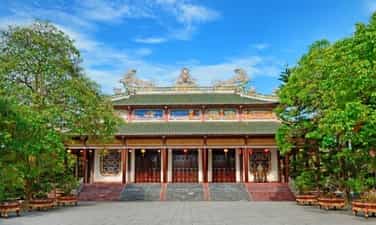
Sac Tu Tinh Quang Pagoda
Sac Tu Pagoda is located on the hills southwest of Ai Tu village in Ai Tu town, Trieu Phong district, Quang Tri province. The pagoda belongs to the Northern Buddhist sect. Sac Tu Tinh Quang Pagoda was originally named Am Tinh Do, built in the early years of the Le Dynasty (1735 - 1739). In the 5th year of Ky Suu, Vinh Huu (1739, reign of King Le Y Tong), Lord Nguyen Phuc Khoat (Vuong Vo) on one occasion went to Quang Tri and was impressed with the scenery of the Buddhist hall and the temple's reputation among the people. So he used his pen to write the five words "Sac Tu Tinh Quang Tu" and then had the plaque made with red lacquer and gilded to give it to the pagoda. From then on, Tinh Do Am was changed to Tinh Quang Pagoda and people from then on became accustomed to calling the pagoda by the name Sac Tu Pagoda (the pagoda ordained by the state), while the Buddhists used to use the combination: Sac Tu Tinh Quang Pagoda. . The pagoda's structure includes a traditional beam house with a match-stacked roof, the main materials used are cement and reinforced steel with a total area of 837m2. The roof is elaborately decorated with stucco art and porcelain pieces. The roof of the pagoda is straight and decorated with dragon patterns. In the temple grounds, there is a Bodhisattva Avalokiteśvara monument (built in 1976) and a number of towers that are the tombs of deceased abbots. The three-entrance gate is built with two roof floors, the upper floor is decorated with a statue of the Dharma Protector facing the pagoda. Behind the three gates, there is a bridge over the lotus pond to enter the front yard of the pagoda and the main hall. The main hall is 31m deep, 27m wide, nearly 15m high, has a match-stacked roof architecture, and the roof is decorated with four sacred animals; On the front, between the two roofs, there are 5 bas-reliefs about the Buddha's life: Birth, renunciation, enlightenment, sermon and nirvana. The main hall of Sac Tu pagoda is in the middle space, the upper class worships the statue of Tam The, next is Shakyamuni meditating with on the left and right are Anan Da and Ca Diep standing. The outermost is Maitreya, the newborn Shakyamuni. The left side worships the statue of Avalokiteśvara Bodhisattva. In front there is a statue of Samantabhadra Bodhisattva sitting on a unicorn. Friends worship the statue of Ksitigarbha Bodhisattva, in front is the statue of Manjushri Bodhisattva riding a dragon horse. The back of the hall worships the statue of Bodhidharma, Patriarch Chi Kha - the founder of Sac Tu Pagoda and two monks, Tuyet Phong and Buu Ngan - who belong to the first generation of abbots at the pagoda. The pagoda has a bronze statue of Shakyamuni Buddha weighing 2,700 kg, cast in 1997, and a large drum made of buffalo leather, with a diameter of 165 cm. In the temple grounds there is a Bodhisattva Avalokiteśvara station. Sac Tu Tinh Quang Pagoda is a famous ancestral temple of Buddhism in Dang Trong, a place where many famous and virtuous monks have been nurtured and trained. The annual death anniversary festival on the 18th day of the second lunar month is held on a large scale with the participation of thousands of monks, nuns, Buddhists in Quang Tri, neighboring provinces and pilgrims everywhere. On November 15, 1991, the pagoda was ranked as a national historical-cultural relic. Source: Quang Tri Newspaper
Quang Tri
5316 view
Rating : National monument
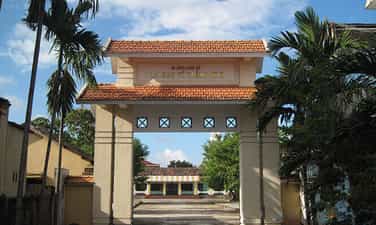
Quang Binh Economic Zone
Located in Giao Te village, Duc Ninh, only 3km west of Dong Hoi city center, the National Historical Site, the Exchange - Experts agency (referred to as Quang Binh Exchange Zone) was established. dated August 21, 1954 and dissolved in July 1988. During 34 years of carrying out its diplomatic mission, this agency has thoughtfully welcomed over 450 domestic and foreign delegations. With its enormous historical role, Quang Binh Economic Zone was recognized by the Ministry of Culture, Sports and Tourism as a national historical site on December 4, 1998. When newly established, Quang Binh Exchange Zone was headquartered in Dong Hoi town. In the early period, the Quang Binh Economic Zone was built in Dong Hoi town. The mission of the Economic Zone at this time was to transport delegations of Southern officers and soldiers to the North, and delegations of visiting and industrial guests. work in the province. In 1964, when the American enemy frantically waged a war of sabotage in the North, in a rain of bombs and bullets, to ensure the transportation and service of guests, Quang Binh Relations Department continuously moved its headquarters to receive guests as well as serve guests. It is necessary to divide communication activities into small groups, located in many localities in the province such as Duc Ninh, Con, Nghia Ninh, Ly Ninh, Bo Trach... In 1970, the Quang Binh Administrative Committee decided to begin building the Exchange Zone at Duc Ninh Hill. The construction was unfinished when the US imperialists returned, continuing to expand the war with increasingly cunning plots. The Economic Zone continued to evacuate to the Con area. In 1973, when the Paris Agreement had just been signed, the Party Central Committee and the Government instructed Quang Binh to urgently build a diplomatic zone in Duc Ninh to serve the international fixed team stationed in Dong Hoi to monitor the Agreement. Geneva. With all the chaos and deprivation of a province that had just escaped a fierce and long war, Quang Binh quickly began implementing new tasks. After only a short time, the Economic Zone was basically completed and put into operation. With a campus of nearly 4 hectares, the Communication Area is divided into many areas such as: motel area for domestic guests, motel area for foreign guests, office, hall, kitchen... In May 1973, 19 international diplomatic delegations and the delegation of the Provisional Revolutionary Government of the Republic of South Vietnam - led by Ms. Nguyen Thi Binh and Mr. Trinh Dinh Thao, Nguyen Huu Tho, Thich Don Hau... met came to the Economic Zone to prepare for the launch of the Provisional Revolutionary Government of the Republic of South Vietnam - Vietnam. In September 1973, the Diplomatic Area was honored to welcome and serve a high-ranking delegation of the Cuban Party and State led by Comrade Black Catsitro. Here, President Phi Den-Catsitro stayed for many days to visit the liberated area in Quang Tri. Also in this economic zone, the top leaders of Laos, Cambodia, Czechoslovakia, the French Communist Party... came to work and stay here. Many high-ranking leaders of our Party and State such as comrades Le Duan, Truong Chinh, Vo Nguyen Giap, and Le Duc Tho once stayed in the exchange area to work. At the Exchange Zone, many historical events have taken place, many guidelines and policies of the Party and State on liberating the South have been initiated... Source: Quang Binh Tourism
Quang Tri
4832 view
Rating : National monument
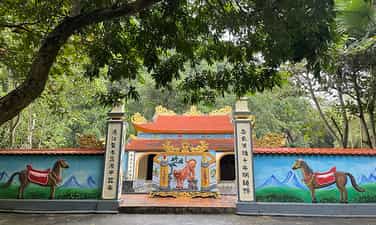
Tomb and church of Admiral Le Truc
The church and grave of Admiral Le Truc are nestled next to the Gianh river, in Thanh Thuy village, Tien Hoa commune (Tuyen Hoa, Quang Binh). Admiral Le Truc was the famous leader of the Can Vuong insurgent army, an example of patriotic loyalty that descendants still talk about today. At the end of the 19th century, Vietnam's feudal society became more and more chaotic, with internal conflicts in Cochinchina and internal jealousy, and French colonialism trying to encroach on Cochinchina. Faced with the power of colonialism with capitalist production methods, the Nguyen feudal court continuously had to sign surrender treaties with France. After the Nguyen feudal court signed treaties to sell the country, all over our country from Tonkin, Central and Cochinchina, the resistance movement against the French emerged strongly, especially when King Ham Nghi issued a decree. In Can Vuong, the uprising spread throughout the provinces, causing confusion and fear among the French colonialists. In Quang Binh, the people's resistance movement emerged loudly, but the most typical was still the insurgent army led by Admiral Le Truc. Le Truc is from Thanh Thuy village, Quang Trach district (now Tien Hoa commune - Tuyen Hoa). He passed the Tao si (Three Giam Doctor of Martial Arts) degree, and was formerly a Hanoi military leader. When enemy general Henry Ryviere defeated Hanoi, Governor Hoang Dieu committed suicide and was dismissed by the court. By the time he received the Can Vuong edict in 1885, uprisings broke out everywhere. Le Truc gathered a number of soldiers and civilians to stand up in the Gianh River region, using Cua Xai in the Thanh Thuy mountain region as a base. Ton That Thuyet gave him the original uniform. From then on, he called on scholars and scholars in the area to follow Ham Nghi against the French. Le Truc's insurgent army grew stronger day by day, its scope of operations became larger, and its reputation spread throughout all areas. Le Truc organized many large and small attacks, raided enemy posts, and captured and killed traitor henchmen. Although the Can Vuong movement failed, patriotic writers and scholars were arrested and killed, but the patriotic spirit, indomitable will and traditional fire always burn brightly in the hearts of the people. the whole country in general and Quang Binh in particular. Around September 28 and 29, 1888, when he heard that King Ham Nghi was arrested and taken to Thuan Bai Fort, Quang Trach, he and a number of other admirals went to pay their respects to the king and surrendered. However, he still refused to accept the new reign name of King Dong Khanh, but only took the reign name of King Ham Nghi. In early 1891, Mr. Le Truc had to reconcile with France to protect the lives of innocent people. The Can Vuong Quang Binh movement ended. Le Truc died in his hometown in June of the year Dinh Meo (1918), in Thanh Thuy village, Tuyen Hoa, Tuyen Hoa, Quang Binh - at the age of 90. Le Truc died in his hometown, but his name is still associated with places such as village names, street names, and street names. His image, merit and unyielding will still live forever in the hearts of the people. In memory of a son who was loyal to the country, filial to the people, devoted and arduous for the sake of his country and country, the people and relatives contributed their contributions and resources to build the church and his tomb in the year 1912. The Tomb Relics and Commodore Le Truc Church were ranked as National Historical and Cultural Monuments on June 21, 1993. Source: Quang Binh Tourism
Quang Tri
6136 view
Rating : National monument
Minh Le communal house relic, Quang Binh
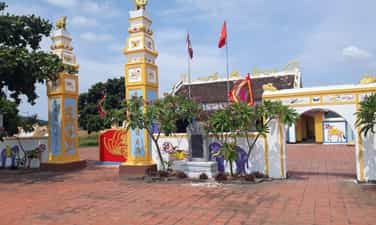
Minh Le communal house belongs to Minh Le village, Thuan Phi district, Quang Trach district, now belongs to Minh Le village, Quang Minh commune, Quang Trach district, Quang Binh. The village communal house is located 400m northwest of the commune People's Committee headquarters, 6km southwest of Ba Don town, 400m northeast of Minh Le station. Minh Le Communal House was built in 1464 under the reign of King Le Thanh Tong, the 5th emperor of the early Le Dynasty. This is a sacred place of worship and also a place of religious cultural activities, and a witness of history. Minh Le village communal house is a place to worship village tutelary god Truong Hy Trong and four ancestors: Truong, Nguyen, Hoang, Tran. He is the second son of Truong Cong Lang - a talented general of King Le Loi. Truong Hy Trong's real name is Truong Cong Chan, following in his father's footsteps, he achieved many great victories in the fight against the Champa army and defending the Thuan Hoa region. He and his three families, Nguyen, Hoang, and Tran, had the merit of recruiting people and exploring the southern land to found Thi Le commune, including 5 villages: Minh Le (Quang Minh), Doai village (Dien Truong-Quang Son), Vinh Ninh. (Hoa Ninh-Quang Hoa), Vinh Phuoc, Vinh Loc (Quang Loc). In 1493, after the battle at Thanh Loi, he was seriously injured and died in his hometown of Minh Le. King Le was extremely sorry for the country's talents, so he ordained him as "Marquis of the Governor". In the second year of Quang Trung, he was awarded the title Trung Lang Thuong General. Through many events, ups and downs of history, Minh Le Communal House still stands the test of time with extremely great cultural and spiritual values for the people. Minh Le communal house was elaborately built from blocks shaped like dragons and phoenixes, to paintings and carvings, expressing colors, especially the arrangement and structure of the doors, consecutive arches, doors sunk into the wall. , doors connecting rooms, thick walls, slightly low in height. Arranged in symmetry, the back pavilion is made in the style of a domed roof that successively forms two arches, the deeper it gets, the lower it gets. The fierce dragon face, rough dragon body, and strong dragon legs represent the powerful force of the Nguyen feudal regime. Minh Le communal house is a relic area including: gate, citadel, courtyard, screen, middle communal house and rear communal house. The central communal house has four roofs, two front roofs and two gable roofs. On the communal house, in the middle of the roof there are two dragons flanking the moon, the two corners of the roof are images of two gliding dragons stylized with flowers and leaves, the dragon's head hidden in the leaves. The four corners of the roof are curved dragon shapes, lifting the roof gracefully. Between the two front roof lines are the shapes of unicorns. The middle space is connected to the two side rooms by three arched doors and is connected to the back pavilion by also three arched doors. Minh Le communal house is associated with many typical historical events of the homeland through the ages. Like during the campaign to establish a party, the uprising to seize power in 1945, or the resistance war against France and America to save the country. In 1992, Minh Le communal house was recognized as a national historical and cultural relic. Every year during the holidays, children and grandchildren in the village from all over the country come here to offer incense. Source: Quang Binh Tourism
Quang Tri
5086 view
Rating : National monument

Trung Thuan War Zone
Trung Thuan war zone is located in the semi-mountainous area of Quang Luu and Quang Thach communes, Quang Trach district, about 5 km west of Ba Don town. Once an important revolutionary base for the army and people of Quang Trach during the resistance war against the French colonialists and American imperialists, Trung Thuan war zone has become a heroic historical testimony and the pride of every person. people around here. Trung Thuan War Zone is a national historical relic site in 1995. The war zone is located on the area of two communes, Quang Luu and Quang Thach. However, the main area still belongs to Quang Thach commune. The ancient Trung Thuan war zone was a valley surrounded by many high mountains and dense forests in a U shape. In the war zone, there was Chop Chai peak, nearly 1,000m above sea level, which became an ideal "observatory" for the soldiers. the whole region. In small hamlets of Trung Thuan such as Duong Khe, Ha hamlet, Xuan Vuong, Kim Thanh, Tam Da, Trung Chinh, Tien Mieu, Dinh Cu, Phu Luu, Van Tap... Archaeologists have discovered many Archaeological artifacts such as: Phu Luu bronze drums, Dong Son type I bronze drums, bronze fish hooks, bronze axes and traces of Lam Hamlet ruins. Trung Thuan during the Trinh - Nguyen conflict period was a large base of the Trinh army north of the Gianh River. Dai Don base (Trung Thuan) along with Roon station and Thuan Bai station were important strategic defense lines of the Trinh army. In the north of Gianh River, the remaining vestiges are Tau Voi well, Vong Bai island... During the Can Vuong period, Trung Thuan was the base of Le Truc's insurgent army in the Can Vuong movement against the French in Quang Binh. Trung Thuan is an important base in the entire Can Vuong base system such as Huong Son, Huong Khe (Ha Tinh), Quy Dat, Khe Ve..., the remaining vestiges are Bai Tap, Bach Thach, Linh Than, Fish pond, Grinding stone slot, Tien Mieu hamlet, Xuan Vuong hamlet. During the resistance war against the French colonialists, the Trung Thuan war zone was not only the place where the District Party Committee, the Administrative Committee and the headquarters of Quang Trach district worked, but also the place where they trained and prepared the uprising forces to seize power. power and additional forces to jointly defend Vo Xa to seize power in Dong Hoi town in August 1954. During the resistance war against America to save the country, Trung Thuan was the rear base of the B70 Corps of the Vietnamese People's Army. This is a transit point in the Ho Chi Minh road system to support human and material resources for the struggle to liberate the South and unify the country. Due to its important role, in 1968 and 1972, the Trung Thuan war zone was heavily bombarded by American aircraft. Local soldiers and people sacrificed a lot, however, with their stubborn will, that still did not shake the revolutionary spirit of the army and people here. With his important contribution, in 1971, Trung Thuan war zone was honored to welcome General Vo Nguyen Giap to visit and summarize the victory of Route 9-Southern Laos. Source: Quang Binh Newspaper
Quang Tri
9965 view
Rating : National monument

Dong Hoi ancient citadel
Dong Hoi Ancient Citadel is a part of the overall historical military relics of Dong Hoi during the Trinh-Nguyen conflict period, built on a key land area of the trans-Vietnam road from North to South. Along with its favorable geographical position, bordering the Nhat Le river and estuary on the East, serving as both a place for reinforcements and contributing to stopping the enemy's waterway attack, this place has marked many events. important history, marking the victory in the Northern advance of the 9 Nguyen Lords, ending 200 years of civil war. At the same time, Dong Hoi citadel also marked many victories of the army and people of Quang Binh through two holy resistance wars of the nation. Dong Hoi Citadel was started construction in the 10th year of Gia Long (1812). The citadel was built on the land where Lord Nguyen Phuc Nguyen built Tran Ninh fortress (also known as Dao Duy Tu fortress - 1631) and Dong Hai fortress (1774) during the Trinh-Nguyen war. At first, the citadel was built of earth, but during the reign of King Minh Mang, he asked a French officer to redesign it and build it with bricks in 1824 according to the tapeless architecture, with the appearance of a military citadel, in the shape of a notch. 4 big zones, 4 small zones in the southwest-northeast and northwest-southeast directions. The citadel has 3 large gates north-south-east, on the gate there are 8-roof watchtowers, the citadel gate is built in a three-door style, connected to the outside by a brick bridge also built in an arch style across the moat. Outside the citadel, about 5-6m from the citadel is a 7 truong (28m) wide moat, the outside of the citadel is covered with additional 3 truong of soil, the citadel is built of bricks, mortar made of molasses mixed with sand, not plastered, bricks are baked. tall, large bricks are also called mallet bricks. In the year of the Tiger, 1842, King Thieu Tri, on his way to the North, passed the Tran Ninh citadel, changed its old name to Dinh Bac Truong Citadel and had it repaired. In 1885, the French colonialists attacked the Central region, Dong Hoi citadel became a place of defense and counterattack of the Nguyen Dynasty's army. On July 19, 1885, the French colonialists attacked Dong Hoi citadel for the second time and the citadel fell into French hands. During the Can Vuong movement, the army and people of Quang Binh joined the insurgent army led by Nguyen Pham Tuan who broke into Dong Hoi citadel three times in January, June, and August 1886 to attack French soldiers, causing them many losses. the seventh. During the anti-French period, Dong Hoi citadel was a place to gather soldiers, a rendezvous point for people who dared to live and sacrifice for the Fatherland. Most of Dong Hoi citadel was destroyed during the French colonial period. In the resistance war against the US, with the purpose of leveling and destroying, turning this place back to the Stone Age to prevent reinforcements from the Northern rear to the Southern battlefield, US imperialism rained down on Dong Hoi. tens of thousands of tons of bombs and ammunition and destroyed part of the ancient citadel. Today, Dong Hoi citadel is only about 1,087m long with 15 zigzag sections in the shape of star teeth. The southern part of the citadel has 2/3 remaining relatively intact, the eastern part of the citadel has 3 gates, 2 south and north bridges have collapsed. Completely, the clearest view from the map is a moat around the citadel according to ancient architecture. Although much destroyed during two wars, Dong Hoi citadel still retains its essential original elements. According to the assessment of researchers, over time Dong Hoi citadel has been a witness and also a historical record marking a period of heroic struggle of the people of Dong Hoi - Quang Binh and the whole country in the fight against enemies. inside and outside to protect the integrity of Vietnam's territory. With its importance as a relic that has existed for more than 200 years, and is an important historical evidence of the land of Dong Hoi - Quang Binh, the Ministry of Culture, Sports and Tourism has classified Dong Hoi as one of 32 works. in the list of key cultural projects invested in from 2001-2010. Source: Quang Binh Newspaper
Quang Tri
5558 view
Rating : National monument