Relic point Vietnam
Việt Nam
Long Ban Pagoda
Co Long Ban Pagoda is also known as Long Dien village pagoda (ancient of An Phu Thuong General, Long Dien District) in Long Phuong village, Long Dien town, Long Dien district. The pagoda is located on a relatively high area. Over 175 years of building pagodas is still almost the state, preserving unique cultural and artistic architectural features. The pagoda was built in the 5th Thieu Tri year - in the year of the Snake 1845 by the two Venerable Hai Chanh and Bao Thanh as the first abbot and was made by the villagers. The architecture of Long Ban Pagoda is magnificent, magnificent with the works of sculpture art with bold tradition, preserving spiritual culture, worshiping Buddha Dharma. "According to the legend, the land of Long Dien has previously had 9 dragons. The temple was built in the style of "tam", with Asian style consisting of 3 parallel houses, which are the lecture hall, the main hall, and the ancestors. The temple campus is flat, wider than 3,000m2 with many ancient trees shiny. The temple gate was built in 1963 with marble. The door on both sides of the arch, above is the bell floor and the empty floor. Above the two pillars are the sign with the words "Long Ban Co Tu". In front of the temple's hall, there was a wooden stilt house, in the statue of "Tieu Dieu Taoist". The roof of the temple is roofed with yin and yang tile, the tile tip has a border of green ceramic ceramic. On the top of the pagoda, there is a statue of "Mesopotamia" and paintings painted with landscape and flowers. The rafters and columns inside the temple are used entirely of good wood. Inside the main hall, in the middle of the worship of Amitabha Buddha, Shakyamuni Buddha, Quan Am, The Chi, Ngoc Hoang, Maitreya, Bodhisattva. The left space worshiped the Bodhi Bodhi monk, the right space to worship Quan Thanh. In addition, there is also the altar of La Han and the cross of Pluto. Behind the main hall is the ancestor church, worshiping the Bodhi Master Dat Ma and the two articles of the Venerable Shanghai Chanh and Venerable Bao Thanh. The 227m2 wide lecture hall, the front has opposite sentences with black paint. Above 3 doors close to the roof are decorative umbrellas, flowers, mountains and human activities. This is a sermon of Buddhism, as a vegetarian dignity to worship the soul, organize the time of repentance. After nearly 175 years of construction, Long Ban Pagoda still preserves many important artifacts such as Buddha statues, Jade Emperor God, Quan Thanh De, 18 Arhat, Dragon God, Dharma ... made of jackfruit wood; 8 stereotypes of Chinese characters on wood; The bells, including Dai Hong Chung with copper with a diameter of 0.4m, 1.2m high, dating back over 150 years. Long Ban Pagoda with a unique beauty of ancient architecture, art sculpture with long -standing spiritual cultural values, located in the middle of the space blended with beautiful nature, the temple becomes a destination of Dharma beliefs of local people and tourists from near and far. In 1991, Co Long Ban Pagoda was recognized by the Ministry of Culture and Sports as a national historical - cultural - scenic monument. Source of electronic portal in Ba Ria - Vung Tau province.
Ho Chi Minh City
3506 view
Rating : National relics.

Bach Dinh
Bach Dinh was used as a resort and a meeting for the Governor -General in Indochina and senior officials of the Saigon government later. This is also the place where King Thanh Thai (from 1909-1910), a king with patriotic thought, against the yoke of the French colonialists. Located in a tall position nearly 30m from the sea level, from the Bach Dinh lobby, visitors will feel like they are on the floor of a building built on the surface of the sea, which can zoom in the center of Vung Tau city. There are two ways to the white palace: a curling line running under the forest of Gia Ty trees for cars up to the lobby. A walk through 146 ancient, discreet steps between two seniors. Bach Dinh with European architecture in the late 19th century, 19m high, 15 m wide, 28 m long, including 3 floors: basement as a place to cook; The ground floor has just made a place to use some ancient artifacts such as: Song Bai Bach Dieu Cheo Phung, the Royal Royal Family dating back to Khai Dinh (1921), African ivory pair of 170cm long ... The floor is more open for resort. But perhaps more impressive are 8 portraits sculpting ancient Greek gods, from faces, nose eyes to nuances are clear, sharp and delicate. Over more than a century, with many changes in time, Bach Dinh still retains the elegance, harmony and majesty rare. From 1991 to now, a part of the White Palace has been used as a museum, displaying 8,000 poison artifacts in the collection of ceramic artifacts with the reign of Khang Hy (17th century) salvaged from the "treasure of Hon Cau". Archaeologists say that these antiques are located at the bottom of the sea for nearly 300 years, up to the time of salvage but still retain the beautiful enamel color. If compared with other collections salvaged in Cu Lao Cham, Ca Mau, Binh Thuan ... Hon Cau Antiques Monks are always considered the most beautiful collection. Bach Dinh not only fascinated the Governor -General in Indochina Paul Douma, senior officials of the Saigon government at that time, but up to now, this is also one of many places to visit in Vung Tau, attracting a large number of tourists to learn about history and enjoy the beauty of nature. With those values on August 4, 1992, Bach Dinh was recognized by the Ministry of Culture and Culture as a national cultural and historical monument. Source of electronic portal in Ba Ria - Vung Tau province.
Ho Chi Minh City
3304 view
Rating : National relics.

Long Phuoc Tunnels Historical Site
Long Phuoc Tunnels in Long Phuoc commune, about 7 km northeast of Ba Ria city center. This is a heroic evidence of our army and people during the two resistance wars against the French colonialists and the American imperialists. In addition, Long Phuoc Tunnels are also a unique creative work of the people's war led by the Communist Party of Vietnam. The monument is recognized as a national monument under Decision No. 34/Culture. Determined on January 9, 1990 of the Ministry of Culture and Information. Due to the important strategic position of the military, the focal point of the revolutionary base of Ba Ria - Long Khanh province, located on the road axis of traffic (highway 52 and 23), the inter -provincial road of Ba Ria - Long Khanh province is always a fierce dispute area between us and the enemy during the two resistance wars against the French colonialists and the American imperialist. In 1948, in order to preserve the forces and consolidate the revolutionary movement and also to ensure the life and property of the people when the enemy swept the enemy, the Long Phuoc Party Committee launched the secret tunnel movement in the whole commune. In 1949, the commune cell had a resolution to build a tunnel to preserve the force and could fight the enemy. Implementing the resolution of the Party cell and Long Phuoc people developed the tunnel system in 5 hamlets: East, West, South, North and Phuoc Huu. The tunnel clusters are connected by the backbone, with a secret tunnel containing food reserves with combat fortifications. The spinal tunnel road is 2-3m from the ground, the tunnel heart is 1.5-1.6m high, 0.6-0.7m wide to ensure travel, easy transportation. The precursor was the basement of Mr. Nam's house with a length of 300 meters, so that in October 1949, the revolutionary armed forces won the sweep of the French enemy to maintain the hamlet and the revolutionary base. In 1963, the tunnel was restored and developed in the southwest hamlet of 200m long, with additional structure of trenches, battle mounds, food warehouses, and ambulance tunnels. The tunnel has become a solid posture for the revolutionary forces to stick to the enemy's attacks and encroachment, typically 44 days and nights (March 5, 01/April 1963). On March 5, 1963, the 61st Battalion was directly commanded by the Head of Long Le district with the guards with M113 cars supporting to destroy Bac Long Phuoc hamlet. Our side maintained the battlefield for 3 days in a row against the enemy's attack. Two medium 445, C20 district soldiers and commune guerrillas rely on traffic trenches, battle docks to consume enemy vitality. On March 8, 1963, the enemy strengthened the 38th Army Battalion, the artillery and the M113 car fiercely swept in Long Phuoc. On April 1, 1963, all traffic trenches fell into the hands of the enemy, the holes of Mai were sealed. The main door of the tunnel was crushed by two M113 cars. The 250 soldiers and people of our people withdrew all to the tunnel, with the command of politician Nguyen Minh Ninh, our soldiers used the mine mines to deliver to comrade Muoi and Sau Bao breakthrough and put in the M113 chain and then the fire point. When the mines explode the car was thrown, our troops quickly crawled up to withdraw the left latch, using weapons massively attacked. Before the unexpected team, quickly the enemy could not back up and had to flee. This is a big battle that has achieved many victories: destroying and injuring 143 enemies, destroying 12 M113 cars and defeating the enemy's sweeping battle with a large force with a large armor, air and artillery support. During the two periods of resistance against colonialism and imperialism, the army and Long Phuoc people dug a total of 3,600 meters of the tunnel, of which 650 meters, 250 meter hamlet, 250 meter hamlet. Experiencing many rain of bombs, tunnel storms and Long Phuoc army and people still standing firmly, worthy of the land of a bombing bullet is still considered an important "milk knob" to nourish the revolutionary movement of Ba Ria - Vung Tau province and deserve the noble title that the State Party offers "the heroic unit of the people's armed forces". Long Phuoc Tunnels are a place to mark the heroic revolutionary tradition, the pride and pride of the next generation, a place to show the policy of the people's wisdom and creativity of the army and people of Ba Ria - Vung Tau province in the two periods of resistance war. Currently, Long Phuoc Tunnels have been restored and embellished by Ba Ria - Vung Tau province, with traditional galleries to welcome domestic and foreign tourists to visit and learn about revolutionary history. Source of electronic portal in Ba Ria - Vung Tau province.
Ho Chi Minh City
3415 view
Rating : National relics.

Pagoda archaeological ruins
The historical site of the temple is a national monument ranked in 2001 (Decision 53/Decision -The Culture and Sports Culture on December 28, 2001), located on the banks of Dong Nai River, on the inter -provincial road road Tan Uyen to Lac An, Tan Hoa hamlet, Tan My commune, Bac Tan Uyen district. Through excavations have formed many collections of artifacts with great historical and scientific value. Stone, ceramic, bronze, ... Especially a collection of 76 copper molds and 68 copper weapons tools discovered in the monument. Pagoda slope became an important collection of artifacts for a peak of development of the prehistoric period of the Southeast region. A diverse and rich monument has many new factors, the economic and technical convergence of society develops high, dating from 2500 to 3000 years today. In particular, there is an animal statue recognized national treasures. Source of portal port of Binh Duong province.
Ho Chi Minh City
3269 view
Rating : National relics.

Archaeological monument of Cu Lao Rua
Turtle island in Thanh Hoi ward, Tan Uyen town, Binh Duong province. Ranking the National Monuments in 2009 (Decision No. 836/Decision -The Culture and Sports Culture on March 3, 2009). The relics dating to two stages (early from 3500 - 3000; late 3000 - 2700 years today). The total area of 277 hectares, height of 15m above the area. This is one of the first discovered archaeological sites in the Southeast, through archaeological excavations discovering Cu Lao Rua is the resident - burial relic area, with many stone, pottery tools and thousands of broken pottery pieces of all kinds and many burial tombs. Over 100 years of research, Cu Lao Rua has made an important contribution to preserving prehistoric cultural heritage and landscape of Binh Duong province. Source of portal port of Binh Duong province.
Ho Chi Minh City
3189 view
Rating : National relics.

Ancient house Tran Cong Vang
The house is located at 21, Ngo Tung Chau Street, Phu Cuong Ward, Thu Dau Mot Town, on a land area of 1,333m2, especially the main part (upper house) is 323m2, auxiliary house (lower house) accounting for 119m2, built and completed around 1889 - 1892. The house was recognized as a national monument on January 7, 1993. The house turned to the South, his back leaned against the hill (where the provincial People's Committee headquarters now), this is also a favorable position, according to the ancient feng shui. In terms of geographical location of the Golden House as well as two old houses of the Tran family in Phu Cuong ward are located near the Saigon River, very convenient for transporting timber trees from the forest. It is known that the ancestor of Mr. Vang used to work as a forest, with a saw and sawn wood. The building is built according to the architecture of Dinh Noi, that is, the horizontal house is on the left of the house, instead of being on the right. This is an improved nail house, there is a part that separates the upper and lower house, the contact between the two parts of a small bridge cut the child's yard to make the two door parts of the lower house in the tip of that yard without blooming at the gable, this door is also specially architecturally, looking like some Chinese temple gates, but the owner has launched in the temple style of India. Like many other houses, the Golden House has a frame in the style of a cross, but there are 8 punches, 8 decisions in the two wings. The set of treasures, treasures, mortars are skillfully peeled, finished bending and creating ledges, the trusses are meticulously and meticulously touched, the leaves are straight in the third column. The whole house counted 48 round pillars, all stood far away. The decoration inside the house is the most interesting visitors, which is the elaborate carved, from the foot of the column to the roof, tables and chairs of chairs, worshiping the door frames of the cage ... Hoanh Phi, Lien, opposite, the paintings of the four jars, the players ... all are carved, painted with elaborate nacre nacre skillfully, making the house magnificent but solemn. In general, the carved motifs here are often estimated, symbolic, which expresses the desire to a peaceful, happy life, and a human life, morality ... The lines focus on flexibility and softness. The carved images include plants, flowers, birds, items, geometric roads. Particularly, the player hanging on the right altar from the inside to look at Tung Loc, Ma Duong has two verses of Chinese characters to create an elegant, elegant and pepper look. Distribution of the ground of the house, first of all the house, the house has 5 spaces of two wings, the worshiping part, receptions, the rooms to live and store the furniture of wealth are clearly divided. The worshiping part occupies three compartments based on the principle of the left space of the home of the host, the right to worship grandparents, the altar between worshiping grandparents is higher than being a fairy. Each altar consists of a nacre altar, above is a five -piece map, inside is a taste or portrait of the deceased, close to the silk wall is the worship, on the top, the opposite sentence, the head of the church somewhat touched "Mesopotamia of Chau Chau" and the player. Two spaces on both sides are the bedroom of the owner, behind the wall of the altar is the chamber containing furniture ... On the altars are the worshiping pages that have placed the articles, the Holy Emperor, the Earth, the East Tru, the Destiny, the Holy Spirit, the Fortune. The reception of guests consists of two base hearts (ie from the second to the fourth column column), this place has tables and chairs to receive guests, including in the middle of a large round table, marble lined table surface, on the table, the bowl of Buu bowl (eight antique weapons), around the table, there is a chairs with sophisticated carvings and rich symbolic meanings. The two sides of the round table are rectangular tables in the style of a chairs. At the beginning, there are two mango box -shaped tables, surrounded by modern chairs, all the tables and chairs are wooden. Along the partition between the reception and the church, there are small square tables above with porcelain dishes, and the owner here puts a genealogy to generalize the things of the people of them. At the two ends of the house, there are also places, on the left on the altar for the owner, there are couples on both sides, small quartet paintings, couplets and quartet paintings. In particular, the front of the bedroom placed a glass cabinet, inside contained many precious dishes such as neck money, sports hats, clothes for the bride when returning to her husband's house, in the old way ... The lower house was a horizontal house, stored in a transparent way but simpler than the upper house. Horizontal houses are used to receive ordinary guests, a place for family activities, cafeteria, kitchen, ... in front of the horizontal house is the garage towards the gate door. The front yard planted many pots of ornamental flowers, ornamental plants ... Add the ancient beauty of the house. The Golden Instrument is both artistic - humanistic bold Vietnamese traditional culture; At the same time, affirming the sculpture and carved technique has a long tradition in Binh Duong. Decorative artifacts and household items are still many and most are antiques. The entire architecture of the house and artifacts inside, showing us the activities of the rich family in the late 19th century, showing the development of the lives of Vietnamese residents in Binh Duong. Source of portal port of Binh Duong province.
Ho Chi Minh City
3233 view
Rating : National relics.

Ben Thanh market
The history of Ben Thanh Market is associated with the ups and downs of Saigon - Cho Lon urban area. The market was built in 1912 and has undergone many restorations and relocations to get its current appearance and position. Initially, the market was located on the bank of Ben Nghe River, where there was a river wharf for soldiers and people to enter and exit Gia Dinh citadel (Quy Thanh, Bat Quai citadel), so it was called Ben Thanh Market. After the uprising of Le Van Khoi (1833-1835), Gia Dinh citadel was demolished, Ben Thanh Market was also deserted. After the French attacked Saigon (February 1859), the market was completely burned down. In 1860, the French rebuilt Ben Thanh Market at the old location. After many restorations, the market gradually became more spacious with a system of brick columns, iron ribs, tiled roofs, etc. At the beginning of the twentieth century, the French rebuilt the new Ben Thanh Market at today's location between 1912 and 1914, with the iconic clock attached to the south door. In front of the main door (south door) is Ben Thanh Market Roundabout, also known as Dien Hong Square, Quach Thi Trang Square... In 1952, when renovating the market, 12 bas-reliefs of the Bien Hoa fine arts workshop were installed at the four market doors. Since then, the image of Ben Thanh Market has become familiar and close, becoming an urban cultural memory of the city. Source: Ho Chi Minh City Law Electronic Newspaper
Ho Chi Minh City
4792 view
Rating : City-level relics

turtle Lake
Turtle Lake in the center of Ho Chi Minh City is officially called International Construction Site, which is the intersection of Pham Ngoc Thach, Tran Cao Van and Vo Van Tan streets. There are many restaurants, bars, and cafes around the lake, so this area is always bustling from morning to night. The original location of Turtle Lake in 1790 was the Kham Khuyet citadel gate of Bat Quai citadel (also known as Quy citadel) built by order of King Gia Long. However, after the rebellion of Le Van Khoi (1833-1835), King Minh Mang destroyed Bat Quai citadel and built a smaller citadel named Phung citadel (Gia Dinh citadel). The location of Kham Khuyet gate became a point outside the citadel and directly connected the road outside the west side of the citadel to the river wharf (Road No. 16 - Catinat and now Dong Khoi). After capturing Saigon in 1859, the French destroyed the entire Gia Dinh citadel. In 1878, a water tower was built at the location of Turtle Lake today to serve the needs of providing drinking water for residents in the area. By 1921, the water tower was demolished and the road was expanded to Mayer Street (now Vo Thi Sau Street). From then on, this location became the intersection of routes as it is today. Also at this location, the French built a bronze monument of three soldiers with a small lake, to mark the invasion and symbolize the French mastery of Indochina. Therefore, people often call it Ba Hinh Construction Site. These monuments existed until 1956 when they were demolished by the Government of the Republic of Vietnam, leaving only a small lake. The intersection was also renamed Soldier Field. After the French withdrew from Vietnam, the Soldiers' Construction site became a traffic circle of Duy Tan (now Pham Ngoc Thach) and Tran Quy Cap (now Vo Van Tan - Tran Cao Van) streets. The time when Turtle Lake was built has not been determined exactly, but some documents say it was built in 1965-1967. The designer is architect Nguyen Ky. In the years 1970 to 1974, Turtle Lake was restored and embellished by the government of the Republic of Vietnam. This includes the addition and adjustment of 5 tall concrete columns shaped like five hands spreading out like flower petals supporting a pistil. This new project also includes a traffic circle with a diameter of nearly 100 meters, decorated with green trees and a large octagonal fountain with 4 spiral walkways leading to the central area and the shape of the lake. alloy turtle statue on the back of a large stone stele. Therefore, the folk name is Turtle Lake. Initially, this intersection was named Freedom Fighters Construction Site, and in 1972 it was renamed International Construction Site. However, in early 1976, the stele and the turtle were destroyed in an explosion. Although the turtle was no longer there, people were still familiar with the old name instead of the official name. Due to its rather strange architecture, Turtle Lake is associated with the legend of protecting the dragon's veins of President of the Republic of Vietnam Nguyen Van Thieu. According to author Huynh Ba Thanh's account in the book The Turtle Lake Case (Tuoi Tre Publishing House 1982), there is an oral anecdote that in 1967 when General Nguyen Van Thieu became president of the Republic of Vietnam, invited a famous Chinese feng shui master to examine the situation at the Independence Palace. This feng shui master praised the palace for being built on a dragon vein. This dragon has its head located right at the Independence Palace (so the Independence Palace is also called the Dragon Head Palace) and its tail is located at the Soldiers' Square. Although prosperous, the dragon's tail often struggled, so his career was not sustainable. It was necessary to cast a large turtle to restrain the dragon's tail from struggling, in order to maintain the presidential position for a long time. Therefore, Mr. Nguyen Van Thieu listened and built an octagonal lake, modeled after the eight trigram formation, a feng shui symbol often used to ward off ancient people, and placed a large turtle. cast in bronze right in the middle of the lake. For that reason, many people believe that the tall tower architecture resembles the shape of a sword or a giant nail hammered into the lake to hold the dragon's tail, and the lake grounds are shaped like a bagua, with a yin and yang shape in the middle. . Source: Vietnamese newspaper
Ho Chi Minh City
4731 view
Rating : City-level relics

Chi Hoa detention camp
Chi Hoa Prison, also known as Chi Hoa Prison, located in District 10, Ho Chi Minh City, is a prison built by the French in 1943 to replace the Saigon Prison at the corner of Ly Tu Trong - Nam Ky Khoi Nghia streets. The project is said to have been initiated by the Japanese after the French coup to detain prisoners, but when construction was not completed, they withdrew from Vietnam. After that, the French continued the unfinished work. Almost all materials such as cement, iron, and steel were shipped from France. On March 8, 1953, when the Chi Hoa Prison was completely built, the Saigon Grand Prison was demolished. In addition to some released prisoners, the remaining about 1,600 people and the guillotine were transferred to Chi Hoa Prison. With an area of 7 hectares, Chi Hoa Clinic has 3 floors and 238 rooms. There are two rows of houses for female prisoners. This place used to hold political prisoners against the French colonialists and the Republic of Vietnam regime. Today, this place is reserved by Ho Chi Minh City Police for defendants in cases in the area. Chi Hoa Temple was designed and built by a Japanese architect according to the five elements and eight trigrams theory and is considered a special architectural work. It harmonizes the basic characteristics of French architecture: solid, discreet, cool, while also carrying the mysterious yin and yang of the five elements of the East. The examination has an octagonal shape with 8 equal sides and 8 corners representing the 8 hexagrams: Can, Khon, Chan, Ton, Can, Kham, Doai, Ly in the I Ching. The prison has 8 prison cells, built in a square octagon. Some research documents say that Ho Chi Hoa was built based on the eight trigrams of Confucius Zhuge Liang during the Three Kingdoms period. The 8 hexagrams correspond to the 8 battle gates: Retirement - Birth - Thuong - Do - Canh - Death - Kinh - Khai. Each side of the trigram formation is a zone, the back is sealed on the outside while the inside is full of iron bars and each zone has 4 prison cells. Chi Hoa has only one entrance, so people call it "death's door". Through this door is a tunnel system designed according to the palace. If not guided, the person entering will be disoriented, like falling into a maze, unable to find their way out. In the middle of Kham Chi Hoa is a large octagonal yard divided into 8 small triangles, with many trees and a clean and airy lawn. In the middle is a guard tower more than 20 meters high, on top is a water tank bulging like a sword stuck straight down. Standing here, the guards can easily observe all the cells. With the architecture of Chi Hoa's eight trigram formation, once prisoners enter here, it will be difficult for them to escape. History so far has only had 3 successful prison escapes. The first case is the revolutionary soldiers at the time of the Japanese coup against France in 1945, the second is the bandit general Dien Khac Kim in 1972 and the third is the notorious death row prisoner Phuoc "Eight Fingers" in 1995. For a long time, Chi Hoa Examination has been associated with mysterious anecdotes. It is rumored that the guard post in the middle of the cemetery is the sword guard. No matter how cunning the criminals are, all their tricks here will be neutralized by this "spiritual" sword. This sword is the "heart" of the building. If it is pulled up, the entire "arrangement" will break. Another thrilling story that is still passed down by word of mouth is that because many people died in Chi Hoa Prison, the negative atmosphere here was very heavy. Therefore, heaven often sends thunder and lightning to break a corner to open a door of birth, allowing resentment to escape and the dead to escape. There was information that the government of the Republic of Vietnam had brought back a very skilled geography teacher to partially solve this "battle". In fact, one of the eight roofs of the octagon has been leveled, breaking the perfection of the "eight trigrams", according to heaven's will, opening a door of Birth for souls to fly away. Meanwhile, some scientists believe that underneath the building there may be an ore mine that causes lightning to often hit Kham Chi Hoa. On the grounds of Chi Hoa Prison, there is also a church (today used as the Camp Hall) built by the French as a place to "baptize" prisoners before being executed. In addition, to free the "negative energy", in 1954, the prison warden of Chi Hoa Prison built a temple outside the "eight trigrams" (but still within the prison grounds) to place a Buddha statue. Later, the temple no longer existed, the Buddha statue now lies on a small lake. Source: Vietnamese newspaper
Ho Chi Minh City
5806 view
Rating : National monument
Cho Quan Hospital Detention Center
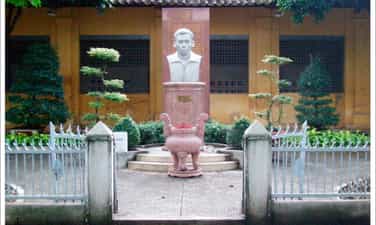
Cho Quan Hospital (now Tropical Diseases Hospital) is the oldest hospital in Saigon, completed in 1864. The hospital specializes in treating infectious diseases and mental illnesses. Due to the need to treat mental illness, a separate area was built in the hospital to house mentally ill patients. That patient confinement area has now become a cultural and historical relic. During the invasion of our country, the French colonialists arrested and brutally tortured many revolutionary soldiers and patriots. Because they needed to exploit information, they took the prisoner to the mental patient ward of Cho Quan hospital for both moderate treatment and continued questioning. Since then, the prison for mentally ill patients has become a place to detain sick prisoners. In 1931, comrade Tran Phu - the first General Secretary of the Indochina Communist Party, now the Communist Party of Vietnam, was detained by the French colonialists and breathed his last breath here. On April 18, 1931, comrade Tran Phu was arrested at 66 Champagne Street (now Ly Chinh Thang Street) - the Party's printing agency. After detaining and brutally torturing comrade Tran Phu in many different detention camps, they transferred him to Saigon Large Prison to prepare for trial. At this time, comrade Tran Phu's health was increasingly deteriorating. The French colonialists wanted to maintain his life to exploit the Party's secrets, so on August 26, 1931, they took him to the detention center at Cho Quan hospital for treatment. On September 6, 1931, comrade Tran Phu breathed his last breath here. The comrade's body was placed in his personal room. Comrades in the prison held a memorial service for their comrades in this room. All political prisoners in the prison stood along the hallway to see off comrade Tran Phu - the first General Secretary of the Party. In addition to comrade Tran Phu, during the two resistance wars against the French and the Americans, many other revolutionary soldiers such as Tran Nao, Ha Huy Tap, Tran Bach Dang, and Nguyen Van Troi were also detained in this prison area. . Today, the prison area in Cho Quan hospital is open to welcome visitors. The relics still bear traces of shackles and shackles under the colonial regime; as well as the imprints of the indomitable and indomitable fight of revolutionary soldiers with bloody fighting slogans still clearly visible on the walls. From the hospital gate, entering the prison area, on the right side, the architectural plan of the prison area is U-shaped. The horizontal row of the U-shape is 32m long and 12m wide. Two equal vertical rows, each 14m long and 7.5m wide. Outside, in front of the prison door, there is a small guard room with a tiled roof. Surrounded by a 2.5m high brick wall. Entering from the prison door, first is a large cell, holding about 20 people. Next are 2 large cells and 2 small cells. In the middle of the walkway, an additional wall was built from the door to the end of the block, separating the cells on the left and right. To the left of the prison door, 10.5 meters away, are two equal cells, each room 10.75 meters wide. Near the end of the row there are 2 small individual cells, with an iron net on the roof. At the end of the row there are 3 small bathrooms. In general, the prison area in Cho Quan hospital is a fairly intact historical relic. In recent years, District 5 has invested nearly 700 million VND to restore the first phase of the monument, making it one of the places for political activities and traditional education for the young generation. After inauguration, the Ho Chi Minh Communist Youth Union of District 5 is responsible for managing, introducing and guiding visitors to visit the monument. The relic has a great educational effect on the young generation, from comrade Tran Phu's shining example of courage, steadfast revolutionary spirit and compassion for comrades and comrades. This relic will forever remind the next generation of the advice of the first General Secretary of the Party: "Keep the will to fight". The prison area in Cho Quan hospital was recognized as a historical relic by the Ministry of Culture on November 16, 1988. Source: People's Committee of District 5, Ho Chi Minh City
Ho Chi Minh City
4540 view
Rating : National monument