Relic point Vietnam
Việt Nam
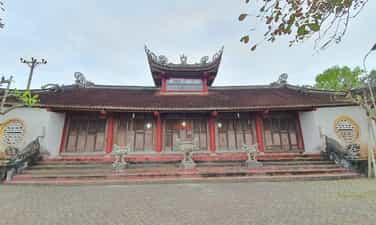
Ca Pagoda
Ca Pagoda in Tan An commune (Thanh Ha) was recognized as a national historical, cultural, architectural and artistic relic in 1994. It also preserves many precious antiques. Ca Pagoda's literal name is Dai Tu Kham Thien Tu. According to history books, the pagoda was built during the Later Le Dynasty and restored on a large scale in 1881. Ca Pagoda worships King Ly Nhan Tong. Legend has it that King Ly Nhan Tong once stationed a garrison here to fight the enemy. The pagoda also worships Buddha Emperor Tran Nhan Tong, whom the people here respect as a Saint. Therefore, Ca Pagoda has two functions: both a temple and a pagoda. The pagoda has a nail-shaped architecture including 5 front halls 21 m long, 7.5 m wide and 3 back halls 10.9 m long, 8.5 m wide. The difference of Ca Pagoda is that the front altar has temple-like architecture, soaring corners, and dragon-shaped reliefs delicately carved by the skillful hands of ancient artisans... Every year on October 30 and November 1 of the lunar calendar, Tan An commune holds an incense offering ceremony to commemorate Buddha Emperor Tran Nhan Tong and King Ly Nhan Tong, praying for favorable weather, favorable production, and a prosperous life. People's lives are increasingly prosperous. On these days, many people who are far from home also come to temples. Since being ranked as a national historical cultural, architectural and artistic relic, the pagoda has been restored and renovated at a cost of more than 2 billion VND. This amount of money is contributed by the people here and tourists from all over. People have contributed thousands of work days to repair and build construction items within the temple grounds. Up to now, the relic site has become more spacious but still retains its sacred and ancient soul. The pagoda now has a three-entrance building and restored a number of statues and worship objects. In the temple yard, many ornamental plants and flowers are placed, creating a quiet, fresh space that attracts tourists. Ca Pagoda also preserves many precious antiques. The person who was instrumental in building and restoring some items of the pagoda is monk Thich Quang Nghiem, currently the abbot of the pagoda. Previously, the pagoda did not have an official abbot but was assigned to the local management. In 2012, Master Thich Quang Nghiem took over the temple, and there were still many abandoned places on the campus. After taking over, monk Quang Nghiem classified each antique and carefully preserved it. The pagoda still retains the nearly 2.7 m high Amitabha Buddha statue (not including the pedestal and lotus). This is one of the largest ancient wooden statues in the country. The statue was built during the Nguyen Dynasty, joined together by pieces of wood, so at first glance it is difficult to recognize the joints. Buddha statue in meditating position on lotus. Although it has been around for a long time, the paint and jackfruit wood material are still durable over time, showing no signs of rot. This place also preserves a 5-storey stone tower right in front of the street. The two upper floors of the stone tower are curved in the shape of apricot blossoms, the four corners are curved in the shape of a dragon's head, and on the top of the tower is a sepal placed on blooming lotus petals. This is also a rare ancient stone tower that few pagodas have. According to the village elders, the stone tower is where the relics of Buddha Emperor Tran Nhan Tong are placed. In the temple grounds, there are also many tomb towers of abbots over many generations, carved with elaborate lines. The pagoda also has 5 valuable stone steles, dating from 1874-1933, recording traces of each historical period in Chinese. Next to the pagoda's well is a pair of stone crocodiles from the 17th century, carved by ancient artisans with exquisite lines. The pagoda still preserves 11 ordinations from the Le and Nguyen dynasties and a bronze bell 1.2 m high and 56 cm in diameter. On the bell are engraved hymns praising the beautiful scenery of the pagoda and the meritorious person who cast the bell. Source Electronic information portal of Thanh Ha district, Hai Duong province.
Hai Phong
3807 view
Rating : National monument
Bach Hao Pagoda
Hao Xa Pagoda or Hao Pagoda (called in Sino-Vietnamese, Bach Hao ancient Zen pagoda), in Hao Xa village, Thanh Xa commune, Thanh Ha district, Hai Duong province; was built during the Ly Dynasty. This pagoda has a charming river landscape, with many unique features of the Red River Delta, and was ranked as a national historical relic in 1993 and 2015; Hao Xa pagoda festival is a national intangible cultural heritage. Hao Xa village, Thanh Xa commune, Thanh Ha district is located on a narrow strip of land along Cua Chua river - a branch of the Huong river. The land of the village resembles the shape of a phoenix with its wings spread. Hao Xa Pagoda is located on the head of a bird with a white plume, so its name is Bach Hao, meaning Bach Hao Pagoda. Local people call it Hao Pagoda for short According to genealogical records, the pagoda was built in 1011 during the reign of King Ly Thai To. At first, people in the area built a pagoda called Hao Pagoda with a scale of three compartments, mainly made of bamboo thatch and covered with palm leaves to worship Buddha. Later, through dynasties, the pagoda was rebuilt and expanded to worship Buddha, King Tran Nhan Tong, village tutelary god and abbots. According to genealogical records and related documents, in the Tran dynasty, in Ha Hao site (in the Later Le dynasty, Ha Hao site was changed to Hao Xa village, in Huong Dai commune, Binh Ha district, Thanh Ha district, Nam Sach district; Since 1956, Hao Xa is a village of Thanh Xa commune, Thanh Ha district) where Mr. Nguyen Danh Doan and Mrs. Pham Thi Phuong gave birth to two sons named Nguyen Danh Nguyen and Nguyen Danh Quang. The two brothers Nguyen and Quang are very good at studying martial arts. Growing up, the two brothers became close friends with Ly Dinh Khue, a classmate and fellow villager. When taking the exam, all three of them passed high and were appointed scholars by the king, specializing in teaching in the palace. When the Mongol invaders brought troops to invade our country, the three men followed King Tran Nhan Tong and Hung Dao Dai Vuong Tran Quoc Tuan to fight the enemy in Pha Lai, Van Kiep. When the enemy was defeated, the king was full of praise. The stone stele also recorded the king's words: "Since the day the war broke out in our country, Tam Cong has diligently cultivated himself day and night to find a way to save the country and the people." On January 6, 1293, Dieu Ngu Dau Da Tran Nhan Tong traveled in early spring and preached scriptures by water. Arriving at Ha Hao site, three lay people organized a boat racing festival with the villagers to welcome the first founder of the Truc Lam Zen sect. Seeing the charming river landscape, the Emperor ordered the pagoda to be rebuilt, expanded, and renamed Bach Hao pagoda. He made a horizontal parallel-panel board, built a lotus-shaped stone altar to worship Buddha, and handed it over to him. The three men stayed to practice at the temple. A few years later, three lay people were summoned by Duc Dieu Ngu to Yen Tu to practice and then "transformed" here one by one. Remembering his father's contributions to helping the people and the country, the King of the Tran Dynasty gave gold and silver to the villagers of Ha Hao to set up a temple and ordained him as a tutelary god, engraved with the great title "General Hao shines". Nguyen Danh Quang was ordained as Pha Lai layperson, Nguyen Danh Nguyen as Pha Ho layperson, Ly Dinh Khue as Pha Te layperson. Three lay people are worshiped at the pagoda and are revered as the first three monks of the pagoda. Every year, on the 4th - 6th day of the first lunar month, Hoa villagers hold ceremonies and festivals (boat racing...) to this day. In the 1540s, during the Mac Dynasty, deputy monk Tran Nhu Thua donated money to rebuild the pagoda with 60 large and small compartments in the style of foreign internal works. Later, due to natural erosion, storms and floods as well as the wars of the Le, Mac and Nguyen dynasties, the pagoda was also repaired, but not much of the ancient architecture was retained. Venerable Thich Gia Hue abbot at the temple from 1954 until his death... In the late 90s and early 2000s, monks, nuns, Zen monks lived at the pagoda, Buddhists and people renovated the pagoda; The bell tower and the Three Jewels of the pagoda were built spaciously. Through time and many wars, up to now, too few unique features and antiques have been retained. The current pagoda includes a 5-compartment front hall, 2-compartment harem, and 3-compartment Ancestral House; The front street is built in the style of stacking lotus lines; The rafters all have carvings of flowers and leaves, with bamboo turning into dragons. At the end of the 19th century, Bai Say insurgents took Hao Pagoda as their base. During the Vietnam - France war, Hao pagoda was the place where the first party cell of Binh Ha commune (formerly Binh Ha district) was established; where the launching ceremony of the Viet Minh Front in Thanh Ha district was witnessed; base of operations of cadres in some neighboring communes and many revolutionary soldiers; where a number of district agencies stand, where the communication station between the district and Ha Dong area is located and where the resistance war is carried out with the bell tower having to be removed. The temple's abbot, Ngo Van Nhan, admitted to the Communist Party of Vietnam, one of the first party members in Hao village. Source Electronic information portal of Thanh Ha district, Hai Duong province.
Hai Phong
3833 view
Rating : National monument

Minh Khanh Pagoda
Minh Khanh Pagoda (Huong Dai Pagoda, Perfume Pagoda) is located in Binh Ha village, Thanh Ha town, Thanh Ha district, Hai Duong province; belongs to the Northern sect, worshiping Buddha and King Tran Nhan Tong; was a national historical and cultural relic in 1990. Minh Khanh Pagoda was built during the Ly - Tran dynasties, and was restored many times in the 16th, 17th, 18th, and 19th centuries. In 1992, abbot Thich Dam organized a major restoration of the pagoda and built three entrance gates. Currently, Minh Khanh Pagoda has a campus of more than 1 hectare, inside also preserving a system of Buddha statues, ancient tower gardens and precious relics: preserving over 200 antiques such as statues, towers, stele, stone pillars, wells. water...; 13 ordinations of the Le and Nguyen dynasties (Vinh Khanh, Canh Hung, Gia Long, Minh Mang, Thieu Tri, Tu Duc, Dong Khanh, Duy Tan, Khai Dinh...) and the Governor-General's relic ranking decree Indochina in 1925. In the main hall, the pagoda still preserves 9 pearl relics that are said to belong to Truc Lam's first patriarch Tran Nhan Tong and his blood-flowing tower. Minh Khanh Pagoda Festival lasts for 3 consecutive days, the main festival is held on November 1 of the lunar calendar every year, commemorating the day King Tran Nhan Tong passed away on Yen Tu Mountain. The ceremony includes a colorful procession, a five-fruit tray procession, a rustic ceremony, and a sacrificial ceremony. The festival includes games: human chess, water puppetry, rowing, five-fruit tray contest, rice cake making contest... Source Electronic information portal of Thanh Ha district, Hai Duong province.
Hai Phong
3622 view
Rating : National monument

Dong Neo Pagoda
Dong Neo Pagoda is located in Egypt Thuong village, Tien Tien commune, Hai Duong city, Hai Duong province. Built in 1699, the temple is more than 300 years old. This is an ancient temple that was ranked as a Cultural and Historical Relic by the Ministry of Culture and Information on December 31, 1997. The pagoda was built according to the architecture: "Noi Cong foreign", Con Son house is convenient, ancient architecture, sophisticated and unique patterns are typical architecture of the Later Le period. The Three Jewels temple was built according to Dinh architecture has 7 front halls and 3 back halls. The materials used to build the pagoda are ancient Bat Trang brick walls and pillars, and at the 4 corners of the roof are four curved roofs carved with dragon heads The pagoda was built with a typical architecture of the Later Le period, following the style of "stacked beams" and "upper beams and lower beams". The load-bearing system includes 2 rows of ironwood columns, 0.40m in diameter placed on the foot of a rock. The traditional ruong-trap architecture has created a lot of background space for folk wood carving art in all details: the left head, the horizontal sandal, the trap body, and the mesmerizing paintings. , armpits, dragons, hammock doors... showing decorative themes: Dragon - phoenix in incarnation art style: mascots always transform into birds, flowers, and natural scenery. Van Van Vu, contributing to complement the architecture, at the same time enhancing the aesthetic value, enhancing the majesty and solemnity of the place where the gods sit - a characteristic of architectural thinking in the Northern Delta: natural and life is always the main theme for all artistic creations, especially the art of building religious architectural works. In the Three Jewels temple, there is also an extremely valuable Buddha statue dating from the Later Le period. The arrangement of worship statues is typical of northern pagodas and the combination of the view of the Three Religions of the same origin, including 3 Buddhas of the Tam The, the three Western Saints, the statue of the Buddha with a flower crown, the statue of Maitreya, and the statue of the Jade Emperor. Emperor and Nam Cao Bac Dau, Kowloon court. The altar objects in the temple are all made of wood and intricately carved. In the pagoda, there are exquisitely carved parallel-verse panels such as: the great title "Hien Ung Linh", the great title "Tue Nhat Vien Dung"... dating back to the Nguyen Dynasty. In particular, the pagoda also preserves more than 100 jackfruit wood engravings including the Shurangama Sutra and the Vien Giac Sutra. Behind the pagoda are 3 compartments of the Patriarch's house, newly restored. Previously, during the resistance war against the French, the To house was built in the shape of the letter Nhi, but the 7 front halls were dismantled to serve the resistance. Currently, the Patriarch's house still worships statues of Bodhidharma and the Patriarchs who once lived at the temple, all of which are ancient statues and unique sculptures. In addition, the pagoda also has many precious antiques that have been preserved for many generations such as: Water storage stone system during the reign of King Le Hy Tong in the 23rd year of Chinh Hoa, the year of Nham Ngo (1702). This ancient stone was donated by a Nguyen family who was a mandarin in the Le Dynasty. The pagoda has an ancient bell that rings every day at dawn and dusk, but few people know that the bell was cast in the Later Le Dynasty, Chinh Hoa's 21st year, which is 1700. For more than 300 years, the pagoda bell has always been heard. close to the villagers as well as the children living far away from home. Besides, the pagoda also preserves ancient stone stele: - Dong Neo Thap stone stele, 4 sides engraved with words dating from 1679. - Linh Ung stone stele in 1895. - Later Buddha stone stele signed in the fifth year of Duy Tan (1911) - In front of the bell tower there is a stone incense stick 1.2m high, with 4 sides 0.18m wide with the inscription: Le Dynasty Chinh Hoa, two decades, Ky Mao phi Viet Cat Nhat (meaning 20 years Chinh Hoa in 1699). In addition to stone and bronze treasures, the pagoda also has an ancient garden like towers - Minh Quang Tower is built of 3-storey bricks, the tower stele reads: Tu Duc Twenties - the first year of Tu Duc (1864), is the tower worshiping Venerable Thich Chieu Khuong. - Thien Quan Tower is a 3-storey brick stupa built during the reign of King Minh Menh in 1827. - Pha Dong Minh Tower was built during the Nguyen Dynasty to worship 3 monks: Pho Chieu, Pho Hieu, Pho Nghiem. - The most valuable tower is Tinh Minh stone tower with 3 floors built in the year of the Rooster, this is the tower worshiping Venerable Thich Tuong Tuong. On the tower there are a couple of parallel sentences: Honor the pure career of setting the forest platform, Overturning the positive force into a device" Venerable Thich Chieu Khuong was born in the year Mau Tuat (1778) in the 39th year of Canh Hung, from Sieu Loai village - Thuan An district, Kinh Bac town (now Thuan Thanh, Bac Ninh.) His mother was Nguyen Thi Dam in East Village. In the 3rd year of Canh Thinh's reign (1796), the Venerable and 18 people went to Khanh Quang Pagoda of the Truc Lam Yen Tu Lam Te Zen sect outside to perform the ordination ceremony. The Venerable is the 9th generation grandson of Zen Master Chuyet Chuyet. The Venerable is an intelligent man, no different from an enlightened Patriarch, fasting and following the Buddha's teachings. In the first year of Bao Hung's reign (1801), the Venerable received full ordination. After that, the Venerable returned to Dong Neo pagoda to be the abbot. The monk repaired the upper palace, renewed the Buddha statue, and built a house for the monks to live in. During the reign of King Tu Duc, the Venerable rebuilt the Patriarch's house and carved a statue of Bodhidharma (still worshiped at the Patriarch's house today). In the Year of the Rat - 1865, the Venerable was now 87 years old, and at the age of 64, his virtue in practice was complete. On February 15, the Venerable sat on the altar, and the Sangha bid farewell to the Venerable with boundless respect. The monk took his attendants and passed away to enter Nirvana. The crowd welcomed the Venerable's relics to enter the Buddhist temple. Every year, the Buddhist people of Dong Neo pagoda commemorate the merits of the Venerable Giac Linh for Dharma and the Nation, and organize a memorial ceremony to show gratitude and gratitude to the enlightened Patriarch. Source Electronic information portal of Tien Tien commune, Hai Duong city.
Hai Phong
3583 view
Rating : National monument

Dong Ngo Pagoda
It is an ancient pagoda located in Update Nhat village, Tien Tien commune (formerly in Thanh Ha district), Hai Duong city, Hai Duong province. Dong Ngo Pagoda is one of the two oldest pagodas in Hai Duong. The pagoda's seal is more than 1000 years old, and in the pagoda there are many ancient trees about 600 to 700 years old. National monk Khuong Viet built this pagoda in 971 by order of King Dinh Tien Hoang. Currently, the pagoda bears many architectural and artistic marks of the late 17th century, belongs to the Northern sect, and is a national historical and cultural relic. Before 1947, the pagoda had a large scale. Now smaller, the layout is square, national-shaped, with 5 spaces on each side. Especially the square Nine-Rank building, two floors and 8 roofs, with 4 columns throughout, 12 supporting columns, 4 lower roofs, the upper roof is supported by 4 additional columns. Dong Ngo Pagoda also has many unique stone structures that were recently built. Since the end of the 20th century, Venerable Thich Thanh Thang, when he returned to become an abbot here, traveled throughout the Northern regions looking for stone mortars, stone shafts, stone bridges, and rice rollers to bring back to the pagoda and then arrange them into statues. unique project. Prominent is the wall with stone bars; two round wells decorated with many stone shafts and stone mortars in front of the temple yard; The stone bridge is nearly 3 meters long; Corridors and walkways are made of stone mortars of all sizes. In particular, the map of Vietnam is 30m long and 10m wide, arranged with about 300 stone mortars in the temple grounds. The pagoda has 07 double-sided ancient steles engraved with two inscriptions with two early dates including: Ly Thai Binh (Ly Thanh Tong, 1054 - 1058, reign name Long Thuy Thai Binh) and Dai Chinh Nguyen (Mac Thai Tong, 1530). . In addition, there is an incense bowl in the 19th year of Hoang Dinh (1619). The stele "Kien Khai Cuu Pham Lien Hoa Bi Ky" is dated to the 13th year of Chinh Hoa (1692) (King Le Hy Tong's reign), confirming the age of the current architecture, the stele reads. The more than 320-year-old Nine-Piece Lotus Tree is the oldest and most valuable work of art at the pagoda today. In 2016, the Prime Minister recognized this Cuu Pham Lotus Palace as a national treasure. Currently in Vietnam there are only three ancient wooden Cuu Hoa lotus towers, the remaining two towers are located at Giam Pagoda (Hai Duong) and But Thap Pagoda (Bac Ninh). The Cuu Pham Lien Hoa tree is placed in the middle of the interior of the Cuu Pham building (house), 5m30 high, 6-sided cross-section, 8 lower floors, each 54 cm high, the top floor is 98 cm high. 9 floors, 6 sides, each side has 3 small statues, the total number of statues is 162, in 1989 there were 146 statues. Three small statues on each side include Amitabha Buddha in the middle, on the two sides are statues of Avalokiteshvara Bodhisattva and Theravada Bodhisattva, and on the sides are statues of Amitabha Buddha, Manjushri Bodhisattva, and Samantabhadra Bodhisattva. The statues are the size of a bicep and are crafted from wood and gilded very delicately. Overall, the nine-level building is a unique architecture representing the boundless, magical, multi-layered world of Buddhism. The Nine-Rank Lotus Tree is placed on lotus-shaped stone pillars. Previously, the nine-grade platform could rotate around its axis. Over time, the nine-grade stage can no longer rotate. Source Electronic information portal of Tien Tien commune, Hai Duong city.
Hai Phong
3593 view
Rating : National monument

Mai Xa Communal House (Mai Hiep Luc Communal House)
Mai Xa communal house (also known as Hop Moi communal house), Mai Xa village, Hiep Luc commune, Ninh Giang district, Hai Duong province. Based on the results of relic survey research and related ancient documents, Mai Xa communal house is the place to worship the Four Deities including: Ong Thinh, Ong Linh, Phuc Chinh and Dao Tu Nhan. Among them, Mr. Thinh and Mr. Linh are Angels, Phuc Chinh and Dao Tu Nhan are gods worshiped according to long-standing folk beliefs of local people. Based on the stone stele: "Long live the Le million, Lord Trinh live for ten thousand years, Pass down the throne for thousands of generations, establish a temple and communal house with inscriptions" there are currently remaining relics. Mai Xa communal house was built in the 13th year of Chinh Hoa (1692) in Luc Dap commune, Bat Be district, Vinh Lai district, Ha Hong district, Hai Duong town. This land is a place where "dragons flank and tigers worship" in front of a meandering river is the convergence of sacred energy "Earth's spirit and outstanding people", giving birth to many talented people who have contributed to helping the country and protecting life. stable people. People built communal houses and engraved steles to recognize the names of those who contributed their merits for long-term transmission. The overall architecture of the old relic no longer exists, but based on the traces of the foundation, the original communal house was built in the style of the letter "Dinh" (J), including 5 Dai Bai compartments and 3 Hau Palace compartments on a quite large scale. Around the communal house there are many ponds and lakes. Mai Xa communal house is one of the famous and beautiful ancient architecture in the region. Based on the existing system of Sino-Nom inscriptions at Dai Bai, Mai Xa communal house was restored on an auspicious day, a leap month, the year Thanh Thai - Quy Mao (1903). Elderly people in Mai Xa village said: this time of restoration, all people in the commune contributed merit. The project by Mr. Le Luong Han - Tien pointed out that Mai Xa village directly placed the roof; Mr. Mai Quang Oanh is the "Editor" (takes notes), Mr. Le Luong Oanh is the "Chapter Manager" (supervises workers), Mr. Dao Dinh Uyen is the "Treasurer" (keeps money and buys and sells goods). Two unions of Nam Ha workers worked together, the western half was done by Cao Da workers, the eastern half was done by Dong Ho workers. At the request of the Huong elders: after agreeing on the specifications and designs, the artisans secretly show off their talents. If any side is beautiful, they will be rewarded. As a result, both were carved very successfully and received a large reward from the commune. Mai Xa Communal House is one of the few famous beautiful works in the area at that time. In 1946-1947, in response to the movement: "Eliminate the ignorant" launched by President Ho Chi Minh, the locality had the communal house floor dismantled to build tables and chairs for the "Popular Education" classes, contributing to the whole community. The country of "Resistance and National Construction" was successful. In 1948, the Commune Cultural Information Board painted a poster "Victory on Lo River" on the west gable and wrote the slogan: "Long live Ho Chi Minh" quite large on the front roof of the communal house to show determination. against the French by people's cadres of Hiep Luc commune. In 1949, the resistance war against the French was fierce and fierce, the commune's guerrilla forces decided to dig a secret tunnel in the Imperial Palace to fight to the end against the French invasion and protect their homeland. Next, in 1956, the communal house was where the government organized a fight against landlords and successfully implemented land reform. In 1965, implementing the district's policy of "Eliminating superstition", the locality ordered the harem to be taken down to get materials to build welfare projects in the commune, Dai Bai's house became a meeting place to discuss and direct production. commune's agriculture. In 1971, meeting the wishes of all local officials and people, the Party Committee and government of Hiep Luc commune asked for permission from the Provincial Party Committee and People's Committee of Hai Hung province to organize the erection of a monument to President Ho Chi Minh. The project was constructed for many months at the communal house before being officially erected in the central area of the commune. In recent years, local people have voluntarily repaired and gradually returned the monument to its original beauty. Currently, Mai Xa communal house is a place for healthy cultural and religious activities and for local people to learn the Party and State's guidelines and policies. On November 10-15 of the lunar calendar every year, the people of 3 villages: Tho Da, Hiep Trung and Tien Liet carry palanquins to Mai Xa communal house to organize a festival to honor the merits of the Thanh Hoang. The festival schedule is quite strictly regulated. Source Electronic information portal of Ninh Giang district, Hai Duong province.
Hai Phong
3365 view
Rating : National monument

Do Xa Communal House
Do Xa communal house, Ung Hoe commune, Ninh Giang district, Hai Duong province is ranked as a national architectural-artistic relic according to Decision No. 05/1999 Decision/Culture and Sports, January 24, 1999. Do Xa Communal House has the literal name: Do Xa Communal House, traditional name: Do Xa Communal House, common name: Do Xa Communal House. The communal house is located on a high, flat land in the center of Do Xa village. Do Xa village in ancient times was Trang Do Xa, during the Le dynasty it was Do Xa commune, Dong Cao district, Vinh Lai district, Ha Hong district, Hai Duong town, during the Nguyen dynasty it was Do Xa commune, Do Xa district, Vinh Lai district, Ninh Giang district. , Hai Duong province. From the day it was built, Do Xa communal house has been named after Do Xa village. Going back in history, based on the name of Do Xa village and the genealogy of some families, it is known that the origins of the residents of Do Xa village are two large families, the Do family and the Nguyen family. Currently, these two families make up the majority of the village's population. Based on legends among local people and Han and Nom documents, especially the divinity currently preserved at the Communal House, it shows that Do Xa Communal House was built to worship three brothers, Nguyen Ton, Nguyen Lau and Nguyen Lang. Supported King Le Loi in the uprising against the Ming invaders in the 15th century. The Ming invaders invaded our country, their crimes piled up as high as an unspeakable mountain. Our people could not bear the loss of their country and their homes and rose up to fight. In the Lam Son region (Ke Cham), now in Tho Xuan district, Thanh Hoa, there was a hero Le Loi who stood up to recruit soldiers and heroes, and trained insurgents to fight together to save the country. At that time in Thai Binh, there was a person named Nguyen Chuyen, his wife was Dao Thi Loi, the couple had been married for a long time but had no children. One night she dreamed that an old man gave her three peaches and then disappeared. She conceived to full term and gave birth to a bundle containing three sons. They happily named their three children Nguyen Ton, Nguyen Lau and Nguyen Lang. The three children grew up to be handsome and handsome. At the age of 7, they were proficient in history, highly skilled in martial arts, and talented. famous. At the age of 15, they soon discovered their literary and martial arts talents. In 1418, Le Loi started the Lam Son uprising, chose people to help the country, knowing that his father was talented, Le Loi appointed Nguyen Ton as the commander of the envoy and general, Nguyen Lau as the Ta Do general, and Nguyen Lang as the Huu. The Thai capital guarded the army general. The three men commanded 5,000 troops, weapons, food, flags, gongs, and drums. After one night, the insurgents marched to Do Xa site, Ha Hong district, Hai Duong district, now Do Xa village, Ung Hoe commune, Ninh Giang district, Hai Duong province, to set up a garrison to recruit troops. The battle was fierce, the enemy army was defeated. The uprising was successful, and his father wished to reward the soldiers. The country enjoys happiness, cultivates the fields, and the people are prosperous and prosperous. Suddenly one day, there was a storm with 3 clouds of purple, red, and pink colors covering the three gentlemen who passed away and did not return. That day was March 10th, which people called the day of transformation. Later on March 10, playing, singing, and using the colors purple, red, and pink are prohibited. Le Loi sent envoys to cut fields to build temples and conferred the titles of Superior deities: Nhat Phong Minh Ton Dai Vuong, Nhat Phong Khong Lau Dai Vuong, Nhat Phong Dai Vuong Tang Lang. Do Xa Communal House was built in the Later Le Dynasty on a quite large scale. To remember the merits of the three men, every year on November 11 (lunar calendar), people hold a 10-day sacrificial festival to commemorate their birth and death anniversary. During the festival, in addition to offerings, there are also Cheo singing, water puppetry, and clay cannon competitions. Do Xa Communal House is not only associated with the names of the three predecessors who made contributions in the resistance war against the Ming invaders in the 15th century but is also associated with many local historical events. During the resistance war against the French colonialists from 1946 to 1954, many secret trenches were dug in the royal palace. The main force of Ninh Giang district many times came to station and take refuge here. In 1946, the Communal House was the place where the people conducted the election of the 1st National Assembly, the first National Assembly of the Democratic Republic of Vietnam. From 1966 to 1969, from 1972 to 1973, the front altar of Do Xa Communal House was used as the hall of branch II - Nguyen Ai Quoc Central School. In 1967, comrade Le Duan, then First Secretary of the Communist Party of Vietnam, visited and talked with local people at Do Xa Communal House. From 1974 until now, the Do Xa Communal House's altar hall has been used as the commune's meeting hall and has witnessed many historical events of the people of Do Xa village in particular and the government of Ung Hoe commune in general. Promoting the traditions of their ancestors, the Party Committee and people of Ung Hoe commune have continuously strived to build an increasingly rich and beautiful homeland. Source Electronic information portal of Ninh Giang district, Hai Duong province.
Hai Phong
3417 view
Rating : National monument

Tuan Tranh Quan Lon Temple ( Tranh Temple )
Tranh Temple is located in Tranh Xuyen village, Dong Tam commune, Ninh Giang district, Hai Duong province with a total area of 29,417m2. Tranh Temple worships Mandarin Pentecostal Tranh, the 5th mandarin in the Five Gods of the Vietnamese people's belief in worshiping the Four Palaces. Currently, Tranh Temple relics are located on a spacious campus with 34 large and small rooms, including 7 pre-worship rooms, 7 intermediate rooms, 7 connecting house rooms, 3 Co-strip rooms, 3 harem rooms, 7 Dong vu rooms and many other auxiliary works such as the Dong Vu building consisting of 7 angled train compartments, made of ironwood, roofed with tiles; Nghi Mon was built in the style of "matching piles", including 2 side doors and one main door, on a large scale like the old Nghi Mon; beer house, radio station... Mr. Vu Dinh Tien, Deputy Director of the Department of Culture, Sports and Tourism of Hai Duong province, said that Tranh Temple in Dong Tam commune, Ninh Giang district was ranked as an Artistic Architectural relic by the Ministry of Culture, Sports and Tourism. country according to Decision No. 1214/Decision - Ministry of Culture, Sports and Tourism, dated March 25, 2009. Tranh Temple traditional festival was recognized by the Ministry of Culture, Sports and Tourism as a national intangible cultural heritage according to Decision No. 781/Decision - Ministry of Culture, Sports and Tourism dated April 4. April 2022. This is a valuable human resource that plays an important role in the cultural and spiritual life not only of the local community but also of the entire Vietnamese people, which further confirms the identification of potential. , the strength of the monument in contributing to the tourism development of Ninh Giang district in particular and Hai Duong province in general. Source: Ministry of Culture, Sports and Tourism.
Hai Phong
3525 view
Rating : National monument

Sung An Pagoda (prayer pagoda)
Sung An Pagoda in Dong Cao village, Dong Xuyen commune, Ninh Giang district (Hai Duong) was ranked as a national historical and cultural relic on March 15, 1974 for its architectural sculpture. This is also the earliest pagoda ranked as a national monument in the district. Previously, Sung An Pagoda welcomed monks and nuns back in March every year and was the ancestral place of the Truc Lam Zen sect in the East Sea. The relic is in Dong Cao village, Dong Xuyen commune, Ninh Giang district, Hai Duong province. The pagoda has been ranked as a national historical and cultural relic since March 15, 1974. History - the architecture of the pagoda dates back to the Ly dynasty and was restored in the Tran dynasty. The scale of the pagoda is quite large, the layout is in the domestic and foreign style. The roof is tiled with ancient hats. The pagoda worships Buddha and worships master Huyen Quang of the Truc Lam sect during the Tran dynasty. The pagoda's relics include a 1.7 m high stone tree built in Canh Tri 9 (1671), 6 stone crocodiles, 3 17th century stone stele, a system of 30 gilded wooden Buddha statues, skillful art, but In the past 10 years, 9 out of 30 ancient statues have been stolen by thieves. The front hall has a bell, cast in the year Gia Long 11 (1812), 90 cm high, 62.5 cm in diameter, the whole body covered with cards, very beautiful. In particular, the 2-storey hexagonal lotus stone pedestal is carved with a fire-crested dragon and a body with many folds. Sung An Pagoda has an area of nearly 5000 square meters. The pagoda's scale includes a main pagoda built in the Dinh style, a Mother Goddess cave, and an Ancestor church. During the two resistance wars against the French colonialists and the American imperialist invaders, Sung An Pagoda was the place to evacuate and raise traces of Viet Minh cadres. Every year on March 15 of the lunar calendar, people hold a festival. In recent years, village officials have donated over 1 billion VND and thousands of man-days to build walls, guest houses, pearl wells, and courtyards. Source Electronic information portal of Ninh Giang district, Hai Duong province.
Hai Phong
3498 view
Rating : National monument

Kien Bai communal house
Kien Bai communal house is located in Kien Bai commune, Thuy Nguyen district, Hai Phong. In the past, Kien Bai was also called Ho Bai Trang, located in Thuy Duong district, Kinh Mon district, Hai Duong town. Trang Ho Bai is located right in Dong hamlet. The gods worshiped at the communal house are: - Chinese Induction Superior God. - Loi Cong Uy Dieu is a supreme god. According to "The Magical District of Thuy Nguyen" currently archived at the Han Nom Research Institute - Hanoi, Kien Bai communal house worships the two tutelary gods Ngoc and Bich, who are twin brothers. Legend has it that when they were born, both of them were handsome and handsome, but they both died early. They were very sacred and had many times blessed the people of Kien village to have a peaceful life and prosperous business. When the Yuan army invaded our country (1287 - 1288), the two kings of Tran fought the enemy. The king built a temple and conferred the gods' names: Chinese Touch Superior God and Loi Cong Uy Dieu Superior God. Kien Bai Communal House was built in the second half of the 17th century. The communal house has a nail-style structure including 5 front rooms and 2 back rooms. The front hall, except for the middle compartment (boat compartment), all 4 compartments have wood and floorboards. On the main pillar and main beam, the year of creation (1681) and the names of those who contributed meritorious deeds are written. This is a typical sculptural architectural work of the architectural art of the Le Dynasty currently remaining in Hai Phong. The highlight of the decoration theme on this artistic architectural work is that besides the images of dragons, phoenixes, stylized flowers, sparks, spears... there are also many very natural scenes of folk activities. , lively. It is a picture of dragons following one another, in front of the dragon are many four-legged animals climbing among the dragon's fins; There are dragon-shaped patches interwoven with four-legged animals such as lizards, elephants, horses, and pigs that eat the leaves; There is an animated scene of a baby herding a buffalo sitting on top of a buffalo... Kien village festival is held from the 10th to the 13th of the first lunar month every year. On these days, villagers go to the communal house to celebrate and participate in festivals: Dum singing festival, banh chung cooking festival... Among them, the highlight is the folk game: robbing cotton trees. To have the cotton tree robbery festival, the whole village must choose the two tallest bamboo trees. Any family that chooses bamboo must bring a cake to the altar. He strongly chose 10 young men from 18 years old or older who were unmarried or were firstborn sons to cut branches from 2 bamboo trees, then each person chose 2 bamboo eyes to make 2 sticks (sticks) 5 meters long and worshiped in the communal house. . Those same two bamboo trees are cut into two pieces into two cotton trees. Out of 10 young men, choose 2 people to sharpen cotton plants. The person who sharpens the cotton tree must first scrape off all the green bark from the bamboo, then along the bamboo, shape it into a flower shape at both ends. To make the cotton tree beautiful, people use glitter paper to wrap each bamboo tassel, then tie five-colored thread... Two cotton trees are brought into the communal house. The cotton tree robbery takes place in 2 phases: first is the altar robbery ceremony (no prize), then the prize robbery ceremony. At the altar robbery ceremony, when he vigorously worshiped and threw up the cotton tree, 10 young men with red pants, scarlet scarves, and green belts rushed in to rob him under the cheers of the villagers. Next was the award winning ceremony, everyone participated. The robbery of cotton plants was very fun, sometimes lasting until morning. Whoever wins the prize for robbing the cotton tree gets to eat the cake of the first prize winner of the banh chung contest. Usually, those who win first prize in cotton tree robbing contests or banh chung cooking contests, if they are unmarried or unmarried, are groomed by villagers to become husbands and wives. The person who wins the prize for robbing the cotton tree is often respected by the villagers because they have been blessed by the gods. Because stealing cotton plants is the most fun in the village festival, people also made a song to remind each other: Ken village (Kien) has a cotton tree ceremony Procession to the Vertical Morning Glory meeting Eleven played cards to exchange officials After twelve feasts, he must go to... During singing, young men and women often delicately express their feelings for each other: - Twelve women competed Why are you still in the courtyard? Looking sideways and vertically at love If I lose here, I'll blame myself - Hey, don't blame me This mortar makes pounding the cake more delicious. - If anyone wins the spring prize I would like to have a picture of the cotton tree. Kien Bai Communal House is a historical and cultural relic with high artistic value, ranked at national level by the State in 1986.
Hai Phong
4760 view
Rating : National monument