
 vn
vn en
en ja
ja ko
ko zh
zh


Dong Nai's Signature Specialties: Must-Try Delicacies for Your Trip and Perfect Souvenirs to Take Home

The local specialties in Đồng Nai are an absolute must-try when you visit, and they make for wonderful gifts to bring back home. Beyond their distinctive flavors, these culinary delights truly encapsulate the rich essence of the region's food culture. Every dish and traditional treat tells its own unique story, making your exploration of Đồng Nai even more complete and truly unforgettable.
Dong Nai doesn't just captivate visitors with its stunning natural landscapes and famous ecological destinations; it also scores points with its rich local cuisine, deeply infused with the flavors of the Southeastern region. From familiar rustic dishes to renowned specialties perfect for souvenirs, everything here is simply unmissable for travelers. Let's joinTravelviet.netto exploreDong Nai specialtiesyou must try when traveling and buy as gifts to make your trip even more complete and memorable.
Related articles:
- Discover Dong Nai's Top 6 Eco-Friendly Hotels: Beautiful Designs & Incredible Value
- Headed to Đồng Nai and wondering what local goodies or unique souvenirs to bring back as gifts?
- Đồng Nai's Top 6 Beautiful and Peaceful Nature Retreats
- Top 10 Incredible Immersive Experiences in Dong Nai
- The 6 Best Villas in Đồng Nai: Beautiful Stays, Great Value, and Traveler Favorites
- Top 4 Affordable Bungalows in Đồng Nai with Scenic Views, Perfect for a Relaxing Getaway
- 18 Heavenly Destinations in Dong Nai That Will Leave You Breathless
- Let's Explore Đồng Nai! Discover Over 10 Captivating Historical Sites.
Dong Nai Specialties You Must Try and Buy as Souvenirs When Traveling
If you have the chance to visit the peaceful land of Dong Nai, don't forget to take the time to savor its local specialties, rich with authentic flavors. And be sure to pick up some meaningful gifts to take home, as these culinary treasures are truly the 'soul' of the region, making your journey unforgettable.
Tan Trieu Pomelo Salad
When talking about Dong Nai specialties, Tan Trieu Pomelo Salad is always the first name that comes to mind, thanks to its refreshing, harmonious, and unforgettable flavor. Plump, lightly sweet and sour pomelo segments are skillfully mixed with river shrimp, pork belly, roasted peanuts, and aromatic herbs, creating a salad that is both rustic and refined.
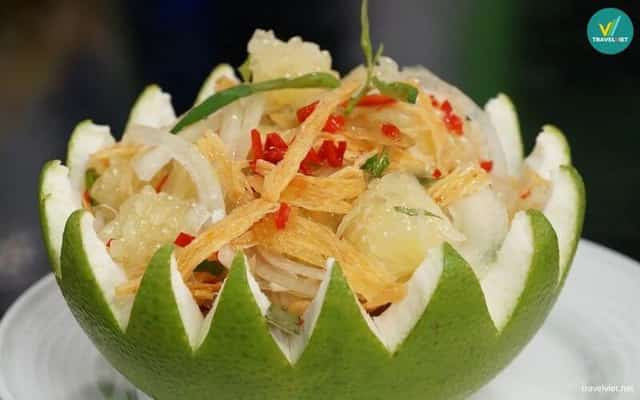
Tan Trieu Pomelo Salad
The rich dressing binds all the ingredients together perfectly, making it a dish you can enjoy endlessly. This isn't just a delicious dish to try when visiting Dong Nai; it's also an excellent suggestion for buying Tan Trieu pomelos as gifts for your loved ones.
Steamed Chicken with Pomelo
One of Dong Nai's specialties that piques travelers' curiosity right from its name is Tan Trieu Steamed Chicken with Pomelo. Firm free-range chicken is steamed with aged pomelo peel, ensuring the meat is perfectly cooked, retaining its natural sweetness, and infused with a distinct, subtle pomelo essential oil aroma.
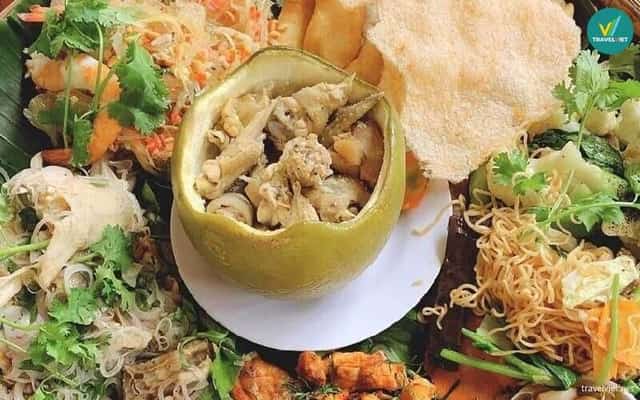
Steamed Chicken with Pomelo
Its light, slightly tangy aroma on the tongue offers a unique culinary experience, hard to find elsewhere. This dish often graces family feasts or special occasions, showcasing the culinary finesse of Dong Nai.
Sour Soup with Giang Leaves
Simple yet rich in local character, Sour Soup with Giang Leaves is a Dong Nai specialty deeply intertwined with the daily lives of its people. Giang leaves offer a natural, refreshing sourness, and when cooked with chicken, fish, or pork, they create a light, aromatic, easy-to-eat soup that pairs perfectly with rice. Uncomplicated in its preparation, this soup wins over diners with its rustic charm and authenticity.
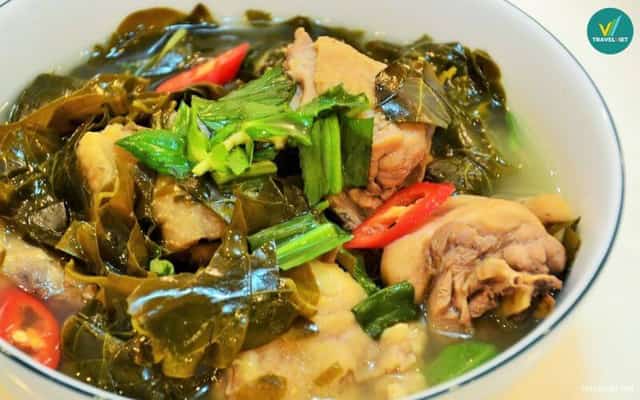
Sour Soup with Giang Leaves
Canh Thụt (Bamboo Tube Soup)
On a culinary journey through Dong Nai, Canh Thụt is a dish that bears the strong cultural imprint of the S'Tieng ethnic group, who have long inhabited the region's mountainous forests. This unique soup is made from various wild vegetables like 'lá nhíp' (a type of forest leaf), 'lá tiên' (another forest leaf), wild bamboo shoots, and small eggplants, combined with fish, small shrimp, prawns, or stream snails.
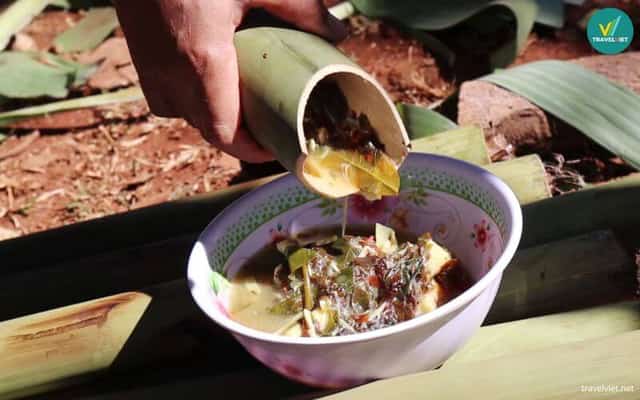
Canh Thụt (Bamboo Tube Soup)
All ingredients are placed into a bamboo tube and cooked until tender, then mashed to create a thick, fragrant mixture redolent of the forest. Canh Thụt is typically served with 'cơm lam' (bamboo-cooked rice), offering an unusual, rustic flavor that is hard to forget once tasted.
Grilled Rattan Shoots
Grilled Rattan Shoots are a Dong Nai specialty deeply connected to the daily lives of the S'Tieng and M'nong ethnic communities. Young shoots, about half a meter long, are harvested from the forest and then grilled directly over hot coals until their distinctive aroma emerges.
When tasted, the rattan shoots have an initial slight bitterness, followed by a unique sweet and fatty aftertaste; the more you chew, the more you appreciate the natural flavors of the mountains and forests. Dipped in chili salt with a squeeze of lime, this rustic dish becomes surprisingly captivating, especially for those who enjoy authentic local culinary experiences.
Wild Bitter Melon Leaf Hotpot
When it comes to dishes that are both delicious and healthy, Wild Bitter Melon Leaf Hotpot is a Dong Nai specialty many travelers seek out. Wild bitter melon leaves have a refreshing bitterness and grow abundantly in the Long Khanh area. When dipped into a simmering hotpot, they create a very distinctive flavor that becomes addictive with every bite.
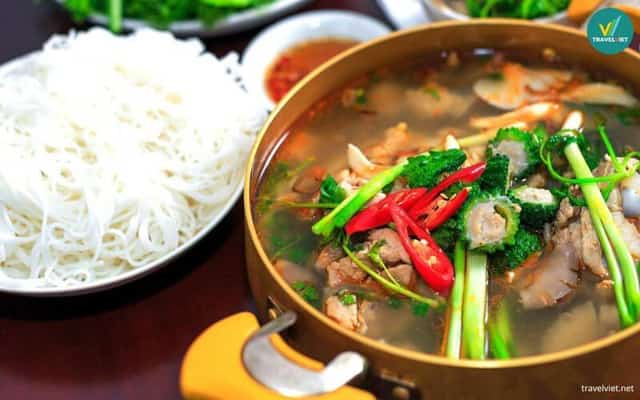
Wild Bitter Melon Leaf Hotpot
The hotpot broth can be made from bones, fish, or seafood, and when combined with bitter melon leaves, it creates a harmonious and pleasant dish. Beyond its appealing flavor, Wild Bitter Melon Leaf Hotpot is also popular for its cooling and detoxifying properties, making it suitable for enjoyment year-round.
Grilled Chicken with Crispy Fried Sticky Rice
Among Dong Nai's renowned specialties, Grilled Chicken with Crispy Fried Sticky Rice is a dish that many travelers instantly want to try. The sticky rice is made from glutinous rice and mashed green beans, then dropped into hot oil to puff up into a golden, crispy exterior while remaining soft and fragrant inside.
Served with grilled chicken that has crispy skin and tender, sweet meat, along with a rich dipping sauce, this dish creates a perfect combination of flavor and presentation. Beyond its delicious taste, the crispy fried sticky rice is also linked to an interesting origin story in Bien Hoa, contributing to the unique and unmistakable character of Dong Nai cuisine.
Bien Hoa Fish Salad
When it comes to dishes that embody the spirit of the river, Bien Hoa Fish Salad is a Dong Nai specialty beloved by many gourmands. Fresh fish, just caught from the Dong Nai River, is cleaned, skillfully deboned, and then mixed with golden roasted rice powder, spices, and accompanying herbs.
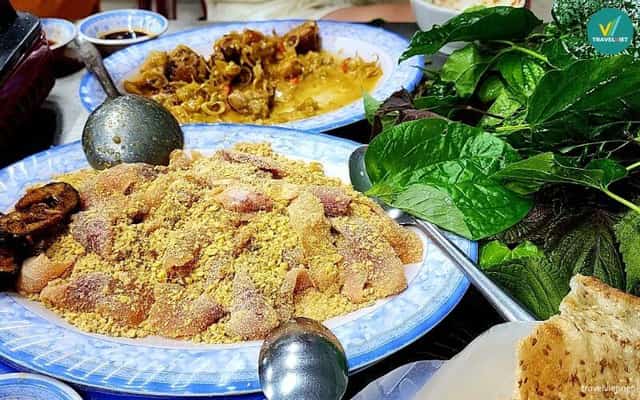
Bien Hoa Fish Salad
This salad perfectly preserves the natural sweetness of the fish, complemented by the fragrant aroma of roasted rice powder. One bite reveals a burst of freshness on the palate. Enjoying fish salad at riverside eateries, with the cool breeze blowing, is a truly unique culinary experience that Dong Nai offers its visitors.
Balut Steamed with Coconut Water
Among the 'trending' street foods recently, Balut Steamed with Coconut Water is considered a Dong Nai specialty with a distinct Bien Hoa flavor. The balut is steamed with fresh coconut water, giving it a delicate sweetness and a light richness that masks the typical strong odor of traditional balut.
As night falls, strolling through Bien Hoa's streets, the subtle aroma of coconut water mingling with the hot balut is enough to entice anyone. Though a humble dish, it earns high marks for its novel, easy-to-eat, and incredibly 'addictive' flavor.
Cha Lui (Grilled Pork Skewers)
Bien Hoa Cha Lui is a familiar Dong Nai specialty enjoyed by many generations, especially popular during gatherings with friends. Minced pork is seasoned perfectly, wrapped around bamboo skewers, and then grilled over charcoal until it releases an enticing aroma.
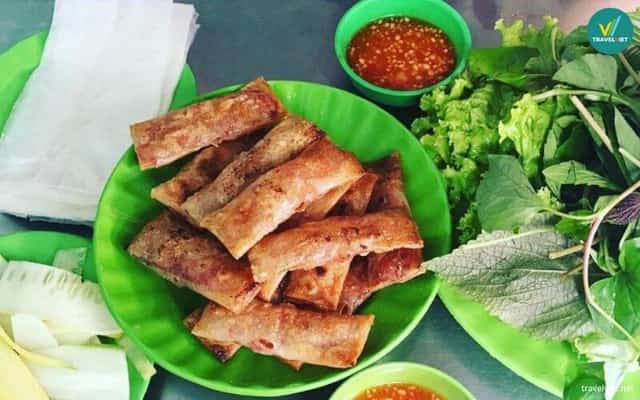
Cha Lui (Grilled Pork Skewers)
When eaten, Cha Lui is wrapped with crispy grilled rice paper, fresh green vegetables, and dipped in a rich sweet and sour fish sauce. The harmonious blend of fatty, salty, and sweet flavors makes this snack incredibly addictive.
Sand Lizard Meat
When it comes to unique dishes bearing the distinct mark of the countryside, Sand Lizard Meat is a Dong Nai specialty that piques many travelers' curiosity. The lizard meat has a natural sweetness and firm texture, often prepared as charcoal-grilled, stir-fried with lemongrass and chili, or cooked in curry.
Not only is it exotic, but this dish is also highly valued for its nutritional content and is deeply connected to the lives of Dong Nai's rural residents. For those who enjoy exploring indigenous cuisine, this is definitely an experience worth trying.
Forest Sterculia Seeds
Forest Sterculia Seeds are a rare Dong Nai specialty, highly sought after when in season. The small 'ươi' seeds, when soaked in water, expand and yield a light, refreshing sour taste, making for a very cool and easy-to-drink beverage.
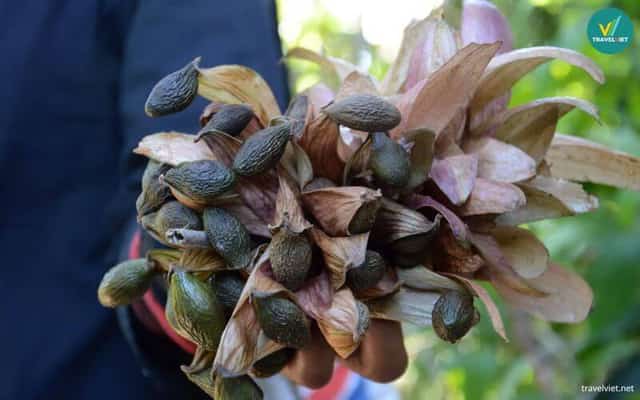
Forest Sterculia Seeds
Locals often use forest sterculia seeds to quench thirst, make refreshing drinks, or process them into jams and candies as gifts. Not only delicious, but 'ươi' seeds are also rich in Vitamin C, with cooling and detoxifying properties, making them a natural gift imbued with the flavors of Dong Nai's mountains and forests.
Dried Garfish
Dried Garfish is a Dong Nai specialty that carries the distinct mark of riverine cuisine. The fish is caught from the Dong Nai River, cleaned, and then naturally sun-dried to preserve its full sweet flavor. Dried garfish has firm flesh, isn't overly salty, and is delicious whether grilled, braised, or cooked in sour soup. This rustic gift is chosen by many travelers for its unique taste and ease of preservation.
Salt-Roasted Cashew Nuts
Besides fresh fruits and dishes, salt-roasted cashew nuts are also a suitable Dong Nai specialty to buy as a gift. Dong Nai cashews are large with firm kernels, and when roasted with salt, they release a rich, buttery aroma and have a perfectly balanced salty taste that's very easy to eat. You can easily find various types, from premium whole cashews to broken ones, all at affordable prices. This is a convenient gift, perfect for snacking or presenting to family and friends.
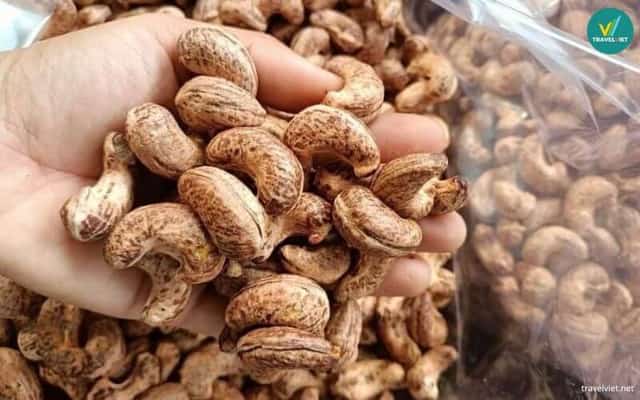
Salt-Roasted Cashew Nuts
Dong Nai Specialty Fruits
When discussing Dong Nai's specialties, one cannot overlook its renowned fruits, most notably Long Khanh jackfruit ('mít tố nữ'), Long Khanh rambutan, Tan Trieu pomelo, and Dong Nai durian. The 'mít tố nữ' jackfruit impresses with its small, deep yellow segments, thick, soft, chewy flesh, and naturally delicate sweetness; meanwhile, Long Khanh rambutan is beloved for its large, translucent white, crispy-sweet flesh and very few seeds.
Tan Trieu pomelo offers a harmonious blend of sweetness and mild tartness, with juicy segments and thin skin, making it easy to preserve and a popular choice for gifts. Additionally, Dong Nai durian, with famous varieties like Ri6 and Monthong, boasts thick, creamy, intensely fragrant flesh that always captivates durian lovers each season. All these fruits contribute to the rich and distinctive fruit landscape of Dong Nai.
Long Thanh Fresh Milk
Another Dong Nai specialty, Long Thanh Fresh Milk, is a familiar name associated with quality and reliability. Thanks to its large-scale dairy farms, the milk here is always fresh, lightly creamy, and rich in nutrients.
In Long Thanh, visitors can not only enjoy pure fresh milk but also experience other appealing products like yogurt, milk cream, and fresh milk cakes. Buying milk directly from the farm ensures quality and good prices, and it's also an interesting experience for those who enjoy agri-tourism.
Cashew Nut Cake
Cashew Nut Cake is a Dong Nai specialty chosen by many travelers as a gift, thanks to its delicious flavor and attractive appearance. The cake layer is baked to a golden crisp, light and airy inside, perfectly complemented by the rich, buttery taste of whole cashew nuts placed on top.
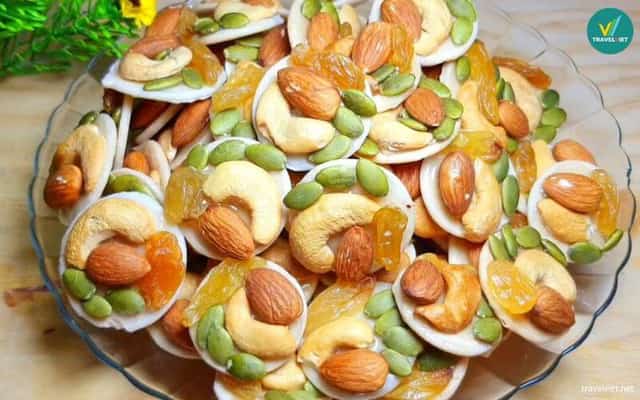
Cashew Nut Cake
Each slice of cake offers a harmonious balance between a gentle sweetness and the distinctive aroma of roasted cashews. With its affordable price and easy storage, cashew nut cake makes an ideal snack or gift for family and friends.
Can Wine (Straw Wine)
On a journey to explore indigenous culture, Can Wine (Straw Wine) is a Dong Nai specialty that bears the strong imprint of its long-standing ethnic communities. This wine is traditionally brewed from rice, forest yeast, and herbs, resulting in a rich aroma, an initial slight bitterness, and a lingering sweet aftertaste.
Enjoying Can Wine in a communal setting, sipping directly from the jar with a bamboo straw, is an experience that is both rustic and rich in cultural identity. This is not just a beverage but also a cultural feature that binds the communities of Dong Nai.
Pomelo Wine
If Tan Trieu pomelo is an iconic fruit, then pomelo wine is a refined and creative version of a Dong Nai specialty. This wine has a delicate aroma, a refreshing sweetness with a hint of spiciness, making it easy to drink. It's popular for its beneficial effects on digestion and overall health.
Notably, the wine is often bottled in containers shaped like pomelos, creating a gift that is both unique and elegant. This is a highly favored choice for travelers wondering what souvenirs to buy after their trip to Dong Nai.
Trang Bom Ginger Jam
Trang Bom Ginger Jam is a familiar Dong Nai specialty, especially popular during Tet holidays. Fresh ginger is prepared and candied by hand, resulting in a perfectly balanced spicy kick, a light sweet aftertaste, and a warming sensation when enjoyed.
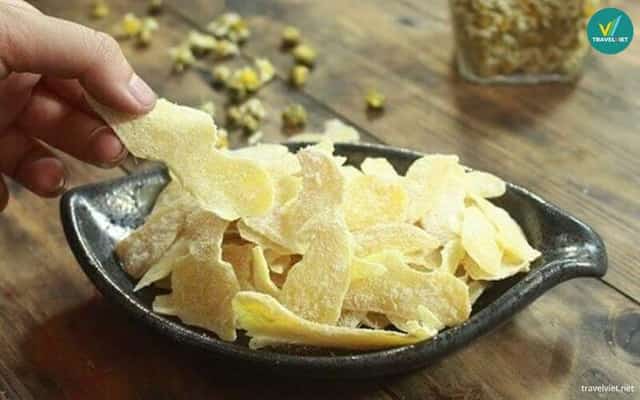
Trang Bom Ginger Jam
More than just a delicious snack, ginger jam also helps warm the body and aids digestion. With its traditional flavor and health benefits, Trang Bom Ginger Jam is a simple yet refined gift.
Dried Fruits
Blessed with abundant fruit resources, dried fruits are a Dong Nai specialty that many travelers choose to take home. Familiar fruits like bananas, jackfruit, mangoes, rambutans, and durians retain their natural, sweet, and appealing chewy-crispy texture after drying. Dried fruits are not only convenient and easy to store but also suitable for all ages.
Pomelo Fermented Pork Roll (Nem Bưởi)
Nem Bưởi (Pomelo Fermented Pork Roll) is one of Dong Nai's unique specialties, showcasing the creativity of the Tan Trieu people. This 'nem' is made from young pomelo peel combined with papaya, carrots, and spices, then naturally fermented. The finished product has a light sourness, a crispy texture, and a spicy kick that is very appetizing. Notably, Nem Bưởi is a vegetarian dish, suitable for many diets, and often surprises visitors from the very first taste.
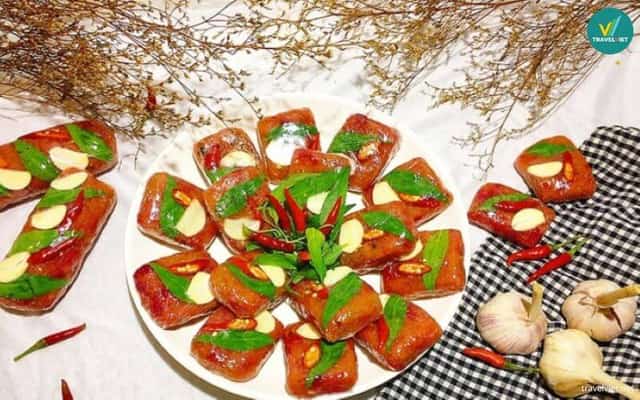
Pomelo Fermented Pork Roll (Nem Bưởi)
Above are theDong Nai specialtiesyou must try when traveling and buy as souvenirs that you shouldn't miss. We hope this list helps you have more memorable culinary experiences and easily choose meaningful gifts imbued with the flavors of Dong Nai for your family and friends after your trip. Continue to followDong NaifromTravelVietto get updates on more exciting destinations, useful tips, and appealing dining and entertainment suggestions for your upcoming journeys!
Dong Nai 1616 view
Update day : 07/01/2026



Monuments close by
See all
Tan Hiep Prison Historical Relic
Tan Hiep Prison, also known as "Tan Hiep Correctional Center", is located in Quarter 6, Tan Tien Ward, Bien Hoa City. Tan Hiep Prison Relic was ranked as a national relic by the Ministry of Culture and Sports on January 15, 1994. Tan Hiep Prison is one of the six largest prisons in South Vietnam and the largest prison in the Southeast region, built in an important military position, northeast of Bien Hoa town. Ahead is National Highway 1; Behind is the North - South railway line. This is an isolated location, convenient for transportation, easy for protecting, guarding, receiving prisoners from other places and transferring prisoners to Con Dao, Phu Quoc... Tan Hiep Prison has an area of 46,520 square meters with 8 prisons, including 5 prisons for communist prisoners and patriots. The prison is surrounded by 4 layers of barbed wire with 9 bunkers, 3 watchtowers with a team of guards and a modern alarm system. It's called "Correctional Center" but inside is actually a gun warehouse, an interrogation and torture room with the most modern tools. Each prison only has an area of nearly 200 square meters but holds 300-400 people, sometimes up to a thousand people. In particular, there are "repentance" rooms and "tiger cages" that are very small and narrow and living conditions are extremely harsh, prisoners live like in a crematorium. The diet was extremely unhygienic. The prison guards bought rotten rice and rotten fish to fertilize the fields, and fried them in oil to feed the prisoners, leading to many people being poisoned. With the determination to escape the imperial prison, return to the Party and the people to continue fighting and liberating the nation, on December 2, 1956, with the agreement of the Eastern Inter-Provincial Party Committee, the soldiers Communists were "detained" in Tan Hiep prison under the direct direction of comrade Nguyen Trong Tam (Bat Tam) - in charge of the prison Party Committee and a number of other comrades who suddenly broke the shackles. was able to free nearly 500 comrades and patriots. This event caused a stir in the Pentagon. America - Diem hastily mobilized both main forces and security forces, civil guards defending the three provinces of Bien Hoa, Ba Ria, Thu Dau Mot and two special forces to encircle and capture the prisoners, but all were defeated. failure. Our comrades and compatriots who escaped from Tan Hiep prison received help and protection from local facilities and returned safely to base. Among the escaped prisoners were comrades: Bay Tam, Hai Thong, Ly Van Sam... who became the core nucleus of the Dong Khoi movement later. In 2001, to partly recreate the crimes of the US - Diem against our comrades and compatriots imprisoned at Tan Hiep prison and describe the entire Tan Hiep uprising on December 2, 1956. , Dong Nai Museum has collected images, documents, and artifacts displayed at the relic and made a model to serve the research and sightseeing needs of all classes of people. Every day, the monument is open to visitors. Source: Dong Nai Electronic Newspaper
Dong Nai
16078 view
Rating : National monument

Nguyen Huu Canh Temple
Nguyen Huu Canh temple, also known as Binh Kinh communal house, is located on the left bank of Dong Nai river, formerly belonging to Binh Kinh hamlet, Binh Hoanh village, Tran Bien canton, now Nhi Hoa hamlet, Hiep Hoa commune, Bien Hoa city. It was ranked as a national historical relic by the Ministry of Culture, Information, Sports and Tourism on March 25, 1991. Nguyen Huu Canh Temple was built around the end of the 18th century. Initially, the temple was small in scale, with walls made of boards and a yin-yang tile roof, about 400m south of the current temple. Documents say: the temple was first rebuilt in the fourth year of Tu Duc (1851); By 1923, the temple was rebuilt at its current location. Nguyen Huu Canh was born in 1650 in Gia Mieu, Tong Son district, Thanh Hoa province in a family with many famous generals in the dynasty. He was a man of both literature and martial arts, accomplished many great victories and was trusted, loved and respected by Lord Nguyen. In the spring of the year Mau Dan (1698), he obeyed Lord Nguyen's order to invade Dang Trong while it was still very desolate. Arriving in Dong Nai, he set up his headquarters at Cu Lao Pho (now Hiep Hoa commune); took Dong Nai land as Phuoc Long district, built Tran Bien palace, took Saigon land as Tan Binh district, built Phien Tran palace, the land expanded thousands of miles. He recruited immigrants to settle down, organized the administrative apparatus gradually and systematically, encouraged land reclamation, and promoted Cu Lao Pho to develop into one of the busiest and most dynamic port towns throughout the century. 18 and officially annexed the new land of the South into the Dai Viet map. After returning from the invasion of the South, the following year he again served Lord Nguyen Phuc Chu's command to lead an army to suppress King Chan Lap and maintain the southern border region. In April of the year Canh Thin (1700), after completing his mission, on the way back to Rach Gam (Tien Giang), he fell ill and passed away on the 16th day of the 5th lunar month, at the age of 51 years old. On the way to his hometown for burial, his coffin was stopped at the land where he once had his headquarters on Cu Lao Pho so that local people could have the opportunity to say goodbye to him one last time. At the mandarin's communal house, local people built a tomb to remember this event. When hearing the news of Nguyen Huu Canh's death, Lord Nguyen was extremely sorry and conferred on him the title of High-ranking official of the Town Chancellor with the title: Thanh Marquis Ceremony and had his tablet enshrined at the Thai temple. Source: Dong Nai Electronic Newspaper
Dong Nai
14411 view
Rating : National monument

La Nga victory relic
La Nga Victory Relic (at km 104-112 on Highway 20 to Da Lat, in Phu Ngoc commune, Dinh Quan district) was ranked a national historical relic by the Ministry of Culture on December 12, 1986. To cheer for the Viet Bac victory in the fall-winter of 1947 and also to deal a fatal blow to the enemy, the command board of squad 10 decided to organize a big battle, to show the enemy that the Vietnamese people were , Vietnamese people do not easily submit to any enemy; With a spirit of courage and ingenuity after nearly half a year of preparation, studying the terrain, and choosing a location: at 15:12 on March 1, 1948, the La Nga ambush battle began and ended at 15:12 on March 1, 1948. 15:57 on the same day, in just 45 minutes. The victory of La Nga delighted the people of Dinh Quan in particular and the people of Dong Nai in general. This is a victory that demonstrates the cunning and courage of our army and people, causing the enemy to be stunned and defeated. From this victory, our force grew stronger and stronger, contributing to defeating the enemy's plan to attack quickly and win quickly, forcing them into a passive position. The scenic complex of Chong Rock, Mai Waterfall, La Nga River and La Nga Victory Monument is an interesting tourist complex of Dinh Quan. The amazing beauty of Hon Ba Chong, Da Voi Mountain, Hon Dia, along with the natural pagoda at the foot of the rocky mountain are typical clusters that create a harmonious beauty for the Da Chong scenic area. Dinh Quan Da Chong Complex is also a place that retains traces of prehistoric life. Here, under the stone roofs, along the streams and on the slopes along the valley, many production and daily life tools of the ancients made of stone, bronze and terracotta were discovered. During the 30-year resistance war. Dinh Quan is an important part of War Zone D. Da Chong witnessed the formation, development, stationing, and combat deployment of revolutionary forces. Today, a part of the land of Da Chong Dinh Quan scenic area has been used and built into the Dinh Quan District Cultural and Sports Center. In the near future, Da Chong Dinh Quan scenic area will be invested in and renovated, contributing to making the natural landscape more beautiful and becoming an attractive eco-tourism destination. Source: Dinh Quan District People's Committee
Dong Nai
14255 view
Rating : National monument
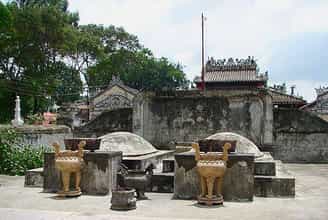
Trinh Hoai Duc Tomb Relics
Trinh Hoai Duc Tomb is located in Quarter 3, Trung Dung Ward, Bien Hoa City, Dong Nai Province. Ranked as a national historical relic by the Ministry of Culture, Information, Sports and Tourism on December 27, 1990. Under the Nguyen Dynasty, Trinh Hoai Duc's tomb was located in Binh Truc village, Tran Bien palace. During the French colonial period, it was changed to Binh Truoc, in Chau Thanh district, Bien Hoa province. In 1938, Trinh Hoai Duc's mausoleum was classified as a relic by the Far East School. Local people often call it "Mr. Mausoleum" and there are many ancient tombs built of compound laterite. Many people believe that this was previously the tomb of the Trinh Hoai Duc family. The tombs are all built in the shape of an elephant, with a rectangular block plan; The stone steles engraved with Chinese characters face southwest, the walls are covered with green moss. In the entire Trinh family tomb area, Trinh Hoai Duc's tomb stands out because of its architectural scale, perhaps this was the intention of the tomb builders in accordance with the ancient principles of family lineage. Before 1975, every year during the Qingming Festival, Trinh Hoai Duc's descendants from other localities came to pay their respects with solemn ceremonies. Later, there was a ceremony because some descendants of the Trinh family had grown old or wandered, so the visiting ceremonies were no longer maintained as before. In 1998, on the occasion of the 300th anniversary of the formation and development of Bien Hoa - Dong Nai, Trinh Hoai Duc's tomb was restored and embellished. The original tomb architecture was preserved, surrounded by a solid citadel. Behind the tomb is a raised wall, forming a wavy oval shape. On the wall is an inscription in Chinese characters that resembles a poem praising Trinh Hoai Duc's virtue, but it has faded over time and is no longer readable. Both sides are decorated with two insulated dragon heads. Currently, this wall is decorated with a hidden dragon pattern. In front of the tomb entrance is a large screen, engraved with Trinh Hoai Duc's biography and career. On the square pillars connecting the walls of the citadel in front of the tomb, Chinese couplets are carved, the content is mainly about history and Trinh Hoai Duc's erudition in research. Inside the citadel is the main element of architecture, consisting of two parts: Graves: one of Trinh Hoai Duc and one of the main wife, surnamed Le. The structure of the tomb is the same, shaped like an elephant, surrounded by a horseshoe-shaped edge, in front of each grave is a stone stele, engraved with Chinese characters; The surrounding area is decorated with lines of text, yin and yang symbols, and the bottom is embossed in the form of a kneeling leg. The contents of the steles at Trinh Hoai Duc's two graves briefly state the titles, positions, ranks, and titles that Trinh Hoai Duc was bestowed with, along with his wife; Stele: also clearly states the time is November of the year At Dau, children Trinh Thien Le Nhien, Trinh Thien Nhien Bao, and Trinh Thien Bao jointly established the stele. Trinh Hoai Duc, a great talent, a great personality, has contributed to laying the foundation for a circle of pride in Dong Nai - Dong Nai Culture, which is the pride of Dong Nai people. Source: Dong Nai province electronic information portal
Dong Nai
10550 view
Rating : National monument
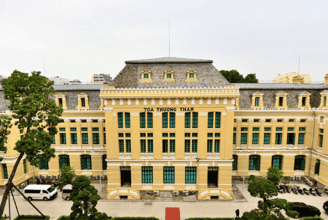
Long Khanh Dong Nai Administrative Court
The Long Khanh Provincial Administrative Building relic located on Cach Mang Thang Tam street, Xuan An ward, Long Khanh town, was ranked a national historical relic by the Ministry of Culture on November 16, 1988. Long Khanh Administration Building has a total area of 9,000 square meters, built in 1965 in French-style architecture, including a ground floor and an upper floor. This was the highest working headquarters of the American puppet in Long Khanh province at that time. In March 1975, the US - puppet government built the strategic defense line of Phan Rang - Xuan Loc - Tay Ninh to prevent the advance of our troops along the North-East gateway to Saigon. Long Khanh Administrative Building was chosen as the control center for all military activities of this defense line. Thoroughly grasping the ideology of the Party Central Politburo, the Regional Command decided to launch the Xuan Loc campaign to liberate Long Khanh town, destroy the enemy's strategic defense line, and advance to liberate Saigon. On April 9, 1975, 5 hours after the campaign started, a major battle took place at the Long Khanh Administrative Building. Comrades Pham Le Canh, Nguyen Van Trong, battalion 5; Nguyen Thanh Son, Nguyen Minh Duc, the 7th battalion of Regiment 266 of the 341st Division's assault spearhead led by comrade Tran Van Tran, attacking from the north of the town, planted the flag "Determined to win, determined to win" on the top of the flagpole. on the 1st floor of the Administration Building. This is a historic turning point victory for the Vietnamese revolution and the pride of the people of Long Khanh in the resistance war against America to save the country. After the liberation of the South on April 30, 1975, Long Khanh province was reorganized into Xuan Loc district. The Administration Building was repaired and became the headquarters of the People's Committee of Xuan Loc district. In 1991, Long Khanh district was separated from Xuan Loc district, the Administrative Building became the headquarters of the People's Committee of Long Khanh district. In 2004, the Administration Building was assigned to the Department of Culture, Sports and Information of Long Khanh town to manage and use: The ground floor is a library to store documents to serve readers, the upper floor is a traditional gallery with 176 documents and artifacts. Every year it attracts about 500 visitors, researchers and students. Source: Dong Nai Electronic Newspaper
Dong Nai
10344 view
Rating : National monument
Nearby tourist attractions
See all
Suoi Lam Lake
Suoi Lam Lake Tourist Area is one of the famous natural tourist destinations in Binh Phuoc next to Bu Gia Map National Park, Thac Mo Hydroelectric Lake, Ba Ra Mountain... With a romantic blue lake and forests. Rubber trees stretch to the horizon, the scenery here not only captures the hearts of the traveling community but also turns Suoi Lam Lake into the most popular weekend destination. It can be said that every season, this place captivates the footsteps of discoverers in a very unique way. If the period from December to January next year is memorable because of the cold weather and the radiant spring sunlight filtering through the leaves that are gradually changing color, then late February and early March will be the ideal time. Let you immerse yourself in the pure white color of the blooming coffee flower forest. Located in Dong Phu district, Binh Phuoc province, Ho Suoi Lam tourist area is very close to Ho Chi Minh City. With a distance of about 120km, it is extremely convenient for traveling, you can easily get here by many types of means of transport such as motorbikes, cars, and buses. A little more specifically about long-distance transportation, at Mien Dong Bus Station there are many bus routes departing from Saigon to Binh Phuoc. Depending on the bus company as well as the travel distance you choose, the expected ticket price will be around 65,000 VND to 100,000 VND/person. For backpackers who want to conquer Binh Phuoc in general and Ho Suoi Lam tourist area in particular by motorbike, below are the most popular routes from near and far: Starting from Saigon, you can go towards Binh Trieu Bridge to Highway 13 or Saigon Bridge to Hanoi Highway. No matter which route you choose, explorers will stop by Binh Duong - a place that welcomes you with a forest of rubber trees all along both sides of the road, as beautiful as a Korean movie, extremely suitable for check-in. virtual living". Possessing an area of up to 100 hectares, Suoi Lam Lake has a depth of about 4 meters. The lake surface here is calm all year round, making a special impression with its clear water reflecting the clouds. Surrounded by immense forests, the lake and stream are home to many species of freshwater fish such as silver carp and carp. carp, snakehead fish, carp... Not only does it impress with the pristine, peaceful and green natural scenery, coming here during the flower blooming season you also have the opportunity to enjoy the beautiful lake space like an earthly fairyland. The surface of the lake, which was originally like a shining mirror, is now covered with a layer of pure white flowers with extremely clear and pure beauty. Rowing a boat in the middle of the lake, you will soon let your soul drift along this beautiful forest of flowers and let them gently relieve all the pressure and fatigue that comes from a busy everyday life. Besides the captivating natural beauty, Suoi Lam Lake Tourist Area is also an ideal destination for relaxation, camping, fishing and picnics. Young people who come here after taking photos with the poetic lake and setting up tents to camp along the forest often participate in recreational activities such as bathing in streams, boating, water skiing... The tourist area also Providing large bamboo huts and cheap charcoal stove services to serve the picnic needs of families and groups of friends.
Dong Nai
9180 view
November to April

Ba Ra Mountain
As one of the three highest mountains in the Southeast region, Ba Ra Thac Mo Mountain, Binh Phuoc, located at an altitude of 723m above sea level and with rugged terrain, was once a place marking many heroic, resilient and heroic achievements. There are so many anecdotes associated with important historical events of the nation. At Ba Ra Mountain Thac Mo Binh Phuoc also has Be River, Thac Me, Thac Mo hydroelectric power plant and forests with diverse and rich flora. Coming here, you will definitely admire the beautiful landscape painting that captivates people's hearts. From 1925 to 1941, the French colonialists built at the foot of Ba Ra mountain a large prison consisting of 3 military camps: Military camp A to imprison thieves and robbers; Military camp B held female prisoners, political criminals, and people suspected of being communists but not convicted; Military camp C to hold political prisoners. Currently, on the top of Ba Ra mountain there are still traces of the airport built by the American invaders. In addition, to commemorate the merits, a stele house and a memorial temple for soldiers, soldiers and people who sacrificed their lives in the resistance war in the Ba Ra area were built on Bang Lang hill in the Ba Ra mountain relic complex. Thac Mo Binh Phuoc. Another option for young people who like to explore and conquer spectacular challenges is trekking Ba Ra mountain. From the foot of the mountain, you can travel by motorbike or car along the paved road leading to Bang Lang hill. There is a memorial stele here to remember the merits of heroic martyrs. In addition, you can also try to experience the feeling of riding the cable car here. Ba Ra Temple is a project belonging to the Ba Ra historical relic complex and is also known as Linh Son Temple. The design here is inspired by the beliefs of the Southeast region, similar to famous architectural works in the Ba Den mountain complex (Tay Ninh) and Ba Chua Xu (An Giang). On the 1st, 2nd, 3rd, 4th days of the third lunar month every year, the Ba Ra Temple Festival is held, attracting many people to gather here to visit and express their gratitude and belief in their beliefs. folk. Binh Phuoc is not only famous for tourist destinations such as Bu Gia Map National Park or Quang Minh Pagoda. Ba Ra Mountain Thac Mo Binh Phuoc is also one of the tourist attractions that attracts many people from all provinces and cities to admire.
Dong Nai
9312 view
From January to December
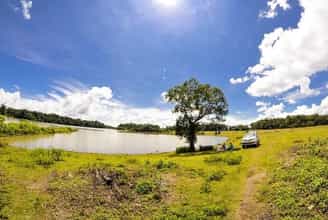
Bu Lach Grassland
If you are looking for a spacious and cool camping location near Saigon, please refer to Bu Lach Glade. Located in village 7, Dong Nai commune, Bu Dang district, Binh Phuoc, this is one of the most attractive camping locations for tourists. Surrounded by primeval forests and a large lake in the middle, Bu Lach has a strangely pristine and peaceful natural scenery. This place was originally a cluster of nearly 20 grasslands of different sizes with an area of up to 500 hectares. The reason for its name is due to a misreading of the local language of the M'Nong people. The village elders explained that here the word "lach" in the M'Nong language means "glad", in the glade there is a water tank so it is called Bau Lach, if read incorrectly it becomes Bu Lach. The road to Bu Lach Grassland is not too difficult. If you are from Saigon, you can buy bus tickets at Mien Dong bus station. Ticket prices are usually from 100k to 250k. If you want to explore nature and travel, you can travel by motorbike. There are two directions to get to Binh Phuoc. One is from Binh Trieu Bridge to follow Highway 133. The second direction is from Saigon Bridge to Hanoi Highway. Travel time is about 2 hours and 30 minutes to arrive. Check-in to the grassland, visitors will be amazed at what nature has bestowed upon them. These are vast green lawns surrounded by clear blue water, surrounded by primeval forests. Just like that, one glade follows another, endlessly green. The glades are usually about 5-10 hectares wide, but Big Glade is the most beautiful and widest, nearly 100 hectares. Another unique feature is that there is only one type of needle grass growing mixed with purple wildflowers, making the scene even more wild. Not only is the background beautiful for taking photos, you will also be impressed with the scenery here. Just standing there looking and breathing feels good. All the worries, fatigue, and dust have gone, leaving only the feeling of being surrounded by nature. Visitors here can also fish, walk sightseeing, boating, camping, play soccer on the grass, etc. Especially, in the dry season, the grass in the glade will turn bright yellow. You can bring tents to camp and hold BBQ parties. In addition to playing in the lake and grass fields, you can also go deep inside to see beautiful waterfalls. The grasslands and water basins are all protected forest areas and forbidden forests, so there are no residents living here. Around the grassland there are only villages of the S'tieng, M'Nong and Chau Ma ethnic groups. You can visit the communal houses to visit and learn about their culture. If you come in the third lunar month, you will be able to participate in their Dam Bau fish-catching festival.
Dong Nai
9382 view
From January to December
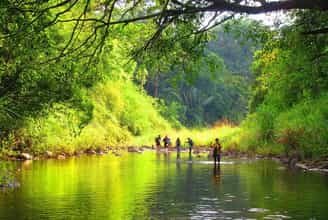
Bu Gia Map National Park
Known as one of the famous national parks in Vietnam thanks to its diverse natural ecosystem, flora and fauna that contribute to creating impressive scenery. Bu Gia Map National Park is currently a famous tourist attraction that many people choose to visit when coming to Bu Gia Map district, Binh Phuoc province. Although it has been established for many years, it was not until 2002 that this place was officially converted from a conservation area to a national park. With a total area of 25,601.18 hectares and divided into many conservation areas for many rare plants, directly affecting the genetic research process of many precious plant species. In particular, the forest coverage reaches 90%, creating a habitat for many types of animals. Not only does it play a conservation role, this is also a national park that greatly contributes to protecting and regulating water sources for hydroelectric and irrigation lakes. Visitors to Bu Gia Map National Park will be able to admire the close natural scenery, admire the green beauty, discover many precious flora and fauna species, and participate in interesting activities. Characterized by a sub-equatorial tropical monsoon climate, the national park has two distinct seasons: sunny and dry during the year. In particular, the average temperature will be about 25.8 - 26.2°C, which is quite favorable for visiting and exploring the national park landscape during the trip. Therefore, you can schedule a visit to the tourist area at any time of the year. However, to have a smooth visit and keep many memorable memories, you should choose to go during the dry season. Specifically, from November to early May of next year, you should avoid going to Bu Gia Map National Park during the rainy season because it will make it difficult to move and see the scenery. After arriving in Binh Phuoc province, to have a memorable and easier trip to Bu Gia Map National Park, many tourists are interested in choosing a quality place to stop. With the strong development of the tourism industry and the large number of tourists visiting every year, here you can find many hotels in Binh Phuoc. In particular, depending on the needs and desires of each person, they can choose a hotel with suitable quality for themselves. Therefore, you do not need to worry about where to stay on this tour. Besides, visitors can also refer to hotels in Binh Duong or City. Ho Chi Minh if you plan to visit during the day or camp on site. Trekking activities are indispensable when visiting natural tourist destinations such as national parks. During this process, you will experience many adventurous activities, immersing yourself in exciting space and scenery. At the same time, this is also an opportunity to explore many species of flora and fauna preserved in the national park. In addition, Da Voi Beach and Dak Mai Waterfall are an interesting attraction located in the national park area. Not only is it a large area, but this place also possesses many giant rocks in the middle of lush cashew gardens. and create the majestic Elephant Rock. Besides, Dak Mai waterfall flows from Dak Nong through Bu Gia Map national park combining changes in height to create an impressive and beautiful waterfall. One of the great experiences when coming to the famous tourist area in Binh Phuoc is to enjoy delicious dishes that are uniquely prepared and attractive. Some outstanding dishes that are highly appreciated by many tourists include: beef soup, bamboo-tube rice, wild boar meat, etc. All of them use available ingredients grown by local people. Through skillful processing, it creates unforgettable specialties from the first time you enjoy it.
Dong Nai
9063 view
November to early May

Stream lake
Suoi Giai Lake is a charming landscape located in Tan Lap commune, Dong Phu district. About 20 km from the center of Dong Xoai City, and about 80 km from the center of Ho Chi Minh City, Suoi Giai Lake is like a peaceful space nestled among the noise and dust of the city. The name Suoi Giai Lake comes from the connotation of Giai Nhan stream, which also means beautiful young woman. Therefore, the beautiful scenery here is often compared to a fairy descending to earth, gentle, gentle but no less flashy. Suoi Giai Lake is about 1.5 km wide, nestled between two hills, you can see the lake bed from above while driving. Review of Suoi Giai Lake shows that, in the past, Suoi Giai Lake was the upstream of a small stream. In 1978, after being approved by the Binh Phuoc provincial government, this place was converted into an irrigation dam with the task of storing and providing water for the use of the people here. Currently, this place is an interesting destination for the backpacking community, suitable for experiencing various types of activities such as camping, boating or fishing. Suoi Giai Lake is a large dam with a romantic and charming scene. At noon, the rays of sunlight shine down on the sparkling clear water, creating a very poetic and peaceful space. The most expensive scenery at Suoi Giai Lake must be at sunrise and sunset. When the sun appears and disappears, the scene seems to be dyed a brilliant orange-yellow color, lighting up the whole land and sky. On the lake bed, you can easily see the scene of a fisherman fishing and catching fish. It all took place under the sunset, painting a picture that couldn't have been more peaceful and romantic. Besides, when moving to Suoi Giai Lake, you will easily encounter wonderful and quite famous scenery. If you move from Binh Duong, you will pass by the Song Be Broken Bridge Relic, a famous place that appears quite a lot on the screen. In addition, when moving around the province, it will not be difficult for you to encounter Binh Phuoc rubber forests during the leaf-changing season. This is a place that many young people check in at the end of the year, when the forests are tall. The sun becomes bright yellow in a corner of Binh Phuoc sky.
Dong Nai
9095 view
November to April
 AI Travelviet