
 vn
vn en
en ja
ja ko
ko zh
zh


This temple is particularly enchanting, where the beautiful chime of its bells gently echoes across the serene lotus pond. Adding to its unique charm, it's also home to one of the world's rarest tree species.
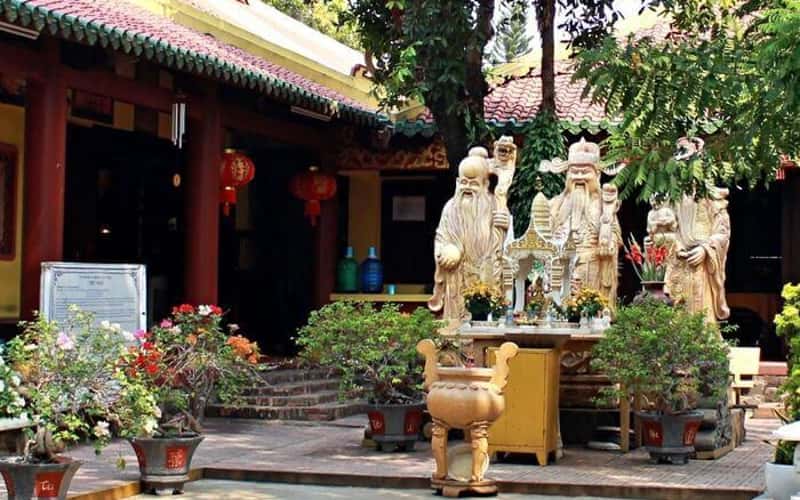
On particular days each month, locals living around the pagoda – once considered the premier scenic landmark of old Gia Dinh city – can still hear the resonant chime of the bronze bell echoing from the lotus pond.
The White Elephant Stumbles, a Sacred Bell Falls into the Water
Nestled amidst lush ancient trees, Phung Son Pagoda (District 11, Ho Chi Minh City) stands ancient and serene, steeped in fascinating legends. Legend has it that the pagoda was originally named Chùa Gò (Mound Pagoda) because Zen Master Liễu Thông temporarily built it on a high mound. One day, the Zen Master saw a phoenix flying to perch on a parasol tree in front of the pagoda, eating its fruit and singing beautifully. Recognizing this as a good omen, the Zen Master decided to rename Chùa Gò to Phung Son Pagoda. According to the book Phung Son Pagoda – History and Culture, published by Social Sciences Publishing House, the pagoda's original location was the foundation of an ancient Khmer temple that had been in ruins for many years. During two exploratory excavations in 1988 and 1991, archaeologists discovered numerous artifacts made of terracotta, brick, and Óc Eo ceramics. This suggests that a Hindu temple from the Óc Eo culture once existed beneath the ancient pagoda's foundation. The fact that Phung Son Pagoda stands on the foundation of an ancient Khmer temple is also preserved in a local legend about people hearing the sound of a bell echoing from the pond nearby. Regarding this legend, Most Venerable Thích Trí Định, the Abbot of Phung Son Pagoda, shared that the pagoda's historical records state that during the reign of King Gia Long, the Khmer people decided to abandon the pagoda. When they left, they took with them a Buddha statue and a bronze bell.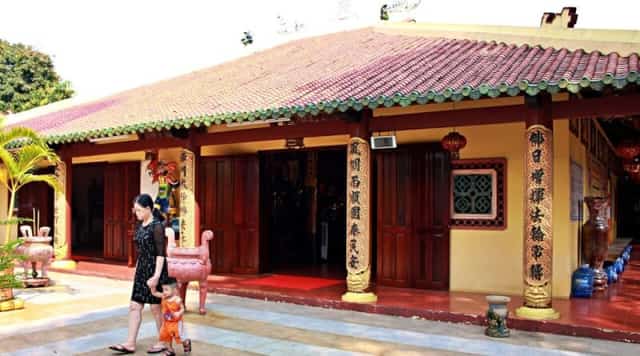
An ancient corner of Phung Son Pagoda
These artifacts were loaded onto the back of a white elephant by the Khmer people. However, after the elephant had moved a short distance, it suddenly stumbled into a lotus pond near the pagoda, causing the Buddha statue and the bronze bell to fall into the water. Most Venerable Trí Định recounted: “Later, the Buddha statue was recovered and brought into the pagoda for worship. Currently, the statue is still revered in the pagoda’s main hall. However, the bell, despite arduous search efforts, was never found. Afterward, on auspicious days each month, locals often heard the sound of a bell echoing from beneath that pond. Finding this strange, the people named the pond where the bell fell 'Bàu Chuông' (Bell Pond).” According to Most Venerable Trí Định, in later years, people encroached on the land and dumped waste into Bàu Chuông, causing the pond to become polluted. Since then, no one has heard the bell's chime anymore. To commemorate this legend, Phung Son Pagoda erected and worships a statue of a white elephant carrying a Buddha statue and a bronze bell within its premises. Next to this statue is a stele detailing the aforementioned legend.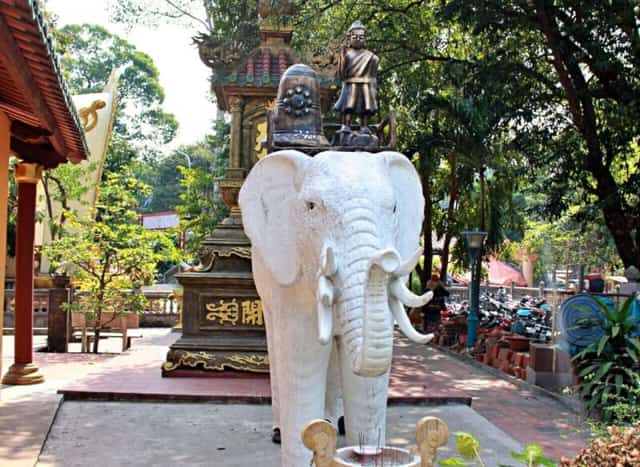
A statue depicting the legend of the white elephant carrying the Buddha statue and bronze bell
Beyond its distinctive legends, Phung Son Pagoda is also renowned for its beautiful scenery. In the past, the pagoda was celebrated as one of the most picturesque landmarks in the former Gia Định citadel. In his work Gia Định Thành Thông Chí (Records of Gia Định Citadel), Trịnh Hoài Đức described the pagoda's grounds as having “numerous Southern Apricot trees, with ancient roots leaning, and when in bloom, their fragrance pervades the air.” He wrote: “Streams gurgle around the mound, and on cool evenings, young women punt canoes to pick lotus flowers. On pleasant days, scholars and poets ascend step by step, carrying their bags, to recite verses beneath the blossoms, their poetry wafting on the breeze – truly a scenic delight for visitors…”Home to the City's Rarest Tree
Today, Phung Son Pagoda remains shaded by lush greenery. Many ancient trees here are over a hundred years old. However, the most famous is the white apricot tree, planted in 1909. To this day, this apricot tree is 114 years old. Most Venerable Thích Trí Định mentioned that the white apricot tree at the pagoda was brought and planted by Venerable Huệ Minh from Cây Mai Pagoda (also known as Mai Son Pagoda on Mai Mound, part of old Gia Định). The tree produces white blossoms, which typically bloom at night during the Tết (Lunar New Year) festival. The white apricot flowers have a gentle fragrance.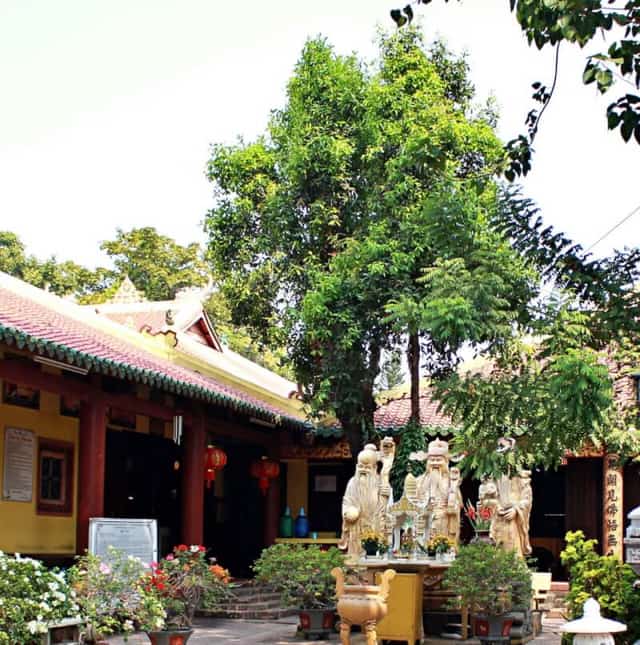
The rare ancient white apricot tree in Ho Chi Minh City, located within Phung Son Pagoda's grounds
The Vietnam Association for Conservation of Nature and Environment states that bạch mai is also known as mai mù u, with the scientific name Ochrocarpos siamensis, belonging to the mangosteen family. This flower is considered a rare and precious apricot variety in Southern Vietnam, hence it is also called nam mai (Southern Apricot). The white apricot often appeared in the poetry and literature of scholars and literati in old Gia Định. The white apricot tree at Phung Son Pagoda was also mentioned by Trịnh Hoài Đức when describing the pagoda's beautiful scenery. In Gia Định Thành Thông Chí, he wrote: “Thirteen and a half dặm south of the citadel, there is a high mound with many Southern Apricot trees, their ancient roots leaning. When they bloom, there is no snow, only leaves to protect their fragrance. These flowers, born of sacred energy, cannot be grown elsewhere.” The ancient white apricot tree at Phung Son Pagoda soars above the pagoda's roof. However, it currently has fewer large branches as it has been neatly pruned.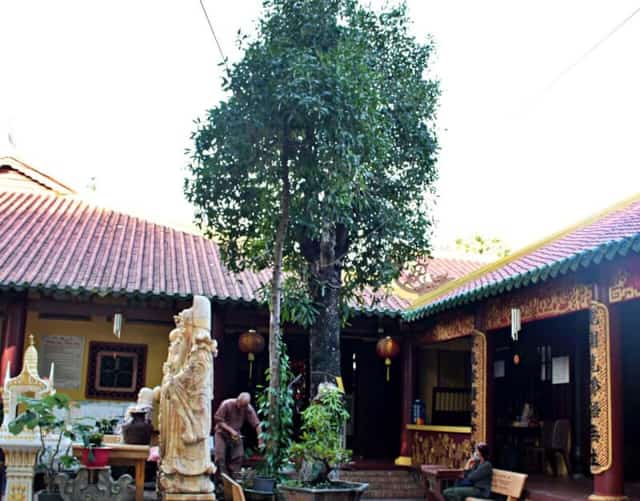
The tree is old, with many dead and dry branches, so it has been neatly pruned
Above the trunk, which is about one person's embrace in size, are small, vibrant branches, covering a corner of the pagoda's roof. Due to its age, part of the tree's base has rotted, causing it to lean towards the pagoda's roof. Given this situation, the pagoda has discussed with local authorities to find ways to protect and care for the tree. According to Most Venerable Thích Trí Định, white apricot trees are now almost non-existent in Ho Chi Minh City. Notably, after the disappearance of the over 300-year-old white apricot tree at Giac Vien Pagoda (District 11), the 'elder' white apricot at Phung Son Pagoda has become Ho Chi Minh City's most precious and rare flowering tree. Therefore, in addition to protecting and caring for the ancient white apricot tree, Most Venerable Thích Trí Định is also seeking ways to propagate and plant more of this precious species within the pagoda's grounds. However, Most Venerable Trí Định noted that white apricot trees are very difficult to cultivate and care for. To date, the pagoda has only successfully grown one white apricot tree from the mother plant. This tree is now also over 70 years old.Ho Chi Minh City 5852 view
Update day : 16/11/2023
Source : Vietnamnet Affiliate links



Monuments close by
See all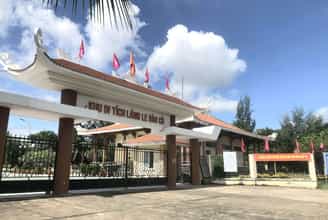
Lang Le Bau Co relic site
Lang Le Bau Co relic site is located in Tan Nhut commune, Binh Chanh district, Ho Chi Minh City. Lang Le Bau Co is associated with the resistance war against the French invasion in 1948 with major battles that went down in history. Lang Le Bau Co relic was recognized as a city-level historical relic in 2003. The reason it is called Lang Le Bau Co relic area is because the name of Lang Le Bau Co relic area was given by local people. The hamlet was established next to the interlaced canals and rivers. Lang Le Bau Co is located inside a large field with many shrimp, crabs, and fish. Along with many species of birds such as mallards, storks, teal, nuthatches, gongs, partridges, herons, and red armpits come to feed here. Therefore, Tan Nhut people call it by the familiar and rustic name Lang Le Bau Co. Lang Le Bau Co relic is considered the gateway to move to the center of Vuon Thom base and attack the enemy headquarters in Saigon. Previously, Lang Le Bau Co relic area was originally a field of overgrown reeds. On April 15, 1948, the French colonialists sent 3 thousand soldiers and many modern weapons to simultaneously attack the Lang Le Bau Co area to destroy the Vuon Thom base. At that time, the revolutionary armed forces in Lang Le - Bau, because of their small force and rudimentary weapons, had the help of local people along with the advantage of terrain. After just over half a day of fighting, it turned to attack, causing the French army to suffer a large number of casualties. The victory at Lang Le Bau Co killed 300 enemies, captured 30 mercenaries, and destroyed many machines, military vehicles, and guns of all kinds of the enemy. However, on our side, there are many officers and soldiers who heroically sacrificed their lives at a very young age. On October 14, 1966, in Lang Le, the Republic of Vietnam Army Ranger Battalion was destroyed by tourist militia. Lang Le Bau Co relic site has great historical significance for the people of Saigon in particular and the whole country in general. Faced with hatred for the French colonialists, Lang Le Bau Co's army and people fought a war of great historical significance that opened the door for our side and the enemy. For our side, the battle opened the door to heroism in a strong resistance position. As for the enemy, they had to retreat into a strategic position and were destroyed. The French colonialists could no longer form a strategy to defeat the Viet Minh. Moreover, at Vuon Thom base, Lang Le Bau Co also took place a determined battle to protect our base and destroy all sabotage plans of the enemy. Lang Le Bau Co relic area, after the Dong Khoi movement in 1960, was also a logistics and springboard for the armed forces to liberate Long An - Saigon - Gia Dinh. To commemorate the sacrifices of our compatriots and soldiers, in 1988 Binh Chanh district built a historical building in Lang Le Bau Co land with an area of 1000m2. Source: Ho Chi Minh City Electronic Information Newspaper
Ho Chi Minh City
18134 view
Rating : City-level relics
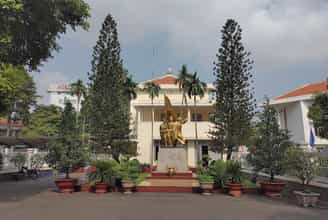
Hoc Mon District Palace
Hoc Mon District Palace is located at No. 1, Ly Nam De Street, Hoc Mon Town, (next to the District People's Committee headquarters) and is the place where many outstanding fighting events have been recorded throughout the long history from 1885 to the Southern days. Complete liberation of the People of 18 Betel Garden Villages. After defeating Chi Hoa Fort, the French colonialists built a 3-storey wooden house here to use as a military post. When Tran Tu Ca took office as Governor of the Palace, he used the Station as the Palace of Binh Long district. Originally a cunning drunkard of the French colonialists, Tran Tu Ca was led by a group led by Mr. Phan Van Hon (Quan Hon) and Nguyen Van Qua (Chanh Lanh Binh) of nearly 1,000 insurgents who came to burn the District Palace, captured and head cut off in the middle of the market. That was February 8, 1885, At Dau Tet. Afterwards, Hoc Mon District Palace was rebuilt with a blue stone foundation, brick walls, and a defense system from the upper floors to the fence. The architecture is similar to the Military Fort, so the locals call it Hoc Mon Fort. Tran took over from Tran Tu Ca as Governor of Ngon district, moving to Tra District and then Tho District. This was a long period of time when the people of the Hoc Mon region suffered from many cruel and despicable scenes from the French colonialists and their oligarchic henchmen mentioned above. With the indomitable tradition of Hoc Mon people. On June 4, 1930, around 6 a.m. in front of the District Palace, hundreds of Hoc Mon people protested demanding "abolition of poll tax, reduction of license and market taxes, and granting land to poor farmers." Tra District invited the leaders into the Palace to negotiate, but they cunningly arrested them, including Mr. Le Van Uoi (Secretary of Tan Thoi Nhi Commune), who was the leader of the protest. People were undaunted and fiercely demanded that Tea District release those detained. The protest group became more and more crowded, the fighting spirit spread somewhat, causing Tra District to give in. On the one hand, they released the detained people, on the other hand, they called the officials in Saigon for help. 2 hours later, the struggle was led by two men, Blachole and Nobbot, who opened fire on the protest group, causing many casualties. But the most impressive historical event at Hoc Mon District Palace was the Southern Uprising on November 23, 1940. Hoc Mon Fort is very solid, built of green stone like a fortress, about 15 meters high, has a gun emplacement and a defense system with battlements guarded by a platoon of green soldiers. On November 22, 1940, France reinforced one more platoon to deal with the situation. On the afternoon of November 22, 1940, Mr. Do Van Coi's army broke into the town, disguised as civilians, ambushed behind the Station waiting for orders to rob the Station. Another army wing has the task of destroying bridges, cutting down trees blocking roads, and occupying offices and houses... The army wing from Phuoc Vinh An, Tan Thong, Tan An Hoi, Tan Phu Trung is led by Mr. Pham Van Sang and Dang Cong Binh commanded, started from Ben Do hamlet, attacked the house, killed 1 person, collected 4 guns, and took control of the situation here (Tan Phu Trung). Immediately this army was ordered to pull back to Hoc Mon. The Long Tuy Thuong army was commanded by Mr. Bui Van Hoat. The army of General Long Tuy Trung was commanded by Mr. Do Van Day and Le Binh Dang. At around 24:00 on the night of November 22, 1940, the sound of artillery fire had not yet been heard in Saigon. After consulting, the army commanders united to attack the enemy's post. Immediately the troops headed straight to Fort Hoc Mon, where District Chief Bui Ngoc Tho resided. Two insurgents named Nghe and Kinh volunteered to enter the front gate and sacrificed their lives. Insurgents from all directions rushed into the Fort like water bursting its banks. Faced with the power of the insurgents and the masses, the soldiers in the Station no longer had the spirit to resist and fled in disarray. The insurgents completely occupied the inside of the station, but upstairs, the enemy still stubbornly used guns to shoot sporadically, at the same time calling Saigon and Thu Dau Mot for emergency help. Because he was eager to capture the name of Tho District, comrade Do Van Day climbed up to the upper floor of the Station by clinging to the gutter. Halfway up, he was hit by bullets, the comrade fell and died later. The battle was at a standstill when enemy reinforcements arrived. Unable to hold out, the insurgents withdrew from the town, dispersed to the villages, the armed forces withdrew to Ben Do hamlet (Tan Phu Trung) and then moved to My Hanh hamlet (Duc Hoa). Although the attack on Hoc Mon Fort (later called Hoc Mon District Palace) failed, it left a deep impression in the hearts of all civilians admiring the courage of revolutionary soldiers in the fight against colonialism. steal the country. During the historic Ho Chi Minh campaign, at 7:00 a.m. on April 30, 1975, Hoc Mon town was completely liberated, the National flag fluttered above the District Palace, where District Chief Nguyen Nhu Sang and his gang sai has been running away since last night. Today, Hoc Mon District Palace is chosen as the District Museum, where many documents are displayed, illustrating the ups and downs of historical periods as well as the revolutionary fighting spirit of the army and people in Hoc Mon district over the past two years. resistance war against French colonialism and American imperialism. A monument placed in front of the Hoc Mon District Palace relic represents the indomitable sacrifice of the army and people of 18 Betel Garden Villages, recognized as a national historical and cultural relic. Source: Hoc Mon District People's Committee
Ho Chi Minh City
14222 view
Rating : National monument
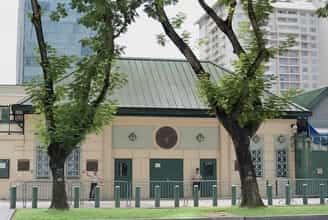
US Embassy building
The US Embassy relics, also known as the "White House of the East", are the origin of sinister military and political plots aimed at long-term annexation of Vietnam. The relic site is a 5-storey building built Built in modern architecture, located at the corner of Mac Dinh Chi - Le Duan Street, Ben Nghe Ward, District 1, Ho Chi Minh City, on a plot of land nearly 5,000 square meters. Previously, the US embassy was located at 39 Ham Nghi Street. At around 10:00 a.m. on March 30, 1963, the US embassy on Ham Nghi Street was hit with explosives by the F21 Commando team, collapsing three floors: 1, 2, 3, so the US decided to rebuild it. Construction began on the building in 1965, most of the materials and construction machinery were transported from the US, under the control of American engineers. According to the design, the building is surrounded by 7,800 Taredo stones that can withstand mines and artillery shells. The main door is equipped with thick steel, the other doors are blocked by a special thick bulletproof layer. All doors use automatic systems, including iron doors blocking the way to the upper floors. Inside the building there are 140 rooms with 200 staff serving day and night. In addition, next to the building is also built an additional row of houses called the "Norodom" area exclusively for C.I.A. employees. When inaugurated, the building had only 3 floors. At the end of 1966, two more floors and a terrace were built to serve as a landing place for helicopters. Surrounding the building is a 3m high wall, at both ends of the wall close to Le Duan Street, 2 high blockhouses are built, guarded day and night. The Embassy was completed in September 1967 with a defense system such as a fortress with 60 guards, a bomb shelter, and a radar screen system to control the facade. Immediately after the building was completed, on September 24, 1967, thousands of students flocked to the gate of the US Embassy to fight for "America to stop bombing the North", "America to go home" and issued a notice denouncing the US for "trampling and seriously violating the right to self-determination of the Southern people". But the outstanding event that happened at the US Embassy was the battle of the City Rangers during the General Offensive and Uprising in the Spring of 1968. The target of attacking the US Embassy was added on January 24, 1968 by Ngo Thanh. Van is in charge of general affairs. Ranger Team 11 took on this important mission, including captain Ut Nho (military region reconnaissance captain) and soldiers: Bay Truyen, Tuoc, Thanh, Chuc, Tran The Ninh, Chinh, Tai, Van, Duc, Cao Hoai Vinh, Mang, Sau and 2 drivers: Tran Si Hung and Ngo Van Thuan. Another equally humiliating event for the US Embassy was the chaotic escape that occurred on April 29 and 30, 1975 by the US and its accomplices. Faced with the rapid attack of the Vietnamese army and people in the historic Ho Chi Minh campaign, over 1,000 Americans and more than 5,000 pro-American Vietnamese jostled, pushed, and kicked each other to compete for a place on the terrace of the building. building to be rescued by helicopter. This relic was granted a certificate of recognition by the Ministry of Culture on June 25, 1976. Currently, the US Embassy building has been demolished and a new consulate in Ho Chi Minh City has been built, but next to it is a memorial stele forever remembering the achievements of the special forces soldiers who died in the battle. . Source: Ho Chi Minh City Youth Union
Ho Chi Minh City
14131 view
Rating : National monument
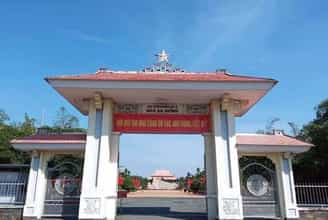
WARRIORS' MEMORIAL AREA AT THREE GIONG FORCES, NATIONAL HISTORICAL MONITOR
Nga Ba Giong relic is a revolutionary historical relic located in Hamlet 5, Xuan Thoi Thuong commune, Hoc Mon district. Surrounded by three roads: Phan Van Hon, Nguyen Van Bua and Provincial Road 19. Nga Ba Giong relic site is a memorial site for historical events in two wars against foreign invaders. Recognized as a national historical site in 2002. Giong Junction (also fully known as Giong Bang Lang Junction) is located in Xuan Thoi Tay village, part of 18 old betel garden villages formed from 1698 to 1731. For a long time, Giong Junction is a place with a folk name that has entered the history of the hometown of 18 betel garden villages of Hoc Mon - Ba Diem. Legend has it that in the past, this place was a relatively high land and a place where many linden trees grew, so this place got its name from there. After the Southern Uprising (November 23, 1940) failed, the French colonialists increased their repression and fierce terror against the revolutionary movement in the Hoc Mon - Ba Diem region. They set up three shooting ranges in Hoc Mon to kill Party leaders and patriotic comrades from their hometown of Hoc Mon and surrounding areas. Giong intersection is the third shooting range to record the heinous crimes of the French enemy and his henchmen against the people of Hoc Mon. Learning from the experience of 2 previous shooting ranges (1 at the old theater in the center of Hoc Mon District, 1 next to the well behind Hoc Mon Hospital today), they executed public shootings, forcing people to come and watch for the purpose of intimidation. revolutionary spirit of Hoc Mon people. But that firing squad backfired. The Hoc Mon people witnessed with their own eyes the cruelty of the French colonialists and the noble sacrifices of the communist soldiers, so their patriotic fire flared up even more fiercely. . For this third shooting range, they did not dare to build it near the center of the District anymore, but moved it to the Giong Junction area as a desolate, sparsely populated area to avoid people's resistance. Here, they built a shooting range with a solid mound of land 12m long, 2.2m high, in front of which were planted 6 shooting posts, each 1.7m high, the shooting direction facing the field (Ba Tram Lac). In 1941, here they secretly executed many times without letting the people see, hundreds of communist soldiers and patriots were killed by them. With the extremely sacred historical significance of Giong Junction, the place that marked the barbaric crimes of the French invaders, the place that demonstrated the indomitable fighting will and noble sacrifices of our comrades and compatriots later on. the Southern Uprising (November 23, 1940); After the complete liberation of the South (April 30, 1975), Hoc Mon district quickly restored and embellished the Nga Giong Junction revolutionary historical relic site to educate traditional generations of youth. This place has become a tourist attraction and a place to organize traditional festivals during major annual holidays of Hoc Mon district and the city, especially the anniversary of Southern Uprising Day (November 23). Currently, with the consent of the city, the district is renovating and building Giong Junction into "Giong Junction Martyrs' Memorial Area". Source: Hoc Mon electronic information portal
Ho Chi Minh City
13322 view
Rating : National monument

Nha Rong Wharf - Ho Chi Minh Museum (Ho Chi Minh City Branch)
Nha Rong Wharf is one of the historical relics associated with the great President Ho Chi Minh's path to national salvation. Nha Rong Wharf or Ho Chi Minh Museum started out as a major commercial port of Saigon. This trading port is located on the Saigon River and was built in 1863, and more than 2 years later, in 1864, this Nha Rong was completed, on the area near Khanh Hoi bridge. Construction of Nha Rong began on March 4, 1863, by the "Sea Shipping Company" to build a store to serve as a residence for the General Director and a place to sell train tickets. The roof is decorated with a dragon image, in the middle instead of a pearl is a badge with the image of "Horse head and anchor". The "Horse Head" insignia refers to the time when in France, this company specialized in road transport with horses pulling carts, while the "Anchor" symbol symbolizes ships. In 1919, the company was allowed to build a wharf with reinforced cement but could not do so. It took until March 1930 to complete the new wharf, which had only one wharf but was 430m long. In 1955, after the French colonialists failed in Vietnam, Saigon Trade was transferred to the southern government of our country to manage. The government restored the roof and replaced the two old dragons with two other dragons with heads facing outward. With a construction area of nearly 1,500 square meters, the remaining area is a green garden with cool air and a romantic setting of more than 400 precious trees from all over the country gathered here to show off their beauty and fragrance, especially especially the banyan tree of the late General Secretary Nguyen Van Linh and the bodhi tree of the President of India. In 1965, Nha Rong was used by the US military as the headquarters of the US Military Aid Receiving Agency. In 1975, after the country was unified, Dragon House, the symbol of Saigon port, was managed by the Vietnam Seaway Department. Nha Rong Wharf is currently the Ho Chi Minh Museum, Ho Chi Minh City Branch, one of the museum branches and souvenirs about President Ho Chi Minh in the country. Because here, on June 5, 1911, young man Nguyen Tat Thanh (later Ho Chi Minh) boarded a train to work as a kitchen assistant to have the opportunity to go to Europe. Next was the day Uncle Ho left to find a way to save the country in Vietnam. Nha Rong Harbor is a place to preserve many priceless documents and artifacts to help future generations better understand the life and great revolutionary career of the Father of the Nation. The museum is built into 12 galleries with about 170 data, images and artifacts. Not only that, this is also an address for people to come and learn about the life and revolutionary career of Uncle Ho. Nha Rong Wharf is also a destination that attracts millions of domestic and international tourists. From the above great values and meanings, Nha Rong Harbor deserves to be a national historical relic that we need to preserve, honor as well as propagate and promote to friends in five continents. Nha Rong Wharf will forever be a great pride of the entire nation. Source: Department of Cultural Heritage
Ho Chi Minh City
11572 view
Rating : National monument
Nearby tourist attractions
See all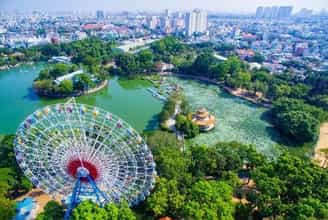
Dam Sen Water Park
On scorching hot days, everyone wants to immerse themselves in the cool, clear blue water. Coming to Dam Sen water park, you can dispel all the fatigue in life. Dam Sen water park with unbelievable ticket prices will be an ideal tourist destination for all tourists in the days when Saigon "lacks" storms. rain. The harmonious space combined with romantic rivers melts away worries and sadness and also provides energy for a new day. Coming to Dam Sen Water Park, you will immediately feel a green oasis located right in the heart of the city. With 36 modern water game equipment and a cool 3,000m2 wave pool, it promises to bring you many exciting feelings of relaxation. Modern 3000m2 water park with modern wave technology and 31 challenging games. Visitors will experience a cool space like being in a green oasis located in the heart of Saigon. Immerse yourself in healthy yet romantic waves to dispel the fatigue and burdens of life. Recharge your energy for a new working week. When coming to Dam Sen Water Park, you will experience the following games: Children's Pool, Wave Pool, Buoyant Slide 3 - Boomerang, Water Jet Massage, Super Speed - Kamizake, Tornado - Tornado,.. and many other games.
Ho Chi Minh City
10349 view
From January to December

Ho Chi Minh City Theater
Ho Chi Minh Opera House is located at 7 Cong Truong Lam Son Street, Ben Nghe Ward, District 1. It is one of the oldest buildings in Ho Chi Minh City following the flowery Western European architecture. Ho Chi Minh City Opera House is one of the typical architectural and cultural works of the city today. The front of the theater faces Lam Son Square and Dong Khoi Street. Next door are two large hotels, Caravelle and Continental. With a convenient location in the city center, the theater is not only a place to organize events but also an interesting tourist destination that attracts many tourists to visit and admire. Saigon Opera House is also an architectural counterpart to Hanoi Opera House. The authors of this ancient architectural building are architects Ernest Guichard, Eugène Ferret and Félix Olivier. Built in 1900 in the "flamboyant" architectural style of the Third French Republic. The facade of the opera house is clearly influenced by the art of the Petit Palais Museum that appeared in the same year in France. The inside is modernly designed with full equipment for sound and lighting. In addition to the ground floor, there are 2 additional floors with a capacity of up to 1800 seats. All decorative patterns, facade reliefs and interiors of the theater were painted by a famous artist in France to resemble the patterns of theaters in France at the end of the 19th century, extremely beautiful. The system of arched doorways with raised railings is designed with bold classical French architecture. Having gone through many historical events, up to now, the Ho Chi Minh City Opera House has been somewhat damaged. Until 1955, the theater was renovated but was used as the House of Representatives of the Republic of Vietnam government. And after 1975, the theater returned to its original function of organizing performing arts. On the occasion of 300 years of Saigon - Gia Dinh, in 1998, the Ho Chi Minh City government decided to renovate the opera house with the motto of preserving the original architectural style. Therefore, the embossed decorations and sculptures on the facade such as the statue of the goddess of art, the flower strings... have all been restored to their original state compared to nearly 100 years ago. Regardless of whether you are interested in learning about culture or simply admiring beautiful architectural works. Ho Chi Minh City Opera House will be your indispensable stop during your trip around Saigon. A beautiful architectural work that has contributed to adding elegance and charm to Ho Chi Minh City. In addition to visiting and admiring the ancient architecture of the Opera House, visitors can visit the Continental Saigon Hotel. One of the oldest hotels in Saigon, hundreds of years old. This place has welcomed many heads of state and politicians from all over the world.
Ho Chi Minh City
9366 view
From January to December

Cu Chi Tunnels
When mentioning Saigon, people often think of the most modern and bustling city in the country, but few people remember that Saigon also has many historical marks of its own. Cu Chi Tunnels are a clear proof of that. Only by going to the Cu Chi Tunnels can we partly understand the magnanimity of Vietnamese history. Cu Chi Tunnels is located about 70 km from Saigon center. This is the place where the transformation of Cu Chi's army and people during the 30-year resistance war to bring independence and freedom to the country is captured. The tourist area consists of 2 parts, 13km apart: Ben Duoc tunnels are located in Phu Hiep hamlet, Phu My Hung commune, Cu Chi district and Ben Binh tunnels are in Nhuan Duc commune and the main tunnel area. Cu Chi Tunnels have a length of up to about 250 km, from the "backbone" of the tunnel it spreads out like a spider web in the ground, including works: tunnels, trenches, embankments, fighting nests, food bunkers. , sleeping, meeting, kitchen, well, storage... The works are connected to each other or can be independent depending on the terrain. Some branches of the tunnel flow into the Saigon River so that in case of emergency, you can cross the river through Ben Cat base (Binh Duong). Inside the Cu Chi tunnels, it is dark and lacking in atmosphere. There are many places where visitors have to stoop to walk. Depending on the terrain, the tunnel can have up to 2 or 3 floors. The closest floor of the tunnel, about 3 meters from the surface, can withstand the weight of tanks and armored vehicles; some deeper places can withstand small bombs. Some hatches are designed into very flexible combat nests and sniper gun emplacements. Around the tunnel door, there are also many spike tunnels and mine pits. Thanks to its intricate and flexible architecture, this place sheltered many officials and people of Saigon during the resistance war against the enemy. Even though the enemy used many methods to destroy the tunnels such as: using water to break through, using an army of "rats", using sniffer dogs, etc. But all failed. In addition to the special historical relics of Cu Chi Tunnels, there are many other interesting fun activities here such as: national defense sports shooting, paintball shooting, swimming, boating on the lake or renting bicycles around. Tunnels. Going around the Cu Chi tunnels tourist area is also an experience worth trying. Here the air is fresh, not noisy like the inner city of Saigon, giving anyone who comes here a feeling of relaxation.
Ho Chi Minh City
10664 view
From January to December

Dai Nam tourist area
Dai Nam tourist area began construction in 1999 and in 2008, it officially opened to welcome visitors. This is a tourist area that has recorded many records such as the tourist area with the largest area in Southeast Asia, the longest wall, the largest temple, the longest artificial mountain, the largest artificial sea, and the largest garden. The first open design animal in Vietnam. Divided into 5 main areas including racetrack, temple, zoo, artificial beach, entertainment area with games classified by popular level, thrills and adventurous exploration. Dai Nam racetrack area is the first complex project in the sports sector in Vietnam with a combination of 5 types: horse racing, motor racing, go-kart, jet-ski and fly-board performance. . All racetrack infrastructure is built according to safety standards, especially go-karts (the basic step to participate in professional F1 racing) appearing for the first time in Vietnam. will certainly attract the curiosity of tourists. Another highlight of Dai Nam tourist area is Dai Nam Temple, which is 9 hectares wide and has the main door facing the Bodhisattva Avalokiteśvara Garden. This is also where national festivals take place, notably the celebration of the United Nations Day of Vesak - VESAK and special performances on major occasions. In addition to Dai Nam Temple, this tourist area also owns an open zoo model that is recognized as the first model to appear in Vietnam with a diverse range of species, including rare and endangered animals. species such as Indochinese tiger, Ca-Tong deer,... Dai Nam tourist area also owns a truly impressive artificial beach, attracting a large number of families to bring their children here to play and immerse themselves in the clear blue water on holidays or weekends. In addition to the sea area, there are also castles surrounded by sea water along with small islands and wave generating systems that bring the most authentic feeling to visitors like being at the natural sea. Tourists who come to Dai Nam tourist area will hardly miss the entertainment area with more than 40 games at many different levels to meet the entertainment needs of all people and all ages. The large area of the game area along with the diverse number of types of games here promises to bring you the most wonderful moments of rest here.
Ho Chi Minh City
11010 view
From January to December

Ben Thanh Market
Ben Thanh market is located in the center of District 1, the most crowded and magnificent area in Saigon. Located near many famous Saigon tourist attractions such as the Independence Palace, City Post Office, City Theater... and many high-end 5-star hotels, Ben Thanh market attracts many tourists. Ben Thanh Market was formed in the mid-19th century. Through the ups and downs of history, this market has long become a symbol of the vibrant trading culture of Saigon in particular and Vietnam in general. Along with the economic and tourism development of Ho Chi Minh City, this market is also increasingly famous and especially attracts a large number of foreign tourists to visit. Vietnamese people are no strangers to crowded, bustling markets. But for foreigners, this is a very unique cultural feature. Therefore, foreign tourists love to go to the market to shop for souvenirs and try Vietnamese specialties. Gradually, Ben Thanh became a prominent symbol of Saigon, making everyone who comes to this city want to visit once. Ben Thanh Market was originally built in the 17th century near the Ben Nghe River to welcome tourists and soldiers into Gia Dinh Citadel. That is also the reason why the market was named Ben Thanh (river wharf + citadel). The market is made of brick, wood and thatched roof. Ben Thanh market in the past was very crowded and bustling, with boats and boats busy day and night. After a long period of use, the market gradually deteriorates and is at risk of collapsing at any time. Therefore, the French rebuilt it and expanded it to a larger scale after filling in a muddy pond named Bo Ret. Since 1912, it took another 2 years for the French construction contractor Brossard et Maupin to complete this project. The old architecture has since been preserved to this day even though Ben Thanh market underwent a major renovation and repair in 1985. Ben Thanh Market has 4 main gates and 12 side gates. Each main gate is located on a different street and displays many popular items for visitors to shop: South gate of Ben Thanh market: South gate is located on Le Loi street, opposite Quach Thi Trang park, this is the main gate of the market. The highlight of this market gate is the famous 3-sided clock tower. The entrance attracts many visitors with stalls selling all kinds of goods, mainly fabrics and dry foods. East Gate of Ben Thanh Market: East Gate is located on Phan Boi Chau Street, a paradise for cosmetics enthusiasts. The stalls here sell a variety of body, skin and hair care products. West gate of Ben Thanh market: West gate is located on Phan Chu Trinh street, this gate has many stalls selling shoes, crafts and souvenirs. North gate of Ben Thanh market: North gate is located on Le Thanh Tong street, this gate sells many types of fresh flowers and tropical fruits. During the day, Ben Thanh market bustles with stalls offering a variety of goods, including textiles, souvenirs, handicrafts, fresh produce, seafood, spices... Atmosphere This place has the true nature of a typical Asian market, bustling and rustic. Ben Thanh Market at night is still crowded but somewhat more peaceful. The stalls mainly sell food with local snacks and drinks. There are also some shops selling clothes, accessories and souvenirs. Bright torches and the sweet aroma of countless Vietnamese specialties are what attract tourists.
Ho Chi Minh City
10496 view
From January to December
 AI Travelviet