
 vn
vn en
en ja
ja ko
ko zh
zh


Don't miss a visit to the historic 247-year-old Thanh Toàn Tile-Roofed Bridge, gracefully situated along the Như Ý River.
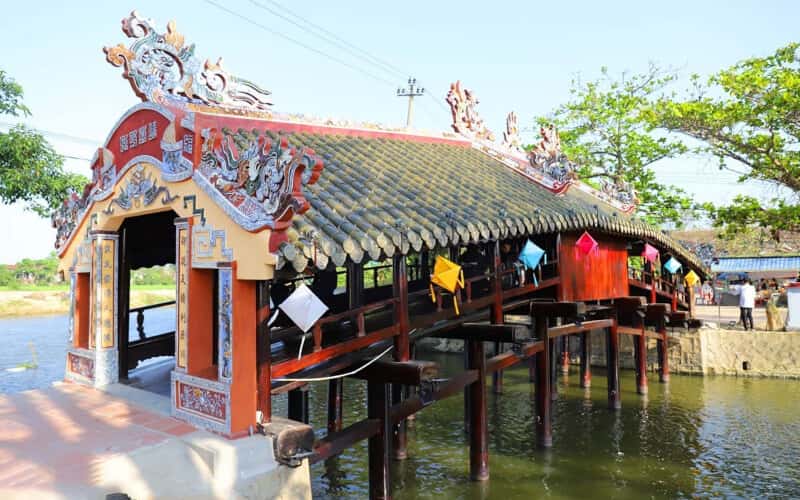
More than just a marvel of distinctive architecture, this bridge stands as a historical sentinel, bearing witness to the remarkable transformation of this former imperial capital.
Thanh Toan Tile-Roofed Bridge – A Unique Must-Visit and Photo Spot in Hue
Built in the "house on bridge" style (thượng gia hạ kiều), Thanh Toan Tile-Roofed Bridge is 16.85m long and 4.63m wide. Constructed from wood with enameled tile roofs, it is adorned with intricate dragon and phoenix motifs.
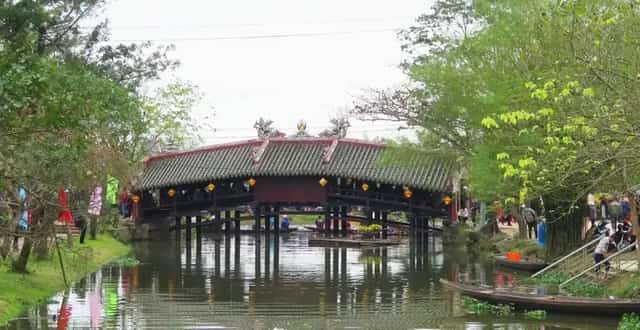
Thanh Toan Tile-Roofed Bridge boasts unique ancient architecture. (Photo: Tuong Vi/VNA)
If you have the chance to visit Hue and wish to admire and explore its ancient, moss-covered beauty, you'll find it not only in the inner city's structures but also in folk architectural works that distinctly embody the rustic charm and simplicity of the countryside.
Such serene landscapes will cleanse your soul, bringing you back to the most peaceful moments and helping you shed the weariness of life. By this criterion, Thanh Toan Tile-Roofed Bridge is an unmissable destination.
Located approximately 8km southeast of Hue city center, Thanh Toan Tile-Roofed Bridge (in Thanh Thuy Chanh village, Thuy Thanh commune, Huong Thuy town, Hue city) stands as one of Vietnam's five most beautiful ancient tile-roofed bridges.
The bridge was built in 1776 by Mrs. Tran Thi Dao, wife of a high-ranking mandarin during the reign of King Le Hien Tong, who generously donated money for its construction. Her aim was to provide convenience for villagers crossing and a resting place for weary travelers and strangers.
In 1776, King Le Hien Tong bestowed an imperial edict upon her, commending her virtues and exempting the village from various taxes and labor duties, so they would remember her generosity and follow her good example. In 1925, King Khai Dinh also granted her the title of Dực Bảo Trung Hưng Linh phò and ordered the villagers to erect an altar directly on the bridge to worship her.
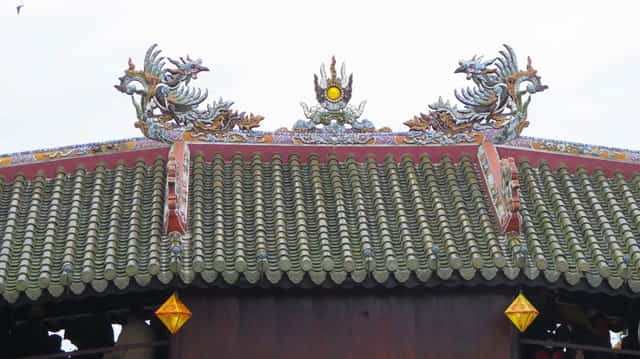
The wooden structure with its azure glazed tile roof, built in the "house on bridge" (thượng gia hạ kiều) architectural style, defines Thanh Toan Tile-Roofed Bridge. (Photo: Tuong Vi/VNA)
Thanh Toan Tile-Roofed Bridge is constructed in the "house on bridge" (thượng gia hạ kiều) style, divided into several compartments, each functioning like a small house within a larger structure. The bridge's body is made of wood, topped with enameled tube tiles. Unlike tile-roofed bridges in the Northern region that typically use fish-scale or slipper-toe tiles, Thanh Toan Bridge features azure glazed tiles (ngói lưu ly).
Regarding the "house" (thượng gia) section of the structure, the tile-roofed bridge utilizes a wooden truss system with seven compartments. The central compartment, also the largest, serves as a shrine to Mrs. Tran Thi Dao. The remaining six compartments are symmetrically structured, each featuring two rows of wooden platforms and railings, creating a central "walking lane" and "resting lanes" on both sides, lending grace and harmony to the tile-roofed bridge.
Originally, Thanh Toan Tile-Roofed Bridge measured 43 thước mộc (18.75m) in length and 14 thước mộc (5.82m) in width. After several restorations, its current dimensions are 16.85m long and 4.63m wide.
Currently in Vietnam, besides Thanh Toan Tile-Roofed Bridge, there are several other bridges with similar architecture, including Chùa Cầu (Hoi An), the tile-roofed bridge in Hai Anh commune (Hai Hau, Nam Dinh), Phat Diem tile-roofed bridge (Kim Son, Ninh Binh), and two tile-roofed bridges at Chua Thay (Hanoi).
While sharing many architectural similarities, unlike Chùa Cầu (Hoi An) which uses mascots of dogs and monkeys for decoration, Thanh Toan Tile-Roofed Bridge features dragons and phoenixes sculpted on the ridges of its tiled roof. The gables are adorned with pháp lam (enamelware) and patterns, all sharing the common theme of "dragon transformation."
As for the "bridge" (hạ kiều) section of the structure, Thanh Toan Tile-Roofed Bridge is supported by six round, multi-span ironwood (gỗ lim) pillars, with abutments built from rough-hewn stone.
After nearly 250 years of existence, in early April 2020, the local authorities carefully dismantled the bridge for preservation, renovation, and restoration. The project to preserve, repair, and restore the Thanh Toan Tile-Roofed Bridge relic was approved by the People's Committee of Thua Thien-Hue province, with a total investment of over 13 billion VND. The renovation and restoration efforts were based on the principle of maximizing the use of original structure and materials.
Pausing at Thanh Toan Tile-Roofed Bridge, visitors can take in the characteristic peaceful panorama of a Vietnamese village: vast rice fields, the tranquil Như Ý River flowing gently, verdant bamboo groves, and farmers diligently working, perhaps casting fishing nets, herding buffalo, or collecting snails. This airy, serene atmosphere, combined with the bridge's special architecture and profound significance, has made it not just a resting place for locals but also a must-visit for anyone coming to Hue:
“Oh, if you're heading to Thanh Toan Tile-Roofed Bridge,
Please let me join your happy crowd!”
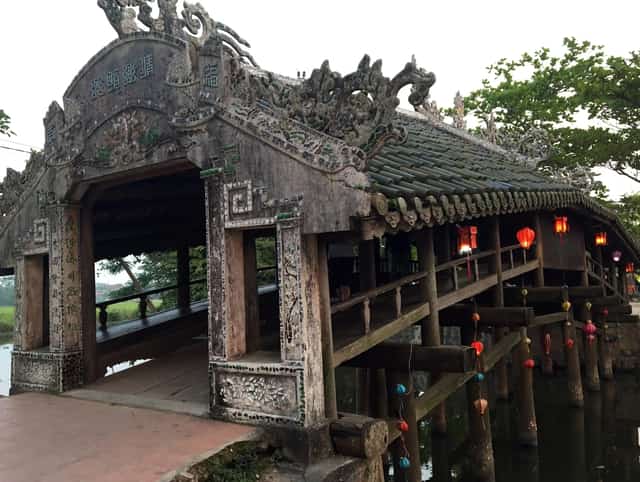 Thanh Toan Tile-Roofed Bridge. (Photo: Quoc Viet/VNA)
Recognized for its significant cultural and historical value, Thanh Toan Tile-Roofed Bridge was designated a National Cultural Heritage Site by the Ministry of Culture, Sports and Tourism in 1990.
In 2019, the Department of Tourism of Thua Thien-Hue province organized a night market at Thanh Toan Tile-Roofed Bridge. The night market was set up around the bridge, featuring many attractive activities such as a food market, bài chòi (folk singing game) performances, traditional folk games, and exhibitions for visitors.
This market is held on the 16th day of every lunar month, even during the rainy season, adding diversity to the local eco-tourism and community tourism offerings.
Next to Thanh Toan Tile-Roofed Bridge, you'll find the Thanh Toan Agricultural Tools Exhibition House. Here, visitors can learn about the history of agricultural tools, explore artifacts reflecting rural life in Thanh Toan—such as water wheels (xe đạp nước), buckets (gàu), sieves (sàng), jars (chum), rice mortars (cối giã gạo), winnowing baskets (nong), and flat baskets (nia)—and experience or observe fascinating rural activities like operating water wheels, husking rice, and crafting conical hats (nón).
Together with Thanh Toan Tile-Roofed Bridge, this place also helps preserve the beautiful aspects of the traditional way of life.
Hue 6026 view
Update day : 28/11/2023
Source : Vietnamplus.vn Affiliate links



Monuments close by
See all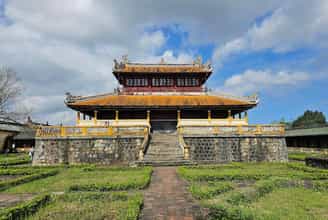
Hue Citadel
Hue Citadel is located at Street 23/8, Thuan Hoa Ward, Hue City, Thua Thien Hue Province, on the banks of the romantic Perfume River. Hue Citadel was built in the first half of the twentieth century, this is one of the relics recognized by UNESCO as a World cultural heritage since 1993. Hue Citadel is the place where people live and activities take place. of the Nguyen kings and the last feudal court of our country. Hue is a peaceful and poetic land, so King Gia Long chose this place to build the Hue Citadel in 1803. It took 30 years for this project to be officially completed. Hue Citadel was built with Hue royal architecture, so every line and decoration is very sophisticated. Hue Citadel has two main areas: the Imperial Citadel and the Forbidden City, each area includes many different works. The Imperial Citadel area includes Ngo Mon gate and Thai Hoa Palace. The Forbidden City is an area reserved for the king and royal family, including Dai Cung Mon, Ta Vu and Huu Vu, Can Chanh Palace, Thai Binh Lau, Dien Tho Palace... 1. Imperial Citadel area Ngo Mon Gate was built massively and majestically with extremely elaborate, sophisticated and solid patterns. Ngo Mon is not simply the entrance gate but also the representative face of the Hue Royal Citadel, so it is designed with many layers with a surrounding moat system. The Ngo Mon Gate of Hue Imperial Citadel looks south of the citadel and has 5 gates, the main gate in the middle is for the king, and the two side gates are for civil and martial mandarins. The remaining area of the two surrounding gates is for soldiers, elephants and horses to follow the king to protect and serve him. Thai Hoa Palace is a symbol of the power of the Nguyen Dynasty at that time. Thai Hoa Palace is the most important building in the overall Imperial Citadel of Hue. This place and Dai Trieu Nghi yard were once the place where court meetings of the Nguyen Dynasty took place, most of which were court meetings. important. Thai Hoa Palace uses ironwood as material. The roof, columns, etc. are carved with delicate, meticulous dragon shapes. In the middle of the palace is the king's throne placed in a solemn position, where the king sits during court meetings. 2. Forbidden City area Dai Cung Mon is the main door (south) into the Forbidden City, consisting of 5 compartments and 3 doors and was built during the reign of King Minh Mang, in 1833. The door in the middle compartment is only for the king to enter, the back on both sides has two corridors connecting Ta Vu and Huu Vu. Dai Cung Mon overlooks the front yard towards Thai Hoa Palace, built entirely of wood, topped with lapis lazuli tiles. Ta Vu and Huu Vu are two buildings right opposite Can Chanh palace, built in the early 19th century. Ta Vu building was built for literary mandarins, Huu Vu is a place for military mandarins in the court. These two buildings are the place to prepare for rituals before the court, where competitions or banquets are held. Can Chanh Palace is located directly with Thai Hoa Palace in the North-South direction, this is the place for the king to hold court. Can Chanh Palace is considered the largest and most beautiful wooden structure in the entire Forbidden City. The columns are made of ironwood, the upper frame is delicately and elaborately carved. Thai Binh Lau is located inside the Forbidden City of the Hue Citadel, this place will be used for the king to rest in his free time, read books, write literature or relax poetry. Thai Binh Lau was built in 1919 by King Khai Dinh and completed in 1921. Among the many palaces in the Imperial Citadel of Hue, Dien Tho Palace is considered the largest palace architectural system in Hue. This is the residence of the Queen Mother and the Queen Mother, powerful women next to the king. Hue Citadel is the largest scale project in Vietnam's history with a construction period lasting many years with tens of thousands of construction workers along with activities of filling rivers, digging trenches, building ramparts, besides Huge amounts of soil and rock amounting to millions of cubic meters. Visiting the Hue Citadel relic complex, you will admire hundreds of magnificent shrines, temples and palaces. With its magnificent beauty combined with unique architecture, it promises to be a destination that will bring you many interesting experiences. Source: Thua Thien Hue tourism information portal
Hue
10931 view
Rating : National monument
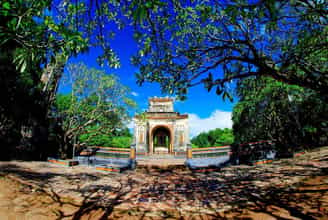
Tomb of Tu Duc
Tu Duc Tomb is located at Thuy Xuan Ward, Hue City, Thua Thien Hue Province. Tu Duc Tomb (Khiem Lang) was built in a narrow valley in Duong Xuan Thuong village (now Thuong Ba village, Thuy Xuan ward, Hue city). This is one of the most beautiful works of royal architecture of the Nguyen Dynasty. The mausoleum is located in the middle of a vast pine forest, 8km from Hue. The overall architecture of the Mausoleum is located in a La Thanh circle of about 12 hectares, including nearly 50 large and small architectural works spread out in clusters on high and low ground about 10 meters above each other. The layout of the mausoleum consists of two main parts, on two parallel axes, with Giang Khiem mountain in the front as the front court, Duong Xuan mountain as the back occipital, Luu Khiem lake as the Minh Duong element. The buildings in the mausoleum in both the palace and mausoleum areas all have the name Khiêm. The panorama of Tu Duc mausoleum looks like a large park. Through Vu Khiem gate, to Luu Khiem lake area, on the lake there are Pulse Khiem ta and Du Khiem ta, where the King often came to admire flowers, write poetry and read books. Continue on three clear stone steps leading to Khiem Cung Mon, then to Hoa Khiem Palace, this was originally the King's workplace but is now used to worship the King and Queen. After Hoa Khiem Palace comes Luong Khiem Palace, formerly the King's resting place and later becoming a place to worship the King's mother, Mrs. Tu Du. To the right of Luong Khiem Palace is On Khiem Hall, where royal belongings are stored. On the left side of Luong Khiem Palace, there is the Minh Khiem Theater for the King to watch. This is considered the oldest theater in Vietnam still preserved. Right behind the two rows of majestic statues of civil and military mandarins is the Bi Dinh (stele house), a large stone stele with the 4,935-word Khiêm Cung ky of King Tu Duc engraved about his life, royal career and mistakes. and your mistakes. On the hill across Tieu Khiem Tri semicircular lake is Buu Thanh built of bricks, in the middle is a small house built of clear stone, where the King rests. Tomb of Tu Duc is a masterpiece of poetry, a charming landscape painting. The work was recognized as a national monument on April 29, 1979. Source: Thua Thien Hue province electronic information portal
Hue
10849 view
Rating : National monument
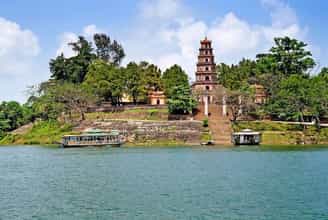
Thien Mu Pagoda
Thien Mu Pagoda is the oldest pagoda in Hue, located on Ha Khe hill, on the left bank of the Perfume River. Thien Mu Pagoda is one of the most scenic spots in the ancient capital of Hue. The pagoda was built on top of a high hill right on the bank of the Perfume River opposite Nagarjuna land. In front of the pagoda's door is an octagonal architectural tower, an octagonal layout. This tower consists of 6 equal floors, but the higher you go, the smaller the area becomes. Each floor has a small roof protruding with decorative lines that are quite sophisticated, regular and unusually vivid. Each side has a fairly large rectangular rolling door but surrounded by many dragon and moon models. At the top is a small 8-sided roof. In the middle is decorated a wine barrel with a pointed nose. There are patterns of clouds all around. Legend has it that, when Lord Nguyen Hoang became governor of Thuan Hoa and governor of Quang Nam, he personally went to examine the terrain here to prepare for his plan to expand his business and build a country for his lineage. later Nguyen family. Once, while riding his horse's hooves along the banks of the Perfume River upstream, he came across a small hill rising next to the meandering clear blue water. The ground looked like a dragon turning its head to look back. This hill has The name is Ha Khe hill. Local people said that at night, an old woman wearing a red shirt and green pants often appears on the hill and tells everyone: "Someday, a true lord will come and build a pagoda to gather spiritual energy and strengthen the temple." Dragon veins, for a strong South country". Therefore, this place is also called Thien Mu Son. Lord Nguyen Hoang's great thoughts seem to be in tune with the will of the people. Nguyen Hoang was so happy that in 1601 he built a pagoda on a hill, facing the Perfume River, naming it "Thien Mu". With its expanded scale and natural beauty, Thien Mu Pagoda has become the most beautiful pagoda in Dang Trong. Through many historical ups and downs, Thien Mu Pagoda was once used as a Dat Sacrifice altar under the Tay Son Dynasty (around 1788), then was restored and rebuilt many times under the Nguyen Dynasty. In 1884, on the occasion of celebrating the "eighth birthday" (80th birthday) of Queen Thuan Thien Cao (King Gia Long's wife, King Thieu Tri's grandmother), King Thieu Tri re-architected the pagoda properly. bigger: Build Tu Nhan tower (later changed to Phuoc Duyen tower), Huong Nguyen communal house and erect two steles recording the king's poetry. The pagoda campus is divided into two areas: The area in front of Nghi Mon gate includes architectural works: The boat wharf has 24 steps up and down, the three-entrance gate is four pillars built close to the main road, from the three-entrance gate. Stepping up 15 steps is Huong Nguyen communal house (now only the ground floor and solid stone foundation remains). Behind Huong Nguyen communal house is the Phuoc Duyen tower built of seven-storey high-height bricks. On both sides of Huong Nguyen communal house, there are two The stele building is quadrangular in shape (built during Thieu Tri's reign), back inside there are two hexagonal shaped floors, one for stele and one for bells (built during Nguyen Phuc Chu). These are memorial works (steles, towers). The area inside Nghi Mon gate includes Dai Hung palace, Dia Tang palace, Quan Am palace, Trai house, Guest house, flower garden, and at the back is a quiet pine garden. Thien Mu Pagoda is like a witness of history taking place on the banks of the Perfume River. The pagoda still exists in the minds of Hue people in particular and the cultural life of Vietnamese people in general. Source: Vietnam National Tourism Administration
Hue
10794 view
Rating : National monument
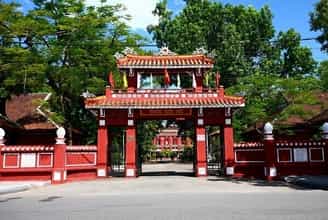
Hue Quoc Hoc School
Hue National School Relics is located at 12 Le Loi, Hue city, Thua Thien Hue province. Quoc Hoc Hue School is now Hue Quoc Hoc specialized high school. The school is the place to witness Uncle Ho's years of diligent study and vibrant activities in the patriotic movement of the early 20th century. Through many ups and downs of history, Hue National School is still a place to mold and nurture talents for the country and preserve within itself the tradition and enthusiasm of revolutionary geniuses. Quoc Hoc School was established according to the edict dated September 17, the 8th year of Thanh Thai (October 23, 1896) and the Decree dated November 18, 1896 of the Governor General of Indochina. This is the main French-Vietnamese school in the whole of Indochina. In May 1906, Mr. Nguyen Sinh Sac entered Hue capital to accept the position of Minister of Rites. Nguyen Tat Thanh and his brother Nguyen Tat Dat followed their father to Hue to live and study. His father sent him to Dong Ba French-Vietnamese Primary School, Nguyen Tat Thanh was smart, studious and good at studying. As an excellent student at the school, in the 1908 Primaire exam, Thanh was one of the ten best students at Dong Ba French-Vietnamese Primary School who passed the exam to enter the second high school class of Quoc Hoc School in the school year 1908 - 1909. . Studying at Quoc Hoc School, Nguyen Tat Thanh had the opportunity to absorb Western civilization more deeply, but he also better understood the demagogic nature of the slogan "Freedom - Equality - Fraternity" that French colonialists are preaching. In the early years of the 20th century, the patriotic movement initiated by Phan Boi Chau, Phan Chu Trinh, Luong Van Can... had a great impact on Nguyen Tat Thanh's awareness, he became a liaison. for patriotic organizations and mobilize classmates to support patriotic movements. These were the activities that marked the beginning of Nguyen Tat Thanh's patriotic struggle career, from which he decided to say goodbye to Quoc Hoc school, gradually go to the South, go abroad to find a way to save the country. In 1975, the South was completely liberated, the country was independent and unified, Quoc Hoc High School truly became a socialist school, a place to attract and train gifted students from Thua Thien Hue, contributing to the training of talented people. for country. In 1990, to celebrate the 100th birthday of President Ho Chi Minh, to commemorate the school's outstanding student, Ho Chi Minh Museum in Thua Thien Hue together with Quoc Hoc School built a statue of Mr. Nguyen Tat Thanh in Thua Thien Hue. Right in the center of the school. Quoc Hoc School is proud to have contributed to cultivating a great personality, a great bravery, and a genius leader for the nation: Ho Chi Minh. * Quoc Hoc School Relics was recognized by the Ministry of Culture, Sports and Tourism as a National Historical Relic on March 26, 1990, and ranked as a special National Relic by the Prime Minister on March 26, 1990. December 31, 2020. Source: Thua Thien Hue electronic information portal
Hue
10646 view
Rating : Special national monument
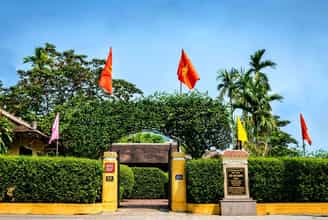
Memorial House of President Ho Chi Minh
Uncle Ho's Memorial House is at No. 112 (new number 158) Mai Thuc Loan, Thuan Loc Ward, Hue City, Thua Thien Hue Province. This is the house where President Ho Chi Minh lived when he followed his family to Hue for the first time from 1895 - 1901. In 1894, Mr. Nguyen Sinh Sac (father of President Ho Chi Minh) passed the Bachelor's exam at Huong Nghe An exam school. In 1895, he went to Hue to take the Ho Chi Minh exam but did not pass. To prepare for the next exam, he applied to study at Quoc Tu Giam School - Hue and was accepted. In order to have the conditions to take care of his children, and his family was also a source of support for him during his busy days, he returned to his hometown and, along with his wife, Hoang Thi Loan, brought his two sons, Nguyen Sinh Khiem and Nguyen Sinh Cung, to Hue. . Thanks to an acquaintance's introduction, he rented a small house on Dong Ba Street (a current relic house). In this house, Mr. Nguyen Sinh Cung (Uncle Ho's name as a child) lived happy years with his family: An exemplary but strict father, dedicated to taking care of the books day and night; a gentle, responsible mother, spending time at the loom and joy when welcoming baby Nguyen Sinh Xin into the world. But this house also imprinted in Nguyen Sinh Cung's soul the pain of losing his mother and the cry of his child thirsting for milk. And the love and care of the poor people of Hue. Those deep sentiments are the cultural values that contribute to the formation of moral personality and humanism. Ho Chi Minh - He spent his entire life striving for independence, freedom of the nation, and happiness of the people. Uncle Ho's memorial house at 112 Mai Thuc Loan is a wooden house with three rooms, four columns, architectural style of traditional Hue houses, with a tiled roof, walls surrounded by bricks, the front is the system of "upper bars, lower bars"; Connected to the main house is the kitchen, plastered walls, and thatched roof. The house is located in a complete house - yard - garden complex. In particular, this house is where Ms. Hoang Thi Loan gave birth to her fourth child, boy Nguyen Sinh Xin, and is also where she breathed her last breath at the age of 33 on December 22, the year of the Rat (February 10, 2019). 1901). * Uncle Ho's memorial house on Mai Thuc Loan street, the house was recognized by the Ministry of Culture and Information as a national historical relic on February 2, 1993. * On December 31, 2020, the Prime Minister issued a Decision to classify the President Ho Chi Minh relic system in Thua Thien Hue as a special national historical relic. (including 4 relics that were previously ranked as National: Uncle Ho's memorial house on Mai Thuc Loan street; Hue National School site; President Ho Chi Minh's childhood memorial house in Duong No village and Duong No village communal house). Source: Thua Thien Hue province electronic information portal
Hue
10079 view
Rating : Special national monument
Nearby tourist attractions
See all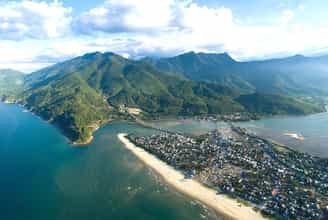
Lang Co Beach
Lang Co Bay is located in Lang Co town, Phu Loc district of Thua Thien Hue province, 70km from the city center in the direction of Da Nang, next to National Highway 1A and embracing the foot of Hai Van pass. Traffic is a convenient condition when you choose to stay in Lang Co. Possessing clear water on the white sand strip of the Central region, surrounded by the towering Hai Van Pass, the bay has a cool, gentle atmosphere all year round. If Sam Son's waves rush to the white sandy shore, Cua Lo's waves are quiet, then Lang Co's waves have their own unique color, calm and gentle, rushing into the hearts of tourists, bringing with them the salty taste of the sea, the serenity of the sea breeze and perhaps even the proud appearance of the towering Hai Van Pass there. Dawn on Lang Co Bay, in the color of silvery clouds, the weak golden sunlight of the morning seems to spread down to the water surface, dyeing the mountain pass yellow, tainting the grass, flowers and leaves, and the mist, lingering in the hearts of those who are passing by. The early morning scene is full of vitality, reflecting both the bright future of the people here and the landscape that has taken root here. In the afternoon, patches of darkness began to cover the landscape, the darkness mixed with the yellow rays of sunlight at the end of the day, making the picture even more diverse, sometimes filled with anxiety, torment and regret, but sometimes very romantic, like an unconscious arrangement of nature. The Creator has given this place a charming scenery, with soft, flexible curves, along with Ha Long Bay and Nha Trang Bay, becoming one of the 30 most beautiful bays in the world. If you have the opportunity to set foot in Lang Co Bay, give yourself a chance to visit Lap An lagoon, one side is a mountain, the other is a shallow lagoon, without any waves, really suitable for tourists who like quiet, dreamy, a scene that seems to only exist in a fairy tale world. Besides the majestic Hai Van Pass, there are still peaceful and gentle beauties like the people of Hue; The heroic scenery, imprinted with a resounding period of the ancient capital mixed with the modesty and charm of the people here, are all specialties of the dreamy land of Hue.
Hue
9974 view
March to November
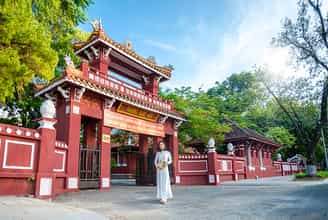
Hue Quoc Hoc School
Hue National School was built in 1896 and is now more than 120 years old. This is also the place that trained many famous leaders in history such as President Ho Chi Minh and General Vo Nguyen Giap. , late General Secretary Tran Phu. The gentle and poetic ancient capital of Hue made many hearts flutter right from the first "meeting". The ancient beauty of the ancient capital of Hue is not the same as the ancient town of Hoi An, and even more different from the mossy walls of Hanoi. Hue has an ancient beauty, quiet and gentle like the children of this land. Adding to the ancient, dreamy features of the capital city is the third oldest school in Vietnam - Hue National School. Located overlooking the romantic Huong River with an area of more than 4,000 square meters, the school is not only famous for the excellent quality of its students and teachers but also attracts many eyes with its unique architectural blend of two styles. Asia – Europe. In the beginning, Hue National School was named "Phap Tu Quoc Hoc Truong Mon", which was a Royal Navy barrack built in the style of a mud-walled cottage, later renovated in the style of French and French architecture. became a school exclusively for boys before 1976. Surrounded by walls built of striking dark red bricks still retain traces of the years. On campus, there is also a boarding house for more than 70 students who are in difficult circumstances going to school away from home so that the School can best care for their living and studying lives. After the Doi Moi period, in September 1989, a statue cast in plaster covered with a layer of bronze was placed right in the middle of the school yard to commemorate President Ho Chi Minh. Regularly for many years now, every Monday morning at the beginning of the week, all students and teachers currently studying and working at Hue National School solemnly stand under the statue and sing the National Anthem. national heroism. Currently, a row of houses has been renovated and built with a swimming pool and sports field to better serve the learning needs and ensure the safety of students without much affecting the overall architecture. of the school. Hue National School was also recognized as a National Historical and Cultural Monument in March 1990. Hue National School - worthy of being a prestigious school and a place that marks the history of our country. The ancient architectural features of France remain intact and still nurture the dreams of many generations of students.
Hue
10609 view
From January to December
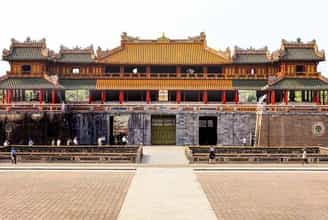
Hue Citadel
Hue Citadel is part of the Hue Monuments Complex, imbued with cultural, historical and architectural imprints of the Nguyen Dynasty, recognized by UNESCO as a world cultural heritage in 1993. Located on the banks of the Perfume River, Hue Citadel is one of the relics belonging to the Hue Monuments Complex group recognized as a World Cultural Heritage and still retains many unique imprints of the feudal style of the Nguyen Dynasty hundreds of years ago. Hue Citadel is a cluster of relics including the Imperial Citadel (where the king held court and worked) and the Forbidden City (where the king and royal family lived). As the most massive project in Vietnamese history, the Hue Citadel Monument had a construction process lasting up to 30 years with tens of thousands of construction workers and a series of tasks such as filling rivers, digging trenches, building ramparts, moving tombs... and a huge volume of soil and rock up to millions of cubic meters. Visiting the Hue Citadel relic complex, you will admire hundreds of magnificent palaces, majestic temples and shrines. With its magnificent beauty and stunning palace architecture, you will definitely enjoy your journey to visit the Citadel. The Imperial Citadel of Hue includes many areas such as the defense area, the ceremony area, the shrine area,... placed in the middle of a beautiful and harmonious natural space of lakes, flower gardens, stone bridges, islands and lush green trees providing shade. The Imperial Citadel has 4 gates placed on 4 sides, of which the largest main gate and the most beautiful architecture is Ngo Mon gate. Ngo Mon Gate looks south of the capital and looks out to the romantic Perfume River. Ngo Mon Gate has 5 gates, of which the main gate in the middle was once the gate for the king, the two side gates were for civil and martial mandarins, and the two surrounding gates were for soldiers, elephants, and horses to follow. Built above the gate is the Ngu Phung Floor with ironwood structure, divided into 2 floors and 9 sets of roofs, the middle roof is covered with yellow roofs, the remaining 8 are covered with green roofs. Previously, Ngu Phung Floor was the place where a number of major ceremonies of the Nguyen Dynasty were held. After nearly 2 centuries and witnessing many important historical events of the nation, Ngo Mon Gate still exists over time and has become an excellent ancient architectural masterpiece! Thai Hoa Palace is a symbol of the power of the Nguyen Dynasty. Located in the Imperial Citadel area, Thai Hoa Palace and Dai Trieu Nghi Yard used to be the place where important court meetings took place. Among the many palaces in the Imperial Citadel of Hue, Dien Tho Palace is the largest palace architectural system in Hue remaining today. This place used to be the residence of the Queen Mother and the Queen Mother. Also belonging to the Hue ancient relic complex and located in the Imperial City area, the Forbidden City was the living place of the king as well as the Nguyen Dynasty. In the Forbidden City, there are more than 50 architectural works of various scales, typically including Can Chanh Palace (where the king held court and held banquets), Can Thanh Palace (where the king slept), Thai Binh Lau (where the king relaxed and read books), Ta Vu & Huu Vu,... When visiting Hue Citadel, you can also participate in the Royal Palace Night held periodically every Saturday. On the night the Royal Palace is filled with light, ancient royal rituals will be recreated authentically and unique cultural and artistic activities will also take place. This will be an extremely interesting highlight for your journey to explore Hue Citadel! More specifically, recently the Hue Citadel has officially opened to welcome visitors at night from 7:00 p.m. to 10:00 p.m. and this is an opportunity for you to visit and learn about the Citadel as well as "own" beautiful photos of the brilliant, sparkling works of light.
Hue
9972 view
March to August
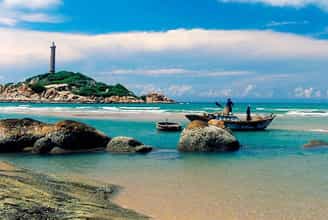
Thuan An Beach
Thuan An Beach is located 15km from Hue city center, so it only takes about 15 minutes by taxi or half an hour by motorbike to admire the beauty of this place. The entire 1km of Thuan An beach still retains its pristine beauty with long stretches of fine white sand and clear blue sea water. Although tourism services are not as developed here as in Lang Co, they still attract many tourists to explore. One day at Thuan An Hue beach, you will have the opportunity to admire the colorful changes of the vast sea. When the first rays of sunlight appeared in the East, the entire sea was dyed a golden color. At this time, you will be immersed in the vibrant, bustling but also very familiar atmosphere of seafood trading activities. After a trip to sea, boats filled with fish and shrimp returned with joy and excitement. When the sun rose high, the entire ocean surface was filled with sparkling silver waves. Then at dusk, we can admire a beautiful sea sunset - a priceless gift from mother nature. Although many services have not yet been developed, you can rest assured about food and drink when coming to Thuan An Hue beach! You can enjoy the fresh flavors of dishes made from seafood caught by local people. It's fun to be with friends watching the night sea while enjoying seafood on a red charcoal grill. With its inherent wild beauty, Thuan An beach is truly an ideal destination for tourists who love to explore and explore. In the future, Thuan An beach promises to be a bright spot in the tourist map of dreamy Hue.
Hue
9764 view
March to August
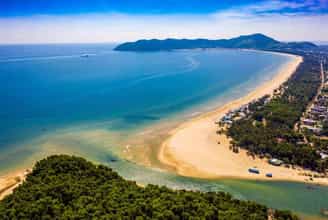
Canh Duong Beach
For those who are passionate about the sea, Canh Duong beach will be a better choice when traveling to Hue. Coming here, you will have the opportunity to experience new and interesting things and immerse yourself in a beautiful pristine beach. Although the beach is quite far from the city center, this place still attracts many tourists to visit. Canh Duong Beach is located in Canh Duong village, Loc Vinh commune, Hue city. This place is known as a beach that still retains its wildness, close to nature, and is cheap, very suitable for young people who want to explore this summer. About 50km from Hue and Da Nang city centers, to get here, visitors will have to drive about 1 hour. You can take a taxi or rent a motorbike to conveniently travel around Canh Duong beach. The route is not too difficult, even for those who come here for the first time. If you are traveling from Hue, just run along Highway 1A towards Hue - Da Nang past the "animal quarantine checkpoint & Chan May port" sign for another 100m. then turn left. As for those coming from Da Nang - Hue direction, turn right about 3km more and you will immediately see the beach. For those who want to save money on the trip, you can choose the Hue - Da Nang bus or the Da Nang - Hue route at a cost of 30,000 VND/person to get to the entrance to Chan May port and then rent a car to go there. in the beach. Coming here, you will be immersed in a fresh atmosphere, dispel the fatigue in life, and relax your soul. Canh Duong Beach in Thua Thien Hue is not only famous for its rustic natural beauty, it is also a place to take unique photos with super beautiful decoration with stone paths and swings. Very cute for you to freely check-in. With the advantage of a large beach, this place is suitable for small parties or camping overnight on the beach with friends, creating great memories for this whole trip of discovery. Visitors coming here can mingle with nature and participate in sports and entertainment activities such as soccer, volleyball, curling, swimming, campfire, BBQ... renting bicycles to explore Canh Duong village, Buy seafood early in the morning. The service quality of Canh Duong Hue beach is quite good with cheap tent rental service. On the beach there are many restaurants, children's play areas, and fully equipped public restrooms. Camping equipment rental is available with modern, safe equipment. For those who want to experience the feeling of living in nature with tents, watching stars and beautiful sea views at night. To be able to fully explore this beautiful beach, visitors can rent a small boat to go out to sea and watch fishermen fishing and squid fishing on the sea. A romantic scene brings a wonderful feeling. This is definitely a new type of travel experience close to nature, full of amenities, worth exploring this summer. The beautiful pristine beach here will help you stay away from the noise and bustle to have fun freely. Coming to Canh Duong beach in Hue, visitors will not only have a completely new experience, get close to nature and immerse themselves in sports and entertainment activities, but also enjoy the unique dishes of the people. here. Delicious, rustic dishes are meticulously prepared and still retain the typical sea flavor. Tourists are attracted by fresh seafood dishes at affordable prices such as steamed crabs, grilled squid, hake fish, shrimp, etc. Coming here, you will find it hard to resist these attractive dishes. A specialty that cannot be missed when traveling to Canh Duong beach is salt-roasted crab, which has a special flavor that visitors will never forget after trying it once. In addition to seafood dishes, you can also enjoy black sesame rice paper, fig mixed with shrimp and lice, which has a unique pungent taste prepared by local people here. Canh Duong Beach has become one of the extremely ideal destinations for anyone who wants to enjoy beach tourism. Coming here, you will be immersed in nature with extremely attractive and new beaches and amusement parks suitable for young people.
Hue
10133 view
March to November
 AI Travelviet