
 vn
vn en
en ja
ja ko
ko zh
zh














List of relic sites (41)

Tan Thach Communal House
Tan Thach Communal House is in Hamlet 9, Tan Thach Commune, Chau Thanh District, Ben Tre Province. Tan Thach communal house was built in 1841, at that time it was called Thach Ho communal house. The communal house was built to worship the village's Thanh Hoang. The structure of the village communal house is in the shape of the letter Tam (三) with three main spaces, Vo Ca, Vo Quy and Main Hall, adjacent to each other. Tan Thach communal house has a campus area of about more than 7,600 square meters. In particular, the area of the communal house is 1,250m2. The communal house was built with traditional architecture, the roof is covered with yin and yang tiles, decorated with familiar images such as two dragons with pearl paintings, carp turning into dragons and eight immortals. The three-entrance gate of Tan Thach Communal House is built of bricks and cement, the roof is tiled, and on the roof are images of two white porcelain dragons. The gate is designed into three doors with the main door in the middle. According to folk beliefs, the main gate is for monks, kings, and mandarins to come to the communal house to offer incense. The side door is for guests from all over, on the left is men, on the right is women. Both sides of the communal house's gate are decorated with unicorns made from blue glazed ceramics in a sitting position. Next to it are two embossed parallel sentences, expressing the wish for peace in the country and people, good weather and wind. The fence around the fence is made of green stone, decorated with bars in the shape of a cone. In front of Tan Thach communal house yard, there is also a large screen of Than Nong made from stone material, about 3 meters high, embossed with a dragon rising and flying. Below is a tiger hidden in patterns of mountains, clouds, and trees. On both sides of the screen are two parallel sentences written in Chinese. "Tiger resides in the mountains and forests in Phu Xa Tac". "Dragon and Moon Palace spans mountains and rivers". On the left side of the screen is a small temple of Son Quan, worshiping the sacred Tiger God. On the right is a temple worshiping the Earth God and the Ha Ba God, who according to folk beliefs is the god who governs the land and rivers. In addition, the temple also worships 3 stones according to the Neak Ta belief of the Khmer people. Vo ca space: This is a space consisting of three rooms and two wings, where activities to build Dai Boi adoration are held on major occasions such as worshiping Ky Yen. Gian Vo Quy: This space consists of five houses and two wings, built in the architectural style of a cross-trinh house with horizontal beams connecting through each column. Gian Vo Quy placed an incense table to worship Buddha, and was also a place to perform sacrificial rituals. Main hall: In front of the main hall is an altar, on the right are two tablets inscribed with: "Nam Hai Cu Toc Ngoc Lan Than" and "Nguyen Thuy Duc". On the left side of the altar are two tablets "Lord of the Holy Motherland" and "Eunuch Bach Ma Moc with Five Directions Worshiping God". The main hall is built in the style of a three-room house with two airy and spacious wings. The middle hall worships the National Patriarch Hung Vuong, next is the worship of President Ho Chi Minh. On the side, there is an altar to worship the Tutelary God with a statue painted in red and gilded with gold, on the left and right sides there are altars of the ancestors and descendants. Former house: Connected to the main hall of Tan Thach communal house is the kitchen (also known as the kitchen). Right next to the tru house is the former house - A place to worship the ancestors who cleared the land and the descendants who contributed to the people and the country. Tan Thach communal house also preserves valuable artifacts such as: 6 decrees of deification were bestowed on Dinh Tan Thach by the Nguyen court. Among them, 4 were conferred under King Thieu Tri (1845), and 2 were conferred under King Tu Duc (1850). 4 sets of exquisite bamboo urns. 7 brass incense burners with beautiful colors. 13 giant horizontal panels are embossed, painted and gilded brilliantly. 13 precious wooden panels, placed on the main pillar in the Vo ca, Vo Quy and Main hall. The artifacts are of different ages, and in some places were damaged during the restoration process. However, in general, all are elaborately carved, demonstrating the talent and skillful hands of generations of artisans at that time. The horizontal panels and parallel sentences praise the merits of the village's Tutelary God, expressing the people's gratitude and admiration for the deeds of the gods. On December 28, 2001, the Ministry of Culture and Information recognized Tan Thach Communal House as a National Historical, Cultural, Architectural and Artistic Monument. Source: Ben Tre province tourism newspaper
Vinh Long
5775 view
Rating : National monument
Military Region Committee of Saigon - Gia Dinh
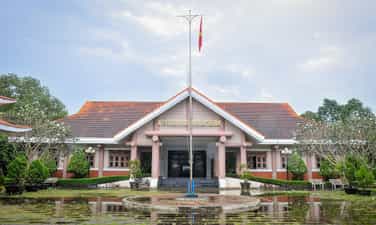
The Saigon - Gia Dinh Party Committee is located in Tan Phu Tay commune, Mo Cay Bac district, Ben Tre province, also codenamed T4, Y4, and is the headquarters commanding the resistance war against the US in the Saigon urban area. Gon - Gia Dinh from July 1969 to October 1970. 50 years ago, in July 1969, the Saigon - Gia Dinh Party Committee was led by comrade Vo Van Kiet and comrades Tran Bach Dang and Mai Chi Tho as Deputy Secretaries, divided into many ministries. small unit, in many secret forms moved to the base of Tan Phu Tay commune. Although the time spent here was not long, the Saigon - Gia Dinh Party Committee Base left behind memorable historical milestones, it was the workplace of Party leaders. Based on the Saigon - Gia Dinh Party Committee, historical documents are still preserved and introduced by the province at the national revolutionary historical relic of the same name, located in Tan Phu Tay commune, Mo Cay Bac district. , Ben Tre province. This is one of the historical sites that attracts a large number of tourists from inside and outside the province every year. The Saigon - Gia Dinh Party Committee base was transferred to be stationed in Tan Phu Tay and Thanh An communes at the time as stated. This is a newly liberated area, the people are resilient, have a high level of political enlightenment, the terrain is very dangerous, many canals divide, there are many consecutive coconut gardens to protect, the enemy cannot land troops by vehicle. Mechanized vehicles, armored vehicles, and even the use of helicopters to land troops are also subject to many restrictions. With only rudimentary materials, mainly using things available on site, local guerrillas built 16 floating bunkers and 14 secret bunkers (distributed in two continuous communes: Tan Phu Tay and Thanh Thanh). An), all are closely arranged so that they can support each other when needed. The floating tunnels are the living, working, and meeting places of the leaders of the Regional Party Committee, the health committee, and the cipher radio department; In addition, there is also a bunker named "happy house", which is the place to stay on the wedding night of Y4 soldiers. By October 1970, the enemy discovered the leaders of the Regional Party Committee operating in Tan Phu Tay commune. They repeatedly sent troops to raid this place and neighboring communes. Faced with that situation, comrade Vo Van Kiet met with the leaders of the Zone Party Committee and decided to withdraw from the base area. While stationed at the base, the leaders of the Saigon - Gia Dinh Party Committee received the loving support of the army and people throughout the district. After the war, the base area was almost completely destroyed. To remember that event, in November 1997, the Party Committee and people of the province restored two bunkers: bunker No. 1 was the meeting place for the basic radio station and bunker No. 2 was the living and working place of the community. Vo Van Kiet and then expanded about 2 hectares to build a number of additional items. The relic was recognized by the Ministry of Culture and Information (now the Ministry of Culture, Sports and Tourism) as a national historical relic on December 23, 1995. Source: Magazine of the Ministry of Labor, War Invalids and Social Affairs
Vinh Long
8400 view
Rating : National monument
Tuyen Linh Pagoda
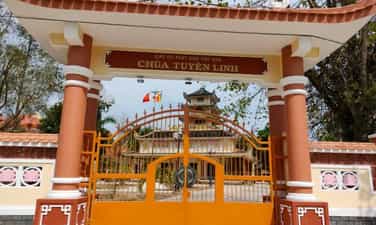
Tuyen Linh Pagoda is located in Tan Thoi Dong B hamlet, Minh Duc commune, Mo Cay Nam district, Ben Tre province. Tuyen Linh Pagoda was built in the year of Tan Dau (1861), during the 14th year of Tu Duc's reign. At first, the pagoda was called Tien Linh, led by Venerable Khanh Phong and made of bamboo and leaves to worship Mrs. Sam - who was tiger pounces but very sacred. Tuyen Linh Pagoda is where Mr. Nguyen Sinh Sac, Uncle Ho's father, stopped many times to stay. The longest time Mr. Pho Bang stayed here was from 1927 to 1929. During his stay at the pagoda, Mr. Pho Bang opened teaching classes, checked pulses and made medicine for people in the area, and discussed matters with the Abbot. people, country affairs. In the years before Dong Khoi, Ben Tre was in the harsh grip of America and Diem. The Tan Huong - Minh Duc region, where Tuyen Linh pagoda is located, is still one of the places with the strongest development of the Revolutionary movement in the province. . The agencies of Mo Cay District Party Committee and Ben Tre Provincial Party Committee were once stationed at Tuyen Linh Pagoda with the help and concealment of the people and Buddhist followers during the Revolutionary period. During the two resistance wars, Tuyen Linh pagoda was a place to hide and nurture revolutionary cadres, so twice the enemy used planes to bomb, destroy and burn the pagoda. The pagoda was restored many times and was newly built in 1999 on the old, very spacious foundation. However, there are not many artifacts associated with the pagoda's past. In 1941 the Pagoda was repaired for the first time, and in 1983 the Pagoda continued to be repaired and expanded. In 1999, the pagoda was greatly restored on the old pagoda's foundation. The pagoda has a 0.7m high dharma guardian statue made of ancient bronze. The pagoda garden has stupas inscribed with the names of three Patriarchs: Venerable Khanh Phong (1823-1905), Zen Master Minh Bao (1846-1919) and Dharma Master Khanh Hoa (1877-1948). In 2003, the pagoda received a giant bell that was 1.7m tall and weighed over 330kg. On July 20, 1994, the Ministry of Culture and Information recognized Tuyen Linh Pagoda as a National Historical and Cultural Monument. Source: Compilation of Ben Tre province newspaper
Vinh Long
5543 view
Rating : National monument
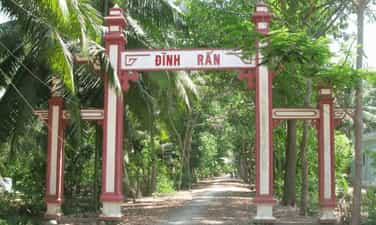
Ben Tre Snake Temple
Snake Temple in Mo Cay, Ben Tre has long been a sacred place, because this place is associated with many legends about the snake god protecting people. Not only that, Dinh Ran is also the place where Hero of the Armed Forces Nguyen Thi Dinh - aka female general Ba Dinh - started the Dong Khoi movement. There is an anecdote that said that when Ms. Ba Dinh was pointed out by Viet traitors, it was the snake god in Dinh Ran who "protected" Ms. Ba, helping her escape from the enemy's vicious gun barrels... Snake Communal House, also known as Dinh Nhon Communal House, is located in Dinh Thuy commune, Mo Cay district, now Mo Cay Nam, Ben Tre province. Snake Communal House is located on a small, isolated road, with spindly eucalyptus trees planted on both sides of the road. According to the people here, in the early 18th century, the four families Nguyen, Phan, Trinh, and Vo were considered the ones who explored this land. This place used to be deserted, with few people and many wild animals. So, when they arrived in this land, the elders built a small temple to worship Mr. Ho. Not long after the temple was established, more and more residents in the area came to admire and worship. The village elders here recently asked to establish a village and named it Dinh Phuoc village. The small temple was built into Snake Communal House. It is called Snake Communal House because in the past there were many high mounds here where many snakes lived. Every time the day comes to worship the temple, the snake appears and disappears for a moment. The offering is left behind after the offering, then the snake comes and takes it away. Since then, the lives of people in the area have become better, crops have always been bountiful, and villagers have been healthy. In the past, in front of the communal house gate, there was a pair of big snakes. That pair of snakes did not harm the people in the area but only ate the meat of beasts, lobsters, and leopards. People in the area call it "Mr. and Mrs. Snake". After the day of national unification, that pair of snakes was no longer seen. In early 1960, Mrs. Nguyen Thi Dinh, known to coconut people as Ms. Ba Dinh, secretly together with the leaders of the Ben Tre Provincial Party Committee, went to Snake communal house to have a meeting to discuss Dong Khoi day. The news leaked out and reached the ears of the Republic of Vietnam regime. The Ngo family immediately sent an army led by a security lieutenant to ambush the Snake temple to capture the revolutionary soldiers. Many soldiers were afraid of the "Snake God" and did not dare to go. A bit confused, the Lieutenant carried a lot of grenades with him so that when he encountered the giant "Mr. and Mrs. Snake" he would blow them up. "My soul is broken", when I was almost able to capture Ms. Ba Dinh, suddenly a soldier screamed wildly, thinking he had seen "Mr. and Mrs. Snake". The soldier pulled out the grenade pin, intending to throw it to "Mr. and Mrs. Snake", but for some reason, he threw it back at his comrades. The soldiers were excited that the other soldier must have been possessed by the "Snake God". The Lieutenant Commander was also seriously injured and a few days later was bitten by a poisonous snake and died. Puppet soldiers attempted to sabotage Snake communal house. But because they were afraid to go near the communal house, they used bombs and grenades to destroy the sacred communal house. Although desolate and dilapidated, Snake Communal House is still a sacred land that surrounded revolutionary soldiers during the years of bloody and horrifying resistance. In 1993, the Ministry of Culture and Information recognized Snake communal house as a national historical and cultural relic. Source: Compilation of People's Electronic Newspaper
Vinh Long
11296 view
Rating : National monument
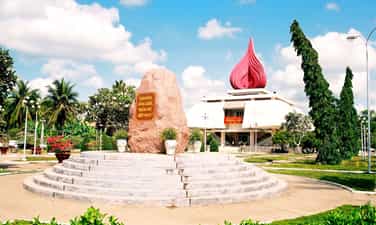
Dong Khoi Ben Tre Special National Monument
Dong Khoi Ben Tre relic belongs to Dinh Thuy commune, Mo Cay Nam district, Ben Tre province. The place where the historical event Dong Khoi Ben Tre took place, opening the Dong Khoi movement of the South Vietnamese revolution. In May 1959, the Party Central Committee held its 15th Conference to review the domestic situation and set out revolutionary guidelines for the whole country and the South, determining the basic task: Liberation of the South from imperialist rule, achieving national independence and the plowmen having their own fields, completing the people's national democratic revolution in the South, moving towards building a peaceful, unified, independent Vietnam. democracy and prosperity. In early December 1959, comrade Nguyen Thi Dinh - Deputy Secretary of the Ben Tre Provincial Party Committee held a meeting at Cu Lao Minh, the Ben Tre Provincial Party Committee selected 3 communes Dinh Thuy, Phuoc Hiep and Binh Khanh in Mo Cay district (now is Mo Cay Nam district) as the guiding base and the starting place of Dong Khoi. At 11:00 a.m. on January 12, 1960, in Dinh Thuy commune, all the people rose up and attacked the enemy. Opening the movement, on the morning of January 17, 1960, revolutionary forces arrested and executed Doi Ty - commander of the General Civil Guard, notorious for his cruelty. Next, the revolutionary forces and the masses surrounded Snake Communal House - where the Civil Guard General was stationed and surrounded and occupied Vam Nuoc station. Our forces captured the station and took control of the situation. Our troops captured 15 guns, 10 grenades and 1,000 bullets of all kinds, liberating all communes and hamlets in Dinh Thuy, puppets and soldiers in the area. rumors of disbandment. At 10:00 p.m. on January 17, 1960, when ordered to rebel, the people of Phuoc Hiep took to the streets to demonstrate their strength to support action groups besieging the civil guard station and the commune. Phuoc Hiep was engulfed in cheers, drums and the continuous explosion of pipes and loudspeakers calling for surrender. The people of Phuoc Hiep commune smashed the enemy's stranglehold, gaining mastery over the entire commune. On January 18, 1960, the people of Binh Khanh commune simultaneously stood up to defeat the hamlets, commune guards, spies and informers, and seized power. Because the puppet forces here were very strong, it was not until 12:00 midnight on January 20, 1960 that Binh Khanh commune was completely liberated. Following the direction of the province, people throughout Mo Cay district simultaneously rebelled, day and night; The continuous sound of drums and gongs spread throughout Cu Lao Minh and Cu Lao Bao. Young men and women were organized into teams, hoisting flags, carrying large guns and small guns with coconut palms, and dragging them like water bursting its banks to demonstrate revolutionary spirit, intimidate the enemy's spirit, making them lie down in fear. stay in the garrison. From Ben Tre, the Dong Khoi movement quickly spread throughout the Mekong Delta provinces. On the night of January 24 and early morning of January 25, 1960, many rural areas rose up to destroy evil, break the grip, disband communes and hamlets, and gain mastery. Until mid-1960, the Dong Khoi fire continued to spread to the Central Highlands provinces, creating a vibrant chain uprising throughout the Southern and Central Highlands provinces. Dong Khoi Traditional House was built in 2001, with a total area of 5,029.3m2, including main items: reception house, victory stele and traditional house. The reception house is built of reinforced concrete, has a pink ceramic tile floor, and a red tiled roof. The house has three doors made of iron frames painted gray and covered with glass, the main door facing East, two side doors facing South. The victory stele was built on the right side of the relic, consisting of seven concentric circular steps covered with blue polished stone. The front facing south is engraved with eight golden words "Heroes rise together, defeat the Americans and destroy the puppets". The back of the stele is engraved with the content "Miracle Fire" because Ben Tre province launched a contest to write an epitaph praising Dong Khoi in 1960, and was engraved on the stele to commemorate the 45th anniversary of Dong Khoi Ben Tre. The Traditional House has a ground floor and an upper floor, on the roof is a 12m high Dong Khoi torch symbol. The inside of the ground floor displays images, documents and artifacts of the political struggle movement of the people of Ben Tre from July 1954 to the end of 1959. The upper floor displays images, documents and artifacts from the Ben Tre people's political struggle. Dong Khoi movement. In the middle hall, there is a stylized wall embossed with the words "Heroes rise together, defeat the Americans and destroy the puppets", next to it is a sand table representing the Dong Khoi Ben Tre movement. Dong Khoi Ben Tre relic was ranked by the Prime Minister as a special national relic on December 22, 2016. Source: Department of Cultural Heritage
Vinh Long
10593 view
Rating : Special national monument
Outstanding monuments
See all
Ben Tre Snake Temple
Snake Temple in Mo Cay, Ben Tre has long been a sacred place, because this place is associated with many legends about the snake god protecting people. Not only that, Dinh Ran is also the place where Hero of the Armed Forces Nguyen Thi Dinh - aka female general Ba Dinh - started the Dong Khoi movement. There is an anecdote that said that when Ms. Ba Dinh was pointed out by Viet traitors, it was the snake god in Dinh Ran who "protected" Ms. Ba, helping her escape from the enemy's vicious gun barrels... Snake Communal House, also known as Dinh Nhon Communal House, is located in Dinh Thuy commune, Mo Cay district, now Mo Cay Nam, Ben Tre province. Snake Communal House is located on a small, isolated road, with spindly eucalyptus trees planted on both sides of the road. According to the people here, in the early 18th century, the four families Nguyen, Phan, Trinh, and Vo were considered the ones who explored this land. This place used to be deserted, with few people and many wild animals. So, when they arrived in this land, the elders built a small temple to worship Mr. Ho. Not long after the temple was established, more and more residents in the area came to admire and worship. The village elders here recently asked to establish a village and named it Dinh Phuoc village. The small temple was built into Snake Communal House. It is called Snake Communal House because in the past there were many high mounds here where many snakes lived. Every time the day comes to worship the temple, the snake appears and disappears for a moment. The offering is left behind after the offering, then the snake comes and takes it away. Since then, the lives of people in the area have become better, crops have always been bountiful, and villagers have been healthy. In the past, in front of the communal house gate, there was a pair of big snakes. That pair of snakes did not harm the people in the area but only ate the meat of beasts, lobsters, and leopards. People in the area call it "Mr. and Mrs. Snake". After the day of national unification, that pair of snakes was no longer seen. In early 1960, Mrs. Nguyen Thi Dinh, known to coconut people as Ms. Ba Dinh, secretly together with the leaders of the Ben Tre Provincial Party Committee, went to Snake communal house to have a meeting to discuss Dong Khoi day. The news leaked out and reached the ears of the Republic of Vietnam regime. The Ngo family immediately sent an army led by a security lieutenant to ambush the Snake temple to capture the revolutionary soldiers. Many soldiers were afraid of the "Snake God" and did not dare to go. A bit confused, the Lieutenant carried a lot of grenades with him so that when he encountered the giant "Mr. and Mrs. Snake" he would blow them up. "My soul is broken", when I was almost able to capture Ms. Ba Dinh, suddenly a soldier screamed wildly, thinking he had seen "Mr. and Mrs. Snake". The soldier pulled out the grenade pin, intending to throw it to "Mr. and Mrs. Snake", but for some reason, he threw it back at his comrades. The soldiers were excited that the other soldier must have been possessed by the "Snake God". The Lieutenant Commander was also seriously injured and a few days later was bitten by a poisonous snake and died. Puppet soldiers attempted to sabotage Snake communal house. But because they were afraid to go near the communal house, they used bombs and grenades to destroy the sacred communal house. Although desolate and dilapidated, Snake Communal House is still a sacred land that surrounded revolutionary soldiers during the years of bloody and horrifying resistance. In 1993, the Ministry of Culture and Information recognized Snake communal house as a national historical and cultural relic. Source: Compilation of People's Electronic Newspaper
Vinh Long
11296 view
Rating : National monument

Ben Tre Provincial Museum
Ben Tre Museum was established in 1981, located at 146 Hung Vuong Street, An Hoi Ward, Ben Tre City with an area of about 20,000 square meters. The main side of the Museum faces the Ben Tre River with shady ancient trees and many lush, precious ornamental flowers - a poetic, gentle, profound scene filled with charm and attraction; The back side faces Cach Mang Thang Tam street, one of the busiest streets of Ben Tre city. Coming to Ben Tre Museum, you can visit, study, and research locations in this complex: National relic "Colonel Pham Ngoc Thao's residence and activities" (recognized as a National Historical Monument in 2015), the House is the Palace of Counsel (France) - Governor's Palace (USA) was built Following the French architectural style (1876) with solemn and ancient features, this place displays images and artifacts about the history and revolutionary traditions of the province's people during the two resistance wars against the French colonialists and the imperialists. American invasion; display pictures and documents about the intelligence soldier, Colonel Pham Ngoc Thao; Giong Noi Archaeological Relics display. The province's Socio-Economic Achievements Exhibition House (2003): displays images and artifacts in the local economic, cultural and social construction from after April 30, 1975 to the present - this place still exists. is a place to display unique and rich topics in many fields with great achievements of the province. Coconut house (2012): 3-room house built of coconut wood in the style of a Southern rural house. The house is designed in a gentle, spacious way with a strong national character, reflecting the simplicity and soul of the Vietnamese people. Inside the church of Uncle Ho and AHLLVTND, Colonel Pham Ngoc Thao, on the wall are displayed images and artifacts related to Ben Tre coconut trees in the resistance war as well as in cultural activities. The coconut house also organizes exchanges of "Don Ca Tai Tu", "Singing Sac Bua",... on the night of the 30th of each month. Coming here, visitors can feel the peace and warmth while enjoying Ben Tre folk melodies performed by artisans and amateurs. Outdoor display area: includes large-sized cubic objects such as plane wrecks, artillery, bomb casings... collected during the war; Around the campus are interwoven miniature landscapes: rice fields, buffaloes, lotus ponds, coconut bridges,... creating a feeling of closeness and familiarity with visitors. It is one of the red addresses for educating extremely meaningful revolutionary traditions, and is an interesting and attractive tourist destination. Each year, Ben Tre Museum attracts about 40,000 tourists inside and outside the province as well as international tourists to visit, learn, study, entertain, experience, and enjoy cultural heritage and folk art. Ben tre. Ben Tre Museum was recognized as a National Historical Monument on August 28, 2015 by the Ministry of Culture, Sports and Tourism. Source: Ben Tre Tourism
Vinh Long
11269 view
Rating : National monument

Phu Le Communal House
Located in Phu Khuong hamlet, Phu Le commune, Ba Tri district, Ben Tre province, Phu Le Communal House was allowed by King Minh Mang to establish a communal house in 1826, on the basis of the wooden leaf communal house built previously. On January 29, 1852, the communal house received the title of king Tu Duc. Amidst the quiet space, the gate of Phu Le communal house appears majestic and outstanding. The communal house is nearly two hundred years old and has been renovated many times but still retains its ancient features. The communal house is hidden among the canopy of ancient trees. When the sun shines, the rays of sunlight creep through the leaves, shining on the brick walls and mossy stone steps, further enhancing the inherent majesty and serenity of the communal house. The terrace and foundation of the communal house are constructed of green stone, with bricks on top. The communal house includes a total of 10 rooms: 6 main rooms attached to the roof and 4 additional rooms arranged in the "Dinh" style, which was also popular in the Mekong Delta in the past. The communal house's pillars are made of ironwood, a rare wood in the Southwest region, 40cm in diameter, and the roof is covered with fish-scale tiles. The communal house includes 6 incense tables, all painted in red and gilded with a very sophisticated dragon, unicorn, and phoenix image following the motif of ancient Vietnamese communal houses and pagodas. In particular, the art of multi-layered carving on wood surrounding the columns in the main hall shows the expert skills of the craftsmen of that day. Legend has it that when building the communal house, the elders in the area invited workers and artisans from Hue to carve these beautiful wooden works. Not only are the conventional images of four sacred animals of ancient Vietnamese culture, but also images of fish and crabs of the Ba Tri sea area - common animals that are also included in the architecture. shaping. The grandeur and majesty of the communal house shows the rich life and cultural richness of the residents of Phu Le in particular and the Ba Tri region in general at the beginning of the last century. Due to war and time, the architectural works and interior decorations (incense burners, scrolls, horizontal panels, screens, sashes, ceremonial items...) have been greatly degraded and damaged. However, the basic parts of the architecture remain intact, undamaged by bombs and bullets, especially the lacquered and gilded wooden sculptures that have been preserved to this day. Phu Le Communal House is the religious center of the resident community, where the villagers entrust their wishes to the god who supports the village, ordained by the state as Tutelary God Bon Canh. In addition to the Tutelary God, the previous sages and later sages who had meritorious achievements in discovering and establishing villages were also brought into the communal house to worship. The difference of Phu Le communal house is that on Tet or the communal house worship festival (Ky Yen ceremony) held on the 18th and 19th of the third lunar month every year, right in front of the communal house, a opera will be held to attract the attention of the crowd. island of people and tourists from all over. On the 9th - 10th day of the 11th lunar month, the communal house holds a ceremony to pray for a good harvest. On January 7, 1993, Phu Le Communal House was recognized by the Ministry of Culture and Information as a national historical and cultural relic. Traveling to Ben Tre, coming to Phu Le, you will also discover the traditional craft village of Phu Le (including weaving and making wine), including the craft of making wine that has existed for a long time. Phu Le sole wine is loved and known by many consumers because the product is delicious, pure, of stable quality, non-toxic and suitable for consumers' taste. Source: Ben Tre Tourism Newspaper
Vinh Long
11050 view
Rating : National monument

Binh Hoa Communal House
Binh Hoa communal house is located close to provincial road 26, in Binh Ninh hamlet, old Binh Hoa commune, now provincial road 88, hamlet 5A, Giong Trom Town, Giong Trom district, Ben Tre province. Binh Hoa Communal House was first built in 1812. The communal house was built by people from simple materials such as trees, leaves, and bamboo to worship the village's tutelary god. In 1852, Binh Hoa Communal House in Ben Tre was ordained by King Tu Duc. This is a very meaningful ceremony when the gods worshiped in the communal house receive recognition from the king. Since then, the communal house has become more known to the people, they come here to celebrate mass to pray for peace and luck. By 1903, the celebration committee stood up to organize and mobilize people to contribute effort and money to rebuild Ben Tre Binh Hoa Communal House on a larger scale. The construction process took 10 years, from 1903 to 1913, when it was completed. The main material used is four iron wood, the structure is attached with tenons and dowels, absolutely no nails are used. This is a very familiar style of pagoda construction during the Nguyen Dynasty. Although rudimentary, it is still extremely sturdy. On December 25, 1959 of the lunar calendar, a Ngo Quyen police regiment commanded by Le Xuan Khanh came from Ben Tre to station here. They used Binh Hoa communal house as a place to imprison and torture our revolutionary soldiers and compatriots. The Wei army used many brutal and cruel forms of torture. According to some records, the total number of compatriots they captured here, tortured and killed was more than 400 people. The hundred-year-old communal house has witnessed the blood of countless compatriots shed, and is also a historical witness to the crimes of the enemy. By 2012, Binh Hoa communal house was restored by the Department of Culture, Sports and Tourism of Ben Tre province in conjunction with the People's Committee of Giong Trom district. The process of renovating the monument lasted for 1 year, retaining the characteristics of the communal house but expanding its scale and building additional auxiliary works to serve visitors and tourists. When completed, the total area of Binh Hoa communal house is 9,000m2 with main items including: martial arts house, incense burner, main hall, lobby, corridor, back hall, Quan Thanh temple. Currently, Binh Hoa communal house still preserves more than 100 exquisite wooden sculptures including horizontal panels, parallel tureens, bamboo panels, reliefs, and incense burners. Binh Hoa Communal House was ranked as a National Historical, Cultural, Architectural and Artistic Monument on January 7, 1993. Source: Summary of Ben Tre tourism newspaper
Vinh Long
10979 view
Rating : National monument

Dong Khoi Ben Tre Special National Monument
Dong Khoi Ben Tre relic belongs to Dinh Thuy commune, Mo Cay Nam district, Ben Tre province. The place where the historical event Dong Khoi Ben Tre took place, opening the Dong Khoi movement of the South Vietnamese revolution. In May 1959, the Party Central Committee held its 15th Conference to review the domestic situation and set out revolutionary guidelines for the whole country and the South, determining the basic task: Liberation of the South from imperialist rule, achieving national independence and the plowmen having their own fields, completing the people's national democratic revolution in the South, moving towards building a peaceful, unified, independent Vietnam. democracy and prosperity. In early December 1959, comrade Nguyen Thi Dinh - Deputy Secretary of the Ben Tre Provincial Party Committee held a meeting at Cu Lao Minh, the Ben Tre Provincial Party Committee selected 3 communes Dinh Thuy, Phuoc Hiep and Binh Khanh in Mo Cay district (now is Mo Cay Nam district) as the guiding base and the starting place of Dong Khoi. At 11:00 a.m. on January 12, 1960, in Dinh Thuy commune, all the people rose up and attacked the enemy. Opening the movement, on the morning of January 17, 1960, revolutionary forces arrested and executed Doi Ty - commander of the General Civil Guard, notorious for his cruelty. Next, the revolutionary forces and the masses surrounded Snake Communal House - where the Civil Guard General was stationed and surrounded and occupied Vam Nuoc station. Our forces captured the station and took control of the situation. Our troops captured 15 guns, 10 grenades and 1,000 bullets of all kinds, liberating all communes and hamlets in Dinh Thuy, puppets and soldiers in the area. rumors of disbandment. At 10:00 p.m. on January 17, 1960, when ordered to rebel, the people of Phuoc Hiep took to the streets to demonstrate their strength to support action groups besieging the civil guard station and the commune. Phuoc Hiep was engulfed in cheers, drums and the continuous explosion of pipes and loudspeakers calling for surrender. The people of Phuoc Hiep commune smashed the enemy's stranglehold, gaining mastery over the entire commune. On January 18, 1960, the people of Binh Khanh commune simultaneously stood up to defeat the hamlets, commune guards, spies and informers, and seized power. Because the puppet forces here were very strong, it was not until 12:00 midnight on January 20, 1960 that Binh Khanh commune was completely liberated. Following the direction of the province, people throughout Mo Cay district simultaneously rebelled, day and night; The continuous sound of drums and gongs spread throughout Cu Lao Minh and Cu Lao Bao. Young men and women were organized into teams, hoisting flags, carrying large guns and small guns with coconut palms, and dragging them like water bursting its banks to demonstrate revolutionary spirit, intimidate the enemy's spirit, making them lie down in fear. stay in the garrison. From Ben Tre, the Dong Khoi movement quickly spread throughout the Mekong Delta provinces. On the night of January 24 and early morning of January 25, 1960, many rural areas rose up to destroy evil, break the grip, disband communes and hamlets, and gain mastery. Until mid-1960, the Dong Khoi fire continued to spread to the Central Highlands provinces, creating a vibrant chain uprising throughout the Southern and Central Highlands provinces. Dong Khoi Traditional House was built in 2001, with a total area of 5,029.3m2, including main items: reception house, victory stele and traditional house. The reception house is built of reinforced concrete, has a pink ceramic tile floor, and a red tiled roof. The house has three doors made of iron frames painted gray and covered with glass, the main door facing East, two side doors facing South. The victory stele was built on the right side of the relic, consisting of seven concentric circular steps covered with blue polished stone. The front facing south is engraved with eight golden words "Heroes rise together, defeat the Americans and destroy the puppets". The back of the stele is engraved with the content "Miracle Fire" because Ben Tre province launched a contest to write an epitaph praising Dong Khoi in 1960, and was engraved on the stele to commemorate the 45th anniversary of Dong Khoi Ben Tre. The Traditional House has a ground floor and an upper floor, on the roof is a 12m high Dong Khoi torch symbol. The inside of the ground floor displays images, documents and artifacts of the political struggle movement of the people of Ben Tre from July 1954 to the end of 1959. The upper floor displays images, documents and artifacts from the Ben Tre people's political struggle. Dong Khoi movement. In the middle hall, there is a stylized wall embossed with the words "Heroes rise together, defeat the Americans and destroy the puppets", next to it is a sand table representing the Dong Khoi Ben Tre movement. Dong Khoi Ben Tre relic was ranked by the Prime Minister as a special national relic on December 22, 2016. Source: Department of Cultural Heritage
Vinh Long
10593 view
Rating : Special national monument

Military Region Committee of Saigon - Gia Dinh
The Saigon - Gia Dinh Party Committee is located in Tan Phu Tay commune, Mo Cay Bac district, Ben Tre province, also codenamed T4, Y4, and is the headquarters commanding the resistance war against the US in the Saigon urban area. Gon - Gia Dinh from July 1969 to October 1970. 50 years ago, in July 1969, the Saigon - Gia Dinh Party Committee was led by comrade Vo Van Kiet and comrades Tran Bach Dang and Mai Chi Tho as Deputy Secretaries, divided into many ministries. small unit, in many secret forms moved to the base of Tan Phu Tay commune. Although the time spent here was not long, the Saigon - Gia Dinh Party Committee Base left behind memorable historical milestones, it was the workplace of Party leaders. Based on the Saigon - Gia Dinh Party Committee, historical documents are still preserved and introduced by the province at the national revolutionary historical relic of the same name, located in Tan Phu Tay commune, Mo Cay Bac district. , Ben Tre province. This is one of the historical sites that attracts a large number of tourists from inside and outside the province every year. The Saigon - Gia Dinh Party Committee base was transferred to be stationed in Tan Phu Tay and Thanh An communes at the time as stated. This is a newly liberated area, the people are resilient, have a high level of political enlightenment, the terrain is very dangerous, many canals divide, there are many consecutive coconut gardens to protect, the enemy cannot land troops by vehicle. Mechanized vehicles, armored vehicles, and even the use of helicopters to land troops are also subject to many restrictions. With only rudimentary materials, mainly using things available on site, local guerrillas built 16 floating bunkers and 14 secret bunkers (distributed in two continuous communes: Tan Phu Tay and Thanh Thanh). An), all are closely arranged so that they can support each other when needed. The floating tunnels are the living, working, and meeting places of the leaders of the Regional Party Committee, the health committee, and the cipher radio department; In addition, there is also a bunker named "happy house", which is the place to stay on the wedding night of Y4 soldiers. By October 1970, the enemy discovered the leaders of the Regional Party Committee operating in Tan Phu Tay commune. They repeatedly sent troops to raid this place and neighboring communes. Faced with that situation, comrade Vo Van Kiet met with the leaders of the Zone Party Committee and decided to withdraw from the base area. While stationed at the base, the leaders of the Saigon - Gia Dinh Party Committee received the loving support of the army and people throughout the district. After the war, the base area was almost completely destroyed. To remember that event, in November 1997, the Party Committee and people of the province restored two bunkers: bunker No. 1 was the meeting place for the basic radio station and bunker No. 2 was the living and working place of the community. Vo Van Kiet and then expanded about 2 hectares to build a number of additional items. The relic was recognized by the Ministry of Culture and Information (now the Ministry of Culture, Sports and Tourism) as a national historical relic on December 23, 1995. Source: Magazine of the Ministry of Labor, War Invalids and Social Affairs
Vinh Long
8400 view
Rating : National monument
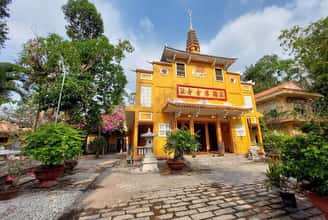
Phuoc Hau Pagoda
Phuoc Hau Pagoda is located in Dong Hau hamlet, Ngai Tu commune, Tam Binh district, Vinh Long province. This is an ancient Buddhist temple of the Lam Te sect, Chuc Thanh sect, and is also famous for its unique stone sutra garden, one of a kind in the West. Initially, Phuoc Hau Pagoda was just a thatched hut. In 1894, everyone in the village worked together to build a thatched hut into a pagoda with wooden ribs, yin-yang tile roof, plank walls, and brick floor. This pagoda is a type of village pagoda so it is named Dong Hau pagoda. In 1910, the name of Dong Hau pagoda was changed to Phuoc Hau, and more and more monks and nuns came to take refuge and receive precepts. During the period of national liberation struggle, Phuoc Hau Pagoda was also a place to house revolutionary cadres in the most difficult and dangerous times. Many monks studied at the pagoda, followed the teachings of the Venerable Monks, and listened to the call of the Fatherland, "taking off their robes and putting on their war robes". This is a relic of special importance to the history of Vietnamese Buddhism in the 20th century as well as the Revolutionary history of Vinh Long province and the Southwestern region during the war. After many times of restoration and new construction, Phuoc Hau Pagoda currently includes many works such as the main hall, middle hall, rear temple, sutra hall, stupa system... Except for the main hall, which was newly built in 1962 with materials. modern according to the architectural model combining East - West, other works are parts of the old temple, dating from 1894. The main hall of Phuoc Hau Pagoda is shaped like the word "painted", overlooking the river. The front of the pagoda is built in the style of an ancient building, with a model of a towering seven-storey tower in the middle. The inner hall is quite large, the middle altar holds a statue of Shakyamuni Buddha in meditating form along with a statue of newborn Prince Siddhartha and the Three Venerables (Avalokitesvara, Amitabha, and The Chi). On both left and right sides there are two altars. Here, there are a group of very precious statues from the ancient Dong Hau pagoda that are still kept, such as statues of Tieu Dien Dai, Ho Phap, Ksitigarbha, Chuan De and a set of Arhat statues all made of wood or Cay Mai ceramic. The pagoda has a very unique stone sutra garden, with elaborately carved sutras on stone. The Dhammapada Sutra Garden consists of 213 blue stone slabs measuring 0.4×0.6m, engraved with 423 sutras on both sides, in addition there is a poem about the general idea of the Dhammapada, 1 poem about the merits of the Dhammapada Sutra. the conduct of monks and Buddhists and a stone slab engraved with the image of Venerable Thich Minh Chau. The stone slabs are arranged to simulate Bodhi leaves spreading out in eight directions, symbolizing the Noble Eightfold Path. The center of the garden is a mountain with four Shakyamuni Buddha statues. There is also the Garden of Amitabha Sutra and the Garden of Bac Truyen Quoc Diem Sutra. Amitabha Sutra Garden has 31 stone slabs arranged in a row of small S-shaped lotus ponds, symbolizing Vietnam. Each North, Central, and South region has a stone slab placed in the middle of the lake inscribed with a symbolic pagoda, plus symbolic pseudo-mountains such as Yen Tu mountain, That Son... The sutras in this garden are translated in six-eight verse form. The pagoda also has a number of stone slabs engraved in English next to Vietnamese so that foreign tourists can understand when visiting and many stone slabs engraved with the words heart, patience, and Buddhist teachings are very unique... Phuoc Hau Pagoda was recognized by the Ministry of Culture and Information as a national revolutionary historical relic on January 25, 1994. Source: Vinh Long Tourism
Vinh Long
7726 view
Rating : National monument

Temple and tomb of famous man Nguyen Dinh Chieu
Nguyen Dinh Chieu Tomb Relic and Memorial Area, located in An Duc commune, Ba Tri district, Ben Tre province, is the place to worship and bury patriotic poet Nguyen Dinh Chieu, along with his wife Le Thi Dien and daughter Nguyen Thi Ngoc Khue (Suong Nguyet Anh). Nguyen Dinh Chieu (1822 - 1888) is a typical representative of the class of patriotic scholars who used poetry as a means of fighting against the invading French colonialists through ideology. Most of his literary and poetic works are written in Nom, expressing both his fighting spirit and his deep feelings about the nation's destiny and love for people. Nguyen Dinh Chieu played an important role in the resistance war against the French, but he could not do what Truong Dinh did when he brought troops from the plantation to fight, like Tran Thien Chanh who recruited brave soldiers to fight the invasion, like Nguyen Thong who joined the army to fight the enemy. ..., He fought with a pen, immersed himself in the people's fight and became the spokesman of the patriotic movement against the French. He was the first Vietnamese poet to talk about the people's war, promoting the role of farmers in the uprisings against the French with a sense of their duties and rights, they needed to fight to protect " inches of land, vegetables, bowls of rice and clothes" for themselves, protecting the sacred sovereignty of the country. In famous works such as "Luc Van Tien", "Orientation of the martyrs of Can Giuoc", "Six heroes of the people in battle"..., he praised the spirit of patriotism and heroic fighting examples of the heroes. peasant soldier. For insurgent leaders such as Truong Dinh, Phan Ngoc Tong,... Nguyen Dinh Chieu dedicated poetic words that expressed art, lyricism and heroism. He saw the relationship between the insurgent leader and the masses, the insurgent's love for the leader as well as the leader's favor towards the insurgent army. That is Nguyen Dinh Chieu's new concept of a hero, very different from previous feudal concepts of patriotic loyalty. Nguyen Dinh Chieu Tomb Relics and Memorial Area has a total area of 14,187.9 m2, including main items: stele house, new temple, old temple, grave area. - Beer house: built in 2000 - 2002 with reinforced concrete, 12m high with two floors of tiled roof, ceramic tiled floor. - New temple: built in 2000 - 2002, 21m high, built of reinforced concrete in a circular shape, ceramic tiled floor, concrete roof covered with blue yin-yang tiles. - Old temple: built in 1972, area 84m2, including two floors of roof, brown yin and yang tiles, brick walls, tiled floor according to traditional architecture. - Tomb area: renovated in 1958, including the grave of Mr. Do Chieu, the grave of the old woman and the grave of her daughter Nguyen Thi Ngoc Khue (Suong Nguyet Anh) - female artist, editor of Women's Chung newspaper - the first women's newspaper of Vietnam. Vietnam. The grave of Mr. Nguyen Dinh Chieu on the stele is engraved with the word Japanese (日), the grave of the old lady on the stele is engraved with the word Nguyet (月). At the monument, there is currently a gallery displaying images of Party and State leaders, domestic and foreign delegations, and people from inside and outside the province visiting... The gallery also has a number of works. Typical works of Nguyen Dinh Chieu such as: Luc Van Tien, Duong Tu - Ha Mau, Ngu Tieu's oral medicine, Can Giuoc's memorial service,... in Han Nom and some documents of researchers, Collect and highlight the ideological value, personality and content of Nguyen Dinh Chieu's works. Every year, the government and people of Ben Tre province organize a traditional cultural festival on July 1 and 3 (the birth and death days of Nguyen Dinh Chieu). Festival with many rich programs. With special historical and cultural value, Nguyen Dinh Chieu's Tomb and Memorial Site were ranked by the Prime Minister as a special national monument on December 22, 2016. Source: Department of Cultural Heritage
Vinh Long
7671 view
Rating : Special national monument

Statue of Generals Le Can and Nguyen Giao
The Le Can - Nguyen Giao monument was built in 2004 at An Nhon intersection, Vung Liem town, with a height of 7.5m, made of bronze, and weighs 21.5 tons. The statue was built to commemorate two national heroes, General Le Can and Nguyen Giao, in the early history of the struggle against the French colonialists. On June 20, 1867, France invaded Vinh Long for the second time. Together with the people of the whole country, the people of Vinh Long rose up to organize many uprisings against foreign invaders. First, there was the Dang Cuu group (a group of court officials who united to raise troops), then Phan Thanh Gian's two children, Phan Ton and Phan Liem, raised the flag of resistance, but failed one after another...Faced with the repression of the invaders. , the hearts of patriotic people became even more angry and angry. Around 1872, the uprising in Vung Liem arose, the leaders of this anti-French movement were Le Can and Nguyen Giao. Le Can and Nguyen Giao were both farmers, but were more or less educated and had passionate patriotism, so when they stood up to call on the people to resist the French, they received a warm response from the farmers. people and scholars around the area. On one night of the year Nham Than (1872), implementing the strategy of Le Can - Nguyen Giao, Pho Mai led a militia group of about thirty people to raid the market of Vung Liem district, killing the district owner named Thuc and 6 soldiers. After this resounding victory, the French army carried out fierce repression and they sent governor Ton Tho Tuong to take over Vung Liem to replace the district owner who was killed by insurgents, in addition to the famous lawyer Alix Salicetti. sinister, but the resistance force did not flinch, temporarily withdrew, hid and waited for the opportunity to counterattack. To destroy Salicetti, Le Can came up with a plan to surrender and lure the enemy into an ambush by the insurgents at Cau Vong. On February 15, 1872, Salicetti led his entourage to Vung Liem to meet the insurgents. When arriving at Cau Vong, General Le Can, as soon as he saw Salicetti sitting on horseback near the end of the bridge, immediately jumped over with a ladder, hugged Salicetti and threw him to the ground. At that time, the war drums sounded loudly, Nguyen Giao led the insurgents to block the French soldiers' retreat and killed over 10 people. Meanwhile, Commander Le Can and Salicetti hugged each other and fell into the river and both died in the water. Nguyen Giao took Salicetti's head and together with the people and troops buried General Le Can on the edge of the forest. After that, the governor Tran Ba Loc brought troops to capture and kill all the people in the hamlet. Bodies filled "Vung Linh" (now the camp is read as Vung Liem), people's houses were also burned. Nguyen Giao continued to resist the French, but the great event was unsuccessful. He was shot down by the enemy in the Co Chien River and the young soldier's body was lost. Although the two heroes and martyrs sacrificed their lives, the names of General Le Can - Nguyen Giao still live forever in history books, remembered by today's generations. Source: Vinh Long Tourism
Vinh Long
7669 view
Rating : National monument
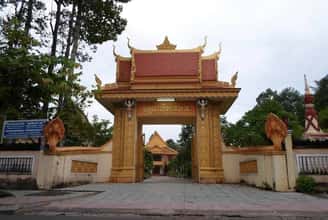
Ong Mat Pagoda
Ong Mat Pagoda is located in Ward 1, Tra Vinh city. The Sanskrit name of this temple is Bodhisàlaraja, Khmer people still call it Wat Kompong, which translates to Ben Temple. Ong Mat Pagoda is the provincial Khmer Buddhist center and was chosen to house the Mahanikay Khmer Buddhist Administration Office. In the early 20th century, when the Catholic Cathedral was invested in and built by the colonial government, the Khmer community also joined forces to build the solemn and majestic Ong Mat pagoda as a form of honoring cultural values. nationalization. The pagoda consists of many harmonious structures surrounding the main hall, in a campus of nearly 1.3 hectares, surrounded by a closed wall. The gate of Ong Mat pagoda is a beautiful architecture with 8 pillars supporting the gate roof and dividing the gate into a wide main walkway in the middle and two smaller walkways on both sides. At the top of each column is decorated with the two-faced Keyno Angel Bird, always smiling to welcome guests. On both sides of the gate are two walls that are both gradually lowering and expanding, decorated with a pair of seven-headed snakes in the style of traditional Khmer art. The main hall of Ong Mat Pagoda faces east and is built on a three-step foundation. The 1.35 m high blue stone foundation is surrounded by an iron fence nearly 2 m high and on each end of the fence post is a four-sided Bhrama image. On the altar inside the main hall is a majestic statue of Sakyamuni Buddha on a 4.4 m high lotus throne; 5 m long and 4.3 m wide. Around this large statue, there are many smaller Buddha statues made of many materials such as stone, cement, bronze, wood... with many different sizes and positions. Behind the main hall is the Library with the unique architecture of a traditional wooden stilt house of the ancient Southern Khmer people. All 24 column heads, central and longitudinal... are elaborately carved and painted with gilded vermilion. The library has three compartments, the middle compartment is where books are stored, including many ancient bibliographies; The two rooms on both sides are reading and studying places for monks and relatives in Phum Soc. In the campus of Ong Mat Pagoda, there are also a number of structures such as the monks' monastery, Mahanikay Buddhist Administration Office, lecture hall, Neakta worship sala, memorial tower... Originating from Ong Mat Pagoda, the movement demanding the teaching and learning of Sanskrit and Khmer scripts spread throughout the pagodas and villages in the province, against the "ignorant" policy of the French colonialists. After that, not only teaching and learning the Khmer language but also the national language was included in teaching, creating more favorable conditions for ethnic minority children to learn, and better realizing equal rights between ethnic groups. nation. Not only learning literacy and knowledge, generations of Khmer monks at Ong Mat Pagoda also focused on enhancing patriotism and the will to hate invaders. Therefore, this pagoda is the starting point of the political struggle movement of monks and Khmer people in the province and is a place that shelters many young people of all ethnic groups in the province from having to serve as soldiers for the enemy during the resistance. war against America. That's why, when the Spring Mau Than offensive was taking place, the enemy sent bombers to cause heavy damage. Ong Mat Pagoda was ranked a national historical and cultural relic by the Ministry of Culture, Sports and Tourism in 2009. Source: Tra Vinh Province Electronic Information Portal
Vinh Long
7465 view
Rating : National monument
 AI Travelviet