Relic point Vietnam
Việt Nam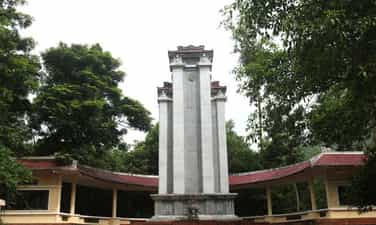
Khuon Manh Forest Relic
Khuon Manh Forest is located in Trang Xa commune, Vo Nhai district, has rugged terrain, and was once the place of operation of revolutionary cadres and guerrillas during the secret period. On September 15, 1941, the founding ceremony of the National Salvation Army II took place here, which was a milestone marking a period in the history of the resilient revolutionary struggle of our Party and people in the cause of national liberation. clan. History records: At Bac Son - Vo Nhai base, the French colonialists' terrorist repression of the revolution took place fiercely, the National Salvation Army I had to withdraw from the base to preserve its forces and many Party facilities. broken, the revolutionary movement encountered difficulties. At that time, Comrade Hoang Quoc Viet, member of the Party Central Committee, and the Bac Son-Vo Nhai base leadership advocated the restoration of the National Salvation Army I to maintain the sound of Bac Son armed guns and encourage the revolutionary movement. network. On the morning of September 15, 1941, at Khuon Manh forest, comrade Hoang Quoc Viet, on behalf of the Party Central Committee, announced the establishment of the Second National Salvation Army, assigned the flag and tasks to the Team to fight against terrorist enemies, eliminate fraud, and destroy enemies. reactionary oligarchs, protect the revolutionary base, protect the bases, strengthen and develop self-defense teams, maintain the guns of armed struggle to encourage the revolutionary movement of the whole country. The command board of the assigned Team consists of three comrades: Chu Van Tan - Commander; Nguyen Cao Dam - Directing political officer; Tran Van Phan - Deputy Commander. The initial team had 36 officers and soldiers (3 female), a few days later the number increased to 46 people, organized into 5 squads, equipped with rudimentary weapons: flintlock guns, bayonets, spears... Between After the siege of the French colonialists and the ruling apparatus of the feudal henchmen, the National Salvation Army II was established, this was a predecessor force of the Vietnam People's Army. Khuon Manh Forest, the location where the National Salvation Army II was established on September 15, 1941, was ranked as a national historical relic by the (former) Ministry of Culture and Information, and Trang Xa commune was honored as Hero of the Force. armed forces in the resistance war against the French. Currently, the list of the National Salvation Army II is solemnly engraved on a marble stele, carved into the great Khuon Manh forest, an important historical event in the struggle for national liberation of the Vietnamese people. Source: Thai Nguyen Electronic Newspaper
Thai Nguyen
4556 view
Rating : National monument
Cho Chu prison historical site
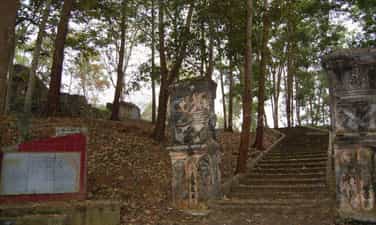
Cho Chu Prison Relics is located in Vuon Rau hamlet, Cho Chu Town, Dinh Hoa district, Thai Nguyen province. In 1889, Cho Chu was occupied by the French colonialists. In 1894, they established a representative agency to rule this area. By 1916, they started building a prison. Initially, the prison was made of simple bamboo and wood to imprison common criminals. Later, they imprisoned patriotic soldiers participating in the Thai Nguyen Uprising (1917) and Yen Bai Uprising (1930). In 1940, the Bac Son Uprising broke out, they arrested many officers participating in the uprising and brought them here to detain. In 1942, the French colonialists built a solid prison made of bricks, tiles, and cement that could hold 200 people at a time, including a number of political prisoners transferred from Cang Ba Van, Son La prison. In August 1943, 100 political prisoners from Son La Prison were detained here, including many comrades who were members of the Communist Party. From there, a Communist Party cell in prison was formed. Because they were able to install people in the ranks of enemy soldiers, Cho Chu Prison Cell was often directed by the Northern Region Party Committee. In prison, Communist soldiers turned the prison into a school, studying Mac-Lenin theory, learning how to organize and lead the revolution, and practice political courage. Here, Communist soldiers in Cho Chu Prison published the newspaper "Thong Ngan" and created plays with patriotic content, national pride, and revolutionary songs to encourage communist soldiers. , patriots persistently struggled, waiting for a favorable opportunity to escape from prison and go out to work. On October 2, 1944, we organized 12 comrades to successfully escape from prison, contributing to building important bases in Dinh Hoa, Dai Tu and Nguyen Hue War Zone. These are comrades Song Hao, Le Hien Mai, Ta Xuan Thu, Hoang Ba Son, Le Trung Dinh, Vu Phong, Nhi Quy, Tran Tung, Chu Nhu, Nguyen Cao and Pham Ngoc Bong... Cho Chu Prison Relics is a place that marks the barbaric crimes of the French colonialists and is also a vivid symbol of revolutionary soldiers who devoted their lives, fighting and sacrificing for the independence and freedom of the Fatherland. . Many comrades have held up a shining example of the spirit of learning and growth through the practice of indomitable struggle, making worthy contributions to the cause of national liberation. Cho Chu Prison was ranked a National Historical and Cultural Relic by the Ministry of Culture and Information on February 25, 1998. Source: Dinh Hoa District Electronic Information Page, Thai Nguyen Province
Thai Nguyen
5038 view
Rating : National monument
Cang Ba Van historical site
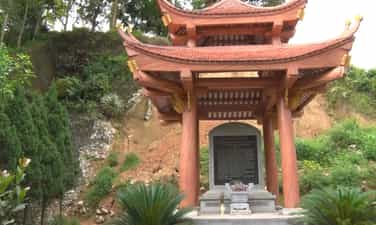
Ba Van Cang is located in Binh Son commune, Song Cong city, Thai Nguyen province - a countryside rich in revolutionary tradition. Before 1941, Ba Van Prison was part of Thai Nguyen province prison, built by the French on a remote area of land in Ba Van village, with difficult traffic, sparse population, separated from the outside by the river. Labour. This prison was proposed to be built in 1902, but for many reasons, construction did not begin until 1913. Initially, Thai Nguyen province prison had a small scale, the cells were made of bamboo, wood, and simple thatched roofs to house common criminals. Realizing that this prison is located in a place of "sacred forest, poisonous water", being imprisoned here is the safest, the French government has renovated and expanded the prison, building it more solidly to be able to take over many prisoners. than. There are solid fences around the prison, four corners are guarded by four guard posts. The prison is the home of the warden and soldiers, with a separate guard post for the guard. On September 29, 1936, the French President issued a Decree on full amnesty for prisoners throughout Indochina. Many political prisoners - patriotic communist soldiers - after being acquitted, have returned to work, connecting with leaders of the patriotic movement from North to South to fight for freedom, democracy, food and clothing. and peace. Before the outbreak of strikes, demonstrations, market yards, lockouts, struggles for tax collection, against tyranny oppression,... taking place from urban to rural areas, January 21, 1940 , The French Government has issued a Decree on the house arrest or deportation from their places of residence or detention in concentration camps of "dangerous elements" for national defense and common security, essentially for house arrest. Former political prisoners were acquitted in previous periods. Implementing this Decree, the colonial government in Vietnam established "special labor" camps (camp spécial des travailleurs) to detain political prisoners who had been acquitted in previous years, including Ba Van camp. was established under the Decree of the Governor of Tonkin on October 28, 1941. Ba Van Camp was maintained until October 1944 and between 1941 and 1944, about 200 prisoners were brought here for detention. After Ba Van Cang was abolished, the French colonialists sent political prisoners to be detained at Nghia Lo canton, Yen Bai province, established in 1944. In December 1994, the Ministry of Culture and Information issued a Decision to recognize Cang Ba Van historical relic as a national relic. The traces of Cang Ba Van are no longer there anymore, because in the past the prison was just rows of houses made from bamboo, the 5 meter high fence was built from sharpened bamboo sticks. This place has become a center for research and development of mountainous livestock, with the largest horse farms in Vietnam today. The strong, smooth-haired horses ready to gallop will create a lot of excitement for visitors, especially children. It feels like visitors are in the remote Mongolian steppe, not in Thai Nguyen. Source: Thai Nguyen Electronic Newspaper
Thai Nguyen
4380 view
Rating : National monument
Location for establishing the Youth Volunteer Team
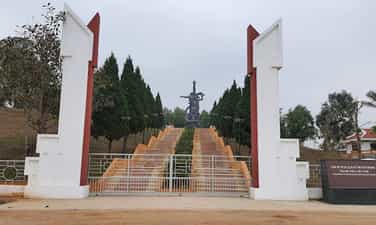
Historical relic The location of the establishment of the Central Youth Volunteer Work Team (July 15, 1950) is located at Go Tho hill, Yen Lang commune, Dai Tu district, Thai Nguyen province. The establishment of the Central Youth Volunteer Work Team is a milestone marking the maturity of the Vietnamese Youth Volunteer Force in the nation's long resistance war against foreign invaders, marking its activities. The actions and dedication of many generations of officials and young people during the resistance war against the French colonialists. Currently, the location is where spiritual and cultural activities of officials and people of Dai Tu district and of Vietnamese officials and youth take place. The relic site was invested and built by the Ho Chi Minh Communist Youth Union Central Committee in 2002 on the occasion of the 52nd anniversary of the traditional Youth Volunteer Day. The relic site has 5 categories of works, monuments, memorial houses, and stele marking events, including: - Youth Volunteer Monument Area: located in the central and highest position of the Monument Area. The cluster of statues is the image of two young volunteers in the side-by-side position of the winner, symbolizing heroic indomitable will on a monolithic stone pedestal. The statue is about 5m high, the stone pedestal is 2.5m high, and about 2m wide. - Statue system area: Includes 8 statues made of monolithic stone carving heroes representing Vietnamese Youth: Ly Tu Trong (1931), Kim Dong (1943), Tran Van On (1950), Vo Thi Sau (1952), Nguyen Van Troi (1964), Nguyen Viet Xuan (1964), Doan Thi Lien (1966), Kpa Klong (1975). - Traditional House Area: The traditional house has a total area of 516 m², in the middle of the house there is a 1.5m high, 0.8m wide stele with a semi-arc shaped forehead, the front is covered with engraved red granite. Golden letters: "Our youth have made many good achievements and deserve to be Heroic Youth of a Heroic nation." - Main gate of the monument and fence system: Including the main gate and open fence in front of the monument. At the main gate, there is a monument nameplate made of monolithic granite material. The relic site has historical value, the first place of origin of the birthplace of the Vietnamese youth volunteer force in Thai Nguyen province, connected to other historical sites related to volunteerism in the Viet Bac region. and the whole country. With the above typical value, the location of the establishment of the Central Youth Volunteer Team (July 15, 1950), Thai Nguyen province, was ranked as a national historical relic by the Minister of Culture, Sports and Tourism. Join on February 24, 2023. Source: Department of Cultural Heritage
Thai Nguyen
4047 view
Rating : National monument

Phja Khao Temple
The Phja Khao temple project was built by local people on the top of Phja Khao mountain, Ban Thi commune, Cho Don district since 1933. This is a familiar place of spiritual cultural activities, long associated with daily life. of local people. Phja Khao Temple worships Saint Tran, who had the merit of defeating the Mongol invaders in the 13th century to maintain the peace of the country and people. Worshiping the mine workers who were killed by the French colonialists. In 2017, the temple was recognized as a provincial historical-cultural relic. Phja Khao peak has many lead and zinc mines, which are historical evidence of the exploitation of the French colonialists against Ban Thi mine workers, from 1909 - 1941. Here more than a hundred years ago, when the Indochina Mining and Metallurgical Company invested a lot of capital in the mine, especially building a cable car more than 3km long and a railway to transport ore. It is known that during its prosperity, the mine had up to 5,000 workers and 80 secretaries. By 1942, there were only 500 workers and 5 European managers. Within 27 years (1914 - 1941), France brought home over 350,000 tons of zinc ore. Phja Khao was a place that brought profit to the colonists, and was also a place where many complex elements gathered, where robberies and killings often occurred. On top of Phja Khao, about 15 meters from the relic site, is a deep abyss that, according to indigenous people, cannot be seen from the top of the abyss to the bottom because it is foggy all year round. That's where the French colonialists threw sick coolies (miners) or people who dared to protest down from the mountains. There are resorts of the French colonialists here, where mine management staff relax. The resort was built 100 years ago and is now just ruins, trees have grown over the walls, creating an ancient, mossy look. Peace returned here, there were no longer mines or resorts of the French colonialists. Phja Khao peak returns to the inherent peace and quiet of the mountains and forests. This place has become a biosphere reserve. The species reserve and habitat here are very diverse in flora and fauna. There are also langurs and cauldrons, species listed in the Red Book that especially need to be protected from extinction. Source: Bac Kan province electronic information portal
Thai Nguyen
7584 view
Rating : Provincial level relics

Luc Giap Temple
Luc Giap Temple, also known as Vat Temple, is located on the left bank of the Cong River, in Dac Son commune, Pho Yen Town, 4 km west of Pho Yen district capital and about 35 km west of Thai Nguyen city center. southern. Every year, the temple opens its main festival on March 15 (lunar calendar) to commemorate famous people Duong Tu Minh, Luu Nhan Chu, and Do Can. In ancient times, the temple was just a small shrine worshiping the gods of the villagers in Son Cot region. In the 12th century (Ly Dynasty) to commemorate and recognize the merits of national hero Duong Tu Minh, the people here built a temple to worship him. In the 15th century (Le dynasty), Do Can from Thong Thuong village, present-day Minh Duc commune, passed his doctorate and was appointed government official of Thanh Hoa (present-day Thanh Hoa). He had skilled workers use good wood to carve and carve a complete house frame in Thanh Hoa and then brought it back to build it here to replace the old small temple. From then on, people in the six neighboring areas of Son Cot village worshiped and Luc Giap temple got its name from there. Luc Giap Temple is also called Mieu Vat, associated with a historical event: in the 15th century (Le Dynasty), a general of Le Loi, Luu Nhan Chu, came to this area to recruit insurgents. While recruiting soldiers here, he organized a wrestling competition (Wrestling Festival) at Luc Giap temple grounds. Later, when the Ming army was defeated, Liu Nhan Chu once returned to visit and write a souvenir at the temple. But unfortunately, due to time and war, currently no trace of Liu Nhan Chu has been found, only the name Mieu Vat is associated with his name and events in this area that still circulate today. The main area of Luc Giap temple is 1,360 m2 wide, including the worship house and the back palace, in front of the temple there is a large yard, in the middle of the yard there is a pedestal to place incense and flowers, the temple is covered with the foliage of a large 6-year-old banyan tree. Up to 7 people can't hug it. Luc Giap Temple is an ancient architectural work of the Le Dynasty. The columns are all made of ironwood and have remained glossy black over the centuries. All pillars, pillars, and planks in front of the harem are delicately and elaborately carved with the images of Dragon, Ly, Quy, and Phuong. In particular, the two main doors to the harem are embossed with two dragons flanking the moon of the Le Dynasty, very beautiful, reaching the level of sophisticated traditional art. The worship objects here such as: pedestals, shrines, statues, offerings... are all painted with gold and gilded, majestic and solemn. Up to now, the temple still retains a number of precious artifacts of the Nguyen Dynasty such as: a bell, two bronze altars, a number of large ancient porcelain worship bowls. The number of artifacts left at the temple today is very small but there are artistic and historical value. With those values, Luc Giap Temple was ranked as a national historical and artistic relic on June 21, 1993. Luc Giap Temple Festival is held on the 15th day of the third lunar month every year, including a ceremony and festival solemnly organized by local people. For many years now, the Luc Giap Temple Festival has been a cultural destination attracting a large number of people in the region and tourists from all over. The ceremony has typical activities related to spiritual beliefs such as: sacrificing to gods, serving bronze, offering incense, procession... The festival recreates folk games such as: traditional objects, singing for love, pulling fighting, cockfighting... Source: Thai Nguyen City Cultural and Media Center
Thai Nguyen
4629 view
Rating : National monument

Hang Sa Khao
Sa Khao Cave is a famous archaeological site located in the northwest limestone mountain range of Na Khao pine, Phu Thuong commune, Vo Nhai district, Thai Nguyen province. Sa Khao Cave is approximately 30km long, passes through 5-6 mountains, located about 2km from the center of Dinh Ca town, Vo Nhai district. Entering Sa Khao cave, visitors will be overwhelmed by the beauty of the multi-shaped stalactites, with traces carved by the flow of time. The cave's dome is high and wide, below is a clear stream gurgling with gurgling water, creating a watercolor painting with thousands of stone fibers clinging to the cave walls hanging down below, the rock patterns curling due to erosion. of water stacked down from the ceiling of the cave. The cave ceiling is about 20m high, below is a vast sand floor. The special thing here is that there are tree-shaped mushrooms and palm mushrooms growing all over the path along with many strange animals. Throughout history, experiencing two fierce wars of resistance against the French and the Americans, Hang Sa Khao was the place where important meetings of revolutionary cadres took place. Comrades Vo Nguyen Giap, Tran Dang Ninh, Hoang Van Thu, Hoang Quoc Viet, Le Duc Ton, Chu Quoc Hung... once sheltered and worked in this place. Sa Khao Cave is also a safe evacuation place for officials and people of Vo Nhai District. From 1965 to 1972, many generations of primary school students in Phu Thuong commune studied at Sa Khao cave. Vo Nhai District agencies evacuated here and set up tents next to the cave entrance to work. Not only that, in Hang Sa Khao there is also a hall for meetings and a stage for musical performances. During the years of the fiercest anti-American resistance war, in this place, the people of Vo Nhai District also enjoyed famous revolutionary songs with the spirit of "Singing over the sound of bombs" by singers Thu Hien and Quoc Huong. .. With majestic beauty and poetic mountains, it is associated with historical events of the revolutionary struggle of revolutionary comrades, as well as of the people of Vo Nhai district through the two resistance wars against the French and the Vietnamese. In the United States, in 2010, the Ministry of Culture, Sports and Tourism ranked Sa Khao cave as a national historical relic, an indispensable discovery point in ecotourism, cave exploration and also is a journey to the source, the place of educating the revolutionary tradition of Thai Nguyen province. Source: Thai Nguyen Tourism
Thai Nguyen
4286 view
Rating : National monument
Tham Temple
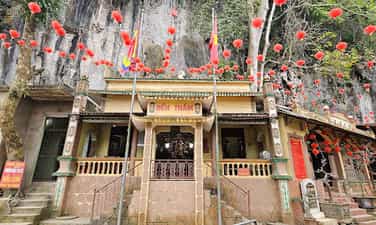
Tham Temple is located in Cho Moi district, Bac Kan province with many myths and legends that have entered the minds of mountain residents here. The temple is located right next to the gravel road leading to Quang Chu commune, less than 4km from Highway 3 and 45km south of Bac Kan city. The temple worships a female general named Tham - who had great contributions in the fight against the Black Flag invaders in the second half of the 19th century. Previously, the temple was a place to worship the Mountain God and the Water God to pray for boats and ships to travel safely. By the end of the 19th century, the temple was renovated to worship the female general who had great merit in fighting the Black Flag invaders, Ms. Tham. The story goes that there was an old father and son who fished for a living on the Trang Co river. A year of natural disasters, floods, and fierce waters swept away the poor old man's boat and nets. After the water receded, the old man brought the fishing net to the river. By dusk, he was able to put away a heavy batch, but sadly it was just a rock. The next time, only that rock went into the net. He moved to another part of the river, still lifting up that strange rock. He was about to throw it away when a voice echoed from within the rock: "Old man, take me home." Feeling strange, he brought the talking rock home. When he arrived, he was exhausted and threw the rock to the ground. It hit another rock and broke. Strangely, there is a yellow glow in the rock's belly. Those were gold bars. Thinking that Giang (God) had given the village to compensate for the flood disaster, he divided the gold among the people around the area. There is gold, but the old man and his son still work hard to make a living by the Trang Co river. Grateful, the people here built a temple to worship two stones, the Mountain God and the Water God, so that boats and ships can travel safely. Ms. Tham, the daughter of an old fisherman, was gentle and beautiful, and had a reputation. Boys from both the upper and lower villages dreamed of marrying her. When she was young, she was taken by God's power to be his wife. She lived in a golden situation but was humiliated in every way, especially when the Black Flag invaders came to harass them, and the Lord Muong not only did not fight the invaders but also became their henchman. She tried every way to escape from the Muong Lord's house and gathered poor people to rise up to fight the enemy. The Muong Lord was angry and wanted to gain merit, so he led the enemy to fight. The female general stubbornly fought back. At the Trang Co river, a fierce battle took place, blood flowed into rivers, but Co Tham's soldiers remained undeterred. Unfortunately, the female general was hit by a poisoned arrow and died. The angry soldiers decided to fight to avenge her. The enemy was terrified and fled in disarray, the Lord Muong was captured alive and executed as a sacrifice to his general. To commemorate the courageous female general, people built a temple to worship Ms. Tham. Tham temple complex includes the main temple, Ms. Tham temple and Son Than temple. The main temple is divided into three compartments, worshiping: Five Venerable Gods, Bach Linh, Saint Tran Hung Dao, Mother Thuong Thien, and Avalokiteśvara Buddha. The shrine to Ms. Tham is located right next to the main temple, on the left side there is a domed concrete structure, on the altar is a statue of Ms. Tham wearing a blue shirt, under the pedestal there are a pair of phoenix birds carved in stone. Every year, tourists from all over come to Tham temple to worship and pray in large numbers, especially on the first and second occasions. After many years of construction and repair, in 2012 the temple was ranked at the provincial level as a historical-cultural relic, a place for cultural and religious activities of the people. Source: Vietnam National Tourism Administration
Thai Nguyen
8086 view
Rating : Provincial level relics
Khuoi Linh historical site, Khau Ma hill
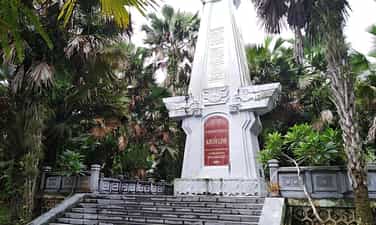
Khuoi Linh historical relic (in Nghia Ta commune, Cho Don district) is the living and working place of comrade Truong Chinh, former General Secretary of the Party Central Committee and the Central office from August to December 2019. 1950. Comrade Truong Chinh's residence is located on a hillside, his workplace is located on the top of a hill next to his residence at the foot of Khau Bon mountain. The Party Central Committee office area is located on a hill near Comrade Truong Chinh's residence. Khuoi Linh relic site is in a very dangerous location but traffic is very convenient for communication in all directions. On March 18, 1996, Khuoi Linh was ranked by the Ministry of Culture and Information as a national historical and cultural relic. In 2000, Nghia Ta commune was awarded the title Hero of the People's Armed Forces by the Party and State. Khau Ma Hill historical relic in Ven village, Luong Bang commune (Cho Don) is where comrade Pham Van Dong - former Prime Minister and the Government Office lived and worked from early 1950 to the summer of 1951. . At this place, comrade Pham Van Dong together with the Party Central Committee and the General Command of the Vietnam People's Army under the direction of President Ho Chi Minh held a meeting to discuss opening the border campaign in 1950, opening A new era for the Vietnamese revolution. It can be said that during the period in the Viet Bac war zone, especially the period of living and working in Khau Ma - Ban Ven (Luong Bang), Prime Minister Pham Van Dong had many positive activities with the Party Central Committee. and Uncle Ho led the people to promote the resistance war against the French colonialists to complete victory. In 1996, the people of Luong Bang commune were honored to receive the Certificate of historical relics ranked by the Ministry of Culture and Information as a national historical relic. Source: Bac Kan Province Electronic Information Portal
Thai Nguyen
7592 view
Rating : National monument

Thach Long Pagoda
Thach Long Pagoda (Stone Dragon) is located in Cao Ky commune, Cho Moi district, Bac Kan province. This place is known as "the sacred temple in the cave". The temple contains many beautiful stories and legends. Thach Long Pagoda attracts thousands of visitors from all over to attend the festival and offer incense to pray for blessings and fortune every spring. Many people say that, traveling from North to South, they have never seen a pagoda located in a large, clean and airy cave like Thach Long Pagoda. Buddhist monks and nuns attending the festival can enter the cave to worship Buddha in thousands of people. The story goes that, in the past, people in Vi Huong - Bach Thong commune went down the Cau River to pick up the Shakyamuni Buddha statue to worship in their village, Hoa Son, on top of the Phja Bjooc mountain range. The golden Buddha statue is very heavy, so when going up to Vi Huong, it had to be pulled by a rope. Coming to Bo Mi river in Cao Ky commune today, the array kept spinning and made it impossible to move. It was already dark, that night, the people going to process the statue had to set up a tent to sleep at the Bo Mi garden to continue the next day. The next morning when they woke up, they were panic-stricken and could not see the Buddha. The person going to process the statue had to light a large bunch of incense and pray: "If you want to stay here, I will obey your wishes, but please let me know where you are sitting so that future generations can worship the incense and smoke." Having finished speaking, the bundle of incense and smoke flew to the other side of the river, forever going into the mountains. The person carrying the statue kept following the incense smoke and discovered a beautiful, spacious cave. Shakyamuni Buddha sat at the highest place. Knowing the sacred cave, the villagers built a temple right in this cave. The pagoda is called Thach Long (stone dragon) because the cave is located in a rocky mountain, the cave entrance has the shape of an open dragon's mouth. The pagoda has two main parts. The first part is Thien Pagoda. This pagoda is located high up, with a stone step from the foot of the mountain leading straight up to the cave entrance. The highest compartment worships Shakyamuni Buddha. In the middle space, on the highest pedestal, there is an image worshiping Uncle Ho. The second part of the pagoda is Am Pagoda, the way to Am Pagoda must go around the mountainside. The entrance to Am Pagoda is a bit narrower than Thien Pagoda. The cave's interior is not as wide as Thien Pagoda. It is estimated to be about 6m high, 6m wide and has a deep recess inside. Both Thien Pagoda and Am Pagoda have many heavenly statues depicting Buddhas. In the heart of Thien Pagoda, the cliff divides itself into segments like high and luxurious parasols covering the Buddhas sitting below. Not only does it contain many legends, Thach Long Pagoda is also a historical relic, the pride of the people of Cao Ky commune during the resistance war against the French. During the resistance war against the French colonialists, Uncle Ho came here three times. During the Dien Bien Phu campaign in 1954, the pagoda became a weapons transport station and a secret arsenal of our army. Peace was restored, the pagoda was again worshiped by people like before. Thach Long Pagoda Festival is held on January 7 every year, attracting many tourists from all over, who come to offer incense to pray for luck and happiness for their families and relatives. Thach Long Pagoda is not only a beautiful landscape of Bac Kan, but also a historical relic. This relic has been receiving a lot of attention, protection, and restoration to become an attractive cultural tourist destination of Bac Kan province. Source: Bac Kan Province Electronic Information Portal
Thai Nguyen
8644 view
Rating : Provincial level relics