
 vn
vn en
en ja
ja ko
ko zh
zh






















List of relic sites (128)
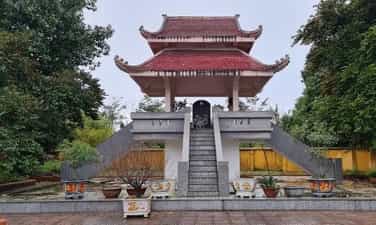
Souvenir relic of Uncle Ho's visit to Cam Xuyen, Xuan Cam commune, Hiep Hoa district
During the years leading the Vietnamese revolution, Uncle Ho many times visited the Party Committee, government and people of all ethnic groups in Bac Giang province. Hiep Hoa district was honored and proud to welcome Uncle Ho to visit Cam Xuyen village, Trung Nghia commune (now Xuan Cam commune) on February 8, 1955. Today, the site of his footprints has become a historical relic, a place of traditional education for generations. The souvenir relic of Uncle Ho's visit to Cam Xuyen is located on an alluvial beach outside the Cau River dyke, running nearly 1 km long with a nearly 100-year-old lychee garden close to the water's edge, limited by two horizontal wharves at the river's edge. North and South of Cam Xuyen village to Soc Son district (Hanoi). This place used to be the old Cam Xuyen communal house (ruined in 1963). Here, in February 1955, Cam Xuyen communal house (Hiep Hoa) was the working place of the Reform Youth Union Party Committee. At that time, the beach along the dyke was a sports ground, cinema, logistics, etc. The lychee garden of Dong Nuong was the meeting hall of the union, more than 2,000 reform officials lived in the homes of Cam Xuyen village. On February 8, 1955, President Ho Chi Minh came to work with the Party Committee of the Reform Youth Union at Cam Xuyen communal house, visited the logistics area at Cam Xuyen village, then he visited a number of farmer's houses in Cam Xuyen. Cam Xuyen village. In particular, here, he attended and spoke at the Land Reform Review Conference, Phase II. This is a historical milestone, marking the great transformation of the Vietnamese revolution: Completing the national revolution, People's democracy, realizing the plowman has the field and the biggest goals that the revolution set. go out. Currently, the memorial site of Uncle Ho's visit to Cam Xuyen village has an area of 3674.8m2. To commemorate the day Uncle Ho visited Cam Xuyen village, on April 28, 2000, the people of Cam Xuyen village worked with comrade Vu Ky (formerly Uncle Ho's personal secretary) in Hanoi to propose building a stele house. commemorating the day Uncle Ho visited Cam Xuyen village on February 8, 1955. In 2005, the project was started construction, including the following items: Concrete road, entrance gate, garden, stele house and wall system to protect the monument. From the Cau River dike road, turn left to a concrete road about 100m long, connecting the Cau River dike with the souvenir area. The entrance gate is designed in a two-story style with 8 curved roofs covered with red-nosed tiles, including 3 doors: 1 main door and 2 side doors. The yard is paved with traditional red spring rolls. Through the yard is the beer house area built with 2 floors. The first floor is built with a wall system, surrounded on four sides by a system of stairs to get to the second floor where the stone stele is placed. The stone stele is made of a rectangular block of green stone, with 2 sides, inside the stele is engraved with the words: "On February 8, 1955, Uncle Ho attended the 2nd Land Reform Summary Conference of the Thai Nguyen Delegation - Bac Giang and visited farmers in Cam Xuyen village, Xuan Cam commune, Hiep Hoa district, Bac Giang province". In 2018 and 2019, Hiep Hoa district invested more than 3 billion VND to build and renovate the relic such as: Reception area, yard, gate, entrance road, lighting system, drainage,... On June 18, 2021, the memorial site of Uncle Ho's visit to Cam Xuyen village, Xuan Cam commune, Hiep Hoa district was ranked as a National historical relic. Source: Hiep Hoa District People's Committee
Bac Ninh
5963 view
Rating : National monument

Chau Lo Temple
Trau Lo communal house is located in Mai Dinh commune, Hiep Hoa district, about 43km west of Bac Giang city center. The communal house worships King Ong and King Ba - two human deities who have made great contributions to their homeland during the reign of King Trieu Viet Vuong. Besides, Trau Lo Communal House also worships Saint Tam Giang - who had many merits in helping Trieu Quang Phuc fight the Luong invaders (VI century), bringing peace to the country. Based on the remaining Sino-Nom sources at Trau Lo communal house, it is said: In the year of Dinh Hoi, the reign of Duc Nguyen of the Le Dynasty (1677), the villagers held a "carpentry" ceremony to build a communal house. In the year of the Dog, during the reign of King Vinh Thinh (1706), Mrs. Ngo Thi The, a native of Trau Lo village, nicknamed Tu Khanh, brought 200 prehistoric mandarins to the commune to buy forest wood to build a communal house. Later, the communal house was also repaired. many times through the Le Trung Hung dynasty (18th century), Nguyen dynasty (19th century) and later periods. The communal house was built right in the center of the village, on a high, open, spacious area of land. This is an ancient architectural complex with a massive scale, including: the 5-compartment Pre-Sacrificing Court, the 5-compartment Great Hall with 5-compartment spaces and the Harem. In front of the communal house is a large square tiled floor. Over time, the Former Temple was damaged, leaving only the Great Court and the Harem. The Great Court - the main architecture of the whole project - has a massive scale with long, wide rooms, each with 6 rows of tall and muscular columns, supporting a wide roof frame with curved blades, soft curved roofs, The roof and strip banks are decorated with pincers, bucktails, phoenixes, and phoenixes dancing very vividly. The most valuable architectural part is the ironwood frame of the rafters, in the style of four pillars stacked on beams, the architectural decorative sculptures are concentrated at the top of the trap, and the diaphragm has many vivid themes and many objects. Cloud dragon patterns have rich variations and stylizations, imbued with the folk art style of the late 17th century. At Trau Lo communal house, each temple exhibits its own style and technical mark, proving that many workers participated in building the communal house, making the entire communal house a unified architectural structure. , but each has its own engravings that express its own artistic talent. Trau Lo Communal House and Trau Lo Temple are the center of cultural and religious activities of local people. Every year, the communal house has two main events taking place with the temple on the 4th day of the first lunar month and the 15th day of the ninth month of the lunar calendar. These are two great days, also known as the Great Blessing Ceremony. On the day of the festival, the people of Trau Lo village organize many solemn ceremonies such as procession of palanquins, tablets, altars to honor the merits of the Tutelary Gods and folk games imbued with regional identities such as marking milestones, pull rope, tug of war... On December 12, 1994, the Ministry of Culture, Sports and Tourism ranked Trau Lo communal house and temple as a national architectural and artistic relic and historical-cultural relic. Source: Bac Giang province electronic information portal
Bac Ninh
6920 view
Rating : National monument
Outstanding monuments
See all
Vinh Nghiem Pagoda
Vinh Nghiem Pagoda, also known as Duc La Pagoda, is an ancient pagoda in Duc La village, Tri Yen commune, Yen Dung district, Bac Giang province. Vinh Nghiem Pagoda is an ancient pagoda, where the only original set of woodblocks of the Truc Lam Buddhist sect is kept. The 3,000 woodblocks of Vinh Nghiem Pagoda have been awarded by UNESCO as a world memory documentary heritage. The pagoda is recognized as a Buddhist center, a place to train monks for the whole country, and the birthplace of the Three Patriarchs of Truc Lam Zen sect of Vietnamese Buddhism. In 2015, the pagoda was recognized by the State of Vietnam as a special national monument. Vinh Nghiem Pagoda is located at the confluence of Luc Nam and Thuong rivers (called Phuong Nhan junction). The pagoda overlooks the confluence of rivers, towards Luc Dau Giang - Kiep Bac, Cam Ly region, the gateway to Yen Tu mountain. Surrounding the pagoda are mountains, including Co Tien Mountain. Across the river is Tran Hung Dao's royal palace, Kiep Bac Temple. Legend has it that Vinh Nghiem Pagoda was built in the Ly Dynasty (11th century). At the end of the 13th century, (1010-1028), Buddha Emperor Tran Nhan Tong expanded and built this place into a major Buddhist center of the Tran Dynasty, renaming the pagoda Vinh Nghiem, associated with the birth and development of Truc Lam Yen Tu Zen sect. As one of the ancestral places of the Zen sect, Vinh Nghiem Pagoda was built with a grand architectural scale, many items, standard and exemplary of traditional pagoda architecture. This is an ancient temple with the richest architecture of Buddhist-Vietnamese identity that no other temple in the region has, worthy of being called a "great ancient site". In the pagoda, there are also Buddha statues, statues of the Patriarchs of the Truc Lam lineage, statues of later monks, statues of Dharma protectors, statues of Arhats... In the pagoda there is also a muzzle nearly half a meter long, painted glossy black, with a sound hole. There are two lines of Sanskrit inscriptions. In the past, Vinh Nghiem Pagoda was a place to train Buddhist monks, so it was a storage place for ancient scriptures that were up to 10 rooms wide. These are collections of sutras dating back 700 years, a treasure trove of extremely valuable ancient books, such as: The novice monk, the monk, the novice monk, the 348 precepts, the Yen Tu diary from the 15th century (the process of forming the Truc Lam sect), Hoa Nghiem Sutra, Amitabha Sutra, Mahayana Chi Quan, Precepts and Ni Sutras... Today there are many wooden shelves printed with historical sutras still at the pagoda. The ancients called this engraving, proving that Vinh Nghiem Pagoda once dominated 72 forests. Currently, the Moc Thu warehouse still preserves 34 books with nearly 3,000 engraved copies, each copy has two sides, each side has 2 upside-down engraved pages (negatives) with about 2,000 Nom and Chinese characters. Those engravings are still handed down in our country with each sharp and delicate handwriting. Today, those values still remain intact, without any loss of value. The pagoda's area is about 1 hectare, surrounded by dense bamboo. Currently, the pagoda is being renovated and creating favorable conditions for tourists to travel and worship. Visitors can follow the route such as: three-entrance gate, go about 100m deeper to worship the road, also known as Ho Pagoda. On both sides of the pagoda's road, pine clumps about 1 meter long were built to form pine forests. On the temple grounds there is a large stone stele with 6 sides built in the 7th year of Hoang Dinh (1606). Right in front of the ancient stele is the tomb tower garden of 5 monks: Phu Lang Trung Phap (named Sa Mon), Thong Due Ung Duyen, Thanh Quy, Tinh Phuong Sa Mon, Thanh Hanh and a number of other towers. Vinh Nghiem Pagoda Festival is held on the 14th day of the second lunar month. Source: Bac Giang Province Electronic Information Portal
Bac Ninh
10148 view
Rating : Special national monument

Phuc Long Communal House
Phuc Long communal house is located in Tang Tien commune, Viet Yen district, Bac Giang province. Phuc Long communal house is the center of traditional religious and cultural activities of the people of Phuc Long village, past and present. The village communal house is a place of worship for the entire people, and is also the center for organizing the village's festivals during Tet holidays, which represent the long history and cultural traditions of Phuc Long village. Based on the legend engraved on the stone stele of King Tu Duc, and according to the legends of the local people, Phuc Long communal house worships the gods of sound and inspiration, helping to fight the enemy to save the country and protect the country. defend the homeland. In addition, Phuc Long people also worship Nhue District Cong Le Tuong Cong, the Le Dynasty mandarin who helped people rebuild Phuc Long pagoda and communal house. That is the communal house and pagoda that remains today. Remembering his gratitude, the villagers carved a stele recording his merits and worshiped the mandarin as his successor. Every year, they worshiped him on the 10th day of the 7th month, called the death anniversary of the old man. The eulogy of the general's official was read on the death anniversary. They share a common belief in worshiping Heaven, Earth and Water - elements closely related to the lives of people working in wet rice agriculture. The value of Phuc Long communal house is not only in its ancient founding date, over 300 years ago, but mainly in its large scale, unique architectural style and talented carving and decoration art. , delicate. The most attractive thing about Phuc Long communal house is the decoration and engravings on the architectural parts: such as on the ends, levers, scrolls, hammock doors in front of the palace, on the gates, The column bibs (also known as column tapers), are all engraved with decorative images with many different designs. Unlike many other communal houses, the entire wooden frame of Phuc Long communal house is bare, unpainted and gilded, showing off all the sophistication and ingenuity of the workers who built the communal house. What is recognizable is the architectural structure and especially the carvings, showing the two unions of carpenters involved in building the communal house. Therefore, the architectural style, especially the carving, shows two different styles, delicate carving, trimming, elaborate and soft lines. But all of them blend together in unity, richness and diversity, reflecting the most common features of architectural art and engravings of the Le Dynasty in the late 17th century, imbued with folk art: Innocence, generous. Popular decorative shapes are the carvings, carvings of the "four sacred animals", "four precious" images with variations of dragon, Nghe, phoenix, tiger face, dragon-shaped, physical-chemical... extremely rich. Phuc Long communal house was officially recognized by the Ministry of Culture and Information as a national historical and artistic relic in 1993. Source: Electronic Information Portal of Viet Yen Town, Bac Giang Province
Bac Ninh
10058 view
Rating : National monument

Ham Long Pagoda
Ham Long Pagoda (or Long Ham) in Thai Bao area, Nam Son ward, Bac Ninh city, was built during the Ly dynasty (about the 12th century). According to folk eyes, the pagoda is located in the jaw of a dragon, meaning under the jaw of a large dragon 9 segments long, which is the entire Lam Son range. This is a large Buddhist center, and is said to be the place of practice for monk Duong Khong Lo. Located on a land area of more than 9,000 square meters, the pagoda has a beautiful landscape, in harmony with nature, is known as an ancient temple with a long history, the architectural works are designed and decorated according to Traditional style, exquisitely carved, artistic. Today, Ham Long Pagoda is the center of spiritual activities of local people and people from all over the region, a place to worship Buddha Dharma, a place to guide living beings to good things, to stay away from evil, to live with compassion, joy and forgiveness. The current pagoda has a large scale including works: Tam Quan gate, Tam Bao, Patriarch's house, Mother's house, Guest house, Monk's house and auxiliary works. The Three Treasures Pagoda is made of ironwood, shaped like a Dinh, including the 7-compartment Tien Duong, the structure of the roof "stacked with beams and gongs", the armpits of which "those sitting on the bed are fascinated" and 3 rooms of the Upper Palace, the structure of the roof. stack of gongs and gongs", because underarms "the one sitting". The pagoda worships the 7 Patriarchs, the Mother Goddess, and Mr. Do Trong Vy, he is famous for being an intelligent and studious man and later became an honest mandarin, teacher, and culturer, especially he was the one who had the merit of founding the Vietnamese Literature. Bac Ninh Temple. After he got old, he returned to Ham Long Pagoda to practice. After his death, he was worshiped here. Currently, Ham Long Pagoda still maintains the ritual of sending souls to the souls who died at evil and sinful hours. To avoid disasters and yokes, families of ghosts often send ghosts to Ham Long Pagoda to receive shelter and salvation, so that ghosts can soon be reborn and escape to the realm of bliss. The architectural works within the Pagoda's grounds are carved with sophisticated, artistic decorations with a spacious and perfect appearance. The pagoda has a festival on the 14th day of the second lunar month, in addition, during the year there are other days such as: Buddha's Birthday, Vu Lan festival, Full Moon week, First lunar month, traditional festivals, Lunar New Year. The pagoda also welcomed many domestic and foreign delegations, high-ranking leaders of the Party and State to visit Buddha. The pagoda was ranked as a cultural and historical relic by the Ministry of Culture and Information on January 18, 1988. Source: Bac Ninh province electronic information portal
Bac Ninh
9726 view
Rating : National monument

Van Coc Communal House, Van Trung Commune
Van Coc communal house is also known as Bai Ca communal house, people in the area often call it Bai communal house. Bai Ca communal house used to worship the saint Cao Son Dai Vuong together with Bai Xanh communal house. For some reason, this communal house was divided into two (upper communal house of Xanh village, lower communal house of Bai village. Both communal houses are located at the foot of the western mountain of Bai Mountain, one of the mountain ranges in the Nham Bien Son range or the 99-top anchor mountain. The village is spread out along the mountain slope like a flying Coc, looking down at the sunken field which is a lake Lang Bac in the past. Looking from above, Van Coc village looked like a Big Coc, the body was Bai Mountain, the head was Don Mountain, and the two long wings spread out on both sides were Van Coc village. The communal house was located under the eyes of the coc . Van Coc communal house is located in Van Trung commune, Viet Yen district, Bac Giang province. This is the place to worship the village's Tutelary God, Saint Cao Son Dai Vuong. Duc Cao Son is from Lang Xuong Cave, Thanh Chau district, Gia Hung district, Son Tay religion. He is the son of Nguyen Hanh and Dau Thi Loan. He was born because his parents were told in a dream that the god was reincarnated. So when he grew up, he was very intelligent in martial arts and knowledgeable about heavenly books. When the country had foreign invaders, King Due Vuong issued an edict to go everywhere to find talented and virtuous people to help the country. He immediately returned to the court to apply for the position and was immediately employed. He was appointed by Tan Vien Son Thanh as a senior general. With the wholehearted help of the local people - gods and people, he soon completed the work. When the Thuc army arrived, he was beaten to a pulp by his generals (afterwards he had to make peace with the Hung dynasty). After the war against the Thuc invaders, he returned to the army where he had built a stronghold to repay the people's kindness. When finished, he was ordered to return to court. Then the king sent him back to enjoy his fortune in Thanh Hoa and there the court ordained him as the Supreme God of Blessing and Strength for the places that had previously gone to fight the enemy and had received help from the people, so they had to establish a place of worship forever. His Holiness Cao Son Dai Vuong. According to Dinh's family tree, Trang Van Coc previously had an ancient temple in the communal house area, then moved it to the middle of the village. The current communal house was built in the year Mau Ty - Le Canh Hung dynasty (1788) and was built by Duong Tuong Cong - Tu Quoc Co. The communal house currently has 5 rooms, 2 rooms, 1 bamboo tube, 2 rooms, 3 harem rooms with high and wide wooden floors. In front of the communal house there are 2 square steles. The remaining relics are 8 sturdy and majestic hammock doors, 4 pairs of parallel sentences, 10 horizontal panels, 2 dragon and tiger altars, 2 water fountains, 2 purifying shelves, 2 ordination boxes, 1 color book. divine insignia, 1 jade genealogy book, 1 stone incense stick, 1 box containing a set of culvert bowls, 2 fan bones, 2 parasol bones, 2 large altar horses, 1 set of halberds with more than 20 halberds, a set of precious bowls, a Culinary temple, 1 dragon communal house, 1 ancient incense burner, 2 altar thrones, 2 tablets. All are painted with gorgeous gold lacquer. One drum, one gong and some stone lamps, candlesticks... Along with the brilliant victory on the Nhu Nguyet river front line, the historical site of Mount Don was the place where extremely fierce battles of our army and people during the Ly dynasty took place against the Song invaders. This was also the place to welcome Win a victory and chase the national enemy out of the country. Because after the swift and courageous strategic battle of our army and people against the army group commanded by General Quach Quy here, the enemy's invasion plot was crushed and Quach Quy resigned to bitter defeat. At night, the order was given to withdraw the remaining troops back to the country, trampling on each other (as the Song Dynasty's own history had to admit). Van Coc Communal House was ranked a national historical, architectural and artistic relic by the Ministry of Culture, Sports and Tourism on January 21, 1989). Source: Electronic Information Portal of Viet Yen Town, Bac Giang Province
Bac Ninh
9401 view
Rating : National monument

Do Temple and Tombs of Ly Dynasty Kings
The tombs and temples of the Ly Dynasty Kings are historical evidence of the ancient Co Phap village and today's Dinh Bang; It is a relic land, a temple to worship the Ly dynasty kings and is also the burial place of the Ly dynasty's ancestors and royal family. Ly Dynasty (1009 - 1225), from when Thai To (Ly Cong Uan) ascended the throne, moved the capital from Hoa Lu to Thang Long (1010), experienced 8 kings, passed the throne for 216 years, was the period when the state conferred independence, autonomy, and strength, the people can live in peace and prosperity. The relic site is a unique architectural work, with stone carving, wood carving, worship statue carving, and construction techniques all reaching a sophisticated level and many intangible cultural heritage values being preserved. : worship beliefs, festivals, customs, practices.... The tomb area of the Ly Dynasty kings is also a particularly important archaeological site serving scientific research. The relic has many other names, such as Do Temple, Co Phap Dien/Ly Bat De Temple and Tombs of Ly Dynasty Kings (Tho Tomb Thien Duc or Son Mau Forbidden Land); Includes 2 main areas: Do Temple and Tombs of Ly Dynasty Kings (Forbidden Land). 1. Do Temple: total area of 31,250m2, divided into inner city and suburban areas. Suburb: 26,910m2 wide, including semicircular lake, water pavilion, writer's house on the right, martial arts house on the left. Inner city: 4,340m2 wide, divided into interior and exterior areas. The interior includes: the harem, the carriage house, the altar house, the stele house and the house for 8 altar palanquins, the house for 8 worship horses on both sides. The exterior includes: Phuong communal house, King's temple, celebrant's house, guest house, exhibition house, hall, five dragon gates, temple yard, elephant statues, stone crocodiles... 2. Tombs of Ly Dynasty Kings (Forbidden Land) The tomb area is the final resting place of the Ly dynasty kings, about 800m northeast of Do temple, located in Sen Pond area, in the fields of Dinh Bang ward, Tu Son town, Bac Ninh province. Today, the tombs of the Ly Dynasty kings include the following buildings: - Tomb of King Ly Thai To - Long Chao Tomb - Tomb of Ca (King Ly Thai Tong) - Tomb Two (also known as Tomb Con) worships King Ly Thanh Tong - Tomb of the Elephant (King Ly Nhan Tong) - Tomb of Duong Gio (King Ly Than Tong) - Tomb of Duong Thuan (King Ly Anh Tong) - Tomb of King Ly Cao Tong - Tomb of King Ly Hue Tong - Mausoleum of Mrs. Nguyen Phi Y Lan - Phat Tich Tomb (Pham Thi's mausoleum) There are not many artifacts left at the Do Temple relics and the Ly Dynasty kings' mausoleum area, such as 8 tablets with the names of the Ly kings painted in red and gilded, carved in the Le dynasty, bronze tops, and cranes. bronze and some bowls and dishes dating back to the Le dynasty. In particular, there is a stone stele, dated 1604, compiled by Dr. Phung Khac Khoan, recording the merits of the Ly kings. In addition, cultural activities of folk beliefs and worship of Ly dynasty kings are still maintained and become traditions at Do temple. Every year, three main festivals take place in Dinh Bang: - Temple festival on January 7. - The communal house is held on February 15, taking place on 2 main days (from February 14 to 15). - Temple festival on March 15, held at Do temple. With special value, the historical site of the Ly Dynasty kings' tombs and temples was ranked a special national monument on December 31, 2014 by the Prime Minister. Source: Department of Cultural Heritage
Bac Ninh
9386 view
Rating : Special national monument

Ngoc Lam Temple
"The Ben Ngoc Daughter" is the name of a female general of the Trung Sisters, who made great contributions to helping the Trung Sisters repel the Han Dynasty invaders, and is today honored as a national historical celebrity. In Bac Giang city, there is a street named after Ba. She is Princess Thanh Thien. Ngoc Lam Temple is a relic located next to Ben Ngoc (literally called Ngoc Chu) - a place to worship and commemorate Princess Thanh Thien. Ben Ngoc is also known as Ngoc Lam, located in Ngoc Lam village, Tan My commune, Yen Dung district. "The Ben Ngoc Daughter" is the name of a female general of the Trung Sisters, who made great contributions to helping the Trung Sisters repel the Han Dynasty invaders, and is today honored as a national historical celebrity. In Bac Giang city, there is a street named after Ba. She is Princess Thanh Thien. Ngoc Lam Temple is a relic located next to Ben Ngoc (literally called Ngoc Chu) - a place to worship and commemorate Princess Thanh Thien. Ben Ngoc is also known as Ngoc Lam, located in Ngoc Lam village, Tan My commune, Yen Dung district. Princess Thanh Thien was the daughter of a family of Lac generals during the time of King Thuc - Because she did not cooperate with the Han dynasty, she hid at the temple. As a child, Thanh Thien was famous for his intelligence and talent. Growing up in the country's misery and humiliation under the domination of the Han Dynasty, this girl has since then nurtured a great ambition to take revenge for the country and society. Then she gathered her forces, stored food, trained soldiers and horses, and set up a base to wait for the opportunity to rebel. To strengthen her forces, she allied with patriots throughout Hai Duong (her hometown). Once when visiting her uncle in Ky Hop (Lang Giang), she stopped at Ngoc Lam site and was welcomed and wholeheartedly supported by the people. She discussed with him a plan to expel the enemy and set up camps in Ky Hop and Ngoc Lam. The base was established, and many clashes with the Han invaders occurred, the enemy forces were defeated many times. Once Ky Hop base was surrounded, Ngoc Lam base was blockaded. At that time, Hai Ba Trung's insurgent army stood up, heroes from everywhere came and Thanh Thien also followed that banner of insurgency. Under the banner of "Repaying the country's debt, avenging the family" of the Hai Ba, Princess Thanh Thien courageously stood side by side with the insurgents to expel the Han invaders and regain independence for the country. Crazy with defeat, the Han Dynasty sent the experienced male general, Ma Vien, to send troops to our country to suppress the uprising. Due to their defeat, Hai Ba Trung threw herself into the Hat Giang river and committed suicide to keep her virginity. As for Princess Thanh Thien, she fought until her last breath, following the Hai Ba to martyrdom at Ben Ngoc, refusing to fall into the hands of the Han invaders. Admiring Ms. Thanh Thien's example of filial piety, after her death, people built a temple to worship right next to Ben Ngoc - where she committed suicide. In the past, the monument was large and majestic, but now it is no longer intact. Currently, the ruins still have the Upper Temple and the Lower Temple. Thuong Temple is located on a high promontory adjacent to Chin Khuc River, opposite Bai Han area. The temple consists of two buildings: 3-compartment altar, simple architecture, inside there is an altar. The 3-room harem is located at the back. The altar has a altar, a throne, tablets and many other worship items. This is the sanctuary where the altar of Princess Thanh Thien is worshiped. The temple yard is tiled with square tiles, and in front there is an open-air altar. The landscape of Thuong Temple has an ancient sycamore tree reflecting on the Ben Ngoc river, creating a beautiful scene. Ha Temple is more ancient, built during the Le dynasty, and destroyed during the resistance war against the French. Now, the people have rebuilt the temple spaciously, including 5 high and wide front worship rooms and 3 back palace rooms. The landscape of Ha Temple is also very beautiful. In front there is a vast lake, located on the banks of the winding Chin Khuc River, creating harmony between the interior and exterior landscape. Ngoc Lam Temple was recognized by the Ministry of Culture and Information as Decision No. 138/QD dated December 31, 1992 as a Historical Relic and granted a monument ranking certificate at the same time. Since being ranked, Ngoc Lam temple relics have received more attention from local people to protect and restore./. SOURCE: ELECTRONIC INFORMATION PORTAL DEPARTMENT OF CULTURE - SPORTS - TOURISM OF BAC GIANG PROVINCE
Bac Ninh
8316 view
Rating : National monument

Chau Lo Temple
Trau Lo communal house is located in Mai Dinh commune, Hiep Hoa district, about 43km west of Bac Giang city center. The communal house worships King Ong and King Ba - two human deities who have made great contributions to their homeland during the reign of King Trieu Viet Vuong. Besides, Trau Lo Communal House also worships Saint Tam Giang - who had many merits in helping Trieu Quang Phuc fight the Luong invaders (VI century), bringing peace to the country. Based on the remaining Sino-Nom sources at Trau Lo communal house, it is said: In the year of Dinh Hoi, the reign of Duc Nguyen of the Le Dynasty (1677), the villagers held a "carpentry" ceremony to build a communal house. In the year of the Dog, during the reign of King Vinh Thinh (1706), Mrs. Ngo Thi The, a native of Trau Lo village, nicknamed Tu Khanh, brought 200 prehistoric mandarins to the commune to buy forest wood to build a communal house. Later, the communal house was also repaired. many times through the Le Trung Hung dynasty (18th century), Nguyen dynasty (19th century) and later periods. The communal house was built right in the center of the village, on a high, open, spacious area of land. This is an ancient architectural complex with a massive scale, including: the 5-compartment Pre-Sacrificing Court, the 5-compartment Great Hall with 5-compartment spaces and the Harem. In front of the communal house is a large square tiled floor. Over time, the Former Temple was damaged, leaving only the Great Court and the Harem. The Great Court - the main architecture of the whole project - has a massive scale with long, wide rooms, each with 6 rows of tall and muscular columns, supporting a wide roof frame with curved blades, soft curved roofs, The roof and strip banks are decorated with pincers, bucktails, phoenixes, and phoenixes dancing very vividly. The most valuable architectural part is the ironwood frame of the rafters, in the style of four pillars stacked on beams, the architectural decorative sculptures are concentrated at the top of the trap, and the diaphragm has many vivid themes and many objects. Cloud dragon patterns have rich variations and stylizations, imbued with the folk art style of the late 17th century. At Trau Lo communal house, each temple exhibits its own style and technical mark, proving that many workers participated in building the communal house, making the entire communal house a unified architectural structure. , but each has its own engravings that express its own artistic talent. Trau Lo Communal House and Trau Lo Temple are the center of cultural and religious activities of local people. Every year, the communal house has two main events taking place with the temple on the 4th day of the first lunar month and the 15th day of the ninth month of the lunar calendar. These are two great days, also known as the Great Blessing Ceremony. On the day of the festival, the people of Trau Lo village organize many solemn ceremonies such as procession of palanquins, tablets, altars to honor the merits of the Tutelary Gods and folk games imbued with regional identities such as marking milestones, pull rope, tug of war... On December 12, 1994, the Ministry of Culture, Sports and Tourism ranked Trau Lo communal house and temple as a national architectural and artistic relic and historical-cultural relic. Source: Bac Giang province electronic information portal
Bac Ninh
6920 view
Rating : National monument

Bac Ninh Temple of Literature
Bac Ninh Temple of Literature is one of six temples in Vietnam, with historical and cultural value, reflecting the academic tradition of the Kinh Bac countryside through the periods of building and defending the country under feudal dynasties. Bac Ninh Temple of Literature is the pride of the homeland's academic tradition and is an attractive tourist destination for tourists inside and outside the province. Bac Ninh Temple of Literature was built on Phuc Son mountain, in area 10, Dai Phuc ward, Bac Ninh city. The Temple of Literature was built before the Nguyen Dynasty (at the latest in the Le Dynasty), to worship and worship "Confucius" - who was honored as "Holy Master" or "Van The Master Bieu" and Tu Pham - the monks. The sages of Confucianism are Nhan Hoi, Tang Sam, Tu Tu, and Mencius (who are jointly worshiped with Confucius). The overall project of the Temple of Literature in Bac Ninh currently includes: Nghi Mon Gate, the Pre-Test Court with 5 compartments and 2 compartments, on the 2 sides of the Hau Duong are 2 Bi Dinh buildings with 5 compartments and 2 compartments, on the 2 sides of the Pre-Test Court are 2 Ta Vu - Huu vu, in the main yard between Nghi Mon gate and the front altar, set up a screen stele. Every year, on the full moon day of the first lunar month, an incense offering ceremony is held at the Temple of Literature with the participation of the provincial leaders to commemorate our ancestors and pray for peace and prosperity for the country and Bac Ninh province. , the education career is increasingly progressing. This place also often welcomes delegations of national and international excellent students from Bac Ninh province to offer incense and report their achievements after each exam. The relic gate is built with three gates, pillars with lanterns, two pillars in the middle of the communal house are covered with phoenixes to form a winch, two pillars on the sides are placed to flank the temple. Around the lantern, the main panels emboss the Four Spirits and Four Quarters bong channel. The stone stele (screen stele) erected in the middle of the Temple of Literature yard "Bac Ninh province restored the Temple of Literature Bi Ky" (Stele records the restoration of the Temple of Literature in Bac Ninh); It is nearly 10m2 in size and is considered a treasure of the Temple of Literature. The stele praises the role and significance of the Temple of Literature, as well as honors talented people. The center of the relic is the Tien Te building consisting of 5 compartments and 2 compartments, built on a brick foundation 55 cm higher than the yard. In front of the door is a table with three middle compartments, and two side compartments with doors shaped like the word Tho. The two walls are built of bricks in the style of a square-shaped square, connecting wind wings, lantern pillars, and a spread-out communal house. The roof is built with thread, the two ends are covered with dragons, in the middle are a pair of dragons flanking the moon. The back hall is next after the front hall and is connected by a bridge to form the word Cong. The 5-room Hau Duong House is carved with the Four Quarters. The back hall is a place to worship Zhou Cong, Confucius, and Tu Phoi. Connecting the two gables of the Hau Duong house, on the right is a stele house, on the left is the Tao Huong house, each building has 4 rooms, built on a brick foundation lower than the Hau Duong house. Architecture follows the style of pulling pincers and spreading rackets. The two houses, Ta Vu and Huu Vu, were built along both sides of the front yard of the front yard, each row had 4 rooms, two compartments, simple architecture in the style of a rectangular vase, brick walls, tiled roof, and open paneled doors in the middle space. The outstanding feature among all the remaining values of Bac Ninh Temple of Literature are the 15 stone steles. Among them, 12 "Kim Bang Luu Phuong" steles were built in 1889, honoring nearly 700 great scholars from Kinh Bac hometown who brightened the tradition of studious academics and contributed to the cause of construction and protection. country, developing Vietnamese culture. Source: Bac Ninh province electronic information portal
Bac Ninh
6789 view
Rating : National monument
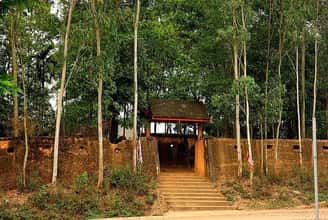
Phon Xuong Fort
Phon Xuong Fort is located in the center of Cau Go town. Here De Tham and the uprising command stayed the longest, directing the strategic and tactical direction of the Yen The insurgent army. Phon Xuong Fort is 30 km west of Bac Giang province; From Bac Giang city, follow National Highway 1A (old) through Thuong River bridge, turn right along Provincial Road 398, Bac Giang-Cau Go route. Phon Xuong Fort, also known as Don Go, Don Cu, is located on the south side of a nearly 20m high hill, nearly 800m south of Go stream. Now this hill is called Phon Xuong hill or Ba Ba hill in Cau Go town. This is a large-scale base with a different structure from Ho Chuoi post and other posts. The fort has an almost rectangular architectural plan running along the North-South direction, with an area of about more than an acre of Northern Vietnam including two citadels. The outer citadel starts from the eastern hillside and runs around the foothill to the northern hilltop, forming an arc that protects the inner citadel, 140m long, 0.80m thick and 4m high. The inner city walls are located on top of a roughly rectangular hill. The inner wall on the east side is 71m long, the north side is 85m long. The wall is made of rammed earth, 2m thick at the base, 3m high and 1m wide on the surface. Inside the wall, there are 3 different levels that can be shot standing or kneeling. There are battlements all around the wall. The outer wall slopes gently like a roof. Phon Xuong Fort has 3 gates: The main gate faces East and two side gates are in the South and North. The two side gates open to the surrounding forests. In particular, the northern gate connects to the forest of the remaining half of the hill. The two 1.50m wide side gates are no longer intact, the main gate is 15m from the north wall, 2m wide with 4 steps up and down. Inside the main gate, there is a guard station located on the northern side of the wall in a square shape of 2m on each side. Inside the main door there are two layers of protective earth walls and many battlements. The gates all have two doors, the outside gate and the inside gate, and are all made of ironwood. The outermost position of the station is the guard posts, followed by the auxiliary posts, the trench system and then the surrounding citadel. The distance between the two rings is 20m at its widest and 10m at its narrowest. Within the citadel is a large space including a system of houses, guest houses, warehouses... all are thatched houses with mud walls mixed with straw. Except for the square house that receives guests, it is built of bricks. From the north to the south of the citadel, respectively, are the houses of Hoang Hoa Tham and Ba Ba, the house has 5 rooms running west and east. The second house is square with four sides left empty and is used as a meeting place for Hoang Hoa Tham with generals and to receive guests. The next house consists of two rows located close to the West and East sides of the citadel, and is the residence of the insurgent army. Next, there are 8 kitchens and stables located close to the southern edge of the citadel running east-west, followed by a light pole and flag pole. The architecture of Phon Xuong Fort is a special architectural style. Not only does it meet the requirements of being a stronghold, it also flexibly handles combat mobility and meets the requirements of being a command post, a place for insurgent transactions. Over time, the rampart system and residential buildings in the citadel built with rammed earth are also easily eroded. Now the residential buildings in the citadel no longer exist, and the citadel walls are no longer intact as before. Particularly, the eastern part of the wall still retains many old architectural features. There are quite clear bullet holes in the citadel wall. In the citadel, a Ba Ba temple is currently built. Every year, on March 16 of the solar calendar, Yen The festival takes place on this relic complex. Around the late 80s of the twentieth century, Mr. Hoang Hoa Tham's daughter, Mrs. Hoang Thi The, came here and when she died, she was buried here, on the tombstone there was only the simple words: "Mrs. Hoang Thi The, born in 1901, died December 9, 1988". It can be said that Phon Xuong was the capital of the uprising, the starting place to expand the movement to localities. Here the insurgents fought bravely against a large-scale attack by the French colonialists led by Colonel Vat-tay on January 29, 1909. With those historical and cultural values, Phon Xuong Fort is one of 23 relics ranked as Special National Monuments in Decision No. 548/QD-TTg dated May 10, 2012 of the Prime Minister. . SOURCE: BAC GIANG PROVINCE ELECTRONIC INFORMATION PORTAL
Bac Ninh
6525 view
Rating : Special national monument
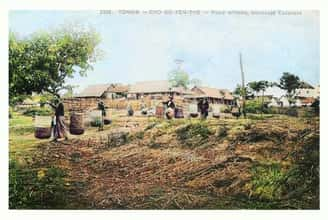
Ho Chuoi Fort
Build a brave and courageous fighting spirit, not afraid of sacrifice, determined to fight to the end to protect your homeland and country. This is the core, most important factor that determines the victory in the Battle of Banana Pit of the Insurgent Army. In particular, in the context of the early years of the Yen The uprising, the Insurgent Army with rudimentary weapons and equipment had to confront the French Expeditionary Force - a professional army equipped with weapons, equipment and supplies. modern means of warfare, so building political and spiritual factors and determination to fight for the Insurgent Army is of decisive significance. Realizing that, De Tham and the leaders of the Insurgent Army educated and fostered a spirit of patriotism and hatred for the enemy in the Insurgents. Accordingly, on the basis of a just war, De Tham taught about the suffering of people losing their country; clearly shows that the cause of suffering is due to the brutality of the invading French empire. Through practice, he showed everyone clearly the hypocritical and hypocritical face of the enemy army; that it was the French army who shot and killed civilians and burned down houses and fields. If you want to save the country and the family, you must rise up to fight the French and his Insurgents swear to kill the enemy to protect the people. That's why the Yen The uprising in general, and the Ho Chuoi battle in particular, the insurgents demonstrated a spirit of courage and strong determination that the enemy did not expect. That was when the enemy fiercely bombarded the station, but the insurgents did not flinch, waiting for the enemy to get very close before opening fire to destroy them, causing the enemy to panic and flee. Even in the third attack (December 22, 1890), the enemy urged European and African troops to use bayonets to attack our fortifications, but the insurgents remained calm, took control of the battle, and rose up to destroy the enemy. leaving them helpless, suffering heavy losses, forcing them to retreat. Not only did De Tham regularly foster patriotism and determination, but when dangerous situations occurred, De Tham also proactively and calmly encouraged the insurgents to fight. Typically, in the battle on January 9, 1891, when Ho Chuoi post was burned by enemy fire, De Tham used the loudspeaker to encourage: "Soldiers in the loyal army, in the indomitable army, in the The army will win. I am very pleased with you! Try to resist. Reinforcements are coming. You are invincible"1. That spiritual medicine promptly encouraged and encouraged the insurgents in the station to calmly, enthusiastically, and resolutely defend, while the forces in the forts, despite the hours-long shelling, still maintained their positions. fight; When the opportunity came (when the enemy infantry was approaching), we all rushed out of the fortifications and fought fiercely, destroying most of the enemy's forces and maintaining the battlefield. Later, researchers all believed that, at Ho Chuoi, the French army faced an opponent with surprisingly high fighting determination.2. Create a dangerous, continuous, solid posture, ensuring smooth defense and attack. Through many battles with the French army, the Insurgents have mastered the rules of operation, combat tactics, and the enemy's strengths and weaknesses. That is, fear of close combat, especially difficulty in maneuvering in difficult terrain; rely on artillery fire and when there are casualties, morale easily declines, etc. Firmly grasping that fatal weakness, the Insurgents Supreme Command advocates creating a solid defensive posture in the Yen The mountainous area. Accordingly, in a low-lying area of the Huu Thuong forest filled with wild bananas, the Insurgents built Ho Chuoi station as a semi-floating, semi-submerged fortification (to limit the enemy's firepower and artillery) as their headquarters. To support the main post, the Insurgents also set up two defensive fortresses (North and South) about 100m away from Ho Chuoi, creating a flexible position to protect and support each other. In addition, De Tham also sent people to set up a system of defense posts around Ho Chuoi, such as: Hom post, Skull Cave, Nua village, Vang village,... a logistics base in Vong Dong with a system of fighting villages (Duong Sat, The Loc, Luoc Ha, Cao Thuong) with many dangerous obstacles. Thanks to a solid posture, the Insurgents were able to detect and attack the enemy from near and far, consuming and destroying many enemy forces before they reached their main target. In particular, at Ho Chuoi, with its unique and dangerous position, the forest became an obstacle to the enemy's firepower and limited vision; If you get close to the base of the fort, you will be shot back from dangerous battlements, etc. The uniqueness of this posture is also shown by the system of submerged trenches (without banks) connecting points together and connecting to Go stream in the rear, creating a flexible maneuver position, while being able to attack the enemy. From the front, you can attack the flanks and rear of their formation. This explains why the enemy gathered large, elite troops, with many modern weapons, attacked from many directions, for many days, but all four attacks were unsuccessful. SOURCE: National Defense Magazine
Bac Ninh
6507 view
Rating : Special national monument
 AI Travelviet