
 vn
vn en
en ja
ja ko
ko zh
zh













List of relic sites (54)

Dinh Dao Fan
Dao Fan Communal House is located on a high, airy area of land in the middle of Dao Fan village, Bai Say commune. In the past, the people of Dao Fan village were famous for their fan making profession and they were very proud of their village's traditional communal house. According to legend, Dao Fan communal house is a place to worship Dao Cong Chi, a martial general of the Ly Dynasty who helped fight the Champa invaders in the early 11th century, bringing a peaceful and prosperous life to the people. When he died, King Ly deeply pitied his talented general, ordered his officials to perform a eulogy, awarded him a lot of gold and silver to make incense, set up a temple and proclaimed him Great King. He was worshiped by local people as the village tutelary god. Legend has it that Dao Fan communal house was built after the death of general Dao Cong Chi, and was initially just a small temple. During the Later Le Dynasty, people carried out renovations. During the Nguyen Dynasty, the communal house was restored on a large scale. Currently, the communal house has a Cong-style architecture including 05 Tien Tien spaces, with a husband and wife fighting lotus style architecture. The center has 03 rooms, the sets are arranged in the style of stacking gongs and gongs. The harem has 03 rooms, the structure is simple in the form of stacked beams. On the pillars, the system of intricately and intricately carved motifs of four sacred animals and dragons... The communal house also preserves many valuable artifacts such as: 18 ordinations from the Le to Nguyen dynasties. , stone stele dated 1758, stone altar, 03 lotus stones of the Le Dynasty with 09 very vividly stylized lotus petals. Every year, on the 10th day of the first lunar month, the people organize a solemn festival to commemorate the death of the general. In the past, during the festival, there were sacrifices, palanquin processions, thrones and statues of gods, color processions, and military drum singing. Today, the festival is organized simply but still ensures traditional cultural rituals. With typical architectural values, Dao Fan communal house has been ranked as an "Architecture - Art" relic by the Ministry of Culture and Information issued Decision No. ” National level. Source Electronic information portal of An Thi district, Hung Yen province.
Hung Yen
6117 view
Rating : National monument.
Thuong Dao Xa Communal House
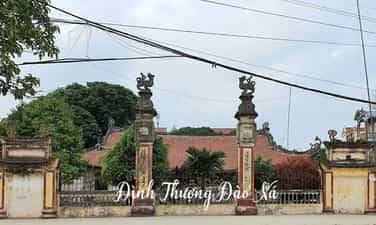
Dao Xa Communal House was built on a high, open area of land in the north of Dao Xa village, Dao Duong commune. This land was explored and developed by the Dao family from the beginning. The communal house's facade faces south. Dao Xa Communal House worships Linh Lang Dai Vuong, the son of King Ly Thanh Tong. He had the merit of leading the army with his generals to repel the invaders, keep the land in peace, and protect the peaceful life of the people. When he died, he was worshiped by people in many places, including Dao Xa village, which honored him as the village's Tutelary God. The communal house was built in the Later Le Dynasty, restored during the Nguyen Dynasty with a Dinh-style structure including Dai Bai with 05 compartments and 02 compartments and the Hau Palace with 04 compartments. The ministries are doing it like stacking the mats and fighting cocks. At the communal house, many panels and structures carved with patterns of the Late Le Dynasty are still preserved, such as: dragons, red heads, fire swords, etc., demonstrating the high level of ancient artisans with their details. extremely unique and sophisticated. The communal house also preserves a number of very valuable artifacts and worship items such as: 01 Le Dynasty tribute bowl palanquin, altar throne, parallel sentences, bronze top, porcelain incense bowl. Every year, on March 10 and October 10 of the lunar calendar, villagers organize festivals to commemorate the merits of the god who saved the country and helped the people. Dao Xa communal house was ranked by the Ministry of Culture and Information as Decision No. 22/1999-Decision - Ministry of Culture and Information as a National "Artistic Architecture" relic on April 6, 1999. Source Electronic information portal of An Thi district, Hung Yen province.
Hung Yen
5639 view
Rating : National monument.

Dinh Danh Xa
Danh Xa Communal House was built southwest on high, open land in the middle of Danh Xa village, Hoang Hoa Tham commune. According to the villagers' legend, the communal house was built on the land of "Dragon's adoration", so Danh Xa village from ancient times to present has always had many famous and successful people. The temple worships the Five Great Kings including: Cao Son Hieu Cong Dai Vuong, Cao Son Huu Cong Dai Vuong, Quy Cong Dai Vuong, Minh Cong Dai Vuong and Uy Cong Dai Vuong. You have contributed to helping Thuc An Duong Vuong defeat the enemy and save the country, bringing a prosperous and peaceful life to the people. During the historical period of the Revolution, many important events took place here such as propagating the Revolutionary policy among the masses. In 1948, the main army was stationed and operated here. The communal house was built during the 12th Nguyen dynasty, Thanh Thai reign (1900) with Cong-style architecture including: 05 Dai Bai spaces, 03 Ong Morning glory spaces and 03 Hau palace spaces. The system of sets has a lotus-shaped structure. The carvings are concentrated mainly in the central hall of Dai Bai with folk themes such as: four sacred animals, four precious animals, dragon pants... The communal house also preserves a number of precious artifacts such as: The royal palanquin of the Nguyen Dynasty is painted in red and gilded with delicate carvings of dragons, phoenixes, great characters, parallel sentences... Every year, on the 10th day of the third lunar month, local people organize a festival to commemorate people who have contributed to their homeland and country. With its existing values, Danh Xa communal house was ranked by the Ministry of Culture and Information as a National "Artistic Architecture" relic on April 6, 1999 according to Decision No. 22/1999 - Decision No. -Ministry of Culture and Information. Source Electronic information portal of An Thi district, Hung Yen province.
Hung Yen
5903 view
Rating : National monument.

HAI THUONG LAN ONG RECONSTRUCTION AREA
The relic site is located in Lieu Xa village, Lieu Xa commune, Yen My district, related to Hai Thuong Lan Mr. Le Huu Trac - Great Vietnamese physician. He was born in 1720 and died in 1791, from Lieu Xa. He was a great physician, poet, excellent writer, and a progressive thinker deeply imbued with a humanitarian spirit. After his death, the people and medical community throughout the country revered him as the Medical Saint of Vietnam. Hai Thuong Lan Ong Le Huu Trac (1720-1791), a native of Lieu Xa village, Duong Hao district, Thuong Hong district, Hai Duong region (now Lieu Xa village, Lieu Xa commune, Yen My district, Hung Yen province). He named himself Hai Thuong Lan Ong, and did not care about fame, fortune, or wealth. He became a physician, a famous physician in Vietnamese history. The life of Hai Thuong Lan Ong is an eloquent example of medical ethics without the need for loud explanations or too much theory. He is the person who laid the foundation for building medical techniques, a shining star in the village of Vietnamese Traditional Medicine, who left behind a treasure trove of experience in Traditional Medicine, not only in medicine but also in practice. farewell to practice. During his 40 years in the medical profession, he put all his heart and soul into treating diseases and serving the people, upholding human ethics, dedication, diligence in researching, compiling, teaching and summarizing experience. Build the country's medical tradition. He was also a talented scientist, a prominent poet of the 18th century, and a cultural figure with great humanistic ideas. During his life as a physician, he left behind a huge and valuable set of books, the "Hai Thuong Lan Ong Y Tong Tam Linh" series, consisting of 28 volumes and 66 volumes. In 1791, he passed away in Nghe Tinh, the "bright star in the medical sky" disappeared, but his shining example remained forever in the sky. After his death, the family's descendants and villagers built a memorial house for Hai Thuong Lan Ong Le Huu Trac. Initially, the scale was quite small, and in 1992, the Ministry of Culture and Information together with the Ministry of Health provided funding to restore and expand into the Memorial House. Visitors will see that this is not only a place of worship but also a place to showcase his personal history and career as well as many of his typical medical works. With an area of 200m2 displayed on a campus of 1000m2, there are many surrounding relics creating a large relic complex. In the middle of the memorial house is an altar with couplets praising him. In 2006, the memorial area was restored and embellished, in which the memorial house was rebuilt into the main temple area. In 1990, the memorial relic of the great physician Hai Thuong Lan Ong was ranked at the National level by the Ministry of Culture and Information. Every year on the full moon day of the first month, people, Oriental medicine practitioners and physicians gather here to remember and honor the great medical ethics of Le Huu Trac. This place has become a spiritual destination for many tourists from all over who come to enjoy the spring at the beginning of the year and burn incense to pray for a new year of good health, luck, and success in life. What makes it attractive is not only the landscape but also this is a place for posterity to look back and learn about the ethics and medical skills of the great physician. Source Electronic information portal of Yen My district, Hung Yen province.
Hung Yen
5735 view
Rating : National monument.
Trieu Da Communal House
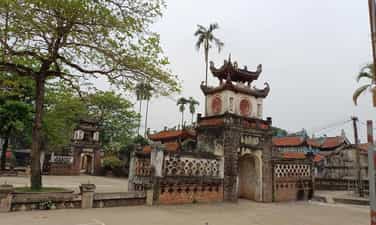
Temple worshiping Trieu Da (during the reign of Emperor Trieu Vu), village 10, Xuan Quan commune, Van Giang district. The communal house was built a long time ago and restored during the Nguyen Dynasty in the 24th year of Tu Duc (1871). Currently, artifacts such as palanquins, stone stele, thrones, and worship statues are still preserved. The annual festival is from the 14th to 16th of the second lunar month. Trieu Da Communal House, Xuan Quan Commune, Van Giang District, Hung Yen Province, was called "Nam Viet Linh Tu". It was not until Ly Anh Tong's reign that it was renamed Long Hung Communal House. Trieu Da communal house has bold architectural features of the 17th - 18th centuries. The communal house's grounds are spacious and airy with an area of about 13,000 square meters. The communal house was built in a foreign domestic style, with construction items located on a straight road stretching from the communal house gate to the harem. The main items of the relic include: the outer gate, Nghi Mon, the great altar, the lower harem, the upper harem and two rows of Giai Vu. The front porch faces South, which is the direction of wisdom and life. The Nghi Mon gate at Trieu Da communal house is completely different from the Nghi Mon gate of many other relics. The ritual gate is made in the style of a two-story, eight-roofed pile of matches, the blades are covered with dragon heads and monkey heads raised high, the roof is tiled, and the banks are flanked by two dragons flanking the Buddha. The neck of the match is emblazoned with three Chinese characters: "Long Hung Dien" (Long Hung Palace). Nghi Mon's architectural structure is in the form of a pile of lotus mats, smooth planing, and sharp edges. The two sides next to it are placed two statues of Tuc Ve (gate guards), statues created in the solemn upright posture of a guard. On both sides of Nghi Mon, there are two side gates made in the style of two floors and eight roofs. Inside the side gate is a small road leading to the inner temple area. Trieu Da Communal House built a main gate and two side gates like today. It is possible that in the past, kings and mandarins in the court often came here to worship and pray for the blessing of the island. Passing through the yard is the inner temple area. The first building is the great worship hall with 3 compartments and 2 floors built in a double-match style with 2 floors and 8 roofs. The dragon-head-shaped blades are raised high. At the top of the roof, there are two numbers flanking the monstrance in the middle of the roof. The great altar is made in a pine style, the two gables are closed, the bottom and back are left blank, creating ventilation for the monument. The altars are structured in the style of stacking lotus beams, the beams and 7 heads are all carved with stylized flowers and leaves. In the middle of the great altar is an incense altar for communal worship. The incense altar is made of wood and carved with four sacred animals and four precious animals. On the incense table are placed worshiping objects such as: incense bowl, copper top set, pair of water hyacinths... Trieu Da's rear palace consists of three rooms and two dishes, with a tiled roof. In the middle space, on the summer side, the porch is built forward to form a space. This space is made of four pillars with two floors and eight roofs. This is the place where the bowl of worship is placed. On both sides of the porch are two statues of Tuc Ve (gate guards). The statues pose in an upright position with a solemn face. Separating between the porch and the inside is a system of tables, each door is engraved with a theme such as: phoenix riding clouds, dragon horse rolling clouds... very sophisticated in the artistic style of the Nguyen Dynasty. The structure of the lower bow sets is a simple gong stand style, smoothed and sharpened. Supporting the roof is a system of two rows of main columns and two rows of military columns. In the center of the nave is the altar, above which is the throne containing the throne of the Village's Thanh Hoang Trieu Vu De. The throne and tablet are 2.1m high; 0.73m long; 0.7m deep. The throne's base is shaped like a fish-wound kneeling leg with a tiger-shaped face. Tablets; The other part is shaped like a fireball, inside the station are 6 dragons curled up; The body is decorated with four sacred lines, shaped like a fire knife; On the body of the tablet is engraved a text in Chinese characters praising the god's merits. In addition, the table is also decorated with a number of worship items such as: candlesticks, candlesticks, ... especially an ancient tamarind-colored incense bowl with a diameter of 0.3m; 0.32m high, decorated with water and mountain patterns, on both sides of the altar are two 1.76m high Eunuch statues; shoulder height 0.5m. The statue is in an upright position. On both sides of the lower palace are altars; The space on the left worships Trieu Da's children and grandchildren; The room on the right worships the queen and two princesses, Truong Trang and the second princess. Connected to the lower palace are three upper palace rooms with an architectural structure of rafters, smooth and sharp. The engravings in this building are concentrated mainly on the front door with themes: stylized flowers and leaves, two dragons flanking the moon, fire swords, phoenix holding a lotus flower..., carved very skillfully by the artist. passionate and full of creativity. In addition, on both sides of the inner temple there are two rows of banh vu, each row has 10 rooms, simple structure, used as a place to receive guests and meet. The communal house is ranked "Artistic Architecture" according to Decision No. 49/2007/Decision - Ministry of Culture and Sports, dated August 3, 2007. Source Electronic information portal of Van Giang district, Hung Yen province
Hung Yen
4182 view
Rating : National monument.

Comrade Le Van Luong Memorial House
Comrade Le Van Luong - an excellent student of President Ho Chi Minh, the first generation of party members of the Communist Party of Vietnam, with 83 years of life, nearly 70 years of continuous revolutionary activities, he has made important contributions to the victory of the Vietnamese revolutionary cause. In recognition of those great merits and contributions, comrade Le Van Luong was awarded many noble titles by the Party and State: Gold Star Medal, 50-year Party badge and many noble orders and medals. other. Comrade Le Van Luong Memorial House was built in 2003 in Nghia Tru commune, Van Giang district, Hung Yen province. This is a project built by the Provincial Party Committee, People's Council, People's Committee of Hung Yen province and descendants of the Nguyen family to remember the comrade's great contributions and contributions to the Vietnamese revolution. This is also a place to display documents and images as well as worship comrade Le Van Luong - a typical senior leader of the Party, of the revolution, an outstanding son of the Vietnamese people. The memorial house has a Dinh (丁) character structure, including two altar buildings, a harem and other items such as: gate, reception house, Nguyen family church, stele building... The architectural items are Made in the traditional style and still relatively consistent. The altar is the place to display and introduce nearly 100 documents, images, and artifacts typical of comrade Le Van Luong's background, life, revolutionary career, and great contributions to his homeland. country. Connected to the Tieu Te is a Harem pavilion with simple architecture like a hitchhiking bridge truss with no decorative patterns. The harem is the most sacred and solemn place where the altar to worship comrade Le Van Luong is placed. On the altar is placed a statue of comrade Le Van Luong's portrait cast by Prime Minister Phan Van Khai on the occasion of the inauguration of the 1996 memorial house. 2003 shows the Party and State's concern for comrades. On the same campus as Comrade Le Van Luong Memorial House is the Nguyen family church built by Comrade Nguyen Thi Bich Thuan (comrade Le Van Luong's wife) in 2005. The church is simple but solemn, on the altar is placed The throne and tablet are titled "Nguyen family Liet To". Next to the Nguyen family church is a stele building built in a four-pillar style with four twisted curved roofs buried in spirals. Inside is a stone stele engraved with words praising the merits and steadfast heart for the Party and people of comrade Le Van Luong and his wife Nguyen Thi Bich Thuan. Every year, the death anniversary of comrade Le Van Luong is organized by the local government and family descendants on the 26th day of the third lunar month (comrade's death anniversary). This is also an opportunity for everyone to gather together to remember the gratitude of our predecessors who sacrificed for the independence, freedom, and happiness of our children and grandchildren today and tomorrow. To honor the great contributions of comrade Le Van Luong to the revolutionary cause of the Party and the nation, while affirming the cultural and historical value of the Comrade Le Van Luong Memorial House, Ministry of Culture , Sports and Tourism issued Decision No. 673/Decision - Ministry of Culture, Sports and Tourism on March 24, 2022, recognizing the ranking of Comrade Le Van Luong's memorial site as a "Historic Relic" National level family./. Source: Department of Culture, Sports and Tourism.
Hung Yen
4406 view
Rating : National monument.
Da Nguu Village Communal House
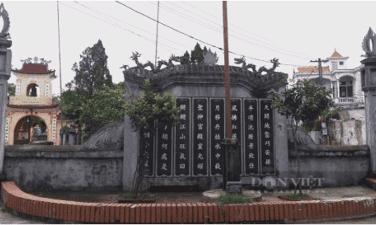
Da Nguu communal house in Da Nguu village, Tan Tien commune, Van Giang district (Hung Yen) said that, based on the vestiges of Ba Chua's mausoleum as well as the ordination of dynasties (including the ordination of King Quang Trung in the past Da Nguu communal house was built very early in 1520, two brothers, Cong Ca and Cong Hai, organized the construction of the communal house. When starting the construction, the village elders bought 101 ironwood trees using 100 ironwood trees as pillars, 1 split tree as a chisel handle and not using any iron nails. There are few communal houses or temples in the Northern Delta region that have a porch structure surrounded by columns Da Nguu communal house. According to the legend of the ancients: "Da Nguu is like a crouching ox, seventy-two stars" (meaning: "Da Nguu village has the shape of a lying buffalo, there are 72 earth gods"), in the middle of the village there is high terrain That beautiful, airy communal house was built with 100 columns. The communal house consists of 3 buildings: the front porch, the middle court and the back palace. The front of the communal house looks to the Northwest and has many large carved paintings The second court has rows of hammock doors carved with magnificent dragons and phoenixes and the great inscription "Long live the Holy Palace". The gilded, mother-of-pearl mosaics are hung on the columns and in front of the altar praising the merits of the three deities worshiped in the harem: Chu Dong Tu, Tien Dung and Princess Hong Van. In front and behind the communal house, there are two Ngoc wells planted with lotus. On summer days, lotus scent is fragrant. On the annual village festival (from the 10th to the 12th day of the second lunar month), the elders often hold a bathing ceremony for the thrones in the shrines at the two Ngoc wells. To the east of the communal house is the old man's house - a place to worship those who have contributed to the country, to the west is Khanh Van Tu. The ritual gate of Da Nguu communal house was built in the traditional style of communal houses and temples in the Northern Delta, including 4 pillars forming three gates. The pillar is built of bricks. The two pillars in the middle are tall and big; The two pillars on both sides are small and low. All four pillars have a top decorated with four phoenixes, the upper body of the pillar is decorated with lanterns, the middle is a box decorated with parallel sentences, and the base is tied in the form of a puffy neck. Between the two tall pillars is the main gate to the communal house. On both sides of the main gate are two side gates, above which there is a roof, in the form of 4 roofs. There is a wall surrounding the communal house. The communal house's yard is 20m wide, 32m long, paved with Bat Trang tiles. In the middle of the yard there is a path made of paved bricks that is higher than the surrounding yard. On the left side of the yard there is a Ta Vu court, where the offerings are placed. The Great Hall consists of two buildings: the Pre-District and the Main Hall, placed parallel to each other. The hall is 20m long, 7.7m wide, includes 5 compartments, 4 roofs, and a 1.4m wide corridor surrounding 3 sides. The electricity hall has the structure of a communal house. The middle space has a low floor called the boat's heart room, which is the place for ceremonies. The 4 compartments on both sides have high floors and are meeting places. The front hall has 40 columns, the main column is 4.2m high, 0.45m wide in diameter, the military column is 3.1m high, 0.35m wide in diameter. It is the column system arranged along the corridor that makes the communal house have more columns than other traditional communal houses. The front and both gables of the front hall have 2.25m high wooden doors with bars on top. Da Nguu Communal House is also a witness of historical events. Pho Duc Chinh (1907 - 1930) - one of the leaders of the Vietnam Nationalist Party, brought his organization here to build a base to prepare to fight against the French. In 1929 - 1930, Da Nguu communal house was the place where meetings took place to listen to Viet Minh cadres propagandize about the Russian October Revolution... With great values in cultural history and architecture, Da Nguu communal house was Ranked as a national monument since 1995. Source Electronic information portal of Van Giang district, Hung Yen province.
Hung Yen
4002 view
Rating : National monument.

Me So Pagoda.
Me So Pagoda is located in Me So village, Me So commune, Van Giang district, Hung Yen province. The pagoda belongs to the Northern sect. Me So Pagoda is located next to the Red River dyke, in the middle of a rich countryside that has long been famous for its thousand-eyed, thousand-armed Quan Am statue. The pagoda was built in the Later Le Dynasty and has been repaired many times. The remaining vestiges were mainly restored at the end of the 19th century. Only the thousand-eyed, thousand-armed Guan Yin statue remains relatively intact. Guan Yin or Avalokiteśvara means to hear the cries of suffering of living beings in life to save them. Guanyin can manifest into thousands of different forms to adapt to every situation to save every case of suffering. With boundless magical power and power, and absolute wisdom with thousands of hands and eyes, he saved all. The statue was created in a meditating position and is quite large in size. From the crown to the seat is 1.4m high, the pedestal is 0.53m high, the lotus flower is 0.23m high, with an elegant, pure face and slim body, creating a beautiful statue in both content and form. show. The statue has two main pairs of hands, the first pair clasped in front of the chest, bearing the "standard de" seal, the other pair of hands raised above to support the lotus stems and small Buddha statue. The large hands are more or less soft and flexible, the arms are round, the bare soles are clasped at the sides in different high and low positions. The opening of the arms is high enough without obscuring the statue. Right behind the big arm is a system of small arms with hundreds of arms and eyes formed into 10 layers growing in symmetrical pairs. These ten layers of hands and eyes are divided into 3 large parts, creating the feeling of a halo radiating from the statue's head. Above the statue's head, the halo is embossed with a cloud shape with small arms intertwined like bird wings in a flying position. This bird avoids the "ungainly" halo of the image, arousing the viewer's curiosity about Buddhism. The small hands of the statue are shown with long, slender arms, the eyes are placed in the palm of the hand to form the nectar seal, these arms vary in length according to the degree of opening gradually taking the statue's head as the center, making them as having a combined function to form an aura... Together with the lotus base and pedestal, all create a complete statue with meticulously skilled lines. The contemporary concept of beauty has been conveyed by artists into the statue with elegant, benevolent lines for the face and figure. This is one of the wooden statues that represent Vietnamese fine arts of the late 18th and early 19th centuries. The thousand-eyed, thousand-armed Guan Yin statue at Me So Pagoda is the pride of Vietnamese statue sculpture, bringing many creative features while still reflecting the compassionate spirit of Buddhism and the soul of Vietnam. Me So Pagoda was ranked as a national architectural and artistic relic by the Ministry of Culture and Information on November 16, 1988. Source Electronic information portal of Van Giang district, Hung Yen province.
Hung Yen
4277 view
Rating : National monument.
Dinh Dau and Ngo Temple
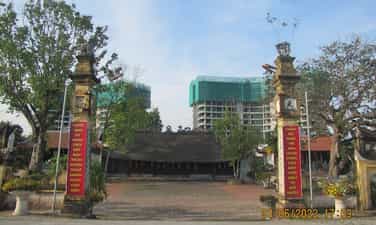
Ngo Temple worships Hai Ba Trung, the first Vietnamese woman to raise the flag of insurrection to drive invaders out of the country and regain independence for the country. The temple was built by our ancestors right at the beginning of the village in a spacious campus, open to all four winds, with a harmonious, solemn and magnificent landscape. The front of the temple has a semicircular lotus pond, printed with a large screen with scroll shapes shaped like flags, swords, dragons, cups, and phoenixes. In front of the temple gate are two large, tall square pillars engraved with two lines of parallel sentences: - Phong District's veteran veteran is majestic and clear in the North. - The incense garden preserves the eternal relics of Tran Nam Bang. The idea is: (The victory of the Chau Phong insurgent army resounded to heaven and earth The fragrance of the two ladies is famous forever.) Next are two floors of statues, in which are carved images of a pair of war elephants - Two Ladies riding elephants into battle. Inside the Temple, there are horizontal panels, couplets, tablets, sacrificial objects... all painted in red and gilded, overwhelming the colors. The harem has two ancient altar thrones and statues of the Two Kings and Ladies sitting in the large coffin. The statue is about one meter high, with exquisite and unique sculpted lines. With a forward posture, the statue's two arms are raised to eye level, a sign of the word Trang Khoat, seducing the three armies, holding the mountains and rivers firmly. The statue of the Two Ladies is resplendent in pink attire, radiating a halo of shimmering candle lights. Ngo Temple still retains 18 ordinations passed through dynasties since the reign of Le Canh Hung. Those are extremely valuable documents. In August 1945, Ngo Temple was the place where a large rally took place after the Van Giang district government was seized, declaring the end of the old regime and the new government returning to the people. Many years have passed, after many restorations and embellishments, Ngo temple still retains its ancient appearance. In 1989, the Ministry of Culture recognized Ngo Temple as a national historical-cultural relic, protected by the State. The historical site of Ngo Temple is forever associated with the historical sites of Dong Chau, Gieng Da, and Bai Yen. Those places marked great feats of a historical period, recognizing the efforts of the Phung Cong people who followed the Hai Ba Trung uprising. Dinh Dau was built at the same time as Ngo Temple and worshiped Hai Ba Trung - National Heroes. Dinh Dau is big, beautiful, windy, rural, ancient, mossy, filled with colors over the years. The gate of the communal house is hung with hanging lanterns and two rows of parallel sentences reminding posterity to cherish order. The pavilion curves upward toward the three mountains in the style of four sacred animals adoring the moon, covering the pre-ceremony and harem areas. The middle of the ceremony area is filled with incense burners, has a crane top, an incense burner... Above is hung a gilded hammock door. Four large horizontal panels spread across the pavilion, bearing 4 lines of text: Thanh Vuong Palace Eternal heroic spirit Thang Long determines the peak Righteousness and light All have summarized the sacred and respectful appearance of the communal house. On both sides of the ceremony area are two majestic and solemn rows of Eight Treasures and golden swords. The harem has statues of the Two Kings carved from precious stones following the national model at Dong Nhan temple - Hanoi. Around the communal house, there are many ancient trees that are hundreds of years old, providing shade and the quiet communal house marks the mark of time. In the early years of peace and the years of resistance against America, Dau Communal House was the venue for many commune-level Party Congresses and many important conferences of Van Giang district. In 1970, also at Dinh Dau, the Ministry of Health of the Democratic Republic of Vietnam organized a conference of medical leaders in the entire North, chaired by Minister Pham Ngoc Thach, to decide on major medical policies during the period. period of building socialism and fighting against America to save the country. Dinh Dau had 18 conferments throughout the dynasties and also began in the Le Dynasty. In 1989, the Ministry of Culture issued a ranking certificate recognizing Dau communal house as a national historical and cultural relic. Source Electronic information portal of Van Giang district, Hung Yen province.
Hung Yen
4177 view
Rating : National monument.
Phu Thi Pagoda (Hung Phuc Tu)
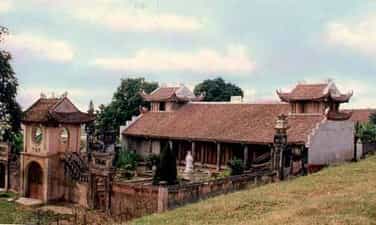
Phu Thi Pagoda is located on a large campus, outside and close to the foot of the Red River dyke, in Me So commune, Van Giang district, Hung Yen province. The pagoda was built in the style of the character "Dinh" (丁), the door faces southwest and has the Chinese name Hung Phuc Tu. The pagoda was built during the Later Le period and followed the Northern sect. The pagoda has been restored many times and the most recent time was in 1991. When entering the pagoda, visitors will first go through the three gates - the gate outside the pagoda. From the outside, the three-entrance gate looks like three separate structures with three doors. The middle door is tall, built on two floors, and has a square floor plan. The upper and lower floors are equal. On the roof of the second floor is a tiled roof with four blades radiating out in four directions. On the left and right sides are two small symmetrical doors. Right behind these two small doors are steps leading to the second floor of the middle door. Passing through the three gates is the front hall (Upper Palace). Looking from the outside, the front street is built in a matchmaking style with two bell towers and drums on the roof top. The temple bell (Dai Hong Chung) was cast during the reign of King Minh Mang. Inside, visitors will see the front hall consisting of five rooms with large and airy space. Four rows of lim columns are regularly distributed in the middle of the front hall. On the central crossbeam of the front hall is a hammock embossed with the image of two dragons flanking a moon and painted with gilded vermilion. Adjacent to the inner wall are 6 statues: the statue of Khuyen Thien, the statue of Trung Evil, the statue of two holy monks, and the statue of two attendants. These statues add to the majesty of the front hall. Besides, the pagoda has many ancient statues made of wood or painted terracotta, such as Chuan De statue, Ksitigarbha statue (1.08m high); set of statues of Thap Dien Minh Vuong (0.90m high), statue of Anathapindika (1.07m high). The pagoda has been recognized by the Ministry of Culture and Information as a national historical and cultural relic. According to Decision No. 14 dated April 4, 1984. Source Electronic information portal of Van Giang district, Hung Yen province.
Hung Yen
4292 view
Rating : National monument.

Plum Village Communal House
Mai Vien communal house is located in Mai Vien village, Song Mai commune - a commune with a large area, dense population and development in many economic and social fields of Kim Dong district. Mai Vien is understood in that "Mai" village is as beautiful as an apricot garden, "Vien" village has many officials and employees. According to legends and ordinations and legends among the people, Mai Vien village communal house was built quite early in the Later Le dynasty on a small scale. The communal house is located on a high, airy mound with beautiful scenery, convenient for the people's cultural and religious activities. The facade faces Southeast, in front of the communal house is an ancient banyan tree with a water well dating back hundreds of years. The courtyard of the communal house is covered with cool canopy of almond and longan trees. Looking at the entire exterior, we feel a sense of majesty and respect because of the massive and ancient appearance of the village communal house. Mai Vien communal house relic was built in the style of the letter I (cong letter) but lost the harem and 2 tea houses. Now the remains are a massive pre-worship house that has just been repaired by the people, the roof is covered with flat tiles, the gables on both sides of the communal house are covered with two pliers crowned with unicorns. Stretching the roof, the artist embossed a pair of dragons flanking the moon, bending into 3 healthy and majestic sections. The architecture of Mai Vien communal house is tall and imposing, the structure of the roof trusses from the top to the roof is in the style of overlapping beams, the system of horizontal supporting beds is embossed with stylized leaf shapes. Due to historical and social upheavals, communal house architecture was no longer consistent and had to be renovated many times during the Nguyen Dynasty, so the architectural art bears strong Nguyen Dynasty characteristics. Like other communal houses in other communes, Mai Vien communal house is considered both a headquarters for people to meet and discuss village affairs as well as a place to worship the emperor. According to the ordination and legend, the communal house worships 5 village tutelary gods and 3 holy ancestors such as: Trung Thanh Dai Vuong, Linh Lang Dai Vuong, Cao Mang Dai Vuong, Dong Vinh Dai Vuong and the tutelary god who had meritorious services to the people. , taught villagers how to burn lime, make bricks, and become masons. During the resistance war against the French, Mai Vien communal house was a gathering place for veteran revolutionary comrades. In 1942, the revolutionary movement developed, revolutionary cadres came here to create a base. The communal house is also where the base district soldiers are stationed, printing resistance documents and digging secret tunnels in the rear to protect the guerrilla soldiers. During the years of anti-American resistance, the base was still facing difficulties. Song Mai Commune People's Committee temporarily borrowed Mai Vien Communal House to hold meetings here. It was not until 1988 that it was paid to the village. Today, Mai Vien communal house still preserves precious artifacts of historical and cultural value such as: at the communal house there is currently a throne worshiped by the Nguyen Dynasty, 3 incense bowls of the Nguyen Dynasty, 2 color boxes, 1 wishing shelf with 27 colors. styled through dynasties, resonators, wooden pedestals and some other late-dating altar items, 2 bronze tops, 2 pairs of bronze candles, 1 pair of water hyacinths. In 1998, Mai Vien communal house was recognized by the state as a national historical relic. Local people not only consider this a center for cultural and religious activities, but also a place for people to organize and review ancestral traditions, fine customs and community lifestyle. Through this, there is cultural exchange between regions and between members of the same community to create bonds of compassion and neighborliness. The communal house is the pride of the people in the village. Source Electronic information portal of Kim Dong district, Hung Yen province.
Hung Yen
4483 view
Rating : National monument.
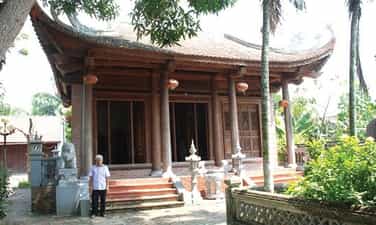
Ba Chua Mua Temple
Lady Mia (1580 - 1648) Her real name is Tran Thi Cu, born on May 5, Canh Thin year (1580) in Mua village, Thien Thi canton, former Khoai Chau district, now in Cong Vu village, Vu Xa commune, Kim Dong district, Hung Yen province. Legend has it that one day, Lord Trinh Trang's chariot passed through this area, bustling with thrones and palanquins, flags filling the sky, trumpets and drums resounding, and villagers excitedly went to see. A girl cutting grass next to the main road still wore it as if she didn't know anything. When the palanquin passed, she did not look up, her hands quickly pulled the sickle to gather grass, her mouth sang softly and clearly: The hand holds the half-moon One hundred herbs are in my hands The soldiers were surprised, the singing became louder and the palanquin slowly stopped. God raised the curtain and saw a girl with stunning beauty. She responded intelligently, knowing that this was a strange woman. God ordered her to be brought back to Thang Long capital, then given her national status and changed her name to Trinh Thi Ngoc Am. She helped the lord oversee the studies in the palace of the concubines and beauties, strengthening the solidarity between the lord and the Le court. She gave birth to a daughter, Trinh Thi Minh, who was given 4 gold plates and 1 silver plate by God. Not long after, Princess Thuy Minh passed away. She was so sad that she asked to become a monk at the village temple. The Lord loved his talented wife very much, so he opened a branch river from the Cuu An River to run through the Silk village to transport precious items to build the tower. Every day, she went up to the tower to pray for the lord's palace in Thang Long. She spent money to help people clear the land and open rivers to bring water to the fields. She is rich in virtue and helps people and prays to Buddha to bless the people. She herself asked to establish and repair pagodas around the area and popularize Buddhist offerings. Not only did she make a great contribution to restoring the pagoda, but she also spent money with the people of 13 villages to build communal houses. Ms. Trinh Thi Ngoc Am died at the age of 68, people worshiped her as a god and built a temple right in her hometown. Mua Temple was built in the 17th century and restored during the Nguyen Dynasty. The architecture is in the style of the letter "Nhi". The Tam Quan gate is quite massive, with two rows of parallel sentences: Talent and beauty are everywhere in the lord's palace Complete love for the homeland Next to it is a small office building with a green stone statue, with a pot-bellied figure worshiped by an incense bowl also made of green stone touching the kneeling feet, with three ears and a tiger face. In front of the temple door is a stele erected in 1634 with the inscription: Princess Mua Trinh Thi Ngoc Am, the first concubine of Lord Trinh Trang's palace. The second stele erected in 1650 recognized her contributions to the villagers in building pagodas, communal houses, temples, shrines... In the center of the main hall, there is a stone incense burner, carved into three reliefs: the middle one is embossed with a clear image, the two sides are carved with "Dragon water", the surrounding is carved with a stylized water wave pattern, carrying the style of the temple. Later Le distance. On the two pillars of the great altar, there are two parallel lines praising her virtues: Highly talented, dignified, and powerful in controlling the mountains and rivers Accumulating virtue as a monk, the lord also devotes himself to Buddhism The harem has a statue of Princess Mua. In 1634, Lord Trinh Trang had a statue of her carved in stone while she was alive. The life-sized statue sits on a lotus throne, with a crown on its head, embossed with the image of Buddha Tathagata, large flowers in its ears, and legs folded like a person meditating. In front of the princess statue is a stone statue of the Duke, sitting cross-legged and wearing a robe. The two temples on both sides worship statues of Thi Ve and Kim Dong worshiping the princess, their bodies embossed with folded clothes. Behind the harem is a nine-grade lotus court, with a lotus flower base and a statue of the princess in her old age. On June 8, 1963, while working on irrigation for the Ngang Cau River, the citizen dug up 4 gold plates and 1 silver plate from Lord Trinh Trang as a reward for his daughter. At the bottom of one plate was an inscription. "Princess Thuy Minh, golden princess, eight-star princess" (my father's silver cup given to me, Princess Thuy Minh). From the above values, Ba Chua Mua Temple was ranked by the Ministry of Culture and Information as a National "Art" relic No. 2233-Decision/Ministry of Culture and Sports on June 26, 1995. In particular, on December 31, 2020, the Prime Minister issued Decision No. 2283/Quyet Dinh - Prime Minister, recognizing the collection of Cong Vu lotus gold plates (Mua temple, Vu Xa commune) dating back to the century XI – XII are National Treasures. Source Electronic information portal of Kim Dong district, Hung Yen province.
Hung Yen
3161 view
Rating : National monument.

Dao Xa Temple
Dao Xa village together with two villages Ngo Xa and Vinh Hau form Vinh Xa commune. Dao Xa is a large village with communal houses, pagodas, shrines, temples run by Buddhist residents and a Catholic church. Dao Xa Temple, formerly known as Suong Thien Temple or Tam Giao Dong, was built at the beginning of the village on a high, airy plot of land in the first decade of the 19th century. According to the elders in the village, around 1896, Mr. Tu, in charge of incense lamps, went to Bach Ma temple in Phu Xuyen district, former Ha Dong province to ask for a temple name to worship, naming the temple Suong Thien. Since then, people in the area have come here to worship, pray for good fortune, and ask for herbal medicine to treat their illnesses. The temple was built according to the sculptural architecture of the Nguyen Dynasty, with concrete arches and foreign internal structures. By 1929, people again contributed their efforts and money to renovate the temple to make it more grand and spacious. When the Three Saints Association was born, the temple worshiped Buddha - Immortals - Saints, three religious ancestors and worshiped national heroes who had the merit of leading troops against foreign invaders such as Tran Hung Dao and Pham Ngu Lao. The name of Suong Thien temple or Tam Giac Dong represents ideas and wishes about good things and actions according to good things. Later, the name of the temple was called after the name of the village: Dao Xa Temple. The word Dao is the name of a family whose people came to explore this land the earliest and was also the most prosperous family at that time. During the period 1939 - 1945, our Party campaigned for revolutionary struggle amid the terror and fierce search of the colonial government. Dao Xa Temple was one of the facilities to hide documents of the Hung Yen Party Committee. During the August General Uprising of 1945, many large meetings of the commune were held at the temple. When the resistance war against the French colonialists was fierce, this land was occupied by the enemy for a time, Dao Xa temple was a place where our cadres safely set foot to develop the movement, sometimes playing the role of outsiders. Temples to worship, sometimes people go to the temple to ask for medicinal leaves to treat their family members. In the temple there is a secret vault to hide officials. The rockery is raised in the middle of a lake on the campus for the purpose of hiding documents, so it is shaped like many caves and creeks deeply embedded in the middle of the faux-painted rock, looking strange and discreet. Entering the resistance war against the US, the Command of Military Region III came here to open a Military Conference to discuss combating the enemy's sabotage war and policies on measures to support the Southern battlefield. Next, the Ministry of Health chose Dao Xa temple as the evacuation location for the Pharmaceutical factory. Dao Xa Temple also preserves many precious artifacts, in addition to the elaborately built Rockery, including 24 statues, each with its own attractive look. Many sacrificial objects have sculptural value such as Ngoc Bo palanquins, thrones, hammock doors, parallel sentences along with many rare antiques such as vases, flower vases, chores, incense bowls... Dao Xa Temple, Vinh Xa commune, was ranked by the State as a National "Historical and Artistic" relic according to Decision No. 570, September 1998. Source Electronic information portal of Kim Dong district, Hung Yen province.
Hung Yen
3253 view
Rating : National monument.

Dinh Thanh Sam
Thanh Sam communal house is located on high, airy land in Thanh Sam village, Dong Thanh commune, Kim Dong district, Hung Yen province. According to feng shui theory, the communal house is located on the land in the shape of a "dragon's head", in front is a large lake, surrounding the communal house is a large road like the "back of a beam", creating a beautiful space for the ancient communal house. . With that location, Thanh Sam communal house is considered to be placed in a "favorable position", where children and grandchildren will enjoy long-term prosperity. Thanh Sam communal house is the place to worship the two village tutelary gods: Huong Thien Ninh Quoc Dai Vuong (Pham Thien) and Dao Quang Vinh Yen Dai Vuong (Pham Quang) during the reign of King Hung Vuong. The two were instrumental in helping kings and generals defeat enemies, establish order in the country, and bring a prosperous life to the people. Not only that, Thanh Sam communal house and the relics still preserved at the site are extremely valuable historical sources in studying the formation and development of Thanh Sam village. Thanh Sam Communal House has an overall floor plan layout of "First, later Dinh" style including: 05 Dai Bai spaces, 05 Trung Tu spaces and 02 Hau palace spaces. The architectural structures are all made entirely from synchronous, strong and durable wood materials with many beautiful carvings, imbued with the architectural and artistic style of the Nguyen Dynasty. The carved panels represent many decorative themes, extremely rich and diverse folk legends such as: Four sacred animals, four precious animals, pine locs, pheasants, flip leaves, twisted patterns, carp... All reflects the high aesthetics and creative talent of contemporary artisans. At the communal house, a number of typical and valuable relics are preserved such as: Ordination (Nguyen dynasty), miracles, great characters, parallel sentences, thrones and tablets, altar palanquins,... With particularly typical values, the architectural and artistic relic of Thanh Sam communal house has been ranked by the Minister of Culture, Sports and Tourism as a national architectural and artistic relic (in Decision No. 887/Quyet No. Dinh - Ministry of Culture, Sports and Tourism April 15, 2022). Source: Department of Culture, Sports and Tourism.
Hung Yen
3084 view
Rating : National monument.
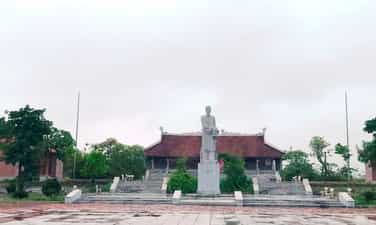
Memorial area for cultural celebrity Le Quy Don
The memorial area of scientist Le Quy Don in Dong Phu village, Doc Lap commune, Hung Ha district is a place to store and preserve artifacts and traces that were closely associated with the scientist - an outstanding Vietnamese cultural celebrity. Male. Le Quy Don's real name is Le Danh Phuong, full name is Doan Hau, nickname is Que Duong, born on the 5th day of the 7th month, year of Binh Ngo, that is, June 2nd, 1726 in Dien Ha village, Son Nam Ha town, now is Dong Phu village, Doc Lap commune, Hung Ha district, Thai Binh province. His father, Le Trong Thu, passed his PhD as an official at the Ministry of Justice and Marquis. Her mother is Truong Thi Ich, daughter of Dr. Truong Minh Luong, who is a Hoang sect official. When he was young, Le Quy Don was famous as a child prodigy. In 1739, he followed his father to the capital to study with Dr. Le Huu Kieu. At the age of 18, Huong passed the exam and won the first prize, then stayed home to teach and write books. At the age of 27, he passed the Hoi exam and passed the Dinh exam. Le Quy Don successively worked at the Academy, the Toan Committee to study national history, went to Liem Phong to participate in military affairs, went to China as an ambassador, worked at Lord Trinh's palace... and was gradually promoted to the positions of Academy Officer and Private Career. Quoc Tu Giam, Litigation, National History General, Hiep Town... In 1784, he was promoted to Minister of Public Affairs, titled Nghia Phai Marquis. That same year, he fell ill and returned home to recuperate in his maternal hometown, Nguyen Xa village, Duy Tien district. (now in Ha Nam province) he died here on the 14th day of the 4th lunar month at the age of 58. His wife is Mrs. Le Thi Trang, daughter of school teacher Le Huu Kieu. He has four sons, Quy Kiet, Quy Ta, Quy Chau, Quy Nghi. Le Quy Don's creative career is very voluminous, he has written about 40 books of all kinds including most contemporary knowledge such as history, poetry, philosophy, classic commentaries, general categories... which is a treasure trove. precious treasure of the country's academic system. The memorial area for cultural celebrity Le Quy Don includes three works: From the street of cultural celebrity Le Quy Don, the mausoleum of Le Trong Thu (Le Quy Don's father), and Le Quy lake. 1. From the street of cultural celebrity Le Quy Don Tu Duong includes the five-room Bai Duong court, the Middle Palace and the Hau Palace, each with three compartments. Tu Duong's predecessor was the home of Le Quy Don. When his father passed away, Le Quy Don converted it into Tu Duong, until his lifetime. Le Quy Kiet also brought Le Quy Don's tablet back with his grandfather. Local people often call this place from Le Quy Don street. 2. Le Trong Thu Tomb. Le Trong Thu (1693 - 1783), was a mandarin during the Le Trung Hung period in Vietnamese history. He was the father of a great Vietnamese scientist during the feudal period, Le Quy Don. Le Trong Thu, Mr. Truc Am, studied very brightly as a child, was famous as a prodigy, and grew up studying with the Vu family's Tham Hoa in Ha Nam. At the age of 27, Le Trong passed Huong Tien, at the age of 31, he passed the 3rd rank of Doctorate. Origin, Giap Thin department, Bao Thai year 5 (1724), reign of King Le Du Tong and Lord Trinh Cuong, served as an honest mandarin Famous inside and out, at the age of 65, he retired to the position of Household Minister Huu Thi Lang. Not long after, he was invited to become a mandarin for the second time, promoted to the position of Minister of Justice, then retired at the age of 80. 3. Ho Le Quy. In the 26th year of Canh Hung (1765), he asked the court to return to his hometown to "close the door and write books". To relax and have conditions to read and write books, Le Quy Don dug a large lake. In the middle of the lake, build a small island, plant ornamental plants, and build a Thu Lan. During this time, he wrote many books "specially focusing on geography" such as: Geography of Essence, Compendium of Geography... Perhaps the chapter on images and products in the Van Dai language series was also prepared with documents from this period. The Memorial Area of cultural celebrity Le Quy Don was ranked a National Monument by the Ministry of Culture, Sports and Tourism on December 12, 1986. Source: Department of Culture, Sports and Tourism of Thai Binh province
Hung Yen
5586 view
Rating : National monument

Thien Hau Temple (upper temple)
Thien Hau Temple (Thien Hau Upper Street) is located on Trung Trac Street - Quang Trung Ward - Hung Yen Town. The temple was built in 1640 by 14 Chinese families in Guangdong, Guangxi and Fujian donating money to build it. Thien Hau Temple worships Mrs. Lam Tuc Mac, according to "Dai Nam Nhat Thong Chi", she is a sea god. Lam Tuc Mac was born on March 23 (lunar calendar) as the 6th daughter of Lam Nguyen, from Bo Dien, Fujian province (China). Legend has it that when Lam Tuc Mac was born, he had a sweet fragrance and a brilliant aura. Lam Tuc Mac is very smart. When he was 8 years old, he went to study immortality, trained to become righteous, could call rain and wind, and use magic to ride a flying mat on the sea. When the people had poor harvests and famine, she found seaweed to eat instead of rice, noodles, and barley, so the people were no longer hungry. She found a type of magnolia oil and sprayed it on the ground to grow plants to grow seeds to eat instead of rice... On the 9th day of the 9th lunar month, she was no longer sick but cured. After transforming, she often wore a red shirt and flew over the sea to help passing boats. Fujian people worship her as the god of navigation. Wherever there are Fujian people, there is a temple to worship her. When migrating to Pho Hien, Fujian people built a temple to worship her on Bac Hoa street (now Trung Trac street). Thien Hau Temple is a project with bold Chinese architectural colors in many items such as: ritual gate, incense burning house, roof, corner blades and truss structure. Legend has it that the temple was built in China and then brought to Pho Hien to build it. Nghi Mon is built like a house, with a tiled roof, the architecture of the pillars, and the door system engraved with images of civil and military mandarins and their followers. The terrace is paved with pebbles that have not worn away through wind and rain for hundreds of years. In front of the ritual gate, there is a pair of goats: the male holds a jade, the female holds a baby, made of marble, very vivid artifacts. The two stone pigs represent the Chinese concept of life: having wealth and having children is the greatest happiness in life. The inner temple area is built in the style of a Dinh letter, including an incense burning house and a harem. The match-stacked incense burning house has 2 floors and 8 roofs, the roof is tiled, the roof line is decorated with Buddha sitting on a lotus, surrounded by passersby. The entire system is structured in a special form with each theme and Chinese story such as: Three Kingdoms, Journey to the West... In addition, here are also decorated with various kinds of flower strings, bowls of horses, pantyhose, and scenes. four seasons: Spring, summer, autumn, winter. The harem consists of 3 rooms, the architecture is "stacked with wings", the ends are carved into the shape of a carp. The outer harem worships Lam Tuc Mac while the inner hall worships her parents, siblings and the Chinese families who contributed to building the temple. Every year, Thien Hau Temple holds festivals on March 23 and September 9 (lunar calendar) to celebrate the birth and transformation of Lam Tuc Mac. A large number of Chinese families in Pho Hien and Vietnamese people came to worship. During the festival, a grand palanquin procession is held, offerings include seaweed cakes, turtle cakes, To Chau cakes... which are traditional Chinese products. Thien Hau Temple is one of the very few ancient Chinese architectural works in Pho Hien still preserved today. With the purpose of preserving and promoting to the masses, Hung Yen province restored Thien Hau Temple to be spacious and clean and in 1992 it was recognized by the Ministry of Culture and Sports as a historical and architectural relic. Artistic architecture. Source: Hung Yen Electronic Newspaper
Hung Yen
4369 view
Rating : National monument
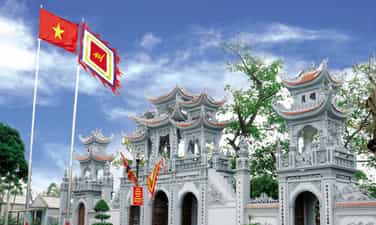
Tien La Temple
Tien La Temple is located on an area of nearly 6000 m2, at Kim Quy mound, Doan Hung commune, Hung Ha district, Thai Binh province. Tien La Temple with ancient architecture "First", "Later" from the rafters to the curved roof with the design of Two Dragons flanking the Moon; The front of the Temple faces the Tien Hung River, near the junction that flows into the Luoc River. Surrounding the Temple are lush, shady green trees. Tien La Temple was recognized as a national historical and cultural relic on November 12, 1986. The temple worships Bat Nan General (General who saved the people from trouble - some places call it Bat Nan or Bat Nao). Vu Thi Thuc was born in 17, died in 43, a famous female general in the Hai Ba Trung uprising who was instrumental in defeating To. Dinh, was given the title: "Dong Nhung Great General" for nearly two thousand years. Princess Bat Nan, general of the Dong Nhung army, was the title Trung Vuong gave to Thuc Nuong (Vu Thi Thuc) when he defeated the Han army. Thuc Nuong was born in her mother's hometown in Huong Da Cuong (now in Tan Tien commune - Hung Ha - Thai Binh), grew up in her father's hometown (Phuong Lau - Vinh Phuc), is a beautiful, dignified and patriotic girl. , loved the people and loved martial arts and martial arts, so she secretly took care of saving the country and helping the people. March of the year Canh Ty (40 AD). The Trung sisters raised the uprising flag, and she followed home to help lead the vanguard. The insurgents won a decisive victory. In 1941, the country was completely liberated. The Trung sisters ascended the throne and established their capital at Me Linh - Vinh Phuc, taking the title Trung Vuong. Tien La Temple has main works such as: Three external gates, Three internal gates, Front altar, Middle gate and Hau palace. Past the three outer gates, the Temple yard is the inner three gates, on both sides there are Lau Cau and Lau Co; Continuing on, you will arrive at the 5-compartment Tien Tien house, built with four-stone wood, the interior is elaborately carved with floral motifs such as: "Dragon - Lan - Quy - Phuong" interwoven with "Pine - Bamboo - Chrysanthemum - Roof ". There are also great inscriptions praising the Trung Vuong dynasty and the virtue and talent of the female general Bat Nan. Next is the Trung Te house, built in the style of a Phuong communal house, with the architecture of "matches piled up". The special thing is that all the house construction materials are made of stone; The entire system of columns and rafters is carved very delicately, in which 4 main columns are carved with four sacred animals; 12 military columns touched dragon clouds; 8 beams carved with pine, bamboo, chrysanthemum, and apricot trees; The column's ribs and 8 stone rafters are carved with garlands and the word Trien; Going deep inside is the harem built with ironwood, consisting of 3 compartments, in which the middle compartment is a throne and a statue worshiping General Vu Thi Thuc, surrounded by her generals. On the roof of the harem hangs the great title "Eternal Heroic Spirit". Legend has it that this is also the place where the tomb of General Vu Thi Thuc's wife, General Vu Thi Thuc, is located. Along with unique architecture, Tien La Temple also preserves many offerings and worship objects dating back to the Tran and Le dynasties; Tien La Temple Festival to commemorate the past merits of General Bat Nan was held on the 15th to 17th of the third lunar month every year. Today, to serve the large number of visitors, the festival's organizing committee has opened the festival since the beginning of March. The main festival is held on the 17th day of the lunar calendar, coinciding with the day of her sacrifice (March 17, Quy Mao year). . Source: Thai Binh Radio and Television
Hung Yen
5574 view
Rating : National monument

Luu Xa Temple
Luu Xa Temple is a place to worship two famous historical figures of the Ly Dynasty (12th - 13th centuries), Luu Khanh Dam and Luu Ba. Bao Quoc Pagoda was the name given by King Ly to show respect for the mandarins who had many contributions to helping the four Ly dynasties (Thai Tong - Thanh Tong - Nhan Tong - Than Tong) build a prosperous country at that time. . The relics of Luu Xa temple and Bao Quoc pagoda are closely related to each other, forming a cluster of relics because they all share a common historical event. The temple and pagoda are located close to each other at the beginning of Luu Xa village - Canh Tan commune - Hung Ha district - Thai Binh province. Luu Khanh Dam and Luu Ba are two brothers from different mothers, their father is Mr. Luu Ngu - hometown in Cuu Chan district (now Thieu Trung commune - Thieu Hoa - Thanh Hoa). Mr. Luu Ngu was an official in the pre-Le dynasty (Kings Le Hoan and Le Long Dinh) to govern this river junction area. Realizing that the land of Luu Xa at that time was behind the river and in front of the lagoon, the river was winding like "The dragon flanks the tiger", so he set up a palace there and married a local woman. When he first married Ms. Tran Thi Ngoc, she was nearly 40 years old but had no children. He married a woman named Pham. After that, the two women became pregnant and gave birth on the same day, the only difference being that one was born at the Tiger hour, the other was born at the Horse hour, he was Luu Khanh Dam, the younger was Luu Khanh Dieu (Luu Ba). Mr. Luu Ngu brought his relatives from the countryside to live in Luu Xa land. When Ly Cong Uan ascended the throne, opening the Ly dynasty, Luu Ngu's children were soon warmed up and entered the court. Both brothers were mandarins of the same dynasty. As soon as the Ly Dynasty was established, the enemy invaded from the south. Luu Khanh Dam was assigned by King Ly Thai To along with his generals to lead the army to fight the enemy, capturing the king of Champa, Bo Hop, and bringing him back. As soon as the South calmed down, the Song enemy threatened to encroach on the North. He told the king: "I hope your majesty will not worry. Your majesty will personally go to command the four seas, beyond the realms, my servants and loyal brothers and generals will take care of fighting the enemy." During the Ly period, the Song invaders invaded the country three times. We were all defeated by our army and people. Thai To considered Luu Dam to be a man who defeated the south and had a "good plan" (good plan), proposed leaving the capital and appointed him the title of Thai Deputy to open the country, and assigned him to teach and instruct crown prince Phat Ma. Thai To died, Thai Tong ascended the throne, Luu Khanh Dam asked the king to exempt the villagers from service and taxes. When Thai Tong died, Thanh Tong ascended the throne and appointed Luu Khanh Dam as Binh Chuong. At the end of his life, Luu Khanh Dam returned to Luu Xa to repair the village pagoda and practice there. While in the village, together with monks Giac Hai, Duong Khong Lo, Nguyen Minh Khong organized for the people "Opening the Luoc River", "Making the Sinh River", "Digging the Hoa River" in Thai Binh. When he passed away, King Thanh Tong returned to attend the funeral ceremony. Because he was a founding citizen, the king gave the name of the pagoda where he practiced as "Bao Quoc Tu", gave him the title of king, and bestowed the title "Chinh Chieu Cam" ”, and built a 9-foot high, 9-storey tower next to King Luu Dam's mausoleum. The villagers of Luu Xa thanked him for building the temple and honored him as the village's Thanh Hoang. When Ly Nhan Tong ascended the throne, he bestowed upon him the four beautiful words "Showing spiritual understanding", and the following dynasties all granted him the title of deity. His temple (Luu Xa temple) and Bao Quoc pagoda were ranked national historical and cultural relics in 1990. Source: Thai Binh Department of Culture, Sports and Tourism
Hung Yen
10192 view
Rating : National monument
Outstanding monuments
See all
Temple of the Salt Lady
The temple worships Ba Chua Muoi (ie the temple of Concubine Nguyen Thi Nguyet Anh), the third wife of King Tran Anh Tong. The palace and temple of Lady Chua Muoi are located in Thuy Hai commune, Thai Thuy district, Thai Binh province. Ancient books recorded: Lady Muoi's real name is Nguyen Thi Nguyet Anh, born in 1280 at Quang Lang site, Thuy Van district, Thai Binh district (now Thuy Hai commune, Thai Thuy district, Thai Binh province) in a family. work in salt. Since childhood, she had an unusual appearance, read books and was very intelligent. Every time she finishes school, Nguyet Anh often goes to the fields to help her parents work. But every time she helps her parents, wherever she goes, the weather gets shady, while salt making requires sunlight. The stronger the sunlight, the more beautiful the salt. Worried about the traditional profession and livelihood of local residents, the village elders gathered together and discussed a plan to build her a boat to bring salt to trade elsewhere. During a trade, her boat parked at the river wharf near Thang Long citadel, coincidentally right on the occasion of King Tran Anh Tong's business trip across the river. By fate, the king was so captivated by her beauty that he took her to the palace, showered his love on her, and made her his third concubine. But unfortunately, she could not give birth to a child and became sad and sick. After that, King Tran Anh Tong took her back to her maternal hometown in the hope that her illness could improve. Seeing the Queen sitting by the window overlooking the village's salt fields every afternoon, the shepherd children gathered around her to use mannequins to dance around her to relieve her sadness. One afternoon, while watching the children dancing happily, she laughed and escaped (April 14, Year of the Dog). When the king heard the news, he was extremely merciful, ordained her as a Blessed Deity and allowed the people to build a temple called the Temple of the Salt Lady. Over time, the temple was damaged and demolished. In 1988, people in the area temporarily rebuilt a small palace to worship her. In 2012, the Ministry of Culture, Sports and Tourism restored this monument. The current palace has 3 rooms, with a harem and altars and statues; In the palace, there are a number of specific items related to the salt making profession such as wheelbarrows, ladles to scoop water for salt and water, rakes for salt on the drying yard... Ba Chua Muoi temple still preserves a banner of conferral of conferments from the Tran and Tran dynasties. two sets of ancient couplets. The temple is a special architectural work combining temple and pagoda, located on Trang Quang Lang land. The pagoda facing North is the place to worship Shakyamuni Buddha. The temple facing south is the place to worship Saint Mother Tam Phi Nguyen Thi Nguyet Anh (ie Lady of Salt). This is the most beautiful temple - pagoda, in the stone stele in 1596, there is the following passage: "Thai Binh's fairy tale is famous for its national pagoda, the traditional version is only famous, and the Nam Bang is famous for its scenic beauty..." Meaning: "The area Thai Binh Hung Quoc Pagoda is a traditional scenic place, the most precious scenic spot in the South..." Source: Vietnamese Rural Newspaper
Hung Yen
10731 view
Rating : National monument

Dong Bang Temple
Dong Bang Temple is located on the Diem river in Dao Dong site, Vong Lo district, Phu Phuong district, now Dong Bang village, An Le commune, Quynh Phu district, Thai Binh province. The temple's self-name is Bac Hai Linh Tu, a place to worship Father Bat Hai Dong Dinh - a person who made great contributions to pacifying Thuc to defend the country and recruit people to establish hamlets and build the country and society in the early days. Dong Bang Temple is known to the people as a sacred temple dating back to the reign of the 18th Hung King. The temple has the title "Tam Ky Linh Ung - Vinh Cong Great Vuong, Supreme Spirit". Legend has it that, during the reign of King Hung Vuong 18, our country was invaded by foreign invaders, the court had to set up an altar to summon Linh Son Tu Qi to help the country defeat the invaders. At that time, the water god of Dao Dong village appeared to assist the king in defeating the enemy and had the first contribution in guarding the eight western estuaries. He was ordained as "Tran Tay An Tam Ky Linh Ung - Vinh Cong Great King, Supreme Spiritual God". Since then, this place has been a spiritual place admired by people from all over and built temples. In the 13th century, Dao Dong village was also one of the important military defense lines of the Tran Dynasty, where soldiers were stationed and practiced naval warfare. Before going into battle, Hung Dao Dai Vuong and his generals all came to offer incense and pray at the temple. After his death, he was worshiped here by the people. Since then, Dong Bang Temple has also been a place to commemorate Hung Dao Vuong and the generals of the Tran Dynasty during the three great defeats of the Mongol Yuan army and the establishment of eight ancient Dao Dong sites. Not only does it have respectable historical values, Dong Bang Temple is also a valuable architectural and artistic relic such as a museum of bronze, stone and wooden art with an internal area of 6,000 square meters, including 13 buildings and 66 compartments are closely linked together to form a temple complex with a closed, imposing "first, second, second" style structure. The architectural pieces are in harmony with sophisticated carvings, hundreds of horizontal panels, couplets, great characters, lacquered and gilded scrolls on the themes of four sacred animals, four precious animals, sets of incense burners, altars, and dragons. The thrones and exquisite, beautiful wooden sculptures from the Khai Dinh and Bao Dai dynasties are still preserved intact. Because of the legends, historical and artistic values, Dong Bang Temple is known as the temple of inspiration and four seasons of incense and smoke. In particular, in 1986, Dong Bang Temple was recognized by the Ministry of Culture, Sports and Tourism as a national historical and cultural relic. According to annual custom, the Dong Bang Temple Festival is held for about a week from August 20 to the 26th of the eighth lunar month. The festival attracts a large number of disciples, people and tourists from near and far. . Dong Bang Temple Festival preserves traditional cultural beauties and noble human values, and is an opportunity to express gratitude, the tradition of "drinking water, remember its source" and the people's admiration and respect for the people. with His Majesty Father Bat Hai Dong Dinh and commemorate the death anniversary of National Cong Tiet Hung Dao Dai Vuong. Source: Department of Culture, Sports and Tourism of Thai Binh province
Hung Yen
10460 view
Rating : National monument

Uncle Ho Memorial House
During his lifetime, despite being busy with thousands of jobs, Uncle Ho still cared about Thai Binh. The Party Committee and people of Thai Binh were honored to welcome Uncle Ho five times: the first time on January 10, 1946, the second time on January 10, 1946. 2 on April 28, 1946, the 3rd time on October 26, 1958, the 4th time on March 26, 1962 and the last time on December 31, 1966 and January 1, 1967, Uncle Ho. Ho returned to reward 5 tons of rice for the Party Committee and people of Thai Binh - the first province in the North to achieve 5 tons of rice/1 hectare. Relics and places marking Uncle Ho's visit to Thai Binh include: 1. Provincial Administrative Committee, Le Hong Phong ward, Thai Binh town. 2. Dia dike section, Hung Nhan district. 3. Town Fitness Tri House, Le Hong Phong Ward, Thai Binh Town. 4. Provincial Administrative Committee headquarters, Le Hong Phong ward, Thai Binh town. 5. Mill factory construction site, Le Hong Phong ward, Thai Binh town. 6. Town Stadium, Le Hong Phong Ward, Thai Binh Town. 7. Nam Cuong commune, Tien Hai district. 8. Ms. Luu's house, Nam Cuong Commune, Tien Hai District. 9. Nho Lam communal house, Dong Lam commune, Tien Hai district. 10. Mr. Du's house, Dong Lam commune, Tien Hai district. 11. A military unit, Dong Lam commune, Tien Hai district. 12. Phuong Cap communal house, Hiep Hoa commune, Thu Tri district. 13. The office of the Provincial Party Committee at the evacuation site, Dai Dong village, Tan Hoa commune, Vu Thu district. On the night of December 31, 1966, and the morning of January 1, 1967, Uncle Ho visited and worked with the Provincial Party Committee. People stay at a thatched house in Dai Dong village, Tan Hoa commune, Vu Thu district. After Uncle Ho's death, the Standing Committee of the Thai Binh Provincial Party Committee retained the house as Uncle Ho's memorial area in the province. The memorial house was recognized as a historical relic by the Ministry of Culture, Sports and Tourism on December 12, 1986. Source: Electronic Information Portal of Department of Culture, Sports and Tourism of Thai Binh province
Hung Yen
10265 view
Rating : National monument

Luu Xa Temple
Luu Xa Temple is a place to worship two famous historical figures of the Ly Dynasty (12th - 13th centuries), Luu Khanh Dam and Luu Ba. Bao Quoc Pagoda was the name given by King Ly to show respect for the mandarins who had many contributions to helping the four Ly dynasties (Thai Tong - Thanh Tong - Nhan Tong - Than Tong) build a prosperous country at that time. . The relics of Luu Xa temple and Bao Quoc pagoda are closely related to each other, forming a cluster of relics because they all share a common historical event. The temple and pagoda are located close to each other at the beginning of Luu Xa village - Canh Tan commune - Hung Ha district - Thai Binh province. Luu Khanh Dam and Luu Ba are two brothers from different mothers, their father is Mr. Luu Ngu - hometown in Cuu Chan district (now Thieu Trung commune - Thieu Hoa - Thanh Hoa). Mr. Luu Ngu was an official in the pre-Le dynasty (Kings Le Hoan and Le Long Dinh) to govern this river junction area. Realizing that the land of Luu Xa at that time was behind the river and in front of the lagoon, the river was winding like "The dragon flanks the tiger", so he set up a palace there and married a local woman. When he first married Ms. Tran Thi Ngoc, she was nearly 40 years old but had no children. He married a woman named Pham. After that, the two women became pregnant and gave birth on the same day, the only difference being that one was born at the Tiger hour, the other was born at the Horse hour, he was Luu Khanh Dam, the younger was Luu Khanh Dieu (Luu Ba). Mr. Luu Ngu brought his relatives from the countryside to live in Luu Xa land. When Ly Cong Uan ascended the throne, opening the Ly dynasty, Luu Ngu's children were soon warmed up and entered the court. Both brothers were mandarins of the same dynasty. As soon as the Ly Dynasty was established, the enemy invaded from the south. Luu Khanh Dam was assigned by King Ly Thai To along with his generals to lead the army to fight the enemy, capturing the king of Champa, Bo Hop, and bringing him back. As soon as the South calmed down, the Song enemy threatened to encroach on the North. He told the king: "I hope your majesty will not worry. Your majesty will personally go to command the four seas, beyond the realms, my servants and loyal brothers and generals will take care of fighting the enemy." During the Ly period, the Song invaders invaded the country three times. We were all defeated by our army and people. Thai To considered Luu Dam to be a man who defeated the south and had a "good plan" (good plan), proposed leaving the capital and appointed him the title of Thai Deputy to open the country, and assigned him to teach and instruct crown prince Phat Ma. Thai To died, Thai Tong ascended the throne, Luu Khanh Dam asked the king to exempt the villagers from service and taxes. When Thai Tong died, Thanh Tong ascended the throne and appointed Luu Khanh Dam as Binh Chuong. At the end of his life, Luu Khanh Dam returned to Luu Xa to repair the village pagoda and practice there. While in the village, together with monks Giac Hai, Duong Khong Lo, Nguyen Minh Khong organized for the people "Opening the Luoc River", "Making the Sinh River", "Digging the Hoa River" in Thai Binh. When he passed away, King Thanh Tong returned to attend the funeral ceremony. Because he was a founding citizen, the king gave the name of the pagoda where he practiced as "Bao Quoc Tu", gave him the title of king, and bestowed the title "Chinh Chieu Cam" ”, and built a 9-foot high, 9-storey tower next to King Luu Dam's mausoleum. The villagers of Luu Xa thanked him for building the temple and honored him as the village's Thanh Hoang. When Ly Nhan Tong ascended the throne, he bestowed upon him the four beautiful words "Showing spiritual understanding", and the following dynasties all granted him the title of deity. His temple (Luu Xa temple) and Bao Quoc pagoda were ranked national historical and cultural relics in 1990. Source: Thai Binh Department of Culture, Sports and Tourism
Hung Yen
10192 view
Rating : National monument

Comrade Nguyen Duc Canh memorial area
Comrade Nguyen Duc Canh's memorial area is located in Diem Dien town, Thai Thuy district, Thai Binh province, this place records a deep impression on Nguyen Duc Canh, one of the first 7 party members who founded the Communist Party. , a first leader of the Vietnam Trade Union. The memorial area was built on the incense burner land of 8 relatives living together, with an area of 1,600m². The scene of the old house of Comrade Nguyen Duc Canh's family during his lifetime includes: The Ancestral Church (which was the teaching school of Comrade Nguyen Duc Canh's father), the house, and the kitchen were completely reconstructed. on old ground. The space is simple and humble, recalling the image of the order and family style of an ancient Confucian family. To pay tribute and commemorate Nguyen Duc Canh's great contributions to the Vietnamese revolutionary cause, Nguyen Duc Canh's memorial area was invested in repairing, upgrading, and expanding spaciously, worthy of a cultural and historical relic. National level. This is also the first cradle that molded and gave wings to the personality, soul, will and actions of loyal communist soldier Nguyen Duc Canh. Behind the house there is still a well preserved, this place more than 100 years ago marked a special moment. On the morning of the first day of Tet Mau Than (1908) (February 2, 1908), Mrs. Tran Thi Thuy went out to celebrate the well's birthday according to the custom of sprinkling coins into the well so that when the well is washed at the end of the year, the person who picks up the money will be the one who picks up the money. Lucky person, little boy Nguyen Duc Canh, was born here. People in the area call it Ngoc well, although in the coastal area, most well water is salty and cloudy, but this well has been full for hundreds of years, the water is still full, sweet and clear, visible to the bottom. Every day, visitors to the memorial area still come out to drink water and wash their faces to cool down. On the bank of the well is a stone stele about 3 meters wide, with the poem "Farewell" engraved on it - a letter from comrade Nguyen Duc Canh to his mother, written during the days of being detained by the enemy in a cell to be beheaded. Nguyen Duc Canh was beheaded by the French colonialists at dawn on July 31, 1932 at Hai Phong Prison. That year, he was only 24 years old, an age full of vitality. Before dying, he shouted: "Down with French imperialism and feudalism!", "Long live the Indochina Communist Party!". Every page of history here records profound impressions of Nguyen Duc Canh, a One of the first 7 members of the Party, he is one of the founders and an outstanding leader of the Vietnamese workers' movement. To pay tribute and engrave the great contributions of Nguyen Duc Canh to the Vietnamese revolutionary cause and to his hometown of Thai Binh, in Thai Binh city and Thai Thuy district, there are 2 roads named after Nguyen Duc Canh, 2 schools named after Nguyen Duc Canh. name Nguyen Duc Canh; The statue of comrade Nguyen Duc Canh is majestically placed at October 14 Square. The memorial was built on the land where he was born and raised, and is associated with the tradition of a family of studious, virtuous, patriotic, and people-loving people. This is also the first place that molded and gave wings to the personality, soul, will and actions of loyal communist soldier Nguyen Duc Canh. Source: Vietnam News Agency
Hung Yen
9391 view
Rating : National monument

A Sao Temple
Located in An Thai commune, Quynh Phu district, Thai Binh province, A Sao Temple is a place of worship and incense of the King of the Republic of Hung Dao Vuong Tran Quoc Tuan, along with ancient festivals and rituals that are still maintained. maintained until today. “A Sao” has the original name of A Cao, an area of land located along the Hoa River, a place that is said to converge the sacred energy of rivers and seas, and has a military-critical terrain, so it was chosen by the Tran court as a place to be. The fiefdom of Phung Can Vuong Tran Lieu, father of Tran Hung Dao. Tran Hung Dao was born and grew up in this land. In 1258, when the Tran court launched the first resistance war against the Yuan-Mongol, Tran Quoc Tuan, who had just turned 18 years old, was given the title of Marquis and was assigned by the court to defend A Sao land. Before the second resistance war, the Tran kings personally and Tran Quoc Tuan directed the construction of the Hoa River area (now including parts of Thai Binh and Hai Phong) into a defensive line to deploy the naval posture. war. In the land of A Sao, Tran Quoc Tuan was assigned by the royal court to build a military force and a food storage center with many places whose names are still associated with the resistance war such as: village Me Thuong, An Thai commune (rice warehouse); Am Qua village (sword warehouse); Dai Nam, Quynh Tho commune (large granary); A Me, An Thai commune (rice storage place of the Tran Dynasty)... In particular, A Sao is a place that means the nest, the nest of the Tran Dynasty. In particular, at the current A Sao relic site, there is also A Sao Statue Wharf, where Tran Hung Dao's war elephants got bogged down on their march across the Hoa River to attack O Ma Nhi's army on the Bach Dang River. The people brought wood, bamboo, straw, straw, and some heroes even had ironwood houses dismantled to try to save the war elephant, but they could not pull the elephant up. The elephant looked at his owner with tears in his eyes. The general had to swallow his tears and get on the boat to cross the river, leaving the elephant behind because the battle was too urgent and urgent. Hung Dao Vuong drew his sword and pointed at the Hoa river and swore: "If we do not win the That battle in this battle, I swear I will not return to this riverbank!". After the victory, the people built a temple to worship Tran Hung Dao called De Nhi Sinh Tu or A Sao Linh Mieu (A Sao Temple). A temple worshiping an elephant statue carved from stone was also built along the riverbank. In the temple grounds, there is Tam Tuong Lake (a lake for elephants to bathe in), Dong Yen mound (a place to saddle soldiers' horses), Barracks (a place for soldiers to live) and many other sacred objects. Every year, on the 10th day of the second lunar month, which is said to be the birthday of Hung Dao Vuong, to remember the merits of Hung Dao Vuong, A Sao villagers hold a festival to worship Saint Tran at the Second Sinh Tu and ceremony. A Sao village festival is one of the largest festivals in the region. According to ancient rules, all rituals in this festival follow national rituals. The court often sends mandarins to perform the sacrifices and there are often cakes and rice cakes to offer. In 1951, the French invaders stationed at A Sao temple. They destroyed many worship objects, used carts to drag stone elephants from the river wharf to the station to make gun emplacements, and shot off the trunks of stone elephant statues. Through many ups and downs, the Second Sinh Tu was demolished, leaving only a wasteland and a stone elephant statue lying on the old temple foundation in the middle of A Sao field. Through many seminars and research, in 2005, a new temple was restored at the old foundation of "Second Born From". On April 14, 2011, the relic site was granted a Certificate of National Historical Relic recognition by the Ministry of Culture, Sports and Tourism. Also in 2011, temple ruins and stone elephant statues at Ben Tuong were restored along with landmarks such as Tam Tuong Lake, Dong Yen Mound... Also from 2012, A Sao Temple Festival will be held annually on the 10th day of the second lunar month with many cultural and artistic activities associated with traditional cultural rituals and unique folk games. such as clay cannon competition, wrestling, Chinese chess, swimming, word drawing dance... Local people and tourists from all over come to the festival excitedly and happily participate because they want to preserve and build traditional cultural beauty. Participating in the festival, visitors from all over can live with national pride, recreating a heroic period in the history of the Vietnamese people's struggle to build and defend the country. Source: Thai Binh Radio and Television
Hung Yen
8817 view
Rating : National monument

Kim Dang Temple
Kim Dang Temple is located in the center of Kim Dang village, Lam Son ward, Hung Yen town, Hung Yen province today. In the past, this place was Dang Man site, An Tao district, Khoai Chau district, upper Son Nam town. Legend has it that the temple was built on the land Dinh Dien chose as its headquarters with the posture "The Thanh Dragon and the White Tiger are coming". The book "Dai Nam Nhat Thong Chi" records: General Dinh Dien is from Gia Phuong - Gia Vien - Ninh Binh, and is the adopted son of Dinh Cong Tru (father of Dinh Bo Linh). Since childhood, he was Dinh Bo Linh's "reed flag practice" friend. When he grew up, he formed a brotherhood with Nguyen Bac, Lu Co, Trinh Tu and Dinh Bo Linh. When the country was in turmoil among the 12 warlords, a few friends followed warlord Tran Lam to occupy the Bo Hai region (now Tien Hai - Thai Binh). When he became Van Thang Vuong, Dinh Bo Linh assigned Dinh Dien to command 10 armies to conquer other warlords. When he arrived at Dang Man site and saw the beautiful terrain, he immediately built a headquarters and chose three people named Phan, Pham and Nguyen from Dang Man site to be his generals and chose a girl from the Phan family named Moi Nuong to be his wife. . After suppressing the rebellion of 12 warlords, Dinh Bo Linh ascended the throne, proclaimed himself Dinh Tien Hoang, named the country Dai Co Viet, and established the capital in Hoa Lu - Ninh Binh. In the year of Ky Mao (979), Dinh Tien Hoang and his eldest son Dinh Lien were killed by the traitor Do Thich. Dinh Dien and his mandarins proclaimed Dinh Toan (then only 6 years old) to the throne and honored Duong Van. Russia as Queen Mother. When the Song army threatened to invade the northern border, the country faced the threat of foreign invasion, the soldiers proclaimed Thap Dao general Le Hoan to the throne, replacing Dinh Toan who was too young at that time. Not accepting that, Foreign Minister Dinh Dien and Dinh Quoc Cong Nguyen Bac, who was guarding Chau Ai, and Pham Hap raised troops and sent troops from Thanh Hoa to attack Hoa Lu but failed, Dinh Dien withdrew his troops to Dang Man camp. On November 17 (lunar calendar) in the year of Ky Mao (979), Dinh Dien and his wife passed away, the people of Dang Man camp built a temple on the base of the barracks, and 3 generals of Dinh Dien were also worshiped here. Over time, the temple has been restored many times. Currently, Kim Dang Temple still retains many architectural features of the Later Le and Nguyen dynasties. In 1997, the temple was classified as a historical relic by the Ministry of Culture and Information. The temple has a nail-shaped architecture, including 5 pre-worship spaces and 3 back palace spaces. The altar building is made of a 2-story, 8-roofed overlapping style; The blades are embossed with dragon heads; On the roof line, there is an image of two dragons flanking the sun, and two pincers are decorated with "two fish" (two carp); The roof is covered with dragon scale tiles, the neck frill is decorated with 4 words "Dinh Dai Linh Tu" in Chinese characters. The structure of the hitching trusses is simple, supported by a system of solid ironwood columns. Connected to the front altar are 3 back-rooms with tiled roofs. The truss structure is in the style of a husband and a lotus, and on the beams are embossed with stylized patterns of flowers and leaves. The central space houses the statues of General Dinh Dien and his wife Phan Thi Moi Nuong, created in a meditating posture... In addition, the relic also preserves a number of horizontal paintings and couplets praising their merits. God. Every year, the Kim Dang Temple festival is held from the 15th to the 17th of the 11th lunar month to commemorate the death of General Dinh Dien and his wife. During the days of the festival, in addition to the palanquin procession, there are also traditional folk games such as cockfighting, lion dancing, spoken singing, military drum singing, water puppetry... to contribute to building solidarity. build relationships with neighbors, educate the Vietnamese people about patriotic traditions, and remember the source when drinking water. Source: Hung Yen Newspaper
Hung Yen
7127 view
Rating : National monument

Da Hoa Temple
Da Hoa Temple is also called Chinh Da Hoa Temple, located in Da Hoa village, Binh Minh commune, Khoai Chau district, Hung Yen province. Temple of Chu Dong Tu - Tien Dung - Princess Hong Van. The temple overlooks the Red River and Tu Nhien beach, and is said to be the place where the love affair between Chu Dong Tu and Tien Dung formed. Da Hoa Temple was built a long time ago, the current project was built at the end of the 19th century, from 1884 to 1886 by Chu Manh Trinh, a native of Phu Thi village, general of Me So, police officer of Hung Yen province. The project is famous for its massive scale and unique architectural ideas, in harmony with the natural landscape. The temple area includes 18 large and small projects: stele house, bell tower, banh ward, noon gate, altar house, incense burning building, second palace, third palace, harem and hermitage houses, tarpaulin houses, and houses. horses, artillery houses. The temple roofs have a stylized dragon boat shape. If you look down from above, you will see the temple roofs, combined together to look like a group of boats bobbing on the river. Chu Manh Trinh intended to shape the temple area to look like the yacht of eighteen-year-old Tien Dung, daughter of the 18th Hung King, traveling on the river. Da Hoa Temple still retains many precious relics. Statue of Saint Chu Dong Tu and his two wives cast in bronze, life-sized. Three thrones worship Chu Dong Tu and his two wives, made of wood, balanced layout, the top of the throne is carved with a dragon in the facing position. The throne dates back to the late 16th and early 17th centuries, and is considered the oldest of its kind still found in our country. Da Hoa Temple Festival is held from February 10-12 of the lunar calendar. The main day of the festival begins with a procession of tutelary gods from 8 villages of the ancient Me district to the main temple (including Me So, Da Hoa, Bang Nha, Phu Thi, Phu Trach, Thiet Tru, Nhan Thap villages). Each procession has flags, gongs and drums, precious bowls, lo bos, bowls of sounds, palanquins, bowls of tribute, dances of life, dragons, and lions. The procession of 8 villages meets each other with gongs and drums resounding, golden dragons winding from beginning to end of the procession. The next day is the water procession. The procession includes water palanquins and palanquins of 8 ancient Mexican villages taking boats to the middle of the Red River to hold a ceremony to bring water to the temple. The whole river section is filled with the bustling sounds of drums and gongs, and bustling bowl music. Da Hoa Festival organizes dragon dance, wrestling, and human flags. Dragon dance, there are 6-8 dragons. The dragon's dance movements are controlled by the person holding the ball and the sound of the mouth drum. The dragon dances around, winding rhythmically. When the drums beat slowly, the dancing is slow; when the drums beat fast, the dancing is fast and exciting. Dragons dance singly, in pairs, or all dragons in villages dance, demonstrating the skillful movements of their village's dragons. Participating in wrestling are 70-80 year old men, dressed in festival clothes, with scarlet turbans, blue shirts, yellow shirts, red and yellow belts, performing symbolic wrestling movements. This performance reminded everyone of the gratitude of Chu Dong Tu - Tien Dung for saving many people from illness and to prove that they were completely healthy, they took each other to the yard to wrestle and perform tricks for their grandparents to see. . Human flag, held at the temple yard. There are 32 troops divided into 2 factions, one male and one female. The people playing the roles of generals and chess pieces are both unmarried men and unmarried women. The most beautiful are the roles of grandfather and grandmother. Chess players from all over come to compete high and low. In 1962, Da Hoa Temple was ranked by the state as a National Historical Architectural and Artistic Monument. Source: Hung Yen province electronic information portal
Hung Yen
7115 view
Rating : National monument

Thai Lac Pagoda
Thai Lac Pagoda, Lac Hong commune, Van Lam district is also called Phap Van Tu. Lac Hong commune has 4 pagodas worshiping 4 gods in the Four Dharmas: Phap Van, Phap Vu, Phap Loi, Phap Dien, i.e. the gods of clouds, rain, thunder, and lightning. Among them, Thai Lac pagoda worships the god Phap Van. Thai Lac Pagoda was built during the Tran Dynasty and underwent 4 renovations in the early 17th and 18th centuries. The pagoda was built in the style of interior and exterior, through the three-entrance gate is the main worship area. The pagoda was built on a high mound, often called the turtle's back. The pagoda still retains 3 ancient steles recording the restoration and embellishment processes. Up to now, there are only 3 wooden constructions from the Tran Dynasty remaining in the country, namely Dau Pagoda in Bac Ninh, Boi Khe Pagoda in Hanoi and Thai Lac Pagoda. On the dunes, the pillars of the rafters, and on the pillars, there are many large carvings bearing the artistic imprint of the Tran Dynasty. The upper palace of Thai Lac pagoda is considered one of the oldest wooden structures in Vietnam from the 14th century. Thai Lac Pagoda previously had about 20 carved reliefs, also known as dunes, but now only 16 remain relatively intact. 16 carved paintings are mounted between the upper and lower vertical beams to cover the decorative border. 16 carved paintings are arranged from the outer space to the inner space. The paintings depict many themes with the floating technique. Chisel carvings and wood grain create a soft, flexible, fanciful look like paintings. It can be said that these 16 reliefs are one-of-a-kind carvings. Not only that, each column, rafter, and inscription preserved to this day also speaks of the antiquity and value of time, history, and sacredness of Thai Lac Pagoda. People in the area tell each other that Thai Lac pagoda is very sacred. If anyone passes by without removing their hat to show respect, they will fall, or if they do not get off their horse when passing the pagoda, they will also fall from their horse. Thai Lac Pagoda is decorated in the style of before God and later Buddha, meaning that the statue of the Four Dharmas is placed in front of the Buddha statue. The statue of Phap Van is placed in the center of the three jewels palace, an ancient statue dating from the Later Le period. The pagoda still retains two statues of the Three Buddhas, representing the past, present and future. These are statues of Nguyen Dynasty sculpture style. With its historical value, time, and sacredness of the ancient pagoda, Thai Lac pagoda has become an outstanding spiritual destination of Hung Yen. Therefore, the pagoda was recognized as a special national monument in 2018. Source: Hung Yen Newspaper
Hung Yen
7070 view
Rating : Special national monument
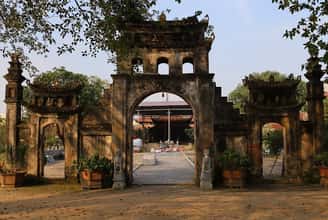
Ong Pagoda
Ong Pagoda, also known as Ban Tich Tu, is located in Binh Luong village, Tan Quang commune, Van Lam district. The pagoda has an ancient and sacred beauty, built during the reign of King Ly Than Tong and is now nearly 1000 years old. This is the pride of Van Lam people in particular and is a historical and cultural relic with long-standing value of the land of Hung Yen. About 19km from the center of Hanoi capital, along Highway 5 direction Hanoi - Hai Phong, turn right into Binh Luong village, Tan Quang commune (Van Lam district) is an ancient pagoda called Pagoda by the people here. Grandfather. According to the pagoda's stele (now only the waterfall is currently stored at the Institute of Sino-Nom Studies), the pagoda was built during the reign of King Ly Than Tong (1128 - 1138). The stele bears the symbols 5527 - 5528, on the forehead of the stele is the title: The Self is Compassionate, the date of the stele is the 20th Le Chinh Hoa period (1644), the stele's content records the worship of Zen Master Tu Dao Hanh and the meaning of the stele. Named the pagoda Ban Tich pagoda. Ong Pagoda under the Le Dynasty was located in two villages: Binh Luong and Luong Xa, Dinh Loan commune, Gia Lam district, Thuan An district, Kinh Bac region. In the 13th year of Minh Mang's reign (1834), Bac Ninh province was changed. At the end of the Nguyen dynasty, it was called Van Lam district, Hung Yen province. In the pagoda, there is still a bronze statue of Zen Master Tu Dao Hanh, King Ly Than Tong (5th generation of Ly Dynasty - also the incarnation of Tu Dao Hanh after his death at Thay Mountain). The pagoda is arranged harmoniously and proportionally in the Tam style including the following categories: front hall, middle hall and back palace. In 1938, the pagoda was restored and re-embellished, the structure of the rafters is in the style of stacking smooth planed beams with patterned spots. The entire frame and columns of the ancient pagoda are made of solid ironwood, combined with elaborately carved ancient architecture, giving the front hall a solid and highly artistic position. Coming here, visitors will admire the ancient beauty of the temple with very elaborate and unique artistic architecture. Entering the temple gate is a peaceful, quiet space with a quiet mossy temple roof. According to history books, Ong Pagoda was built by King Ly Than Tong in the spring. Therefore, every spring, the people of Binh Luong village in particular and the people of Tan Quang commune along with tourists from all over gather here to celebrate and hold incense offerings to commemorate those who have contributed to fighting the enemy and defending the country. , built a temple. The traditional festival of Ong Pagoda takes place on 3 days, from March 7 to March 9 (lunar calendar), of which March 9 is the main festival. In 2001, the Pagoda was ranked by the Ministry of Culture and Information as a national architectural and artistic relic, the pride of Van Lam people. Source Department of Cultural Heritage.
Hung Yen
6744 view
Rating : National monument.
 AI Travelviet