
 vn
vn en
en ja
ja ko
ko zh
zh
















List of relic sites (1478)

Mount Sua Temple
Mount Sua Temple is located on top of Mount Sua in the western area of Thang Long citadel of Thap Tam Trai land, now in Bach Thao Park, Ngoc Ha ward, Ba Dinh district. The temple worships Huyen Thien Hac De - the god who assisted Ly Thanh Tong in fighting the Champa invaders, fighting against foreign invaders, and protecting the independence and autonomy of the nation. The temple was built in the 19th century. According to the legend of Huu Tiep village, before the Ly dynasty, in Sua mountain area, Quang Duc district, Phung Thien district of Thang Long citadel, there was a famous chief named Ly Phuc, married to Hoang Thi Duc from the area. The couple has a rich family background, is tolerant in nature, cultivates virtue, and often takes care of the poor and destitute. There's nothing I don't try to do when it comes to helping people. The only thing is that the couple was three weeks pregnant and still had no children, so they immediately went to the One Pillar Pagoda to pray day and night with incense lamps without end. One day, in the dark temple, suddenly I saw a halo of light shining brightly in one corner, shaped like a torch. The couple dreamed of a white-haired and bearded mandarin holding a baby boy and giving it to his grandparents, saying that this child was the third child of the Jade Emperor, and because he was guilty of breaking the jade cup in heaven, he had to be born. earthly. Now seeing that the couple's family is blessed, Hoang Thien has decided to reincarnate as your child. Saying this, the couple hugged the baby and saw the mandarin fly into the sky and disappear. When they woke up, they knew it was a good dream. Three days later, the wife knew she was pregnant, and since then she has been vegetarian. On January 19, the year of the Tiger, she gave birth to a baby with a handsome face like the one in her dream, with dark skin and an extraordinary appearance. The boy had honey-colored skin. When he was three years old, his family had a ceremony to name him Hac Cong. In that same year, unfortunately, his mother passed away. When he was eight years old, Hac Cong accidentally slipped and fell from a tree and transformed on November 21. The villagers took pity on those who died young, so they set up a shrine on the mountain, and people worshiped in large numbers because their prayers would be fulfilled. When King Ly Thanh Tong led his army to defeat the Champa invaders on the southern border, he dreamed at night that there was a black-skinned boy asking to come and help the King save the country. When entering the battle, the King saw dark clouds covering the sky, covering the enemy's eyes. The great victory contributed to keeping Dai Viet peaceful. The king thought that the dream corresponded to the dream of meeting an angel, so he gave the Han Xuan page 100 francs of money, rebuilt the temple on Sua mountain, and appointed the god Huyen Thien Hac De as the Supreme God of Happiness, everywhere in the Huong region. smoke of worship. The Sua Mountain Festival is held every year on his birthday - January 19 of the lunar calendar. In 2015, Nui Sua Temple was ranked as a historical, cultural, architectural and artistic relic. Source: Electronic information portal of Ba Dinh district, Hanoi city.
Hanoi
5270 view
Rating : National monument

Ngu Xa Pagoda
Ngu Xa Pagoda, whose literal name is Than Quang Tu or Phuc Long Tu, is located on Ngu Xa Street, Ba Dinh District, Hanoi, and was built in the Later Le Dynasty, 18th century. After a fire in 1949, the pagoda was rebuilt and completed. Founded in 1952. The pagoda is a place to worship Buddha and bronze casting founder Nguyen Minh Khong of Ngu Xa bronze casting village. Ngu Xa Pagoda consists of 2 adjacent buildings shaped like a "Nhi letter" connected to the Ta Vu house adjacent to the martyrs' memorial and the back of Ngu Xa communal house. The front hall on the upper floor consists of 5 compartments, the middle compartment is the main shrine of the Three Jewels, two corridors lead to the incense burning court and the harem has a pair of statues of the Dharma Protector standing guard, 2 outer compartments worship the Saint Tang and the Monsignor. The upper floor of this house has 3 worship rooms, the middle room worships the Holy Mothers, the left room worships Quan Tam Thanh, the right room worships the Patriarch. The Buddha hall is solemnly decorated, the main hall has a giant Amitabha Buddha statue, a famous work in many aspects. What is special is that the amount of bronze used to cast the statue was taken from statues honoring the colonial regime erected by the Protectorate government in flower gardens in Hanoi city. They are the statue of Governor-General Paul Bert in the Paul Bert flower garden (today's Ly Thai To flower garden), the Statue of Liberty in Cua Nam flower garden and the Canh Nong statue in the Robin flower garden (today's Lenin flower garden). The Amitabha Buddha statue currently located at the pagoda is the oldest bronze Buddha statue in Vietnam still kept and was confirmed by the Vietnam Record Book Center in 2010. In addition, the pagoda also preserves an incense burner worshiping Avalokiteshvara Bodhisattva and 16 stone stele built from 1919 to 1947. On May 11, 1993, Ngu Xa Pagoda and Ngu Xa communal house were ranked as National Architectural and Artistic Monuments by the Minister of Culture and Information. Source: Electronic information portal of Ba Dinh district, Hanoi city.
Hanoi
4585 view
Rating : National monument
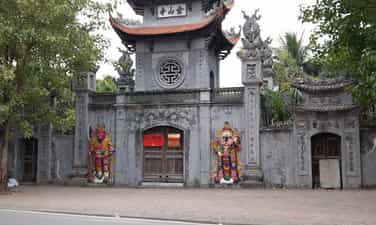
Kim Ma Pagoda (Kim Son Pagoda)
Kim Son Pagoda, also known as Tau Ma Pagoda, or Kim Ma Pagoda, was built during the Tay Son Dynasty, located at 73 Kim Ma Street, Ba Dinh District, Hanoi. During the Ly Dynasty, the Kim Ma area was a place of execution, this place became a cemetery, people in Kim Ma village established a small temple to worship. At the end of the Le - Trinh period, when Nguyen Hue defeated the Qing army in 1789, tens of thousands of bodies of Tay Son soldiers who died in the battle of Dong Do citadel were also buried here; The temple was restored and named Van Linh hermitage. During the reign of King Tu Duc of the Nguyen Dynasty, in 1881, the people of Kim Ma village contributed to repairing the pagoda and called it Tau Ma pagoda. In the main hall, Buddha statues were erected and the Van Linh altar tablets were moved to both sides. In 1898, the pagoda changed its name to Kim Son Tu. In 1932, the villagers rebuilt and expanded the pagoda, separating the three Tam Bao buildings, the Mother Goddess Temple and the Van Linh altar. During the French temporary occupation of Hanoi, due to the need to re-plan the city, in 1952 the remains in Kim Ma cemetery had to be moved to Yen Ky cemetery (Son Tay). In 1972, Linh Son Pagoda on Nguyen Truong To Street was destroyed by American bombs, all 6 Buddha statues had to be moved to the Van Linh altar and are worshiped until now. In 2011, a memorial stele house for Tay Son martyrs was built next to the Van Linh altar on the left side of the pagoda yard, with its back against the long wall along Kim Ma street. The stele and stele base were made by artisans of Binh Dinh province on a solid red stone slab taken from the mountains of Tay Son district. The pagoda was built in the style of "domestic and foreign" and has bold artistic features of the late Nguyen Dynasty. The Five Gates Gate is about 50m from Kim Son Pagoda and was built in 1953. The Kim Son Pagoda shrine area includes three three-room houses built next to each other. In the middle is the Three Jewels temple worshiping Buddha, on the right is the Van Linh altar, and on the left is the Mother Goddess temple. Inside the Three Jewels there are many horizontal panels, parallel sentences and stone steles. The great painting "Golden Mountain Co Sat" hangs in front of the main hall. In the hall, there are 21 Buddha statues arranged in 4 floors, above are 4 elaborately carved hammock doors. In addition, at Tam Bao there is a monolithic bronze Buddha statue, considered a masterpiece of Buddhist art, 77cm high and weighing over 30kg. The statue is shown in an upright position with the hand holding the "no comrade" seal on a nearly square box-shaped pedestal, molded in one piece with the statue. The front of the pedestal has an engraved Sanskrit text. Kim Son Pagoda has an important history in Buddhist history in particular and national history in general, contributing significantly to the study of the history of formation and development of Thang Long capital. In 1985, Kim Son Pagoda was ranked as a national historical and cultural relic. Every year, on the 5th day of the first lunar month, the death anniversary of the Dong Da battle, the pagoda sets up a vegetarian altar to worship the souls of the soldiers who sacrificed their lives for the country. Source: Electronic information portal of Ba Dinh district, Hanoi city.
Hanoi
5267 view
Rating : National monument

Hoe Nhai Pagoda (Hong Phuc Tu)
Hoe Nhai Pagoda (also known as Hong Phuc Pagoda) is located at 19 Hang Than, Nguyen Trung Truc Ward, Ba Dinh District, Hanoi. This is the largest pagoda in the ancient capital of Thang Long, said to have existed since the Ly Dynasty. According to the stele of the 24th year of Chinh Hoa (1703), originally built in the early 11th century, Hong Phuc Pagoda was destroyed by war. Until the end of the 17th century, there was a nanny of King Le Hy Tong. A native of this ward came forward to rebuild it, then invited Venerable Thuy Nguyet - the first founder of the Taoist sect to become an abbot. The pagoda has been considered the ancestral temple of Northern Buddhism in particular and Vietnam in general since the 17th century. The pagoda has an area of about 3,000 square meters, the door faces west, the outermost is the four-pillar flower-style three-entrance gate, this is typical of Nguyen Dynasty architecture. In the pagoda yard, there are two 3-storey towers commemorating the monks who have passed away, and to the left corner in front of the pagoda, there is a new An Quang tower built in 1963 to commemorate Venerable Thich Quang Duc who self-immolated in Saigon to denounce crimes. of the US-Puppet regime's suppression of Buddhism. The pagoda is the place of origin of two National Masters, five Supreme Patriarchs and the Dharma Master. The pagoda bears the mark of the First Dharma Master of the Vietnam Buddhist Sangha, the late Venerable Thich Duc Nhuan. After the August Revolution of 1945, at the temple's Patriarch's house, a meeting of the capital's Buddhist monks and nuns took place to send a delegation to meet the government of the Democratic Republic of Vietnam. This is also the place where the Buddhist Association for National Salvation was founded and Venerable Thich Duc Nhuan - Dharma Head of the Vietnam Buddhist Association also once abbot at this pagoda. In addition, the pagoda is also famous for many ancient statues, including the "king carrying Buddha" statue, which is unique in both architecture and history. According to researchers, the origin of the statue dates back to the reign of King Le Hy Tong (1663 - 1716), the 10th king of the restored Le Dynasty. In 1678, the king implemented a very harsh anti-Buddhist policy, causing Buddhism during this period to fall into tragedy. Zen master Chan Dung Tong Dien, the second Patriarch of the Soto Zen sect in Vietnam, saw this and presented the king with a box that he said was a precious jade, but inside was actually a note recording the benefits to society. Buddhism brings. Legend has it that after reading it, the king suddenly woke up and immediately invited the monk into the court to bow down and apologize, revoking the decree banning Buddhism. Perhaps stemming from the above story, later generations sculpted a statue of a king in a prostrate position, with Buddha sitting on his back, and placed it in the temple. This is a unique statue among Buddhist sculptures. Hoe Nhai Pagoda was ranked as a national monument on January 21, 1989. The pagoda is an attractive destination for domestic and foreign tourists. In particular, on the occasion of the beginning of the new year, reciting the Medicine Sutra, praying for peace to sentient beings, Buddha's birthday, the full moon day of the 7th month to forgive the sins of the dead, many formal Buddhist ceremonies are held at the pagoda. , sacred attracting thousands of visitors to worship Buddha, visit and admire. Source: Electronic information portal of Ba Dinh district, Hanoi city.
Hanoi
5100 view
Rating : National monument

Chau Long Pagoda
Chau Long Pagoda's name is Chau Long Tu. In the 19th century, the pagoda was located in Chau Long village, An Thanh district - Vinh Than District - Hoai Duc Phu. Now belongs to Chau Long street, Truc Bach ward, Ba Dinh district - Hanoi. (New address No. 112 Tran Vu Street - Truc Bach - Ba Dinh - Hanoi). Chau Long Pagoda is a Buddhist architectural facility located on ancient land, closely linked to the history of existence and development of the capital city of Thang Long. The pagoda is located on a high mound overlooking Truc Bach lake. The pagoda is shaped like the letter Dinh, in front is the front hall, behind is the back palace. In the pagoda there are eight hammock doors intricately carved with images of dragons, cups, tortoises, phoenixes, flowers, leaves, clouds... as well as many horizontal panels, parallel sentences and Buddha statues. The pagoda currently has 5 front halls, 3 mallet rooms, 8 sets of gilded carved hammock doors, a set of worship statues including 23 statues, an altar set, horizontal panels, parallel sentences, and bronze bells all of high artistic value. In particular, the two statues of Manjushri riding a green lion and the statue of Pho Hien riding a white elephant are both rare bronze statues. In addition, the pagoda also has a statue of the World-Honored One over 3 meters high, covered with clay, a bronze statue of Maitreya, and 10 statues of the King of Hell with beautiful artifacts. Inside the pagoda there is also a bronze bell transferred from Vinh Phuc Pagoda. In addition to the three jewels worshiping Buddha, the pagoda also has a Mother Goddess shrine including 3 statues of Tam Phu, 3 statues of Quan Hoang, statue of Lady Thuong Ngan, 1 statue of Master Bodhidharma and 1 statue of Bodhisattva Guanyin. In addition, there is also the Patriarch's house, kitchen, monk's house... The pagoda was restored and repaired many times. During the Nguyen Dynasty, the pagoda was greatly restored in the year of Mau Thin (1808) during the reign of King Gia Long; In the year of Tan Suu under the reign of King Thanh Thai (1901) and in the year of Nham Than under the reign of King Bao Dai (1932), the pagoda still retains its ancient features, preserving many statues as well as worshiping objects and decorations of artistic value. It is as tall as a beautiful sculptural architectural relic, including pillars and a system of hammock doors carved with images of the four sacred animals "Dragon, Ly, Quy, Phuong", flowers, birds, geometric patterns of clouds... especially the statue of newborn Sakyamuni is a masterpiece. quite unique creation. The Buddha statue is also a tall statue rarely seen in the system of statues of the same type in pagodas in our country. Chau Long Pagoda is like an ancient fine arts museum in the capital city of Thang Long, reflecting the talents of artisans in history. . The pagoda was ranked by the State as an Architectural Art Monument on February 5, 1994. Currently, Venerable Thich Thanh Phuc - member of the Executive Council of the Vietnam Buddhist Sangha Central Committee - Deputy Executive Committee of the Hanoi Buddhist Sangha, current Abbot. Source: Electronic information portal, Truc Bach ward, Ba Dinh district, Hanoi.
Hanoi
4772 view
Rating : National monument

Vo Vi Pagoda
Vo Vi is an ancient pagoda built in 968. Although it has a history of more than 6 centuries, Vo Vi pagoda is not known to many people, and around the pagoda is often quiet and peaceful. About 25 km from the center of Hanoi, Vo Vi Pagoda is located on a rocky mountain about 300 m high, surrounded by trees and lakes. The pagoda is surrounded by dozens of tall, rough frangipani trees, casting a shadow that obscures the entire small pagoda. During the blooming season, the scent of flowers lingers as if leading people into a place of leisure and pleasure, the space is as quiet as space. Legend has it that Vo Vi is an ancient pagoda built in 968. During the Early Le Dynasty, the pagoda was built at the foot of Mount Trao (980-1004) and was called Phuc Tru Tu. During the Tran Dynasty, the pagoda was built on the back of the mountain called Trai Tinh Tu. During the Later Le Dynasty, the 6th year of Hong Thuan (1514), the pagoda moved to near the top of the mountain like today, and changed its name to Vo Vi Tu as in the Dinh Dynasty. Vo Vi Pagoda is associated with general Tran Van Tang, who became a monk at a young age. After fighting against internal and external enemies, he went to Vo Vi mountain to build a temple in hiding. As a person imbued with Taoist ideology, he named the pagoda Vo Vi with the spirit expressed in the poem "Duplicate Vo Vi Tu" composed by himself and engraved on stone. Stepping through the arch of the gate with three Chinese characters "Vo Vi Tu", a small road with stone steps takes visitors to the front hall, model house, and then the main hall. Only about a few hundred steps, but the path to Vo Vi pagoda is not too easy, the higher you go, the narrower and steeper it gets. Unlike the usual large-scale pagodas, Vo Vi Pagoda is more than 10 square meters wide, the design does not follow the usual rules of Dinh shape or foreign Noi Cong, but is only modest with a single compartment and tiled roof. Comedy nose with simple columns and small beams of wood and stone. In the temple, there are only the Three Jewels and statues of Buddha and saints. On both sides are two majestic Dharma Protectors. On the side of the church is a small, craggy path along the mountain. The space behind opens to a small floor designed with a curved roof, bricks, and many pillars, like a meditation place for monks. Right next to it is Vo Vi mountain with Nghenh Phong pavilion at the top, where there is also a small bell cast in 1814. Next to the side of the pagoda is a small path that can only fit one person, leading to Nghenh Phong floor. Looking down from above, the layers of roofs skillfully alternate like a link between Vo Vi Pagoda and this attic for centuries. A special feature of Nghenh Phong floor is that on the top of the roof there is a yin and yang image of Lac Viet inside the eight trigrams. This image is drawn on two halves of pink bricks assembled so that from this central point, the beams, columns, and rafters radiate down according to strict architectural rules. The yin and yang image of Lac Viet is the pride of the cultural identity of the Vietnamese people, a small motif but strong enough to affirm the nationality and independence of Vietnamese culture, and cannot be mixed with any other culture. transformed. From Nghenh Phong tower, to reach the highest peak of Vo Vi mountain, visitors must climb about twenty steep stone steps and crawl through narrow rock crevices to reach the top. Around Vo Vi Mountain is a peaceful village scene. In the middle of empty air, the temple bell suddenly rang, making people's hearts flutter and reflect on the philosophy of "no action" for which the Taoist named the temple. Source: Electronic information portal of Chuong My district, Hanoi city.
Hanoi
4780 view
Rating : National monument

Tram Pagoda
Tram Pagoda is located on Tram Mountain, also known as Tu Tram Son, in Phung Chau commune, Chuong My district (Hanoi). Tram Pagoda has a long history, founded by General Tran Van Tang around 1515 of the 16th century. Tram Pagoda was also honored to welcome Uncle Ho to visit 3 times. The Tram Pagoda relic complex is the place where, more than 77 years ago, President Ho Chi Minh read a call for national resistance with the words that have become sacred words: "We would rather sacrifice everything than the first." determined not to lose our country, determined not to be slaves." More than three-quarters of a century has passed since President Ho Chi Minh called for nationwide resistance on December 19, 1946, and the historical relic of Tram cave is still protected and preserved intact. This place has welcomed President Ho Chi Minh three times, including twice when he called for resistance in our nation's two resistance wars against the French colonialists and the American imperialists. The call for national resistance in 1946, to prepare for the long-term resistance war against the French, in which the especially important task is to continuously maintain national awareness, in order to fully and promptly convey policies, The leadership of President Ho Chi Minh, the Party and the State at that time reached the people. According to the direction of the Party Central Committee, the Voice of Vietnam chose Tram cave as its workplace since the end of 1946. until early 1947. At Tram cave, on December 19, 1946, through the morning light of the Voice of Vietnam, President Ho Chi Minh read a national call for resistance with the immortal words: "We would rather sacrifice everything than absolutely I refuse to lose my country, I definitely refuse to be a slave." That sentence resonated in all parts of the country and entered the minds of more than 30 million Vietnamese people (at that time) like a summons. Immediately after Uncle Ho's call for nationwide resistance, on December 20, 1946, the army and people of Hanoi capital fired the first shots to attack the French colonialists who returned to invade our country. Also here, on New Year's Eve of the Year of the Pig in 1947, President Ho Chi Minh read a New Year's greeting to compatriots, soldiers nationwide and our compatriots abroad via the Voice of Vietnam. At the entrance of Tram cave, there is still a broadcasting tower marking the period of operation of the Voice of Vietnam, which is also an important historical milestone in the struggle for independence of the Vietnamese people. The call for resistance against America to save the country in 1966, when the war against America entered its most difficult and fierce time, on July 3, 1966, Tram cave once again welcomed Uncle Ho to write the Call for Resistance. fight against America to save the country, prepare for the special political conference of the Party Central Committee with the immortal declaration "Nothing is more precious than independence and freedom". While working here, on the cliff of Tram cave, President Ho Chi Minh wrote couplets in Chinese characters praising the beauty of Tram mountain. He advised the Party Committee and local authorities to carry out welfare projects to serve the people's lives as well as serve the long-term resistance war. With particularly important historical significance, in 1962 the Tram Pagoda relic complex, including Tram cave, was recognized as a National Historical Site. Tram Pagoda and Tram cave today are chosen by many people throughout the country as spring vacation destinations at the beginning of the new year because in addition to spiritual elements, this place also holds great historical value during the two resistance wars for independence. of the Vietnamese people. Source: Electronic information portal of Chuong My district, Hanoi city.
Hanoi
4987 view
Rating : National monument

Hundred Gian Pagoda (Quang Nghiem Pagoda)
Hundred Gian Pagoda, also known by other names as Quang Nghiem Pagoda or Tien Lu Pagoda, is classified as one of the "four great landscapes of Doai". This is an ancient pagoda dating back to the Ly Dynasty, located on a hill about 50m high, in Chuong My district, Hanoi. Construction of Hundred Gian Pagoda began around 1185, under the reign of King Ly Cao Tong, associated with the legend of Thanh Boi. Due to the impact of time, the temple has been restored many times and has the same appearance as it does today. The pagoda has a total of 104 compartments, divided into 3 main architectural clusters, perhaps that is why the pagoda is called Hundred Gian. The Hundred Gian Pagoda is associated with the legend of Thanh Boi. Legend has it that during the Tran Dynasty, in Boi Khe village, there was a woman who dreamed of the Buddha and gave birth to a son. His parents died when he was young, and his son became a monk at Dai Bi Pagoda in the village. During his studies at the temple on the mountain, he mastered many magical powers. After being ordained by King Tran as Venerable in the capital, he asked the king to return to the village to build a new temple. At the age of 95, he sat in a wooden inlaid box of transcendence. After 100 days, the disciple opened the wooden inlay and saw a sweet fragrance filling the entire area. Seeing this, the villagers and disciples built a tower to worship Saint Boi. Currently, the Hundred Gian Pagoda is considered one of the four most famous and sacred pagodas in Doai, next to the Thay Pagoda, Tram Pagoda and Tay Phuong Pagoda. According to the Quang Nghiem stele, built in the year Hoang Dinh 4 (1603), this pagoda is the most beautiful in Quoc Oai palace. In recent decades, the temple has been continuously renovated and embellished but basically still follows the old style. Because of its outstanding values of architecture and sculpture, in 1962, the Hundred Gian Pagoda was ranked by the Ministry of Culture, Sports and Tourism as a national historical and cultural relic. Source: Electronic information portal of Chuong My district, Hanoi city.
Hanoi
4834 view
Rating : National monument

Cu Da Pagoda - Linh Minh Tu
Cu Da Pagoda dates back to the 17th century. Font name: Linh Minh Tu. Cu Da Village is the name of one of three villages Khuc Thuy, Khe Tang, Cu Da, in Cu Khe commune, Thanh Oai district, City. Hanoi. Of these three villages, Cu Da is the oldest. This place is not only known for its two traditional occupations of making vermicelli and soy sauce, but also for its architecture. Outside the village gate and hamlet gate, villagers today still preserve ancient communal houses, pagodas, temples and some houses with hybrid French-style architecture from hundreds of years ago. Cu Da Pagoda's literal name is Linh Minh Tu, built a long time ago but no one remembers exactly when. According to the remaining epitaph, the pagoda occupies a good feng shui position: behind is a pile of old mountains like that, to the east is a gathering of residents, on the left is the Dinh family street, on the right is a temple worshiping the Tutelary God, in front There is Nhue river. In the spring of Chinh Hoa 16 (1695), Cu Da Pagoda, with 3 compartments and 2 wings, was restored for the first time by Master Thich Duy Nghiem and Chief Ly Trinh Dang Long. In the fall of the 32nd year of Tu Duc (1879), the pagoda was expanded by Master Thich Tinh Doan on a larger scale than before, including 5 front halls and 3 back halls. The current abbot of the pagoda is Venerable Thich Tien Dat, Standing Deputy Head of the Legal Department of the Vietnam Buddhist Sangha. In Decision No. 06 QD/BVHTT dated April 13, 2000 of the Ministry of Culture and Information, Cu Da pagoda was ranked as a national architectural and artistic relic. On November 2, 2014, Cu Da Pagoda inaugurated a new restoration. The pagoda has since continued to complete the project with 2 stone wells inside and outside the front yard, and a side gate on the west opening to the land with the village fields. The eastern side gate connects to the main walkway towards the railway bridge. The pagoda's main gate is a narrow three-door gate, facing south, looking through two large Muom trees to the Nhue River. Visitors enter the pagoda yard and then pass three more ancient trees to reach the dragon steps of the main pagoda, with a statue of a pair of elephants kneeling on stone pedestals on both sides. The front hall is built with 5 wooden doors with table tops, gabled ends, connected to the upper palace in the shape of a "Ding letter", on both sides there are side doors leading into 2 corridors running along the upper palace and then extending to the rear hall. On the right side of the main pagoda there is the Ancestral Hall parallel to the school, each with 5 rooms; Behind is the tower and entrance to the guesthouse; In front is a 2-story communal house with 8 floors and 16-column roof, with a large bell tower overlooking a small 3-compartment house with 10 assorted back steles, and further away is a temple worshiping the Thanh Hoang. On the left side of the main pagoda, there is a dance hall and a statue of Guanyin Nam Hai standing in a small 2-storey, 8-roof and 4-column floor, behind the floor is the Mother House and the Monk's house. Source: Electronic information portal of Phu Dien commune, Thanh Oai district, Hanoi city.
Hanoi
3681 view
Rating : National monument

Canh Hoach village communal house
Canh Hoach communal house, Dan Hoa commune, Thanh Oai district is one of the historical and cultural relics dating back to early construction, valuable in many aspects of research. Today, although the relics no longer retain their former grandeur, the historical, architectural, and artistic values are still preserved intact and have many values in many aspects in the relic treasure trove. national culture. Canh Hoach communal house was recognized as a national relic in 1991. According to the elders, in the past, Canh Hoach village had three communal houses: Ca communal house, Diec communal house and Trung communal house. Through many historical events, Ca communal house and Diec communal house were damaged, only Trung communal house remained. The villagers moved the worshiping objects and the ordained genealogies of Ca communal house and Diec communal house to Trung communal house for joint worship. Canh Hoach's traditional name is Vac village, so the village communal house is also called Vac communal house. The communal house is located on high land in the middle of the village, facing west overlooking Highway 21B. According to the genealogical book, Canh Hoach communal house worships three people: Hung Ly, Cao Han and Tran Quoc Uy. The first tutelary deity was Hung Ly Dai Vuong, originally a prince, the son of Hung Doan Vuong's sixth concubine. When he grew up, he had many talents and was appointed by his father to be the governor of Tam Giang. The second tutelary deity was King Cao Han, at the same time as King Hung Ly. When Van Lang country had an enemy, Cao Han was assigned by the king along with Hung Ly to join forces to fight the enemy in the Tam Giang region. The third tutelary god is Tran Quoc Uy, son of Hung Dao Dai Vuong Tran Quoc Tuan. He was originally a smart and studious person, passed the university entrance exam and was appointed by King Tran as a mandarin, held a military position, and had merit in fighting the Mongol-Nguyen invaders who invaded our country. The overall layout of the relic includes the communal house gate, communal house yard, two houses on the left and right, the main worship house, the central palace and the harem. First, the communal house's gate was built in the style of four flower-shaped pillars to create an entrance for villagers to enter the holy ceremony. The four pillars are built of brick into a tall square block, divided into three parts: base, body and top. The cupped base creates a solid position for the body and pillar. The body of the pillar is built of a rectangular box, in addition to decorative edges, inside is written a couplet praising the traditions of the homeland and the merits of the Tutelary God. On the pavilion are placed lantern boxes and flowers with stylized petals of the four seasons: Spring, Summer, Autumn, Winter, praying for good weather and good crops. Next is the communal house yard paved with red bricks, opposite the communal house yard there are two houses, left desert and right desert. Both houses have three rooms, built with bricks, gabled walls, thin tiled roofs, and architectural structures made in the style of hitchhiking bridge trusses, favoring round and sharp planing. The main architectural works include the main worship house, the central palace and the harem with a connected structure in the Cong style. The main house in front has a rectangular-shaped structure with five rooms, the gable walls are made of bricks with square dowels, and the two roofs are tiled. The architectural frame of the house has three rows of round wooden pillars that support the sets, made in the style of stacking beams, gong racks, and seven porches. Next is the central palace house, the bridge house connecting the main hall with the harem, with three narrow rooms. Next is the three-compartment harem house shaped like a letter running parallel to the main worship house. This house is surrounded by brick walls, the gables are covered with square dowels, and the two roofs are tiled. Regarding the internal architecture of the three houses, they all have the same style: the house frame is made of wood, four rows of round columns, and the rafters are in the style of upper and lower beams. Regarding sculpture and art on the wooden architectural layers, there are stylized flowers and leaves, dragon-shaped leaves bearing the artistic style of the late Nguyen Dynasty, such as the inscription on Thuong Luong stating that the communal house was built in 1912. The communal house is still preserved. gathered many worship objects from three communal houses. Among them, there are two incense burners of the Nguyen Dynasty carved with dragons, phoenixes, and stylized flowers and leaves. A letter book on the outer edge has carved lines with four-quarter patterns. Inside, there is a poem painted in five-word form. eight owls with the content of praising the merits of the Tutelary God. In particular, the communal house still preserves 9 ordinations and a genealogy book recording the stories of the gods worshiped as Tutelary Gods of Canh Hoach village. Regarding festivals, in the past, Canh Hoach village festival was from the 11th to 13th of the third lunar month. In the past, the form of organizing the festival was as follows: On March 11, the villagers held a procession of three palanquins for the tutelary god, the palanquin of the Holy Elder Trinh Ly went first, followed by the palanquin of the Holy Hai Cao Han and the palanquin of the Holy Ba Tran. Uat from the communal house down to the palace gate entered the communal house to process the tutelary gods to the communal house. After that, the village used a palanquin to carry the incense bowl of Nguyen Duc Luong Poinsettia from the Nguyen Poinsettia Church and then process the incense bowl of Thuong Quoc Cong at Sac communal house to Dun communal house to enjoy the community offerings. On March 13, the villagers held a colorful procession, receiving incense bowls and incense sticks, and Duke Thuong Quoc returned to the palace. Source Electronic information portal of Dan Hoa commune, Thanh Oai district, Hanoi city
Hanoi
3896 view
Rating : National monument
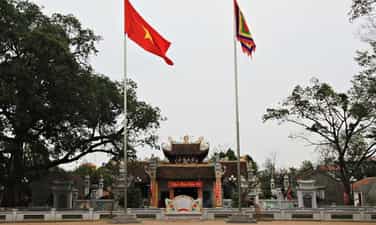
Noi Binh Da Temple
Noi Binh Da Temple worships the Father of the Nation Lac Long Quan (from legend to later history) located in the Red River Delta in Bao Cuu commune - Phu Ung Thien - Do Dong Giang (now Binh Da village - commune Binh Minh - Thanh Oai district - Hanoi city). The temple faces west, with Tam Thai mountain in the southwest (now called Ba Go area). According to local legend and the remaining ancient vestiges, this is the place where the tomb of Father Lac Long Quan is located. Noi Temple was built in ancient times, going through many ups and downs of history, the mark of time is only left through the steles of the Ly and Le Trung Hung dynasties. During the reign of Khai Dinh (1918), the temple was restored on a grand scale. Through many times of restoration and restoration, from 1980 until now, with the attention and leadership of the Party and local authorities, the cultural sector at all levels along with the merits of hundreds of families and overseas Vietnamese in our country. Outside, the people of Binh Minh commune rebuilt the Temple on the old sacred foundation. Especially from 2009 - 2010, on the occasion of preparing for the Great Thang Long Millennium Celebration, Noi Temple received the attention of Party, State and Government leaders at all levels, investing in large-scale restoration and completion. adjusted, becoming a splendid historical-cultural relic, in a spacious cultural space and attractive to tourists from all over. Located in a 10,000m2 campus on a turtle-shaped high-arched land (Hoang Quy Cung), head facing the rising sun, where the Nhue River curves softly like a silk strip across vast rice fields, facing the river, The world resembles the shape of two phoenixes meeting a concubine. The temple door looks to the West, the fields rise up to Ba Go (also known as Bao Hoa, Tam Thai) shaped like a tiger in uniform. Legend has it that this place is the burial place of Lac Long Quan, in the distance the shimmering Singing stream has the color of orange. rocks, soft banks of rice and corn, looking up at Tan Vien with a green color that seems to challenge time, thirsty sunlight, and steady rain. In the south, the Do Dong stream originates from the Hat River like a jade belt, circling and flowing down the middle of the village, becoming a sacred vein, rising up two alluvial terraces to nourish the people and becoming a silent sacred river through generations. . Along with that, water from 6 directions flows to Dinh Gang and Cau Hoi like winding dragons (six dragons flanking Hoi). North of But Moc Pagoda is located in the middle of the vast Co Loi field, where there are hidden precious heritages from the time when the Hung Kings built the country (bronze drums, golden betel, and golden areca nuts were found in 1984). Could it be that the sacred energy of rivers and mountains has converged here to create a sandy area! The temple was built in the style of the Dinh script, surrounded by brick walls, the harem housed Lac Long Quan's throne, the second palace placed worshiping objects (sacrifices), followed by the great communal house (daily worship) where ceremonies were held. On both sides, the majestic road covers a large brick yard, shaded by trees in all four seasons. In front of the noon gate is an outer courtyard next to a 500m2 lotus pond filled with incense offerings. These buildings are all spaciously built with a strong oriental identity. The precious thing in the Temple is that it still preserves many precious antiques such as: genealogies, ordinations, inscriptions, bronze bells, sacrificial objects, horizontal plates, couplets, literature, etc. In particular, the temple has a bas-relief, an unforgettable impression with delicate carvings on a wooden base painted with gilded vermilion and still intact, said to have been created nearly ten centuries ago. The painting depicts the scene of Lac Long Quan and martial arts officials watching the boat racing festival. It is the crystallization of the nation's culture of thousands of years. The potential for tangible and intangible cultural values of Noi Temple was granted a relic status by the Ministry of Culture and Information (now the Ministry of Culture, Sports and Tourism) on March 13, 1985. * The statue's bas-relief Located in the front of the solemn and majestic harem is a rare, majestic and splendid relief, 2.8 meters long and 2.2 meters wide. The relief has 5 floors. Up there, in the front row, there were twenty mandarins wearing robes, carrying pots in their hands, and wearing dragon-winged hats on their heads. Sixteen military mandarins carried heroic belts and rulers, holding dragon swords. Eighteen maids wearing thin, soft, pleated ao dai are offering trays with all kinds of flags, scatterings, umbrellas, and parasols. There are also elephants, horses and a group of militiamen holding fruit offering trays. In front of the rows of people is a vast stream of water showing dragon boats with curved noses as if they are breaking the waves and rushing fast. Legend has it that this relief was started during the Dinh Dynasty, when Dinh Tien Hoang became king and built Thuong Temple in Phong Chau to worship the Hung Kings with the beautiful words: "Hung Vuong Son Nguyen Thanh To". He assigned Queen Dan Gia and Dinh Quoc Cong Nguyen Bac the responsibility, along with the Ministry of Rites, to recruit skilled workers to craft this statue. This is an extremely unique and rare work of ancient art and belief, if not the only one currently available among spiritual cultural relics in Vietnam. The value of the statue has made an important contribution to creating the overall value of the Noi Temple relic, which worships the National Patriarch Lac Long Quan in Binh Da. Previously, the Binh Da Traditional Festival was officially opened from February 24 to the 6th of the third lunar month every year. In recent years, according to the Government's Festival Organization Regulations, the Lac Long Quan National Ancestor Temple festival in Binh Da, Binh Minh commune, Thanh Oai is only open for 3 days, from the 4th to the 6th of the third lunar month. every year (common for both Inner Temple and Ngoai Communal House). The 4th day of the 3rd lunar month is the day of the lunar cycle of blessings (that is, offerings to pray for blessings at both Temples); On the 5th day of the 3rd lunar month is the day of procession and ceremony, making holy cakes according to legend to offer at the Temple for the Trao ceremony. On the evening of the 5th day of the 3rd lunar month, at the time of death, the ceremony is held at the Noi Temple to harmonize yin and yang. fit; 6th day of the 3rd lunar month: morning community sacrifice (offering to the National Ancestor and Duong Canh Thanh Hoang), procession of holy bread to Ngoc well to release and then fall into Thien Quan outdoor. In the afternoon is the Hoan Cung procession (carrying Duong Canh Thanh Hoang to the Ngoai temple). The potential tangible and intangible cultural value of Noi Temple was granted a relic status by the Ministry of Culture and Information (now the Ministry of Culture, Sports and Tourism) on March 13, 1985. And in 1990, Noi Temple continues to be recognized by the Ministry of Culture as a National Historical and Cultural Monument. On April 1, 2014, Binh Da Festival was recognized by the State as the first national intangible cultural festival of Hanoi city. On December 25, 2015, the Prime Minister issued Decision No. 2382/QD-TTg Decision to recognize the Statue (relief) carved with the image of Lac Long Quan and characters of the Hung King period, Currently kept at Noi Temple - Binh Da as a National Treasure. Source Electronic information portal of Binh Minh commune, Thanh Oai district, Hanoi city.
Hanoi
4163 view
Rating : National monument

Boi Khe Pagoda
Boi Khe Pagoda has the literal name "Dai Bi Pagoda", one of the oldest pagodas in the North. Legend has it that the pagoda was built in 1338 during the Tran dynasty. The pagoda worships Buddha, Tam Toa Thanh Mau, worships Saint Boi Nguyen Dinh An - who was instrumental in fighting the northern invaders, and also preserves many religious vestiges of the Truc Lam sect, Taoism, and Confucianism. According to documents recognized by researchers, the pagoda underwent eight major restorations during the Le So, Mac, Le Trung Hung and Nguyen dynasties. Currently, the architecture and most of the carvings of the pagoda have the appearance of the Nguyen Dynasty. The pagoda brings together many typical architectural and artistic features of many periods. The steps in front of the upper palace still retain traces of bricks from the Mac and Le dynasties, with embossed decorative patterns and mascots remaining almost intact. The pagoda's wood carvings are mostly from the Nguyen Dynasty. These carvings are unique in that, instead of the familiar motifs such as pine, chrysanthemum, bamboo, apricot, lotus, dragon, phoenix..., some of the carvings depict the story of Tang Monk and his disciples going to seek sutras, two children. Horses (or deer) were playing with each other and falling down, meticulously and delicately carving dragon and unicorn... Boi Khe Pagoda has the structure "Pre-Buddhist, post-Holy", "Internal, foreign", facing West, including items: Duc Ong Temple, tower garden, five gates, brick bridge, three gates, stele house about to celebrate; Buddha pagoda (front hall, incense burning, upper hall, left - right corridor); The Holy Palace (the main altar, the tube, the harem), the Patriarch's house - the Mother's house and the guest house. Over many periods, Boi Khe Pagoda still retains many unique artifacts with different dates. In the pagoda today, there is still a lotus pedestal supporting the statue of Guan Yin carved with the image of the god Garuda, influenced by Champa carving art, and the stele "Convoluted relics of the relics" from 1453 records the saint's legend. Sets, two large bells cast in the 4th year of Thieu Tri (1844), a unique 12-armed Guan Yin statue, a number of steles from the Tran dynasty and 22 ordinations from the Ly to Nguyen dynasties, two jade wells beside side of the temple. The pagoda has a system of ancient Buddha statues including 12 statues, from the Dharma Protector, the Three Buddhas, the Cuu Long throne, the Ten Palaces of the King of Hell, including especially the beautiful terracotta Arhat statues, extremely vivid and realistic. , showing different faces and poses. Boi Khe Pagoda was recognized as a national architectural and artistic relic in 1979. Boi Khe Pagoda Festival takes place from January 10 to 12 (lunar calendar). In addition, at the pagoda there is also a festival to pray for rain and the custom of making love between the two villages of Boi Khe and Tien Lu (Tien Phuong commune, Chuong My district). In addition, Boi Khe Pagoda also has a unique feature: behind the pagoda grounds there is a tunnel tunnel that was once a model during the resistance war against the French, built in January 1948 with 3 main niches. The bunker has the effect of moving troops underground and when retreating, it becomes a solid defense. Here, the army and villagers of Boi Khe defeated 3 raids by the French enemy, killing 372 enemies. Thanh Oai district determined that Boi Khe pagoda has special local value. In the present and the future, Boi Khe Pagoda is a spiritual cultural tourist destination located on the route of Huong Pagoda (My Duc), Duc Thanh Ca Temple (Ung Hoa) to promote socio-economic and tourism development of the country. district in particular and tourism linking the southern districts of Hanoi in general. Source Hanoi Department of Culture and Sports.
Hanoi
3751 view
Rating : National monument

Lang To Temple
Lang To Temple is the place to worship King An Duong Vuong. Legend has it that, in the past, when An Duong Vuong succeeded the Hung Kings, he returned from his ancestral land to Lang To to camp and set up a headquarters, mobilizing people from neighboring provinces to build Co Loa Citadel to successfully fight against the Northern Qin invaders. The To villagers built a temple. According to documents and epitaphs still kept at the temple, the temple was built during the Le Dynasty and underwent many restorations, the largest being during the Nguyen Dynasty. To Temple was built with three gates, an altar, a worship hall and a harem. Relics at the temple are quite rich and diverse, notably the stone stele with the date Canh Thinh (1800) and the system of horizontal panels, parallel sentences, thrones, tablets, and worship statues. To Temple was granted a certificate of historical and cultural relic status by the Hanoi People's Committee in 1999 and on January 29, 2019, it was recognized by the Ministry of Culture, Sports and Tourism with Decision No. 420/QD-BVHTTDL. National historical and cultural relic./. Source Hanoi Department of Culture and Sports.
Hanoi
3690 view
Rating : National monument

Dinh Van Noi
Van Noi Communal House is located in Phu Luong ward, Ha Dong district, Hanoi. In the early 19th century, Van Noi belonged to Thang Lam canton, Thanh Oai district, Ung Thien district, Son Nam Thuong town. After periods of administrative boundary changes, Van Noi currently belongs to Phu Luong ward, Ha Dong district. The relic is called after the village name Van Noi communal house. According to legend, Van Noi communal house has long been dedicated to worshiping King Dong Xa, also known as Chu Ba, a general during the Hai Ba Trung period. During the time of King Le Dai Hanh personally fighting the enemy, he marched through this land and stopped to pray for the island and receive blessings from the gods to fight the enemy. After returning from defeating the enemy, Le Dai Hanh gave a reward of 10 gold coins to the people here to repair the communal house to "bring out the fire and fragrance of the years" and bestow the beautiful word "protecting the country and the people". During the Le Dynasty, the reign of Bao Thai 2 (1721), Van Noi communal house was built of wood and bricks facing west. In March 1854, the 7th year of Tu Duc, the communal house was renovated as it is today. The communal house includes the architectural items of Nghi Mon, Left Huu Mac, Dai Bai and Hau Palace with structures in the style of the letter "nail". The ritual gate is made in the style of lantern pillars, on top are 4 phoenixes, their tails are bunched together to form flowers, lanterns are decorated with four precious decorations, on both sides of the pillars are walls, the cannon gate has 2 floors and 8 tiled roofs. , the mezzanine wall is decorated with the word longevity. On the left and right side are two rows of houses, each row has 3 walls built with gables, the main parts are smooth and sharp, favoring durability, serving the function of being a place to check offerings before entering to offer to the tutelary god. . From the communal house yard, step through 3 steps to reach the Great Pagoda with dimensions of 10m x 20m, height from the foundation to the roof of the communal house is 5m with a load-bearing column system consisting of 30 military columns 3.15m high. 6 sets of trusses are structured in the style of "dual gong racks" linked from the main column to the military column, which is a pile of beams embossed with the four sacred relics. The door system is made in the style of a table. The hammock door is decorated with the theme of two dragons flanking the moon, surrounded by carvings of four sacred animals. Below the hammock door is a horizontal diaphragm with a brocade background and gold letters in the artistic style of the Nguyen Dynasty. The current architectural status of Van Noi Communal House bears the mark of the Nguyen Dynasty. In addition, the communal house also preserves many valuable relics such as the village's book of legends compiled by the great scholar Nguyen Binh in the year of Hong Phuc (1572) and 30 ordinations of feudal dynasties conferring meritorious virtues. royal. During the general uprising to seize power, meetings and demonstrations took place at this relic, and the Provisional Revolutionary Committee was established. During the resistance war against the French colonialists and American imperialists, Van Noi communal house was the evacuation place of the General Logistics Department and welcomed General Vo Nguyen Giap to visit and talk with soldiers and people. The communal house was ranked an architectural and artistic relic by the Ministry of Culture and Information in 1986. Source: Electronic information portal of Ha Dong district, Hanoi city
Hanoi
3482 view
Rating : National monument

Dai Phung Communal House
From Hanoi, along Highway 32, through Phung Town, Dan Phuong District, turn right to reach Dai Phung Communal House. The communal house's name comes from the name of the village, now belonging to Dan Phuong commune, Dan Phuong district, Hanoi city. The spacious, majestic and ancient communal house dates back to the post-Le period (17th century) and is located at the beginning of the village, facing the ancient Day River and Tan Vien mountain. On the left is the "Three Giao" Pagoda and surrounding prosperous villages. In addition to its value as a village cultural center, Dai Phung communal house also preserves unique architectural features and folk carvings. According to the genealogy, Dai Phung Communal House dates back to the Tran Dynasty. The temple worships the god Tich Li Hoa Quang, one of the natural gods (Clouds - Rain - Thunder - Lightning) and general Vu Hung, who had merit in fighting the enemy during the Tran Nghe Tong period. . General Vu Hung crushed the invaders who often harassed the western capital of Thang Long. After his death, the Tran dynasty conferred the title of Tran Dynasty's Trung Quan Nga Bon, Vu Hung Dai Vuong. The people of Phung built a temple right on the land where he established his headquarters. Around the communal house, the names still remain: Ao Don, Nha Mon, Ngo Phu... The communal house has a large scale, including the Tieu Tien and the Great communal house. The Dai Dinh building has carvings that demonstrate the creative talent of the artisans, including two parts: the Dai Pagoda and the Harem. The communal house is located in the group of famous communal houses of Doai. Although not large or imposing, it has very unique folk carvings, typical of Doai communal houses. Architecturally, the communal house consists of two buildings, in front is the gentle court, behind is the great communal house with a structure of three compartments and two wings, spacious and taller than the gentle court. Ancient architectural imprints show that initially, the communal house was built in the shape of the letter Nhat, the place of worship was located in the middle space and in the mezzanine. By the 19th century, the villagers built an additional harem, making the architectural plan change to the shape of the letter Dinh. Almost all the values of the communal house are hidden in the architectural building with 17th century wood carvings, demonstrating the characteristics of folk carving art of this period. Regarding the art of carving and decoration in the communal house, it is concentrated on the remaining ends, pillars, stripes, hammock doors and roof rafters. It can be said that the delicate carvings have expressed ideas and content of high artistic value, rich in genres and focused on exploiting topics of folk culture, spirituality, and expression. the aspirations of the people. The carvings exude a peaceful scene of this period... Typical is the tableau motif "Honoring and worshiping ancestors". The procession to the village has scenes of traditional ca tru singing, the paintings depict a crowded village festival with many performances and games such as wrestling, shuttlecock...; Scenes: Boys and girls falling in love, fairies bathing in lotus ponds, drinking wine, playing chess... from sacred animals such as: Dragon, Phoenix, Horse, Elephant to animals close to humans such as: Cat, Thach Sung, Bird , Fish... are all vividly carved in the interior of the communal house. The massive, majestic sculptures become a happy, close, and warm living space of the homeland. In 1991, Dai Phung Communal House was recognized by the Ministry of Culture, Sports and Tourism and ranked as a particularly important national relic. In 2010, the communal house was majorly restored and labeled "Project commemorating 1000 years of Thang Long-Hanoi". Dai Phung communal house festival is held three times a year. January 18 is the birthday of Saint Vu Hung, this is the biggest festival of the year; Monday is February 12 to commemorate the god Tich Lich Hao Quang, the general god of the entire Phung canton; The third ceremony is November 18, commemorating Vu Hung's transformation day. In the years of large festivals, Dai Phung village invites villages in the commune such as Dong Khe, Doi Khe, Phuong Tri... to participate in the procession. The palanquin processions of the villages were majestic, flags filled the sky, and drums and gongs were bustling. Men, women, elders, children, all members of the group join the association. The large procession started from Dai Phung communal house yard, passed through Dong Khe and Doi Khe villages, climbed the dike slope, circled Tam Giao pagoda and then returned to gather at the communal house yard. The heroic and majestic spirit of the procession simulates the historical scene of General Vu Hung's military departure to fight the Cao barbarians and regain peace for the country. Source Electronic information portal of Dan Phuong district, Hanoi city.
Hanoi
4096 view
Rating : Special national monument
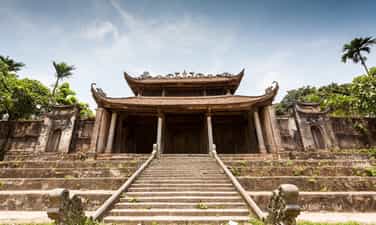
Dinh So
So Communal House was built in the second half of the 17th century. Up to now, Dinh So Communal House still retains its ancient original features and is a familiar cultural address for people in the region in particular and for tourists from all over the world in general. . Dinh So is a famous and quite large-scale architecture of the ancient Phu Quoc land, famous for the song: "Beautiful Dinh So, big Dinh Can". Dinh So is located on the ground in the shape of a turtle following the mountain and water pedaling position. Currently, the communal house includes the following items: Great worship, Harem, two rows of Ta - Huu vu, Nghi gate, large semicircular lake. The main communal area is located in the center. So Communal House was built in the style of "internal and foreign affairs", on a large scale. The Great Pagoda consists of 7 rooms and 2 compartments; Surrounded by a system of table doors and wooden floors running along both sides. The harmony between the two elements of monument and landscape space creates another unique feature for Dinh So relic. The architectural structure of the communal house is mainly made of wood, mixed with stone materials, and the roof system is made in a traditional style, all made of funny-nosed tiles. All of these components create a quite complete and unique religious architectural complex of the monument. Regarding the art of carving, in ancient architecture, the artistic value is clearly and uniquely expressed in the sculptural decoration. Most of them are gathered at the Nghi Mon wall and the most at Dai Bai. In addition to the values mentioned above, Dinh So relic still preserves relics and antiques of typical value such as: two steles talking about the construction process and restorations of the communal house, a system of footrests. Columns carved in the style of lotus flowers appear in the Great Pagoda. A pair of meticulously carved stone dragons are placed on both sides of the steps leading to the Dai Bai, and the palanquin and tribute bowl are very elaborately crafted. Dinh So worships the three Cao brothers who helped King Dinh quell the rebellion of 12 warlords and became the sacred gods of the village. According to the Dinh So legend, it is written that: In the spring of the year Canh Dan 930, there was Mr. Cao Hien and Mrs. La Thi A in Van Ky village, Gia Dinh district, Thuan An district, Kinh Bac religion, whose family was very poor, working as fishermen. on the river. The couple are over 50 years old and still do not have a son. I heard that at Huu Linh temple, Son Lo site is a place where the spirit gets whatever he prays for, so together we prepared offerings and went there to pray. On the 8th day of the second month of the year Quy Ty (933), she gave birth to a bundle, giving birth to three sons, with strange shapes, dignified appearance, and tall bodies. The three children grew up into healthy young men and followed Dinh Tien Hoang to quell the rebellion of 12 warlords. The great recorded victory of the three men was the battle with warlord Do Canh Thac in Do Dong region. When Dinh Bo Linh was besieged in Boi Khe, the situation was extremely dangerous, so his father immediately brought troops to relieve the siege. Son Lo's villagers brought noodles and cakes to support them, and chose 300 men to follow them as their subjects. Entering the battle, the three brothers, left and right, suddenly beheaded Chief General Do Thanh Long and tens of thousands of good soldiers, freeing Dinh Bo Linh. When Dinh Tien Hoang ascended the throne, he ordained three men as the Three Thong Hien Marshal Dai Vuong. Up to now, Dinh So still retains 42 titles bestowed by dynasties to commemorate the merits of the three great kings. To commemorate their gratitude, every year on the 8th day of the second lunar month, the people in the village hold a festival. Accordingly, the So village communal house festival includes contents such as: incense offering ceremony, worshiping the village's Tutelary God, cultural exchanges, quan ho singing and folk games. Worshiping the village tutelary god aims to educate generations of villagers to respect, remember their roots and ancestors, and educate the spirit of community solidarity to build a better life together. With values of construction history; historical figures are worshiped; Unique artistic architecture; Scientific value of the village communal house here, on December 24, 2018, the Prime Minister issued a Decision to classify So communal house as a special national monument. Source Hanoi Department of Culture and Sports.
Hanoi
3464 view
Rating : Special national monument

Tuong Phieu Communal House
Dinh Tuong Phieu (also known as Dinh Ca) located in Tich Giang commune, Phuc Tho district, Hanoi city, is an architectural relic that still preserves many typical tangible and intangible cultural values. . Currently, Tuong Phieu communal house worships four village tutelary gods, which are: Three saints Tan Vien and Quan Son tutelary god. In fact, on the outskirts of Ba Vi region, there are 5 famous temples worshiping the god Tan Vien: Thuong temple, Trung temple (on the mountain), Va temple (Son Tay town), Ha temple (Minh Quang commune) and Da temple. Black (Tan Linh). In historical relics worshiping Saint Tan, there are usually 3 tablets or 3 statues. According to people, Saint Tan is in the middle, on both sides are two younger brothers or two generals who followed him to fight the Thuc invaders (Dinh). Tuong Phieu is one such case). This is a cross-cultural influence, including Han culture, Indian Buddhism and indigenous Taoism that created the trinity Cao Son - Tan Vien - Quy Minh. It is from the concept of Ba Vi that the above trinity was born. which is now often worshiped according to the Holy Trinity of Tan in some village communal houses in general, Tuong Phieu communal house in particular. Tuong Phieu Communal House has an overall layout in the shape of the letter "Nhat" divided into 03 rooms and 2 wings. Standing in the yard, looking in, the communal house looks like a large stilt house, styled gracefully and softly by the roof system and curved blades. On the roof is embossed "Two dragons flanking the sun". The top edge of the roof is embossed with pliers, the edge has pairs of crocodiles (made of terracotta with a strong mark of the Le Trung period), symmetrically placed. Tuong Phieu Communal House is located in the system of religious and religious relics and is a highly valuable architectural and artistic work. Currently, Tuong Phieu communal house still preserves many precious relics of many different materials and types, such as: Wooden relics: 03 processions in the artistic style of the 17th - 18th centuries; 03 sets of altar altars date back to the first half of the 18th century, 03 three sets of altars date back to the 19th century. Paper relics: 06 ordinations of the Nguyen Dynasty. Ceramic relics: 03 ancient incense bowls made of Tho Ha ceramic with artistic style around the 18th - 19th centuries. In addition, there are relics such as: robes and bronze candlesticks,... With the special value of the relic, the architectural and artistic relic of Tuong Phieu communal house, Phuc Tho district, Hanoi city has been ranked by the Prime Minister as a special national relic (in Decision No. 1820/QD -TTg December 24, 2018). Source Department of Cultural Heritage.
Hanoi
3911 view
Rating : Special national monument

Dinh Chem
Nestled on the red Red River, about 12km west of Hanoi center, is an ancient, majestic communal house, dating back more than 2,000 years of history. Chem communal house in Chem village, Thuy Phuong ward, Bac Tu Liem district, Hanoi - is considered one of the few oldest communal houses in Vietnam. Chem Communal House was built according to foreign domestic architectural style, sturdy and elaborate. The outer ritual gate is a type of ritual pillar with four tall pillars, near the top of the pillar is decorated with a lantern, the top of the pillar and the body of the pillar are decorated with four sacred animals, four precious animals and are covered with Chinese couplets praising the Holy Ly Ong Trong. . Nghi Mon Noi (also known as Tau Tuong) is a four-roof, three-compartment, two-winged house, with a tiled roof and curved corners forming embossed dragon heads. Nghi Mon's inner door opens with 3 large doors with wooden doors. This is where the statues of the mahout, war elephant and war horse of the Saint are placed. The stele house, communal house yard, left and right moc, 8-roofed communal house and the great worship hall and harem form a public shape. The main area of Chem communal house includes the altar hall and the great worship hall. These two buildings have the same structure and are connected to each other by a system of armpit beams supporting bronze troughs. Each row of houses consists of 5 rooms and two wings in the style of a 4-roof house. The interior has 6 rows of wooden columns supporting the roof. The columns are all placed on the base of green stone. On the short rafters, the panels are carved with images of cloud dragons, rolling water dragons, fish transforming into dragons, and four sacred animals with soft, elaborate lines, imbued with the artistic style of the late Le Dynasty - 18th century. This is where the incense burners and important offerings of Chem communal house are arranged, and is also where important annual rituals and festivals take place. The royal harem was built adjacent to the great worship house with a small bridge in the middle. The harem area consisted of 3 rows of houses connected together to form an architectural structure in the letter "Cong". The outer house and inner house are located parallel to each other with a tube house in the middle. This is the most sacred place at Chem communal house, where the dragon throne and worship statues of Monsignor and Notre Dame are about 3.2 meters high, on both sides are statues of the 6 children of the Holy Saint, also known as the Six Kings. In the Vietnamese saint's genealogy, Ly Ong Trong ranks third after Thanh Tan and Thanh Giong. Chem village communal house is probably the only communal house in the South facing north. It seems that this is the way the Chem people show their sincerity to the princess who lives far from home but loves her husband very much and always looks towards her ancestral homeland. Currently, Chem communal house still preserves a Chinese book recording the rites, rituals, and ceremonies, 3 decrees of the Nguyen kings conferring deity on Mr. Ly Ong Trong, 4 stone steles, including 1 of the Le dynasty. Canh Hung and 3 panels of the Nguyen Dynasty, 10 worship statues, 8 horizontal panels with parallel sentences, 2 cast bronze bells of the Nguyen Dynasty. In particular, the bronze trough system is a unique relic, rare in other relics, dating back to the Le, Tay Son and Nguyen dynasties. The architectural works of Chem communal house are durable and harmoniously arranged in a large space. The folds of the houses are made symmetrically along the Northeast - Southwest zodiac axis. Surrounding the architectural works are ancient trees with lush branches and leaves, contributing to the ancient and solemn beauty of the sacred communal house over 2,000 years old. To pay tribute to the Holy Spirit's merits, every year on the full moon day of the 5th lunar month, the people of three villages including Chem village (now Thuy Phuong ward), Hoang village and Mac village (Lien Mac ward) jointly organize the ceremony. Traditional festival, with the participation of people of Da Loc commune (An Thi, Hung Yen), La Tinh village (Dong La, Hoai Duc). Referring to the Chem festival, a folk song has a saying: “The first is the Co Loa Association The second is the Giong festival, the third is the Chem festival. Chem communal house festival takes place on 3 days 14, 15, 16 of the 5th lunar month with activities such as: water procession from the Red River to Chem communal house; procession of writings from Chem pagoda to Chem communal house; flower offering ceremony; Three people entered the temple. Chem village is changing every day with the rise of the country's economy but still retains the old cultural features, old lifestyle of an ancient Vietnamese village and ancient temple in a harmonious, evocative space. longing for those who have visited. Kho kho is a special product of the Dinh Chem festival because it is associated with the vegetarian festival. Only braised sweet soup, white sticky rice, fragrant flowers, and fruits are respectfully offered by the people in the village to the saint. This represents the purity and desire for peace of the people of Thuy Phuong commune in particular and the people of Vietnam in general. With typical values, Chem communal house was ranked as a historical and architectural and artistic relic by the Ministry of Culture and Information (now the Ministry of Culture, Sports and Tourism) in 1990 and was recognized by the Prime Minister. decided to recognize it as a special national monument in 2017. Source Electronic information portal of Bac Tu Liem district, Hanoi city.
Hanoi
3623 view
Rating : Special national monument
Outstanding monuments
See all
Lang Le Bau Co relic site
Lang Le Bau Co relic site is located in Tan Nhut commune, Binh Chanh district, Ho Chi Minh City. Lang Le Bau Co is associated with the resistance war against the French invasion in 1948 with major battles that went down in history. Lang Le Bau Co relic was recognized as a city-level historical relic in 2003. The reason it is called Lang Le Bau Co relic area is because the name of Lang Le Bau Co relic area was given by local people. The hamlet was established next to the interlaced canals and rivers. Lang Le Bau Co is located inside a large field with many shrimp, crabs, and fish. Along with many species of birds such as mallards, storks, teal, nuthatches, gongs, partridges, herons, and red armpits come to feed here. Therefore, Tan Nhut people call it by the familiar and rustic name Lang Le Bau Co. Lang Le Bau Co relic is considered the gateway to move to the center of Vuon Thom base and attack the enemy headquarters in Saigon. Previously, Lang Le Bau Co relic area was originally a field of overgrown reeds. On April 15, 1948, the French colonialists sent 3 thousand soldiers and many modern weapons to simultaneously attack the Lang Le Bau Co area to destroy the Vuon Thom base. At that time, the revolutionary armed forces in Lang Le - Bau, because of their small force and rudimentary weapons, had the help of local people along with the advantage of terrain. After just over half a day of fighting, it turned to attack, causing the French army to suffer a large number of casualties. The victory at Lang Le Bau Co killed 300 enemies, captured 30 mercenaries, and destroyed many machines, military vehicles, and guns of all kinds of the enemy. However, on our side, there are many officers and soldiers who heroically sacrificed their lives at a very young age. On October 14, 1966, in Lang Le, the Republic of Vietnam Army Ranger Battalion was destroyed by tourist militia. Lang Le Bau Co relic site has great historical significance for the people of Saigon in particular and the whole country in general. Faced with hatred for the French colonialists, Lang Le Bau Co's army and people fought a war of great historical significance that opened the door for our side and the enemy. For our side, the battle opened the door to heroism in a strong resistance position. As for the enemy, they had to retreat into a strategic position and were destroyed. The French colonialists could no longer form a strategy to defeat the Viet Minh. Moreover, at Vuon Thom base, Lang Le Bau Co also took place a determined battle to protect our base and destroy all sabotage plans of the enemy. Lang Le Bau Co relic area, after the Dong Khoi movement in 1960, was also a logistics and springboard for the armed forces to liberate Long An - Saigon - Gia Dinh. To commemorate the sacrifices of our compatriots and soldiers, in 1988 Binh Chanh district built a historical building in Lang Le Bau Co land with an area of 1000m2. Source: Ho Chi Minh City Electronic Information Newspaper
Ho Chi Minh City
18227 view
Rating : City-level relics

Tan Hiep Prison Historical Relic
Tan Hiep Prison, also known as "Tan Hiep Correctional Center", is located in Quarter 6, Tan Tien Ward, Bien Hoa City. Tan Hiep Prison Relic was ranked as a national relic by the Ministry of Culture and Sports on January 15, 1994. Tan Hiep Prison is one of the six largest prisons in South Vietnam and the largest prison in the Southeast region, built in an important military position, northeast of Bien Hoa town. Ahead is National Highway 1; Behind is the North - South railway line. This is an isolated location, convenient for transportation, easy for protecting, guarding, receiving prisoners from other places and transferring prisoners to Con Dao, Phu Quoc... Tan Hiep Prison has an area of 46,520 square meters with 8 prisons, including 5 prisons for communist prisoners and patriots. The prison is surrounded by 4 layers of barbed wire with 9 bunkers, 3 watchtowers with a team of guards and a modern alarm system. It's called "Correctional Center" but inside is actually a gun warehouse, an interrogation and torture room with the most modern tools. Each prison only has an area of nearly 200 square meters but holds 300-400 people, sometimes up to a thousand people. In particular, there are "repentance" rooms and "tiger cages" that are very small and narrow and living conditions are extremely harsh, prisoners live like in a crematorium. The diet was extremely unhygienic. The prison guards bought rotten rice and rotten fish to fertilize the fields, and fried them in oil to feed the prisoners, leading to many people being poisoned. With the determination to escape the imperial prison, return to the Party and the people to continue fighting and liberating the nation, on December 2, 1956, with the agreement of the Eastern Inter-Provincial Party Committee, the soldiers Communists were "detained" in Tan Hiep prison under the direct direction of comrade Nguyen Trong Tam (Bat Tam) - in charge of the prison Party Committee and a number of other comrades who suddenly broke the shackles. was able to free nearly 500 comrades and patriots. This event caused a stir in the Pentagon. America - Diem hastily mobilized both main forces and security forces, civil guards defending the three provinces of Bien Hoa, Ba Ria, Thu Dau Mot and two special forces to encircle and capture the prisoners, but all were defeated. failure. Our comrades and compatriots who escaped from Tan Hiep prison received help and protection from local facilities and returned safely to base. Among the escaped prisoners were comrades: Bay Tam, Hai Thong, Ly Van Sam... who became the core nucleus of the Dong Khoi movement later. In 2001, to partly recreate the crimes of the US - Diem against our comrades and compatriots imprisoned at Tan Hiep prison and describe the entire Tan Hiep uprising on December 2, 1956. , Dong Nai Museum has collected images, documents, and artifacts displayed at the relic and made a model to serve the research and sightseeing needs of all classes of people. Every day, the monument is open to visitors. Source: Dong Nai Electronic Newspaper
Dong Nai
16683 view
Rating : National monument

Nguyen Huu Canh Temple
Nguyen Huu Canh temple, also known as Binh Kinh communal house, is located on the left bank of Dong Nai river, formerly belonging to Binh Kinh hamlet, Binh Hoanh village, Tran Bien canton, now Nhi Hoa hamlet, Hiep Hoa commune, Bien Hoa city. It was ranked as a national historical relic by the Ministry of Culture, Information, Sports and Tourism on March 25, 1991. Nguyen Huu Canh Temple was built around the end of the 18th century. Initially, the temple was small in scale, with walls made of boards and a yin-yang tile roof, about 400m south of the current temple. Documents say: the temple was first rebuilt in the fourth year of Tu Duc (1851); By 1923, the temple was rebuilt at its current location. Nguyen Huu Canh was born in 1650 in Gia Mieu, Tong Son district, Thanh Hoa province in a family with many famous generals in the dynasty. He was a man of both literature and martial arts, accomplished many great victories and was trusted, loved and respected by Lord Nguyen. In the spring of the year Mau Dan (1698), he obeyed Lord Nguyen's order to invade Dang Trong while it was still very desolate. Arriving in Dong Nai, he set up his headquarters at Cu Lao Pho (now Hiep Hoa commune); took Dong Nai land as Phuoc Long district, built Tran Bien palace, took Saigon land as Tan Binh district, built Phien Tran palace, the land expanded thousands of miles. He recruited immigrants to settle down, organized the administrative apparatus gradually and systematically, encouraged land reclamation, and promoted Cu Lao Pho to develop into one of the busiest and most dynamic port towns throughout the century. 18 and officially annexed the new land of the South into the Dai Viet map. After returning from the invasion of the South, the following year he again served Lord Nguyen Phuc Chu's command to lead an army to suppress King Chan Lap and maintain the southern border region. In April of the year Canh Thin (1700), after completing his mission, on the way back to Rach Gam (Tien Giang), he fell ill and passed away on the 16th day of the 5th lunar month, at the age of 51 years old. On the way to his hometown for burial, his coffin was stopped at the land where he once had his headquarters on Cu Lao Pho so that local people could have the opportunity to say goodbye to him one last time. At the mandarin's communal house, local people built a tomb to remember this event. When hearing the news of Nguyen Huu Canh's death, Lord Nguyen was extremely sorry and conferred on him the title of High-ranking official of the Town Chancellor with the title: Thanh Marquis Ceremony and had his tablet enshrined at the Thai temple. Source: Dong Nai Electronic Newspaper
Dong Nai
15309 view
Rating : National monument

La Nga victory relic
La Nga Victory Relic (at km 104-112 on Highway 20 to Da Lat, in Phu Ngoc commune, Dinh Quan district) was ranked a national historical relic by the Ministry of Culture on December 12, 1986. To cheer for the Viet Bac victory in the fall-winter of 1947 and also to deal a fatal blow to the enemy, the command board of squad 10 decided to organize a big battle, to show the enemy that the Vietnamese people were , Vietnamese people do not easily submit to any enemy; With a spirit of courage and ingenuity after nearly half a year of preparation, studying the terrain, and choosing a location: at 15:12 on March 1, 1948, the La Nga ambush battle began and ended at 15:12 on March 1, 1948. 15:57 on the same day, in just 45 minutes. The victory of La Nga delighted the people of Dinh Quan in particular and the people of Dong Nai in general. This is a victory that demonstrates the cunning and courage of our army and people, causing the enemy to be stunned and defeated. From this victory, our force grew stronger and stronger, contributing to defeating the enemy's plan to attack quickly and win quickly, forcing them into a passive position. The scenic complex of Chong Rock, Mai Waterfall, La Nga River and La Nga Victory Monument is an interesting tourist complex of Dinh Quan. The amazing beauty of Hon Ba Chong, Da Voi Mountain, Hon Dia, along with the natural pagoda at the foot of the rocky mountain are typical clusters that create a harmonious beauty for the Da Chong scenic area. Dinh Quan Da Chong Complex is also a place that retains traces of prehistoric life. Here, under the stone roofs, along the streams and on the slopes along the valley, many production and daily life tools of the ancients made of stone, bronze and terracotta were discovered. During the 30-year resistance war. Dinh Quan is an important part of War Zone D. Da Chong witnessed the formation, development, stationing, and combat deployment of revolutionary forces. Today, a part of the land of Da Chong Dinh Quan scenic area has been used and built into the Dinh Quan District Cultural and Sports Center. In the near future, Da Chong Dinh Quan scenic area will be invested in and renovated, contributing to making the natural landscape more beautiful and becoming an attractive eco-tourism destination. Source: Dinh Quan District People's Committee
Dong Nai
15135 view
Rating : National monument

Chot Mat ancient tower
Chot Mat Tower Historical-Cultural Relic, located in Xom Thap hamlet, Tan Phong commune, Tan Bien district, Tay Ninh province, was recognized by the Ministry of Culture and Information (now the Ministry of Culture, Sports and Tourism) as historical - cultural relic on July 23, 1993. Also one of the last three ancient towers remaining in the South of our country. Having undergone many restorations in 1938, 2003 and most recently in 2013. Despite undergoing restorations, the Chot Mat ancient tower relic site has given itself a new look but still remains retains the spirit of ancient architecture. The entire Tower is built of brick and slate with the top of the tower tapering upward, from the ground to the highest point of the tower is estimated to be 10m. In addition, this ancient tower is located on a high mound in the middle of the field, so from a distance it looks like a pen rising gradually. In 2003, the People's Committee of Tay Ninh province decided to approve the investment project to restore, embellish and preserve Chot Mat tower relics and carried out the restoration, restoration, display and opening of the excavation pit in 2003. into use. On November 27, 2019, the Provincial People's Committee issued a Decision regulating the decentralization of management, protection and promotion of the value of historical and cultural relics and scenic spots in Tay Ninh province. Decision to assign the People's Committee of Tan Bien district to directly manage 4 relics, including the National Historical-Cultural relic Thap Chot Mat. In particular, the Chot Mat Tower Historical-Cultural Relic in Tan Phong commune, Tan Bien district was chosen to be part of the tourism development link of Tay Ninh Province. This is a tourist destination worth exploring, contributing to tourism development in Tan Phong commune in particular and Tan Bien district in general. Source: Tay Ninh province electronic information portal
Tay Ninh
14988 view
Rating : National monument

Hoc Mon District Palace
Hoc Mon District Palace is located at No. 1, Ly Nam De Street, Hoc Mon Town, (next to the District People's Committee headquarters) and is the place where many outstanding fighting events have been recorded throughout the long history from 1885 to the Southern days. Complete liberation of the People of 18 Betel Garden Villages. After defeating Chi Hoa Fort, the French colonialists built a 3-storey wooden house here to use as a military post. When Tran Tu Ca took office as Governor of the Palace, he used the Station as the Palace of Binh Long district. Originally a cunning drunkard of the French colonialists, Tran Tu Ca was led by a group led by Mr. Phan Van Hon (Quan Hon) and Nguyen Van Qua (Chanh Lanh Binh) of nearly 1,000 insurgents who came to burn the District Palace, captured and head cut off in the middle of the market. That was February 8, 1885, At Dau Tet. Afterwards, Hoc Mon District Palace was rebuilt with a blue stone foundation, brick walls, and a defense system from the upper floors to the fence. The architecture is similar to the Military Fort, so the locals call it Hoc Mon Fort. Tran took over from Tran Tu Ca as Governor of Ngon district, moving to Tra District and then Tho District. This was a long period of time when the people of the Hoc Mon region suffered from many cruel and despicable scenes from the French colonialists and their oligarchic henchmen mentioned above. With the indomitable tradition of Hoc Mon people. On June 4, 1930, around 6 a.m. in front of the District Palace, hundreds of Hoc Mon people protested demanding "abolition of poll tax, reduction of license and market taxes, and granting land to poor farmers." Tra District invited the leaders into the Palace to negotiate, but they cunningly arrested them, including Mr. Le Van Uoi (Secretary of Tan Thoi Nhi Commune), who was the leader of the protest. People were undaunted and fiercely demanded that Tea District release those detained. The protest group became more and more crowded, the fighting spirit spread somewhat, causing Tra District to give in. On the one hand, they released the detained people, on the other hand, they called the officials in Saigon for help. 2 hours later, the struggle was led by two men, Blachole and Nobbot, who opened fire on the protest group, causing many casualties. But the most impressive historical event at Hoc Mon District Palace was the Southern Uprising on November 23, 1940. Hoc Mon Fort is very solid, built of green stone like a fortress, about 15 meters high, has a gun emplacement and a defense system with battlements guarded by a platoon of green soldiers. On November 22, 1940, France reinforced one more platoon to deal with the situation. On the afternoon of November 22, 1940, Mr. Do Van Coi's army broke into the town, disguised as civilians, ambushed behind the Station waiting for orders to rob the Station. Another army wing has the task of destroying bridges, cutting down trees blocking roads, and occupying offices and houses... The army wing from Phuoc Vinh An, Tan Thong, Tan An Hoi, Tan Phu Trung is led by Mr. Pham Van Sang and Dang Cong Binh commanded, started from Ben Do hamlet, attacked the house, killed 1 person, collected 4 guns, and took control of the situation here (Tan Phu Trung). Immediately this army was ordered to pull back to Hoc Mon. The Long Tuy Thuong army was commanded by Mr. Bui Van Hoat. The army of General Long Tuy Trung was commanded by Mr. Do Van Day and Le Binh Dang. At around 24:00 on the night of November 22, 1940, the sound of artillery fire had not yet been heard in Saigon. After consulting, the army commanders united to attack the enemy's post. Immediately the troops headed straight to Fort Hoc Mon, where District Chief Bui Ngoc Tho resided. Two insurgents named Nghe and Kinh volunteered to enter the front gate and sacrificed their lives. Insurgents from all directions rushed into the Fort like water bursting its banks. Faced with the power of the insurgents and the masses, the soldiers in the Station no longer had the spirit to resist and fled in disarray. The insurgents completely occupied the inside of the station, but upstairs, the enemy still stubbornly used guns to shoot sporadically, at the same time calling Saigon and Thu Dau Mot for emergency help. Because he was eager to capture the name of Tho District, comrade Do Van Day climbed up to the upper floor of the Station by clinging to the gutter. Halfway up, he was hit by bullets, the comrade fell and died later. The battle was at a standstill when enemy reinforcements arrived. Unable to hold out, the insurgents withdrew from the town, dispersed to the villages, the armed forces withdrew to Ben Do hamlet (Tan Phu Trung) and then moved to My Hanh hamlet (Duc Hoa). Although the attack on Hoc Mon Fort (later called Hoc Mon District Palace) failed, it left a deep impression in the hearts of all civilians admiring the courage of revolutionary soldiers in the fight against colonialism. steal the country. During the historic Ho Chi Minh campaign, at 7:00 a.m. on April 30, 1975, Hoc Mon town was completely liberated, the National flag fluttered above the District Palace, where District Chief Nguyen Nhu Sang and his gang sai has been running away since last night. Today, Hoc Mon District Palace is chosen as the District Museum, where many documents are displayed, illustrating the ups and downs of historical periods as well as the revolutionary fighting spirit of the army and people in Hoc Mon district over the past two years. resistance war against French colonialism and American imperialism. A monument placed in front of the Hoc Mon District Palace relic represents the indomitable sacrifice of the army and people of 18 Betel Garden Villages, recognized as a national historical and cultural relic. Source: Hoc Mon District People's Committee
Ho Chi Minh City
14298 view
Rating : National monument

US Embassy building
The US Embassy relics, also known as the "White House of the East", are the origin of sinister military and political plots aimed at long-term annexation of Vietnam. The relic site is a 5-storey building built Built in modern architecture, located at the corner of Mac Dinh Chi - Le Duan Street, Ben Nghe Ward, District 1, Ho Chi Minh City, on a plot of land nearly 5,000 square meters. Previously, the US embassy was located at 39 Ham Nghi Street. At around 10:00 a.m. on March 30, 1963, the US embassy on Ham Nghi Street was hit with explosives by the F21 Commando team, collapsing three floors: 1, 2, 3, so the US decided to rebuild it. Construction began on the building in 1965, most of the materials and construction machinery were transported from the US, under the control of American engineers. According to the design, the building is surrounded by 7,800 Taredo stones that can withstand mines and artillery shells. The main door is equipped with thick steel, the other doors are blocked by a special thick bulletproof layer. All doors use automatic systems, including iron doors blocking the way to the upper floors. Inside the building there are 140 rooms with 200 staff serving day and night. In addition, next to the building is also built an additional row of houses called the "Norodom" area exclusively for C.I.A. employees. When inaugurated, the building had only 3 floors. At the end of 1966, two more floors and a terrace were built to serve as a landing place for helicopters. Surrounding the building is a 3m high wall, at both ends of the wall close to Le Duan Street, 2 high blockhouses are built, guarded day and night. The Embassy was completed in September 1967 with a defense system such as a fortress with 60 guards, a bomb shelter, and a radar screen system to control the facade. Immediately after the building was completed, on September 24, 1967, thousands of students flocked to the gate of the US Embassy to fight for "America to stop bombing the North", "America to go home" and issued a notice denouncing the US for "trampling and seriously violating the right to self-determination of the Southern people". But the outstanding event that happened at the US Embassy was the battle of the City Rangers during the General Offensive and Uprising in the Spring of 1968. The target of attacking the US Embassy was added on January 24, 1968 by Ngo Thanh. Van is in charge of general affairs. Ranger Team 11 took on this important mission, including captain Ut Nho (military region reconnaissance captain) and soldiers: Bay Truyen, Tuoc, Thanh, Chuc, Tran The Ninh, Chinh, Tai, Van, Duc, Cao Hoai Vinh, Mang, Sau and 2 drivers: Tran Si Hung and Ngo Van Thuan. Another equally humiliating event for the US Embassy was the chaotic escape that occurred on April 29 and 30, 1975 by the US and its accomplices. Faced with the rapid attack of the Vietnamese army and people in the historic Ho Chi Minh campaign, over 1,000 Americans and more than 5,000 pro-American Vietnamese jostled, pushed, and kicked each other to compete for a place on the terrace of the building. building to be rescued by helicopter. This relic was granted a certificate of recognition by the Ministry of Culture on June 25, 1976. Currently, the US Embassy building has been demolished and a new consulate in Ho Chi Minh City has been built, but next to it is a memorial stele forever remembering the achievements of the special forces soldiers who died in the battle. . Source: Ho Chi Minh City Youth Union
Ho Chi Minh City
14205 view
Rating : National monument

Tomb of Mai Xuan Thuong
Mai Xuan Thuong was the leader of the Can Vuong movement against the French at the end of the 19th century in Binh Dinh. Mai Xuan Thuong was born in the year of Canh Than, 1860, died in the year of the Pig, 1887, from Phu Lac village, Phu Phong district, Tuy Vien district, Binh Dinh province (now Phu Lac village, Binh Thanh commune, Tay Son district, Binh Dinh province). His father, Mai Xuan Tin, was the chief father in Cao Bang. His mother, Huynh Thi Nguyet, was the daughter of a noble family in the village. Mai Xuan Thuong is inherently intelligent and eager to learn. At the age of 18 (1878), he passed the Baccalaureate at Binh Dinh Examination School. At the age of 25 (1885), he passed the bachelor's exam. Responding to King Ham Nghi's Can Vuong edict, Mai Xuan Thuong returned to his hometown of Phu Lac, recruited insurgents, set up a base on Sung island to raise the Can Vuong flag against the French, then Mai Xuan Thuong brought his forces to join the army. The insurgent army was led by Dao Doan Dich and was appointed by Dao Doan Dich to the position of Military Salary Officer (in charge of food for the insurgent army). From then until 1887, the Can Vuong movement in Binh Dinh developed strongly and spread to Quang Ngai, Phu Yen... attracting tens of thousands of people from all walks of life to participate. On September 20, 1885, Dao Doan Dich died and assigned all his forces to Mai Xuan Thuong. He chose the Loc Dong mountain area (now in Binh Tuong commune, Tay Son district) as his headquarters and organized a flag worshiping ceremony, calling on scholars, literati, and people to join the movement to fight against the French. During that ceremony, insurgents from many regions in Binh Dinh province agreed to honor him as the Marshal leading the uprising and raised the slogan: "First to kill the left, later to attack the West". In early 1887, the French army under the command of Lieutenant Colonel Cherrean and the royal army led by Tran Ba Loc along with Minister Trira launched a major attack on the headquarters of the Can Vuong movement in Binh Dinh, the battle The fighting between the insurgent forces and the French enemy was extremely fierce, the fight was unequal, and in the end the insurgent force was pushed back. In March 1887, after a fierce battle in Bau Sau (An Nhon town, Binh Dinh province), Mai Xuan Thuong was seriously injured, the insurgents withdrew to Linh Dong secret area. On April 21, 1887, Tran Ba Loc surrounded and captured the Linh Dong secret base and captured a number of insurgents, including Mai Nguyen Soai's mother. On the night of April 30, 1887, Mai Xuan Thuong sent a suicide squad to break into Tran Ba Loc barracks, relieve the captured people, and he and a group of 50 subordinates crossed the mountain into Phu Yen and continued to resist. battle, but when she reached Phu Quy Pass (boundary between Binh Dinh and Phu Yen), she was captured by Tran Ba Loc's ambush and taken to be beheaded at Go Cham (East of Binh Dinh Citadel). The mausoleum of patriot Mai Xuan Thuong is located on a high hill of the Ngang mountain range (in Hoa Son village, Binh Tuong commune, Tay Son district, Binh Dinh province) about 50km northwest of Quy Nhon city; The mausoleum was built on a land area of 1988m2, inaugurated on January 22, 1961. Overall, the mausoleum is designed in the style of an ancient mausoleum, surrounded by low walls. The Lang gate (three gates) is made up of 4 square pillars, the top is tied in the style of a gourd and a vase, bearing the architectural appearance of a communal house or temple gate of the late 19th century. In the middle of the Mausoleum is Mai Xuan Thuong's tomb, rectangular in shape in the East - West direction; At the head of the grave is a stone stele engraved with an inscription recording the biography and career of Mai Xuan Thuong: The relic was ranked at the National level by the Ministry of Culture and Information on April 20, 1995. Source: People's Committee of Tay Son District, Binh Dinh Province
Gia Lai
13932 view
Rating : National monument

Mac Dynasty Citadel in Cao Bang (Na Lu Citadel, Ban Phu Citadel, Phuc Hoa Citadel)
During the period when the Mac dynasty had its capital in Cao Bang, in order to prevent the Le dynasty from attacking, the Mac dynasty restored and repaired Na Lu citadel (now in Hoang Tung commune, Hoa An) and Ban Phu citadel (now in Hung Dao commune). ), Phuc Hoa citadel, in addition to building many other citadels in Cao Bang, making Cao Bang a political and military center in the far Northeast border region at that time. Na Lu citadel and Phuc Hoa citadel are two citadels built before. According to the records of Be Huu Cung in Cao Bang Thuc Luc, Na Lu citadel and Phuc Hoa citadel began in the reign of Tang Y Tong in the year Giap Than, the 5th Ham Thong era (874). Based on the presence of many ancient tombs with stone inscriptions containing the names, addresses, and hometowns of the citadel builders who died here during the Ham Thong Dynasty, it can be confirmed that these two citadels were built during the Tang Dynasty. Na Lu Citadel was built over many different dynasties. When the Mac dynasty came to Cao Bang, it was rebuilt with bricks. Na Lu citadel has a nearly rectangular shape, has a total area of about 37.5 hectares, a length of about 800 m, a width of about 600 m, the citadel has 4 gates. Ban Phu citadel in the capital of Nam Binh, Nam Cuong country of Thuc Phan in the past in Cao Binh (Cao Bang), the Mac dynasty renovated the royal palace in the inner circle of the old capital of Nam Binh and called it Ban Phu citadel or Royal Palace. In the ancient capital of Nam Binh of the Nam Cuong country and the Mac dynasty, Ban Phu citadel still has clear traces. The capital city of Nam Binh consists of two citadels, to protect the citadel, the outer ring has a circumference of about 5 km, including a low hillock area, around the foot of the hill is covered with vertical canvas like a wall, convenient for navigation. Build defense lines. The western wall of the citadel runs parallel to the bank of the Bang River to the beginning of Bo Ma village, connecting the southeast wall of the citadel, flowing in front of Ban Phu, following the foot of the hill to meet National Highway 4, the northeastern side running along the foot of the hill close to the outside of National Highway 4. , up to the top of the mound is the northwest side, continue running along the foot of the hill, out to the river bank and meet the west wall, forming a closed citadel. When the Mac Dynasty established the capital, it repaired and built a number of additional works, in which Ban Phu Citadel (inner citadel - the king's working place) was built higher on the old citadel walls from the Thuc Phan period. The citadel is located on a flat land. Along with rebuilding the capital, the Mac dynasty also built a system of posts and ramparts quite thick around the capital and a number of important border points, forming a system of protecting the capital and protecting the border. gender. Phuc Hoa citadel (Phuc Hoa district) was built in a square style, about 400 m in each direction, including two citadel rings, the distance between the two rings is 80 m. Currently, the southern wall has been completely destroyed. Phuc Hoa Citadel has 2 main gates: The North Gate is open to the national highway to Ta Lung Border Gate today, people often call it Pac Gate, this gate is built in a rectangular style, 8 m wide, 5 m high. , including two gates made of thick, very sturdy wood; The second gate is in the south, opening to the river bank. Both gates were flattened long ago, and now there are no traces left. Near the citadel, in the northwest suburbs along the riverbank, there are many traces of brick kilns. People said that during the process of labor and exploration, many intact brick kilns were found in this area. Through research and surveys, it has been shown that in Cao Bang, the Mac dynasty renovated, embellished and built many citadels and fortresses, including repairing, embellishing and rebuilding Ban Phu citadel, Na Lu citadel, and Phuc citadel. Hoa. These fortifications have formed a quite solid system of protecting the capital. Up to now, of the ancient citadels built by the Mac Dynasty during the capital period in Cao Bang, some of the citadels built of earth only have traces left, but the citadels built of stone are still very clear. Source: Cao Bang Electronic Newspaper
Cao Bang
13530 view
Rating : National monument

WARRIORS' MEMORIAL AREA AT THREE GIONG FORCES, NATIONAL HISTORICAL MONITOR
Nga Ba Giong relic is a revolutionary historical relic located in Hamlet 5, Xuan Thoi Thuong commune, Hoc Mon district. Surrounded by three roads: Phan Van Hon, Nguyen Van Bua and Provincial Road 19. Nga Ba Giong relic site is a memorial site for historical events in two wars against foreign invaders. Recognized as a national historical site in 2002. Giong Junction (also fully known as Giong Bang Lang Junction) is located in Xuan Thoi Tay village, part of 18 old betel garden villages formed from 1698 to 1731. For a long time, Giong Junction is a place with a folk name that has entered the history of the hometown of 18 betel garden villages of Hoc Mon - Ba Diem. Legend has it that in the past, this place was a relatively high land and a place where many linden trees grew, so this place got its name from there. After the Southern Uprising (November 23, 1940) failed, the French colonialists increased their repression and fierce terror against the revolutionary movement in the Hoc Mon - Ba Diem region. They set up three shooting ranges in Hoc Mon to kill Party leaders and patriotic comrades from their hometown of Hoc Mon and surrounding areas. Giong intersection is the third shooting range to record the heinous crimes of the French enemy and his henchmen against the people of Hoc Mon. Learning from the experience of 2 previous shooting ranges (1 at the old theater in the center of Hoc Mon District, 1 next to the well behind Hoc Mon Hospital today), they executed public shootings, forcing people to come and watch for the purpose of intimidation. revolutionary spirit of Hoc Mon people. But that firing squad backfired. The Hoc Mon people witnessed with their own eyes the cruelty of the French colonialists and the noble sacrifices of the communist soldiers, so their patriotic fire flared up even more fiercely. . For this third shooting range, they did not dare to build it near the center of the District anymore, but moved it to the Giong Junction area as a desolate, sparsely populated area to avoid people's resistance. Here, they built a shooting range with a solid mound of land 12m long, 2.2m high, in front of which were planted 6 shooting posts, each 1.7m high, the shooting direction facing the field (Ba Tram Lac). In 1941, here they secretly executed many times without letting the people see, hundreds of communist soldiers and patriots were killed by them. With the extremely sacred historical significance of Giong Junction, the place that marked the barbaric crimes of the French invaders, the place that demonstrated the indomitable fighting will and noble sacrifices of our comrades and compatriots later on. the Southern Uprising (November 23, 1940); After the complete liberation of the South (April 30, 1975), Hoc Mon district quickly restored and embellished the Nga Giong Junction revolutionary historical relic site to educate traditional generations of youth. This place has become a tourist attraction and a place to organize traditional festivals during major annual holidays of Hoc Mon district and the city, especially the anniversary of Southern Uprising Day (November 23). Currently, with the consent of the city, the district is renovating and building Giong Junction into "Giong Junction Martyrs' Memorial Area". Source: Hoc Mon electronic information portal
Ho Chi Minh City
13401 view
Rating : National monument