
 vn
vn en
en ja
ja ko
ko zh
zh

















List of relic sites (26)
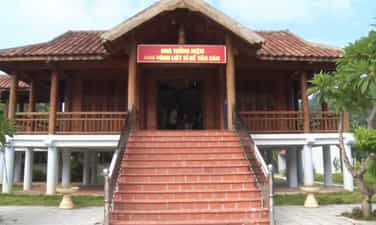
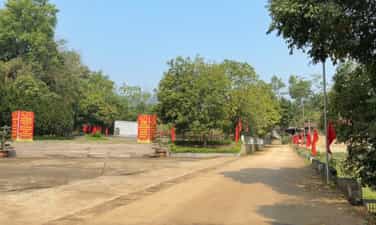
Be Van Dan Heroic Martyrs Memorial House
Be Van Dan Heroic Martyrs Memorial House - Red address in the revolutionary homeland of Cao Bang Be Van Dan Heroic Martyr Memorial House is located in Ban Buong hamlet, Trieu Au commune, Cao Bang province, on the foundation of the house where the hero was born and raised. This is a work of special significance, built to commemorate and pay tribute to Hero of the People's Armed Forces Be Van Dan - an outstanding son of the Tay people, who heroically sacrificed his life in the Dien Bien Phu Campaign. Be Van Dan was born in 1931 in a poor family, joined the army in 1949 and participated in many major campaigns. During the battle at Muong Pon in 1954, when his comrades had no support to use the machine gun, he bravely used his shoulder as a gun stand, encouraging his comrades to continue fighting. That brave action contributed to repelling the enemy's counterattack, before he heroically sacrificed his life. With a particularly outstanding victory, Be Van Dan was posthumously awarded the title of Hero of the People's Armed Forces by the State. The memorial house was built according to the traditional stilt house architecture of the Tay people, in harmony with the landscape of Cao Bang mountains and forests. Inside is a solemn worship space with an altar, portraits and documents and artifacts introducing the life, career and heroic fighting example of Heroic Martyr Be Van Dan. The spacious, green campus creates a solemn space, a place for people and tourists to offer incense and commemorate. Today, the Be Van Dan Martyrs' Memorial House is not only a place to pay tribute to the national hero but also a "red address" that educates patriotic traditions, gratitude and revolutionary spirit for generations. This is a destination with historical significance, contributing to preserving the nation's heroic memories and spreading good values of courage and sacrifice for the independence and freedom of the Fatherland. According to Cao Bang electronic newspaper
Cao Bang
87 view
Rating : Provincial level relics
Nam Lin historical relic site
Nam Lin historical relic site, in Hoang Tung commune, Cao Bang province, is one of the typical "red addresses" of the Vietnamese revolution. This is the place that marked the establishment of the first Communist Party cell of Cao Bang province on April 1, 1930, marking an important turning point in the local revolutionary history. With great significance in history and traditional education, Nam Lin has become a destination not to be missed for those who want to learn about the revolutionary roots of Cao Bang. More than 90 years ago, under the leadership of the Communist Party of Vietnam and the direct direction of comrade Hoang Dinh Giong, the first Communist Party cell of Cao Bang province was established in Nam Lin with three party members: Hoang Van Non, Le Doan Chu and Nong Van Do. Comrade Hoang Van Non was elected Party Cell Secretary. From here, the revolutionary movement in Cao Bang was organized and developed strongly, making an important contribution to the cause of national liberation. To recognize the special historical value of this location, on February 13, 1995, the Ministry of Culture and Information recognized Nam Lin as a national historical site. Today, the relic site is preserved and beautifully restored, becoming a place to store documents, images and traces of the birth of the first Party organization in Cao Bang. The space of the monument looks solemn, quiet, and in harmony with the natural landscape of the midland region, creating favorable conditions for sightseeing and historical learning activities. Coming to Nam Lin Historical Relic Area, visitors will not only be introduced to the process of forming the province's first Party Cell but also have the opportunity to better understand the patriotic tradition, spirit of solidarity and resilient will to fight of the people of Cao Bang's ethnic groups. This is where resource-giving activities, incense offerings, thematic activities, admission of party members, union members and traditional educational programs for pupils, students, officials and the armed forces regularly take place. According to Cao Bang electronic newspaper
Cao Bang
434 view
Rating : National monument
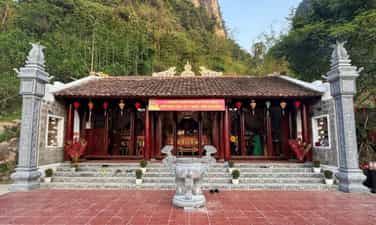
To Thi Hoan Temple
To Thi Hoan Temple Located in Dong Tam hamlet, Ly Quoc commune, Cao Bang province, To Thi Hoan Temple is a destination rich in historical, cultural and spiritual values. With a peaceful setting at the foot of Xuan Son mountain and unique traditional architecture, the temple is not only a place where local people place their religious beliefs but also an attractive attraction for tourists when coming to the borderland of Cao Bang. The temple was built to worship Mrs. To Thi Hoan (To Thi Hue), a character associated with the legend of Vietnamese women's loyalty. After her death, people built a temple to commemorate and pay tribute to her virtues. Over the centuries, the temple has always been preserved by the people, becoming a place for cultural and religious activities and a symbol of the local community's tradition of "when you drink water, remember its source". In 2011, To Thi Hoan Temple was ranked by the People's Committee of Cao Bang province as a provincial-level historical and cultural relic. Faced with the deterioration of the project over time, in 2025 the locality implemented a renovation and restoration project with a total cost of 6 billion VND. After the renovation process, the temple was built spaciously according to traditional architecture including three compartments, yin-yang tiled roof, main courtyard, steps to the temple and a solid embankment wall system. The interior is solemnly decorated with horizontal panels, couplets, hammock doors, worship statues, altar tables and worship objects made of ceramic and stone, creating a sacred and ancient space. Coming to To Thi Hoan Temple, visitors will not only admire the beauty of a traditional architectural work but also have the opportunity to learn about the history, culture and beliefs of local people. The peaceful space, blending with the green mountain and forest landscape, creates a peaceful feeling, suitable for sightseeing trips, offering incense and exploring local culture. According to Cao Bang electronic newspaper
Cao Bang
488 view
Rating : Provincial level relics
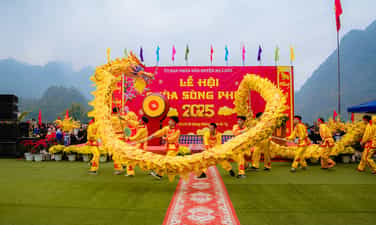
Sung Phuc Pagoda
Sung Phuc Pagoda Located in Thanh Nhat town, Ha Lang district, Cao Bang province, Sung Phuc Pagoda is one of the famous ancient pagodas of the Northeast region, with a history of more than 700 years. The pagoda was built during the reign of King Tran Nhan Tong with the original name Sung Khanh, to develop Buddhism and assert sovereignty in the border area after the victory against the Yuan-Mongol army. In 1782, the pagoda was restored, moved to its current location and renamed Sung Phuc. The pagoda has bold Le Dynasty architecture with a Nhi-shaped main hall, traditional tiled roof and ancient campus. Not only is it a place to worship Guan Yin Buddha, the pagoda also worships Nghia Thanh Vuong Nguyen Dinh Ba - the person who publicly destroyed and protected the Cao Bang border area, and is associated with Nguyen Thi Due, Vietnam's first female doctorate, who practiced and taught here. The relic still preserves many precious artifacts such as stone stele, Nguyen Dynasty ordination and many valuable historical documents. Every year, from the 14th to the 16th of the first lunar month, the Sung Phuc Pagoda festival is held with incense offering ceremonies, Buddha procession and many unique folk cultural activities, attracting a large number of people and tourists. With outstanding historical, architectural and religious values, Sung Phuc Pagoda was ranked a National Historical and Cultural Relic by the Ministry of Culture and Information on January 29, 1993. Today, the pagoda is not only a famous spiritual destination of Cao Bang but also a symbol of patriotic tradition, studious spirit and cultural identity of the border region. Source: Journal of Buddhist Studies (compilation)
Cao Bang
468 view
Rating : National monument
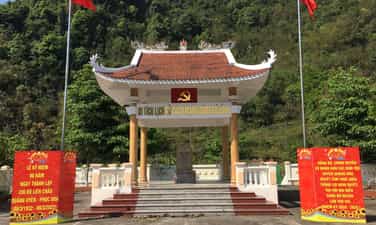
Historical Relics of Dong Bo Linh Revolution
Dong Bo Linh revolutionary historical relic On March 8, 1932, comrade Duong Cong Hoat, on behalf of the Cao Bang Provincial Party Executive Committee, introduced and admitted comrades to the Communist Party of Vietnam: 1. Comrades Ma Kien Kien (i.e. Ma Trung Lam) was born in 1914, Tay ethnicity 2. Comrade Ma Kien Moi (i.e. Hong Hai) was born in 1917, Tay ethnicity 3. Comrade Ma Kien Hoach (i.e. Hong Chi) was born in 1914 , Tay ethnic group 4. Comrade Ma Kien Tich (ie Hong Lac) was born in 1914, Tay ethnic group Coc Coc branch is the Lien Chau Quang Uyen - Phuc Hoa cell and is also the first Communist Party cell in the East Cao Bang province, officially recognized by the Cao Bang Provincial Party Committee; Comrade Ma Trung Lam was elected party cell secretary. The first task of the Coc Coc cell was to immediately carry out the tasks that the Long Chau Overseas Cell (China) and the Nam Lin cell were carrying out: Secretly transporting books, newspapers, documents, and transporting passengers. Soldiers engaged in revolutionary activities, studied between regions, actively developed the party, promoted the movement against taxes, against widowhood, abuse, against forcing husbands to work during the harvest season, and being a husbandman required money and rice. Dong Bo Linh revolutionary historical relic was built on March 7, 2012, completed on May 19, 2013. Decision No. 2917/Decision - People's Committee dated November 11, 2005 of the Provincial People's Committee recognized Dong Bo Linh as a revolutionary historical relic - the place where the first Communist Party cell of Pan-African was established. Quang Uyen - Phuc Hoa (now Quang Hoa district) on March 8, 1932. Source Electronic information portal of Quang Uyen district, Cao Bang province.
Cao Bang
5962 view
Rating : Provincial level relics
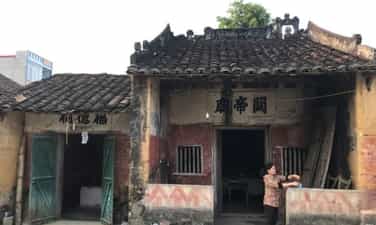
Quan De Temple
In Ngoc Dong commune (Quang Uyen), there is a Quan De temple that has been recognized as a provincial historical-cultural relic by the Provincial People's Committee. The temple has meaning and is associated with each ups and downs of historical periods in this land. Quan De Temple was built at the beginning of Dong Da market, Ngoc Dong commune to worship the figure Quan Van Truong, a general of the Three Kingdoms period (China). According to Vietnamese beliefs, worshiping Quan Cong is due to admiration and respect for his virtue. In Cao Bang today, there are many temples and shrines worshiping Quan Cong in districts: Bao Lac, Tra Linh, Trung Khanh... and Quan De temple in Ngoc Dong commune. According to the survey results of the Provincial Museum, the temple was probably built in the 36th year of Tu Duc's reign (ie 1882) based on the date recorded on the great letter in the temple and the decorative patterns of some remaining architectural pieces. left of the temple. Overall, the temple has a house with an area of over 40 m2, next to the temple there is a small room to worship the local people. The total area of the two rooms is over 57 m2, both are built in the style of a walled house. The main material that creates solid walls is fine red clay combined with lime and molasses, kneaded thoroughly to create a mixture with high adhesion, the wall layer is 30 to 35 cm thick. Tile roof system, wooden truss structure. The system of altars and statues in the temple includes: The outer altar is built of bricks, 73 cm high and 2.2 m long, used to hold incense bowls, candles and other offerings. The inner altar is 62 cm high, 1.8 m long, 1.4 m wide with 4 statues: The innermost statue is a 120 cm tall statue of Quan Cong wearing a yellow shirt, red dragonfly hat, long black beard, in sitting posture; The two statues of soldiers on both sides are 50 cm high, the statue on the right is wearing a light red shirt, holding a sword, the statue on the left is wearing a yellow shirt, holding a javelin, both statues are in a standing position; A 57 cm tall statue of Quan Cong's assistant wearing a blue shirt in a sitting position. The statues are all handcrafted from clay, plastered with cement, and covered with color on the outside. In the temple there are also many horizontal panels and couplets in Chinese characters. Outside the temple, there is a stone stele recording the kindness of the deity worshiped in the temple. Mr. La Van Quynh, who has lived for many generations adjacent to the west side of the temple, shared: Every year at the temple, there are holidays held throughout the year, such as: On February 2, there is a ceremony to worship the gods; Qingming Day; May 13 is the death anniversary of Quan Cong; August 2 celebrates the day of temple repair... to pray for good luck, happiness and peace for the people. On holidays, people in the area contribute money and rice to buy offerings to bring to the temple. To prepare for each holiday, people divide into groups and groups take turns preparing the ceremony tray, including: 1 pig, sticky rice, chicken, fruits, candies... The ceremony is conducted by the elderly. Only on the February 2nd holiday are priests invited to perform the ceremony. After the ceremony, everyone eats together and when they leave, there is a fortune distributed to the families. In addition to the main holidays of the year, on the first and full moon days of every month or when there is a big event at home, people in the area still come to burn incense and pray for peace and fortune. In April 2018, the temple was recognized by the Provincial People's Committee as a Provincial Historical-Cultural Monument. But due to a long period of time and the influence of many factors: weather, climate, people..., Quan De Temple can no longer maintain its original status. The relics in the monument, such as drums, bells... were lost in 1978, and the old statue system was demolished in 1979. On the other hand, because the temple foundation is 20 cm lower than the road surface, humidity leads to the wall system. , roof, rafters... are all in a degraded state so they are in dire need of repair. According to Ngoc Dong commune leaders, since the beginning of 2019, people in the temple area have voluntarily donated money and will carry out repairs, continuing to preserve, preserve and promote the value of the temple's historical and cultural relics. Guan Di is effective. Source: Cao Bang province electronic information portal
Cao Bang
6300 view
Rating : Provincial level relics
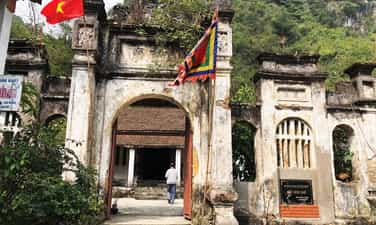
Bach Linh Temple.
Bach Linh Temple (local people also call Bach Linh Pagoda) is located in Old Street, Quang Uyen town (Quang Hoa). The shrine worships 100 of the most sacred things of many types of animals, the chief of which is the dragon - a divine animal with magical power, a symbol of mystical nobility that spits pearls and pearls, and is the head of the four sacred dragons. Ly, Quy, Phung. The dragon at the temple is deified to a supernatural level, along with precious things that become priceless spiritual values, beliefs, and aspirations of local people when they come to worship. Up to now, social and humanistic researchers have not yet determined when the temple was built. They only know that it appeared a long time ago and is deeply embedded in folk memory, associated with the Fireworks Festival. held at the beginning of spring every year. The current situation of Bach Linh Temple is quite similar to other temples, pagodas, and shrines in the province. It has gone through the historical ups and downs of the dynasties, so there have been changes and are no longer intact as before. Legend has it that the temple's architecture consists of 3 parts: three gates, front hall, and harem with the architectural appearance of the Nguyen Dynasty. The three-entrance part of the temple is built of brick material, has 3 doors in a rolling circle style, but for some reason the small doors on both sides have been covered, leaving only the middle door. On the pillars of the three-entrance gate, there are diaphragms and couplets that are now blurred and cannot be read. In the middle of the main gate, there are only the words "Bach Linh Temple" and on it is embossed a vivid curving dragon image. Step through the three gates to reach the front street. The connection between the three gates and the front street is a fairly large yard (now covered with cement), with a stone wall surrounding the yard about 1.5 m high. The frontage has a foundation 0.65 m higher than the yard level, wooden columns and rafters; The roof and porch are covered with tiled roofs and have carvings of a dragon holding a pearl and a dragon's head with sophisticated stylized patterns. In the middle of the front hall is a wooden door 1.6 m wide, 2.2 m high; In the front hall there are 3 altars. Bach Linh Temple is associated with the Fireworks Festival in Quang Uyen town held on the 2nd day of the 2nd lunar month every year. Before entering the festival, there is a ceremony held from the afternoon of the 30th day of the first lunar month. The opening ceremony begins at Coc Chu water mine near Bach Linh temple, the ceremony is celebrated by an elderly man with prestige in the community, family, and prosperous clan. On the afternoon of February 1 of the lunar calendar, the Festival Organizing Committee and people went to Bach Linh Temple to offer offerings, worship, and pray to the gods to bless every family and everyone in the new year with prosperity and prosperity. On the morning of February 2, there is a procession to process the gods, including 4 palanquins in order: the palanquin carrying Uncle Ho's image, the palanquin carrying the local spirit, the palanquin carrying fireworks, the palanquin carrying a roasted pig, and finally the dragon procession. The procession starts from Bach Linh Temple to Nung Tri Cao Temple, Tran Hung Dao Temple and then passes through alleys, families, offices, schools, production and business establishments. This is considered a spirit that acts, checks, observes people doing business and brings them fortune and luck. Therefore, wherever the procession went, everyone respectfully and warmly welcomed it with joy and excitement. The festival is held on the afternoon of the 2nd day of the 2nd lunar month with many folk games like dragon dance, unicorn dance, toss, sli singing, love exchange, traditional martial arts, Chinese chess, tug of war, stick pushing, volleyball. , football... attracts people to participate. In particular, the folk game of fighting for cannon heads is the most exciting. This is a game that demonstrates strong physical strength and trains the bravery, determination, agility, dynamism, martial spirit, and generosity of young people. year. The Festival Organizing Committee gathered youth teams into a circle around the central area of the playground. Whoever won the fortune ring at the top of the cannon would have fortune, peace, and luck all year round. The reward is a roasted pig with honey leaves for the whole team and the pig's head belongs entirely to the lucky bracelet owner. That day, everywhere we saw people serving five-color sticky rice and roasted pork, festival specialties and all kinds of candies, local food and drinks. Bach Linh Temple was also a place to store food, weapons, and classrooms during the two resistance wars against the French colonialists and against the American imperialist invasion. Along with the values of customs, beliefs, and spirituality imbued with national cultural identity, the temple was recognized by the Provincial People's Committee as a provincial-level relic according to Decision No. 2856/Decision - Committee of the Day. December 2, 2003. Source: Cao Bang province electronic information portal.
Cao Bang
6435 view
Rating : Provincial level relics

Dong Mu Fort historical relic site
It is an important historical relic of the Vietnamese revolution. This is where the battle of the Vietnam Propaganda Liberation Army Team took place on the night of February 4 and early morning of February 5, 1945. To attack the fort and destroy the enemy, comrade Xuan Truong (real name Hoang Van Nhung) heroically sacrificed his life, becoming the first martyr of the Vietnam People's Army. Over the past 70 years, the historical relic of Dong Mu post has always been an important evidence and a mark of the revolutionary history of the locality and the nation. Before the August Revolution in 1945, the French colonialists built a fortress at Dong Mu that was quite solid. Dong Mu Fort was located on a mound emerging between the fields of Na Doong and Ban Than hamlets in An Quang commune, now Xuan Truong commune. , Bao Lac district. According to the memoirs of General Vo Nguyen Giap: "Compared to Phai Khat and Na Ngan posts, Dong Mu post is much more "solid" in both fortifications and firepower. The station was located on a hill, built of stone and thick walls, with many bunkers, walls and thick stone with battlements"... From this station, the enemy prevented and suppressed the revolutionary movement and pursued hunt down and arrest revolutionary cadres. Because we were near the Vietnam-China border and often had to deal with bandits, the enemy built a quite solid defense system. On the night of the 4th and early morning of December 5, 1945, the Vietnamese Liberation Army Propaganda Team, after winning at Phai Khat and Na Ngan posts, marched to attack and destroy Dong Mu post. Taking advantage of the dark night, the Vietnam Liberation Army Propaganda Team secretly broke in. The battle took place fiercely from 11:00 pm on the 4th to 3:00 am on February 5, 1945. Our team destroyed many enemies, captured 5 guns and some other ammunition. Comrade squad leader Hoang Van Nhung, alias Xuan Truong, Tay ethnic group, from Soc Ha commune, Ha Quang district, heroically fought and died. In 1958, the alias Xuan Truong was named for An Quang commune to express gratitude and remember his contributions to the history of the revolutionary struggle of the Party Committee and people of all ethnic groups in Bao Lac district in general. and Xuan Truong commune in particular. Dong Mu post became the red address of Xuan Truong commune as well as Bao Lac district. Dong Mu Fort Relics was ranked as a National Historical Relic by the Ministry of Culture and Information, now the Ministry of Culture, Sports and Tourism, in 1995. In recent years, many groups have come to visit and learn about history. of Dong Mu station, expressing admiration for the fighting will of our army and people. Source Electronic information portal of Bao Lac district, Cao Bang province.
Cao Bang
6227 view
Rating : National monument
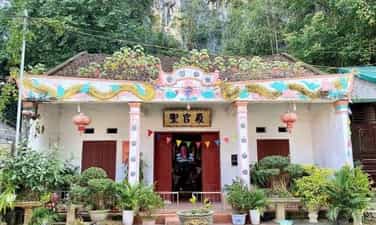
Quan Thanh Temple
The provincial-level cultural and historical relic Quan Thanh Temple is located at the foot of Phja Phu mountain, group 2, Trung Khanh town (Chongqing). The relic is associated with the Quan Thanh temple festival (also known as Co Sau street festival) held annually on the 15th day of the second lunar month. Quan Thanh Temple originally worshiped the mountain god Phja Phu with the concept of praying for the god to protect and protect the people from natural disasters. Currently, on the cliff of Phja Phu behind the temple, there is an engraved Chinese character transliterated "Quan Son protects the people" (roughly translated as mountain protects the people). According to historical records, in 1868, Ngo Con - "yellow flag" invaders from across the border invaded, looted, and killed civilians in the Cao Bang, Lang Son, Tuyen Quang regions, including the Trung Khanh area. To deal with the invaders, many healthy young men in the area gathered and chose Phja Phu temple as a place to practice their troops. Legend has it that one night, a large fireball flew across Co Sau street and fell in front of Phja Phu temple, right on the occasion when the soldiers who went to defeat the enemy "yellow flag" returned victorious. The people saw this and thought that the temple was sacred, so they contributed their efforts and money to renovate the temple to remember the merits of the heroic soldiers who fought against the enemy. At the same time, the statue of Quan Van Truong (Quan Vu, Quan Cong), a general of the Eastern Han period during the Three Kingdoms period who had great contributions in establishing the Shu Han dynasty, was worshiped. According to Vietnamese beliefs, worshiping Quan Cong is due to admiring and admiring his loyal and virtuous qualities and believing that worshiping Quan Cong will bring good luck and avoid unlucky things. From then until now, the temple has been named Quan Thanh Temple. In addition to worshiping Quan Cong, Son Than, Bach Linh, and Bodhisattva Guan Yin, during the resistance war against the French and Americans, Quan Thanh temple was also a place to evacuate local people and organize popular education classes. The monument has significance in educating patriotic traditions. Currently, there are no documents confirming the date of construction of Quan Thanh Temple. However, based on the date engraved on the stone stele in front of the harem, it shows that the temple was restored in the 6th year of Thanh Thai, Giap Ngo (ie 1894). Experiencing historical events, ups and downs, the temple was destroyed and rebuilt many times. Up to now, many items in the Quan Thanh Temple relics have been restored and renovated, creating a quite spacious appearance but still retaining the ancient and solemn features. The temple is built of bricks, tiled roof, wooden truss structure in the style of "Foreign Noi Cong", with a front hall in front and a harem in the back. Connecting the front hall and the back palace is a courtyard. The front hall has a level 4 house architecture, wooden trusses, tiled roof, brick walls, brown square tiled floor. In the middle of the front hall there is an altar, on the altar there is a stone incense bowl, engraved with some Chinese characters. Above the altar hangs a pair of yellow fabric parasols. Through the front hall, step up 4 steps to reach a yard more than 9 m long, 64 m wide, tiled with dark square tiles, which is the space separating the front hall and back palace, making the temple's view more airy but still maintain silence and solemnity. The harem is divided into 3 compartments where Quan Van Truong, Quan Am, Bach Linh and Son Than are worshiped. The middle compartment has a three-step altar, at the top in the middle is a statue of Quan Van Truong sitting on a throne. The left side worships Guan Yin, the right side is the altar worshiping Bach Linh god. The left compartment is the place to worship Son Than, separated by a brick canopy with 2 side doors made of wood. The right compartment is used as a way to burn incense, and at the same time, this is also the door leading to the back to go to Phja Phu cave. The historical and cultural relic of Quan Thanh Temple is ranked as a provincial-level relic according to Decision No. 2268/Decision of the Provincial People's Committee dated December 30, 2014 of the Provincial People's Committee. Source: Cao Bang province electronic information portal.
Cao Bang
6142 view
Rating : Provincial level relics
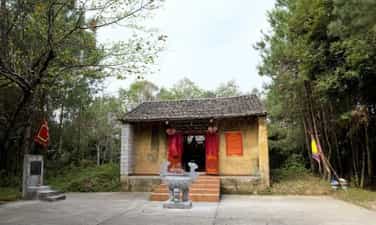
Hoang Luc Temple
The temple worshiping famous general Hoang Luc is located in Doong Luong - Chi Choi hamlet, Dinh Phong commune, Trung Khanh district (Cao Bang province), built by people in the 11th century to worship An Bien general Hoang Luc to educate love. country, determined to protect every inch of the Fatherland's sacred land. Legend has it that General Hoang Luc was a Tay chief, born in the 11th century in Lung Dinh area, Thuong Lang district (now Dinh Phong commune, Trung Khanh district). He is a talented man, knowledgeable in history books, and skilled in the art of war. At the age of 18, he was assigned to be a local prisoner to govern a region. During the resistance war against the Song invaders for the second time, implementing Ly Thuong Kiet's "Improvement and defeating the enemy" plan, General Hoang Luc sent troops to attack Song land, breaking through many strongholds and smashing rear bases. needed to serve the enemy's invasion of Dai Viet. When the Song army entered our country, with a bold guerrilla fighting style, the army he commanded raided the enemy's rear and caused a lot of damage to the enemy, contributing to the overall victory of the entire nation. With that great merit, he was appointed An Bien general by the court and assigned to guard a large border strip from Cao Bang to Lang Son today. To remember his merits when he passed away, people built a temple to worship him right in his hometown of Lung Dinh. The temple worshiping famous general Hoang Luc consists of 2 level 4 houses with an area of about 100 square meters arranged in the shape of the letter "Nhi". The temple has a yin-yang tile roof and rafters made of bamboo and wood. In particular, the temple still retains the same clay walls as when it was built. According to ancient people, when building, people used clay mixed with molasses and crushed sugar, molded boards, then stamped and pounded that soil mixture to form the surrounding walls. Many centuries have passed, the temple is still there on the Quay Son river as a cultural and historical address of the country. Mr. Ha Dinh Toan, a resident of Doong Luong-Chi Choi hamlet, Dinh Phong commune, said that every year, on February 28 of the lunar calendar, many people come to the ceremony. His family lived near the Temple, so every few days they went up to burn incense for the famous general Hoang Luc. Proud of a general guarding the border, the people here continue to promote patriotic traditions and unite to build an increasingly prosperous homeland; Participate in movements to ensure border security, protect national territorial sovereignty... Every year, on the day commemorating General Hoang Luc, many children of Dinh Phong commune who are far from home always return to their roots and make positive contributions to help build an increasingly prosperous and prosperous locality. The temple is also gradually becoming a familiar address for tourists when coming to Cao Bang. Coming to Dinh Phong commune, visitors can immerse themselves in the nature of a charming countryside; Experience the peaceful life of the people along the poetic Quay Son river; Especially, lighting incense sticks to commemorate those who have contributed to protecting the Fatherland's borders... With many historical significance and patriotic traditional education, in 2004, the Temple of famous general Hoang Luc was ranked as a provincial-level historical and cultural relic by the People's Committee of Cao Bang province. Source: Cao Bang province electronic information portal.
Cao Bang
6426 view
Rating : Provincial level relics
Na Ngan Fort Relics
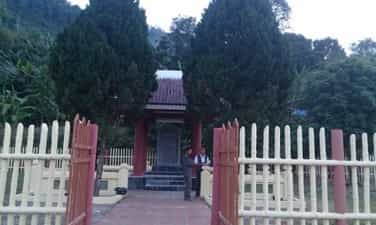
Na Ngan Fort relic in Hoa Tham commune, Nguyen Binh district, Cao Bang province, is an important relic in the complex of Tran Hung Dao Forest Special National Relic Area. This is where the second victorious battle of the Vietnam Liberation Propaganda Army (Vietnam Liberation Propaganda Army) took place on December 26, 1944. Na Ngan Fort is located on a high hill in Hoa Tham commune, Nguyen Binh district, a place with rugged terrain surrounded by valleys. The enemy chose the house of Deputy Administrator Nong Van Pao, the most solid three-room stilt house in the village, to turn into a military post with several layers of fences surrounding it. The station had 22 red loincloth soldiers commanded by 2 French officers. Thanks to the investigation and understanding of the enemy situation, during the battle of the garrison on December 26, 1944, the Vietnam Liberation Army Propaganda Team disguised itself as a team of brave soldiers to capture communists to enter the garrison. The sudden, lightning-fast battle took place within only 15 minutes. We destroyed and captured all enemy soldiers in the station and collected many guns, ammunition, and documents to bring back to the war zone. At the same time, distribute propaganda leaflets to the People and release all captured red loincloth soldiers back to the locality after spreading enlightenment propaganda. Currently, at this location, on the foundation of the old house, a stele house has been built to mark the event and the glorious victory of the Vietnam Liberation Propaganda Team. Source: Cao Bang province electronic information portal.
Cao Bang
6355 view
Rating : National monument

Nguom Slua Cave
Nguom Slua developed in limestone blocks formed in shallow and warm marine conditions about 270-360 million years ago (Permian Carboniferous period). In front of the cave entrance, there are still traces of two river steps - evidence of the lifting activity of this area in the recent period (called neo-tectonics). According to the legend of the Tay people, Nguom Boc is the place where the couple Pu Luong - Slao Cai met and became husband and wife, while Nguom Slua is the cave where Pu Luong fought with a tiger to protect their peaceful life. my family. Nguom Slua was the place where the Red Flag newspaper (1932-1933) was printed, a base for revolutionary activities from 1932 to 1936. Here, the Cao Bang Party Committee held the Indochina Congress in May 1936 to mobilize People of all ethnic groups in the province responded to the "Indochina Congress" movement and the draft "People's Prayer" demanding democratic reform, improving people's lives, and fighting openly and legally. Nguom Slua is ranked as a national historical relic according to Decision No. 188 VH/QD/BT dated February 13, 1995. Source: Ministry of Culture, Sports and Tourism.
Cao Bang
6047 view
Rating : National monument
Dong Lan Pagoda
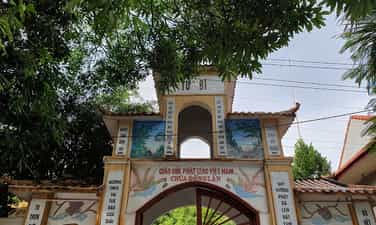
Dong Lan Pagoda located in Hung Dao commune (City) is a pagoda with a long history, built during the Le - Mac dynasties. The pagoda was recognized as a provincial cultural and historical relic in 1997. Dong Lan Pagoda is located on Dong Lan mound (Doong Lan in Tay language), in the northwest of Cao Bang city. The origin of the name "Dong Lan" has many hypotheses, associated with historical stories through many periods such as the story of Thuc Phan organizing the contest "Nine lords fighting for the king" (there are many other place names associated with this story such as : Tong Chup field, banyan tree in Cao Binh, stone clogs in Ban Thanh, upturned boat in Khau Lua). Dong Lan is the place where the lord went to get the bronze drums. He came back tired and fell asleep. Rats bit the drum strings. The drums rolled down the hill and echoed throughout the whole area. The other lords thought the lord who went to get the drums had won, so they abandoned the competition, so no one won. . Tong Lan is a rolling drum, called Dong Lan. There is a hypothesis that Dong Lan is a pagoda located on the Lan hill. During the Ly Dynasty (late 11th century), Dong Lan Pagoda was built to worship Buddha. From the year of Tan Hoi, the 19th Canh Thong era of the Mac Dynasty, the Queen of the Mac Dynasty ordered the pagoda to be built in the shape of a nail, with corridors and a back hall on both sides, and a monk's room. Behind the pagoda is Ly palace of the Mac dynasty. The pagoda is a place for queens and princesses to chant Buddhist scriptures. Before the pagoda was built, at Dong Lan mound there was a temple worshiping Tran Quy and Tran Kien. According to "Cao Bang Thuc Luc" there are many detailed records about the origins and special talents of brothers Tran Quy and Tran Kien. Their father, Tran Trieu, married a fairy wife, so his two sons were blessed with many miracles. When they reached adulthood, their fairy mother had to return to heaven, and their father also went to the mountains to study the way of immortals. The two brothers Tran Quy and Tran Kien remembered their parents' advice and carried swords around the area to search for monsters. , eliminating harm to the people. Remembering the merits of the two young men, the people built a spring-autumn temple to worship. These two, throughout the dynasties, were all ordained. During the Le Dynasty, Tran Kien was appointed Cai Cong Dai Vuong, a lower-class minister; Tran Quy is Dong Lan Dai Vuong, a middle class god. Experiencing historical events, Dong Lan Pagoda was destroyed and severely damaged many times, then repaired. In the year of Thieu Tri (1841-1847) of the Nguyen Dynasty, the pagoda was completely rebuilt. The place to worship Tran Quy - Tran Kien is separately worshiped in a small temple next to the corridor on the right side of the pagoda, while Buddha is worshiped in the main hall. During the resistance war against the French, in 1950, the pagoda was once again destroyed. In addition, according to information provided by some elderly people in Hung Dao commune, previously in the pagoda there was an incense bowl to worship Thach Sanh. This is a character in the legend of the Tay people. Thach Sanh killed the ogres, protecting the peaceful life of the people. On January 15, 1997, the pagoda was granted a Provincial Cultural Historical Relic Certificate by the Provincial People's Committee. In 2004, the pagoda was funded by the state to invest in renovating the three jewels, adding many Buddha statues, and renovating the pagoda grounds. However, the original architecture of the temple is no longer retained intact. Artifacts such as bells, Buddha statues, parallel sentences, etc., can no longer be kept from the past. Only artifacts will be given to Buddhists later. Dong Lan Pagoda currently has quite a large campus. The three-entrance gate is built firmly and solemnly. Looking from the outside you see the words "Compassion", looking from the inside you see the words "Happiness and forgiveness". The pagoda consists of a main church with 5 front halls and a main hall. There is also an ancestral church (3 compartments). The pagoda's roof is tiled and decorated with two dragons flanking the moon. From the pagoda yard, you have to go through 9 steps to reach the first architectural layer, which is the front hall (worship house). The doors are all built in an arch shape. The front hall is spacious, high and airy, with 5 compartments. In the middle is an altar with a thousand-eyed and thousand-armed Guan Yin Buddha statue. The space on the right is the altar to worship Saint Tran Quy - Tran Kien and the statue of Monsignor. The space on the left is the altar for Thach Sanh. Between the altar and the main hall there is a transit gap which is a space used to get light. The main hall (three jewels space) has two layers of altars. The highest layer adjacent to the pagoda's roof contains three Buddhas of the Three Worlds, symbolizing Buddhas belonging to three lifetimes: past, present, and future. Three Tam The Buddhas of the same size and shape are placed on a lotus throne. The second altar layer has 3 statues in the same row called Amitabha Tam Ton. Sitting in the middle is a fairly large carved Amitabha Buddha statue. On both sides are statues of Bodhisattvas and monks, arranged in rows from low to high, majestic and solemn. In the temple yard, there is a 3m high white marble statue of Avalokiteshvara Bodhisattva holding a vase of nectar in his hand. Behind the main church is the Mother Goddess Temple with three altars: Thanh Mau (main hall), Son Trang, and Tran Trieu. Above the main shrine there is the image of a pair of Thanh and White Snakes crossing horizontally. The pagoda festival is held on the 8th day of the first lunar month every year with many activities: chanting sutras, reciting Buddha's name, shaking hexagrams to pray for good fortune, praying for fortune, burning incense to pick fortune, organizing folk games..., attracting visitors from all over. Go to a crowded festival. Source Electronic information portal of Hoa An district, Cao Bang province.
Cao Bang
6381 view
Rating : Provincial level relics

De Doong Temple
De Doong Temple, also known as Giang Dong Temple, is located right on the land of De Doong village, Hong Viet commune (Hoa An). This is the original temple worshiping the stone god according to the folk belief concept of "all things are sacred" of the Tay and Nung Cao Bang ethnic groups. Later, it had the additional function of worshiping Buddha and mother worship. This is one of the sacred temples that local people and tourists admire, pray for, and worship. Legend has it that, once upon a time, there was a poor man who worked diligently as a fisherman, working hard along the river to make a living. He is filial to his parents, lives in harmony and humility with everyone in the neighborhood, and is loved by his relatives. On the day of his father's death anniversary, he went to the river to cast his net in the hope of catching a catch of fish to take home as a memorial, but he kept casting without catching any fish. Whenever I pull up the fishing net, there is only a stone shaped like two people; Feeling strange, he clasped his hands together and prayed: "If it is a god, please give me a catch of fish to commemorate my father's death." Sure enough, right after that, he threw a full catch of fish. Seeing the miracle, the young man took the stone and built a shrine in Vo Ban. On a night of heavy rain and strong winds, the temple's roof was blown off and a piece of wood flew to Riet Ri hill, from which people built the temple there. But this is a place far from the population, with difficult roads and narrow surroundings around the temple, not meeting the needs of crowded ceremonies, so the villagers built a temple in De Doong village and took the god stone to worship. During the Le and Mac dynasties, De Doong temple was repaired and Buddha and mother statues were placed in the altar. Through many changes in history, the temple disappeared and was restored and embellished many times, creating a new appearance until today. The overall architecture of De Doong Temple is in the shape of the letter "nail", including three vertical compartments, tiled roofs, and walls built of local bricks. The partition walls are decorated with motifs of rolling clouds, flying dragons, flowers and leaves..., each room has its own pattern and layout. The outermost space is also known as the main hall or the great worship space. There are no statues in this space, but on the hitch there are decorations depicting charming mountain and water scenes. On both sides of the hall, there are paintings of two mighty generals standing guard with two war horses. In the middle of the space is the altar and incense bowl, and on the right side hangs a small bronze bell. On both sides of the outside wall are painted two tall horses, with the words "great horse" written in Chinese characters on their chests. This is the main space for local people and tourists to burn incense and pray. The middle space, also known as the middle room, has an area of about 21.5 m2. On the hitch are engraved two dragons flanking the moon, showing the descriptive content: two dragons flanking the moon, dragon rolling in the clouds. In the middle of the room there are 3 statues of mandarins, all of them wearing dragon-winged hats and holding scriptures in their hands to preach. The left wall is an altar of meditating statues, the right wall has Buddha statues and Guan Yin Buddha statues with small sizes ranging from 20 - 60 cm. The innermost space, also known as the main hall or harem, has an area of about 20.44 m2. This is the space used for worship with solemn and majestic ceremonies. The middle wall acts as a background decorated with small patterns, orchids and rolling rattan. In this space, there are 3 statue pedestals with 3 steps, the highest step and the second step are a system of Shakyamuni Buddha statues, each step has 3 statues sitting on a lotus. In the middle of the second pedestal is a sitting statue with many arms, smaller than the other statues. The third pedestal is the statue of Maitreya, a symbol of the god of wealth, with an incense bowl and flower vase next to it. On the left side of the altar, there is a statue of Tang Tang in the middle and statues of good and evil gods on both sides. On the left wall is a throne to worship a god stone and an incense bowl for offerings. The right wall has 3 statues of mandarins and incense bowls for good luck. De Doong Temple Festival is held on the 15th day of the first lunar month every year, attracting a large number of people from all over to attend the festival, pray for blessings, pray for wealth, pray for good fortune, hope for favorable rains, peaceful winds, and fresh crops. Good for cultural activities, arts, traditional folk sports, and bustling spring days. During the resistance war against the French colonialists, the temple witnessed the activities of the Cao Bang Party Committee, many revolutionary soldiers came here to take refuge at the temple door and discuss state affairs. On June 15, 1945, a meeting was held here to welcome the establishment of the province's revolutionary government. De Doong Temple was ranked as a provincial-level historical and cultural relic on November 4, 2008. Source Ministry of Culture, Sports and Tourism.
Cao Bang
6376 view
Rating : Provincial level relics

Nguom Boc Cave
Nguom Boc - meaning Dry Cave in the local language - is located on the west slope of Lam Son mountain range, in Ban Nua hamlet, Lam Son village, Hong Viet commune. This is the place that marks many historical events about President Ho Chi Minh's revolutionary life in the years 1942-1945. From late March to August 1942, President Ho Chi Minh moved from Pac Bo to the base in Lam Son to direct the revolution. Here, people often secretly go back and forth to Nguom Boc cave, affectionately called "Mr. Ke" by local people. In May 1945, at Nguom Boc cave, President Ho Chi Minh attended a meeting with leaders of the Cao - Bac - Lang Joint Provincial Party Committee to prepare for the historic general uprising in August 1945. Nguom Boc is also where Le To's military workshop lived and worked during the resistance war against the French. Here in October 1950, President Ho Chi Minh attended and directed the Conference summarizing the Border Campaign; talked with workers at the Le To military factory and representatives of the people of Hong Viet commune, Hoa An district. Archaeologists also found many relics in Nguom Boc showing that this was once the residence of prehistoric people of the early Neolithic period, equivalent to the early Hoa Binh Culture, about 10,000 years ago today. In the famous legend Pu Luong - Slao Cai of the Tay people, Nguom Boc is the first residence of these two legendary characters in Cao Bang. Geologically, Nguom Boc cave developed in limestone formed in shallow sea conditions about 270 - 360 million years ago (Permian Carboniferous period). At the cave entrance, traces of shelves and ancient flows are clearly visible, evidence appears to have been raised during the recent period (called the neo-tectonic period). Nguom Boc Cave was recognized as a national revolutionary historical relic according to Decision No. 02/2004/QD/BVHTT of the Ministry of Culture, Sports and Tourism dated January 19, 2004. Source Electronic information portal of Hoa An district, Cao Bang province.
Cao Bang
6130 view
Rating : National monument
Phai Khat Fort
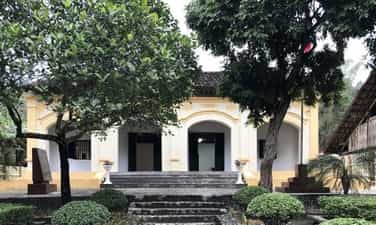
Phai Khat Fort is located in Tam Kim commune, Nguyen Binh district, 7km from Tran Hung Dao forest. Here, on December 22, 1944, the Vietnam Liberation Army Propaganda Team was established. President Ho Chi Minh instructed the Team to develop a plan to organize a battle to "encourage the revolutionary fighting spirit of an enslaved nation, seething with the will to rise up", at the same time " overcome the situation of lack of weapons and equipment". Under the command of comrade Vo Nguyen Giap, the Team discussed carefully to clarify the issue: "Where to attack and how to attack, so that with only a small force we can win a great political victory." political and military, while limiting the loss of our people and weapons. After discussing options, the Team Command decided "to raid the enemy's camp to capture ammunition", the goal. Targets are Phai Khat and Na Ngan stations. The garrison force consisted of two squads, under the direct command of comrade Van (Vo Nguyen Giap). In addition, there was also the participation of guerrillas and local Viet Minh officers on duty to guard the roads leading to the village. In order to break in smoothly, comrade Vo Nguyen Giap prepared a fake patrol permit with a red stamp to serve in the battle. On the afternoon of February 24, the forces participating in the battle disguised themselves as soldiers and marched to Phai Khat. After receiving news that Station Chief Simono was going to the capital of Nguyen Binh, at 5:00 p.m. on February 25, "Squad" Thu Son led his troops into the station easily. The team quickly divided into two prongs: Platoon 1 captured the gun storage area, Platoon 2 surrounded the station. While the enemy had not yet reacted, comrade Thu Son shouted: "Rat-sam-mang" (gather), 17 soldiers and the commander gathered in the middle of the yard. The enemy was surprised and could not react in time and quickly surrendered. The battle took place quickly, and Simono returning from Nguyen Binh was also destroyed. As a result, we destroyed 1 enemy and captured 17 enemies, capturing 17 guns, some ammunition and military equipment. After defeating Phai Khat post, on the night of December 25, the Team urgently marched to Cam Ly commune (15km from Phai Khat), where Na Ngan post was located. The team learned from experience and praised the comrades for completing the task well, and at the same time disseminated the attack plan the next day. Due to the dangerous terrain of Na Ngan station, the Team decided to disguise themselves as a group of soldiers and red loincloth soldiers to escort three Man Communists to hand over to the station. The force attacking Na Ngan garrison was all members who participated in attacking Phai Khat garrison. At around 7:00 a.m. on December 26, comrade Thu Son and the volunteer team led three tied communists into the station along with the tricolor flag (the team got it at Phai Khat station). The soldiers thought they were in a hurry to arrange 6 soldiers and the commander to line up to welcome them according to military protocol. After the whole team entered the station, according to the assigned plan, four soldiers approached the middle of the gun rack. Comrades Thu Son and Be Van Sat talked to Duong to create a distraction. Platoon 2 blocked the station gates, then divided into groups to capture prisoners. Platoon 3 fired into the air while calling for the enemy to surrender. At the end of the battle, we destroyed 5 people, captured 17 people, and collected 27 guns and many bullets. In this battle, comrade Nong Van Be was slightly injured. After taking down the station, the Team quickly collected guns, ammunition, documents and distributed leaflets and banners to the people. The group of prisoners of war was gathered in the middle of the yard. Two female comrades Cam and Thanh explained in Tay language to them to understand the Viet Minh's policy of fighting the French and Japanese to save the country, calling on them to turn their guns on France and Japan to win independence for the nation. After hearing the policies of the Viet Minh, some prisoners of war asked to join the revolution and most asked to return home. In the first two battles, the Team used the tactic of "attacking with a disguised raid (raid), which excellently opened the tactical history of the Vietnam People's Army". Training disguise is a way of fighting that uses few guns and bullets, has low casualties but is highly effective in combat. In the first two battles, in addition to destroying and capturing all enemy soldiers in the station, the Team also captured many weapons and military equipment. Most importantly, the team won in accordance with leader Ho Chi Minh's directive "The first match must be successful". Source: Cao Bang electronic information portal
Cao Bang
6157 view
Rating : National monument

Dong Khe Victory Historical Relic Area
Dong Khe Victory Historical Site (1950 Border Campaign) is located in Na Lan, Duc Long commune, Thach An district, far from Cao Bang city. This is a relic associated with the revolutionary career of President Ho Chi Minh, with the victory of the 1950 Border Campaign, led by the Military Region Command, Military Region 1, Military Region II and Cao Bang province. construction coordination. The relic site was put into use on May 19, 2004, demonstrating the noble morality "When you drink water, remember its source" for the genius leader, the beloved father of the nation, and left a glorious mark. , the heroic victory of a strategically significant victory in the resistance war against the French colonial invasion. The relic site consists of 2 parts: President Ho Chi Minh Memorial House and Uncle Ho's monument cluster observing the Dong Khe battle on Bao Dong Mountain. The memorial house is designed in a modern stilt architectural style, displaying images and artifacts related to the activities of President Ho Chi Minh observing the battle on Bao Dong Mountain. The cluster of Uncle Ho's monuments observing the Dong Khe battle on Bao Dong mountain is made of imitation bronze composite material, 2.8m high, weighs 418kg, reinforced concrete columns, the entire statue is placed on a stone pedestal covered with floral tiles. . To get to Uncle Ho's Monument to observe the battle of Dong Khe on Bao Dong Mountain, go through 846 stone steps, divided into 79 steps, symbolizing Uncle Ho's 79 springs. Today's stone steps are the old road, on September 13, 1950, Uncle Ho left the Campaign Command Post to the Forward Command Post in Na Lan, went to Bao Dong Mountain to observe the battle of Dong Khe. Early in the morning of September 16, 1950, from an observation position on Bao Dong mountain, President Ho Chi Minh attentively observed and closely followed the developments of Dong Khe battle, opening the 1950 Border Campaign, creating money. for the nation's great victorious resistance war. On September 16, 1950, our army units opened fire to open the Campaign with a battle at Dong Khe base. Losing Dong Khe, the enemy army in That Khe fell into a threatening situation, Cao Bang was isolated. Faced with the risk of being destroyed, the French army was forced to withdraw from Cao Bang along Route 4. To support this withdrawal, France mobilized troops from That Khe to retake Dong Khe and welcome troops from Cao Bang to withdraw. ; At the same time, send troops to attack Thai Nguyen to attract our main force. Guessing the enemy's intentions, our army proactively ambushed and blocked the enemy in many places on Route 4, making it impossible for these two armies to meet each other. It was That Khe's turn to be threatened. On October 8, 1950, the French army had to withdraw to Na Sam; On October 13, 1950, France withdrew from Na Sam to Lang Son. Meanwhile, the enemy's march to Thai Nguyen was also blocked by our troops. The French army became panicked and had to retreat. On October 22, 1950, Route 4 was liberated. On October 3, 1950, Cao Bang province was liberated, marking an important milestone in history, becoming a major anniversary day of Cao Bang every year. At the end of the Border Campaign, we eliminated more than 8,300 enemies from combat, liberating the entire Vietnam-China border from Cao Bang to Dinh Lap with 350,000 people, with an area of 4,500 km2; breaching France's "East-West Corridor". The enemy's siege both inside and outside of the Viet Bac base was broken. The victory of the Border Campaign changed the war situation between us and France, creating a new change in attack and counter-attack strategies, contributing to bringing the resistance war to victory, culminating in the campaign. Dien Bien Phu, moving towards the great victory in the spring of 1975, completely liberating the South, unifying the country, moving towards socialism. Source: Cao Bang province electronic information portal
Cao Bang
9149 view
Rating : Special national monument

PAC BO MONUMENT AREA
Pac Bo historical site is located in Truong Ha commune, Ha Quang district, Cao Bang province. This is the location that was once associated with Uncle Ho's activities in the early stages of returning to the Fatherland to lead the Revolution (1941 - 1945). In early 1941, Nguyen Ai Quoc and five comrades returned home and stayed at Mr. Ly Quoc Gun's house, then moved to Coc Bo cave, Lung Lan cave and Khuoi Nam shack. Here, from May 10 to May 19, 1941, the 8th Party Central Conference took place. And, also at Khuoi Nam II shack, Uncle Ho established the Independent Vietnam Newspaper, calling on the entire people. unite to fight common enemies, the French colonialists, Japanese fascists and Vietnamese traitors, to gain independence and freedom. According to the "Monuments Master Plan" approved by the Prime Minister, Pac Bo relics include: 1. Cluster of relics in the watershed area - Coc Bo Cave (meaning "watershed" in Nung language) is about 80m2 wide, the cave entrance can only fit one person. This is where Uncle Ho and his fellow revolutionary cadres stayed from February 8, 1941 to mid-March 1941. - The floor of Mr. Ly Quoc Gun's house: is the house where Uncle Ho lived when he first returned to the Fatherland to direct the revolution (from January 28 to February 7, 1941). - Lung Lan Cave: is where Uncle Ho lived and worked around the end of March 1941. - Nguom Vai Cave: here, in 1941, Uncle Ho directly guided and admitted Comrade Nong Thi Trung to the Party. - Lenin Stream: during his time in Pac Bo, Uncle Ho often sat fishing in this stream. - Mr. La Thanh's house: was an important revolutionary base in the pre-uprising period. This is the place to welcome national delegates to the 8th Party Central Committee Conference. - Milestone 108: now milestone number 675, one of 314 Vietnam-China border landmarks. - Gooc Mu field: In 1940, the people of Pac Bo village once came here to cut blood and swear, vowing to follow the revolution all their lives. 2. Souvenir spots in the central area - President Ho Chi Minh Memorial House and square yard: built according to the ethnic stilt house model, located on the Linh Son range, in the Pac Bo relic area. - Na Chang field area: This is the place for the rally to welcome President Ho Chi Minh to visit and talk with the people of Pac Bo on February 20, 1961. - Projects: exhibition house, reception house. 3. Bo Bam relic cluster - Mr. Duong Van Dinh's house: is where President Ho Chi Minh often spoke and propagated about the revolution. - Karl Marx Mountain, Lenin Stream, Tiger Head Cave: is where Cao Bang people held a memorial ceremony for Uncle Ho (September 1969). 4. Khuoi Nam relic cluster - Khuoi Nam Shack: is the place where Uncle Ho stayed the longest. In addition, to ensure Uncle Ho's safety, comrades and officers built two more shacks for him (Khuoi Nam II and III shacks). - Slí Dieng cave and Diem Tieu cave: are places used by Uncle Ho as secret mailboxes, in the period 1941 - 1945. On May 10, 2012, the Prime Minister decided to classify Pac Bo Historical Relic as a special National Monument. Source: Department of Cultural Heritage
Cao Bang
7332 view
Rating : Special national monument
Outstanding monuments
See all
Mac Dynasty Citadel in Cao Bang (Na Lu Citadel, Ban Phu Citadel, Phuc Hoa Citadel)
During the period when the Mac dynasty had its capital in Cao Bang, in order to prevent the Le dynasty from attacking, the Mac dynasty restored and repaired Na Lu citadel (now in Hoang Tung commune, Hoa An) and Ban Phu citadel (now in Hung Dao commune). ), Phuc Hoa citadel, in addition to building many other citadels in Cao Bang, making Cao Bang a political and military center in the far Northeast border region at that time. Na Lu citadel and Phuc Hoa citadel are two citadels built before. According to the records of Be Huu Cung in Cao Bang Thuc Luc, Na Lu citadel and Phuc Hoa citadel began in the reign of Tang Y Tong in the year Giap Than, the 5th Ham Thong era (874). Based on the presence of many ancient tombs with stone inscriptions containing the names, addresses, and hometowns of the citadel builders who died here during the Ham Thong Dynasty, it can be confirmed that these two citadels were built during the Tang Dynasty. Na Lu Citadel was built over many different dynasties. When the Mac dynasty came to Cao Bang, it was rebuilt with bricks. Na Lu citadel has a nearly rectangular shape, has a total area of about 37.5 hectares, a length of about 800 m, a width of about 600 m, the citadel has 4 gates. Ban Phu citadel in the capital of Nam Binh, Nam Cuong country of Thuc Phan in the past in Cao Binh (Cao Bang), the Mac dynasty renovated the royal palace in the inner circle of the old capital of Nam Binh and called it Ban Phu citadel or Royal Palace. In the ancient capital of Nam Binh of the Nam Cuong country and the Mac dynasty, Ban Phu citadel still has clear traces. The capital city of Nam Binh consists of two citadels, to protect the citadel, the outer ring has a circumference of about 5 km, including a low hillock area, around the foot of the hill is covered with vertical canvas like a wall, convenient for navigation. Build defense lines. The western wall of the citadel runs parallel to the bank of the Bang River to the beginning of Bo Ma village, connecting the southeast wall of the citadel, flowing in front of Ban Phu, following the foot of the hill to meet National Highway 4, the northeastern side running along the foot of the hill close to the outside of National Highway 4. , up to the top of the mound is the northwest side, continue running along the foot of the hill, out to the river bank and meet the west wall, forming a closed citadel. When the Mac Dynasty established the capital, it repaired and built a number of additional works, in which Ban Phu Citadel (inner citadel - the king's working place) was built higher on the old citadel walls from the Thuc Phan period. The citadel is located on a flat land. Along with rebuilding the capital, the Mac dynasty also built a system of posts and ramparts quite thick around the capital and a number of important border points, forming a system of protecting the capital and protecting the border. gender. Phuc Hoa citadel (Phuc Hoa district) was built in a square style, about 400 m in each direction, including two citadel rings, the distance between the two rings is 80 m. Currently, the southern wall has been completely destroyed. Phuc Hoa Citadel has 2 main gates: The North Gate is open to the national highway to Ta Lung Border Gate today, people often call it Pac Gate, this gate is built in a rectangular style, 8 m wide, 5 m high. , including two gates made of thick, very sturdy wood; The second gate is in the south, opening to the river bank. Both gates were flattened long ago, and now there are no traces left. Near the citadel, in the northwest suburbs along the riverbank, there are many traces of brick kilns. People said that during the process of labor and exploration, many intact brick kilns were found in this area. Through research and surveys, it has been shown that in Cao Bang, the Mac dynasty renovated, embellished and built many citadels and fortresses, including repairing, embellishing and rebuilding Ban Phu citadel, Na Lu citadel, and Phuc citadel. Hoa. These fortifications have formed a quite solid system of protecting the capital. Up to now, of the ancient citadels built by the Mac Dynasty during the capital period in Cao Bang, some of the citadels built of earth only have traces left, but the citadels built of stone are still very clear. Source: Cao Bang Electronic Newspaper
Cao Bang
12982 view
Rating : National monument

Kim Dong historical relic site
To commemorate the brave Captain of the National Salvation Children's Team who sacrificed his life while on duty to protect the revolution, the Party and State built the Kim Dong Heroic Martyr Monument in Na Ma village, Truong Ha commune (district). Ha Quang) Cao Bang province. May 15, 1941, forever shines brightly in the golden pages of traditional history of the Ho Chi Minh Youth Union. That day, near Coc Bo cave, down Lenin stream, at the foot of Thoong Ma mountain, in Na Ma village, Truong Ha commune, Ha Quang district, Cao Bang province, 5 teenagers including: Nong Van Den (alias Kim Dong ), Nong Van Than (Cao Son), Ly Van Tinh (Thanh Minh), Ly Thi Ni (Thuy Tien) and Ly Thi Xuu (Thanh Thuy), were enlightened and challenged by Duc Thanh and other revolutionary cadres. , gathered to form the National Salvation Children's Team according to the Party's decision; in which Nong Van Den was elected Team Leader. The Children's National Salvation Team has the purpose of participating in fighting the West, expelling the Japanese, and gaining independence for the country, with the tasks of transportation, transportation, protection of officials, and guarding Party meetings... From After May 1941, children's teams for national salvation were established everywhere to participate in the revolution. Many youth teams achieved outstanding achievements, brightening the golden history of the Children's Team, contributing to the victory of the People's Army. August Revolution 1945. In August 1942, Kim Dong had the honor of meeting Uncle Ho at Noc En cave on the mountain behind Na Ma village. He praised Captain Kim Dong for his cleverness, agility, and courage. He advised Kim Dong and his fellow members to help and actively protect the revolution, working while studying culture and politics so that the country can later gain independence and contribute to national construction. At 5 a.m. on February 15, 1943, while on guard duty at a meeting of the Viet Minh committee, when he discovered that the enemy was approaching, Kim Dong quickly created a diversion to protect the revolutionary cadres. The enemy opened fire, Kim Dong was hit and died, just 14 years old at that time. In 1997, Kim Dong was posthumously awarded the title Hero of the Armed Forces by the Party and State. Kim Dong Heroic Martyr Relic was built right in his hometown in Na Ma Village, Truong Ha commune (Ha Quang). The relic area includes Mr. Kim Dong's grave and his spacious statue at the foot of a massive high rocky mountain range, next to a green tree that always gives shade. Statue of Mr. Kim Dong wearing Nung clothes and holding up a homing pigeon. There is a large yard here. Every year, teenagers and children from the province and the whole country often gather here to organize new team members, camp, play, generations of Vietnamese children come to join the team. his first adult, came to the revolutionary homeland of Lenin stream, Cac Mac mountain and Pac Po cave forever engraved in the minds of Vietnamese children. Source: Cao Bang province electronic information portal
Cao Bang
9632 view
Rating : National monument

Tran Hung Dao Forest Relic
Tran Hung Dao Forest Special National Relic Area is located at the foot of Slam Cao Mountain in Tam Kim and Hoa Tham communes (Nguyen Binh district, Cao Bang province). This is where a system of relics associated with a particularly important historical period of the Vietnamese revolution is kept. Tran Hung Dao Forest Special National Relic Area is the place marking the establishment and activities of the Vietnam Liberation Army Propaganda Team, the predecessor of the Vietnam People's Army. At the same time, this is also the place associated with the life and revolutionary career of General Vo Nguyen Giap - an excellent student of President Ho Chi Minh. The relic area includes 5 important points: Tran Hung Dao forest relic cluster (including the location of the establishment of the Vietnam Liberation Army Propaganda Team, the rest shack and kitchen, the water mine for domestic water, and Slam Cao Peak); Tham Khau Cave (Tam Kim commune) - was once used as a communication station, serving meals to revolutionary comrades; Phai Khat Fort (Tam Kim commune) - where the first battle of the Vietnamese Liberation Propaganda Army team took place (December 25, 1944); Na Ngan Fort (Hoa Tham commune) - the place marking the second victorious battle of the Vietnam Liberation Army Propaganda Team (December 26, 1944); Va Pha relic (Tam Kim commune). With these historical values, in 2013, the Prime Minister decided to classify Tran Hung Dao Forest Historical Relic (Nguyen Binh district, Cao Bang province) as a special national monument. The exhibition house at the relic site, after being completed and put into use, has contributed to honoring and paying tribute to the previous generation, while preserving, embellishing and promoting the value of the relic site. Artifacts here are displayed centrally, ensuring true scientific and historical value according to 3 themes: Cao Bang - Country, people and traditions; The process of formation, birth and operation of the Vietnam Liberation Army Propaganda Team; Glorious traditional heroic army. The special national relic site of Tran Hung Dao forest is not only a red address of glorious historical tradition with many relics but also a primeval forest. With an area of over 201.7 hectares, Tran Hung Dao forest has a wild beauty with fresh air. Deep under the canopy of ancient trees is the stele house of 34 soldiers of the Vietnam Liberation Army Propaganda Team, with tents and kitchens simulating the simple daily life of the soldiers. Following a small slope about 50 meters is a natural water mine, also a water source for soldiers, which has been producing cool and clear water for many years. Also in Tran Hung Dao forest, a 300-year-old ancient crocodile tree that was closely associated with the daily life of the Vietnam Liberation Army Propaganda Team has been recognized as a Vietnamese Heritage Tree. Over the past 75 years, the vestiges from the early establishment of the Vietnam Liberation Army Propaganda Team have always been respected and preserved by ethnic people of Cao Bang province, contributing to educating patriotism and revolutionary traditions. for future younger generations. The vast primeval forest spreads out each canopy, covering the sacred relics of the arduous revolutionary activities of General Vo Nguyen Giap and the Vietnam Liberation Army Propaganda Team. Source: Vietnam National Tourism Administration
Cao Bang
9615 view
Rating : Special national monument

Dong Khe Victory Historical Relic Area
Dong Khe Victory Historical Site (1950 Border Campaign) is located in Na Lan, Duc Long commune, Thach An district, far from Cao Bang city. This is a relic associated with the revolutionary career of President Ho Chi Minh, with the victory of the 1950 Border Campaign, led by the Military Region Command, Military Region 1, Military Region II and Cao Bang province. construction coordination. The relic site was put into use on May 19, 2004, demonstrating the noble morality "When you drink water, remember its source" for the genius leader, the beloved father of the nation, and left a glorious mark. , the heroic victory of a strategically significant victory in the resistance war against the French colonial invasion. The relic site consists of 2 parts: President Ho Chi Minh Memorial House and Uncle Ho's monument cluster observing the Dong Khe battle on Bao Dong Mountain. The memorial house is designed in a modern stilt architectural style, displaying images and artifacts related to the activities of President Ho Chi Minh observing the battle on Bao Dong Mountain. The cluster of Uncle Ho's monuments observing the Dong Khe battle on Bao Dong mountain is made of imitation bronze composite material, 2.8m high, weighs 418kg, reinforced concrete columns, the entire statue is placed on a stone pedestal covered with floral tiles. . To get to Uncle Ho's Monument to observe the battle of Dong Khe on Bao Dong Mountain, go through 846 stone steps, divided into 79 steps, symbolizing Uncle Ho's 79 springs. Today's stone steps are the old road, on September 13, 1950, Uncle Ho left the Campaign Command Post to the Forward Command Post in Na Lan, went to Bao Dong Mountain to observe the battle of Dong Khe. Early in the morning of September 16, 1950, from an observation position on Bao Dong mountain, President Ho Chi Minh attentively observed and closely followed the developments of Dong Khe battle, opening the 1950 Border Campaign, creating money. for the nation's great victorious resistance war. On September 16, 1950, our army units opened fire to open the Campaign with a battle at Dong Khe base. Losing Dong Khe, the enemy army in That Khe fell into a threatening situation, Cao Bang was isolated. Faced with the risk of being destroyed, the French army was forced to withdraw from Cao Bang along Route 4. To support this withdrawal, France mobilized troops from That Khe to retake Dong Khe and welcome troops from Cao Bang to withdraw. ; At the same time, send troops to attack Thai Nguyen to attract our main force. Guessing the enemy's intentions, our army proactively ambushed and blocked the enemy in many places on Route 4, making it impossible for these two armies to meet each other. It was That Khe's turn to be threatened. On October 8, 1950, the French army had to withdraw to Na Sam; On October 13, 1950, France withdrew from Na Sam to Lang Son. Meanwhile, the enemy's march to Thai Nguyen was also blocked by our troops. The French army became panicked and had to retreat. On October 22, 1950, Route 4 was liberated. On October 3, 1950, Cao Bang province was liberated, marking an important milestone in history, becoming a major anniversary day of Cao Bang every year. At the end of the Border Campaign, we eliminated more than 8,300 enemies from combat, liberating the entire Vietnam-China border from Cao Bang to Dinh Lap with 350,000 people, with an area of 4,500 km2; breaching France's "East-West Corridor". The enemy's siege both inside and outside of the Viet Bac base was broken. The victory of the Border Campaign changed the war situation between us and France, creating a new change in attack and counter-attack strategies, contributing to bringing the resistance war to victory, culminating in the campaign. Dien Bien Phu, moving towards the great victory in the spring of 1975, completely liberating the South, unifying the country, moving towards socialism. Source: Cao Bang province electronic information portal
Cao Bang
9149 view
Rating : Special national monument

Historical relic site of the Voice of Vietnam at Nguom Chieng cave
Location of the Voice of Vietnam at Nguom Chieng cave (1966 - 1978), in Trung Khanh town, Cao Bang province. Nguom Chieng Cave, with its rugged terrain and solid terrain, was chosen as the place to set up a backup station of the Voice of Vietnam (called Dien Radio A3). The A3 radio broadcasting station was the evacuation site of the Voice of Vietnam during the resistance war against the US invasion from 1966 to 1978. This is one of the important "bases" responsible for relaying and broadcasting. broadcasting to Finland and Northern European countries, contributing to ensuring that the Voice of Vietnam's broadcast is maintained and smoothly, transmitting the voice of the Party and Government, the voice of the Vietnamese people steadfastly. strong and proud on the front line against America, winning independence and freedom for the Fatherland. Over 10 years of operation (from the first day of broadcasting on April 24, 1966 to 1978), Radio A3 has successfully completed its historical mission, marking many memories of the arduous period of resistance against the US to save the country. magnanimity, especially of radio people with their bravery and burning revolutionary enthusiasm. At the beginning of construction, Dien Dai A3 was called Site 50. During the two-year construction period, at one point, up to 300 workers had to be mobilized to pave the way and explore the surrounding area to ensure broadcasting. bar as fast as possible. When chosen as the place to set up a backup station for the Voice of Vietnam, Nguom Chieng was expanded into a very wide and deep cave through the mountain. In front of the cave entrance on the left is a solid stone ventilation house. Inside the cave, 3 houses were built to house generators and warehouses. At the end of the cave is also an empty space and finally the path to the back door is built with 124 steps leading out of the cave behind the mountain and is also where the receiver system is located. Standing here, you can observe National Highway 4A leading to Ban Gioc Waterfall and the surrounding area. In addition to the main cave, there is also a secondary cave with a narrower cave to place the dynamo system. In front of the cave is a row of mechanical buildings on the right, further to the left is the security force's house and the cafeteria. All of these rows of houses are built of very solid and sturdy stone. The more flat and empty space in front of the cave entrance is where the transceiver antenna system is located. Over a long period of time with the impact of nature and humans, currently the houses built in Nguom Chieng cave to place transmitters and radio transmitters have been destroyed, leaving only the tiled and marble floors. The foundation system of the house, at the end of the cave, still has 124 steps leading to the back door where the receiver is located. The small cave on the right to place the dynamo system currently still has a cement and stone pedestal and reinforced steel. In front of the cave entrance, the rows of mechanical houses, the security force's house, the cafeteria and the water tank are still intact, currently only the roof is damaged. All rows of houses are built of solid and sturdy cement and stone. The land area to place the antenna columns is currently the rice fields of people in Bo Da hamlet, Trung Khanh town, Trung Khanh district. Nguom Chieng cave relic has an area of protection zone 1 of 6,616.7m2 and protection zone 2 of 42,016.6m2. With the above typical value, the location of the Voice of Vietnam at Nguom Chieng cave (1966 - 1978), was ranked a National Historical Monument by the Minister of Culture, Sports and Tourism on June 29. /2021. Source: Department of Cultural Heritage
Cao Bang
8893 view
Rating : National monument

Ky Sam Temple
Ky Sam Temple is located on a low hill, close to the foot of Khau Sam mountain in Ban Ngan village, Vinh Quang commune (City). The temple worships historical figure, famous general Nung Tri Cao (1025 - 1053), during the reign of King Ly Thai Tong. The temple was built on a large campus, with "two" shaped architecture, bearing the architectural style of the Nguyen Dynasty, with a worship hall and a harem. At the worship house there is an altar. Inside the harem there are three altars, in the middle worshiping Nung Tri Cao, on the left worshiping A Nung's mother, and on the right worshiping three wives: Vuong Lan Anh, Doan Hong Ngoc, and Tran Thi Cam. Nung Tri Cao was born in 1025, the son of Nung Ton Phuc, the leader of Thang Do province. Right from his childhood, Nung Tri Cao was a healthy, handsome, hyperactive, exceptionally intelligent boy who was good at learning letters and martial arts like he was born. In 1038, Nung Ton Phuc occupied the two continents of Vu Lac and Quang Nguyen, founded the Truong Sinh country, proclaimed himself Chieu Thanh Emperor, and established A Nung's wife as Minh Duc Queen. vast area in the Northeast of our country. In 1039, King Ly Thai Tong personally led a large army to suppress Truong Sinh country. Nung Ton Phuc and his eldest son Nung Tri Thong were captured and brought to the capital to be executed. A Nung and his second son Nung Tri Cao ran to Loi Hoa cave, located in present-day Guangxi province (China). Here, mother and son urgently gathered soldiers, practiced martial arts day and night, and built a force of soldiers, swords, and war horses. In 1041, when Nung Tri Cao was 16 years old, he and his mother A Nung led troops from Loi Hoa cave to recapture Thang Do province, establishing the Dai Lich kingdom. The Ly Dynasty sent a large army to attack and capture Nung Tri Cao and take him to the capital. After reviewing and assessing the situation, needing to calm the border areas and protect the national territory, the King of the Ly dynasty exonerated Nung Tri Cao and continued to manage Thang Do province; At the same time, he granted the authority to govern a large area, including the caves: Loi Hoa, Binh, Ba and Tu Lang province, and ordained Nung Tri Cao as the governor of Quang Nguyen. In 1043, King Ly Thai Tong sent people to Quang Nguyen province to bestow the title of Thai Bao on Nung Tri Cao, one of the three highest-ranking officials at the court, and hand over the capital. In 1048, Nung Tri Cao started an army in Animal Evil, conquered An Duc province, belonging to the Song Dynasty (China) as a base. Two years later (1050), taking advantage of the powerful army and generals, Nung Tri Cao conquered Vat Duong (Song land), then proclaimed himself king, established Nam Thien Quoc, and took the reign name Canh Thuy. Victory after victory, the frontiers and territories are rapidly expanding. However, Tri Cao still intended to make peace with the Song dynasty. In 1051, he sent people to bring jewels, gold, silver, and ivory to pay tribute, but the Song court refused. Faced with that situation, in 1052, Nung Tri Cao led 5,000 troops to attack Ung Chau and Guangzhou. After mastering Ung Chau, Tri Cao proclaimed himself Emperor Nhan Hue; The reign name was changed to Khai Lich and the national name was Dai Nam. Tri Cao ordered the destruction of prisons, amnesty for prisoners, the opening of logistics warehouses, and the Song army's food distribution to the poor. Therefore, Tri Cao's forces grew strongly. In 1053, the Song Dynasty sent Dich Thanh - a famous general at the court - to lead a mighty army to fight the Nung Tri Cao army. This time, Tri Cao was defeated and had to flee to the land of Dali, in present-day Yunnan province (China). Nung Tri Cao sent Luong Chau to the capital to ask for help from the Ly dynasty but could not save the situation. To commemorate Nung Tri Cao's virtues, people in many places built temples to worship. The Ly dynasty specifically decreed Tri Cao to be Khau Sam Dai Vuong and established a temple in Ban Ngan village, Tuong Lac commune, Thach Lam district (now Ban Ngan village, Vinh Quang commune, Cao Bang city). The temple was conferred the title of Supreme Deity by the Ly dynasty. Nung Tri Cao Temple was ranked a national historical relic by the State in 1993. Source: Cao Bang Electronic Newspaper
Cao Bang
8446 view
Rating : National monument

PAC BO MONUMENT AREA
Pac Bo historical site is located in Truong Ha commune, Ha Quang district, Cao Bang province. This is the location that was once associated with Uncle Ho's activities in the early stages of returning to the Fatherland to lead the Revolution (1941 - 1945). In early 1941, Nguyen Ai Quoc and five comrades returned home and stayed at Mr. Ly Quoc Gun's house, then moved to Coc Bo cave, Lung Lan cave and Khuoi Nam shack. Here, from May 10 to May 19, 1941, the 8th Party Central Conference took place. And, also at Khuoi Nam II shack, Uncle Ho established the Independent Vietnam Newspaper, calling on the entire people. unite to fight common enemies, the French colonialists, Japanese fascists and Vietnamese traitors, to gain independence and freedom. According to the "Monuments Master Plan" approved by the Prime Minister, Pac Bo relics include: 1. Cluster of relics in the watershed area - Coc Bo Cave (meaning "watershed" in Nung language) is about 80m2 wide, the cave entrance can only fit one person. This is where Uncle Ho and his fellow revolutionary cadres stayed from February 8, 1941 to mid-March 1941. - The floor of Mr. Ly Quoc Gun's house: is the house where Uncle Ho lived when he first returned to the Fatherland to direct the revolution (from January 28 to February 7, 1941). - Lung Lan Cave: is where Uncle Ho lived and worked around the end of March 1941. - Nguom Vai Cave: here, in 1941, Uncle Ho directly guided and admitted Comrade Nong Thi Trung to the Party. - Lenin Stream: during his time in Pac Bo, Uncle Ho often sat fishing in this stream. - Mr. La Thanh's house: was an important revolutionary base in the pre-uprising period. This is the place to welcome national delegates to the 8th Party Central Committee Conference. - Milestone 108: now milestone number 675, one of 314 Vietnam-China border landmarks. - Gooc Mu field: In 1940, the people of Pac Bo village once came here to cut blood and swear, vowing to follow the revolution all their lives. 2. Souvenir spots in the central area - President Ho Chi Minh Memorial House and square yard: built according to the ethnic stilt house model, located on the Linh Son range, in the Pac Bo relic area. - Na Chang field area: This is the place for the rally to welcome President Ho Chi Minh to visit and talk with the people of Pac Bo on February 20, 1961. - Projects: exhibition house, reception house. 3. Bo Bam relic cluster - Mr. Duong Van Dinh's house: is where President Ho Chi Minh often spoke and propagated about the revolution. - Karl Marx Mountain, Lenin Stream, Tiger Head Cave: is where Cao Bang people held a memorial ceremony for Uncle Ho (September 1969). 4. Khuoi Nam relic cluster - Khuoi Nam Shack: is the place where Uncle Ho stayed the longest. In addition, to ensure Uncle Ho's safety, comrades and officers built two more shacks for him (Khuoi Nam II and III shacks). - Slí Dieng cave and Diem Tieu cave: are places used by Uncle Ho as secret mailboxes, in the period 1941 - 1945. On May 10, 2012, the Prime Minister decided to classify Pac Bo Historical Relic as a special National Monument. Source: Department of Cultural Heritage
Cao Bang
7332 view
Rating : Special national monument

Hoang Dinh Giong relic
Comrade Hoang Dinh Giong's memorial area was built in Na Toan hamlet, De Tham ward, Cao Bang city. The memorial area was recognized as a National Historical Site in 1988. The memorial area is located on a large area of land including the following items: Campus, statue of comrade Hoang Dinh Giong, memorial house. Comrade Hoang Dinh Giong (aka Hoang, Nam Binh, Van Tu, Vo Van Duc, Vu Duc, Le Minh), was born on June 1, 1904, in Na Toan village, Xuan Phach commune, Chau Hoa An (now ward De Tham, Cao Bang City). From a young age, Hoang Dinh Giong was an intelligent student, enthusiastic about studying, deeply influenced by the patriotic and anti-French colonial ideology of his grandfather, Hoang A Ca. In the years 1923 - 1924, he secretly propagated patriotic ideology among students of primary schools in the Town, Hoa An and Ha Quang. In late 1925 and early 1926, he studied at the Polytechnic School, Hanoi, actively participated in the class strike movements of Hanoi students, and participated in organizing the memorial service for patriot Phan Chu Trinh. After a period of activities in Hanoi, he returned to Cao Bang and mobilized a number of young people and students in Hoa An to join the Patriotic Youth Association. In 1927, Hoang Dinh Giong went to China to participate in revolutionary activities, absorbing Marxism-Leninism, the revolutionary ideology of leader Nguyen Ai Quoc, and participating in the organization of the Vietnam Revolutionary Youth Association. In December 1929, he was admitted to the Indochina Communist Party. The Party cell in Long Chau (China) was established, comrade Hoang Dinh Giong was elected Party Secretary, and was directly assigned by the Party to direct the organization, building and development of the revolutionary movement in Cao Bang - Lang Son and Northeast provinces. On April 1, 1930, the first Communist Party cell of Cao Bang province was established, opening a new turning point for the Cao Bang revolutionary movement. Comrade Hoang Dinh Giong built Cao Bang into a bridge between the Party's overseas leadership and the domestic revolutionary movement. Cao Bang Party Committee has successfully completed its tasks during the revolutionary campaign period 1930 - 1935, as well as in later periods. With outstanding achievements, comrade Hoang Dinh Giong was appointed head of the delegation of the Northern Party Committee to attend the First Congress of the Indochina Communist Party in Macau (China) in March 1935; Comrade was elected member of the Party Central Committee's Standing Committee term I. In August 1945, he was the Head of the Provincial Uprising Committee, leading the people's uprising to seize power in Cao Bang. After the success of the August Revolution, he was named Vo Van Duc by Uncle Ho and assigned the task of commanding the Southern army to enter the South to fight against the French colonialists. With his contributions and great contributions to the Party's glorious revolutionary cause, in 1998, the Party and State posthumously awarded comrade Hoang Dinh Giong the noble medal - Ho Chi Minh Medal. . In 2009, the President signed a decision to posthumously award comrade Hoang Dinh Giong the title of Hero of the People's Armed Forces. Source: Cao Bang Newspaper
Cao Bang
6715 view
Rating : National monument

King Le Temple
King Le Temple is located in Den village, Hoang Tung commune, Hoa An district, Cao Bang province, 11km from Cao Bang city center. The temple worships King Le Thai To (also known as Emperor Le Loi Cao). King Le's temple was built on Long mound (ie dragon mound), a high mound north of Na Lu citadel. Inside the citadel, there are 4 raised mounds corresponding to 4 names: Long, Ly, Quy, Phuong. According to legend and historical documents, King Le Temple was originally a palace in Na Lu citadel. The citadel was built by Cao Bien. In the 11th century, Nung Ton Phuc (father of Nung Tri Cao), leader of Quang Nguyen province, continued to build. During the reign of Ly Thai Tong, in the reign of Thong Thuy, in the 6th year, i.e. 1039, Nung Ton Phuc proclaimed himself Chieu Thanh Emperor and changed the name of Quang Nguyen province to Truong Sinh country; Then he built a citadel and a palace at Na Lu. In March 1039, Nung Ton Phuc was destroyed by the Ly dynasty. In 1414, the Ming invaders ruled our country. In Cao Bang, they stationed a Thai governor at Dong Lan mound, Na Lu citadel, forced the people to pay heavy taxes, suppressed and oppressed the people's lives. extremely miserable. Faced with that situation, Be Khac Thieu - a wealthy commander in Cao Bang recruited troops to stand up for an uprising, and at the same time linked up with Nong Dac Thai to organize a fight against the enemy, winning after a fierce battle at Na Khuoi. (September 1426). Be Khac Thieu proclaimed himself Be Dai Vuong, appointed Nong Dac Thai as Marshal of Nong, stationed in Na Lu citadel, and sent troops to rebuild the palace in 1430. In 1592, the Mac dynasty fled to Cao Bang, Mac Kinh Cung took over Na Lu citadel and established a palace. After three generations living in Cao Bang, during the time of Mac Kinh Vu, he was defeated by the Le - Trinh army. The Mac Dynasty abandoned the palace and Na Lu citadel and fled to China. In the 3rd Chinh Hoa year of King Le Hy Tong's reign, in 1682, the governor of Cao Bang, Le Van Hai, asked King Le to repair the old Na Lu citadel as a temple to worship King Le Thai To (King Le Temple today). ; Take the robe and sword to worship at the throne. Before the August Revolution and during the resistance war against the French and the Americans, King Le's temple was a historical relic associated with the Party's activities during the period of national and democratic revolution. Here, in 1936, comrade Hoang Dinh Giong founded the "Anti-Imperial Youth Union". The temple is built in a triangle shape with 3 houses, 7 compartments, walls made of bricks, tiled roofs, trusses, and wooden diaphragms. Around the temple, a 600m long wall was built, in front of the temple there were two courtyards of about 1,000m2. The temple is a place to organize festivals and gather cultural and artistic activities of the people in the region. King Le Temple Festival is held on the 6th day of the first lunar month every year. In addition to the ceremony held early in the morning in the presence of a large number of people in the area, the festival includes cultural and artistic activities, folk games such as Chinese chess, human chess, stick pushing, tug of war... attracts a large number of people to participate. King Le Temple is a valuable historical and educational relic of our people's struggle against invaders, as well as a valuable cultural heritage in terms of architectural and artistic value of the nation. This is also a place to affirm the value of cultural quintessence and pride in the history of the glorious revolutionary struggle tradition of our nation in general and Cao Bang province in particular. On April 20, 1995, King Le Temple was ranked by the State as a National Historical and Cultural Relic. Source: Vietnam National Tourism Administration
Cao Bang
6685 view
Rating : National monument
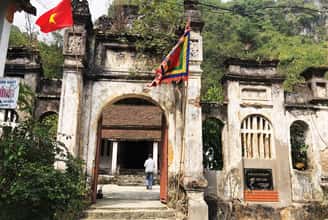
Bach Linh Temple.
Bach Linh Temple (local people also call Bach Linh Pagoda) is located in Old Street, Quang Uyen town (Quang Hoa). The shrine worships 100 of the most sacred things of many types of animals, the chief of which is the dragon - a divine animal with magical power, a symbol of mystical nobility that spits pearls and pearls, and is the head of the four sacred dragons. Ly, Quy, Phung. The dragon at the temple is deified to a supernatural level, along with precious things that become priceless spiritual values, beliefs, and aspirations of local people when they come to worship. Up to now, social and humanistic researchers have not yet determined when the temple was built. They only know that it appeared a long time ago and is deeply embedded in folk memory, associated with the Fireworks Festival. held at the beginning of spring every year. The current situation of Bach Linh Temple is quite similar to other temples, pagodas, and shrines in the province. It has gone through the historical ups and downs of the dynasties, so there have been changes and are no longer intact as before. Legend has it that the temple's architecture consists of 3 parts: three gates, front hall, and harem with the architectural appearance of the Nguyen Dynasty. The three-entrance part of the temple is built of brick material, has 3 doors in a rolling circle style, but for some reason the small doors on both sides have been covered, leaving only the middle door. On the pillars of the three-entrance gate, there are diaphragms and couplets that are now blurred and cannot be read. In the middle of the main gate, there are only the words "Bach Linh Temple" and on it is embossed a vivid curving dragon image. Step through the three gates to reach the front street. The connection between the three gates and the front street is a fairly large yard (now covered with cement), with a stone wall surrounding the yard about 1.5 m high. The frontage has a foundation 0.65 m higher than the yard level, wooden columns and rafters; The roof and porch are covered with tiled roofs and have carvings of a dragon holding a pearl and a dragon's head with sophisticated stylized patterns. In the middle of the front hall is a wooden door 1.6 m wide, 2.2 m high; In the front hall there are 3 altars. Bach Linh Temple is associated with the Fireworks Festival in Quang Uyen town held on the 2nd day of the 2nd lunar month every year. Before entering the festival, there is a ceremony held from the afternoon of the 30th day of the first lunar month. The opening ceremony begins at Coc Chu water mine near Bach Linh temple, the ceremony is celebrated by an elderly man with prestige in the community, family, and prosperous clan. On the afternoon of February 1 of the lunar calendar, the Festival Organizing Committee and people went to Bach Linh Temple to offer offerings, worship, and pray to the gods to bless every family and everyone in the new year with prosperity and prosperity. On the morning of February 2, there is a procession to process the gods, including 4 palanquins in order: the palanquin carrying Uncle Ho's image, the palanquin carrying the local spirit, the palanquin carrying fireworks, the palanquin carrying a roasted pig, and finally the dragon procession. The procession starts from Bach Linh Temple to Nung Tri Cao Temple, Tran Hung Dao Temple and then passes through alleys, families, offices, schools, production and business establishments. This is considered a spirit that acts, checks, observes people doing business and brings them fortune and luck. Therefore, wherever the procession went, everyone respectfully and warmly welcomed it with joy and excitement. The festival is held on the afternoon of the 2nd day of the 2nd lunar month with many folk games like dragon dance, unicorn dance, toss, sli singing, love exchange, traditional martial arts, Chinese chess, tug of war, stick pushing, volleyball. , football... attracts people to participate. In particular, the folk game of fighting for cannon heads is the most exciting. This is a game that demonstrates strong physical strength and trains the bravery, determination, agility, dynamism, martial spirit, and generosity of young people. year. The Festival Organizing Committee gathered youth teams into a circle around the central area of the playground. Whoever won the fortune ring at the top of the cannon would have fortune, peace, and luck all year round. The reward is a roasted pig with honey leaves for the whole team and the pig's head belongs entirely to the lucky bracelet owner. That day, everywhere we saw people serving five-color sticky rice and roasted pork, festival specialties and all kinds of candies, local food and drinks. Bach Linh Temple was also a place to store food, weapons, and classrooms during the two resistance wars against the French colonialists and against the American imperialist invasion. Along with the values of customs, beliefs, and spirituality imbued with national cultural identity, the temple was recognized by the Provincial People's Committee as a provincial-level relic according to Decision No. 2856/Decision - Committee of the Day. December 2, 2003. Source: Cao Bang province electronic information portal.
Cao Bang
6435 view
Rating : Provincial level relics
 AI Travelviet